Galvin serves as the publicity director for the New York-based NORAID, an Irish American group fundraising organization which raises money for the families of Irish republican prisoners, but is also accused by the American, British, and Irish governments to be a front for the supply of weapons to the Provisional Irish Republican Army
Galvin becomes a publisher of The Irish People in the 1980s. He is banned from Northern Ireland because of a speech he gives that seems to endorse terrorism. In August 1984 he defies the ban and enters Northern Ireland from the Republic of Ireland. The following year he returns to Northern Ireland to attend a funeral for an IRA member killed when a makeshift grenade launcher he is trying to fire at a Royal Ulster Constabulary barracks explodes. In 1989 Galvin is arrested and deported for violating the exclusion ban yet again.
William Stephen “Billy” Wright, named after his grandfather, is born in Wolverhampton, England on July 7, 1960, to David Wright and Sarah McKinley, Ulster Protestants from Portadown, Northern Ireland. The family returns to Northern Ireland in 1964. While attending Markethill High School, Wright takes a part-time job as a farm labourer where he comes into contact with a number of staunchly unionist and loyalist farmers who serve with the Royal Ulster Constabulary (RUC) Reserve or the Ulster Defence Regiment (UDR). The conflict known as the Troubles has been raging across Northern Ireland for about five years by this stage, and many young men such as Wright are swept up in the maelstrom of violence as the Provisional Irish Republican Army ramps up its bombing campaign and sectarian killings of Catholics by loyalists continue to escalate. During this time his opinions move towards loyalism and soon he gets into trouble for writing the initials “UVF” on a local Catholic primary school wall. When he refuses to clean off the vandalism, he is transferred from the area and sent to live with an aunt in Portadown.
Wright joins the Ulster Volunteer Force (UVF) in 1975. After spending several years in prison and becoming a born-again Christian, he resumes his UVF activities and becomes commander of its Mid-Ulster Brigade in the early 1990s, taking over from Robin “the Jackal” Jackson. According to the Royal Ulster Constabulary, he is involved in the sectarian killings of up to 20 Catholics, although he is never convicted for any. It is alleged that Wright, like his predecessor, is an agent of the RUC Special Branch.
Wright attracts considerable media attention during the Drumcree standoff, when he supports the ProtestantOrange Order‘s desire to march its traditional route through the Catholic/Irish nationalist area of his hometown of Portadown. In 1994, the UVF and other paramilitary groups call ceasefires. However, in July 1996, Wright’s unit breaks the ceasefire and carries out a number of attacks, including a sectarian killing. For this, Wright and his Portadown unit of the Mid-Ulster Brigade are stood down by the UVF leadership. He is expelled from the UVF and threatened with execution if he does not leave Northern Ireland. He ignores the threats and, along with many of his followers, defiantly forms the breakaway Loyalist Volunteer Force (LVF), becoming its leader.
The LVF carries out a string of killings of Catholic civilians. In March 1997 Wright is sent to the HM Prison Maze for having threatened the life of a woman. While imprisoned, Wright continues to direct the LVF’s activities. On the morning of December 27, 1997, he is assassinated inside the prison by three INLA volunteers – Christopher “Crip” McWilliams, John “Sonny” Glennon and John Kennaway – armed with two smuggled pistols, a FEG PA-63 semi-automatic and a .22 Derringer. The LVF carries out a wave of sectarian attacks in retaliation. There is speculation that the authorities collude in his killing as he is a threat to the peace process. An inquiry finds no evidence of this but concludes there are serious failings by the prison authorities.
Owing to his uncompromising stance as an upholder of Ulster loyalism and opposition to the Northern Ireland peace process, Wright is regarded as a cult hero, icon, and martyr by hardline loyalists. His image adorns murals in loyalist housing estates and many of his devotees have tattoos bearing his likeness. His death is greeted with relief and no little satisfaction, however, from the Irish nationalist community.
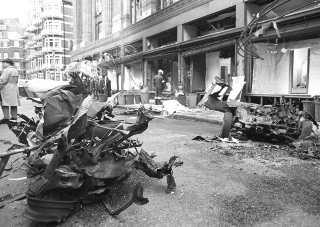
A Provisional Irish Republican Army (PIRA) car bomb kills six and injures ninety outside London‘s Harrods department store, a large, upmarket department store in the affluent Knightsbridge district near Buckingham Palace on December 17, 1983. The IRA Army Council claims that it has not authorised the attack and expresses regret for the civilian casualties. After the bombing, the IRA changes its tactic to focus on military targets on the mainland.
Harrods had been the target of an earlier IRA bomb on December 21, 1974, which was placed in the northeast corner of the first floor. There was a very short warning, and the store was in the process of being cleared when it exploded. It was also the target of a much smaller IRA bomb almost ten years later, in January 1993, which injured four people.
From 1973 the Provisional IRA has carried out waves of bombing attacks on commercial targets in London and elsewhere in England as part of its “economic war.” The goal is to damage the economy and cause disruption, which would put pressure on the British government to withdraw from Northern Ireland. On December 10, 1983, the IRA carries out its first attack in London in some time when a bomb explodes at the Royal Artillery Barracks, injuring three British soldiers.
One week later, on the afternoon of December 17, IRA members park a car bomb near the side entrance of Harrods, on Hans Crescent. The bomb contains 25 to 30 lbs. of explosives and is set to be detonated by a timer. It is left in a 1972 blue Austin 1300 GT four-door sedan. At 12:44 PM a man using an IRA codeword phones the central London branch of the Samaritans charity. The caller says there is a car bomb outside Harrods and another bomb inside Harrods and gives the car’s registration plate. According to police, he does not give any other description of the car.
The bomb explodes at about 1:21 PM, as four police officers in a car, an officer on foot and a police dog-handler near the suspect vehicle. Three officers and three bystanders are killed, and 90 others are injured, including 14 police officers. The blast damages 24 cars and all five floors on the side of Harrods, sending a shower of glass down onto the street. The police car absorbs much of the blast and this likely prevents further casualties.
Five people die at the scene of the bombing and a sixth later dies in the hospital. The bystanders who die are Philip Geddes (24), a journalist who had heard about the alert and went to the scene, Jasmine Cochrane-Patrick (25) and Kenneth Salvesen (28), a United States citizen. The Metropolitan Police Service officers killed are Sergeant Noel Lane (28) and Constable Jane Arbuthnot (22). A third officer, Inspector Stephen Dodd (34), dies in the hospital from his injuries on December 24. Constable Jon Gordon survives but loses both legs and part of a hand in the blast.
At the time of the explosion, a second warning call is made by the IRA. The caller says that a bomb has been left in the C&A department store at the east end of Oxford Street. Police clear the area and cordon it off, but this claim is found to be false. In the aftermath of the attack, hundreds of extra police and mobile bomb squads are drafted into London. Aleck Craddock, chairman of Harrods, reports that £1 million in turnover has been lost as a result of the bombing. Despite the damage, Harrods re-opens three days later, proclaiming it will not be “defeated by acts of terrorism.” Denis Thatcher, the husband of British Prime MinisterMargaret Thatcher, visits the store and tells reporters “no damned Irishman is going to stop me going there.”
Ross and his twin brother Norris become sports journalists in 1950. In 1951, they found an agency to provide facts and figures to Fleet Street, setting out, in Norris McWhirter’s words “to supply facts and figures to newspapers, yearbooks, encyclopaedias and advertisers.” In the same year they publish Get to Your Marks.
While building up their accounts, they both work as sports journalists. One of the athletes they know and cover is runner Christopher Chataway, an employee at Guinness who recommends them to Hugh Beaver. After an interview in 1954 in which the Guinness directors enjoy testing the twins’ knowledge of records and unusual facts, the brothers agree to start work on the book that becomes The Guinness Book of Records. In August 1955, the first 198-page green volume is at the bookstalls, and in four more months it is the UK’s number one non-fiction best-seller. Both brothers are regulars on the BBC show Record Breakers. They are noted for their encyclopedic memories, enabling them to provide detailed answers to questions from the audience about entries in The Guinness Book of Records. Norris continues on the programme after Ross’s death.
In the early 1960s, McWhirter is a Conservative Party activist and seeks, unsuccessfully, the seat of Edmonton in the 1964 general election. Following his killing, his brother and others found the National Association for Freedom (later The Freedom Association).
McWhirter advocates various restrictions on the freedom of the Irish community in Britain, such as making it compulsory for all of them to register with the local police and to provide signed photographs of themselves when renting flats or booking into hotels and hostels. In addition, he offers a £50,000 reward for information leading to a conviction for several recent high-profile bombings in England that were publicly claimed by the Provisional Irish Republican Army (IRA). In doing so, he recognises that he might then be a target himself. This is considered a “bounty” by the IRA Army Council, a view that leads directly to the events that follow, although the idea is not originally his, but that of John Gouriet.
At 6:45 PM on November 27, 1975, McWhirter is shot and killed by two IRA volunteers, Harry Duggan and Hugh Doherty, both of whom are members of what becomes known as the Balcombe Street Gang, the group for whose capture McWhirter had offered the reward. He is shot with a .357 Magnum revolver at close range in the head and chest outside his home in Village Road, Bush Hill Park. He is taken to Chase Farm Hospital but dies soon after being admitted. His killers are captured and charged with his and nine other murders. They are sentenced to life imprisonment but freed in 1999 under the terms of the Good Friday Agreement.
Hugh Leonard, Irish dramatist, television writer and essayist, is born in Dublin on November 9, 1926. In a career that spans 50 years, he writes nearly 30 full-length plays, 10 one-act plays, three volumes of essays, two autobiographies, three novels and numerous screenplays and teleplays, as well as writing a regular newspaper column.
After birth, Leonard is put up for adoption. Raised in Dalkey, a suburb of Dublin, by Nicholas and Margaret Keyes, he changes his name to John Keyes Byrne. For the rest of his life, despite the pen name of “Hugh Leonard” which he later adopts and becomes well known by, he invites close friends to call him “Jack.”
Leonard is educated at the Harold Boys’ National School, Dalkey, and Presentation College, Glasthule, winning a scholarship to the latter. He works as a civil servant for fourteen years. During that time, he both acts in and writes plays for community theatre groups. His first play to be professionally produced is The Big Birthday, which is mounted by the Abbey Theatre in Dublin in 1956. His career with the Abbey Theatre continues until 1994. After that his plays are produced regularly by Dublin’s theatres.
Leonard moves to Manchester for a while, working for Granada Television before returning to Ireland in 1970. There he settles in Dalkey.
During the 1960s and 1970s, Leonard is the first major Irish writer to establish a reputation in television, writing extensively for television including original plays, comedies, thrillers and adaptations of classic novels for British television. He is commissioned by RTÉ to write Insurrection, a 50th anniversary dramatic reconstruction of the Easter Rising of 1916. His Silent Song, adapted for the BBC from a short story by Frank O’Connor, wins the Prix Italia in 1967. He writes the script for the RTÉ adaptation of Strumpet City by James Plunkett.
Three of Leonard’s plays have been presented on Broadway: The Au Pair Man (1973), which stars Charles Durning and Julie Harris, Da (1978) and A Life (1980). Of these, Da, which originates off-off-Broadway at the Hudson Guild theatre before transferring to the Morosco Theatre, is the most successful, running for 20 months and 697 performances, then touring the United States for ten months. It earns Leonard both a Tony Award and a Drama Desk Award for Best Play. It is made into a film in 1988, starring Martin Sheen and Barnard Hughes, who reprises his Tony Award-winning Broadway performance.
Leonard writes two volumes of autobiography, Home Before Night (1979) and Out After Dark (1989). Some of his essays and journalism are collected in Leonard’s Last Book (1978) and A Peculiar People and Other Foibles (1979). In 1992 the Selected Plays of Hugh Leonard is published. Until 2006 he writes a humorous weekly column, “The Curmudgeon,” for the Irish Sunday Independent newspaper. He has a passion for cats and restaurants, and an abhorrence of broadcaster Gay Byrne.
Even after retiring as a Sunday Independent columnist, Leonard displays an acerbic humour. In an interview with Brendan O’Connor, he is asked if it galls him that Gay Byrne is now writing his old column. His reply is, “It would gall me more if he was any good at it.” He is a patron of the Dublin Theatre Festival.
In 1994, Leonard appears in a televised interview with Gerry Adams, president of Sinn Féin, an Irish political party associated with the Provisional Irish Republican Army. He has long been an opponent of political violence and a critic of the IRA. However, on the show and afterwards he is criticised for being “sanctimonious and theatrical” towards Adams. At one point he refers to Sinn Féin as “dogs.”
Hugh Leonard – Odd Man In, a film on his life and work is shown on RTÉ in March 2009. Leonard’s final play, Magicality, is not performed during his lifetime. A rehearsed reading of the second act is staged at the Dalkey Castle and Heritage Centre in June 2012.
Hugh Leonard dies after a long illness on February 12, 2009, in his hometown of Dalkey at the age of 82, leaving €1.5 million in his will.
The crisis, triggered by the 1981 Irish hunger strike of Provisional IRA and Irish National Liberation Army (INLA) prisoners, leads to an increase in militant Irish republican activity in Northern Ireland. British intelligence reports unveil IRA intentions of mounting illegal checkpoints and hijacking vehicles on the IRA-controlled roads in South County Armagh, near the Irish border. To counter it, the British Army deploy the so-called COPs (close observation platoons), small infantry sections acting as undercover units, a tactic introduced by Major GeneralRichard Trant in 1977.
On May 6, 1981, a day after the death of hunger-striker Bobby Sands, one IRA member from a three-man unit is arrested while trying to set up a roadblock east of the main Belfast-Dublin road by twelve members of the Royal Green Jackets, divided in three teams. A second volunteer crosses the border, only to be arrested by the Irish Army. The third IRA man escapes apparently injured. A total of 689 rounds are fired by the soldiers.
After this initial success, the British Army continues these tactics. On July 16, another operation is carried out by eighteen Royal Green Jackets soldiers. That night, four concealed positions – Alpha, Bravo, Charlie and Delta – are inserted into the Glassdrumman area, around a scrapyard along the border. The plan is that another unit, called the triggering team, would ambush any IRA unit on sight, while the other four would block the expected escape routes. On July 17, the commanders in charge of Alpha and Delta teams, suspecting that the operation has been compromised by the presence of local civilians, orders the withdrawal of their men. Shortly thereafter, Bravo team is suddenly engaged by automatic fire from an M60 machine gun and AR-15 rifles fired by six or seven IRA members. The concealed position, emplaced inside a derelict van, is riddled by more than 250 bullets. The team’s leader, Lance Corporal Gavin Dean, is killed instantly and one of his men, Rifleman John Moore, is seriously wounded. Moore is later awarded the Military Medal. The IRA members fire their weapons from across the border, 160 yards away.
British army commanders conclude that “it was not worth risking the lives of soldiers to prevent an IRA roadblock being set up.” The incident also exposes the difficulties of concealing operations from local civilians in South Armagh, whose sympathy with the IRA is manifest. Several years later, the IRA would repeat its success against undercover observation posts in the course of Operation Conservation in 1990.
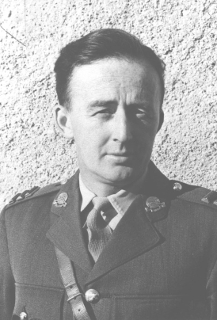
Kelly is a central figure in the Arms Crisis, having traveled to Hamburg to arrange the purchase of arms. It emerges later that Neil Blaney had ordered him to do so outside normal legal channels, but before the weapons arrive the Gards Special Detective Unit hears of the plan and informs the Taoiseach, Jack Lynch, aborting the importation and resulting in criminal charges for the plotters. Although in his summation the judge says it is no defence for Kelly to say that he believes that the government authorised the importation of arms, Kelly is acquitted.
Despite his acquittal, Kelly suffers financially because he had felt compelled to resign from the Army even before the prosecution was brought. He prints and publishes a personal memoir in paperback format called Orders for the Captain? in 1971.
Kelly never denies his involvement in extra-legal arms purchase talks, but contends that he had been ordered to do so by some ministers. A typical version of the events is found in a 1993 hostile biography of Charles Haughey, claiming: “As early as October 1969, to the certain knowledge of Charles Haughey, James Gibbons, the Department of Justice, the Special Branch and Army Intelligence, there were meetings with leading members of the IRA, when they were promised money and arms. The critical encounter took place in Bailieborough, County Cavan, on Saturday, 4 October 1969. It had been arranged by Captain James Kelly, an army intelligence officer, and Cathal Goulding. Kelly, at that stage, was already the subject of several security reports to the Secretary of the Department of Justice, Peter Berry, from the Special Branch, implicating Kelly with subversives and with promises of money and of arms.” Kelly never objected to such versions of the events of 1969.
Kelly is elected vice-chairman of Aontacht Éireann. Aontacht Éireann meets with little success at the polls and by 1980 he has joined Fianna Fáil, becoming a member of its national executive. Following the first applications of the 1987 Extradition (European Convention on the Suppression of Terrorism) Act, he resigns from the party in 1989 in opposition to the extradition of Provisional IRA prisoners to the United Kingdom. He also serves twice as President of the 1916-1921 Club. He launches a successful defamation case against Garret FitzGerald over an article in The Irish Times.
James Kelly dies on July 16, 2003 and is buried in Glasnevin Cemetery in Dublin. The epitaph on his grave is “Put not your trust in princes,” a quote from Psalm 146.
In 1990 Wilson challenges Brian Lenihan for the Fianna Fáil nomination for the 1990 presidential election. Lenihan wins the nomination but fails to be elected President and is also sacked from the government. Wilson is then appointed Tánaiste. He remains in the cabinet until retirement in 1993. Although the 26th Dáil Éireann is dissolved in December 1992, he serves in Government until the new government takes office.
John Wilson dies at St. James Hospital, Dublin on July 9, 2007, one day after his 84th birthday. His funeral takes place at the Good Shepherd Church at Churchtown, Dublin. President Mary McAleese is one of a number of prominent figures among the mourners, while Taoiseach Bertie Ahern is represented by his Aide-de-Camp.
A week before the Falls Curfew, on Saturday, June 27, 1970, there is severe rioting in Belfast following marches by the Protestant/unionist Orange Order. At the Short Strand, a Catholic enclave in a Protestant part of the city, the Provisional Irish Republican Army (IRA) fights a five-hour gun battle with loyalists. Three people are killed, and the loyalists withdraw. The Provisional IRA presents itself as having successfully defended a vulnerable Catholic enclave from armed loyalist mobs.
Meanwhile, the Official IRA arranges for a large number of weapons to be brought into the mainly nationalist and Catholic Lower Falls area for distribution. The area is a stronghold of the Official IRA.
The operation begins at about 4:30 PM on Friday, July 3, as a search for weapons in the staunchly Irish nationalist district. As the search ends, local youths attack the British soldiers with stones and petrol bombs and the soldiers respond with CS gas. This quickly develops into gun battles between British soldiers and the Irish Republican Army (IRA). After four hours of continuous clashes, the British commander seals off the area, which comprises 3,000 homes, and imposes a curfew which lasts 36 hours. Thousands of British troops move into the curfew zone and carry out house-to-house searches for weapons, while coming under intermittent attack from the IRA and rioters. The searches cause much destruction, and a large amount of CS gas is fired into the area. Many residents complain of suffering abuse at the hands of the soldiers. On July 5, the curfew is brought to an end when thousands of women and children from Andersonstown march into the curfew zone with food and groceries for the locals.
During the operation, four civilians are killed by the British Army, at least 78 people are wounded and 337 are arrested. Eighteen soldiers are also wounded. Large quantities of weapons and ammunition are captured. The British Army admits afterwards that some of its soldiers had been involved in looting.
The Falls Curfew is a turning point in the Troubles. It is seen as having turned many Catholics/Irish nationalists against the British Army and having boosted support for the IRA.
(Pictured: British soldiers on the Falls Road during the 1970 curfew)
On June 16, 1994, high-ranking UVF Commander volunteer Trevor King is standing on the Shankill Road about one hundred yards from “The Eagle,” the UVF’s Belfast GHQ, talking to fellow UVF members David Hamilton and Colin Craig. A car drives past them and as it does so Irish National Liberation Army (INLA) gunmen inside the vehicle open fire on the three men. The car is later found burning close to Divis Tower.
David Lister and Hugh Jordan claim that Gino Gallagher, who is himself shot dead in 1996 during an internal dispute, is the main gunman in the attack. However, Henry McDonald and Jack Holland say that Gallagher is inside the car, which is scouting the area for UVF members, and not one of the gunmen.
Colin Craig is killed on the spot. King and David Hamilton lay in the street, seriously wounded as panic and chaos erupt on the Shankill in the wake of the shooting. Presbyterian minister Roy Magee is in “The Eagle” discussing an upcoming Combined Loyalist Military Command (CLMC) meeting and the possibility of a loyalist ceasefire with the UVF Brigade Staff when the attack takes place. He and the others race out of the building after hearing the gunfire.
King is rushed to the hospital where he is put on a life-support machine. The shooting has left him paralysed from the neck down. He dies on July 9 with Reverend Magee at his bedside. According to Magee, King himself makes the decision to turn off the machine.
The killings are a blow for the Northern Ireland peace process and a morale boost for the INLA. The attack is the INLA’s most notorious since the Droppin Well bombing in 1982 which killed seventeen people, eleven British soldiers and 6 civilians.
The following day, the UVF launches two retaliatory attacks. In the first, UVF members shoot dead a Catholic civilian taxi driver in Carrickfergus. In the second, they shoot dead two Protestant civilians in Newtownabbey, whom they believe to be Catholics. Two days after the killings the UVF decide to launch another revenge attack when they kill six Catholic civilians in a bar while they are watching the Ireland vs. Italy 1994 FIFA World Cup game opener in what becomes known as the Loughinisland massacre. The tit-for-tat attacks continue during the spring and summer of 1994 until the Provisional Irish Republican Army ceasefire of August 31, 1994, and the Combined Loyalist Military Command ceasefire in October. The attacks on the Shankill are the INLA’s deadliest attacks of the 1990s.
When interviewed for Boston College for research on the conflict, Progressive Unionist Party leader David Ervine suggests the INLA might have been working in cahoots with the Provisional IRA in targeting prominent Loyalists, as the month after the Provisional IRA kill three leading Ulster Defence Association (UDA) men.
(Pictured: Trevor King mural, Disraeli Street, May 2012)






 seamus dubhghaill