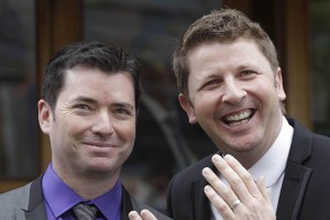
Filmmaker and lecturerBarry Dignam and his partner of seventeen years, Hugh Walsh, become the first gay couple in Irish history to enter into a civil partnership on April 5, 2011. The event takes place at the Registry Office in Dublin City Centre.
Dignam and Walsh hail their wedding as an emotional milestone. The couple says their simple civil partnership ceremony signals how far the country has come on in recent years.
Both have already set their sights on full marriage, allowing the same rights and protections afforded to heterosexual partners, as the next landmark in a struggle for equality.
“We just need that little bit more of a push now,” says a beaming Dignam alongside his partner moments after the ceremony. “Now that people realise the sky is not going to fall down, that push for civil marriage is not a far journey at all.”
Dignam and Walsh say they have been waiting seventeen years to formalise their commitment to each other in the eyes of the State.
“When we met it was illegal to be gay in Ireland,” Dignam says. “Now we are having a civil partnership, it is pretty amazing the change that’s happened. But we still have places to go yet.”
The Dubliners become the public face of same-sex weddings in the Republic of Ireland as the first in line to openly exchange vows after the mandatory three-month wait.
Six other gay couples who were granted court exemptions have already signed the partnership register, away from the spotlight, since the laws were enacted at the beginning of the year.
Ahern is urged by Paisley to ensure that criminals who flee across the Irish border are arrested. The Democratic Unionist leader makes the proposal during a cordial one-and-a-half-hour meeting at Farmleigh in Phoenix Park, where the two leaders exchange their first public handshake.
Afterwards Paisley, who receives an invitation from the taoiseach to visit the Battle of the Boyne site later in the year, says that they had also discussed the need for the new administrations in Northern Ireland and in the Republic of Ireland to work for each other’s best interests. “We can confidently state that we are making progress to ensure our two countries can develop and grow side by side in the spirit of generous cooperation,” he declares. “I trust that old barriers and threats will be removed in my day. Business opportunities are flourishing. Genuine respect for the understanding of each other’s differences and, for that matter, similarities is now developing.”
Earlier the DUP leader, who becomes the First Minister of the new power-sharing government on May 8 alongside Sinn Féin‘s Martin McGuinness as deputy First Minister, firmly shakes the hand of Ahern in public for the first time. As he arrives at Farmleigh, he quips, “I better shake the hands of this man. I’ll give him a firm handshake.”
Paisley, who is accompanied by his son, Ian Paisley, Jr., affectionately grabs the taoiseach by the shoulder. There is another handshake after the meeting at Farmleigh is finished.
Paisley says, “Mr. Ahern has come to understand me as an Ulsterman of plain speech. He didn’t ever need a dictionary to find out what I was saying. We engaged in clear and plain speech about our hopes and our aspirations for the people we both serve. The prime minister kindly congratulated me on my election victory.”
Paisley says that he had raised a number of issues crucial to unionists. “I have taken the opportunity to raise with the prime minister a number of key matters including ensuring that fugitives from justice who seek to use the border to their advantage are quickly apprehended and returned without protracted legal wrangle.” He adds, “I raised other legal issues of interests to unionists, and we discussed cooperation of an economic nature that will be to our mutual benefit.” He also says he had raised the issue of bringing Northern Ireland’s corporation tax into line with that of Ireland.
Regarding the invitation to visit the site of the Battle of the Boyne, Paisley says, “We both look forward to the visit to the battle site at the Boyne… Not to refight it, because that would be unfair, for he would have the home advantage. No Ulsterman ever gives his opponents an advantage. He adds, “Such a visit would help to demonstrate how far we have come when we can celebrate and learn from the past, so the next generation more clearly understands.”
Ahern pays tribute to the leadership shown by Paisley in helping to deliver a better future for the people of Northern Ireland. As Northern Ireland’s politicians continue at great pace to prepare for the return of power sharing, the taoiseach says that the progress has been very encouraging. “At this important time in our history, we must do our best to put behind us the terrible wounds of our past and work together to build a new relationship between our two traditions,” he says. “That new relationship can only be built on a basis of open dialogue and mutual respect. I fervently believe that we move on from here in a new spirit of friendship. The future for this island has never been brighter. I believe that this is a future of peace, reconciliation and rising prosperity for all. We stand ready to work with the new executive. We promise sincere friendship and assured cooperation. I believe that we can and will work together in the interests of everyone on this island.”
Ahern says he believes that the Battle of the Boyne site can be a symbol of the new beginning in the relationship between governments in Belfast and Dublin. “I believe that this site can become a valuable and welcome expression of our shared history and a new point of departure for an island, north and south, which is at ease with itself and respectful of its past and all its traditions,” he declared.
The Battle of the Boyne was fought in 1690 between the followers of England‘s King William of Orange, a Protestant, and the deposed King James, a Catholic, in Drogheda, eastern Ireland. Ireland was at that point under English rule. The battle is commemorated by many Northern Irish loyalists on July 12 each year.
Ministerial posts within the new devolved Stormont government have yet to be finalised. Already Sinn Féin has announced that MPs Michelle Gildernew and Conor Murphy and assembly members Gerry Kelly and Caitríona Ruane will be members of the government. However, the party has not yet indicated which of the four will take the three senior cabinet posts in education, agriculture and regional development and which one will be the junior minister in the Office of First and Deputy First Minister.
The DUP has also yet to name its ministers, but it has chosen finance, economy, environment and culture arts and leisure as the government departments it will head. The DUP’s deputy leader, Peter Robinson, and Nigel Dodds, the Belfast North MP, who both served in the last devolved government, are tipped to be the finance and economy ministers.
The Ulster Unionist Party (UUP) has yet to declare who their two ministers will be at the Departments of Health and Employment and Learning.
(From: “Upbeat Paisley shares first handshake with Irish PM” by Hélène Mulholland and agencies, The Guardian, http://www.theguardian.com, April 4, 2007)
Josephine McNeill, Irish diplomat, is born on March 31, 1895, in Fermoy, County Cork. She is the first Irish female diplomat appointed to represent Ireland abroad in a ministerial capacity.
McNeill is born Josephine Ahearne, the daughter of shopkeeper and hotelier, James Ahearne, and his wife Ellen Ahearne (née O’Brien). She attends the Loretto Convent, Fermoy, and goes on to graduate from University College Dublin (UCD) with a BA, H.Dip.Ed. in French and German. With this she begins a teaching career, at St. Louis’ Convent, Kiltimagh, at the Ursuline Convent, Thurles, and at Scoil Íde. Scoil Íde, the female counterpart to St. Enda’s School, had been established by her friend, Louise Gavan Duffy. She is fluent in the Irish language and takes an active part in the cultural elements of the Irish independence movement, such as literature and music. She is a member of Cumann na mBan, serving as a member of the executive committee in 1921.
After the death of her husband in 1938, McNeill becomes the honorary secretary of the council of the Friends of the National Collections, as well as serving as chair of the executive committee of the Irish Countrywomen’s Association until 1950. As a member of the Department of External Affairs advisory committee on cultural relations, she writes on economic, social and cultural issues. She represents Ireland at the UNESCO general assembly in Paris in 1949.
McNeill is an active member of Clann na Poblachta from its foundation in 1946. She is appointed the minister to the Netherlands in 1950 by Seán MacBride, making her the first Irish female diplomat to represent the Republic of Ireland abroad in a ministerial capacity. This appointment is not well received by diplomats in the Department of External Affairs. Her reports from The Hague focus on the issues the Netherlands faces with decolonisation. In 1955, she becomes the minister to Sweden, going on to hold the joint appointment to Austria and Switzerland from 1956 to 1960, after which she retires. While serving in Switzerland she puts aside the resentment she feels towards Éamon de Valera based on how he had treated her husband, to sit with him during a convalescence while de Valera recovers from an eye operation.
McNeill is an amateur pianist and collects paintings and porcelains. In 1933, she publishes the Irish language book, Finnsgéalta ó India.
Coalisland is a town in County Tyrone that has a tradition of militant republicanism; five residents are killed by British security forces before the first IRA ceasefire in 1994. In February 1992, four IRA volunteers are killed in a gun battle with the SAS during their escape after a machine gun attack on the RUC/British Army barracks there. Three months later, an IRA bomb attack on a British Army patrol at Cappagh, in which a paratrooper loses his legs, triggers a series of clashes between local residents and British troops on May 12 and 17. A number of civilians and soldiers are injured, a soldier’s backpack radio destroyed, and two British weapons stolen. The melee is followed by a 500-strong protest in the town and bitter exchanges between Republic of Ireland and British officials. Further scuffles between civilians and soldiers are reported in the town on March 6, 1994.
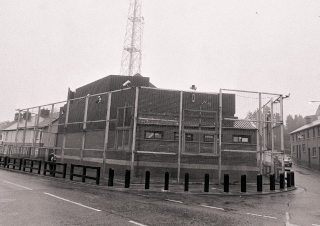
At 9:40 p.m. on Wednesday, March 26, 1997, a grenade is thrown at the joint British Army/RUC base at Coalisland, blowing a hole in the perimeter fence. The RUC reports that a 1 kg device hit the fence ten feet off the ground. Another source claims that the device is a coffee-jar bomb filled with Semtex. The grenade is thrown or fired by two unidentified men. At the time of the attack, there is an art exhibition at Coalisland Heritage Hall, also known as The Mill, from where the explosion and the gunshots that follow are clearly heard. The incident lasts less than two minutes.
Just one minute after the IRA attack, bypassers hear high-velocity rounds buzzing around them. A number of men, apparently SAS soldiers, get out of civilian vehicles wearing baseball caps with “Army” stamped on the front. A source initially describes them as members of the 14 Field Security and Intelligence Company. The men are firing Browning pistols and Heckler & Kochsubmachine guns. Witnesses say there are eight to ten gunshots, while a republican source claims that up to eighteen rounds are fired. Nineteen-year-old Gareth Doris is shot in the stomach and falls to the ground. He is allegedly returning from the local church and is in the company of a priest when he is shot. A local priest, Seamus Rice, is driving out of the church car park when his car is hit by bullets, smashing the windscreen.
Three minutes after the blast, hundreds of angry residents gather at the scene and confront the undercover soldiers. The soldiers fire live rounds at the ground and into the air to keep people back. The crowd keeps drawing back and moving forward again until 9:50 p.m., when the RUC arrives and begins firing plastic bullets at the protesters. Two women are wounded by plastic bullets and the undercover soldiers then flee in unmarked cars, setting off crackers or fireworks at the same time. Sinn FéincouncillorFrancie Molloy claims that the protesters forced the SAS to withdraw, saving Doris’s life in the process. Witnesses allegedly fear an undercover soldier brandishing a pistol would have killed the wounded Doris with a shot to his head.
Afterward, hundreds of residents are forced to leave their homes as security forces search the area near the base. This keeps tensions high, according to local republican activist Bernadette McAliskey. Two men are later questioned by the RUC about the attack.
The attack, along with two large bombings the same day in Wilmslow, England, raise concerns that the IRA is trying to influence the upcoming UK general election. Martin McGuinness describes the shooting as “murderous,” while independent councillor Jim Canning says that more than a dozen soldiers “were threatening to shoot anybody who moved […] while a young man lay shot on the ground.” Republican sources claim that this is another case of shoot-to-kill policy by the security forces. Ulster Unionist Party (UUP) MPKen Maginnis, however, praises the SAS for their actions.
Gareth Doris is admitted to South Tyrone Hospital in Dungannon, where he is arrested after undergoing surgery. He is later transferred to Musgrave Park Hospital in Belfast. He is later convicted for involvement in the bombing and sentenced to ten years in jail, before being released in 2000 under the terms of the Good Friday Agreement. Gareth is the cousin of Tony Doris, an IRA member killed in an SAS ambush in the nearby village of Coagh on June 3, 1991, and a cousin of Sinn Féin leader Michelle O’Neill. According to Sinn Féin councillor Brendan Doris, another cousin of Gareth, “He absolutely denies being involved in terrorist activity of any description.” Amnesty International raises its concerns over the shooting and the fact that no warning is given beforehand.
DNA evidence collected in the area of the shooting leads to the arrest of Coalisland native Paul Campbell by the Police Service of Northern Ireland (PSNI) in 2015, on the charges of being the other man with Doris during the attack. In February 2020, he is convicted by a Diplock court in Belfast. He denies the charges but receives a seven-and-a-half-year sentence. The prosecutor acknowledges that Campbell would have been released by this time under the provisions of the Good Friday Agreement but argues that that was a decision for the parole commission, not the court.
On July 5, 1997, on the eve of the 1997 nationalist riots in Northern Ireland, the British Army/RUC base is the scene of another attack, when an IRA volunteer engages an armoured RUC vehicle with gunfire beside the barracks. One female officer is wounded. The former RUC station at Coalisland is eventually shut down in 2006 and sold for private development in 2010.
(Pictured: Coalisland RUC/British Army base in Coalisland, County Tyrone, Northern Ireland)
The second of two bombing attacks in early 1993 in Warrington, Cheshire, England, takes place on March 20, 1993. The first attack takes place on February 26, when a bomb explodes at a gas storage facility. This explosion causes extensive damage, but no injuries. In the March 20 attack, two smaller bombs explode in litter bins outside shops and businesses on Bridge Street. Two children are killed and 56 people are injured.
The attacks are carried out by the Provisional Irish Republican Army (IRA). From the early 1970s, the IRA had been carrying out attacks in both Northern Ireland and England with the stated goal of putting pressure on the UK Government to withdraw from Northern Ireland. The IRA is designated a terrorist organisation in the United Kingdom.
Shortly before midday on Saturday, March 20, 1993, the Samaritans in Liverpool receive a bomb warning by telephone. According to police, the caller says only that a bomb has been planted outside a Boots shop. Merseyside Police send officers to branches of Boots in Liverpool and warn the Cheshire Constabulary, who patrols nearby Warrington. About 30 minutes later, at about 12:25 p.m., two bombs explode on Bridge Street in Warrington, about 100 yards apart. The blasts happen within a minute of each other. One explodes outside Boots and McDonald’s, and the other outside the Argos catalogue store. The area is crowded with shoppers. Witnesses say that shoppers flee from the first explosion into the path of the second. It is later found that the bombs had been placed inside cast iron litter bins, causing large amounts of shrapnel. Buses are organised to ferry people away from the scene and twenty paramedics and crews from seventeen ambulances are sent to deal with the aftermath.
Three-year-old Johnathan Ball dies at the scene. He had been in town with his babysitter, shopping for a Mother’s Day card. The second victim, 12-year-old Tim Parry, is gravely wounded. He dies on March 25, 1993, when his life support machine is switched off, after tests find only minimal brain activity. Another 54 people are injured, four of them seriously. One of the survivors, 32-year-old Bronwen Vickers, the mother of two young daughters, has to have a leg amputated, and dies just over a year later from cancer.
The Provisional IRA issues a statement the day after the bombing, acknowledging its involvement but saying:
“Responsibility for the tragic and deeply regrettable death and injuries caused in Warrington yesterday lies squarely at the door of those in the British authorities who deliberately failed to act on precise and adequate warnings.”
A day later, an IRA spokesman says that “two precise warnings” had been given “in adequate time,” one to the Samaritans and one to Merseyside Police. He adds, “You don’t provide warnings if it is your intention to kill.” Cheshire’s assistant chief constable denies there had been a second warning and says, “Yes, a warning was given half-an-hour before, but no mention was made of Warrington. If the IRA think they can pass on their responsibility for this terrible act by issuing such a nonsensical statement, they have sadly underestimated the understanding of the British public.”
The deaths of two young children ensures that the March 20 bombings receive major coverage in the media and cause widespread public anger. Shortly after the bombings, a group called “Peace ’93” is set up in Dublin. The main organiser is Susan McHugh, a Dublin housewife and mother. On March 25, 1993, thousands hold a peace rally in Dublin. They sign a condolence book outside the General Post Office and lay bouquets and wreaths, with messages of sorrow and apology, to be taken to Warrington for the boys’ funerals. Some criticise Peace ’93 for focusing only on IRA violence and for not responding to the deaths of children in Northern Ireland.
On September 19, 1994, Irish rock band The Cranberries release the song “Zombie,” which is written in protest of the bombings. The song goes on to become their biggest hit.
On November 14, 1996, the Duchess of Kent officially inaugurates a memorial called The River of Life, depicting “a symbol of hope for future generations,” in Bridge Street. It is developed in the aftermath of the bomb attack and commissioned by the Warrington Borough Council. The project, consisting of a symbolic water sculpture that features a commemorative plaque, is designed by the local primary school and Stephen Broadbent.
The parents of Tim Parry set up the Tim Parry Trust Fund to promote greater understanding between Great Britain and Ireland. The Tim Parry Johnathan Ball Foundation for Peace works jointly with the National Society for the Prevention of Cruelty to Children (NSPCC) to develop The Peace Centre, close to Warrington town centre, which opens on the seventh anniversary of the attack in 2000. Its purpose is to promote peace and understanding amongst all communities affected by conflict and violence. The centre hosts an annual peace lecture, as well as being home to the local NSPCC and is the home of Warrington Youth Club until 2022.
The bombings receive further attention in 2019 after the Brexit Party selects former Living Marxism writer Claire Fox as their lead candidate in the North West England constituency for the 2019 European Parliament election. The Revolutionary Communist Party, of which Fox is a leading member in 1993, defends the IRA’s bombing in their party newsletter. Despite the controversy, which sees another Brexit Party candidate resign from the party list in protest at the comments, Fox and the Brexit Party top the poll in several areas of the North West, including in Warrington.
The killing of Ball and Parry is still on Cheshire Police’s list of unsolved murders.
A piece on BBC North West‘s Inside Out programme in September 2013 speculates that the bombing may have been the work of a “rogue” IRA unit, which was supported by the IRA but operated independently and who used operatives who were from England to avoid suspicion. The programme also examines a possible link between the attack and British leftist political group Red Action, though nothing is ever proven.
(Pictured: Army bomb disposal at the Warrington Bomb scene in March 1993, photo credit: Walker Howard)
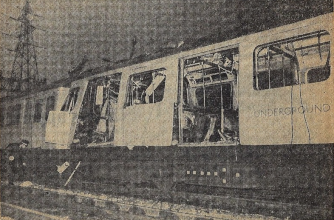
A 5-lb. (2.3 kg) bomb on a Metropolitan line train explodes prematurely in the front carriage of the train, injuring seven passengers. The bomb detonates prior to reaching the City of London, where it is thought the intended target to be Liverpool Street station at rush hour. Adrian Vincent Donnelly, a Provisional Irish Republican Army (IRA) volunteer, then shoots Post Office engineer Peter Chalk in the chest, and kills train driver Julius Stephen, who had attempted to catch him. Donelly exits the station to the street and threatens people with his revolver before Police Constable Raymond Kiff catches up with him. Shouting “You English bastards!” Donelly shoots himself in the chest but survives and is apprehended by Kiff.
Eleven days prior to the West Ham station attack, an IRA bomb explodes in a train at Cannon Street station. The day after the West Ham attack, a bomb on a train at Wood Green tube station explodes, injuring a man. On March 17, a 9-lb. (4.1 kg) bomb is discovered in a train at Neasden Depot. After these events, the London Transport Executive launches a security operation and assigns 1,000 plainclothed policemen on the London Underground system.
An appeal to raise money is launched for the family of the driver of the train, Julius Stephen, who left behind a widow and a family. As of August 1976, £17,000 had been raised.
(Pictured: The underground train damaged in the explosion, The Times, March 16, 1976)
The last time England had played Ireland at Lansdowne Road was a UEFA Euro 1992 qualifying Group 7 match on November 14, 1990. After that match, there were clashes between some Irish and English fans and the Gardaí on O’Connell Street in Dublin. Before the 1995 friendly match, the Football Association of Ireland (FAI) holds talks with The Football Association (The FA) to review security arrangements to avoid a similar episode. The FA is offered 4,000 out of approximately 40,000 tickets, for English fans.
In pubs near Lansdowne Road stadium some English fans chant “No surrender to the IRA,” “Fuck the Pope” and “Clegg is innocent.” Irish fans are goaded, spat on and attacked. Pub staff find British National Party (BNP) literature left behind and, in some cases, pro-Loyalist graffiti in toilets.
The match begins at 6:15 p.m., and after 22 minutes, David Kelly scores a goal for Ireland. When a David Platt goal is disallowed for England in the 26th minute due to Platt being offside, some of the English fans begin throwing debris down into the lower stands, including parts of benches which they had ripped out earlier in the match. When this happens, the referee immediately stops the game, and brings the players off the pitch. When Jack Charlton, the Irish manager and former England player, walks off the pitch, the mobs “Judas, Judas.” The fans in the lower stands then spill out onto the pitch to escape the missiles from the English fans. Some Irish fans had mistakenly been put into the area where the English fans are when the FA returned a number of tickets to the FAI.
After the teams leave the pitch, the frequency of missiles intensifies, and after 12 minutes, the game is called off, and the fans are evacuated, with the exception of 4,500 English fans, who are kept in the stadium until the Garda Public Order Unit attempts to escort them out, at which time more violence breaks out. The Gardaí are slow to reach the area where the rioters are, and there is some confusion as to the exact location of the English fans between the Gardaí and the stewards. Twenty people are injured during the rioting, and forty are arrested.
The rioting is condemned on both sides of the Irish Sea. England manager Terry Venables says, “It was terrible. I have no words strong enough to describe how we feel about this. There could be repercussions.” Jack Charlton says, “I have seen a lot in football but nothing like this. It is a disaster for Irish football, but I didn’t want the game abandoned because what do you do with 2,000 English fans running around the town? The English fans were being bombarded by some of their own. And they brought out the worst in some of ours.” The rioting brings into question England’s hosting of UEFA Euro 1996, with Ireland’s Minister of State for Youth and Sport, Bernard Allen asking, “How can people from Ireland and from other countries go to England and expect to be safe watching matches in the presence of people like those who were here tonight?” The Garda handling of the match is criticised in the press when it is revealed that the Gardaí had been informed of the plans of some of the English fans to cause trouble by the British National Criminal Intelligence Service (NCIS). The decision to seat the English fans in an upper tier is also questioned in the press.
After questions are raised about the conduct of the Gardaí, former Chief Justice of Ireland, Thomas Finlay, is appointed to investigate the events. He finds that the rioting was entirely caused by the English fans without any provocation. The investigation finds that the head of the NCIS had offered help to the Gardaí in dealing with the hooligans, an offer which the Gardaí refused. Gardaí failed to act on a warning that 20 supporters of the England team who wore insignia of Combat 18 were travelling to the match. The segregation of the fans was also found to be insufficient, and this was found to be a contributory factor to the incident.
The next meeting between the two sides does not take place until Wednesday, May 29, 2013, a friendly at Wembley Stadium, and the next meeting in the Republic of Ireland is on Sunday, June 7, 2015, at Dublin’s Aviva Stadium. Both games pass without major disturbances.
McGlinchey is one of eleven siblings born into a staunchly republican home in Ballyscullion Road, Bellaghy, in rural south County Londonderry, Northern Ireland. His father owns a garage and some of his father’s police customers later die at McGlinchey’s hands. His mother Monica is a devout Catholic. He is educated at the local school. When he was sixteen, he begins an apprenticeship in his father’s garage. About this time, he is joining the numerous civil rights marches that are taking place in the county. His precise reasons for doing so are unclear, but speculation is that he is reacting to events around him and the idea of participating in marches offers glamour and a close identification with his own community.
In 1971, McGlinchey is interned without charge for ten months in Long Kesh Detention Centre. Not long after his release the following year, he is imprisoned again on arms charges. On July 5, 1975, during his imprisonment, he marries Mary O’Neil, daughter of Patrick O’Neil from Toomebridge. Together they have three children.
Following his release, McGlinchey joins Ian Milne and future Provisional IRA hunger strikersFrancis Hughes and Thomas McElwee and wages a campaign of shooting and bombing throughout the county and beyond. Together, they later join the Provisional IRA. The gang spends the late 1970s on the run, carrying out operations and evading both the British Army and the Garda Síochána. Following a mailvan robbery, the latter force arrests McGlinchey in County Monaghan in 1977 for carjacking a Garda patrol vehicle and threatening the officer with a pistol, although he claims that the gun is actually a wheel brace. He fails to make bail at Dublin‘s Special Criminal Court after a Garda Superintendent argues that McGlinchey would fail to attend court if bailed. He is convicted and sent to the maximum-security Portlaoise Prison. In 1982, while serving his prison sentence, he clashes with the prison’s IRA leadership and is either expelled by them for indiscipline or leaves the organisation due to strategic differences.
Following his departure from the IRA and his release from prison, McGlinchey joins the INLA. Due to his experience, he rises through the ranks, becoming chief of staff by 1982. Under his leadership, the INLA, which had previously had a reputation for disorganisation, becomes extremely active in cross-borderassassinations and bombings. These include many individual assassinations and woundings, but also massacres such as the Droppin Well bombing of 1982 in which both civilians and soldiers die. There are some failed operations, and McGlinchey, who believes this is the result of an informer within the ranks, devotes much time and energy to finding the cause. Those suspected of betraying the organisation are treated brutally, often by McGlinchey personally. As a result of this resurgence of activity and his high profile, the press nicknames him “Mad Dog.” Under his tenure the Darkley massacre is carried out, ostensibly by another group but using a weapon supplied by McGlinchey. In late 1983, while still on the run, he gives an interview with the Sunday Tribune newspaper in which he condemns the Darkley killings but also lays out his political philosophy and plans for the future.
By 1984, McGlinchey has fallen out with members of a powerful Republican family from South Armagh over what he considers missing funds. Men loyal to this family are subsequently killed by McGlinchey’s unit, which includes his wife. In March of the same year, he is captured in Newmarket-on-Fergus, County Clare, following a gunfight with the Gardaí. At this time, he is wanted in Northern Ireland for the shooting of an elderly woman, but republicans have traditionally been able to avoid extradition by claiming their offences were political. The bloody war in the north is leading the Republic of Ireland to re-evaluate its position, however, and he becomes the first republican to be extradited to Northern Ireland. Although convicted and sentenced there to life imprisonment, this is overturned in 1985. As a result, he is returned to the Republic, where he is sentenced to ten years’ imprisonment on firearms charges. While he is incarcerated, his wife is shot dead at her Dundalk home.
McGlinchey is released in March 1993 and claiming to have no further involvement with the INLA, moves to Drogheda. He survives an assassination attempt soon after his release from prison, but in February 1994, his enemies catch up with him. At around 9:30 on the evening of Thursday, February 10, 1994, he visits and dines with friends of his in Duleek Road, near his home. He leaves about forty minutes later, intending to take a video back to a shop in Brookville, on the north side of town. At around 11:00 p.m. he and his 16-year-old son Dominic are returning home, when he pulls up to make a phone call from a public kiosk on Hardman’s Gardens, near Our Lady of Lourdes Hospital. Almost immediately and despite the presence of four witnesses, a red Mazda pulls up alongside him. While his son watches from the car, three men get out and beat McGlinchey. Once he is on the ground the men, who are armed with three pump action shotguns and a pistol, fire into him fourteen times. The attack finishes with a coup de grâce to the head, although he is already dead. His last words are reputed to be “Jesus, Mary help me.” His son yells for an ambulance.
The following day, an autopsy is carried out in Our Lady of Lourdes Hospital, which indicates McGlinchey had been hit in the neck, skull, the left upper chest, the left arm, and both legs. His inquest is held in Drogheda two weeks later, suspended and then reopened in November 1996. Gardaí forensic officers tell the coroner that they had compared the shell casings they had found with the database, but no matches have been made to other known weapons. The officer notes that no such information has been received from the Royal Ulster Constabulary (RUC). The shotguns used are impossible to trace ballistically, but it is ascertained that the Mazda was registered in the north. His and his wife’s killers have never been found.
McGlinchey’s funeral is held on February 13, 1994, in Bellaghy, with no republican accoutrements. There is no INLA colour guard, and only an Irish tricolor draped over the coffin. Over 1,500 people attend and are watched closely by 200 RUC. Police armoured vans are held on the perimeter. He is buried alongside his wife and their young daughter Máire. His coffin is carried from the McGlinchey family home to St. Mary’s Church by pallbearers who are swapped out from the crowd every 40-yards or so. Martin McGuinness is among them, as is Bernadette McAliskey and her daughter Róisín. His sons carry the coffin for the final yards.
McGlinchey’s posthumous reputation ranges from being a “psycho” to his enemies to being an inspiration to those who followed him. Commentators have speculated on what he would have contributed to Irish politics had he lived. Some have suggested that he would have contributed to the Northern Ireland peace process, while others have argued that dissident republicans, opposed to that process, would have found him a willing rallying point. He remains an influence on Irish fiction and music, with both Edna O’Brien and Martin McDonagh producing acclaimed pieces based on his life and career. He is also featured in popular songs.
After the death of Brendan Doris in 2006, Martin McGuinness pays tribute to the Doris family as “a well-known and respected republican family [who] have played a significant role in the republican struggle for many years.”
O’Neill becomes involved in republican politics in her teens, assisting her father with constituency work in his role as a Dungannon councillor. She joins Sinn Féin after the Good Friday Agreement in 1998, at the age of 21, and starts working as an advisor to Francie Molloy in the Northern Ireland Assembly, holding this role until 2005.
O’Neill automatically relinquishes her office following Paul Givan‘s resignation as first minister on February 3, 2022. Sinn Féin becomes the largest party after the 2022 Northern Ireland Assembly election, putting O’Neill in line to become the First Minister of Northern Ireland, and the Democratic Unionist Party (DUP) leader to become the deputy First Minister of Northern Ireland. However, she remains to be officially sworn in as First Minister because, as part of its opposition to the Northern Ireland Protocol, the DUP has refused to nominate a deputy First minister and there is therefore no functioning executive of Northern Ireland.
In August 2022, O’Neill is asked in a BBC interview whether it was right during the Troubles for the Provisional IRA “to engage in violent resistance to British rule.” She is criticised for her response, “I think at the time there was no alternative, but now thankfully we have an alternative to conflict, and that is the Good Friday Agreement – that is why it’s so precious to us all.”
In May 2023, O’Neill attends the coronation of King Charles, saying, “Well obviously I wanted to be here. We live in changing times, and it was the respectful thing to do, to show respect and to be here for all those people at home, who I had said I would be a first minister for all. Attendance here is about honouring that and fulfilling my promise.”
Córas Iompair Éireann is formed as a private company by the Transport Act 1944 and incorporates the Great Southern Railways Company and Dublin United Transport Company, initially adopting the logo of the latter company. Great Southern Railways (GSR) is incorporated in 1925, having been Great Southern Railway since 1924. Essentially the GSR becomes – especially as it starts to broaden its business interests into road transport – a monopoly transport operator. The Transport Act 1950 amalgamates CIÉ and the Grand Canal Company and formally nationalises CIÉ, changing its structure from that of a private limited company to a corporation under a board appointed by the Minister for Transport. The Northern Ireland Great Northern Railway Act, 1958 transfers the lines of Great Northern Railway Board south of the border to CIÉ. Until 1986 CIÉ operates as a single legal entity, although it is internally organised into rail services and two bus divisions – Dublin City Services and Provincial Services. The vast majority of services are branded CIÉ, although long-distance provincial buses are branded “Expressway” and Dublin electric trains DART. In 1987, CIÉ reorganises into a holding company and three operating companies. In 1990 it sells its nine Great Southern Hotels, including its hotel in Derry, Northern Ireland, to Aer Rianta, the airports authority.
Since the enactment of the Transport (Re-organisation of Córas Iompair Éireann) Act, 1986 CIÉ has been the holding company for Bus Éireann, Dublin Bus and Iarnród Éireann/Irish Rail, the three largest internal transport companies in Ireland. It was originally to have operated the Luas tram system in Dublin, but that project was transferred to the newly created Railway Procurement Agency.
CIÉ is responsible for the overall strategy of the group. It owns all fixed assets used by the three companies, such as railway lines and stations, the latter being dealt with through the Group Property division. It also operates an international tour division, CIÉ Tours International. CIÉ’s vast number of advertising sites are organised through Commuter Advertising Network (CAN), since the mid-1990s employing an external company (currently Exterion Media Ireland) to manage them. There are also a number of shared services provided by CIÉ to its three operating companies.
Other than in the railway sector CIÉ is not a monopoly provider of public transport services as a number of other operators exist. However, under the Transport Act, 1932, these may not compete directly on any route for which CIÉ has been granted a licence. Legislation is enacted in 2013 to provide for the tendering of 10% of routes operated by Dublin Bus and Bus Éireann. This public competition includes these two operators, along with private operators such as Go-Ahead Ireland, and is completed in January 2019.
(Pictured: “The Broken Wheel” logo introduced in 1964 and modernised in 2000)







 seamus dubhghaill