The province’s institutions are suspended on October 14 following a row over allegations of Irish Republican Army (IRA) activity, including alleged spying within the Northern Ireland Office (NIO).
Speaking after a 40-minute meeting with Trimble, Adams says they had had a “useful exchange of views.” But he adds, as expected, “there were very few conclusions in terms of the big picture….I asked Mr. Trimble how he thought things could be sorted out and Mr. Trimble had no particular suggestion to offer. But it was a good meeting.”
The Sinn Féin president says he had suggested to Trimble that each leader could address the executive of the opposite’s party. “He declined. But I hope he will think about the suggestion.”
Trimble says no significant developments came out of the meeting. He adds that the onus is on the republican movement to move the process forward. He dismisses Adams’s suggestion that they should address each other’s parties as a “stunt.”
Sands is the oldest of four children born to John and Rosaleen Sands, and the couple’s first son. Sands grows up in Belfast under the cloud of nationalist and loyalist divisions. At an early age, Sands’s life is affected by the sharp divisions that shape Northern Ireland. At the age of ten, he is forced to move with his family out of their neighborhood due to repeated intimidation by loyalists.
“I was only a working-class boy from a Nationalist ghetto,” Sands later writes about his childhood. “But it is repression that creates the revolutionary spirit of freedom.” Loyalist intimidation proves to be a theme throughout Sands’ life. At the age of 18, he is forced out of his job as an apprentice car builder. Not long afterwards, he and his family have to move again, as a result of political trouble.
The steady number of conflicts pushes Sands to join the republican movement in 1972. His ties to the movement soon capture the attention of the authorities, and later that year, he is arrested and charged with possessing firearms in his house. He spends the next three years of his life in prison. Upon his release, Sands immediately returns to the Republican Movement. He signs on as a community activist in Belfast’s rough Twinbrook area, quickly becoming a popular go-to person for a range of issues affecting the neighborhood.
In late 1976, authorities arrest Sands again, this time in connection with the bombing of Balmoral Furniture Company and an ensuing gun battle. After weathering a brutal interrogation and then a court proceeding that offers up questionable evidence connecting Sands and three others to the attack, a judge sentences Sands to 14 years in prison at the Long Kesh Detention Centre, a facility used to house Republican prisoners from 1971 until 2000, located just outside of Belfast.
As a prisoner, Sands’s stature only grows. He pushes hard for prison reforms, confronting authorities, and for his outspoken ways he is frequently given solitary confinement sentences. Sands contention is that he and others like him, who are serving prison sentences, are actually prisoners of war, not criminals as the British government insists.
Beginning on March 1, 1981, Sands leads nine other Republican prisoners in the H-Block section of the Maze prison on a hunger strike that lasts until death. Their demands range from allowing prisoners to wear their own clothes to permitting visits and mail, all of which are central in improving the inmates’ way of life.
Unable to move authorities to give in to his requests, and unwilling himself to end his hunger strike, Sands’s health begins to deteriorate. During the first seventeen days of the strike alone, he loses 16 pounds. A hero among his fellow nationalists, Sands is elected as a Member of Parliament (MP) for Fermanagh and South Tyrone while in prison. Sands becomes the youngest MP at the time. However, he dies less than one month later without ever having taken his seat in the House of Commons.
Only days after slipping into a coma, on the morning of May 5, 1981, Sands dies from malnutrition due to starvation. He is 27 years old and has refused to eat for 66 days. He becomes so fragile over his final weeks that he spends his final days on a waterbed to protect his deteriorating and fragile body. At time of his death, Sands is married to Geraldine Noade, with whom he has one son, Gerard.
The announcement of Sands’s death prompts several days of rioting in nationalist areas of Northern Ireland. Over 100,000 people line the route of Sands’s funeral. He is buried in the ‘New Republican Plot’ alongside 76 others. Their graves are maintained by the National Graves Association, Belfast.
While loyalists dismiss Sands’s death, others are quick to recognize its significance. Over the next seven months, nine other IRA supporters die on hunger strike. Eventually, the British government gives proper political recognition to the prisoners, many of them earning their release under the 1998 Good Friday Agreement.
The British, in a general amnesty, release 33 Fenian prisoners on January 5, 1871. Most of these prisoners are men who have either been swept up by the British in 1865, when they suppressed the Fenian newspaper The Irish People for taking part in the Fenian Rising of March 1867, or had been rounded up after the “Smashing of the Van” rescue of Thomas J. Kelly and Timothy Deasy in September 1867.
The British penal system of the period is brutal under normal circumstances, and the Fenians receive much harsher treatment than that received by the normal inmates. Those Fenians still on the outside agitate constantly for the release of their comrades. The man most responsible for the release of 1871 is John “Amnesty” Nolan, who thus earns his sobriquet.
The names of many of the men released by William Ewart Gladstone’s government are well known to those who have studied the Irish republican movement. One of them is Jeremiah O’Donovan Rossa, as steadfast an enemy of English rule in Ireland as any who has ever lived. After Rossa’s death in the United States, his body is returned to Ireland for burial, and his funeral in 1915 includes the famous eulogy by Patrick Pearse, one of the seminal moments in the renewal of armed struggle for Irish freedom. Another Fenian released that day is John Devoy, who perhaps more than any other man keeps the struggle for Irish freedom alive among Irish exiles in America.
The British government releases the Fenians on condition that they exile themselves to the country of their choice and not return until their sentences have expired. Many chose to go to Australia, but Rossa, Devoy, John McClure, Henry Mulleda, and Charles Underwood O’Connell, who have all been imprisoned together, chose to go to the United States and ship together from Liverpool on board the Cuba. The so-called Cuba Five arrive in New York City to a hero’s welcome from the city’s large Irish community and even receive a resolution of welcome from the United States House of Representatives.
(Pictured: “The Cuba Five” – John Devoy, Jeremiah O’Donovan Rossa, Charles Underwood O’Connell, Henry Mulleda and John McClure)
Rossa’s body had been returned from New York City where he died June 29. He had been exiled by the British for his Fenian activities in 1871. While in exile, Rossa manages to alienate many of his former Fenian colleagues, including his good friend John Devoy, with his uncompromising advocacy of violence to end British rule in Ireland. Perhaps his attitude is due in part to the harsh treatment he receives in British prisons as well as scenes he witnesses while helping to distribute relief in his native County Cork during the Great Hunger.
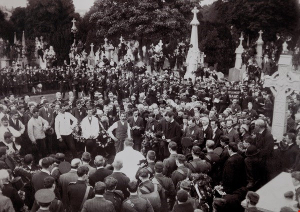
Rossa’s funeral is one of the seminal events in the revival of the Irish republican movement in Ireland. During the three days when Rossa lays in the vestibule of the City Hall, encased in a coffin with a plate glass lid, thousands of citizens pass by to pay their final respects.
The coffin is conveyed from the City Hall in the four-horse bier in waiting at 2:25 PM and fifteen minutes later the cortège starts, headed by a guard of honour of the Irish Volunteers with rifles, a mounted guard being supplied by the same body. The coffin is thickly covered with wreaths and an open carriage behind is also filled with floral tokens, while many of the contingents carry wreaths to be placed on the grave.
The procession, in marching four deep at a slow pace, takes a little over fifty minutes to pass the corner of Dame Street into George’s Street. A conservative estimate of those who actually take part in the procession give the numbers as exceeding 6,000 and there must be at least ten times that number lining the streets.
The funeral comes into College Green at about 3:00 PM, headed by a body of Volunteers with the St. James’s Band. It is nearing 6:00 PM when the hearse passes through the main gates of Glasnevin Cemetery. The avenue leading to the mortuary chapel is lined by detachments of Volunteers. The prayers in the chapel are said by the Rev. D. Byrne, chaplain. Several priests then accompany the coffin to the grave, which is situated just beyond the eastern fringe of the O’Connell circle, close to the graves of two other prominent Fenians, John O’Leary and James Stephens.
Patrick Pearse gives an address at the graveside which has resounded with republicans down through the years. The final words of his oration provide them with one of their most enduring slogans, “Ireland unfree will never be at peace.”
A firing party then fires a volley, the Last Post is sounded, and wreaths are laid on the grave.
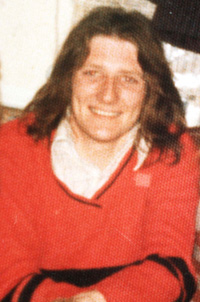
Born in Belfast on March 9, 1954, Sands is the oldest of four children born to John and Rosaleen Sands, and the couple’s first son. Sands grows up in Belfast under the cloud of nationalist and loyalist divisions. At an early age, Sands’s life is affected by the sharp divisions that shape Northern Ireland. At the age of ten, he is forced to move with his family out of their neighborhood due to repeated intimidation by loyalists.
“I was only a working-class boy from a Nationalist ghetto,” Sands later writes about his childhood. “But it is repression that creates the revolutionary spirit of freedom.” Loyalist intimidation proves to be a theme throughout Sands’ life. At the age of 18, he is forced out of his job as an apprentice car builder. Not long afterwards, he and his family have to move again, as a result of political trouble.
The steady number of conflicts pushes Sands to join the republican movement in 1972. His ties to the movement soon capture the attention of the authorities, and later that year, he is arrested and charged with possessing firearms in his house. He spends the next three years of his life in prison. Upon his release, Sands immediately returns to the Republican Movement. He signs on as a community activist in Belfast’s rough Twinbrook area, quickly becoming a popular go-to person for a range of issues affecting the neighborhood.
In late 1976, authorities arrest Sands again, this time in connection with the bombing of a large furniture company and an ensuing gun battle. After weathering a brutal interrogation and then a court proceeding that offers up questionable evidence connecting Sands and three others to the attack, a judge sentences Sands to 14 years in prison at Long Kesh Prison, a facility used to house Republican prisoners from 1971 until 2000, located just outside of Belfast.
As a prisoner, Sands’s stature only grows. He pushes hard for prison reforms, confronting authorities, and for his outspoken ways he is frequently given solitary confinement sentences. Sands contention is that he and others like him, who are serving prison sentences, are actually prisoners of war, not criminals as the British government insists.
Beginning on March 1, 1981, Sands leads nine other Republican prisoners in the H Block section of the Maze prison on a hunger strike that lasts until death. Their demands range from allowing prisoners to wear their own clothes to permitting visits and mail, all of which are central in improving the inmates’ way of life.
Unable to move authorities to give in to his requests, and unwilling himself to end his hunger strike, Sands’s health begins to deteriorate. During the first seventeen days of the strike alone, he loses 16 pounds. A hero among his fellow nationalists, Sands is elected as a Member of Parliament (MP) for Fermanagh and South Tyrone while in prison. Sands becomes the youngest MP at the time. However, he dies less than one month later without ever having taken his seat in the House of Commons.
Only days after slipping into a coma, on the morning of May 5, 1981, Sands dies from malnutrition due to starvation. He is 27 years old and has refused to eat for 66 days. He becomes so fragile over his final weeks that he spends his final days on a waterbed to protect his deteriorating and fragile body. At time of his death, Sands is married to Geraldine Noade, with whom he has one son, Gerard.
The announcement of Sands’s death prompts several days of rioting in nationalist areas of Northern Ireland. Over 100,000 people line the route of Sands’s funeral. He is buried in the ‘New Republican Plot’ alongside 76 others. Their graves are maintained by the National Graves Association, Belfast.
While loyalists dismiss Sands’s death, others are quick to recognize its significance. Over the next seven months, nine other IRA supporters die on hunger strike. Eventually, the British government gives proper political recognition to the prisoners, many of them earning their release under the 1998 Good Friday Agreement.


 seamus dubhghaill