seamus dubhghaill

Promoting Irish Culture and History from Little Rock, Arkansas, USA


Leave a comment

Storm Frank Causes Widespread Flooding

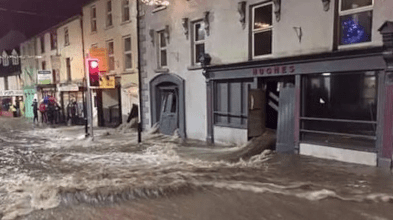
Clean-up operations are underway around Ireland on Wednesday, December 30, 2015, in the wake of Storm Frank, which causes widespread flooding following its landfall in western areas on Tuesday, December 29. Thousands of households and businesses are left without electricity in many areas of the country.

A Met Éireann status orange wind warning is lifted at 2:00 p.m. on Wednesday although the forecasts caution that severe winds of 65-80 km/h and gusts of up 130 km/h are still expected. While the heaviest rainfall from the storm falls overnight, many rivers and lakes have yet to peak meaning further flooding is possible.

According to an ESB Networks spokesman, 7,500 homes are without power in the afternoon, down from the overnight total of 13,000. He says repair crews are working to restore power to those cut off. The biggest single outage overnight is around Bandon and Fermoy in County Cork where 4,000 homes are without power, although it has been restored to almost all homes by the afternoon of December 30.

At 2:00 p.m. on Wednesday, the worst affected areas are County Wicklow with 1,200 houses without power, Macroom in County Cork where 600 are without power and Athlone where 500 homes are cut off. Around 500 homes in Naas, County Kildare, are without power as are 350 houses in Skerries in north County Dublin. It is hoped that power will be restored to all customers by the evening.

County Cork appears to be the worst affected by the storm where 60 mms (almost three inches) of rain falls since the morning of December 29. The threat of further flooding in Cork remains as the ESB increases the flow of water through the Inniscarra Dam to 250 cumecs (cubic metres per second) between 9:00 a.m. and midday which leads to increased flooding downstream. This is higher than the level of flow (180 cumecs) the previous and between December 6 and 12 along the River Lee following Storm Desmond.

Cork County manager Tim Lucey says there has been “extensive flooding” across a range of areas, but that Midleton and Bandon are worst hit with some 90 properties affected in each of the towns. He tells RTÉ Radio that one positive is the fact flood defences in Mallow and Fermoy have done their job. He notes that some five feet of water has built up behind a flood barrier in Mallow and this indicates the damage that could have been done to the town.

South Galway bears the brunt of flooding in the west, with river gauges expected to rise further over the coming days. Overnight rainfall is not as heavy as anticipated in the west, but several properties succumb to the waters. Up to 30 families in the south Galway area are forced to stay with relatives, with several being accommodated in hotels by Galway County Council, as floodwaters cut off access routes to their homes.

In Mayo, the area around the Neale remains underwater and a number of minor roads and thousands of acres of farmland are also affected. With rain continuing to fall across the west, conditions are expected to remain critical over the next few days.

The N11 between Rosslare and Dublin, the N25 from Cork to Waterford, the N71 between Cork and Killarney and the N4 between Dublin and Sligo all have diversions in place. The N25 is closed overnight between Killeagh and Castlemartyr in County Cork due to flooding. The N71 Cork/Bandon Road is also closed overnight at the viaduct due to flooding. There is severe flooding on the N40 South Ring Rd. at J6 Kinsale, particularly on the westbound off-ramp. The N11 Dublin/Wexford Road is impassable through Enniscorthy and also at Kyle’s Cross near Oylegate. The N4 is closed eastbound at Ballynafid in County Westmeath due to flooding. There are also several road closures in Kerry, Waterford and Tipperary.

Midleton is also hit by severe flooding as water levels in the Owenacurra River rise dramatically with up to 30 families having to be evacuated from their homes. Macroom in mid-Cork is also flooded for the first time during the year. Bandon is put on red alert by Cork County Council’s early warning system. Traders and residents are told to take all measures necessary to protect their property and stock. Locals stay up all night preparing the town for the latest round of flooding. Nevertheless, some 20 businesses in Bandon are flooded for the second time in a month after waters start to come up shores and gutters in the town as water levels in the River Bandon rise overnight.

The River Slaney burst its banks in Enniscorthy, County Wexford, causing widespread flooding in the town. Several cars have to be abandoned. High tide in Enniscorthy occurs around 10:30 a.m. on December 30.

Limerick City Council and Limerick County Council say there has been no significant flooding in the county as a result of overnight rainfall but that water levels along the lower River Shannon continue to increase. Water levels on the river rise by some 11cm at Castleconnell and Montpelier.

The ESB says the flow of water through Parteen Weir, which regulates water flow through Ardnacrusha power plant, will remain at 440 (cubic metres per second) on December 30 and that the situation will be reviewed again the following day. “The levels in Lough Derg may reach 2009 levels in the coming days and, as a result, the flow through Parteen Weir may increase to 2009 levels (up to 500 cumecs) in the coming days,” it says.

Clare County Council says water levels on the lower River Shannon at Springfield, Clonlara, have increased by 5-10cm in the last 24 hours and are some 20cm below a peak level recorded on December 13th. It says the Mulkear River in County Limerick, which enters the River Shannon south of Annacotty, is currently in flood and is contributing to increased water levels at Springfield. Council staff are assisted by the Fire Service and Defence Forces at Springfield in their pumping operations and transporting residents of some 12 homes isolated by floodwaters.

Fianna Fáil urges Taoiseach Enda Kenny to call an emergency Cabinet meeting to address the fallout from the storm. The party’s environment spokesman, Barry Cowen, says many communities felt neglected as further significant damage was inflicted on homes and businesses by the rainfall and winds brought by Storm Frank. “The scenes that we are witnessing in communities impacted by the latest storm are truly heart-breaking,” he says. “People feel neglected by the Government. It’s astonishing that the Taoiseach has decided not to interrupt his Christmas holidays in light of the devastation caused by Storm Frank.”

The Government’s National Coordination Group on Severe Weather meets in Dublin on December 30. Sinn Féin MEP Liadh Ní Riada says the Government has displayed “ineptitude in preparing flood defences” and that “more hollow promises” from the Coalition are no substitute for action. “The risk of flooding is increasing and will continue to increase. People across this island need to know that our political leaders have a plan to prevent this happening in the future,” she says.

(From: “Storm Frank causes floods, closes roads and cuts power to thousands” by Ronan McGreevy, Th Irish Times, http://www.irishtimes.com, December 30, 2015 | Pictured: Water flows through buildings and down the street in Graignamanagh, Co Kilkenny on Tuesday night by Paul B via Twitter)
Leave a comment

Death of Molly Keane, Novelist & Playwright

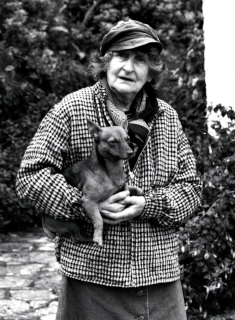
Molly Keane, Irish novelist and playwright who writes as M. J. Farrell, dies on April 22, 1996 in Ardmore, County Waterford.

Keane is born Mary Nesta Skrine on July 20, 1904 in Ryston Cottage, Newbridge, County Kildare. Her mother is a poet who writes under the pseudonym Moira O’Neill. Her father is a fanatic for horses and hunting. She grows up at Ballyrankin House on the banks of the River Slaney, a few miles southeast of Bunclody, County Wexford and refuses to go to boarding school in England as her siblings had done. She is educated by her mother, governesses, and at a boarding school in Bray, County Wicklow. Relationships between her and her parents are cold and she states that she had no fun in her life as a child. Her own passion for hunting and horses is born out of her need for fun and enjoyment. Reading does not feature much in her family, and, although her mother writes poetry, it is of a sentimental nature, “suitable to a woman of her class.”

Keane claims she had never set out to be a writer, but at seventeen she is bed bound due to suspected tuberculosis, and turns to writing out of sheer boredom. It is then she writes her first book, The Knight of Cheerful Countenance, which is published by Mills & Boon. She writes under the pseudonym “M. J. Farrell,” a name over a pub that she had seen on her return from hunting. She explains writing anonymously because “for a woman to read a book, let alone write one was viewed with alarm: I would have been banned from every respectable house in County Carlow.”

In her teenage years Keane spends much of her time in the Perry household in Woodruff, County Tipperary. Here she befriends the two children of the house, Sylvia and John Perry. She later collaborates with John in writing a number of plays. Among them is Spring Meeting, directed by John Gielgud in 1938, and one of the hits of the West End that year. She and Gielgud become life long friends.

It is through the Perry family that Keane meets Bobby Keane, whom she marries in 1938. He belongs to a Waterford squirearchical family, the Keane baronets. The couple goes on to have two daughters, Sally and Virginia.

Keane loves Jane Austen, and like Austen’s, her ability lay in her talent for creating characters. This, with her wit and astute sense of what lay beneath the surface of people’s actions, enables her to depict the world of the big houses of Ireland in the 1920s and 1930s. She “captured her class in all its vicious snobbery and genteel racism.” She uses her married name for her later novels, several of which (including Good Behaviour and Time After Time) have been adapted for television. Between 1928 and 1956, she writes eleven novels, and some of her earlier plays, under the pseudonym “M. J. Farrell.” She is a member of Aosdána.

Keane’s husband dies suddenly in 1946, and, following the failure of a play, she publishes nothing for twenty years. In 1981 Good Behaviour comes out under her own name. The manuscript, which had languished in a drawer for many years, is loaned to a visitor, the actress Peggy Ashcroft, who encourages Keane to publish it. The novel is warmly received and is short-listed for the Booker Prize.

Following the death of her husband, Keane moves to Ardmore, County Waterford, a place she knows well, and lives there with her two daughters. She dies on April 22, 1996 in her Cliffside home in Ardmore at the age of 91. She is buried beside the Church of Ireland church, near the centre of the village.


2 Comments

The Battle of Vinegar Hill

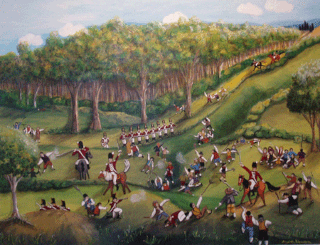
The Battle of Vinegar Hill, an engagement during the Irish Rebellion of 1798, takes place on June 21, 1798 when over 13,000 British soldiers launch an attack on Vinegar Hill outside Enniscorthy, County Wexford, the largest camp and headquarters of the Wexford United Irishmen. It marks a turning point in the rebellion, as it is the last attempt by the United Irishmen to hold and defend ground against the British military. The battle is actually fought in two locations: on Vinegar Hill itself and in the streets of nearby Enniscorthy.

By June 18, the British have surrounded County Wexford with between 13,000 and 18,000 troops and are ready to pour into Wexford to crush the insurgency. The United Irishmen leadership issues a call to all its fighters to gather at Vinegar Hill to meet the army in one great, decisive battle. The number assembled is estimated at between 16,000 and 20,000, but the majority lack firearms and have to rely on pikes as their main weapon. The camp also includes many thousands of women and children who are staying there for protection against the rampaging military.

The British plan, as formulated by General Gerard Lake, envisages the complete annihilation of the United Irishmen, women and children by encircling the hill and seizing the only escape route to the west, the bridge over the River Slaney. Lake divides his force into four columns to accomplish this. Three columns, under Generals David Dundas, James Duff and Francis Needham are to assault Vinegar Hill, while the fourth column, under General Johnson, is to storm Enniscorthy and its bridge.

The battle begins shortly before dawn with an artillery bombardment of Irish positions on the hill. Advance units quickly move against the United Irishmen outposts under cover of the bombardment and move artillery closer as forward positions are secured. The tightening ring forces the United Irishmen into an ever-shrinking area and increases exposure to the constant bombardment, including new experimental delayed-fuse shells resulting in hundreds of dead and injured. At least two mass charges are launched by the United Irishmen which fail to break the lines of the military and the situation on Vinegar Hill soon becomes desperate for the United Irishmen.

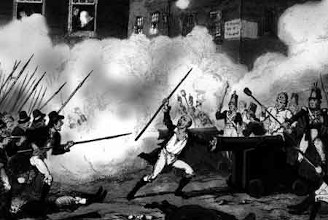
Meanwhile, a detachment of light infantry under the command of General Johnson attacks the town of Enniscorthy but meets with fierce resistance. Buildings in the town have been fortified and the initial attack is driven back with the loss of munitions and men. A second attack commences with reinforcements including cavalry, which retake the lost cannon and ammunition while also incurring considerable casualties. The United Irishmen are slowly driven out of the town but manage to hold the Slaney bridge and prevent the British from crossing.

When British troops crest the eastern summit of Vinegar Hill, the rebels begin to slowly withdraw through a gap in the British lines later known as “Needham’s Gap”, so-named because the late arrival of General Needham’s troops prevented a total encirclement of the hill. Although the bulk of the United Irishmen army escape, many are left behind and killed in the routing phase of the battle from both cavalry and infantry attack, but also from the advanced field guns which are switched to grapeshot to maximize casualties.

In addition to conventional casualties, there are also instances of British troops raping the women accompanying the United Irishmen and in Enniscorthy, United Irishmen wounded are burned to death when soldiers set fire to a building used as a casualty station. These atrocities may have been perpetrated in revenge for the execution by the United Irishmen of numbers of mostly Protestant loyalist prisoners of war in the preceding weeks. The United Irishmen abandon much of the supplies they had taken from surrounding areas, and thirteen cannons are captured by the British, a number of which had been taken from the British forces previously.

Meanwhile, the bulk of the United Irishmen force streams uninterrupted towards the Three Rocks camp outside Wexford and, following the decision to abandon the town, split into two separate columns in a new campaign to spread the rebellion beyond Wexford. One immediately sets out to the west, the other northwards towards the Wicklow Mountains to link up with General Joseph Holt‘s forces.

The defeat is therefore not the immediate crushing blow to the Wexford United Irishmen that it has falsely been depicted as, but it does alter the course of the fighting as continued resistance now takes the form of mobile warfare, raids, and large scale, guerilla-type operations.

Casualties for the United Irishmen have been variously reported, with estimates ranging from 400 to around 1,200. Kevin Whelan estimates a figure of between 500 and 1,000 including camp followers, while Archibald McLaren, a British soldier eyewitness, writes that the United Irishmen casualties total about 1,200 men. British casualties are around one hundred.


Leave a comment

The Battle of Enniscorthy

battle-of-enniscorthy

The Battle of Enniscorthy is a land battle fought on May 28, 1798, during the Irish Rebellion of 1798, when an overwhelming force of rebels assails the town of Enniscorthy, County Wexford, which is defended only by a 300-strong garrison supported by loyalist civilians. On the previous day at nearby Oulart, several thousand rebels led by Fr. John Murphy had massacred a detachment of the North Cork militia, amounting to 110 officers and men, in the Battle of Oulart Hill.

The attack on Enniscorthy begins at about 1:00 PM, when the rebels drive a herd of cattle through the town’s Duffry gate, creating disorder, and set the town’s buildings on fire. The troops defending the gate withdraw to a stone bridge over the River Slaney. After a determined defence of about three hours, the loyalist forces have expended their ammunition. They are also flanked by rebels wading across the river’s low water. However, after having driven all the rebels out of town they are ordered to abandon the town and withdraw to Wexford, which they do alongside a terrified multitude of men, women and children fleeing the burning town. In the action, the garrison and yeomanry had killed up to 500 insurgents at a cost of 90 of their own dead.

According to the historian Maxwell, the town’s Protestants see a merciless night attack as almost certain. Throughout the fight, Catholic residents support the rebels by shooting loyalists from their windows. Of the many fugitives, the weakest are carried on cavalry horses or otherwise abandoned to their fate, including infants and the elderly.

The rebels are brutal and vengeful in occupying their captured town. They set up a formidable encampment of 10,000 men on the nearby heights of Vinegar Hill and are able to roster forces to garrison Enniscorthy, whose streets are littered with dead and dying while flames continued to rage. Four hundred seventy-eight dwelling houses are destroyed in addition to commercial premises.


Leave a comment

Death of John Kelly, United Irish Leader

john-kelly-marker

John Kelly, also known as Kelly of Killanne, a leader of the Society of United Irishmen, is hanged along with seven other rebel leaders on Wexford bridge on June 22, 1798.

Kelly lives in the town of Killanne in the parish of Rathnure and is a United Irish leader who fights in the Irish Rebellion of 1798.

While Kelly is obviously well known to rebel and loyalist alike during the short duration of the Wexford Rebellion, almost nothing is known of him outside this time. He is one of the leaders of the rebel victory at the Battle of Three Rocks which leads to the capture of Wexford town but is later seriously wounded while leading a rebel column at the Battle of New Ross.

Kelly is under orders from the Wexford commander Bagenal Harvey to attack the British outposts around New Ross but on no account to attack the town itself.

The rebels outnumber the British forces, and so Harvey sends a messenger to give them an opportunity to surrender. The messenger is shot while carrying a white flag. This angers the rebels who begin the attack without receiving the official order from Harvey.

Kelly’s column of 800 men attacks and breaks through Ross’s “Three Bullet Gate” and proceeds into the town itself. After initial success, they are eventually beaten back by British troops and Kelly is wounded in the leg. He is moved to Wexford to recuperate but, after the fall of Wexford on June 21, he is dragged from his bed, tried and sentenced to death.

John Kelly is hanged on June 22, 1798, along with seven other rebel leaders on Wexford bridge, after which his body is decapitated, the trunk thrown into the River Slaney and the head kicked through the streets before being set on display on a spike.

Kelly’s exploits are commemorated in the famous Irish ballad Kelly the Boy From Killanne written by Patrick Joseph McCall (1861–1919). Don Partridge records a solo acoustic version of the song in 1964, and later regularly plays the song during street busking, before and after his hit records in the late 1960s.

(Pictured: The grave of John Kelly, Kelly of Killanne, in Saint Anne’s Churchyard, Killanne, County Wexford)


Leave a comment

The Sack of Wexford

sack-of-wexford

The Sack of Wexford takes place on October 11, 1649, during the Cromwellian conquest of Ireland, when the New Model Army under Oliver Cromwell takes Wexford town in southeastern Ireland. The English Parliamentarian troops break into the town while the commander of the garrison, David Synnot, is trying to negotiate a surrender, massacring soldiers and civilians alike. Much of the town is burned and its harbour is destroyed. Along with the Siege of Drogheda, the sack of Wexford is still remembered in Ireland as an infamous atrocity.

Wexford is held by Irish Catholic forces throughout the Irish Confederate Wars. In the Irish Rebellion of 1641, over 1,500 local men muster in the town for the rebels. In 1642, Lord Mountgarret, the local Commander of the Confederate Catholic regime, orders Protestants to leave Wexford.

Wexford is also the base for a fleet of Confederate privateers, who raid English Parliamentary shipping and contribute 10% of their plunder to the Confederate government based in Kilkenny. In 1642, Parliamentary ships begin throwing captured Wexford sailors overboard with their hands tied. In reprisal, 150–170 English prisoners are kept in Wexford and threatened with death if such killing continued.

In 1648, the Confederates and Royalists in Ireland sign a treaty joining forces against the English Parliament. After Cromwell’s landing in Ireland in August 1649, therefore, Wexford is a key target for the Parliamentarians, being an important port for the Royalist alliance and a base for the privateers.

Cromwell arrives at Wexford on October 2, 1649 with about 6,000 men, eight heavy siege guns, and two mortars. The town’s garrison initially consists of 1,500 Confederate soldiers under David Synnot. However, the morale of the town is low and many of the civilians in Wexford want to surrender. Synnot, however, strings out surrender negotiations with Cromwell insisting on several conditions for surrender that Cromwell does not countenance, including the free practice of the Catholic religion, the evacuation of the garrison with their arms, and the free passage of the privateer fleet to a friendly port.

Negotiations are reopened when Cromwell’s guns blast two breaches in the walls of Wexford castle, opening the prospect of an assault on the town. However, while negotiations are still ongoing, the town is unexpectedly stormed and sacked on October 11, 1649.

Stafford, the English Royalist captain of Wexford Castle, surrenders the castle for reasons that have never been determined. The troops of the New Model Army, on their own initiative, immediately assault the walls of the town, causing the Confederate troops to flee in panic from their positions. The Parliamentarians pursue them into the streets of Wexford, killing many of the town’s defenders. Several hundred, including David Synnot, the town governor, are shot or drowned as they try to cross the River Slaney. Estimates of the death toll vary. Cromwell himself believes that over 2,000 of the town’s defenders have been killed compared with only 20 of his troops. Several Catholic priests, including seven Franciscans are killed by the Roundheads. Much of the town, including its harbour, is burned and looted. As many as 1,500 civilians are also killed in the sacking. This figure is difficult to corroborate but most historians accept that many civilians are killed in the chaos surrounding the fall of Wexford.

The destruction of Wexford is so severe that it can not be used either as a port or as winter quarters for the Parliamentarian forces. One Parliamentarian source therefore describes the sack as “incommodious to ourselves.” Cromwell reports that the remaining civilians have “run off” and asks for soldiers to be sent from England to repopulate the town and reopen its port.