Discontented with James Chichester-Clark and Brian Faulkner who come to government after O’Neill’s 1969 fall from power, Boal resigns from the UUP in 1971 and joins Ian Paisley in establishing the Democratic Unionist Party (DUP) in order to provide dissident unionist opinion with a viable political alternative. He works as the first chairman and one of the first public representatives of the DUP and continues to sit in Stormont during the years of 1971–1972. He later resumes his practice as a barrister.
While Boal’s interest in federalism diminishes after the 1970s, the federalist Boal scheme of January 1974 is again put forward by liberal protestants such as John Robb as late as 2007. His friendship with Paisley finally breaks when the DUP agrees to enter government with Sinn Féin in 2007. He tells Paisley, who takes the breach very hard, that he had betrayed everything he ever advocated.
Kilfedder leaves the UUP in 1977 in opposition to the party’s policies tending to integrationism, preferring to advocate the restoration of the Stormont administration. For a time he sits as an “Independent Ulster Unionist.” He contests the 1979 European Parliament election under that label, finishing fourth in the count for the three seats, having overtaken the UUP leader Harry West on transfers.
On March 20, 1995, while traveling by train into London from Gatwick Airport, Kilfedder dies of a heart attack. This is the same day that the Belfast Telegraph carries a front-page story saying that an Ulster MP has been targeted as one of twenty MPs invited by the LGBT rights organisation OutRage! in a letter to come out. He dies unmarried and is survived by two sisters.
Brooke is born on June 9, 1888, at Colebrooke Park, his family’s neo-Classicalancestral seat on what is then the several-thousand-acre Colebrooke Estate, just outside Brookeborough, a village near Lisnaskea in County Fermanagh. He is the eldest son of Sir Arthur Douglas Brooke, 4th Baronet, whom he succeeds as 5th Baronet when his father dies in 1907. His mother is Gertrude Isabella Batson. He is a nephew of Field MarshalAlan Brooke, 1st Viscount Alanbrooke, Chief of the Imperial General Staff (CIGS) during World War II, who is only five years his senior. His sister Sheelah marries Sir Henry Mulholland, Speaker of the Stormont House of Commons and son of Lord Dunleath. He is educated for five years at St. George’s School in Pau, France, and then at Winchester College (1901–05).
Brooke is a very active Ulster Unionist Party member and ally of Edward Carson. He founds his own paramilitary group, Brooke’s Fermanagh Vigilance, from men returning from the war front in 1918. Although the umbrella Ulster Volunteers had been quiescent during the war, it is not defunct. It re-emerges strongly in 1920, subsuming groups like Brooke’s.
In 1920, having reached the rank of captain, Brooke leaves the British Army to farm the Colebrooke Estate, the family estate in west Ulster, at which point he turns toward a career in politics.
Brooke has a very long political career. When he resigns the Premiership of Northern Ireland in March 1963, he is Northern Ireland’s longest-serving prime minister, having held office for two months short of 20 years. He also establishes a United Kingdom record by holding government office continuously for 33 years.
On May 2, 1943, Brooke succeeds John M. Andrews as Prime Minister of Northern Ireland. In 1952, while Prime Minister, was raised to the peerage as Viscount Brookeborough, the title taken from the village named after the Brookes. Although a peer, he retained his seat in the House of Commons at Stormont and remained Prime Minister for another decade.
As the Northern Ireland economy begins to de-industrialise in the mid-1950s, leading to high unemployment amongst the Protestant working classes, Brooke faces increasing disenchantment amongst UUP backbenchers for what is regarded as his indifferent and ineffectual approach to mounting economic problems. As this disenchantment grows, British civil servants and some members of the UUP combine to exert discreet and ultimately effective pressure on Brooke to resign to make way for Captain Terence O’Neill, who is Minister of Finance.
Brooke is noted for his casual style toward his ministerial duties. Terence O’Neill later writes of him, “he was good company and a good raconteur, and those who met him imagined that he was relaxing away from his desk. However, they did not realise that there was no desk.”
In his retirement Brooke develops commercial interests as chairman of Carreras (Northern Ireland), a director of Devenish Trade, and president of the Northern Ireland Institute of Directors. He is also made an honorary LL.D. of Queen’s University Belfast.
From 1970 to 1973, years in which the Stormont institution comes under its greatest strain and eventually crumbles, Brooke makes only occasional forays into political life. In 1972, he appears next to William Craig MP on the balcony of Parliament Buildings at Stormont, a diminutive figure beside the leader of the Vanguard Unionist Progressive Party (VUPP) who is rallying right-wing Unionists against the Government of Northern Ireland. He opposes the Westminsterwhite paper on the future of Northern Ireland and causes some embarrassment to his son, Captain John Brooke, the UUP Chief Whip and an ally of Brian Faulkner, by speaking against the Faulkner ministry‘s proposals.
Brooke dies at his home, Colebrooke Park, on the Colebrooke Estate, on August 18, 1973. His remains are cremated at Roselawn Cemetery, East Belfast, three days later, and, in accordance with his wishes, his ashes are scattered on the demesne surrounding his beloved Colebrooke Park.
Brian Robinson, loyalist militant from Belfast, Northern Ireland, and member of the Ulster Volunteer Force (UVF), is shot dead by two members of an undercover British Army unit on September 2, 1989. His death is one of the few from the alleged shoot-to-kill policy in Northern Ireland to have involved a loyalist victim.
Robinson is born in Belfast in 1962 to Rab and Margaret Robinson, and brought up a Protestant on Disraeli Street in the staunchly loyalist Woodvale district of the Shankill Road. It is unknown when he becomes a member of the local Ulster Volunteer Force. He holds the rank of volunteer in its B Company, 1st Battalion Belfast Brigade. By the time of his death he has moved to Forthriver Crescent in the Glencairn estate, an area immediately northwest of Woodvale.
On September 2, 1989, Robinson and fellow UVF member Davy McCullough are travelling on a motorbike, with Robinson as the passenger armed with a gun, in Belfast’s Crumlin Road, close to the Irish nationalist area of Ardoyne. Upon seeing Paddy McKenna, a Catholic civilian, walking along the street, Robinson opens fire, hitting McKenna a total of eleven times and killing him. Unbeknownst to the two UVF members, an undercover British Army unit, linked to the Special Air Service, is in the area. Giving chase in a Vauxhall Astra car and a Fiat, the soldiers ram the motorbike, forcing both men off the road. Robinson is shot twice in his torso, then twice more in the back of the head by a female soldier standing over him. He is 27-years-old. Upon hearing the news of her son’s death, Robinson’s mother, Margaret, suffers a fatal heart attack. The two are buried on the same day.
The UVF leadership in west Belfast later claims that the intelligence leading to Robinson’s death had been provided by one of their own men, Colin “Crazy” Craig, who allegedly had been a police informer for several years. Craig is killed by the Irish National Liberation Army (INLA) on June 16, 1994, along with fellow UVF members Trevor King and David Hamilton. A UVF commander is quoted as mourning King and Hamilton, but adding that Craig was in line to be shot by the UVF anyway. Republican sources claim that the security forces infiltration of the UVF is even deeper, including Trevor King and “the most senior UVF figure in the North.”
Robinson’s funeral is well-attended as it leaves his home in Forthriver Crescent. Despite his membership in the UVF there are no paramilitary displays at the funeral, and the coffin is covered in the Union Jack instead of a UVF standard. Robinson is a member of the “Old Boyne Heroes” lodge of the Orange Order, and several members wearing their sashes flank the coffin. The cortege then meets up with Margaret Robinson’s funeral as it leaves her home in Crimea Street. A lorry carrying floral tributes leads the cortege. Both mother and son are buried in Roselawn Cemetery. A death notice from Robinson’s Orange lodge is published in the local press, which causes controversy.
Robinson’s death is commemorated annually in a band parade attended by loyalist bands in the Belfast area. One band, Star of the Shankill, has “In Memory of Brian Robinson” written on its crest and emblazoned upon its bass drum. The band also attracts controversy when it appears at a parade organised by the Apprentice Boys of Derry that passes near the area in which Robinson killed his victim. In 2010, Rab Robinson, the brother of Brian, issues an appeal to the parades organisers to postpone the parade that year, owing to the death of his younger brother earlier that year.
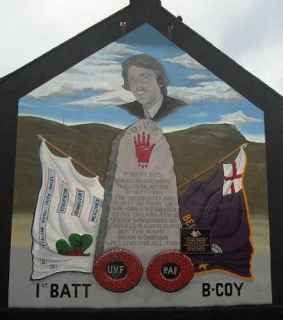
Robinson is commemorated in a mural on Disraeli Street, off Woodvale Road in Belfast.
In 2015, Robinson’s son Robert removes a Special Air Service flag that had been erected by the loyalists at the Twaddell Avenue protest camp. The Shankill UVF is later said to be reviewing its policy of flying the flag.
(Pictured: Mural commemorating Brian Robinson on Disraeli Street, off Woodvale Road in Belfast)
Basil Blackshaw, Northern Irish artist, dies at the age of 83 on May 2, 2016. He is best known for his paintings of dogs, horses, landscapes and people and is regarded as one of the country’s most talented artists.
Blackshaw’s home and studio is in County Antrim by Lough Neagh. He becomes well known for his country scenes including landscapes, farm buildings and horses, painted in an expressionist style.
Blackshaw is initially acclaimed for his mastery of traditional approaches to painting. He continues to develop as an artist, becoming most highly regarded for his very loose gestural application of paint and a very distinctive and subtle use of colour. His paintings of such sports as horse racing and boxing make him particularly popular, but he is also a talented portrait painter.
Blackshaw’s paintings are often figurative in form, but with a non-naturalistic palette which re-balances the composition in an expressionist, even abstract, way. His themes are very Irish and often rural; greyhounds, Irish Travellers, and the landscape. He also produces portraits and designs posters for Derry‘s Field Day Theatre Company.
The Arts Council of Northern Ireland organises a major retrospective of Blackshaw’s work in 1995, which travels from Belfast to Dublin, Cork and many galleries in the United States. In 2001 he receives the GlenDimplex Award for a Sustained Contribution to the Visual Arts in Ireland. The Ulster Museum holds a major exhibition of his work in 2002 and a major book is published by Eamonn Mallie on the artist in 2003.
For a 2005 exhibition at the Fenton Gallery in Cork, Blackshaw works exclusively over a period of 20 months creating a dramatic collection of fifteen new paintings. His choice of arguably mundane subjects, The Studio Door, Car, Wall, Six Trees, express both an engagement with tradition and a watchful detachment.
In 2006 Blackshaw’s work is exhibited at the Irish College in Paris (French: Centre Culturel Irlandais).
Blackshaw is elected as an associate of The Royal Ulster Academy of Arts in 1977 and elected an Academician in 1981. Dublin’s Royal Hibernian Academy describes him as “one of Ireland’s greatest artists” who was “lauded by the art world and his fellow painters.”
Basil Blackshaw dies on May 2, 2016. Father to well-known artist Anya Waterworth, he is buried in a wicker coffin in a humanist funeral, the ceremony ending to Bob Dylan‘s “Mr. Tambourine Man” at Roselawn Cemetery on the outskirts of Belfast. More than 100 mourners come to pay their respects. Among them are artists Jack Pakenham and Neil Shawcross, actor Stephen Rea and boxing legend Barry McGuigan.
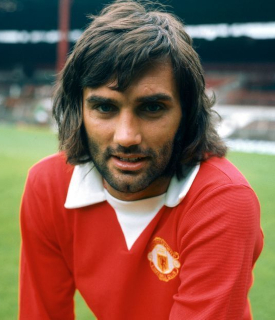
Best is born on May 22, 1946 and grows up in Cregagh, east Belfast. In 1957, he passes the eleven-plus and goes to Grosvenor High School, but he soon plays truant as the school specialises in rugby. He then moves to Lisnasharragh Secondary School, reuniting him with friends from primary school and allowing him to focus on football. He plays for Cregagh Boys Club. He grows up supporting Glentoran F.C. and Wolverhampton Wanderers F.C..
Best spends most of his club career at Manchester United. Named European Footballer of the Year in 1968, he is regarded as one of the greatest players of all time. A highly skillful winger, considered by several pundits to be one of the greatest dribblers in the history of the sport, he receives plaudits for his playing style, which combines pace, skill, balance, feints, two-footedness, goalscoring and the ability to get past defenders.
In international football, Best is capped 37 times for Northern Ireland between 1964 and 1977. A combination of the team’s performance and his lack of fitness in 1982 means that he never plays in the finals of a major tournament. He considers his international career as being “recreational football,” with the expectations placed on a smaller nation in Northern Ireland being much less than with his club. He is regarded as one of the greatest players never to have played at a World Cup. The Irish Football Association describes him as the “greatest player to ever pull on the green shirt of Northern Ireland.”
With his good looks and playboy lifestyle, Best becomes one of the first media celebrity footballers, earning the nickname “El Beatle” in 1966, but his extravagant lifestyle leads to various personal problems, most notably alcoholism, which he suffers from for the rest of his life. These issues affect him on and off the field, often causing controversy. Although conscious of his problems, he is publicly not contrite about them. He says of his career, “I spent a lot of money on booze, birds [women] and fast cars – the rest I just squandered.” After football, Best spends some time as a football analyst, but his financial and health problems continue into his retirement.
Best is diagnosed with severe liver damage in March 2000. His liver is said to be functioning at only 20%. In 2001, he is admitted to hospital with pneumonia. In August 2002, he has a successful liver transplant at King’s College Hospital in London.
On October 3, 2005, Best is admitted to intensive care at the private Cromwell Hospital in London, suffering from a kidney infection caused by the side effects of immunosuppressive drugs used to prevent his body from rejecting his transplanted liver. In the early hours of November 25, 2005, treatment is stopped. Later that day he dies, aged 59, as a result of a lung infection and multiple organ failure. He is interred beside his mother in a private ceremony at Roselawn Cemetery, overlooking east Belfast.


 seamus dubhghaill