seamus dubhghaill

Promoting Irish Culture and History from Little Rock, Arkansas, USA


Leave a comment

Death of Writer Robert Tressell

robert-tressell

Robert Noonan, Irish writer born Robert Croker and best known by the pen name Robert Tressell, dies in Liverpool, England on February 3, 1911. He is best known for his novel The Ragged-Trousered Philanthropists.

Noonan is born in Dublin on April 18, 1870, the illegitimate son of Samuel Croker, a senior member of the Royal Irish Constabulary. He is baptised and raised a Roman Catholic by his mother Mary Noonan. His father, who is not Catholic, has his own family, but attempts to provide for Robert until his death in 1875.

By 1875 Noonan is living in London. When he is sixteen, he shows signs of a radical political consciousness. He leaves his family declaring he “would not live on the family income derived largely from absentee landlordism.” It is around this time he changes his surname to his mother’s maiden name.

In 1890, Noonan is a sign writer living in Queen’s Road, Everton, Liverpool. On June 10, 1890, he appears at Liverpool County Intermediate Sessions court at Sessions House, Islington, Liverpool on charges of housebreaking and larceny. He is found guilty and given a six-month prison sentence.

By 1891, Noonan has moved to Cape Town, South Africa, where he is a painter and decorator. He marries in 1891, but the marriage is an unhappy one, with his wife having numerous affairs after the birth of their daughter, Kathleen. They divorce in 1895, and Noonan acquires all the property, including their house in an affluent suburb of Cape Town.

Noonan and his daughter move to Johannesburg, where he secures a well-paying job with a construction company. It is here that he learns the ways of the industry he would later write about in his novel, although Noonan’s actual circumstances vary greatly from the proletarian characters of the book. After becoming Secretary of the Transvaal Federated Building Trades Council, he is able to send his daughter to an exclusive convent school and also to employ a black manservant called Sixpence.

In 1897, Noonan leads a successful protest against the employment of black skilled labour. During 1898, he becomes a member of the Transvaal Executive Committee of the Centennial of 1798 Association, which commemorates the revolutionary nationalist Society of United Irishmen. As a 1798 Association member, he helps form the Irish Brigades, an anti-British force that fights alongside the Boers in the Second Boer War. At this point, accounts of his life differ. Some assert he takes up arms and is interned by the British until the end of the war, when he returns to Britain. Others say he leaves South Africa just before hostilities began in October 1899.

In any event, around the turn of the century, Noonan ends up in Hastings, Sussex. Here, he finds work as a sign writer, but at much lower wages and in far poorer conditions than he had experienced in South Africa. He has to take part-time jobs in addition to his full-time position.

Influenced by the Marxist-influenced ideas of designer and socialist William Morris, he joins the Social Democratic Federation in 1906. The next year, after a dispute with his employer, he loses his job. Despite the demand for his skills, his health begins to deteriorate, and he eventually develops tuberculosis. Unemployed and unable to remain politically active, he starts writing, something he hopes will earn enough money to keep him from the workhouse.

He writes under the pen name Robert Tressell as he fears the socialist views expressed in the book will have him blacklisted. He completes The Ragged Trousered Philanthropists in 1910, but the 1,600-page hand-written manuscript is rejected by three publishing houses. The rejections severely depress him, and his daughter has to save the manuscript from being burned.

Unhappy with his life in Britain, Noonan decides that he and Kathleen should emigrate to Canada. However, he only reaches Liverpool when he is admitted to the Royal Liverpool Infirmary, where he dies of pulmonary tuberculosis on February 3, 1911, at the age of 40. He is buried in a pauper’s grave at Liverpool Parochial Cemetery, later known as Walton Park Cemetery. The location of the grave is not rediscovered until 1970. Twelve other people are buried in the same plot. The plot is now marked although the land is no longer used as a cemetery and is now used by Rice Lane City Farm.

Kathleen mentions her father’s novel to a friend, writer Jessie Pope, who recommends it to her publisher. In April 1914, the publisher purchases the rights to the book for £25, and it appears in Britain, Canada and the United States later that year, in the Soviet Union in 1920, and in Germany in 1925. The version as originally published is heavily abridged by Pope, with much of the socialist ideology removed.

The original manuscript is subsequently located by F. C. Ball and, after he raises funds to acquire and reassemble the original version, an unabridged edition is published in 1955.


Leave a comment

Execution of Robert Erskine Childers

During the Irish Civil War, British writer and Irish republican Robert Erskine Childers is executed by the Irish Free State government at the Beggars Bush Barracks in Dublin on November 24, 1922.

The London-born son of a British scholar and an Irish mother, Childers is a lifelong Protestant, itself an anomaly since Irish nationalism maps strongly to Catholicism. In his early years his loyalty was with the British Empire. In his twenties, Childers volunteers for the Second Boer War, and he later says the rank savagery and underlying injustice of England’s war “changed the whole current of my life and made me a Liberal and a Nationalist.”

Laying down the sword, Childers takes up the pen and writes several books of military history. He also writes a novel, The Riddle of the Sands, that has a claim of being the first spy novel. The Riddle of the Sands has never gone out of print since it was published in 1903.

Both in fiction and nonfiction, Childers’ warnings against the German challenge to British hegemony are prophetic, but he is himself becoming a man divided. In 1914 he runs German guns to Irish nationalists aboard his yacht Asgard and then signs up for the royal navy when World War I erupts. The British crackdown on the Easter Rising during the war completes his radicalization. He moves to Dublin and turns his eloquence against the British.

Childers is swept into the tragedy of the Irish War of Independence and the Irish Civil War that follows. Although both he and Michael Collins are in the delegation that produces the contentious Anglo-Irish Treaty, Childers breaks with Collins over it and backs the Irish Republican Army (IRA) nationalists who fight the Irish Free State.

After Collins’s assassination, emergency laws promulgate the death sentence for anyone caught armed without authorization. Childers is a writer, not a partisan, but he is arrested in early November with a small sidearm, a gift Collins had given him back when they were on the same side. It is a time of bloody justice, and they throw the book at him.

Childers knows as well as Collins had that the internecine conflict would have to end. He faces his execution with awe-inspiring forgiveness. Summoning his 16-year-old son to prison the night before his execution, Childers extracts a promise from the boy that he will find everyone who signed his death warrant and shake their hands. This son, young Erskine Hamilton Childers, eventually becomes President of Ireland.

Childers himself likewise shakes the hands of his own firing squad, one by one. His last words, reported in a number of slightly different variations, are lightheartedly addressed to them: “Take a step or two forwards, lads. It will be easier that way.”


Leave a comment

Death of Winston Dugan, 1st Baron Dugan of Victoria

Winston Joseph Dugan, 1st Baron Dugan of Victoria and known as Sir Winston Dugan between 1934 and 1949, dies in Marylebone, London, England, on August 17, 1951. He is a British administrator and a career British Army officer. He serves as Governor of South Australia from 1934 to 1939, then Governor of Victoria until 1949.

Dugan is the son of Charles Winston Dugan, of Oxmantown Mall, Birr, County Offaly, an inspector of schools, and Esther Elizabeth Rogers. He attends Lurgan College in Craigavon from 1887 to 1889, and Wimbledon College, Wimbledon, London.

Dugan is a sergeant in the Royal Sussex Regiment but transfers to the Royal Lincolnshire Regiment as a second lieutenant on January 24, 1900. He fights with the 2nd battalion of his regiment in the Second Boer War and receives the Queen’s South Africa Medal with three clasps. Following the war, he is appointed adjutant of his battalion on June 28, 1901, and is promoted to lieutenant on November 1, 1901. He later fights with distinction in World War I, where he is wounded and mentioned in despatches six times. He is awarded the Distinguished Service Order (DSO) in 1915 and appointed a Companion of the Order of St. Michael and St. George (CMG) in 1918. In 1929 he is made a Companion of the Order of the Bath (CB) and the following year is promoted to major general. From 1931 to 1934 he commands the 56th (1st London) Division, Territorial Army.

In 1934, Dugan is appointed Governor of South Australia. He is appointed a Knight Commander of the Order of St. Michael and St. George (KCMG), retires from the Army and moves to Adelaide with his wife. They become an extremely popular and glamorous vice-regal couple. Sir Winston and Lady Dugan are both excellent public speakers and travel widely in order to bring problems to the attention of the ministers of the day. Upon the expiration of his term, there is bipartisan parliamentary support for him to serve a second term, but he has already accepted an appointment to be Governor of Victoria.

Sir Winston and Lady Dugan arrive in Melbourne on July 17, 1939. They continue their active role in community affairs, promoting unemployment reduction and making the ballroom of Government House available for the Australian Red Cross.

Dugan has an active role stabilising state politics during the tumultuous 1940s. Upon the disintegration of Albert Dunstan‘s Country Party in 1943, he installs Australian Labor Party leader John Cain as Premier. Four days later, Dunstan forms a coalition with the United Australia Party. Following the collapse of that ministry in 1945, Dugan dissolves parliament and calls a general election for November, which results in the balance of power being held by independents. Dugan commissions Cain to form the ministry of a minority government.

Dugan’s term as Governor is extended five times. He returns to England in February 1949. On July 7, 1949, he is raised to the peerage as Baron Dugan of Victoria, of Lurgan in County Armagh.

Winston Dugan dies at Marylebone, London, on August 17, 1951, at the age of 74. As there are no children from his marriage, the barony becomes extinct.


Leave a comment

Birth of Robert Erskine Childers, Writer & Fenian

Robert Erskine Childers, British writer universally known as Erskine Childers and whose mother is from County Clare, is born on June 25, 1870, in Mayfair, London, England. His works include the influential novel The Riddle of the Sands. He is the second son of Robert Caesar Childers, a translator and oriental scholar from an ecclesiastical family, and Anna Mary Henrietta, née Barton, from an Anglo-Irish landowning family of Glendalough House, Annamoe, County Wicklow. He is also the cousin of Hugh Childers and Robert Barton, and the father of the fourth President of Ireland, Erskine Hamilton Childers.

Childers is raised at the home of family members at Glendalough, County Wicklow. At the recommendation of his grandfather, Canon Charles Childers, he is sent to Haileybury College. There he wins an exhibition to Trinity College, Cambridge, where he studies the classical tripos and then law. He distinguishes himself as the editor of Cambridge Review, the university magazine.

Childers’s first published work is some light detective stories he contributes to the Cambridge Review while he is editor. His first book is In the Ranks of the C. I. V., an account of his experiences in the Boer War, but he writes it without any thought of publication.

After serving in the British army during the Boer War he becomes an Irish nationalist. In 1914, Childers smuggles a cargo of 900 Mauser Model 1871 rifles and 29,000 black powder cartridges to the Irish Volunteers movement at the fishing village of Howth, County Dublin on his yacht, Asgard.

Though he serves as the principal secretary to Michael Collins and Arthur Griffith at the Anglo-Irish Treaty negotiations, Childers opposes the treaty, supporting the anti-treaty forces during the Irish Civil War. Childers is captured with a pistol by Free Staters in November 1922 shortly after the Free State has passed legislation making such possession a capital offence. Ironically, the revolver Childers possesses is a gift from former comrade Michael Collins, who led the Free State until his death in an ambush three months earlier.

Childers is put on trial by a military court on the charge of possessing a small Spanish-made Gaztanaga Destroyer .32 calibre semi-automatic pistol on his person in violation of the Emergency Powers Resolution. Childers is convicted by the military court and sentenced to death on November 20, 1922.

While his appeal against the sentence is still pending, Childers is executed on November 24, 1922, by firing squad at the Beggar’s Bush Barracks in Dublin. Before his execution he shakes hands with each member of the firing squad. He also obtains a promise from his then 16-year-old son, the future President Erskine Hamilton Childers, to seek out and shake the hand of every man who has signed his death sentence. His final words, spoken to the firing squad, are, “Take a step or two forward, lads, it will be easier that way.”

Robert Erskine Childers is buried at Beggar’s Bush Barracks until 1923, when his body is exhumed and reburied in the republican plot at Glasnevin Cemetery, Dublin.


Leave a comment

Assassination of Field Marshal Sir Henry Hughes Wilson

Field Marshal Sir Henry Hughes Wilson is shot and killed by two Irish Republican Army (IRA) men in London on June 22, 1922.

Wilson is born in County Longford and a long-time opponent of the Irish Home Rule movement. He joins the British army in 1884 and sees action during the Boer War. He is assigned to British army headquarters during the infamous Curragh incident and supports the near-mutiny of British officers who refuse to lead troops against Ulster opponents of home rule. He serves in France during the World War I and, when the war ends, continues his staunch support of the Unionist cause while serving as Chief of General Staff. He is a strong supporter of the coercion tactics of the British in Ireland during the Irish War of Independence, even suggesting that the leaders of Sinn Féin be executed. He leaves the army when David Lloyd George decides not to renew his term as chief of staff and is elected Member of Parliament (MP) for North Down as a Conservative in 1922. In Parliament, he urges even stronger coercion methods than those then being carried out by the Black and Tans.

On June 22, 1922, two London-based volunteers of the Irish Republican Army, Reginald Dunne and Joseph O’Sullivan, assassinate Wilson outside his house at 36 Eaton Place at approximately 2:20 PM. He is in full uniform as he is returning from unveiling the Great Eastern Railway War Memorial at Liverpool Street station at 1:00 PM. He has six wounds, two of them fatal wounds to the chest.

Stories later circulate that the first shot misses but rather than taking shelter in the house, he draws his sword and advances on his attackers, who are able to shoot and kill him. These stories often stress that he dies a martyr. His housemaid testifies that she found his drawn sword lying by his side. These details do not feature in the witness accounts by Reginald Dunne, which is smuggled out of prison, the inquest testimony of one of two road menders working nearby, and the taxi driver who had just dropped Wilson off. One of the road mender’s accounts, as published in the Daily Mail, mentions Wilson turning on his attackers with the words “you cowardly swine!” but this is believed to be a possible embellishment by the newspaper.

Two police officers and a chauffeur are also shot as the men attempt to avoid capture. They are then surrounded by a crowd and arrested by other policemen after a struggle. Dunne and O’Sullivan are convicted of murder and hanged on August 10, 1922. On the day Wilson’s killers were hanged, Currygrane, the family homesite in Ballinalee, County Longford is burned to the ground, possibly as a reprisal although possibly as an unrelated part of the unrest in that county.

Wilson’s widow blames the government for his death and is only persuaded to allow government representation at the funeral on the grounds that not to do so would be disrespectful to the King. Wilson’s funeral is a public affair attended by David Lloyd George and the cabinet, Ferdinand Foch, Robert Nivelle and Maxime Weygand from France as well as many of his former army colleagues including John French, Nevil Macready, Douglas Haig and William Robertson. He is buried in the crypt of St. Paul’s Cathedral in London.


2 Comments

Formation of The Irish Guards

The Irish Guards regiment is formed on April 1, 1900 by order of Queen Victoria to commemorate the Irishmen who fought in the Second Boer War for the British Empire. The Irish Guards, part of the Guards Division, is a Foot Guards regiment based in Cavalry Barracks, Hounslow.

The regiment takes its motto, “Quis Separabit” or “Who shall separate us?” from the Order of St. Patrick, an order of chivalry founded by George III.

As a Foot Guards Regiment the Irish Guards Regiment is involved in state ceremonial and public duties at Buckingham PalaceWindsor CastleSt. James’s Palace, and the Tower of London. HRH Prince William is Colonel of the Regiment and wore the uniform of the Irish Guards for his marriage to Kate Middleton.

Saint Patrick’s Day is the traditional celebration of the Irish Guards and fresh shamrock is presented to members of the regiment.

The 1st Battalion Irish Guards is broken down into five separate Companies – three rifle companies, Numbers One, Two, and Four Companies, the Support Company (3 Company) and Headquarter Company. The rifle companies use the Warrior tracked armoured vehicle. In common with her sister Guards regiments, the regimental organization also includes the Band of the Irish Guards and the Corps of Drums, a fife and drum band.

The Battalion has deployed on recent conflicts including Iraq and Afghanistan. The Battalion has also recently carried out a tour of Cyprus under the United Nations. As well as deploying on operations the Battalion has also deployed on various oversea exercises to BosniaLatviaOmanKenya, and numerous other countries.

(Photo used with approval of copyright holder James Brunker, https://james-brunker.pixels.com/featured/irish-guards-on-the-march-james-brunker.html)


Leave a comment

Birth of Irish Revolutionary Maud Gonne

maud-gonne

Maud Gonne, Irish revolutionary, romantic muse for William Butler Yeats, and mother to Nobel Peace Prize-winner Seán MacBride, is born at Tongham, England on December 21, 1866.

Gonne is born into a distinguished and wealthy family, and her father serves as an army captain. Her mother dies of tuberculosis when she is a child, and she and her sister are raised and educated by a French nanny. This cosmopolitan upbringing is furthered by travels throughout Europe with her father, then a military attaché.

In 1884, Gonne’s father dies of typhoid fever, and she receives a considerable inheritance. After moving to France to be with her aunt, she meets and falls in love with right wing politician Lucien Millevoye. Though he is already married, he instills Gonne with his political passions. She begins a nearly lifelong fight for Irish freedom from England and the release of political prisoners. She and Millevoye have two children, one of whom survives, before their relationship ends.

Moved by the plight of those evicted in the Land Wars, Gonne continues to campaign for the Irish nationalist cause. While living in Paris, she is introduced to Fenianism by John O’Leary, a veteran of the Young Ireland Rebellion of 1848. In 1889, O’Leary introduces her to a man whose infatuation with her would last most of his life, poet William Butler Yeats. She begins a relationship with Yeats, though she refuses his many marriage proposals. She is the inspiration for many of Yeats’s poems. In 1900, she founds the Daughters of Ireland, which provides a home for Irish nationalist women.

In 1918, Gonne is arrested for being a political agitator. She becomes severely ill in prison and after her release, she begins a crusade for improved conditions for Ireland’s political prisoners. In 1903, she marries Major John MacBride, who had led the Irish Transvaal Brigade against the British in the Second Boer War, in Paris in 1903. After the birth of their son, Seán, Gonne and her husband agree to end their marriage. She demands sole custody of their son but MacBride refuses, and a divorce case begins in Paris on February 28, 1905. The only charge against MacBride substantiated in court is that he was drunk on one occasion during the marriage. A divorce is not granted, and MacBride is given the right to visit his son twice weekly.

The couple’s son, Seán MacBride, is active in politics in Ireland and in the United Nations. He is a founding member and Chairman of Amnesty International and is awarded the Nobel Peace Prize in 1974.

Gonne dies in Clonskeagh on April 27, 1953, at the age of 86 and is buried in Glasnevin Cemetery, Dublin. Maud Gonne’s autobiography, A Servant of the Queen, is published in 1938.


Leave a comment

Execution of John MacBride, Irish Republican

john-macbride

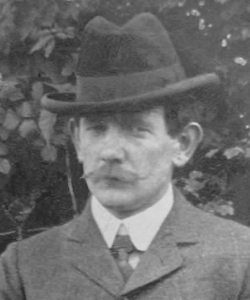
Major John McBride, Irish republican, is executed by firing squad in the Stonebreakers Yard at Kilmainham Gaol in Dublin on May 5, 1916, for his participation in the 1916 Easter Rising.

MacBride is born at The Quay, Westport, County Mayo, to Patrick MacBride, a shopkeeper and trader, and the former Honoria Gill. He is educated at the Christian Brothers School in Westport and at St. Malachy’s College in Belfast. He studies medicine but gives it up and begins working with a chemist’s firm in Dublin.

He joins the Irish Republican Brotherhood (IRB) and is associated with Michael Cusack in the early days of the Gaelic Athletic Association. He also joins the Celtic Literary Society through which he comes to know Arthur Griffith, who is to remain a friend and influence throughout his life. Beginning in 1893, MacBride is termed a “dangerous nationalist” by the British government. In 1896, he travels to the United States on behalf of the IRB. Upon his return he emigrates to South Africa.

In the Second Boer War MacBride is instrumental in the raising of the Irish Transvaal Brigade and leads it into action against the British. When organised resistance collapses, he and the surviving members cross the border into Mozambique. After the war he marries Maud Gonne and they have a son, Seán MacBride, who is also to make a name for himself in Irish Politics. The marriage, however, is not a success and they go their separate ways. MacBride keeps up his associations with Republican activists but does not become personally involved other than making the odd speech in support of Ireland’s Cause.

After returning permanently from Paris to Dublin in 1905, MacBride joins other Irish nationalists in preparing for an Insurrection. Because he is so well known to the British, the leaders think it wise to keep him outside their secret military group planning a Rising. As a result, he happens to find himself in the midst of the Rising without notice.

MacBride is in Dublin early on Easter Monday morning, April 24, to meet his brother, Dr. Anthony MacBride, who is arriving from Westport to be married two days later. As MacBride walks up Grafton Street, he sees Thomas MacDonagh in uniform and leading his troops. He offers his services and is appointed second-in-command at the Jacob’s Biscuit Factory, which is occupied and held through Easter Week until the order to surrender is received. As he is dressed in civilian clothes rather than a military uniform, he could likely have escaped without too much difficulty but rather he decides to go with his comrades into captivity.

Tried by court martial under the Defence of the Realm Act, MacBride is found guilty and sentenced to death. He is executed on May 5, 1916, two days before his forty-eighth birthday. Facing the British firing squad, MacBride refuses to be blindfolded saying, “I have looked down the muzzles of too many guns in the South African war to fear death and now please carry out your sentence.”

John MacBride is buried in the cemetery at Arbour Hill Prison in Dublin.

Leave a comment

Birth of Irish National Land League Founder Michael Davitt

michael-davitt

Michael Davitt, Irish republican and agrarian agitator, is born in Straide, County Mayo, on March 25, 1846. Davitt is the  founder of the Irish National Land League, which organizes resistance to absentee landlordism and seeks to relieve the poverty of the tenant farmers by securing fixity of tenure, fair rent, and free sale of the tenant’s interest.

Davitt is the son of an evicted tenant farmer. After their eviction, the family emigrates to England. In 1856, at the age of 10, he starts work in a cotton mill, where he loses an arm in a machinery accident a year later. In 1865, he joins the revolutionary Fenian Brotherhood, an international secret society that seeks to secure political freedom for Ireland. He becomes secretary of its Irish analogue, the Irish Republican Brotherhood (IRB), in 1868. Arrested  in Paddington Station in London for sending firearms to Ireland on May 14, 1870, he is sentenced to 15 years in Dartmoor Prison and there lays plans to link Charles Stewart Parnell’s constitutional reform with Fenian activism to achieve political-agrarian agitation.

Paroled from prison in 1877, Davitt rejoins the IRB and goes to the United States, where the Fenian movement originated. There he is deeply influenced by Henry George’s ideas about the relationship between land monopoly and poverty.

Back in Ireland, using funds raised by John Devoy and Clan na Gael in the United States, Davitt wins Parnell’s cooperation in organizing the Land League in 1879, which leads, however, to his expulsion from the supreme council of the IRB in 1880. He is elected member of Parliament for County Meath in 1882 but is disqualified as he is a convict. He is also imprisoned for seditious speeches in 1881 and 1883.

Because of his public championing of Henry George’s theories of land reform, Parnell repudiates him. Davitt actively defends the Nationalists before the Parnell Commission, which meets between 1887 and 1889. When the Irish party splits in 1890 over Parnell’s involvement in Capt. William Henry O’Shea’s divorce case, Davitt is among the first to oppose Parnell’s continuance as leader.

Davitt is elected to Parliament in 1892 and 1893 but is unseated in both cases. He is elected again, for South Mayo in 1895, but resigns in 1899 in protest against the Second Boer War.

Davitt dies in Elphis Hospital, Dublin on May 30, 1906, at the age of 60, from blood poisoning. The fact that the Lord Lieutenant of Ireland attends his funeral is a public indication of the dramatic political journey this former Fenian prisoner has taken. There is no plan for public funeral, and hence Davitt’s body is brought quietly to the Carmelite Friary, Clarendon Street, Dublin. However, the next day over 20,000 people file past his coffin. His remains are taken by train to Foxford, County Mayo, and buried in the grounds of Straide Abbey at Straide, near his place of birth.

Davitt’s book, The Fall of Feudalism in Ireland (1904), is a valuable record of his time.


Leave a comment

Birth of Edward J. Smith, Captain of the RMS Titanic

edward-john-smith

Edward John Smith, English naval reserve officer best known as the captain of the ill-fated RMS Titanic, is born on Well Street, Hanley, Staffordshire, England, on January 27, 1850.

Smith attends the Etruria British School until the age of 13, when he leaves school for a job at the Etruria Forge. In 1867, at the age of 17, he goes to Liverpool in the footsteps of his half-brother Joseph Hancock, a captain on a sailing ship. He begins his apprenticeship on Senator Weber, owned by A. Gibson & Co. of Liverpool.

Smith joins the White Star Line in March 1880 as Fourth Officer on the SS Celtic. He serves aboard the company’s liners to Australia and New York City, where he quickly rises in status. In 1887, shortly after his marriage to Sarah Eleanor Pennington, he receives his first White Star command on the SS Republic.

Beginning in 1895, Smith serves as captain of the SS Majestic for nine years. When the Second Boer War starts in 1899, Majestic is called upon to transport troops to Cape Colony. Smith makes two trips to South Africa, both without incident. From 1904 on, Smith commands the White Star Line’s newest ships on their maiden voyages, including RMS Baltic, RMS Adriatic, RMS Olympic, and RMS Titanic.

The RMS Titanic is built at the Harland & Wolff shipyard in Belfast. On April 10, 1912, Smith boards RMS Titanic at 7:00 AM to prepare for a noon departure. It’s final point of departure on the Atlantic crossing is Queenstown (now Cobh), County Cork, on April 11, 1912.

edward-john-smith-statue

The first four days of the voyage pass without incident, but shortly after 11:40 PM on April 14, Smith is informed by First Officer William McMaster Murdoch that the ship has just collided with an iceberg. It is soon apparent that the ship is seriously damaged with all of the first five watertight compartments having been breached. Smith, aware that there are not enough lifeboats for all of the passengers and crew, does everything in his power to prevent panic and assist in the evacuation. Just minutes before the ship sinks, Smith is still busy releasing Titanic‘s crew from their duties.

At 2:10 AM, Steward Edward Brown sees the captain approach with a megaphone in his hand. He is heard to say, “Well boys, do your best for the women and children, and look out for yourselves.” He then watches as Captain Smith walks onto the bridge alone. This is the last reliable sighting of Smith. Ten minutes later the ship disappears beneath the waves. His body is never recovered.

A statue, sculpted by Kathleen Scott, wife of Antarctic explorer Robert Falcon Scott, is unveiled in July 1914 at the western end of the Museum Gardens in Beacon Park, Lichfield. The pedestal is made from Cornish granite and the figure is bronze. Lichfield is chosen as the location for the monument because Smith was a Staffordshire man and Lichfield is the centre of the diocese.