seamus dubhghaill

Promoting Irish Culture and History from Little Rock, Arkansas, USA


Leave a comment

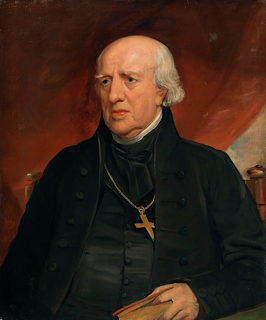
Birth of John Thomas Troy, Archbishop of Dublin

John Thomas Troy, an Irish Dominican friar who serves as Archbishop of Dublin from 1786 to 1823, is born at Annefield House, near Porterstown, County Dublin on May 10, 1739.

Troy receives his early education at Liffey Street, Dublin. At the age of sixteen he joins the Dominican Order and proceeds to their house of San Clemente at Rome. Historian Edward D’Alton notes that he is “amenable to discipline, diligent in his studies, and talented.” He makes rapid progress, and while still a student is appointed to give lectures in philosophy. Subsequently, he teaches theology and canon law, and finally becomes prior/rector of the convent in 1772.

When Thomas Burke, the Bishop of Ossory, dies in 1776, the priests of the diocese recommend one of their number, Father Molloy, to Rome for the vacant see, and the recommendation is endorsed by many of the Irish bishops. But Troy, who is held in high esteem at Rome, has already been appointed Bishop of Ossory. He is consecrated at Leuven in June 1777 by the nuncio to Flanders, Archbishop (later Cardinal) Ignazio Busca.

Troy arrives at Kilkenny in August 1777 and for the next nine years he Labour a hard for the spiritual interests of his diocese. Maddened by excessive rents and tithes, and harried by grinding tithe-proctors, farmers have banded themselves together in a secret society called the “Whiteboys,” so called from the white smocks the members wear in their nightly raids. They attack landlords, bailiffs, agents, and tithe-proctors, and often commit fearful outrages. Bishop Troy frequently and sternly denounces them, declaring any who join the secret society to be excommunicated. He has no sympathy with oppression, but he had lived long in Rome, and does not fully appreciate the extent of misery in which the poor Catholic masses live.

Troy is ready to condemn all violent efforts for reform, and has no hesitation in denouncing not only all secret societies in Ireland, but also “our American fellow-subjects, seduced by specious notions of liberty.” This makes him unpopular. He is zealous in correcting abuses in his diocese and in promoting education. So well is this recognized at Rome that in 1781, in consequence of some serious troubles which have arisen between the primate and his clergy, Troy is appointed Administrator of Armagh. He holds this office until 1782.

Upon the death of Archbishop John Carpenter of Dublin in 1786, Troy is appointed to succeed him. At Dublin, as at Ossory, he shows his zeal for religion, his sympathy with authority, and his distrust of popular movements, especially when violent means are employed. Though his circular, issued on March 15, 1792, disavowing the authority of any ecclesiastical power to absolve subjects from their allegiance, is believed to influence the concession in that year of the relaxations embodied in Langrishe’s Act, and the extension of the franchise to Roman Catholics in 1793, he declines to associate himself with John Keogh and other Catholic reformers in their demands for further relief.

In early 1798, the French Directory conquers Rome, and establishes the Roman Republic. Its ally in Ireland, the Society of United Irishmen, starts a rebellion in May 1798. Troy issues a sentence of excommunication against all those of his flock who decide to join the rebellion. In a pastoral read in all the churches, he speaks of the clerical organisers of the rebellion as “vile prevaricators and apostates from religion, loyalty, honour, and decorum, degrading their sacred character, and the most criminal and detestable of rebellious and seditious culprits.” Hus action at this time appears to endanger his life. But the influence he has acquired with the government enables him to moderate the repressive measures taken by the authorities. Believing that Catholic emancipation can never be conceded by the Irish parliament, he is one of the most determined supporters of the Union.

In 1799, Troy agrees to accept the veto of government on the appointment of bishops in Ireland, and even when the other bishops, feeling they have been tricked by Pitt and Castlereagh, repudiate the veto, he continues to favour it. However, in 1809, he recommends Daniel Murray be appointed his coadjutor. Murray is an uncompromising opponent of the veto, and while Troy’s coadjutor, makes trips in 1814 and 1815 to Rome concerning the controversy.

In April 1815, Archbishop Troy lays the foundation of St. Mary’s Pro-Cathedral in Marlborough Street, Dublin, but does not live to see it completed. He dies in Dublin on May 11, 1823, at the age of eighty-four. He dies very poor, leaving scarce sufficient to pay for his burial, and is interred in the unfinished St. Mary’s Pro-Cathedral.

In the administration of his diocese and in his private life, Troy is eminently zealous, pious, and charitable. Although his cordial relations with the government expose him to many suspicions and accusations, there is no ground for questioning the integrity of his motives and conduct, which are inspired by his views of the interest of his church. His distrust of revolutionary tendencies in civil affairs is fully aligned with the policy of the Vatican throughout his career. John D’Alton speaks of Troy as “a truly learned and zealous pastor, … a lover and promoter of the most pure Christian morality, vigilant in the discharge of his duty, and devotedly solicitous not only for the spiritual good of those consigned to his charge, but also for the public quiet of the state.”
Leave a comment

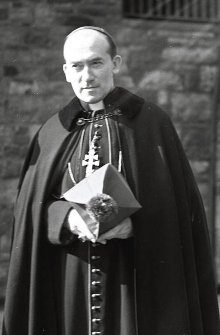
Death of John Charles McQuaid, Archbishop of Dublin

John Charles McQuaidC.S.Sp., the Catholic Primate of Ireland and Archbishop of Dublin between December 1940 and January 1972, dies in LoughlinstownCounty Dublin, on April 7, 1973. He is known for the unusual amount of influence he has over successive governments.

McQuaid is born on July 28, 1895, in CootehillCounty Cavan, the eldest son of Eugene McQuaid and Jennie Corry McQuaid. He comes from a medical family, with his father, paternal uncle, sister and half-brother all being doctors. He is educated at St. Patrick’s College, Cavan, followed by Blackrock College in Blackrock, Dublin, which is run by the Holy Ghost Fathers, and the Jesuit Clongowes Wood College. He enters the Holy Ghost novitiate at Kimmage, Dublin, in 1913 and is professed in 1914. He graduates from the University College Dublin (UCD) in 1917 with first-class honors in classics. He continues his postgraduate studies at UCD with a master’s degree and a teaching diploma and subsequently earns a doctorate in theology at the Pontifical Gregorian University in Rome.

Ordained in 1924, the theology in which McQuaid is trained is conservative — strongly neo-scholastic and hostile to modernism and liberalism. His hatred of the French Revolution is expressed in several pastorals and speeches throughout his career. He also regards Protestantism as a fundamental error from which Irish Catholics should be quarantined as much as possible.

Appointed Dean of Studies at Blackrock College, McQuaid becomes a prominent figure in Catholic education and chairs the Catholic Headmasters’ Association for several years. In 1931 he is appointed president of Blackrock College, in which capacity he becomes acquainted with Éamon de Valera, the future Irish Taoiseach whose sons attend the school. In 1936, while drafting a new Irish constitution, de Valera consults McQuaid, although he rejects McQuaid’s draft “One, True Church” clause which states, among other things, that the Catholic Church is the one true church in Ireland.

When McQuaid is appointed Archbishop of Dublin in 1940, the appointment of a priest from the regular clergy causes considerable surprise. Irish government archives reveal that de Valera, as is suspected at the time, presses McQuaid’s claims at the Vatican. However, it is doubtful whether the Vatican needs much persuasion. There is a dearth of potential episcopal talent and McQuaid has an outstanding reputation as a Catholic educationalist.

Once appointed, McQuaid proves to be one of the ablest administrators in the history of the Irish Church. In the first two years of his episcopate, he sets up the Catholic Social Service Conference to alleviate the poverty and distress in Dublin which is aggravated by the war, and the Catholic Social Welfare Bureau to help the thousands of Irish emigrants going to Britain for war work. These two organizations fill a much-needed gap and continue to exist after the war. The expansion of Dublin city and its suburbs during his episcopate requires the building of new churches, schools, and hospitals. Meeting these demands also necessitates a considerable increase in the number of clergies, secular and regular, whose numbers more than double in the period from 1941 to 1972.

Given his previous career, the importance McQuaid assigns to education is not surprising. He is critical of the low priority accorded to education by successive governments and is particularly critical of the poor and pay conditions of teachers. His intervention in the primary teachers’ strike in 1946 is poorly received by the government and marks the souring of his relationship with de Valera. During his episcopate the number of primary schools increases by a third while the number of secondary schools more than double but, as with social welfare, the government increasingly assumes a dominant role in education from the 1960s onwards. Almost immediately after his appointment in 1940, he takes a hardline stand against the attendance of Catholic students at Trinity College Dublin (TCD). The ban lasts until 1970, when the increase in student numbers renders it untenable and he accedes reluctantly.

McQuaid has a formidable list of achievements in health care, especially maternity and pediatric services, physical and mental handicap services, and the treatment of alcoholism. It is ironic, therefore, that the most controversial episode of his career occurs in this area — the Irish hierarchy’s rejection in 1951 of a free mother-and-child health service. This leads to the resignation of the Minister for Health, Dr. Noël Browne, and is a watershed in Church-State relations in Ireland. With Irish tuberculosis and infant mortality statistics ranking among the highest in the world, the hierarchy, and particularly McQuaid, lose considerable support by lining up with the conservative medical establishment to resist efforts at socialized medicine.

From various pastorals that McQuaid issues at the time, it is clear that he does not see the need for the Second Vatican Council. As its deliberations proceed, his unease grows, and he becomes increasingly preoccupied with the issue of episcopal power and independence that he believes are being threatened by the Council. In the areas of liturgical reform, greater lay participation, and ecumenism, he is slow in implementing the Vatican II reforms. His views on ecumenism had always been lukewarm and had led to allegations that he was anti-Protestant. His personality and policies are criticized by a more assertive Dublin laity, but being a shy, reserved man who increasingly feels the isolation of office, he never responds to such comments. In 1968 the reaction to Humanae vitae causes open rebellion in the Dublin diocese, the force of which catches him unaware. His last pastoral as archbishop in 1971 betrays his anger and bemusement at the response to Humanae vitae in Dublin.

At the age of 75, McQuaid submits his resignation to the Vatican, and it is accepted. His resignation is announced in January 1972, when he is replaced by Dermot Ryan. McQuaid dies in Loughlinstown, County Dublin, the following year on April 7, 1973. He is buried in St. Mary’s Pro-Cathedral in Dublin, the seat of the Roman Catholic Archdiocese of Dublin.

McQuaid’s substantial archives are released by the Dublin Diocesan Archives in the late 1990s. In 1999 journalist John Cooney publishes a hostile biography of McQuaid, which makes controversial allegations of sexual abuse against McQuaid. The allegations are based on tenuous evidence gathered by McQuaid’s nemesis from the 1951 Mother and Child controversy, Dr. Noël Browne, who had died in 1997. No corroborating evidence is produced or has since emerged.


Leave a comment

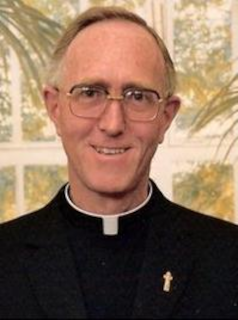
Birth of Dermot Ryan, Roman Catholic Archbishop of Dublin

Dermot Joseph Ryan, the Roman Catholic Archbishop of Dublin from 1972 until 1984, is born on June 26, 1924, in ClondalkinDublin.

Ryan is born to Andrew Ryan, a medical doctor, and Therese (née McKenna). In 1932, he goes to Belvedere College, Dublin. In 1942 he enters Holy Cross CollegeDrumcondra, and graduates with a first in Hebrew and Aramaic at University College Dublin in 1945. He spends a year at St. Patrick’s College, Maynooth before attending the Pontifical Irish College in Rome gaining his BD in 1948 at the Pontifical Lateran University, Rome. He returns to Clonliffe to complete his formation, and where he is ordained a priest on May 28, 1950. He returns to Rome to study at the Pontifical Gregorian University, gaining a Licentiate in Sacred Theology in 1952. In 1954 he is awarded an MA in Semitic Languages from the National University of Ireland (NUI), followed by a licentiate in sacred scripture at the Pontifical Biblical Institute.

Ryan is Professor of Oriental Languages at University College Dublin before his appointment by Pope Paul VI as Archbishop of Dublin and Primate of Ireland on December 29, 1971. Maintaining his connection and interest in oriental studies, he serves as chairman of the trustees of the Chester Beatty Library from 1978 to 1984.

Ryan is ordained a bishop by Pope Paul VI in Rome, assisted by Cardinals Bernardus Johannes Alfrink and William Conway (Archbishop of Armagh and Primate of All Ireland), on February 13, 1972. At the time of his appointment, he is seen as a liberal and a reformer in the Church.

During his term, Ryan consolidates much of the expansion of the archdiocese which had taken place during the term of his predecessor. He also oversees the fuller implementation of the reforms of Vatican II. He is particularly interested in liturgical reform.

Seen as a Liberal, following the episcopacy of John Charles McQuaid, in November 1972, Ryan becomes the first Roman Catholic archbishop to attend a Church of Ireland service in Christ Church Cathedral, Dublin, and holds an interdenominational service in St. Mary’s Pro-Cathedral. He also supports “Ballymascanlon talks,” an inter-church initiative to try to bring communities together and bring peace to Northern Ireland.

Ryan also takes a traditional stand on social issues, including poverty, family life and opposition to abortion. He strongly promotes the Eighth Amendment of the Constitution of Ireland in 1983, granting the equal right to life to mother and unborn.

As Archbishop, Ryan gives the people of Dublin a public park on a site earmarked by his predecessors for a proposed cathedral. It is named “Archbishop Ryan Park” in his honour. The land, at Merrion Square, is a gift from the archbishop to the city of Dublin.

Ryan dies at the age of 60 in Rome on February 21, 1985, following a heart attack. He is buried in St. Mary’s Pro-Cathedral.