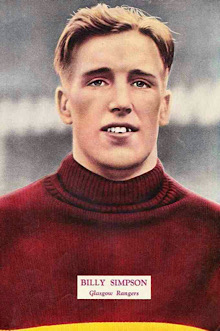
Simpson signs for Rangers from Linfield for a sum of £11,500 in 1950. He spends nine years (1950–59) at Rangers making 239 appearances and scoring 163 goals. He wins three championship medals and a Scottish Cup winners medal with Rangers to add to the two Northern Ireland Football League and two Irish Cups he wins with Linfield. He leaves Ibrox Stadium in 1959 and spends the last couple of years of his career with Stirling Albion, Partick Thistle and (then non-league) Oxford United.
As an illustration of his popularity, in the fictional song “A Trip to Ibrox,” Simpson is credited with scoring twice in a “Ne’erday” Old Firm Derby at Ibrox. Whereby Rangers are 1-0 down at halftime, and Simpson inspires his team to a second half comeback after Willie Waddell has scored an equaliser.
In recognition of his service to that club, Simpson is made a member of the Rangers F.C. Hall of Fame.
Simpson makes his debut for Northern Ireland in 1951 against Wales, scoring in the process. He represents his country twelve times in total between 1951 and 1958, scoring five goals. He is selected in Northern Ireland’s squad for the 1958 FIFA World Cup in Sweden but a late injury ensures he does not play at all during the finals.
In April 2015, the feature-length documentarySpirit of ’58 is screened as part of the Belfast Film Festival. It features Simpson prominently alongside the other surviving players (Billy Bingham, Peter McParland, Jimmy McIlroy and Harry Gregg) as it tells the story of Northern Ireland’s journey throughout the 1950s under the managership of Peter Doherty, culminating in the 1958 World Cup.
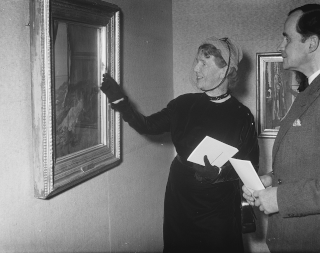
Josephine McNeill, Irish diplomat, dies in Dublin on November 19, 1969. She is the first Irish female diplomat appointed to represent Ireland abroad in a ministerial capacity.
McNeill is born Josephine Ahearne on March 31, 1895, in Fermoy, County Cork, the daughter of shopkeeper and hotelier, James Ahearne, and his wife Ellen Ahearne (née O’Brien). She attends the Loretto Convent, Fermoy, and goes on to graduate from University College Dublin (UCD) with a BA, H.Dip.Ed. in French and German. With this she begins a teaching career, at St. Louis’ Convent, Kiltimagh, at the Ursuline Convent, Thurles, and at Scoil Íde. Scoil Íde, the female counterpart to St. Enda’s School, had been established by her friend, Louise Gavan Duffy. She is fluent in the Irish language and takes an active part in the cultural elements of the Irish independence movement, such as literature and music. She is a member of Cumann na mBan, serving as a member of the executive committee in 1921.
After the death of her husband in 1938, McNeill becomes the honorary secretary of the council of the Friends of the National Collections, as well as serving as chair of the executive committee of the Irish Countrywomen’s Association until 1950. As a member of the Department of External Affairs advisory committee on cultural relations, she writes on economic, social and cultural issues. She represents Ireland at the UNESCO general assembly in Paris in 1949.
McNeill is an active member of Clann na Poblachta from its foundation in 1946. She is appointed the minister to the Netherlands in 1950 by Seán MacBride, making her the first Irish female diplomat to represent the Republic of Ireland abroad in a ministerial capacity. This appointment is not well received by diplomats in the Department of External Affairs. Her reports from The Hague focus on the issues the Netherlands faces with decolonisation. In 1955, she becomes the minister to Sweden, going on to hold the joint appointment to Austria and Switzerland from 1956 to 1960, after which she retires. While serving in Switzerland she puts aside the resentment she feels towards Éamon de Valera based on how he had treated her husband, to sit with him during a convalescence while de Valera recovers from an eye operation.
McNeill is an amateur pianist and collects paintings and porcelains. In 1933, she publishes the Irish language book, Finnsgéalta ó India.
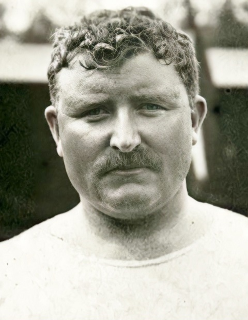
McDonald was born Patrick Joseph McDonnell in Killard, County Clare, on July 29, 1878. When his sister lands at Ellis Island after her sea voyage from Ireland, immigration officials pin a name tag on her with her name spelled “McDonald.” Taking no chances of being deported, she and all the McDonnells who come after her, accept the name McDonald.
McDonald competes for the United States in the 1912 Summer Olympics held in Stockholm, Sweden, in the shot put where he once again defeats Rose and wins the gold medal. He also takes part in the shot put competition where the distance thrown with each hand is added together. This is the only time this event is held in the Olympic program, and he finishes second behind Rose.
McDonald continues to be a nationally competitive athlete well into his 50s. At the age of 54, he beats his old rival Matt McGrath to win the weight throw for distance at the 1933 USA Outdoor Track and Field Championships. It is his 26th senior national championship meet, and the Omaha World-Herald notes that he has gray hair at the time of his last victory.
Joyce is the eldest of three sons of Michael Joyce, an Irish Catholic from a family of tenant farmers in Ballinrobe, County Mayo, and his wife, Gertrude (née Brooke), who although born in Shaw and Crompton, Lancashire, is from a well-off AnglicanAnglo-Irish family of physicians associated with County Roscommon. The Joyces return to Ireland in 1909. William, a precocious child, attends Coláiste Iognáid SJ, a Jesuit school in County Galway, from 1915 to 1921. At the age of fourteen, he abandons Catholicism for Anglicanism, apparently after being told that all non-Catholics, including his mother, would be damned. In adult life he is nominally anglican, though his adherence to Christianity is tenuous.
The Joyces are unionists and teach their children fervent imperialism. During the Irish War of Independence, Joyce openly associates with the Black and Tans and acts as a scout for them. An acquaintance claims that his views are so extreme even loyalists dislike him. On December 9, 1921, he flees to England to join the Worcestershire Regiment and is followed to England in 1923 by the rest of the family. When he enlists, he claims to be eighteen, but after he contracts rheumatic fever, his age is discovered, and he is discharged in March 1922. For a time, he studies mathematics and chemistry at Battersea Polytechnic Institute as a pre-medical student (1922–23), but he leaves of his own accord, with a reputation for laziness and violent political views. His studies in English and history at Birkbeck College are more successful. He is a brilliant linguist and mathematician and graduates BA with first-class honours in 1927. He publishes an academic article on philology and considers progressing to an MA. He later falsely claims that his research had been plagiarised by a Jewish academic. In 1932, he enrolls at King’s College, London, for a Ph.D. in educational psychology.
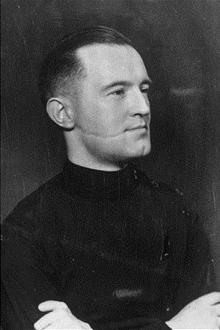
Joyce is disturbed by the difference between depressed post-war Britain and the imperial ideal that he had imbibed in Galway and is mocked for his outspoken patriotism and obvious Irishness. He identifies strongly with Thomas Carlyle, an earlier angry anti-liberal from the provinces. His life is marked by repeated episodes of hero worship, followed by disillusion and bitter denunciation. In 1923, he joins the British Fascists, an organisation that has a significant Irish loyalist membership, and in 1924 he allies himself with a militant splinter group, the National Fascists. Most British fascists see themselves as Tory auxiliaries, and they often provide a security presence at conservative meetings. On October 22, 1924, while stewarding a meeting addressed by a Jewish conservative candidate, he has his face slashed and is left with a prominent scar across his right cheek. He joins the Conservative Party in 1928 and is active in the Chelsea constituency until 1930, when he is forced out because of his eccentricities and sexual misbehaviour. On April 30, 1927, he marries Hazel Kathleen Barr. They have two daughters but separate in 1935, largely because of his infidelities, heavy drinking, and temper. The marriage is dissolved in 1937.
In November 1933, Joyce abandons his Ph.D. studies to work for Sir Oswald Mosley‘s British Union of Fascists (BUF). By early 1934 he has become its paid publicity director, traveling throughout Britain to organise meetings. He is a powerful, rabble-rousing speaker, driven by an instinctive awareness that vitriolic verbal abuse gives speaker and audience a sense of power and solidarity. MI5 sees him as a compelling, though deranged, personality. On February 8, 1937, he marries Margaret Cairns White, a BUF activist from Lancashire, with whom he had cohabited since 1936.
Joyce leads a BUF faction that favours a recruitment strategy based on uncompromising ideological assertion. This is challenged by populists who prioritise marches and displays and hold that indoctrination should follow membership. In February 1937, he is BUF candidate for the London County Council in Shoreditch. The party wins 14 percent of the vote. In March 1937, he, along with many full-time BUF staff, are sacked when the BUF cuts expenses. But his dismissal also reflects Mosley’s awareness that his obsessive rhetoric repels “respectable” recruits and that he is no longer a biddable, slavish admirer of “the Leader.” He later falsely claims near-exclusive credit for the BUF’s escalating antisemitism, a view that Mosley eventually finds it convenient to adopt in order to evade his own responsibility.
In April 1937, Joyce founds the National Socialist League, helped by a wealthy patron. He supports himself as a private tutor, refusing to take Jewish pupils. He is active in various antisemitic and pro-Nazi groups such as the Right Club and engages in “peace” campaigns based on the view that British interests lay with Germany against Russia. Political marginalisation intensifies his admiration for Nazi Germany and hero worship of Adolf Hitler. By the time of the Munich crisis in 1938, he has decided that if war comes, he will go to Germany, though he also considers moving to Ireland. He renews his British passport for one-year terms in August 1938 and August 1939.
On August 26, 1939, Joyce and his wife leave London for Berlin. He is allegedly tipped off about his impending arrest and internment by an MI5 officer, to whom he had supplied information on communists. His siblings, whom he recruited into his fascist organisations, are variously penalised for his activities. At a loose end in Berlin, he is persuaded by a British associate to become a radio announcer with the English-language service of the Reichs-Rundfunk-Gesellschaft (RRG). He makes his first broadcast on September 6, 1939, and receives a contract in October. He finds in radio an outlet for his forceful style and delight in saying the unsayable, and in the early years of the war takes an exultant pride in recounting Nazi victories. His performances are admired by Joseph Goebbels, whom Joyce, to his regret, never meets. On September 26, 1940, he acquires German citizenship.
The novel experience of hearing the enemy in one’s own living room attracts wide audiences in Britain. Joyce’s practice of naming newly captured prisoners of war in his broadcasts is also a compelling motive for listening. In fact, he tries to recruit British prisoners of war as collaborators. The name “Lord Haw-Haw,” invented by the Daily Express radio critic in September 1939, initially applies to several English-language broadcasters but in time becomes associated with Joyce. He is initially a figure of fun, imitated by comedians, but there are sinister undercurrents of terrifying omnipotence, intensified by his sneering, gloating delivery and his delighted deployment of the “big lie” technique. It is widely believed that British-based fifth columnists supply him with information, that he predicts air raids, and shows minute local knowledge. In time, fear and his growing notoriety feed popular hatred of him in Britain, though his anti-British taunts allegedly win appreciative Irish audiences. He exults that he is daily committing treason and rendering himself liable to the death penalty.
In 1940, Joyce publishes a commissioned self-justifying propaganda work, Twilight over England. His representation of himself echoes that of Hitler in Mein Kampf – the provincial patriot, whose martial sacrifices are betrayed by corrupt elites, learning through poverty the hollowness of bourgeois patriotism and the need to synthesise socialism with nationalism. He shares with his hero a paranoid belief in his own ability to create an alternative reality through language and obstinacy. He dreams of becoming the English Führer.
In Berlin, the Joyces’ marriage comes under increasing strain, marked by drunken rows, domestic violence, and infidelity on both sides, though they retain a fierce mutual fascination. They divorce on August 12, 1941, but remarry on February 11, 1942, while continuing their previous behaviour. As the Axis powers begin to fail, his broadcasts become more defensive, focusing on the Soviet threat. On October 14, 1944, he is awarded the German War Merit Cross, first class. On October 22, he is sworn into the Volkssturm (territorial army) and begins drilling. The Joyces are evacuated from Berlin in March 1945, initially to Apen near the Dutch border and then to Hamburg, where he makes a last, drunken, defiant broadcast on April 30, 1945, the day of Hitler’s death. After an unsuccessful attempt to escape to Sweden, the Joyces hide at Flensburg near the Danish border. On May 28, 1945, he is shot and captured while gathering firewood.
Joyce is brought back to Britain on June 16 after Parliament passed legislation simplifying treason trial procedures. At his September 17-20 trial, he proves his American citizenship, but the court holds that his illegally acquired British passport incurred duties of allegiance. His appeals are rejected by the Court of Appeal and the House of Lords. His fate is influenced by British public opinion, and possibly by a desire to avoid antagonising the Soviet Union. In his death cell he blames the defeat of national socialism on German limitations. He also fantasises that he could have saved Hitler from his incompetent subordinates.
Joyce is hanged by Albert Pierrepoint at Wandsworth Prison on January 3, 1946. Unlike most of his fellow Nazis, he proclaims to the end his allegiance to national socialism and hatred of Jews. He corresponds cheerfully with Margaret, joking evasively about the death camps and expressing a belief that his spirit will survive, watch over her, and continue his work. To neo-Nazis he becomes a martyr. Even among those to whom his activities had been repellent, a significant body of opinion holds he should not have been condemned on a questionable and innovative technicality. The historian A. J. P. Taylor maintains that Joyce was executed for making a false declaration to obtain a passport, a misdemeanour that normally incurs a £2 fine.
In 1976, Joyce is reinterred in Galway as it is feared that a grave in England might become a fascist shrine. Thomas Kilroy‘s play Double Cross (1986) juxtaposes Joyce and Brendan Bracken as Irishmen who reinvented themselves through fantasies of Britishness. The BBC Sound Archive has recordings of some of Joyce’s broadcasts and transcripts of others, collected during the war as evidence for a future treason trial.
(From: “Joyce, William Brooke (‘Lord Haw-Haw’)” by Patrick Maume, Dictionary of Irish Biography, http://www.dib.ie, October 2009)
Linda Martin, Northern Irish singer and television presenter, is born in Belfast, Northern Ireland on March 27, 1952. She is best known as the winner of the 1992 Eurovision Song Contest during which she represents Ireland with the song “Why Me?,” the first of a record three consecutive wins by Ireland. She is also known within Ireland as a member of the band Chips.
Martin is of Irish, Scottish and Italian ancestry. Her father’s family’s surname is originally Martini. Her paternal great-grandfather, Francis Martini, is born in Dublin to immigrants from Saronno, north of Milan, Italy. Two of her maternal great-grandparents, William Green and Elizabeth Nangle, have a coal-mining background and transferred to Belfast from Larkhall, Scotland.
Martin begins her musical career when she joins the band Chips in Omagh in 1969. They quickly become one of the top bands in Ireland on the live circuit, and release hit singles “Love Matters,” “Twice a Week” and “Goodbye Goodbye” during the mid-to-late 1970s. In 1972, she leaves Chips to be a vocalist with the new group Lyttle People but rejoins her former bandmates the following year.
The group appears on Opportunity Knocks in 1974 and appears a number of times on British television promoting their singles, but never scores a UK hit. With multiple entries to the Irish National finals of the Eurovision Song Contest, the band carries on into the 1980s. They score a final Irish hit in 1982 with “David’s Song (Who’ll Come With Me),” after which Martin leaves when she wins the Castlebar Song Contest with “Edge of the Universe” in 1983. From this point, she concentrates on a solo career as well as occasional live appearances with Chips until they recruit a new lead singer, Valerie Roe, in the late 1980s.
Martin participates in the National Song Contest four times as a member of Chips; however, they do not score successfully. She participates another four times in the contest as a soloist and once more as part of the group “Linda Martin and Friends.” With nine participations, she has been the most frequent entrant in the National Song Contest’s history. She wins the contest twice, going on to represent Ireland twice at the Eurovision Song Contest.
The first of these victories is in 1984 with the song “Terminal 3,” written by Johnny Logan. The song comes in second in the final, being beaten by eight points. “Terminal 3” reaches No. 7 in the Irish charts. The second victory is in 1992 when her song “Why Me?,” also written by Logan, goes on to win the final in Sweden. This becomes Ireland’s fourth victory in the Eurovision Song Contest, and the song reaches No. 1 in the Irish chart as well as becoming a hit in many European countries.
Martin is, at the time, one of only three artists to finish both first and second at Eurovision, behind Lys Assia and Gigliola Cinquetti. Since then, only Elisabeth Andreassen and Dima Bilan have achieved this, raising the number to five.
Martin is one of the hosts on the RTÉquiz showThe Lyrics Board and also serves as one of Louis Walsh‘s behind-the-scenes team on the first series of ITV‘s The X Factor. She also serves as a judge on the first, second and fourth seasons of RTÉ’s You’re a Star and on Charity You’re a Star in 2005 and 2006. While she is dismissed from later seasons, speaking on Saturday Night with Miriam on RTÉ television on July 28, 2007, she says that she is “open” to being invited back to the show. She does not rule out a return to Eurovision following Ireland’s dismal performance in the 2007 contest, finishing last with only five points.
During the interval of Eurovision 2013, the host Petra Mede presents a light-hearted history of the contest, during which she explains to viewers that Johnny Logan had won the competition three times, in 1980, 1987 and 1992. Appearing alongside Linda Martin in some vintage footage she jokes that he had won the third time disguised as a woman, saying, “I recognise a drag queen when I see one.” The joke proves controversial, particularly in the Irish media. However, on June 1, 2013, during an appearance on RTÉ’s The Saturday Night Show Martin says that she has actually benefited from all the publicity. On the same show she performs a cover of the song “Get Lucky” by Daft Punk.
Martin also appears in pantomime, in Dublin. She stars in Cinderella as the Wicked Stepmother, Snow White as the Evil Queen and Robin Hood as herself, at the Olympia Theatre. She tours Menopause The Musical with Irish entertainer Twink. While on tour, Twink describes Martin as a “cunt” during a tirade in May 2010. The two had been friends for 30 years but both say afterwards that they have no plans to speak to each other again.
Quinlan goes to school in nearby Loher. He and his wife Carmel have a son, Leo, who is sixteen when his father serves in the Congo, and later becomes a commandant, the same rank his father held when in Katanga, although the father retires with the higher rank of colonel.
“A” Company, 35th Battalion (UN service) of the Irish Army United Nations Operation in the Congo (ONUC) contingent, commanded by Quinlan, is attacked by Katangese Gendarmerie troops loyal to President Moïse Tshombe and the State of Katanga. Quinlan’s lightly armed company is besieged in Jadotville, and resists Katangese assaults for six days. A relief force of Irish, Indian and Swedish troops is unsuccessful in their attempts to reach Quinlan’s position.
Quinlan’s company suffers five wounded in action during the six-day siege. On the other hand, up to 300 Katangese troops are killed, including thirty mercenaries, and an indeterminate number are wounded, with figures ranging from 300 to 1,000. Quinlan, however, has no access to resupply and reinforcements and, with his transport destroyed by Katanga’s Fouga Magister jet, a breakout is virtually impossible. In the end, with his position untenable, without any clear orders or promise of assistance, having run out of ammunition and food and low on water, he accepts a second offer to surrender to the Katangese.
Although suffering no loss of life, Quinlan’s company are held as prisoners of war and hostages for approximately one month. The Katangese barter the Irish soldiers for prisoners in the custody of the Congolese government. After being released, “A” Company are returned to their base in Elisabethville (now Lubumbashi). Some weeks later, Quinlan finds himself involved in active combat again, this time with his company in support of Swedish UN troops. Eventually they are reinforced with fresh troops from Ireland. After weeks of fighting and their six-month tour of duty now complete, “A” Company is rotated home to Ireland that December.
In its immediate aftermath, the Irish state does not give much recognition to the Battle of Jadotville, and no Irish soldier receives any decoration for actions at Jadotville. This may have been because of a perceived shame that “A” Company had surrendered and an unwillingness to highlight political or strategic errors at higher levels by the UN mission. Quinlan, however, recommends a number of his men for the Military Medal for Gallantry (MMG), Ireland’s highest award for military valour, for their actions during the battle.
Quinlan never serves overseas again and retires as a full colonel after forty years with the Irish Army.
Quinlan dies on August 27, 1997, unaware that his reputation will be restored nine years after his death. His wife does not live to see his official rehabilitation either, dying two years after her husband.
The veterans of Jadotville are dissatisfied with the Irish Defence Forces‘ refusal to acknowledge the battle and the implied black mark on the reputation of their commander. Following a long campaign for recognition, in 2004 the then Minister for Defence, Willie O’Dea, agrees to hold a review of the battle. An inquiry by the Defence Forces clears Quinlan and “A” Company of allegations of soldierly misconduct. A commemorative stone recognising the soldiers of “A” Company is erected on the grounds of Custume Barracks in Athlone in 2005. A commissioned portrait of Quinlan is installed in the Congo Room of the Irish Defence Forces’ UN School.
In 2016, the Irish government awards a Presidential Unit Citation to “A” Company, the first in the State’s history. In October 2017, a plaque commemorating Quinlan is unveiled by former TaoiseachEnda Kenny at Coomakista Pass, County Kerry.
In November 2020, an Independent Review Group commissioned by Irish Defence Minister Simon Coveney recommends that Quinlan receive the Distinguished Service Medal (DSM).
Quinlan’s tactics at Jadotville influence subsequent training programmes, and are, according to RTÉ, “cited in military textbooks worldwide as the best example of the use of the so-called perimeter defence.”
Quinlan is played by Jamie Dornan in the film The Siege of Jadotville (2016), which is adapted from Declan Power‘s book, The Siege at Jadotville: The Irish Army’s Forgotten Battle (2005). His wife Carmel is played by Fiona Glascott. Colonel Quinlan’s son, Commandant Leo Quinlan, says that Dornan bears an uncanny resemblance to his father, and gets everything about him right except his County Kerry accent, which is so strong that “if he had done my father’s accent, you’d need subtitles.” Quinlan’s grandson Conor is a member of the film’s cast.
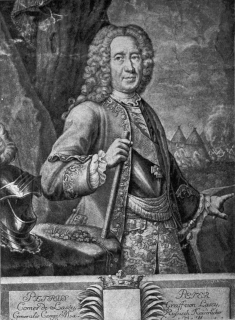
Peter Lacy, Irish-born soldier who later serves in the Imperial Russian Army, is born Pierce Edmond de Lacy into a noble Irish family on September 26, 1678, in Killeedy near Limerick, County Limerick. Considered one of the most successful Russian Imperial commanders before Pyotr Rumyantsev and Alexander Suvorov, in a military career that spans half a century, he claims to have participated in 31 campaigns, 18 battles, and 18 sieges.
Lacy’s first taste of land battle in Russia is the disastrous defeat at Narva, in which he commands a unit of musketeers, holding the rank of poruchik. During the Great Northern War he is seriously wounded on two occasions, also gaining the rank of colonel in 1706. In the same year, Peter the Great gives him command of the Polotskii regiment and three new regiments raising him to colonel status. The following year he leads his brigade at Poltava and in the ensuing battle he greatly distinguishes himself. In the 1708 battle of Rumna, he attacks and captures the headquarters of Charles XII of Sweden. He gains fame at this stage by advising the Czar that musketeers should wait until they were within a few yards of the enemy before opening fire. Prior to this, the Russians were known for uncoordinated fire. From this point begins his fame as a soldier. His next active service, still under Prince Anikita Repnin, is the siege of Riga. He is reputedly the first Russian officer to enter the capital of Livland and he is appointed the first Russian chatelain of Riga Castle in the aftermath.
In 1719, Major General Fyodor Apraksin‘s fleet lands Lacy with 5,000 infantry and 370 cavalry near Umeå in Sweden, where they proceed to devastate a dozen iron foundries and a number of mills. Two years later he leads a similar action against Sundsvall. Soon promoted to General, he enters the Military Collegium, as the Russian Ministry of Defense was then known, in 1723. Three years later, he succeeds Repnin in command of the Russian forces quartered in Livland, and in 1729 he is appointed Governor of Riga. These positions bring him in contact with the Duchess of Courland, who before long ascends the Russian throne as Empress Anna. During her reign, Lacy’s capacity for supreme command is never doubted.
Lacy is one of the first recipients of the Order of Saint Alexander Nevsky when it is established, furthermore, he is given command of all infantries in Saint Petersburg, Ingria and Novgorod. By 1728 he is ranked third of only six full generals in the Russian Army and the only foreigner. As a foreigner, his salary is 3,600 Roubles a year, 15% higher than Russian generals. Higher salaries for foreign-born generals are seen in other ranks too. His signature, even on documents in Cyrillic script, always appear in English and Latin script which suggests he never gains proficiency in the Russian language.
Having saved her from marriage to Saxe, Anna is very familiar with Lacy, and he becomes one of her most trusted generals. The War of the Polish Succession again calls him into the field. In 1733, he and Burkhard Christoph von Münnich expel the Polish king, Stanisław I, from Warsaw to Danzig, which is besieged by them in 1734. Thereupon the Irishman is commanded to march toward the Rhine and join his 13,500-strong contingent with the forces of Eugene of Savoy. To that end, his corps advances into Germany and, meeting the Austrians on August 16, returns to winter quarters in Moravia with exemplary discipline. In 1734, he commands Russian forces at the Siege of Danzig in which French and Polish forces are defeated. Lacy leads the Russians in two other decisive battles of the conflict, Wisiczin and Busawitza. In the latter battle, he is outnumbered ten to one but nevertheless prevails. For this victory, he is awarded Order of the White Eagle. After Busawitza Lacy is ordered to reinforce the Austrians at Mannheim. however, when he reaches Mannheim peace has been declared. He is received by Emperor Charles and Viennese society. On his return from Vienna, he is met by a courier from Saint Petersburg who delivers to him his patent honouring him as Field Marshal.
With the patent of Field Marshal is the news that Russia is at war with Turkey and Lacy is ordered at once to capture Azov Fortress. This he does despite being wounded in the fray. His rival, Burkhard Christoph von Münnich, had been campaigning in the Crimea with little success. Thus, after taking Azov, Lacy is ordered to capture Crimea. He bridges the Sea of Azov at a narrow point near Perekop. Within four days, aided by favourable winds and tides, his entire army crosses it and begins marching on Arabat. The Russians meet the Khan’s much larger Crimean army and rout them in two battles, on June 12 and 14. In 1738, his corps again land in Crimea and take the fortress of Chufut-Kale near the Khan’s capital, Bakhchisaray. For his success in Poland and Crimea he is awarded the Order of St. Andrew.
As soon as peace has been restored, Lacy is reinstated as the Governor of Livland, while Emperor Charles VI confers on him the title of an imperial count. His indifference to politics prevents his downfall following Anna’s death, when other foreign commanders, most notably von Münnich, fall into disgrace and are expelled from active service.
In December 1741, Elizabeth seizes power. Lacy is roused from bed in the early hours of the morning in a test of his loyalty. He is not aware if the men sent to him are from Elizabeth or Grand Duchess Anna. He is asked what party he is of, Anne or Elizabeth, and he answers, “Of the party of the reigning Empress.” A period of unrest follows, and he is called upon to restore order. Most of what is known as the German Faction falls out of favour at this stage. The restoration of order in Saint Petersburg is largely down to the prompt actions of Lacy.
When the Russo-Swedish War breaks out in 1741, the government of Anna Leopoldovna appoints Lacy Commander-in-Chief as the most experienced among Russian generals. He quickly strikes against Finland and wins his last brilliant victory at Lappeenranta in August 1741. His force, however, is poorly supplied and he is forced to withdraw to Saint Petersburg. The following year he rallies his forces and proceeds to capture Hamina, Porvoo and Hämeenlinna, by August encircling more than 17,000 Swedes near Helsinki and effectively bringing the hostilities to an end.
The war over, Lacy withdraws to Riga and resumes the command of the Russian forces stationed in Livland. He administers what is now northern Latvia and southern Estonia until his death on his private estate in Riga on April 30, 1751. His son, Franz Moritz von Lacy, enters the Austrian service in 1743 and becomes one of the most successful imperial commanders of the 18th century and also a Count of the Holy Roman Empire. His nephew, George Browne, is also a general in the Russian army.
Josephine McNeill, Irish diplomat, is born on March 31, 1895, in Fermoy, County Cork. She is the first Irish female diplomat appointed to represent Ireland abroad in a ministerial capacity.
McNeill is born Josephine Ahearne, the daughter of shopkeeper and hotelier, James Ahearne, and his wife Ellen Ahearne (née O’Brien). She attends the Loretto Convent, Fermoy, and goes on to graduate from University College Dublin (UCD) with a BA, H.Dip.Ed. in French and German. With this she begins a teaching career, at St. Louis’ Convent, Kiltimagh, at the Ursuline Convent, Thurles, and at Scoil Íde. Scoil Íde, the female counterpart to St. Enda’s School, had been established by her friend, Louise Gavan Duffy. She is fluent in the Irish language and takes an active part in the cultural elements of the Irish independence movement, such as literature and music. She is a member of Cumann na mBan, serving as a member of the executive committee in 1921.
After the death of her husband in 1938, McNeill becomes the honorary secretary of the council of the Friends of the National Collections, as well as serving as chair of the executive committee of the Irish Countrywomen’s Association until 1950. As a member of the Department of External Affairs advisory committee on cultural relations, she writes on economic, social and cultural issues. She represents Ireland at the UNESCO general assembly in Paris in 1949.
McNeill is an active member of Clann na Poblachta from its foundation in 1946. She is appointed the minister to the Netherlands in 1950 by Seán MacBride, making her the first Irish female diplomat to represent the Republic of Ireland abroad in a ministerial capacity. This appointment is not well received by diplomats in the Department of External Affairs. Her reports from The Hague focus on the issues the Netherlands faces with decolonisation. In 1955, she becomes the minister to Sweden, going on to hold the joint appointment to Austria and Switzerland from 1956 to 1960, after which she retires. While serving in Switzerland she puts aside the resentment she feels towards Éamon de Valera based on how he had treated her husband, to sit with him during a convalescence while de Valera recovers from an eye operation.
McNeill is an amateur pianist and collects paintings and porcelains. In 1933, she publishes the Irish language book, Finnsgéalta ó India.
The Organisation’s aims are to “encourage and assist any movement that will tend to bring about the National Independence of Ireland.” Among the first members of the Executive Committee are Victor Herbert (President), Thomas Hughes Kelly (Treasurer) and John D. Moore (Secretary). An office is set up in Sweden and relations are established with Imperial Germany. The Friends of Irish Freedom support the 1916 Easter Rising and, in the months following, raise $350,000 through the Irish Relief Fund to assist dependents of many who fought in the Rising.
In 1917, the Executive Committee of the Friends of Irish Freedom circulates a petition calling for the independence of Ireland throughout the United States and secures several hundred thousand signatures. PresidentWoodrow Wilson in turn directs Secret Service agents to examine the membership and funding of the organisation. In May 1918, the Friends of Irish Freedom organises the fourth Irish Race Convention during which Diarmuid Lynch becomes National Secretary holding the post until his return to Ireland in 1932.
By 1920, there is a Regular membership of 100,000 and 484 Associate Branches with an Associate membership of 175,000. During the Irish War of Independence, the Friends of Irish Freedom raise over $5,000,000 in Dáil loans for the newly declared Irish Republic through the promotion of Bond Certificates. Legal advisor to the organisation for the Bond Drive is Franklin Delano Roosevelt. In October 1920, a rift develops between the Irish American leaders and Éamon de Valera which results in a split between the Friends of Irish Freedom in the United States and the Irish Republican Brotherhood in Ireland. Prior to his departure from the United States, de Valera founds a rival organisation — the American Association for the Recognition of the Irish Republic — to take over the activities of the Friends.
The public dispute between the Friends of Irish Freedom and Sinn Féin representatives damages the effectiveness and credibility of the Irish American organisation. While the Executive largely remains loyal to Daniel F. Cohalan, many rank-and-file members do not renew their subscriptions. By mid-1921 membership has fallen to 20,000 and is further reduced after the outbreak of Irish Civil War in 1922. By 1928, the Friends of Irish Freedom has virtually ceased to exist as a viable Irish American organisation.
The Friends of Irish Freedom is wound up in 1932 following extensive litigation concerning the funds raised for the Irish Republic which were claimed by de Valera. Most of the funds are returned to the original donors.
(Pictured: Éamon de Valera and Friends of Irish Freedom members Daniel Cohalan, John Goff and James Devoy)
Joyce is born on April 24, 1906, in Brooklyn, New York, the eldest of three sons of Michael Joyce, an Irish Catholic from a family of tenant farmers in Ballinrobe, County Mayo, and his wife, Gertrude (née Brooke), who although born in Shaw and Crompton, Lancashire, is from a well-off AnglicanAnglo-Irish family of physicians associated with County Roscommon. The Joyces return to Ireland in 1909. William, a precocious child, attends Coláiste Iognáid SJ, a Jesuit school in County Galway, from 1915 to 1921. At the age of fourteen, he abandons Catholicism for Anglicanism, apparently after being told that all non-Catholics, including his mother, would be damned. In adult life he is nominally anglican, though his adherence to Christianity is tenuous.
The Joyces are unionists and teach their children fervent imperialism. During the Irish War of Independence, Joyce openly associates with the Black and Tans and acts as a scout for them. An acquaintance claims that his views are so extreme even loyalists dislike him. On December 9, 1921, he flees to England to join the Worcestershire Regiment and is followed to England in 1923 by the rest of the family. When he enlists, he claims to be eighteen, but after he contracts rheumatic fever, his age is discovered, and he is discharged in March 1922. For a time, he studies mathematics and chemistry at Battersea Polytechnic Institute as a pre-medical student (1922–23), but he leaves of his own accord, with a reputation for laziness and violent political views. His studies in English and history at Birkbeck College are more successful. He is a brilliant linguist and mathematician and graduates BA with first-class honours in 1927. He publishes an academic article on philology and considers progressing to an MA. He later falsely claims that his research had been plagiarised by a Jewish academic. In 1932, he enrolls at King’s College, London, for a Ph.D. in educational psychology.
Joyce is disturbed by the difference between depressed post-war Britain and the imperial ideal that he had imbibed in Galway and is mocked for his outspoken patriotism and obvious Irishness. He identifies strongly with Thomas Carlyle, an earlier angry anti-liberal from the provinces. His life is marked by repeated episodes of hero worship, followed by disillusion and bitter denunciation. In 1923, he joins the British Fascists, an organisation that has a significant Irish loyalist membership, and in 1924 he allies himself with a militant splinter group, the National Fascists. Most British fascists see themselves as Tory auxiliaries, and they often provide a security presence at conservative meetings. On October 22, 1924, while stewarding a meeting addressed by a Jewish conservative candidate, he has his face slashed and is left with a prominent scar across his right cheek. He joins the Conservative Party in 1928 and is active in the Chelsea constituency until 1930, when he is forced out because of his eccentricities and sexual misbehaviour. On April 30, 1927, he marries Hazel Kathleen Barr. They have two daughters but separate in 1935, largely because of his infidelities, heavy drinking, and temper. The marriage is dissolved in 1937.
In November 1933, Joyce abandons his Ph.D. studies to work for Sir Oswald Mosley‘s British Union of Fascists (BUF). By early 1934 he has become its paid publicity director, traveling throughout Britain to organise meetings. He is a powerful, rabble-rousing speaker, driven by an instinctive awareness that vitriolic verbal abuse gives speaker and audience a sense of power and solidarity. MI5 sees him as a compelling, though deranged, personality. On February 8, 1937, he marries Margaret Cairns White, a BUF activist from Lancashire, with whom he had cohabited since 1936.
Joyce leads a BUF faction that favours a recruitment strategy based on uncompromising ideological assertion. This is challenged by populists who prioritise marches and displays and hold that indoctrination should follow membership. In February 1937, he is BUF candidate for the London County Council in Shoreditch. The party wins 14 per cent of the vote. In March 1937, he, along with many full-time BUF staff, are sacked when the BUF cuts expenses. But his dismissal also reflects Mosley’s awareness that his obsessive rhetoric repels “respectable” recruits and that he is no longer a biddable, slavish admirer of “the Leader.” He later falsely claims near-exclusive credit for the BUF’s escalating antisemitism, a view that Mosley eventually finds it convenient to adopt in order to evade his own responsibility.
In April 1937, Joyce founds the National Socialist League, helped by a wealthy patron. He supports himself as a private tutor, refusing to take Jewish pupils. He is active in various antisemitic and pro-Nazi groups such as the Right Club and engages in “peace” campaigns based on the view that British interests lay with Germany against Russia. Political marginalisation intensifies his admiration for Nazi Germany and hero worship of Adolf Hitler. By the time of the Munich crisis in 1938, he has decided that if war comes, he will go to Germany, though he also considers moving to Ireland. He renews his British passport for one-year terms in August 1938 and August 1939.
On August 26, 1939, Joyce and his wife leave London for Berlin. He is allegedly tipped off about his impending arrest and internment by an MI5 officer, to whom he had supplied information on communists. His siblings, whom he recruited into his fascist organisations, are variously penalised for his activities. At a loose end in Berlin, he is persuaded by a British associate to become a radio announcer with the English-language service of the Reichs-Rundfunk-Gesellschaft (RRG). He makes his first broadcast on September 6, 1939, and receives a contract in October. He finds in radio an outlet for his forceful style and delight in saying the unsayable, and in the early years of the war takes an exultant pride in recounting Nazi victories. His performances are admired by Joseph Goebbels, whom Joyce, to his regret, never meets. On September 26, 1940, he acquires German citizenship.
The novel experience of hearing the enemy in one’s own living room attracts wide audiences in Britain. Joyce’s practice of naming newly captured prisoners of war in his broadcasts is also a compelling motive for listening. In fact, he tries to recruit British prisoners of war as collaborators. The name “Lord Haw-Haw,” invented by the Daily Express radio critic in September 1939, initially applies to several English-language broadcasters but in time becomes associated with Joyce. He is initially a figure of fun, imitated by comedians, but there are sinister undercurrents of terrifying omnipotence, intensified by his sneering, gloating delivery and his delighted deployment of the “big lie” technique. It is widely believed that British-based fifth columnists supply him with information, that he predicts air raids, and shows minute local knowledge. In time, fear and his growing notoriety feed popular hatred of him in Britain, though his anti-British taunts allegedly win appreciative Irish audiences. He exults that he is daily committing treason and rendering himself liable to the death penalty.
In 1940, Joyce publishes a commissioned self-justifying propaganda work, Twilight over England. His representation of himself echoes that of Hitler in Mein Kampf – the provincial patriot, whose martial sacrifices are betrayed by corrupt elites, learning through poverty the hollowness of bourgeois patriotism and the need to synthesise socialism with nationalism. He shares with his hero a paranoid belief in his own ability to create an alternative reality through language and obstinacy. He dreams of becoming the English Führer.
In Berlin, the Joyces’ marriage comes under increasing strain, marked by drunken rows, domestic violence, and infidelity on both sides, though they retain a fierce mutual fascination. They divorce on August 12, 1941, but remarry on February 11, 1942, while continuing their previous behaviour. As the Axis powers begin to fail, his broadcasts become more defensive, focusing on the Soviet threat. On October 14, 1944, he is awarded the German War Merit Cross, first class. On October 22, he is sworn into the Volkssturm (territorial army) and begins drilling. The Joyces are evacuated from Berlin in March 1945, initially to Apen near the Dutch border and then to Hamburg, where he makes a last, drunken, defiant broadcast on April 30, 1945, the day of Hitler’s death. After an unsuccessful attempt to escape to Sweden, the Joyces hide at Flensburg near the Danish border. On May 28, 1945, he is shot and captured while gathering firewood.
Joyce is brought back to Britain on June 16 after Parliament passed legislation simplifying treason trial procedures. At his September 17-20 trial, he proves his American citizenship, but the court holds that his illegally acquired British passport incurred duties of allegiance. His appeals are rejected by the Court of Appeal and the House of Lords. His fate is influenced by British public opinion, and possibly by a desire to avoid antagonising the Soviet Union. In his death cell he blames the defeat of national socialism on German limitations. He also fantasises that he could have saved Hitler from his incompetent subordinates.
Joyce is hanged at Wandsworth Prison on January 3, 1946. Unlike most of his fellow Nazis, he proclaims to the end his allegiance to national socialism and hatred of Jews. He corresponds cheerfully with Margaret, joking evasively about the death camps and expressing a belief that his spirit will survive, watch over her, and continue his work. To neo-Nazis he becomes a martyr. Even among those to whom his activities had been repellent, a significant body of opinion holds he should not have been condemned on a questionable and innovative technicality. The historian A. J. P. Taylor maintains that Joyce was executed for making a false declaration to obtain a passport, a misdemeanour that normally incurs a £2 fine.
In 1976, Joyce is reinterred in Galway as it is feared that a grave in England might become a fascist shrine. Thomas Kilroy‘s play Double Cross (1986) juxtaposes Joyce and Brendan Bracken as Irishmen who reinvented themselves through fantasies of Britishness. The BBC Sound Archive has recordings of some of Joyce’s broadcasts and transcripts of others, collected during the war as evidence for a future treason trial.
(From: “Joyce, William Brooke (‘Lord Haw-Haw’)” by Patrick Maume, Dictionary of Irish Biography, http://www.dib.ie, October 2009)




 seamus dubhghaill