seamus dubhghaill

Promoting Irish Culture and History from Little Rock, Arkansas, USA


1 Comment

Birth of Patrick Ford, Irish American Journalist & Land Reformer

Patrick Ford, Irish American journalist, Georgist land reformer and fund-raiser for Irish causes, is born in Galway, County Galway, on April 12, 1837.

Ford is the son of Edward Ford (1805-1880) and Anne Ford (1815-1893). He emigrates with his parents to Boston, Massachusetts, in 1845, never returning to Ireland. Although he devotes his life to Irish causes, he writes in The Irish World in 1886 that “I might as well have been born in Boston. I know nothing of England. I brought nothing with me from Ireland—nothing tangible to make me what I am. I had consciously at least, only what I found and grew up with in here.”

Ford is educated in Boston’s public schools and the Latin school of the parish of St. Mary in the North End. He leaves school at the age of thirteen and two years later is working as a printer’s devil for William Lloyd Garrison‘s abolitionist newspaper The Liberator. He begins writing for Boston newspapers in 1855 and by 1861 is editor and publisher of the Boston Tribune, also known as the Boston Sunday Tribune or Boston Sunday Times. He is an abolitionist and pro-union.

During the American Civil War, Ford serves in the Union Army with his father and brother. He serves in the 9th Massachusetts Infantry Regiment and sees action in the Northern Virginia campaign, including the Battle of Fredericksburg on December 13, 1862.

After the Civil War, Ford spends four years in Charleston, South Carolina, editing the South Carolina Leader which promotes the welfare of newly freed slaves. He later edits the Irish American Charleston Gazette. He settles in New York City in 1870 and founds the populist The Irish World, which promotes Irish and Catholic interests and becomes the principal newspaper of Irish America. It promises “more reading material than any other paper in America” and outsells John Boyle O’Reilly‘s Boston Pilot. In 1878, he re-titles his newspaper The Irish World and American Industrial Liberator. During the early 1880s, he promotes the writings of land reformer Henry George in his paper.

The American economic depression of 1873 convinces Ford that the Irish rural poor and the American urban poor share the same plight. He believes that the Homestead Act of 1862 is exploited by big business, especially the railroads, and by speculators who leave the poor without access to the western land meant for settlement. He calls for land reform with the belief that land monopoly is the cause of poverty and that a single tax based on land valuation is the solution. In the mid–1870s he leaves the Democratic Party. Critical of Tammany corruption and attracted to the fiscal policies of the Greenback Party, he is a member of the party’s New York State central committee as early as 1876 and backs the Greenback presidential candidates Peter Cooper and James B. Weaver in 1876 and 1880. Even the Greenbacks fail to offer the land reforms envisaged by Ford, so he forms the short-lived National Cooperative Democracy Party in 1879.

In 1880, Ford begins to solicit donations through The Irish World to support Land League activities in Ireland. Funds received are tabulated weekly under the heading “Land League Fund.” Between January and September 1881 alone, more than $100,000 is collected in donations. British Prime Minister William Ewart Gladstone later states that without the funds from The Irish World, “there would have been no agitation in Ireland.”

In the 1884 and 1888 elections, Ford turns to the Republican Party, encouraging Irish American voters to abandon their traditional loyalty to the Democrats for the Republican candidate James G. Blaine, whom he promotes in The Irish World as supportive of labour and of Ireland. The Republican patronage of the financially troubled The Irish World is a factor in the endorsement, but he believes Blaine’s promise to introduce high trade tariffs will protect American labour interests.

After the Irish Parliamentary Party split in 1891, Ford supports the Parnellite faction of John Redmond and endorses the terms of the Third Home Rule Bill of 1912.

Ford dies on September 23, 1913, at his home at 350 Clermont Street, Brooklyn. After an impressive funeral, he is buried in Brooklyn’s Holy Cross Cemetery.

In 1863, Ford marries Odele McDonald, who predeceases him. They have eleven children, three daughters and eight sons. At the time of his death, his son Patrick is managing editor of The Irish World, and his brother Augustine is business manager and publisher. He appears to have destroyed his personal papers. The files of The Irish World are the best record of his life and work.

Leave a comment

Introduction of the Third Home Rule Bill

Prime Minister of the United Kingdom Herbert Henry Asquith, a member of the Liberal Party, introduces the Third Home Rule Bill on April 11, 1912, which would provide self-government for Ireland, an apparent triumph for Nationalist leader John Redmond.

As a minority party after 1910 elections, the Liberal Party depends on the Irish vote, controlled by John Redmond. To gain Irish support for the budget and the parliament bill, Asquith promises Redmond that Irish Home Rule will be the highest priority. It proves much more complex and time-consuming than expected. Support for self-government for Ireland had been a tenet of the Liberal Party since 1886, but Asquith has not been as enthusiastic, stating in 1903 (while in opposition) that the party should never take office if that government would be dependent for survival on the support of the Irish Nationalist Party. After 1910, though, Irish Nationalist votes are essential to stay in power. Retaining Ireland in the Union is the declared intent of all parties, and the Nationalists, as part of the majority that keep Asquith in office, are entitled to seek enactment of their plans for Home Rule, and to expect Liberal and Labour support. The Conservatives, with die-hard support from the Protestant Orange Order of Ulster, are strongly opposed to Home Rule. The desire to retain a veto for the House of Lords on such bills has been an unbridgeable gap between the parties in the constitutional talks prior to the December 1910 United Kingdom general election.

The cabinet committee (excluding Asquith) that in 1911 plans the Third Home Rule Bill opposes any special status for Protestant Ulster within majority-Catholic Ireland. In 1913, Asquith writes to Winston Churchill, stating that the Prime Minister has always believed and stated that the price of Home Rule should be a special status for Ulster. In spite of this, the bill as introduced in April 1912 contains no such provision and is meant to apply to all Ireland. Neither partition nor a special status for Ulster is likely to satisfy either side. The self-government offered by the bill is very limited, but Irish Nationalists, expecting Home Rule to come by gradual parliamentary steps, favours it. The Conservatives and Irish Unionists oppose it. Unionists begin preparing to get their way by force if necessary, prompting nationalist emulation. Though very much a minority, Irish Unionists are generally better financed and more organised.

Since the Parliament Act the Unionists can no longer block Home Rule in the House of Lords, but only delay Royal Assent by two years. Asquith decides to postpone any concessions to the Unionists until the bill’s third passage through the House of Commons, when he believes the Unionists will be desperate for a compromise. Biographer Roy Jenkins concludes that had Asquith tried for an earlier agreement, he would have had no luck, as many of his opponents wanted a fight and the opportunity to smash his government. Sir Edward Carson, MP for the University of Dublin and leader of the Irish Unionists in Parliament, threatens a revolt if Home Rule is enacted. The new Conservative leader, Bonar Law, campaigns in Parliament and in Northern Ireland, warning Ulstermen against “Rome Rule,” that is, domination by the island’s Catholic majority. Many who oppose Home Rule feel that the Liberals have violated the Constitution by pushing through major constitutional change without a clear electoral mandate, with the House of Lords, formerly the “watchdog of the constitution,” not reformed as had been promised in the preamble of the 1911 Act and thus justified actions that in other circumstances might be treason.

The passions generated by the Irish question contrast with Asquith’s cool detachment, and he writes about the prospective partition of the county of Tyrone, which has a mixed population, deeming it “an impasse, with unspeakable consequences, upon a matter which to English eyes seems inconceivably small, and to Irish eyes immeasurably big.” As the House of Commons debate the Home Rule bill in late 1912 and early 1913, unionists in the north of Ireland mobilise, with talk of Carson declaring a Provisional Government and Ulster Volunteer Forces (UVF) built around the Orange Lodges, but in the cabinet, only Churchill views this with alarm.

These forces, insisting on their loyalty to the British Crown but increasingly well-armed with smuggled German weapons, prepare to do battle with the British Army, but Unionist leaders are confident that the army will not aid in forcing Home Rule on Ulster. As the Home Rule bill awaits its third passage through the House of Commons, the so-called Curragh incident occurs in March 1914. With deployment of troops into Ulster imminent and threatening language by Churchill and the Secretary of State for War, John Seely, around sixty army officers, led by Brigadier General Hubert Gough, announce that they would rather be dismissed from the service than obey. With unrest spreading to army officers in England, the Cabinet acts to placate the officers with a statement written by Asquith reiterating the duty of officers to obey lawful orders but claiming that the incident had been a misunderstanding. Seely then adds an unauthorised assurance, countersigned by Sir John French, the professional head of the army, that the government has no intention of using force against Ulster. Asquith repudiates the addition, and requires Seely and French to resign, taking on the War Office himself, retaining the additional responsibility until hostilities against Germany begin.

Within a month of the start of Asquith’s tenure at the War Office, the UVF lands a large cargo of guns and ammunition at Larne, but the Cabinet does not deem it prudent to arrest their leaders. On May 12, Asquith announces that he will secure Home Rule’s third passage through the House of Commons (accomplished on May 25), but that there will be an amending bill with it, making special provision for Ulster. But the House of Lords make changes to the amending bill unacceptable to Asquith, and with no way to invoke the Parliament Act on the amending bill, Asquith agrees to meet other leaders at an all-party conference on July 21 at Buckingham Palace, chaired by King George V. When no solution can be found, Asquith and his cabinet plans further concessions to the Unionists, but this does not occur as the crisis in Europe erupts into war.

In September 1914, after the outbreak of the conflict, Asquith announces that the Home Rule bill will go on the statute book as the Government of Ireland Act 1914 but will not go into force until after the war. He adds that in the interim a bill granting special status to Ulster will be considered. This solution satisfies neither side.

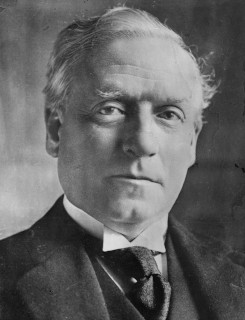
(Pictured: H.H. Asquith, former Prime Minister of the United Kingdom)


Leave a comment

Birth of Robert Wilson Lynd, Writer & Irish Nationalist

robert-wilson-lynd

Robert Wilson Lynd, Irish writer, editor of poetry, urbane literary essayist and strong Irish nationalist, is born in Belfast on April 20, 1879.

Lynd is born to Robert John Lynd, a Presbyterian minister, and Sarah Rentoul Lynd, the second of seven children. His paternal great-grandfather emigrated from Scotland to Ireland. He is educated at Royal Belfast Academical Institution and Queen’s University Belfast. His father serves a term as Presbyterian Church Moderator, but he is just one of a long line of Presbyterian clergy in the family.

Lynd begins as a journalist with the Northern Whig in Belfast. He moves to London in 1901, via Manchester, sharing accommodation with his friend the artist Paul Henry. Initially he writes drama criticism for Today, edited by Jerome K. Jerome. He also writes for The Daily News (later the News Chronicle), being its literary editor from 1912 until 1947.

Lynd marries the writer Sylvia Dryhurst on April 21, 1909. They meet at Gaelic League meetings in London. Their daughters Máire and Sigle become close friends of Isaiah Berlin. Sigle’s son, born in 1941, is artist Tim Wheeler. In March 1924, they move to what is to be their long-term married home, the elegant Regency house of 5 Keats Grove in the leafy suburb of Hampstead in northwest London. The house had been lived in by various members of Sylvia’s family.

The Lynds are literary hosts, in the group including J. B. Priestley. They are on good terms also with Hugh Walpole. Priestley, Walpole and Sylvia Lynd are founding committee members of the Book Society. Irish guests include James Joyce and James Stephens. On one occasion reported by Victor Gollancz in Reminiscences of Affection, Joyce intones Anna Livia Plurabelle to his own piano accompaniment. Joyce and his wife Nora Barnacle hold their wedding lunch at the Lynds’ house after getting married at Hampstead Town Hall on July 4, 1931.

Lynd uses the pseudonym Y.Y. in writing for the New Statesman. According to C. H. Rolph‘s Kingsley, Lynd’s weekly essay, which runs from 1913 to 1945, is “irreplaceable.” In 1941, editor Kingsley Martin decides to alternate it with pieces by James Bridie on Ireland, but the experiment is not at all a success.

Lynd’s political views are at a certain point radicalised by his experience of how Ulster and Home Rule develop in the 1912–1914 period. He is appalled at the threat of the use of violence to deliver Ulster from Home Rule and the later decision to postpone the implementation of the Third Home Rule Bill. He later writes, “Then came August 1914 and England began a war for the freedom of small nations by postponing the freedom of the only small nation in Europe which it was within her power to liberate with the stroke of a pen.”

Lynd becomes fluent in the Irish language and is a Gaelic League member. As a Sinn Féin activist, he uses the name Robiard Ó Flionn/Roibeard Ua Flionn. He dies in Hampstead, London on October 6, 1949. He is buried in Belfast City Cemetery.