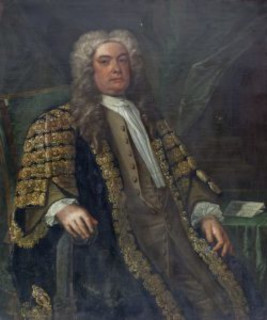
Coghill is the son of John Coghill of Knaresborough, North Yorkshire, judge of the prerogative court and one of the masters in chancery. His mother is the daughter of Tobias Cramer, of Ballyfoyle, County Kilkenny. Two elder sisters and a younger brother, James, survive infancy. He spends his childhood in Dublin.
Coghill occupies a prominent place in the life of Dublin, and is remarkable for his early display of ability. At the age of fourteen he enters the University of Dublin, graduating at the age of eighteen as a Bachelor of Laws. At the age of nineteen he is returned to Parliament and at the age of 26 he becomes judge of the prerogative court.
In Parliament, from 1692 to 1713 Coghill is a representative of the borough of Armagh, and from 1713 until his death in 1739, a representative of the University of Dublin. He is politically close to William Conolly, speaker of the Irish House of Commons, who dies in 1729. Upon Conolly’s death he succeeds him as a commissioner of the revenue. Over the following years he plays a prominent role in parliament, particularly on financial matters. He also builds up a close relationship with John Perceval, the British Prime Minister‘s chief advisor on Irish affairs.
Coghill becomes Chancellor of the Exchequer in 1735 and is regarded as an honest and able supporter of Irish interests. Outside parliament he is very active on boards, commissions and trusts, takes a hand in the building of Dr. Steevens’ Hospital and is pro-vice-chancellor of Trinity College Dublin. He lives in Belvedere House, now in the grounds of St. Patrick’s College, Dublin. He suffers from gout for a large part of his life.
From his father, Coghill, who never married, had inherited a lease from the Corporation of lands in Clonturk, where he erects a house which is afterwards known as Drumcondra House. He moves into Drumcondra House and lives there with his unmarried sister Mary until his death in 1738. He is buried in the family vault in St. Andrew’s Church, Dublin.
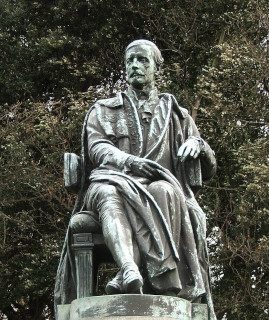
Upon Coghill’s death Mary is left, for her lifetime, his lands in the barony of Coolock, rents from his properties in Clonturk, all his household goods, and his coach, chariot and horses. In 1743, she erects the parish church of Clonturk, now Drumcondra Church, and places in it a statue of her brother by the Dutch sculptor Peter Scheemakers.
Croker is the only son of John Croker, the surveyorgeneral of customs and excise in Ireland. He is educated at Trinity College, Dublin, where he graduates in 1800. Immediately afterwards he enters Lincoln’s Inn and, in 1802, he is called to the Irish bar.
Croker enters the Parliament of the United Kingdom in 1808 as member for Downpatrick, obtaining the seat on petition, though he had been unsuccessful at the poll. In 1810 he is appointed to the office of First Secretary to the Admiralty, which he holds without interruption under various administrations for more than twenty years. From the beginning he has the backing of Arthur Wellesley, 1st Duke of Wellington, and the friendship continues between them until Wellesley’s death in 1852.
From 1831 to 1854 Croker is one of the chief writers for the Quarterly Review, to which he contributes about 270 articles on a variety of subjects. His literary tastes are largely those of the 18th century, as may be seen from his severe criticism of John Keats’s Endymion, Alfred Tennyson’s Poems of 1832, and of course the first two volumes of Macaulay’s The History of England from the Accession of James the Second (1848). For some years before his death he accumulates material for an annotated edition of Alexander Pope’s works. This is passed to Whitwell Elwin, who begins the edition later completed by William John Courthope. Croker also edits the collected letters or memoirs of various 18th-century figures.
Croker dies at the age of 76 on August 10, 1857 at St. Albans Bank, Hampton.
(Pictured: Portrait of John Wilson Croker, by William Owen (died 1825), given to the National Portrait Gallery, London in 1872)
Nominated by the Labour Party and supported by the Green Party and the Workers’ Party, Robinson becomes Ireland’s first woman president in 1990 by mobilizing a liberal constituency and merging it with a more conservative constituency opposed to the Fianna Fáil party. As president, she adopts a much more prominent role than her predecessors and she does much to communicate a more modern image of Ireland. Strongly committed to human rights, she is the first head of state to visit Somalia after it suffers from civil war and famine in 1992 and the first to visit Rwanda after the genocide in that country in 1994.
Shortly before her term as president expires, Robinson accepts the post of United Nations High Commissioner for Human Rights (UNHCHR). As high commissioner, she changes the priorities of her office to emphasize the promotion of human rights at the national and regional levels. She was the first UNHCHR to visit China, and she also helps to improve the monitoring of human rights in Kosovo. In 2001 she serves as secretary-general of the World Conference against Racism held in Durban, South Africa. In 1998 she is elected chancellor of Trinity College, a post she holds until 2019.
After stepping down as UNHCHR, Robinson founds the nongovernmental organization Realizing Rights: The Ethical Globalization Initiative (2002–2010). Its central concerns include equitable international trade, access to health care, migration, women’s leadership and corporate responsibility. She is also a founding member of the Council of Women World Leaders, serves as honorary president of Oxfam International, a private organization that provides relief and development aid to impoverished or disaster-stricken communities worldwide, and is a member of the Club of Madrid, which promotes democracy. She also holds various posts at the United Nations, and in 2010, she establishes the Mary Robinson Foundation—Climate Justice, which operates until 2019.
The same year Woodward joins the office of Sir Thomas Deane and becomes a partner in 1851 along with Deane’s son, Thomas Newenham Deane. It seems that Deane looks after business matters and leaves the design work to Woodward.
The work of Deane and Woodward is characterised by naturalistic decoration with foliage and animals carved into capitals and plinths around windows and doors. It is extolled by John Ruskin in particular when he visits the Museum at Trinity College, Dublin. Woodward collaborates in particular with the O’Shea brothers, James and John, who are stone carvers from County Cork. They, along with London sculptors, carve the abundant decorative stonework at Trinity, showing owls, lizards, cats and monkeys, as well as other flora and fauna. Later the O’Sheas carve stonework at the Kildare Street Club, including the famous window piece showing the club members as monkeys playing billiards. Some stories tell of the O’Sheas getting into trouble and possibly even being sacked for carving cats or monkeys at the Oxford University Museum.
In 1979, McGuinness is elected as an independent candidate to Seanad Éireann at a by-election on December 11, 1979, as a Senator for the University of Dublin constituency, following the resignation of Senator Conor Cruise O’Brien, taking her seat in the 14th Seanad. She is re-elected at the 1981 elections to the 15th Seanad, and in 1983 to the 17th Seanad, where she serves until 1987, losing her seat to David Norris. She is appointed to the Council of State on May 2, 1988, by President Patrick Hillery and serves until 1990.
McGuinness is appointed a judge of the Circuit Court in 1994, the first woman to hold that office in Ireland. In 1996, she is appointed to the High Court and remains there until her appointment to the Supreme Court in January 2000.
In November 2005, McGuinness is appointed Adjunct Professor at the Faculty of Law, National University of Ireland, Galway. She is also appointed President of the Law Reform Commission in 2005 and holds that position until 2011.
In April 2009, McGuinness is awarded a “Lord Mayor’s Award” by Lord Mayor of DublinEibhlin Byrne “for her contribution to the lives of children and families in the city through her pioneering work.” In September 2010, she is named as one of the “People of the Year” for “her pioneering, courageous and long-standing service to Irish society.” In November 2012, she wins the Irish Tatler Hall of Fame Award.
In addition to her judicial career, McGuinness serves on the Employment Equality Agency, Kilkenny Incest Investigation, the Forum for Peace and Reconciliation, the National Council of the Forum on End of Life in Ireland and the Irish Universities Quality Board. In June 2011, she becomes patron of the Irish Refugee Council. In November 2011, she is appointed Chairperson of the “Campaign for Children.”
In January 2014, McGuinness is appointed by Minister for Communications, Energy and Natural Resources, Pat Rabbitte, to chair the expert panel to oversee the preparation of reports on the best underground route options to compare with the Grid Link and Grid West high voltage power lines in Ireland. In March 2015, McGuinness receives an Alumni Award from Trinity College Dublin.
McGuinness is married to broadcaster and writer Proinsias Mac Aonghusa from 1954 until his death in 2003 and has three children. She resides in Blackrock, Dublin.
Risteárd Earnán Ó Glaisne is born on September 2, 1927, near Bandon, County Cork, the third of four children of George William Giles and his wife, Sara Jane (née Vickery). Educated at Bandon Grammar School and Trinity College Dublin, he graduates with a BA in 1949 and obtains a master’s degree in 1959. At TCD he is greatly influenced by Daithí Ó hUaithne.
Ó Glaisne first becomes interested in the Irish language at school in Bandon. His headmaster gives him a copy of Liam Ó Rinn‘s Peann agus Pár, along with a book of poems by Ivan Turgenev translated into Irish by Ó Rinn. “I suddenly found myself breaking into a world vastly larger than my own world in Irish,” he recalls. “The quality of mind I encountered made me realise I could never again connect Irish only with poteen and potatoes.”
Ó Glaisne further explores the language by making contact with the few native Irish speakers left in the Bandon area. He gradually comes to the conclusion that he is a member of a nation that has an extremely old and in many ways distinguished culture, of which Irish has been historically an integral part. Deciding that Irish best reflects the society in which he grew up and reflects him as an individual, he adopts it as his first language.
On graduating from TCD Ó Glaisne teaches Irish at Avoca School, Blackrock. He later teaches in St. Andrew’s College, Dublin, and at St. Patrick’s Cathedral Grammar School, where he ends his teaching career in 1989. He took a career break in the mid-1960s to study the French educational system and to travel on the Continent.
To perfect his Irish Ó Glaisne holidays on the Great Blasket Island, where he immerses himself in the rich oral culture. He makes many friends among the islanders, and the friendships continue after they are resettled on the mainland in Dún Chaoin. He regularly visits Corca Dhuibhne to meet friends like Muiris Mhaidhc Léan Ó Guithín, one of the last surviving islanders, and to enjoy the annual Ceiliúradh an Bhlascaoid.
Ó Glaisne holds that Protestants have enjoyed a long association with Irish, pointing to 18th-century followers of John Wesley such as Charles Graham, Gideon Ousley and Tomás Breathnach, who evangelised in Irish. He firmly believes that Protestants can be “every whit as Irish” as Roman Catholics. He urges his co-religionists to identify fully with Ireland.
Ó Glaisne is the founder and editor of Focus (1958-66), a monthly magazine that aims to help Protestants “come to an understanding of their cultural heritage.” He is a regular contributor to programmes on RTÉ and RTÉ Raidió na Gaeltachta, and writes for Comhar, Inniú, An tUltach and The Irish Times.
Mitchel is the son of a Presbyterian minister. At the age of four, he is sent to a classical school, run by an old minister named Moor, nicknamed “Gospel Moor” by the students. He reads books from a very early age. When a little over five years old, he is introduced to Latin grammar by his teacher and makes quick progress. In 1830, not yet 15 years old, he enters Trinity College, Dublin and obtains a law degree in 1834.
In the spring of 1836 Mitchel meets Jane Verner, the only daughter of Captain James Verner. Though both families are opposed to the relationship, they become engaged in the autumn and are married on February 3, 1837, by the Rev. David Babington in Drumcree Church, the parish church of Drumcree.
Mitchel works in a law office in Banbridge, County Down, where he eventually comes into conflict with the local Orange Order. He meets Thomas Davis and Charles Gavan Duffy during visits to Dublin. He joins the Young Ireland movement and begins to write for The Nation. Deeply affected by the misery and death caused by the Great Famine, he becomes convinced that nothing will ever come of the constitutional efforts to gain Irish freedom. He then forms his own paper, United Irishmen, to advocate passive resistance by Ireland’s starving masses.
In May 1848, the British tire of Mitchel’s open defiance. Ever the legal innovators in Ireland, they invent a crime especially for the Young Irelanders – felony-treason. They arrest him for violating this new law and close down his paper. A rigged jury convicts him, and he is deported first to Bermuda and then to Australia. However, in June 1853, he escapes to the United States.
Mitchel works as a journalist in New York City and then moves to the South. When the American Civil War erupts, he is a strong supporter of the Southern cause, seeing parallels with the position of the Irish. His family fully backs his commitment to the Southern cause. He loses two sons in the war, one at the Battle of Gettysburg in 1863 and another at the Battle of Fort Sumter in 1864, and another son loses an arm. His outspoken support of the Confederacy causes him to be jailed for a time at Fort Monroe, where one of his fellow prisoners is Confederate PresidentJefferson Davis.
In 1874, the British allow Mitchel to return to Ireland and in 1875 he is elected in a by-election to be a member of the Parliament of the United Kingdom representing the Tipperary constituency. However, his election is invalidated on the grounds that he is a convicted felon. He contests the seat again in the resulting by-election and is again elected, this time with an increased vote.
Unfortunately, Mitchel, one of the staunchest enemies to English rule of Ireland in history, dies in Newry on March 20, 1875, and is buried there. Thirty-eight years later, his grandson, John Purroy Mitchel, is elected Mayor of New York City.
Ireland’s first passenger railway, the Dublin and Kingstown Railway (D&KR), opens on October 9, 1834. It links Westland Row in Dublin with Kingstown Harbour (Dún Laoghaire) in County Dublin. The D&KR is also notable for a number of other achievements besides being Ireland’s first passenger railway. It operates an atmospheric railway for ten years, claims the first use of a passenger tank engine and is the first railway company to build its own locomotives.
Construction begins on a new harbour at Dunleary village in 1817 that soon begins to attract traffic due to silting problems elsewhere around Dublin Bay. Proposals for canal or rail infrastructure links to Dublin are variously proposed through to the 1830s. James Pim takes the initiative and commissions a plan by Alexander Nimmo which is presented as a petition to the House of Commons on February 28, 1831 for a rail line from near Trinity College Dublin to the west pier at the Royal Harbour of Kingstown under a company to be known as the D&KR. A bill is presented and is progressing but is scuppered by a prorogation of parliament and an election. A fresh bill receives Royal assent on September 6, 1831.
A meeting of D&KR subscribers on November 25, 1831 at the Dublin Chamber of Commerce includes the submission of a long report which indicates that Westland Row is to be the Dublin terminus and that the enterprise is initially to focus on passenger traffic with a high train frequency.
The construction contract is awarded to William Dargan, with Charles Blacker Vignoles as engineer. The construction contract is signed on May 7, 1833 and is completed in about 18 months. The railway proves expensive to build with the final cost being a little under £60,000 per mile. Thomas Grierson, the Dublin, Wicklow and Wexford Railway (DW&WR) chief engineer comments in a presentation to the Institution of Civil Engineers of Ireland in 1887 that speed of construction is remarkably short and leads to “many failures in masonry, bridges, etc.”
On October 4, 1834 the first recorded train with invited passengers is hauled by the engine Vauxhall and runs as far as the Williamstown Martello Tower at what is now Blackrock Park before returning. The engine Hibernia on October 9, 1834 hauls another train of invited passengers composed of eight carriages the entire length of the line and back. Plans are made to introduce a service on October 22, 1834 but storms and flooding damage the line including wrecking the bridge over the River Dodder and this leads to delays for repairs. A timetabled regular service is introduced from January 1835.
On June 30, 1856 the Dublin and Wicklow Railway (D&WR) takes over operation of the line from the D&KR with the D&KR continuing to lease out the line. The D&WR had formerly been known as the Waterford, Wicklow, Wexford and Dublin Railway (WWW&DR or 3WS). It changes its name to the Dublin Wicklow and Wexford Railway (DW&WR) in May 1860 and is ultimately renamed the Dublin and South Eastern Railway (D&SER) in 1907, a name which is retained until the amalgamation of the D&KR and D&SER with the Great Southern Railways on January 1, 1925. As of 1974, its independent existence of over 90 years by a railway company is only exceeded in the British Isles by the Great Western Railway and the Londonderry and Lough Swilly Railway.
(Pictured: Sketch of Second Class Carriage on the Dublin and Kingstown Railway by E. Heyden, with Patent Spiral spring Buffer, as invented by T.F. Bergin)
Malone is born to Edmond Malone Sr. (1704–1774), MP of the Irish House of Commons and judge of the Court of Common Pleas in Ireland, and Catherine Collier, the niece of Robert Knight, 1st Earl of Catherlough. He has two sisters, Henrietta and Catherine, and an older brother, Richard (later Lord Sunderlin). His father is a successful lawyer and politician in England, but his practice fails and he returns to Ireland. Little is known of his childhood and adolescence except that in 1747 he is sent to Dr. Ford’s preparatory school in Molesworth Street, Dublin. The next record of his education is ten years later, in 1757, when he enters Trinity College, Dublin. He receives his BA degree on February 23, 1762.
In the following months Malone sends a steady stream of notes and corrections to George Steevens, who, by then the inheritor, from Samuel Johnson, of the editor’s mantle for the Jacob Tonson edition of Shakespeare’s collected works, is busy preparing a second edition. His main contribution appears in the first volume as “An Attempt to Ascertain the Order in Which the Plays Attributed to Shakspeare Were Written.”
Malone’s three supplemental volumes (1780–1783) to Steevens’ edition of Johnson’s Shakespeare, containing apocryphal plays, textual emendations, and the first critical edition of the sonnets, are landmarks in Shakespearean studies. His “Historical Account of the Rise and Progress of the English Stage, and of the Economy and Usages of the Ancient Theatres in England” (1800) is the first treatise on English drama based on original sources. His own edition of Shakespeare in 11 volumes appears in 1790. A new octavo edition, unfinished at his death, is completed by James Boswell, the son of Samuel Johnson’s biographer, and published in 1821 in 21 volumes. This work, which includes a memoir of Malone, is the standard edition of Shakespeare’s writings for more than a century.
Malone dies at the age of 70 in London on May 25, 1812.
(Pictured: Portrait of Edmond Malone by Joshua Reynolds (1778), National Portrait Gallery)
Francis Llewellyn Harrison, better known as “Frank Harrison” or “Frank Ll. Harrison” and one of the leading musicologists of his time and a pioneering ethnomusicologist, is born in Dublin on September 29, 1905. Initially trained as an organist and composer, he turns to musicology in the early 1950s, first specialising in English and Irish music of the Middle Ages and increasingly turning to ethnomusicological subjects in the course of his career. His Music in Medieval Britain (1958) is still a standard work on the subject, and Time, Place and Music (1973) is a key textbook on ethnomusicology.
Harrison is the second son of Alfred Francis Harrison and Florence May (née Nash). He becomes a chorister at St. Patrick’s Cathedral, Dublin in 1912 and is educated at the cathedral grammar school and Mountjoy School. A competent organist, he is deputy organist at St. Patrick’s from 1925 to 1928. In 1920, he also begins musical studies at the Royal Irish Academy of Music, where he studies with John Francis Larchet (composition), George Hewson (organ) and Michele Esposito (piano). In 1926, he graduates Bachelor of Music at Trinity College Dublin and is awarded a doctorate (MusD) in 1929 for a musical setting of Psalm 19. He then works in Kilkenny for one year, serving as organist at St. Canice’s Cathedral and music teacher at Kilkenny College.
In 1930, Harrison emigrates to Canada to become organist at Westminster Presbyterian Church in New Glasgow, Nova Scotia. In 1933, he studies briefly with Marcel Dupré in France but returns to Canada in 1934 to become organist at Knox Presbyterian Church in Ottawa. In 1935, he takes a position as organist and choirmaster at St. George’s Cathedral in Kingston, Ontario, as well as taking up the newly created post of “resident musician” at Queen’s University at Kingston. His duties include giving lectures, running a choir and an orchestra, and conducting concerts himself. His course in the history and appreciation of music is the first music course to be given for full credit at Queen’s. He resigns from St. George’s in 1941 to become assistant professor of music at Queen’s in 1942. During his years in Canada, he still pursues the idea of remaining a performing musician and composer, winning three national composition competitions: for Winter’s Poem (1931), Baroque Suite (1943) and Night Hymns on Lake Nipigon (1945).
In 1951, Harrison takes the degrees of Master of Arts (M.A.) and Doctor of Music (DMus) at Jesus College, Oxford, and becomes lecturer (1952), senior lecturer (1956), and reader in the history of music (1962–1970) there. In 1965, he is elected Fellow the British Academy and Senior Research Fellow at Oxford. From 1970 to 1980, he is Professor of Ethnomusicology at the University of Amsterdam in the Netherlands, retiring to part-time teaching in 1976.
Harrison also holds Visiting Professorships in musicology at Yale University (1958–1959), Princeton University (spring 1961 and 1968–1969), and Dartmouth College (winter 1968 and spring 1972). He also briefly returns to Queen’s University at Kingston as Queen’s Quest Visiting Professor in the fall of 1980 and is Visiting Andrew W. Mellon Professor of Music at the University of Pittsburgh for the calendar year 1981.
Harrison’s honorary titles also include Doctor of Laws at Queen’s University, Kingston (1974), Corresponding Member of the American Musicological Society (1981), and Vice President and Chairman of the Plainsong and Medieval Music Society (1985). At Queen’s also, the new Harrison-LeCaine Hall (1974) is partly named in his honour.
In 1989, Harry White appreciates Harrison as “an Irish musicologist of international standing and of seminal influence, whose scholarly achievement, astonishingly, encompassed virtually the complete scope of the discipline which he espoused.” David F. L. Chadd writes of him “He was above all things an explorer, tirelessly curious and boyishly delighted in the pursuit of knowledge, experience and ideas, and totally heedless of artificially imposed constraints and boundaries.”
Since 2004, the Society for Musicology in Ireland (SMI) awards a bi-annual Irish Research Council Harrison Medal in his honour to distinguished international musicologists.