seamus dubhghaill

Promoting Irish Culture and History from Little Rock, Arkansas, USA


Leave a comment

RMS Titanic Departs Southampton, England

titanic-departing-southampton-dock

The RMS Titanic leaves port in Southampton, England for her first and only voyage on April 10, 1912. Built by the Belfast shipbuilders Harland & Wolff, the RMS Titanic is the second of the three Olympic-class ocean liners — the first being the RMS Olympic and the third being the HMHS Britannic.

Following the embarkation of the crew the passengers begin arriving at 9:30 AM, when the London and South Western Railway‘s boat train from London Waterloo station reaches Southampton Terminus railway station on the quayside, alongside RMS Titanic‘s berth. In all, 923 passengers board RMS Titanic at Southampton, 179 First Class, 247 Second Class and 494 Third Class. The large number of Third Class passengers means they are the first to board, with First and Second Class passengers following up to an hour before departure. Stewards show them to their cabins, and First Class passengers are personally greeted by Captain Edward Smith upon boarding. Third Class passengers are inspected for ailments and physical impairments that might lead to their being refused entry to the United States, a prospect the White Star Line wishes to avoid, as it would have to carry anyone who fails the examination back across the Atlantic. A total of 922 passengers are recorded as embarking on RMS Titanic at Southampton. Additional passengers are to be picked up at Cherbourg, France and Queenstown.

The maiden voyage begins on time, at noon. An accident is narrowly averted only a few minutes later as RMS Titanic passes the moored liners SS City of New York of the American Line and what would have been her running mate on the service from Southampton, White Star’s RMS Oceanic. Her huge displacement causes both of the smaller ships to be lifted by a bulge of water and then dropped into a trough. SS City of New York‘s mooring cables cannot take the sudden strain and snap, swinging her around stern-first towards RMS Titanic. A nearby tugboat, Vulcan, comes to the rescue by taking SS City of New York under tow, and Captain Smith orders RMS Titanic‘s engines to be put “full astern.” The two ships avoid a collision by a matter of about 4 feet. The incident delays RMS Titanic‘s departure for about an hour, while the drifting SS City of New York is brought under control.

After making it safely through the complex tides and channels of Southampton Water and the Solent, RMS Titanic heads out into the English Channel. She heads for the French port of Cherbourg, a journey of 77 nautical miles. The weather is windy, very fine but cold and overcast. Four hours after RMS Titanic leaves Southampton, she arrives at Cherbourg and is met by the tenders SS Traffic and the SS Nomadic which have to be used to transfer passengers from shore to ship because Cherbourg lacks docking facilities for a ship the size of RMS Titanic. An additional 274 passengers are taken aboard. Twenty-four passengers who have booked passage only cross-channel from Southampton leave aboard the tenders to be conveyed to shore. The process is completed in about 90 minutes. At 8:00 PM RMS Titanic weighs anchor and departs for Queenstown on the south coast of Ireland with arrival scheduled late the following morning.

(Pictured: RMS Titanic departing the Southampton docks on April 10, 1912)

Leave a comment

Birth of James White, Science Fiction Writer

james-whiteJames White, author of science fiction novellas, short stories and novels, is born in Belfast, Northern Ireland on April 7, 1928.

White is educated in Belfast at St. John’s Primary School and St. Joseph’s Technical Secondary School. As a teenager he lives with foster parents. He wants to study medicine but financial circumstances prevented this. Between 1943 and 1965 he works for several Belfast tailoring firms and then as assistant manager of a Co-op department store. He marries Margaret “Peggy” Sarah Martin, another science fiction fan, in 1955 and the couple has three children. He later works for the aeroplane builders Short Brothers as a technical clerk, publicity assistant and publicity officer.

White becomes a science fiction fan in 1941, attracted particularly by the works of E. E. “Doc” Smith, which features good aliens as well as evil ones, and of Robert A. Heinlein, many of whose stories concern ordinary people. In 1947 he meets another Irish fan, Walt Willis, and the two help to produce the fan magazines Slant and Hyphen, which feature stories and articles by noted authors including John Brunner, A. Bertram Chandler and Bob Shaw. In 2004 both White and Willis are nominated for the retrospective Hugo Award for Best Fan Writer of 1953, although neither wins. White says that he started writing stories because the Slant team felt that Astounding Stories of Super-Science was too dominated by prophesies of nuclear doom, and his friends dared him to write the kind of story that they all liked to read. Getting published is fairly easy during the 1950s, as the World War II restrictions on paper are ended, and there are at least 12 science magazines in Britain and about 40 in the United States. His first published short story, Assisted Passage, a parody of 1950s Anglo-Australian emigration policies, appears in the January 1953 edition of the magazine New Worlds. Further stories appear in New Worlds during the next few years, but White’s attempt to access the more lucrative American market by submitting stories to Astounding Stories of Super-Science stall after the publication of The Scavengers. As a result, White’s work is little-known outside the UK until the 1960s.

In 1957, Ace Books publishes White’s first novel, The Secret Visitors, which includes locations in Northern Ireland. Ace Books’ science fiction editor, Donald A. Wollheim, thinks the original ending is too tame and suggests that White should insert an all-out space battle just after the climactic courtroom scene. In November of the same year New Worlds publishes White’s novella Sector General, and editor John Carnell requests more stories set in the same universe, founding the series for which White is known best. White gains a steady following for his scientifically accurate stories, which are examples of hard science fiction in New Worlds, despite the magazine’s promotion of literary New Wave science fiction during the 1960s.

White keeps his job with Short Brothers and writes in the evenings, as his stories do not make enough money for him to become a full-time author. In 1980 he teaches a literature course at a Belfast branch of the Workers’ Educational Association. When diabetes has severely impaired his eyesight, he takes early retirement in 1984 and relocates to the north County Antrim resort town of Portstewart, where he continues to write. For many years he is a Council Member of the British Science Fiction Association and, with Harry Harrison and Anne McCaffrey, a Patron of the Irish Science Fiction Association. He is also a strong pacifist.

James White dies of a stroke in Portstewart, Belfast, Northern Ireland on August 23, 1999, while his novels Double Contact and The First Protector are being prepared for publication.


Leave a comment

Death of Songwriter & Lyricist Jimmy Kennedy

jimmy-kennedy

James Kennedy, a Northern Irish songwriter and lyricist, dies in Cheltenham, Gloucestershire, England on April 6, 1984. In a career spanning more than fifty years, he writes some 2,000 songs, of which over 200 become worldwide hits and about 50 are all-time popular music classics. Until the duo of John Lennon and Paul McCartney, Kennedy has more hits in the United States than any other Irish or British songwriter.

Kennedy is born near Omagh, County Tyrone, Northern Ireland. His father, Joseph Hamilton Kennedy, is a policeman in the Royal Irish Constabulary, which exists before the partition of Ireland. While growing up in Coagh, Kennedy writes several songs and poems. He is inspired by local surroundings such as the view of the Ballinderry river, the local Springhill house and the plentiful chestnut trees on his family’s property, as evidenced in his poem Chestnut Trees. Kennedy later moves to Portstewart, a seaside resort.

Kennedy graduates from Trinity College, Dublin, before teaching in England. He is accepted into the Colonial Service, as a civil servant, in 1927.

While awaiting a Colonial Service posting to the colony of Nigeria, Kennedy embarks on a career in songwriting. His first success comes in 1930 with The Barmaid’s Song, sung by Gracie Fields. Fellow lyricist Harry Castling introduces him to Bert Feldman, a music publisher based in London‘s “Tin Pan Alley,” for whom Kennedy starts to work. In the early 1930s he writes a number of successful songs, including Oh, Donna Clara (1930), My Song Goes Round the World (1931), and The Teddy Bears’ Picnic (1933), in which he provides new lyrics to John Walter Bratton‘s tune from 1907.

In 1934, Feldman turns down Kennedy’s song Isle of Capri, but it becomes a major hit for a new publisher, Peter Maurice. He writes several more successful songs for Maurice, including Red Sails in the Sunset (1935), inspired by beautiful summer evenings in Portstewart, Northern Ireland, Harbor Lights (1937) and South of the Border (1939), inspired by a holiday picture postcard he receives from Tijuana, Mexico, and written with composer Michael Carr. Kennedy and Carr also collaborate on several West End theatre shows in the 1930s, including London Rhapsody (1937). My Prayer, with original music by Georges Boulanger, has English lyrics penned by Kennedy in 1939. It is originally written by Boulanger with the title Avant de Mourir in 1926.

During the early stages of World War II, while serving in the British Army‘s Royal Artillery, where he rises to the rank of Captain, Kennedy writes the wartime hit, We’re Going to Hang out the Washing on the Siegfried Line. His hits also include Cokey Cokey (1945), and the English lyrics to Lili Marlene. After the end of the war, his songs include Apple Blossom Wedding (1947), Istanbul (Not Constantinople) (1953), and Love Is Like a Violin (1960). In the 1960s he writes the song The Banks of the Erne, for recording by his friend from the war years, Theo Hyde, also known as Ray Warren.

Kennedy is a patron of the Castlebar International Song Contest from 1973 until his death in 1984 and his association with the event adds great prestige to the contest. He wins two Ivor Novello Awards for his contribution to music and receives an honorary degree from the New University of Ulster. He is awarded the Order of the British Empire (OBE) in 1983.

Jimmy Kennedy dies in Cheltenham on April 6, 1984, at the age of 81, and was interred in Taunton, Somerset. In 1997 he is posthumously inducted into the Songwriter’s Hall of Fame.


Leave a comment

Death of Showband Icon Butch Moore

butch-moore

Butch Moore, born James Augustine Moore, Irish singer and showband icon during the 1960s, dies in Massachusetts on April 3, 2001. He is born in Dublin on January 10, 1938.

Moore plays with a number of bands before securing his big break with the Capitol Showband in 1958. Its lineup includes band leader, Des Kelly, and Paddy Cole, who is still involved in the entertainment business, and an early songwriter for the band is Phil Coulter. The Capitol achieves a considerable degree of success in the early 1960s attracting huge crowds in the State’s many ballrooms. It tours the United States in 1961, and two years later becomes the first showband to appear on the new RTÉ Television service. The Capitol plays in the London Palladium in 1964 on a night when the lineup includes Roy Orbison.

Moore marries Norah Sheridan in 1962. They have three children – Karen, Grainne and Gary.

Moore achieves celebrity status as Ireland’s first contestant in the Eurovision Song Contest in 1965. At the height of his success, he wins the National Song Contest to represent Ireland in the Eurovision Song Contest 1965, in Naples, singing Walking the Streets in the Rain. The song reaches number one on the Irish Singles Chart but fails to chart in the United Kingdom.

As the lead singer with the Capitol Showband, he rivals the Royal Showband’s Brendan Bowyer as Ireland’s most popular showband vocalist. His marriage to Norah breaks down in 1969 and his career begins to decline. He emigrates to the United States in 1970, where he spends the last 31 years of his life.

Moore marries Irish ballad singer Maeve Mulvany in 1972 in the United States. They form a very successful group known as “Butch N Maeve” with a mixture of ballads and pop. They also own a pub in Massachusetts named after one of their songs, The Parting Glass. They have three children, Rory, Tara and Thomas.

Although suffering from cancer of the esophagus, Butch Moore dies of a heart attack on April 3, 2001. His body is returned to Dublin and a funeral Mass is celebrated at St. Canice’s Church in Finglas. After his death, Maeve makes plans to move back to Ireland where she has bought a house in Cormeen, County Cavan, but she dies on February 14, 2004.


Leave a comment

Birth of Playwright Seán O’Casey

sean-ocasey

Seán O’Casey, Irish playwright renowned for realistic dramas of the Dublin slums in war and revolution, in which tragedy and comedy are juxtaposed in a way new to the theatre of his time, is born at 85 Upper Dorset Street in Dublin on March 30, 1880.

Born as John Casey into a lower middle-class Irish Protestant family, his father dies when he is six, and thereafter the family becomes progressively poorer. With only three years of formal schooling, he educates himself by reading. He starts work at 14, mostly at manual labour, including several years with the Irish railways.

O’Casey becomes caught up in the cause of Irish nationalism, and he changes his name to its Irish form and learns the Irish language. His attitudes are greatly influenced by the poverty and squalor he witnesses in Dublin’s slums and by the teachings of the Irish labour leader Jim Larkin. He becomes active in the labour movement and writes for The Irish Worker. He also joins the Irish Citizen Army, a paramilitary arm of the Irish labour unions, and draws up its constitution in 1914. At this time, he becomes disillusioned with the Irish nationalist movement because its leaders put nationalist ideals before socialist ones. He does not take part in the 1916 Easter Rising against the British authorities.

Disgusted with the existing political parties, he turns his energies to drama. His tragicomedies reflect in part his mixed feelings about his fellow slum dwellers, seeing them as incapable of giving a socialist direction to the Irish cause but at the same time admirable for their unconquerable spirit.

After several of his plays have been rejected, the Abbey Theatre in Dublin produces The Shadow of a Gunman (1923), set during the guerrilla warfare between the Irish Republican Army and British forces. In 1924 the Abbey stages Juno and the Paycock, his most popular play, set during the period of civil war over the terms of Irish independence. The Plough and the Stars (1926), with the 1916 Easter Rising as its background, causes riots at the Abbey by patriots who think the play denigrates Irish heroes. When first produced in the 1920s, these plays have an explosive effect on the audiences at the Abbey and help to enlarge the theatre’s reputation.

O’Casey goes to England in 1926, meets the Irish actress Eileen Carey Reynolds, marries her, and henceforth makes England his home. His decision to live outside Ireland is motivated in part by the Abbey’s rejection of The Silver Tassie, a partly Expressionist antiwar drama produced in England in 1929. Another Expressionist play, Within the Gates (1934), follows, in which the modern world is symbolized by the happenings in a public park. The Star Turns Red (1940) is an antifascist play, and the semiautobiographical Red Roses for Me (1946) is set in Dublin at the time of the Irish railways strike of 1911.

O’Casey’s later plays, given to fantasy and ritual and directed against the life-denying puritanism he believes has beset Ireland, include Cock-a-Doodle Dandy (1949), The Bishop’s Bonfire (1955), and The Drums of Father Ned (1958). His last full-length play is a satire on Dublin intellectuals, Behind the Green Curtains, published in 1961.

O’Casey’s three indisputably great plays are The Shadow of a Gunman, Juno and the Paycock, and The Plough and the Stars. All are tragicomedies set in the slums of Dublin during times of war and revolution. Violent death and the everyday realities of tenement life throw into relief the blustering rhetoric and patriotic swagger of men caught up in the struggle for Irish independence. The resulting ironic juxtapositions of the comic and tragic reveal the waste of war and the corrosive effects of poverty. His gifts are for vivid characterization and working-class language and, though he portrays war and poverty, he writes some of the funniest scenes in modern drama. His later plays are not considered as powerful or moving as his earlier realistic plays. In his later plays he tends to abandon vigorous characterization in favour of expressionism and symbolism, and sometimes the drama is marred by didacticism.

Six volumes of O’Casey’s autobiography appeared from 1939 to 1956. They are later collected as Mirror in My House (1956) in the United States and as Autobiographies (1963) in Great Britain. O’Casey’s letters from 1910 to 1941 are edited by David Krause in two volumes (1975, 1980).

Sean O’Casey dies of a heart attack at the age of 84 on September 18, 1964, in Torquay, Devon. He is cremated at the Golders Green Crematorium.


Leave a comment

Birth of Peig Sayers, Author & Seanchaí

peig-sayers

Peig Sayers, Irish author and seanchaí, is born in the townland of Vicarstown, Dunquin, County Kerry, on March 29, 1873. Seán Ó Súilleabháin, the former archivist for the Irish Folklore Commission, describes her as “one of the greatest woman storytellers of recent times.”

Sayers is born Máiréad (Margaret) Sayers, the youngest child of the family. She is called Peig after her mother, Margaret “Peig” Brosnan, from Castleisland. Her father Tomás Sayers is a renowned storyteller who passes on many of his tales to Peig. At age 12, she is taken out of school and goes to work as a servant for the Curran family in the nearby town of Dingle. She spends two years there before returning home due to illness.

She spends the next few years as a domestic servant working for members of the growing middle class produced by the Land War. She plans to join her best friend, Cáit Boland, in the United States, but Boland writes that she has had an accident and can not forward the cost of the fare. Peig moves to the Great Blasket Island after marrying Pádraig Ó Guithín, a fisherman and native of the island, on February 13, 1892. She and Pádraig have eleven children, of whom six survive.

The Norwegian scholar Carl Marstrander, who visits the island in 1907, urges Robin Flower of the British Museum to visit the Blaskets. Flower is keenly appreciative of Sayers’ stories and tales. He records them and brings them to the attention of the academic world.

In the 1930s, a Dublin teacher, Máire Ní Chinnéide, who is a regular visitor to the Blaskets, urges Sayers to tell her life story to her son Micheál. She is illiterate in the Irish language, although she receives her early schooling through the medium of English. She dictates her biography to Micheál. He then sends the manuscript pages to Máire Ní Chinnéide in Dublin, who edits them for publication. It is published in 1936.

Over several years beginning in 1938 she dictates 350 ancient legends, ghost stories, folk stories, and religious stories to Seosamh Ó Dálaigh of the Irish Folklore Commission.

Sayers continues to live on the island until 1942, when she leaves the Island and returns to her native Dunquin. She is moved to a hospital in Dingle, County Kerry where she dies on December 8, 1958. She is buried in the Dún Chaoin Burial Ground on the Dingle Peninsula. Her surviving children, except for her son Micheál, emigrate to the United States and live with their descendants in Springfield, Massachusetts.


Leave a comment

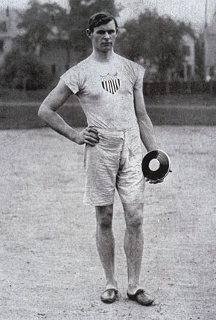
Death of Olympic Gold Medalist Martin John Sheridan

martin-john-sheridan

Martin John Sheridan, “one of the greatest athletes the United States has ever known” according to his obituary in The New York Times, dies in St. Vincent’s Hospital in Manhattan, New York City on March 27, 1918, the day before his 37th birthday.

Sheridan is born in Bohola, County Mayo on March 28, 1881. At 6’3″ and 194 lbs., Sheridan is the best all-around athlete of the Irish American Athletic Club, and like many of his teammates, serves with the New York City Police Department from 1906 until his death. He is so well respected in the NYPD, that he serves as the Governor’s personal bodyguard when the governor is in New York City.

A five-time Olympic gold medalist, with a total of nine Olympic medals, Sheridan is called “one of the greatest figures that ever represented this country in international sport, as well as being one of the most popular who ever attained the championship honor.” He wins the discus throw event at the 1904, 1906, and 1908 Summer Olympic Games as well as the shot put at the 1906 Olympics and the Greek discus in 1908. At the 1906 Intercalated Games in Athens, Greece he also wins silver medals in the standing high jump, standing long jump and the stone throw.

In 1907, Sheridan wins the National Amateur Athletic Union discus championship and the Canadian championship, and in 1908 he wins the Metropolitan, National and Canadian championships as well as two gold medals in the discus throw and bronze in the standing long jump at the 1908 Olympic Games.

Two of Sheridan’s gold medals from the 1904 Summer Olympic Games in St. Louis, Missouri, and one of his medals from the 1906 Intercalated Games in Athens, Greece, are currently located in the USA Track & Field‘s Hall of Fame History Gallery, in Washington Heights, Manhattan.

There are claims that Sheridan fuels a controversy in London in 1908, when flagbearer Ralph Rose refuses to dip the flag to King Edward VII. Sheridan supports Rose by explaining “This flag dips to no earthly king,” and it is claimed that his statement exemplifies both Irish and American defiance of the British monarchy. However, careful research has shown that this is first reported in 1952. Sheridan himself makes no mention of it in his published reports on the Games and neither does his obituary.

Martin Sheridan dies in Manhattan, New York City on March 27, 1918, a very early casualty of the 1918 flu pandemic. He is buried in Calvary Cemetery, Queens, New York. The inscription on the granite Celtic Cross monument marking his grave says in part: “Devoted to the Institutions of his Country, and the Ideals and Aspirations of his Race. Athlete. Patriot.” He is part of a group of Irish American athletes known as the “Irish Whales.”


Leave a comment

Birth of Harry Furniss, Artist & Illustrator

harry-furniss

Harry Furniss, artist and illustrator, is born in Wexford, County Wexford on March 26, 1854. His father is English and his mother Scottish, Furniss identifying himself as English. He is educated at Wesley College in Dublin.

Furniss’s first job as an illustrator is for the Illustrated Sporting and Dramatic News, and when it is purchased by the owner of The Illustrated London News he moves to that magazine. There he produces illustrations of social events such as the The Boat Race, Goodwood Racecourse and even the annual fancy dress ball at Brookwood Asylum, as well as acting as a special correspondent reporting on less pleasant aspects of life in contemporary England, such as the scandalous divorce trial of Lady Colin Campbell.

After some years Furniss moves to The Graphic, initially writing and illustrating a series of supplements titled “Life in Parliament,” and he comments that “from this time forward it would be difficult to name any illustrated paper with which I have not at some time or other been connected.”

Furniss’s most famous humorous drawings are published in Punch, for which he starts working in 1880, and to which he contributes over 2,600 drawings. He leaves Punch in 1894 when its owners discover that he has sold one of his Punch drawings to Pears Soap for use in an advertising campaign.

He illustrates Lewis Carroll‘s novel Sylvie and Bruno in 1889 and Sylvie and Bruno Concluded in 1893. Carroll and Furniss sometimes produce both pictures and text simultaneously. Carroll exerts strong control over Furniss’s illustration, to such an extent that Furniss pretends to be out when Carroll calls at his home. After completing Sylvie and Bruno Concluded Furniss vows never to work for the author again. In 1890, he illustrates the Badminton Library‘s volume on Golf.

Upon leaving Punch, Furniss brings out his own humorous magazine, Lika Joko, but when this fails, he moves to the United States where he works as a writer and actor in the fledgling film industry and where, in 1914, he pioneers the first animated cartoon film for Thomas Edison.

His two-volume autobiography, titled The Confessions of a Caricaturist is published in 1902, and a further volume of personal recollections and anecdotes, Harry Furniss At Home, is published in 1904.

Furniss writes and illustrates 29 books of his own, including Some Victorian Men and Some Victorian Women and illustrates 34 works by other authors, including the complete works of Charles Dickens and William Makepeace Thackeray. On some projects, like his illustrations for G. E. Farrow‘s Wallypug books, Furniss collaborates with his daughter, fellow artist Dorothy Furniss.

Harry Furniss dies on January 14, 1925, in London, England.


Leave a comment

Birth of Boxer Jack McAuliffe

jack-mcauliffe

Jack McAuliffe, Irish American boxer who fights mostly out of Williamsburg, Brooklyn, is born in Cork, County Cork, on March 24, 1866. Nicknamed “The Napoleon of the Ring,” he is one of only fifteen world boxing champions to retire without a loss. He is the World Lightweight champion from 1886 to 1893. He is posthumously inducted into The Ring magazine Hall of Fame in 1954 and the International Boxing Hall of Fame in 1995.

McAuliffe’s parents are Cornelius McAuliffe and Jane Bailey, who are living at 5 Christ Church Lane, Cork, at the time of Jack’s birth. He emigrates to the United States in 1871, where he spends his early years in Bangor, Maine.

McAuliffe makes his first appearance as an amateur boxer in 1883. He turns professional soon after, fighting Jem Carney 78 rounds to a draw at Revere Beach, Massachusetts. He fights Billy Dacey for the lightweight championship and a $5,000 purse in 1888, knocking him out in eleven rounds. He is known as a strong two-handed fighter with “cat-like” reflexes.

McAuliffe is married twice, both times to stage actresses. His first wife is Katie Hart, who plays in farce comedies. After her death, he marries Catherine Rowe in 1894, whose stage name is Pearl Inman, of the song and dance team The Inman Sisters. Between marriages he dates a third actress, Sadie McDonald. McAuliffe and Rowe move back to Bangor, Maine, in 1894, where he undertakes preliminary training for a fight later that year at the Seaside Athletic Club on Coney Island.

McAuliffe retires in 1897. According to the International Boxing Hall of Fame, he has 36 professional fights. He finishes his career with 30 victories with 22 by knockout, five draws and one no decision.

Jack McAuliffe dies on November 5, 1937, at his home on Austin Street in Forest Hills, Queens.


Leave a comment

Birth of Production Designer Cedric Gibbons

cedric-gibbons

Austin Cedric Gibbons, Irish American art director and production designer for the film industry, is born in Dublin on March 23, 1893. He also makes a significant contribution to motion picture theater architecture from the 1930s to 1950s.

Gibbons was born to architect Austin P. Gibbons and Veronica Fitzpatrick Simmons. He is privately tutored and studies at the Art Students League of New York. In 1911 he begins working in his father’s office as a junior draftsman. From 1915 he serves as art director at Edison Studios in New Jersey and then serves in the United States Navy during World War I. He then joins Goldwyn Studios and begins a long career with Metro-Goldwyn-Mayer in 1924, the year the studio is founded.

Gibbons is one of the original 36 founding members of the Academy of Motion Picture Arts and Sciences and oversees the design of the Academy Awards statuette in 1928, a trophy for which he himself would be nominated 38 times for Best Production Design, winning eleven.

In 1930, Gibbons marries actress Dolores del Río and co-designs their house in Santa Monica, an intricate Art Deco residence influenced by Rudolf Schindler. They divorce in 1941. Three years later he marries actress Hazel Brooks, with whom he remains until his death.

Gibbons’s set designs, particularly those in such films as Born to Dance (1936) and Rosalie (1937), heavily inspire motion picture theater architecture in the late 1930s through 1950s. The style is found very clearly in the theaters that are managed by the Skouras brothers, whose designer Carl G. Moeller uses the sweeping scroll-like details in his creations. Among the more classic examples are the Loma Theater in San Diego, The Crest in Long Beach and Fresno, and the Culver Theater in Culver City. The style is sometimes referred to as Art Deco and Art Moderne.

Gibbons retires in 1956 with about 1,500 films credited to him, however, his contract with MGM dictates that he receives credit as art director for every MGM film released in the United States, even though other designers might do the bulk of the work. Even so, his actual hands-on art direction is believed to be about 150 films.

Gibbons’ second cousin, Frederick Gibbons, a musician, orchestra conductor, and entertainer who works with him at MGM, is the father of Billy Gibbons of the rock band ZZ Top.

Cedric Gibbons dies in Los Angeles on July 26, 1960, at the age of 67. He is buried in the Calvary Cemetery, East Los Angeles.