In 2017, award-winning artist Vera Klute is commissioned by the National Gallery of Ireland to create a portrait of Hynes as part of the 2015 Hennessey Portrait Prize. The bust, made of porcelain, concrete and timber (with a dimension of 164cm x 54cm x 45cm), is unveiled to the public in April 2017 and is currently on display as part of the Gallery’s National Portrait Collection.
In 1998 Hynes wins the Tony Award for Direction for The Beauty Queen of Leenane, the first woman to receive the award. She is a recipient of many other Theatre Awards, including The Irish Times/ESB Irish Theatre Award for Best Director (2002) and a The Irish Times Special Tribute Award for her contribution to Irish Theatre in February 2005.
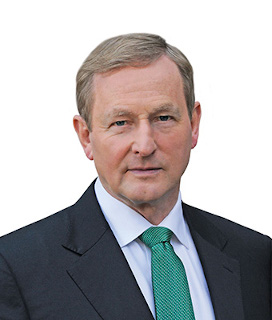
Kenny turns to politics in 1975 upon the death of his father, Henry Kenny, a long-serving member of the Dáil Éireann, representing Mayo. He wins a comfortable victory in a special election to fill his father’s seat, and at age 24 he is the youngest member of the Dáil. He spends much of his early political career on the backbench, focusing on local issues. In 1994 he is appointed Minister for Tourism and Trade in the “rainbow coalition” government of Fine Gael Taoiseach John Bruton.
With the collapse of Bruton’s coalition in 1997, Kenny loses his portfolio, but his stature rises as the party itself declines. Weeks after the 2002 Irish general election, which sees Fine Gael win just 31 seats, he is elected party leader. He immediately sets to restoring the party’s fortunes, and Fine Gael makes an impressive showing in the 2007 Irish general election, capturing 51 seats.
Fine Gael’s momentum continues to build as Fianna Fáil Taoiseach Brian Cowen, beset with a banking crisis and a soaring national deficit, is obliged to accept a bailout package of more than $100 billion from the International Monetary Fund and the European Union. The Green Party withdraws from Cowen’s coalition, and the government collapses, forcing early elections in February 2011. Capitalizing on widespread voter dissatisfaction, Fine Gael wins more than 70 seats, ending 14 years of Fianna Fáil rule, and Kenny begins discussions with the Labour Party about the formation of a coalition government. After more than a week of negotiations, the details of the coalition are settled and Kenny is formally elected Taoiseach by the Dáil on March 9, 2011, by an unprecedented 90 votes.
Kenny oversees a strong rebound by the Irish economy over the next five years, but the perception by many that the recovery has not been shared equally is reflected in the results of the 2016 Irish general election, when the electorate punishes the ruling coalition by ending its majority. In particular, voters appear to be disenchanted by the government’s pledge to end the Universal Social Charge — a graduated tax on all income over €13,000 — despite austerity-mandated cuts to social services. In the event, Fine Gael remains the largest party in the Dáil, but its share of the seats falls from the 76 it ultimately had secured in 2011 to 50, while coalition partner Labour plummets from 37 seats to seven. Meanwhile, Fianna Fáil, Fine Gael’s traditional rival for power, which had appeared politically moribund after the last general election, bounces back forcefully to add 24 seats to its 2011 count, reaching a total of 44 deputies.
With no party holding a majority and no quick path to coalition rule evident, a hung parliament ensues. Ten weeks of negotiations follow as Kenny seeks to form a government. Even the unheard-of possibility of grand coalition rule with Fianna Fáil is on the table. Finally, in early May, after much policy-related horse trading, an agreement is reached whereby Kenny and Fine Gael will continue to lead the government, supported by independent deputies and with a promise by Fianna Fáil that it will abstain on key votes until 2018. With Fianna Fáil abstaining, Kenny captures 59 votes on May 6, 2016, enough to return to power. In the process he becomes the first Fine Gael Taoiseach to be reelected.
A scandal involving the public smearing of a police whistleblower nearly topples the government in February 2017, and Kenny narrowly survives a vote of confidence, 57 to 52, with Fianna Fáil abstaining. Under pressure from the opposition as well as from members of his own party, Kenny stands down as Fine Gael leader in May 2017. The following month the party chooses Kenny’s Minister for Social Protection, Leo Varadkar, to succeed him as leader of Fine Gael. Kenny resigns as Taoiseach on June 13, 2017, and Varadkar is elected Taoiseach the following day.
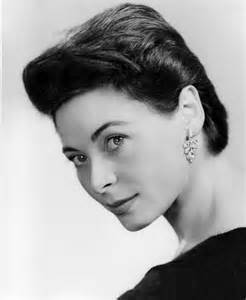
McKenna is born Siobhán Giollamhuire Nic Cionnaith into a Catholic and nationalist family in Belfast on May 24, 1923. She grows up in Galway, where her father is Professor of Mathematics at University College Galway, and in County Monaghan, speaking fluent Irish. She is still in her teens when she becomes a member of an amateur Gaelic theatre group and makes her stage debut at Galway’s Gaelic theatre, the Taibhdhearc na Gaillimhe, in 1940.
McKenna is remembered for her English language performances at the Abbey Theatre in Dublin where she eventually stars in what many consider her finest role in the George Bernard Shaw play, Saint Joan.
While performing at the Abbey Theatre in the 1940s, she meets actor Denis O’Dea, whom she marries in 1946. Until 1970 they live in Richmond Street South, Dublin. They have one child, a son Donnacha O’Dea, who swims for Ireland at the 1968 Summer Olympics and later wins a World Series of Poker bracelet in 1998.
In 1947, McKenna makes her debut on the London stage in The Chalk Garden. She reprises the role on Broadway in 1955, for which she receives a Tony Award nomination for “Best Actress in a Leading Role, Drama.” In 1956, she appears in the Cambridge Drama Festival production of Saint Joan at the Off-BroadwayPhoenix Theatre. Theatre critic Elliot Norton calls her performance the finest portrayal of Joan of Arc in memory. Siobhán McKenna’s popularity earns her the cover of Life magazine. She receives a second Tony Best Actress nomination for her role in the 1958 play, The Rope Dancers, in which she stars with Art Carney and Joan Blondell.
Although primarily a stage actress, McKenna appears in a number of made-for-television films and dramas. She also appears in several motion pictures such as King of Kings in 1961, as the Virgin Mary. In 1964, she performs in Of Human Bondage and the following year in Doctor Zhivago. She also appears in the miniseries The Last Days of Pompeii as Fortunata, wife of Gaius, played by Laurence Olivier. She stars in the title role of the Tales of the Unexpected episode “The Landlady.”
McKenna is awarded the Gold Medal of the Éire Society of Boston, for having “significantly fulfilled the ideals of the Éire Society, in particular, spreading awareness of the cultural achievements of the Irish people.”
McKenna’s final stage appearance comes in the 1985 play Bailegangaire for the Druid Theatre Company. Despite surgery, she dies of lung cancer on November 16, 1986, in Dublin, at 63 years of age. She is buried at Rahoon Cemetery in County Galway.
Between 1932 and 1937 Dillon serves as Teachta Dála (TD) for the Donegal constituency for the National Centre Party and after its merger with Cumann na nGaedheal, for the new party of Fine Gael. He plays a key role in instigating the creation of Fine Gael and becomes a key member of the party in later years. He remains as TD for Monaghan from 1937 to 1969. He becomes deputy leader of Fine Gael under W. T. Cosgrave.
Dillon resigns from Fine Gael in 1942 over its stance on Irish neutrality during World War II. While Fine Gael supports the government’s decision to stay out of the war, he urges the government to side with the Allies. He is a rabid anti-Nazi, proclaiming the Nazi ideology is “the devil himself with twentieth-century efficiency.” His zealousness against the Nazis draws him the ire of the German minister to Ireland, Eduard Hempel, who denounces him as a “Jew” and “German-hater.”
Dillon has a personally eventful 1942. While holidaying in Carna, County Galway he meets Maura Phelan of Clonmel on a Friday. By that Monday the two are engaged and six weeks after that they are married.
Dillon is one of the independents who supports the first inter-party government (1948–1951) and is appointed Minister for Agriculture. As Minister, he is responsible for huge improvements in Irish agriculture. Money is spent on land reclamation projects in the areas of less fertile land while the overall quality of Irish agricultural produce increases.
Dillon rejoins Fine Gael in 1953. He becomes Minister for Agriculture again in the second inter-party government (1954–1957). In 1959 he becomes leader of Fine Gael, succeeding Richard Mulcahy. He becomes president of the party in 1960. In 1965 Fine Gael loses the general election to Seán Lemass and Fianna Fáil. The non-Fianna Fáil parties win 69 seats to Fianna Fáil’s 72. Had the other parties been able to win four more seats between them, they would have been able to form a government. Having narrowly failed to become Taoiseach, Dillon stands down as Fine Gael leader after the election.
Dillon is a colourful contributor to Dáil proceedings and is noted for his high standard of oratory. He remains a TD until 1969, when he retires from politics. He died in Malahide, Dublin on February 10, 1986, at the age of 83.
After the failure of the Young Ireland Rebellion of 1848, O’Leary attempts to rescue the Young Ireland leaders from Clonmel Gaol, and is himself imprisoned for a week from September 8, 1849. He takes part in a further attempted uprising in Cashel on September 16, 1849, but this proves abortive.
On September 16, 1865, O’Leary is arrested and later tried on charges of high treason, eventually reduced to “treason felony.” He is sentenced to twenty years of penal servitude, of which five years are spent in English prisons, prior to his release and exile in January 1871. During his exile, he lives mainly in Paris, also visiting the United States, remains active in the IRB and its associated organisations, and writes many letters to newspapers and journals.
On the expiration of his 20-year prison term and therefore of the conditions associated with his release in 1885, O’Leary returns to Ireland. He and his sister, the poetEllen O’Leary, both become important figures within Dublin cultural and nationalist circles, which include William Butler Yeats, Maud Gonne, Rose Kavanagh, Rosa Mulholland, George Sigerson, and Katharine Tynan. He also functions as an elder statesman of the separatist movement, being active in the Young Ireland Society, and acts as president of the Irish Transvaal Committee, which supports the Boer side in the Second Boer War.
John O’Leary dies at his residence in Dublin on the evening of March 16, 1907. He is referred to famously by W.B. Yeats in his poem September 1913: “Romantic Ireland’s dead and gone/It’s with O’Leary in the grave.”
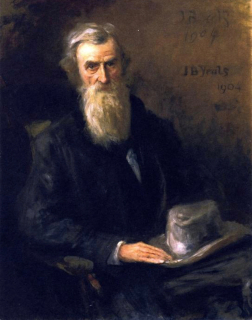
(Pictured: Painting of John O’Leary, a favorite subject of John Butler Yeats (1904). The National Gallery of Ireland owns three oil portraits of O’Leary.)
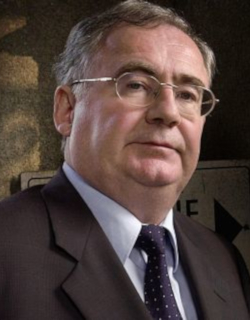
Rabbitte becomes involved in electoral politics for the first time in late 1982, when he unsuccessfully contests Dublin South-West for the Workers’ Party (WP) at the November general election. He is elected to Dublin County Council in 1985. He enters Dáil Éireann as a Workers’ Party Teachta Dála (TD) for Dublin South-West at the 1989 election. He retains his seat at every election until 2016.
After Tomás Mac Giolla‘s retirement as President of the Workers’ Party in 1988, Rabbitte is seen as one of those who wants to move the party away from its hard left position. In 1992, he plays a prominent role with Proinsias De Rossa in an attempt to jettison some of the party’s harder left positions. This eventually splits the Workers’ Party.
In 1994, a new ‘Rainbow Coalition’ government of Fine Gael, the Labour Party and Democratic Left comes to power. Rabbitte is a member of the junior ministerial team, serving as Minister of State to the Government, as well as Minister for State at the Department of Enterprise and Employment with responsibility for Commerce, Science and Technology.
Following the 1997 general election the Rainbow Coalition loses power. The following year sees a merger between the Labour Party and Democratic Left, with Rabbitte participating in the negotiations. In October 2002 he succeeds Ruairi Quinn as the new leader of the Labour Party. Under his leadership the party makes some gains in the local elections of 2004.
The Labour Party agrees to enter a pre-election pact, commonly known as ‘The Mullingar Accord,’ with Fine Gael in an attempt to offer the electorate an alternative coalition government at the 2007 general election. This move causes some tension in the parliamentary party, as some members prefer not to be aligned with any party in advance of an election.
Following the disappointing result in the election for Labour, Rabbitte announces he is stepping down as leader on August 23, 2007. He is succeeded as party leader by Eamon Gilmore. Rabbitte is re-elected on the first count in the 2011 general election. His running mate Eamonn Maloney is also elected. On March 9, 2011, he is appointed as Minister for Communications, Energy and Natural Resources.
In July 2014, Rabbitte is replaced by Alex White as part of a reshuffle of the cabinet. He does not contest the 2016 general election.
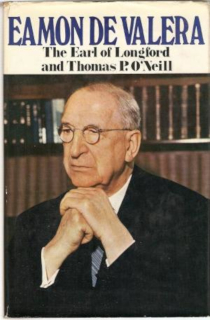
De Valera knows of O’Neill’s reputation as a historian and asks him to undertake the project. A contract is signed with the publishers in 1963, and O’Neill moves to Áras an Uachtaráin to work on the book. He is later joined by Lord Longford as co-author.
O’Neill’s other works include a biography in Irish of James Fintan Lalor and a major study of the Great Famine, which establishes his reputation as a historian.
After the completion of the de Valera work, O’Neill is appointed lecturer and later professor of history in University College, Galway. On his retirement, he returns to live in Dublin, where he renews his association with the National Library, becoming a strong supporter of its expansion.
O’Neill is survived by his wife, Marie, and six children. His funeral Mass takes place at St. Joseph’s Church on March 5, followed by his interment at Shanganagh Cemetery.
(From: “Biographer of de Valera dies at 74,” The Irish Times, Monday, March 4, 1996)
Michael “Mick” Lally, Irish stage, film and television actor, dies in Dublin on August 31, 2010. He departs from a teaching career for acting during the 1970s. Though best known in Ireland for his role as Miley Byrne in the television soap Glenroe, his stage career spans several decades, and he is involved in feature films such as Alexander and the Academy Award-nominated The Secret of Kells. Many reports cite him as one of Ireland’s finest and most recognisable actors.
In 1982, Lally stars in the TV series The Ballroom of Romance alongside Brenda Fricker. From 1983 he plays the role of Miley Byrne in the RTÉ soap Glenroe, reprising the character that he played earlier in Bracken in 1978. In 1979, he wins a Jacob’s Award for his performance as Miley in Bracken. He also has some musical success when “The By-road to Glenroe” goes to the top of the Irish charts in 1990. He is also involved in voice-over work, including a noted advertisement for Kilmeaden Cheese during the 1990s. Other TV appearances include roles in Tales of Kinvarna, The Year of the French and Ballykissangel.
In 1994, Lally plays the character Hugh in The Secret of Roan Inish, and in 1995 portrays Dan Hogan in the film adaptation of Maeve Binchy‘s Circle of Friends. Other film roles included Poitín, Our Boys, The Outcasts, A Man of No Importance and others. In later years, he provides the voice of Brother Aidan in the Academy Award-nominated The Secret of Kells, an animated film directed by Tomm Moore.
Lally appears in several TV advertisements encouraging elderly people to “release the equity tied up in their homes” during the Celtic Tiger.
Mick Lally dies on the morning of August 31, 2010, after a short stay in the hospital. The cause of death is reported as heart failure, arising from an underlying emphysema condition. His funeral takes place in Dublin on September 2, 2010. The Irish Examiner comments that the “nation has lost one of its favourite uncles.” Personalities from TV, film, theatre and politics attend, while President of IrelandMary McAleese sends a letter and Lally receives a standing ovation at the end.
Though most widely remembered for playing rugby union, Fitzgerald is an accomplished sportsman, winning two All-Ireland boxing championships. He also plays minor hurling for Galway GAA with his team reaching the minor final against Cork GAA in 1970.
Fitzgerald rises to prominence in the game of rugby, making his test debut for Ireland against Australia on June 3, 1979, during an Irish tour of Australia. His last test comes against Scotland on March 15, 1986, in the 1986 Five Nations Championship. In total, Fitzgerald receives 22 competitive and three friendly caps for Ireland. He scores once, a try against Wales, in the 1980 Five Nations Championship. He also captains the British and Irish Lions team on their 1983 tour, when the team travels to New Zealand and is beaten in each test against the All Blacks.
Following his retirement from playing, Fitzgerald continues to be involved in the game. He serves as head coach of Ireland from 1990 to 1992, leading the team to the 1991 Rugby World Cup, where they reach the quarterfinals. He also had a career in media, appearing on Setanta Sports and RTÉ, the Irish national TV and radio service, as a rugby pundit.
Delia Murphy Kiernan, singer and collector of Irish ballads, is born on February 16, 1902, in Ardroe, Roundfort, County Mayo. She records several 78 rpm records in the 1930s, 1940s and 1950s. In 1962 she records her only LP, The Queen of Connemara, for Irish Prestige Records, New York, on the cover of which her name appears alongside the LP title.
Delia’s father, John Murphy, from nearby Hollymount, makes his fortune in the Klondike Gold Rush. While in America, he marries Ann Fanning from Roscrea, County Tipperary. They return to Ireland in 1901 and purchase the large Mount Jennings Estate in Hollymount. John encouraged Delia’s interest in singing ballads from a young age. He also allows Irish travelers to camp on the estate. According to her own account, she learns her first ballads at their campfires.
Delia is educated at Presentation Convent in Tuam, Dominican College in Dublin and University College Galway (UCG), where she graduates with a Bachelor of Commerce degree. In UCG she meets Dr. Thomas J. Kiernan, and they marry in 1924, on her 22nd birthday. Kiernan then joins the Irish diplomatic service, where his first posting is to London. While there Delia sings at many venues including many gatherings of Irish emigrants and becomes quite well-known. In 1939 she records The Blackbird, The Spinning Wheel and Three Lovely Lassies for HMV.
In 1941 Kiernan is appointed Irish Minister Plenipotentiary to the Holy See in Rome. The Irish legation is the only English-speaking legation to remain open after the United States enters World War II. Delia becomes one of those who assist Hugh O’Flaherty in hiding Jews and escapes allied soldiers from the Nazis. In 1943, when Italy changes sides, many escaped POWs are helped by the legation to leave Italy. In 1946 she is awarded to Dame Commander of the Equestrian Order of the Holy Sepulchre.
Kiernan later serves as Irish High Commissioner and later first Ambassador in Australia, and later to West Germany, Canada, and the United States. In 1961, while she is living in Ottawa, Delia makes the recording of The Queen of Connemara produced by Ken Goldstein. The Kiernans purchase a farmhouse in Jasper, Ontario, near the Rideau Canal where she spends most of her time, even after Kiernan is posted to Washington, D.C. Tom Kiernan dies in December 1967.
By 1969 Delia’s health is in decline. In November of that year, she sells her farmhouse in Canada and returns to Ireland. She lives in a cottage in Strawberry Beds, Chapelizod, County Dublin. She dies of a massive heart attack on February 11, 1971, five days before her 69th birthday. She records upwards of 100 songs during her lifetime.





 seamus dubhghaill