It has more than 500,000 members worldwide, assets in excess of €2.6 billion, and declares total revenues of €94.8 million in 2010, with a total gross profit of €78.5 million.
Gaelic football and hurling are the most popular activities promoted by the organisation, and the most popular sports in the Republic of Ireland in terms of attendances. Gaelic football is also the largest participation sport in Northern Ireland. GAA competitions, activities, and structures are organised on an all-Ireland basis, without reference to the border drawn in 1921. The women’s version of these games, ladies’ Gaelic football and camogie, are organised by the independent but closely linked Ladies’ Gaelic Football Association and the Camogie Association respectively. GAA Handball is the Irish governing body for the sport of handball, while the other Gaelic sport, rounders, is managed by the GAA Rounders National Council.
Since its foundation in the late 19th century, the Association has grown to become a major influence in Irish sporting and cultural life with considerable reach into communities throughout Ireland and among the Irish diaspora.
Bulldozers begin demolishing Northern Ireland‘s notorious HM Prison Maze, previously known as Long Kesh Detention Centre, on October 31, 2006. The prison once housed the most dangerous guerrillas from both sides of the province’s sectarian conflict.
Among the inmates at Maze are ten Irish nationalisthunger strikers who starved themselves to death in 1981. The prison has been empty since 2000, after the release of most guerrilla prisoners under the Good Friday Agreement, which ushered in relative peace after 30 years of fighting in which 3,600 people died.
A sports stadium, equestrian center, hotel, and shopping center are originally proposed for the 360-acre site in County Antrim. In January 2009, however, Sports Minister Gregory Campbell rules out the plan for a multi-sports stadium which has divided political and sporting opinion, opting instead to explore alternatives with the soccer, rugby, and Gaelic Athletic Association (GAA) authorities.
Northern Ireland first and deputy first ministers, Peter Robinson and Martin McGuinness, announce in 2010 that an agreement has been reached on building a peace and conflict resolution facility at the Maze site. It will also host the Royal Ulster Agricultural Society’s annual show. On February 2, 2012, European funding of £18m is approved for building the contentious conflict resolution centre.
Planning permission for the peace centre on the site of the former prison is granted on April 18, 2013. However, in June the Orange Order calls on unionist politicians to halt the peace centre plan, objecting to its location on the former prison site.
On August 15, 2013, Peter Robinson calls a halt to the peace centre plan. In a letter to Democratic Unionist Party (DUP) members, he says it would be wrong to proceed without a consensus about how it will operate. As a result, in October 2013 the European Union funding programme withdraws its £18m offer in financial support for the Maze peace centre.
That the Maze Prison development remains unrealised 16 years after the site’s closure testifies to the complexities involved. That the prospect of redevelopment has never been taken off the table affirms the ineluctable power ideas of profit still hold.
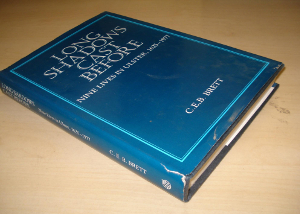
Brett is born into a long line of solicitors, the family firm being L’Estrange and Brett, based in Belfast. He is a partner there from 1954 until 1994. He is educated at Rugby School and New College, Oxford, where he is President of the Poetry Society and a friend of Dylan Thomas and attends lectures by Lord Clark.
Between 1949 and 1950 he works in France as a journalist with the Continental Daily Mail, where he is said to have mixed in anarchist and Trotskyite circles.
In 1956, the Earl of Antrim invites Brett to join the Northern Ireland Committee of the National Trust. On finding there are no books written to prepare himself for this, he resolves to write the necessary volumes. In 1957 he becomes the first chairman of the Ulster Architectural Heritage Society, founded alongside, amongst others Lady Dunleath. Brett serves as chairman for ten years and then as President from 1979 until his death.
With the National Trust he puts his legal skill to use in order to establish a public footpath along the cliffs of the North Coast of Ulster. He also sits on the board of the Irish Architectural Archive in Dublin.
In 1971, he is appointed to the board of the newly created Northern Ireland Housing Executive. He serves as Chairman for five years from 1979, during which time 50,000 dwellings are built. He is asked to compile a list of historic buildings in Jersey in 1975. In 1986, Brett becomes the first chairman of the International Fund for Ireland, established to encourage investment in Ireland.
Brett is also involved in Northern Irish politics, being chairman of the Northern Ireland Labour Party for a time. In 1981 he receives a CBE, this is followed by a Knighthood in 1990.
Brett dies on December 19, 2005. His church memorial is located along those of his family in the Comber Church of Ireland Parish Church of St. Mary, in Comber, North County Down.
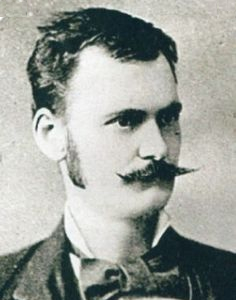
The style of trompe-l’œil painting that Harnett develops is distinctive and inspired many imitators, but it is not without precedent. A number of 17th century Dutch painters, Pieter Claesz for instance, specialize in tabletop still life of astonishing verisimilitude. Raphaelle Peale, working in Philadelphia in the early 19th century, pioneers the form in America. What sets Harnett’s work apart, besides his enormous skill, is his interest in depicting objects not usually made the subject of a painting.
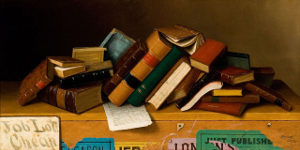
Harnett paints musical instruments, hanging game, and tankards, but also painted the unconventional Golden Horseshoe (1886), a single rusted horseshoe shown nailed to a board. He paints a casual jumble of second-hand books set on top of a crate, Job Lot, Cheap (1878), as well as firearms and even paper currency. His works sell well, but they are more likely to be found hanging in a tavern or a business office than in a museum, as they did not conform to contemporary notions of high art.
Harnett spent the years 1880–1886 in Europe, staying in Munich from 1881 until early 1885. Harnett’s best-known paintings, the four versions of After the Hunt, are painted between 1883 and 1885. Each is an imposing composition of hunting equipment and dead game, hanging on a door with ornate hinges at the right and keyhole plate at the left. These paintings, like the horseshoe or currency depictions mentioned earlier, are especially effective as trompe-l’œil because the objects occupy a shallow space, meaning that the illusion is not spoiled by parallax shift if the viewer moves.
Overall, Harnett’s work is most comparable to that of the slightly younger John F. Peto. The two artists know each other, and a comparison can be made between two paintings featuring violins. Harnett’s Music and Good Luck from 1888 shows the violin hanging upright on a door with ornate hinges and with a slightly torn piece of sheet music behind it. The elements are arranged in a stable, deliberate manner. Peto’s 1890 painting shows the violin hanging askew, as well as chipped and worn, with one string broken. The sheet music is dog-eared and torn around the edges and placed haphazardly behind the instrument. The hinges are less ornate, and one is broken. Harnett’s objects show signs of use but are well preserved, while Peto’s more humble objects are nearly used up.
Crippling rheumatism plagues Harnett in his last years, reducing the number but not the quality of his paintings. He seeks relief in the waters at Karlsbad and Wiesbaden, Germany and later at Hot Springs, Arkansas. But he continues to worsen and is hospitalized several times. He dies in New York City in 1892.
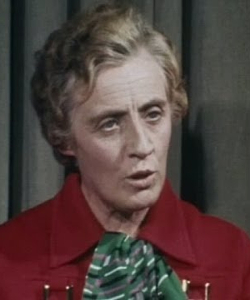
Drumm is born in Newry, County Down to a staunchly Irish republican family. Drumm’s mother has been active in the Irish War of Independence and the Irish Civil War. Drumm grows up in the village of Killean, County Armagh, where she plays camogie. She is active in the republican movement after meeting her husband, a republican prisoner. She begins to speak at many rallies and protest meetings and is soon elected as Vice President of Sinn Fein. She becomes involved in the Northern Ireland Civil Rights Association in the 1960s and works to rehouse Catholics forced from their homes by loyalist intimidation.
Drumm is jailed twice for seditious speeches. After she is released from HM Prison Armagh, raids on her house by the security forces escalate. She is widely demonised in the British media and is already a target for assassination when she is admitted to Belfast’s Mater Hospital for eye treatment in October 1976.
While recovering from the operation, Drumm is shot at point blank range in a joint operation by the Ulster Volunteer Force and the Ulster Defence Association who are able to enter and leave the hospital undisturbed. No one has ever been convicted of her murder.
Drumm’s speeches and quotations can be found on murals across Northern Ireland, including:
“The only people worthy of freedom are those who are prepared to go out and fight for it every day, and die if necessary.”
“We must take no steps backward, our steps must be onward, for if we don’t, the martyrs that died for you, for me, for this country will haunt us forever.”
As an heir to the Guinness brewing fortune and a handsome, charming young man, Bryan is an eligible bachelor. One of London’s “Bright Young Things,” he is an organiser of the 1929 “Bruno Hat” hoax art exhibition held at his home in London. Also, in 1929 he marries the Hon. Diana Mitford, one of the Mitford sisters, and has two sons with her. The couple become leaders of the London artistic and social scene and are dedicatees of Evelyn Waugh‘s second novel Vile Bodies. However, they divorce in 1933 after Diana deserts him for British fascist leader Sir Oswald Mosley.
Guinness remarries happily in 1936 to Elisabeth Nelson, of the Nelson publishing family, with whom he has nine children.
During World War II, Guinness serves for three years in the Middle East with the Spears Mission to the Free French, being a fluent French speaker, with the rank of major. Then in November 1944 Guinness succeeds to the barony when his father, posted abroad as Resident Minister in the Middle East by his friend Winston Churchill, is assassinated in Cairo.
After the war, Lord Moyne serves on the board of the Guinness corporation as vice-chairman (1947-1979), as well as the Guinness Trust and the Iveagh Trust, sitting as a crossbencher in the House of Lords. He serves for 35 years as a trustee of the National Gallery of Ireland and donates several works to the gallery. He writes a number of critically applauded novels, memoirs, books of poetry, and plays. With Frank Pakenham he seeks the return of the “Lane Bequest” to Dublin, resulting in the 1959 compromise agreement. He is invested as a Fellow of the Royal Society of Literature.
Lord Moyne dies of a heart attack on July 6, 1992, at Biddesden House, his home in Wiltshire, and is succeeded by his eldest son Jonathan. He is buried at Ludgershall, Wiltshire, England.
Comhdháil Náisiúnta na Gaeilge, the central steering council for the Irish language community, is formed on October 26, 1943. Its mission is to “strengthen and consolidate goodwill and support for the Irish language and its usage as a living language so that it may be used freely and widely in all aspects of Irish life.”
The role of Comhdháil Náisiúnta na Gaeilge is to act as a coordinating body for voluntary Irish language organisations. The National Youth Council of Ireland and the Irish Congress of Trade Unions are similar umbrella organisations. The board of the nonprofit organisation is made up of representatives of its 24 member organisations. The secretaria of An Chomhdháil, ten employees, is responsible for the day-to-day running of the organisation.
The organisation sees its role as providing leadership to those involved in community and voluntary work on behalf of the Irish language, to provide analysis of Government policies with reference to the language, and the development and promotion of new policy measures. In practice this meant developing policies which are broadly acceptable to all member organisations and have their support, political lobbying in support of various issues and the undertaking of new and innovative projects.
The information website Gaelport.com is a project managed by staff of Comhdháil Náisiúnta na Gaeilge. The community-focused website contains information on Irish language news and events as well as Irish language classes and vacancies. It also contains information on advocacy work carried out by Comhdháil Náisiúnta na Gaeilge and other Irish language organisations. The website wins best Irish language website at the 2010 Irish Web Awards.
The last meeting of the board of management of Comhdháil Náisiúnta na Gaeilge is on the evening of July 14, 2014, due to an abrupt end of funding from Foras na Gaeilge, the inter-governmental agency established to promote the Irish language throughout the island of Ireland. The management board of Comhdháil Náisiúnta na Gaeilge thus has no choice but to cease all activities with the loss of six full-time staff.
In 1181, he is elected to the archbishopric of Dublin by some of the clergy of Dublin, who have assembled at Evesham for the purpose. He is not then a priest, but is subsequently, in the same year, ordained such, at Velletri, and on Palm Sunday is consecrated archbishop by Pope Lucius III. The following year the pope grants him manors and lands in and around Dublin, which subsequently form the Manor of St. Sepulchre, which remains under the authority of the Archbishop of Dublin until the 19th century. The pope also, in an effort to protect the Dublin archbishopric from claims from Canterbury, extends certain privileges to Comyn, which intensifies the rivalry between the sees of Dublin and Armagh for the Primacy of Ireland.
Comyn waits three years before visiting Ireland, until he is sent there by King Henry to prepare the reception of his son, Prince John. The king grants him lands and privileges which make him a Lord of Parliament. After his arrival in Ireland, John grants Comyn the Bishopric of Glendalough, with all its appurtenances in lands, manors, churches, tithes, fisheries, and liberties, although Comyn never has an opportunity to take this up in his lifetime. Under Pope Urban III, Comyn carries out a number of reforms of the Irish church to bring it into line with the church in England and in continental Europe.
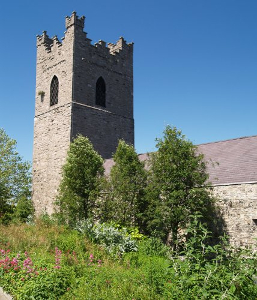
In 1189, Archbishop Comyn assists at the coronation of King Richard I. The following year he demolishes the old parish church of St. Patrick, south of Dublin, and erects a new building, next to his Palace of St. Sepulchre, which he elevates to the status of a collegiate church, and which later becomes St. Patrick’s Cathedral. This enables him to rule in his own Liberty, without the interference of mayor and citizens. About the same time, he enlarges the choir of Christ Church Cathedral.
Prince John grants Comyn further legal rights throughout the country of Ireland, while Comyn also receives the church and lands of All Hallows, to the northeast of Dublin. Between Lusk and Swords, he founds the convent of Grace Dieu, which later becomes wealthy through grants from the Anglo-Norman prelates and magnates. However, when Hamo de Valoniis is appointed Justiciar of Ireland he seizes some of these lands for the treasury, with a good portion for himself, and a dispute arises which causes Comyn to flee for his own safety to Normandy. Comyn appeals to Pope Innocent III, who settles the dispute, but John is angered by the actions of Comyn and does not reconcile himself with him until 1206.
Comyn dies six years later and is buried in Christ Church Cathedral, where a marble monument is erected to his memory. Two years later William Piro, Bishop of Glendalough, dies, whereupon the union of the sees granted by King John takes place.
(Pictured: St. Audoen’s Church, the only remaining authentic medieval church in Dublin, built by Archbishop John Comyn around 1190)
Construction begins on the Royal Canal on October 24, 1789. The canal is originally built for freight and passenger transportation from the River Liffey in Dublin to Longford.
In 1755, Thomas Williams and John Cooley make a survey to find a suitable route for a man-made waterway across north Leinster from Dublin to the River Shannon. They originally plan to use a series of rivers and lakes, including the Boyne, Blackwater, Deel, Yellow, Camlin, and Inny and Lough Derravaragh.
Work commences in 1789 and lasts 27 years before finally reaching the River Shannon in 1817, at a total cost of £1,421,954. Construction is unexpectedly expensive, and the project is riven with problems. In 1794 the Royal Canal Company is declared bankrupt. The Duke of Leinster, a board member, insists that the new waterway take in his local town of Maynooth. The builders have to deviate from the planned route and necessitate the construction of a ‘deep sinking’ between Blanchardstown and Clonsilla. The diversion also calls for the building of the Ryewater Aqueduct, at Leixlip.
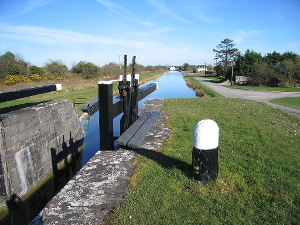
The canal passes through Maynooth, Kilcock, Enfield, Mullingar and Ballymahon has a spur to Longford. The total length of the main navigation is 145 kilometres (90 miles), and the system has 46 locks. There is one main feeder, from Lough Owel, which enters the canal at Mullingar.
In 200 years, it has been maintained by eight successive agencies – the Royal Canal Company, the Commissioners of Inland Navigation, the New Royal Canal Company, Midland Great Western Railway Company, Great Southern Railways, CIÉ, and the Office of Public Works.
The canal falls into disrepair in the late 20th century, but much of the canal has since been restored for navigation. The length of the canal to the River Shannon is reopened on October 1, 2010, but the final spur branch of the canal to Longford Town remains closed.
(Pictured: Royal Canal as it enters Dublin city centre (left) and Royal Canal in rural County Westmeath north of Kinnegad (right)
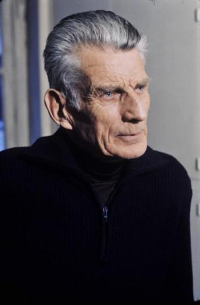
Samuel Barclay Beckett, Irish avant-garde novelist, playwright, theatre director, and poet, is awarded the Nobel Prize in Literature on October 23, 1969. Beckett lives in Paris for most of his adult life and writes in both English and French. He is widely regarded as among the most influential writers of the 20th century. He is elected Saoi of Aosdána in 1984.
In October 1969 while on holiday in Tunis with his wife Suzanne, Beckett hears that he has won the Nobel Prize for Literature. Anticipating that her intensely private husband would be saddled with fame from that moment on, Suzanne calls the award a “catastrophe.” In true ascetic fashion, he gives away all of the prize money. While Beckett does not devote much time to interviews, he sometimes meets the artists, scholars, and admirers who seek him out in the anonymous lobby of the Hotel PLM St. Jacques in Paris near his Montparnasse home. Although Beckett is an intensely private man, a review of the second volume of his letters by Roy Foster in the December 15, 2011 issue of The New Republic reveals Beckett to be not only unexpectedly amiable but frequently prepared to talk about his work and the process behind it.
Confined to a nursing home and suffering from emphysema and possibly Parkinson’s disease, Beckett dies on 22 December 22, 1989, just five months after the passing of Suzanne. The two are interred together in the Cimetière du Montparnasse in Paris and share a simple granite gravestone that follows Beckett’s directive that it should be “any colour, so long as it’s grey.”
Of all the English-language modernists, Beckett’s work represents the most sustained attack on the realist tradition. He opens up the possibility of theatre and fiction that dispense with conventional plot and the unities of time and place in order to focus on essential components of the human condition.

 The Gaelic Athletic Association (GAA) is founded on November 1, 1884, by a group of Irishmen gathered in the billiard room of the Hayes’ Hotel in Thurles, County Tipperary. The architects and founding members are Michael Cusack of County Clare, Maurice Davin, Joseph K. Bracken, Thomas St. George McCarthy, P.J. Ryan of Tipperary, John Wyse Power, and John McKay. Their goal is to to formulate a plan and establish an organisation to foster and preserve Ireland’s unique games and athletic pastimes.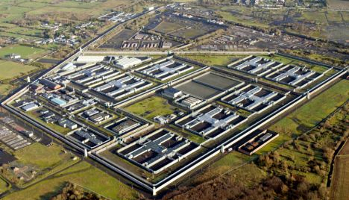



 seamus dubhghaill