Though most widely remembered for playing rugby union, Fitzgerald is an accomplished sportsman, winning two All-Ireland boxing championships. He also plays minor hurling for Galway GAA with his team reaching the minor final against Cork GAA in 1970.
Fitzgerald rises to prominence in the game of rugby, making his test debut for Ireland against Australia on June 3, 1979, during an Irish tour of Australia. His last test comes against Scotland on March 15, 1986, in the 1986 Five Nations Championship. In total, Fitzgerald receives 22 competitive and three friendly caps for Ireland. He scores once, a try against Wales, in the 1980 Five Nations Championship. He also captains the British and Irish Lions team on their 1983 tour, when the team travels to New Zealand and is beaten in each test against the All Blacks.
Following his retirement from playing, Fitzgerald continues to be involved in the game. He serves as head coach of Ireland from 1990 to 1992, leading the team to the 1991 Rugby World Cup, where they reach the quarterfinals. He also had a career in media, appearing on Setanta Sports and RTÉ, the Irish national TV and radio service, as a rugby pundit.
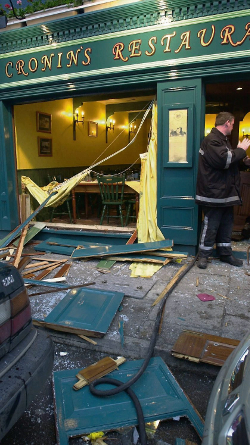
At about 8:10 PM on a busy Saturday night, owner Pat Cronin smells gas in the restaurant and moves swiftly to evacuate all 30 guests. The people are moved out but, while standing on the pavement outside the restaurant, the restaurant explodes and twelve people are injured by flying debris and broken glass. They are transported to Tralee Hospital with four being detained overnight.
Gardaí and fire officers at the time believe that the explosion resulted from a domestic propane gas supply. The gas is piped from cylinders in a small, open backyard into the restaurant kitchen. The tank itself fails to explode and, had it done so, fire officers say that it would have taken out the whole building. The site is described by witnesses “for all the world like the aftermath of a bomb blast.”
Plates and cutlery remain undamaged on the tables in the aftermath of the explosion, while the downstairs glass and wood front of the building is blown onto the street. Locks are blown off the back doors of the adjoining Corcoran’s Tours shop and glass is shattered. A ceiling of an upstairs room in the nearby Fáilte Hotel partly collapses. The sides of two parked cars are damaged by the force of the explosion and by flying wood. Four ambulances and two units of the Killarney fire brigade are called to the scene. Nearby houses, hotels and pubs are evacuated for up to an hour and most of College Street is cordoned off for several hours.
Sergeant Ray Walsh, who attends the scene along with six gardaí, says, “They expected the worst themselves and, in fairness, they got the place evacuated.” Owner Pat Cronin receives deserved praise for showing the initiative and quick thinking in clearing the restaurant and saving people from serious injury or worse.
The Fenian insurgents, led by Brigadier GeneralJohn O’Neill, a former Union cavalry commander who had specialized in anti-guerrilla warfare in Ohio, secures boats and transfers some 800 men across the Niagara River, landing above Fort Erie, before dawn on June 1, 1866. An additional 200–400 Fenians and supplies cross later in the morning and early afternoon until the U.S. Navygunboat, the USS Michigan, begins intercepting Fenian barges at 2:20 PM.
O’Neill spends the first day trying to rally the local citizenry to the Fenian cause and to commandeer supplies for his mission, but his force is plagued by desertions almost from the outset. An additional column of 200 Fenians join his group, bringing his total strength at Ridgeway to at least 650 men.
Meanwhile, the British are mobilizing both local Canadian militia and British garrison troops to defend against the impending invasion of Canada. The Fenians night-march north across Black Creek through a cedar swamp, then turn inland on Ridge Road on the morning of June 2, taking up a defensive position on Limestone Ridge near the present Canadian town of Ridgeway. There, they clash with 850 advancing Canadian militia commanded by Lieutenant-Colonel Alfred Booker of the 13th Battalion.
In the first hour of the battle, the Canadians appear to prevail, driving Fenian skirmishers back across Bertie Road. Then the tide turns, and to this day, it is not clear what causes the impending chaos. O’Neill, observing the chaos breaking out in the Canadian ranks, quickly orders a bayonet charge that completely routs the inexperienced Canadians. The Fenians take and briefly hold the town of Ridgeway. Then, expecting to be overwhelmed by British reinforcements, they quickly turn back to Fort Erie where they fight a second battle, the Battle of Fort Erie, against a small but determined detachment of Canadians holding the town.
The Canadian loss is nine killed on the field, four dying of wounds in the immediate days following the battle, 22 dying of wounds or disease later and 37 are wounded, some severely enough to require amputation of their limbs. O’Neill says that four or five of his men are killed, but Canadians claim to have found six Fenian bodies on the field. The relatively low casualty figures make this an interesting battle for proponents of theories about soldiers’ reluctance to shoot to kill but might also be accounted for by the fact that the Fenians had deployed only their skirmishers in an attempt to lure the Canadians towards their main force which did not advance until the last minutes of the battle when they launched a bayonet attack that broke Canadian lines.
In 1972, Linehan wins a Jacob’s Award for her RTÉ Radio comedy series Get an Earful of This. She is the recipient of the Lifetime Achievement Award at the Irish Theatre Awards in 2008.
Linehan and her husband live in Dublin and have four children and eight grandchildren. Her father Daniel McMenamin was a Teachta Dála for Donegal from 1927 to 1961.
The hull of the RMS Titanic, is launched at 12:15 PM on May 31, 1911 at the Harland & Wolff shipyard in Belfast, Northern Ireland in the presence of Lord William Pirrie, J. Pierpoint Morgan, J. Bruce Ismay and 100,000 onlookers. Twenty-two tons of soap and tallow are spread on the slipway to lubricate the ship’s passage into the River Lagan. In keeping with the White Star Line‘s traditional policy, the ship is not formally named or christened with champagne. The ship is towed to a fitting-out berth where, over the course of the next year, her engines, funnels and superstructure are installed and her interior is fitted out.
The construction of RMS Olympic and RMS Titanic take place virtually in parallel. The sheer size of the RMS Titanic and her sister ships pose a major engineering challenge for Harland and Wolff. No shipbuilder has ever before attempted to construct vessels this size. RMS Titanic‘s keel is laid down on March 31, 1909. The 2,000 hull plates are single pieces of rolled steel plate, mostly up to 6 feet wide and 30 feet long and weigh between 2.5 and 3 tons.
Some of the last items to be fitted on RMS Titanic before the ship’s launch are her two side anchors and one centre anchor. The anchors themselves are a challenge to make with the centre anchor being the largest ever forged by hand and weighing nearly 16 tons. Twenty Clydesdale draught horses are needed to haul the centre anchor by wagon from the N. Hingley & Sons Ltd. forge shop in Netherton, near Dudley, United Kingdom to the Dudley railway station two miles away. From there it is shipped by rail to Fleetwood in Lancashire before being loaded aboard a ship and sent to Belfast.
The work of constructing the ships is difficult and dangerous. For the 15,000 men who work at Harland and Wolff at the time, safety precautions are rudimentary at best. Much of the work is dangerous and is carried out without any safety equipment like hard hats or hand guards on machinery. As a result, deaths and injuries are to be expected. During RMS Titanic‘s construction, 246 injuries are recorded, 28 of them “severe,” such as arms severed by machines or legs crushed under falling pieces of steel. Six people die on the ship herself while she is being constructed and fitted out, and another two die in the shipyard workshops and sheds. Just before the launch a worker is killed when a piece of wood falls on him.
(Pictured: Launch of the hull of the RMS Titanic with an unfinished superstructure in 1911)
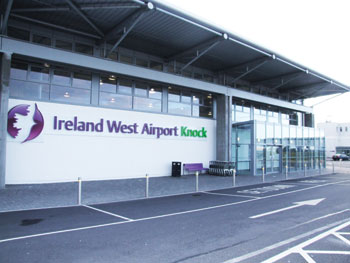
Ireland West Airport, officially known as Ireland West Airport Knock, at Knock, County Mayo, and now named Horan International Airport, is officially opened by TaoiseachCharles Haughey on May 30, 1986. The airport is located 5.6 km (3.5 miles) southwest of Charlestown, County Mayo. The village of Knock is 20 km (12.5 miles) away.
The airport opens on October 25, 1985 with three Aer Lingus charter flights to Rome however the official opening is on May 30, 1986. The site, on a hill in boggy terrain, is thought by many to be unrealistic but the airport is built following a long and controversial campaign by MonsignorJames Horan, the story of which has even spawned a musical.
At the time of construction, the primary motivation is for pilgrims to Knock Shrine. Despite criticisms that the site is too boggy and too foggy, Monsignor Horan delivers an airport within five years, primarily financed by a Government grant of £9.8 million. Monsignor Horan dies shortly after the opening of the airport, and his funeral is held at the then named Horan International Airport. In recent times, Monsignor Horan has been celebrated with a bronze statue erected at the airport.
By 1988, over 100,000 passengers have passed through the airport. In 1995 Aer Lingus commences flights to Birmingham Airport. On June 1, 2003, hundreds of people gather to view an Air Atlanta IcelandicBoeing 747 land with 500 returning pilgrims from Lourdes.
In 2016, 735,869 passengers use the airport, making it the fourth busiest in the Republic of Ireland after Dublin Airport, Cork Airport and Shannon Airport. It is announced in November 2017 that €15 million will be invested in improving and upgrading the airport in 2018 and 2019, to coincide with strong passenger growth. These plans include upgrading of car parks, passenger facilities, the terminal and resurfacing of the runway.
Within two years of their marriage, both of their sons, Cyril and Vyvyan, are born. In 1888 Constance publishes a book based on children’s stories she has heard from her grandmother, called There Was Once. Both Oscar and Constance are involved in the Victorian dress reform movement.
It is unknown at what point Constance becomes aware of her husband’s homosexual relationships. In 1891 she meets his lover Lord Alfred Douglas when Wilde brings him to their home for a visit. Around this time Wilde is living more in hotels, such as the Avondale Hotel, than at their home in Tite Street. After the birth of their second son they become sexually estranged. It is claimed that on one occasion, when Wilde warns his sons about naughty boys who make their mamas cry, they ask him what happens to absent papas who make mamas cry. Nevertheless, by all accounts, Wilde and Constance remain on good terms.
After Wilde’s imprisonment, Constance changes her and her sons’ last name to Holland to dissociate them from Wilde’s scandal. The couple never divorces and though Constance visits Oscar in prison so she can tell him the news of his mother‘s death, she also forces him to give up his parental rights and later, after he has been released from prison, refuses to send him any money unless he no longer associates with Douglas.
(Pictured: Oscar, Constance and Cyril Wilde in 1892)
James Plunkett Kelly, known by the pen name James Plunkett, Irish novelist, playwright, and short-story writer, dies in Dublin on May 28, 2003. His works, which deal with Ireland’s political and labour problems, contain vivid portraits of working-class and middle-class Dubliners.
Plunkett is born in Sandymount, Dublin on May 21, 1920, and grows up among the Dublin working class and they, along with the petite bourgeoisie and lower intelligentsia, make up the bulk of the dramatis personæ of his oeuvre. He is educated at Synge Street CBS, a Christian Brothers school located on Synge Street in Dublin. He leaves school at the age of seventeen. He later studies violin and viola at the Dublin College of Music and plays professionally in Dublin. He serves for a time as an official in the Workers’ Union of Ireland.
Plunkett’s best-known works are the novel Strumpet City, set in Dublin in the years leading up to the Dublin lock-out of 1913 and during the course of the strike, and the short stories in the collection The Trusting and the Maimed. His other works include a radio play on James Larkin, who figures prominently in his work.
During the 1960s, Plunkett works as a producer at Telefís Éireann. He wins two Jacob’s Awards, in 1965 and 1969, for his TV productions. In 1971 he writes and presents “Inis Fail – Isle of Destiny,” his very personal appreciation of Ireland. It is the final episode of the BBC series Bird’s Eye View, shot entirely from a helicopter, and the first co-production between the BBC and RTÉ. Plunkett is a member of Aosdána.
James Plunkett dies in a Dublin nursing home on May 28, 2003, just a week after his 83rd birthday. He is cremated at Mount Jerome Cemetery and Crematorium in Dublin.
A second-year class, “2 Plunkett” at Synge Street CBS, is named in honour of James Plunkett.
The last barge on the Grand Canal makes its final journey to Limerick on May 27, 1960 carrying a cargo of Guinness. The impressive broad-beamed barge carrying the number 51M casts off from Dublin‘s James Street Harbour marking the end of a way of life on the canal which has existed since the construction of the waterway in the early 1800s.
For some 160 years freight barges ply the canal bringing cargoes to and from Dublin, Limerick, Waterford and canal-side villages across the midlands from Sallins to Shannon Harbour. The spine of the waterways system is the Grand Canal which crosses mid-Kildare in a southwest direction from Hazelhatch to west of Ticknevin.
Typically a crew of four men live on the boats on voyages which can take up to four days from Dublin to Limerick. The crew is comprised of the Master or skipper, the Engineman, Deck man and Greaser. Although a seemingly idyllic job the boatmen worked hard in all weather, sometimes sailing through the night.
The canal cargo business is always under pressure from the railways but tonnages of bulk goods (barrels of porter, turf, coal, sand, gravel, and grain and flour) where speed is not important remain high. Competition from the motor lorry in the 1920s and 1930s causes tonnages to fall severely. The canals get a brief respite during the Emergency years (1939-45) when they are pressed into service to transport turf from the Bog of Allen to Dublin city where it is stored in massive clamps at Phoenix Park.
As part of a rationalisation in the post-war decades, the Government brings out the shareholders of the Grand Canal Company and amalgamates its operations with Córas Iompair Éireann (CIÉ), a newly formed semi-state entity with a mandate to take over all transport services in Ireland. CIÉ has enough on its hands trying to keep the railway system viable and it is clear that the days of canal freight are numbered. In November 1959 CIÉ announces that the Grand Canal will close to cargo boats on December 31 of that year.
The Guinness brewery asks for a stay of a few months so it can complete alternative arrangements for road deliveries. The definitive final voyage from Dublin begins on the afternoon of May 27, 1960 when 51M casts off at James Street Harbour bound for the Guinness depot in Limerick.
51M escapes the wrecker’s torch and is kept in service though a succession of canal authorities as a maintenance boat for the canals. In May 2010, fifty years after it carried the last commercial cargo from Dublin to Limerick, the canal boat 51M retraces its historic journey, once again carrying a number of original Guinness casks as its cargo.
Herbert is born in Dublin on February 1, 1859, to Protestants Edward Herbert and Fanny Herbert (née Lover). At age three and a half, shortly after the death of his father, he and his mother move to live with his maternal grandparents in London, England, where he received encouragement in his creative endeavours. His grandfather is the Irish novelist, playwright, poet and composer Samuel Lover. The Lovers welcome a steady flow of musicians, writers and artists into their home. He joins his mother in Stuttgart, Germany in 1867, a year after she marries a German physician, Carl Schmidt of Langenargen. In Stuttgart he receives a strong liberal education at the Eberhard-Ludwigs-Gymnasium, which includes musical training.
Herbert initially plans to pursue a career as a medical doctor. Although his stepfather is related by blood to the German royal family, his financial situation is not good by the time Herbert is a teenager. Medical education in Germany is expensive, and so he focuses instead on music. He initially studies the piano, flute and piccolo but ultimately settles on the cello, beginning studies on that instrument with Bernhard Cossmann from age 15 to age 18. He then attends the Stuttgart Conservatory. After studying cello, music theory and composition under Max Seifritz, he graduates with a diploma in 1879.
Although Herbert enjoys important careers as a cello soloist and conductor, he is best known for composing many successful operettas that premiere on Broadway from the 1890s to World War I. He is also prominent among the Tin Pan Alley composers and is later a founder of the American Society of Composers, Authors, and Publishers (ASCAP). A prolific composer, Herbert produces two operas, a cantata, 43 operettas, incidental music to 10 plays, 31 compositions for orchestra, nine band compositions, nine cello compositions, five violin compositions with piano or orchestra, 22 piano compositions and numerous songs, choral compositions and orchestrations of works by other composers, among other music.
In the early 1880s, Herbert begins a career as a cellist in Vienna, Austria, and Stuttgart, Germany, during which he begins to compose orchestral music. Herbert and his opera singer wife, Therese Förster, move to the United States in 1886 when both are engaged by the Metropolitan Opera. He continues his performing career, while also teaching at the National Conservatory of Music of America, conducting and composing. His most notable instrumental compositions are his Cello Concerto No. 2 in E minor, Op. 30 (1894), which enters the standard repertoire, and his Auditorium Festival March (1901). He leads the Pittsburgh Symphony Orchestra from 1898 to 1904 and then founds the Victor Herbert Orchestra, which he conducts throughout the rest of his life.
Herbert begins to compose operettas in 1894, producing several successes, including The Serenade (1897) and The Fortune Teller (1898). Some of the operettas that he writes after the turn of the 20th century are even more successful: Babes in Toyland (1903), Mlle. Modiste (1905), The Red Mill (1906), Naughty Marietta (1910), Sweethearts (1913) and Eileen (1917). After World War I, with the change of popular musical tastes, he begins to compose musicals and contributes music to other composers’ shows. While some of these are well-received, he never again achieves the level of success that he enjoyed with his most popular operettas.
A healthy man throughout his life, Herbert dies suddenly of a heart attack at the age of 65 on May 26, 1924, shortly after his final show, The Dream Girl, began its pre-Broadway run in New Haven. He is survived by his wife and two children, Ella Victoria Herbert Bartlett and Clifford Victor Herbert. He is entombed in Woodlawn Cemetery in The Bronx, New York City.






 seamus dubhghaill