seamus dubhghaill

Promoting Irish Culture and History from Little Rock, Arkansas, USA


Leave a comment

The Ealing Bombing

ealing-bombing

The Real Irish Republican Army (IRA), a dissident Irish republican organisation and splinter of the Provisional Irish Republican Army, detonates a car bomb containing 100 lbs. of homemade plastic explosives in Ealing, West London, England on August 3, 2001.

The bomb is in a grey Saab 9000 near the Ealing Broadway station, restaurants and pubs on Uxbridge Road, which explodes shortly after midnight, injuring seven people. Debris from the blast spreads more than 220 yards. The bomb is timed to target leaving karaoke pub-goers, but while most escape injury, the explosion still causes significant damage to property, estimated to be around £200,000. The adjacent Ealing Broadway shopping centre is also damaged by flooding arising from the water main under the car bomb being ruptured.

Experts regard the bomb to be designed to look spectacular on CCTV for the purposes of “armed propaganda” rather than to cause large numbers of injuries. However, anti-terrorist detectives claim that the attack is planned to be a massacre and to cause as much carnage as the Omagh bombing three years earlier.

The bombing is the last successful Irish republican bombing on British soil outside Northern Ireland, of whom dissidents have waged an armed campaign since the Good Friday Agreement was signed in 1998, ending the Troubles.

The attack is condemned by British Prime Minister Tony Blair, Sinn Féin President Gerry Adams and others. It also comes during a crucial time for the Northern Ireland peace process with disagreements regarding the Provisional IRA’s decommissioning process. The attack comes months after the Real IRA bombed the BBC Television Centre three miles away. Two days prior to the attack, a 20 kg Real IRA bomb is discovered at Belfast International Airport. After Ealing, the bombers target a new attack on Birmingham on November 3, which ultimately fails.

In November 2001, three men, Noel Maguire, Robert Hulme and his brother Aiden Hulme, are arrested in connection with the Ealing, BBC and Birmingham bomb attacks. They are all later convicted at the Old Bailey on April 8, 2003. Robert and Aiden Hulme are each jailed for twenty years. Noel Maguire, whom the judge says played “a major part in the bombing conspiracy,” is sentenced to twenty-two years.

Two other men, James McCormack of County Louth and John Hannan of Newtownbutler, County Fermanagh, had already admitted the charge at an earlier hearing. McCormack, who plays the most serious part of the five, is jailed for twenty-two years. John Hannan, who is seventeen at the time of the incidents, is given sixteen years of detention.


Leave a comment

Birth of John Tyndall, Experimental Physicist

File source: //commons.wikimedia.org/wiki/File:John_Tyndall_(scientist).jpg

John Tyndall, Irish experimental physicist who, during his long residence in England, is an avid promoter of science in the Victorian era, is born on August 2, 1820, in Leighlinbridge, County Carlow.

Tyndall is born into a poor Protestant Irish family. After a thorough basic education, he works as a surveyor in Ireland and England from 1839 to 1847. When his ambitions turn from engineering to science, he spends his savings on gaining a Ph.D. from the University of Marburg in Marburg, Hesse, Germany (1848–1850), but then struggles to find employment.

In 1853 Tyndall is appointed Professor of Natural Philosophy at the Royal Institution, London. There he becomes a friend of the much-admired physicist and chemist Michael Faraday, entertains and instructs fashionable audiences with brilliant lecture demonstrations rivaling the biologist Thomas Henry Huxley in his popular reputation and pursuing his research.

An outstanding experimenter, particularly in atmospheric physics, Tyndall examines the transmission of both radiant heat and light through various gases and vapours. He discovers that water vapor and carbon dioxide absorb much more radiant heat than the gases of the atmosphere and argues the consequent importance of those gases in moderating Earth’s climate, that is, in the natural greenhouse effect. He also studies the diffusion of light by large molecules and dust, known as the Tyndall effect, and he performs experiments demonstrating that the sky’s blue color results from the scattering of the Sun’s rays by molecules in the atmosphere.

Tyndall is passionate and sensitive, quick to feel personal slights and to defend underdogs. Physically tough, he is a daring mountaineer. His greatest fame comes from his activities as an advocate and interpreter of science. In collaboration with his scientific friends in the small, private X Club, he urges greater recognition of both the intellectual authority and practical benefits of science.

Tyndall is accused of materialism and atheism after his presidential address at the 1874 meeting of the British Association for the Advancement of Science, when he claims that cosmological theory belongs to science rather than theology and that matter has the power within itself to produce life. In the ensuing notoriety over this “Belfast Address,” his allusions to the limitations of science and to mysteries beyond human understanding are overlooked. He engages in a number of other controversies such as spontaneous generation, the efficacy of prayer and Home Rule for Ireland.

In his last years Tyndall often takes chloral hydrate to treat his insomnia. When bedridden and ailing, he dies from an accidental overdose of this drug on December 4, 1893, at the age of 73 and was buried at Haslemere, Surrey, England.

Tyndall is commemorated by a memorial, the Tyndalldenkmal, erected at an elevation of 7,680 ft. on the mountain slopes above the village of Belalp, where he had his holiday home, and in sight of the Aletsch Glacier, which he had studied.


Leave a comment

Death of Hunger Striker Kevin Lynch

kevin-lynch

Kevin Lynch, Irish republican hunger striker and member of the Irish National Liberation Army (INLA), dies on August 1, 1981 at Maze Prison in County Down, Northern Ireland following 71 days on hunger strike.

Lynch is born on May 25, 1956 in Park near Dungiven, County Londonderry, Northern Ireland, the youngest in a family of eight children born to Paddy and Bridie Lynch. His older brother, Frank, is an amateur boxer and he also participates in the sport as well as Gaelic football and hurling. He is a member of the winning Dungiven GAC team which wins the Féile na nGael Division 3 in Thurles, County Tipperary in 1971. In 1972 he captains the Derry Hurling team to an Under-16 All-Ireland title at Croke Park in Dublin by defeating the Armagh GAA club.

Lynch stands as a Anti H-Block candidate in the Waterford constituency during the June 1981 general election in the South and polls extremely well despite missing out on election.

Lynch is tried, convicted and sentenced to ten years for conspiracy to obtain arms, taking part in a punishment shooting and conspiring to take arms from the security forces. He is sent to the Maze Prison in County Down in December 1977. He becomes involved with the blanket protest and joins the 1981 hunger strike at the Maze on May 23, 1981. He dies at Maze Prison 71 days later on August 1, 1981.

The Dungiven hurling team is renamed Kevin Lynch’s Hurling Club in his honour following his death.


Leave a comment

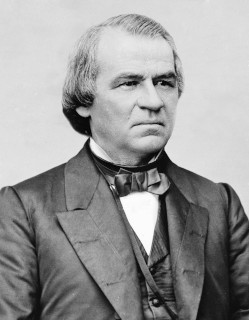
Death of Andrew Johnson, 17th President of the United States

andrew-johnson

Andrew Johnson, the 17th President of the United States (1865 – 1869), dies on July 31, 1875, at his daughter Mary’s farm near Elizabethton, Tennessee after suffering two strokes.

Johnson assumes the presidency at the time of the assassination of Abraham Lincoln as he is Lincoln’s Vice President. He is a Democrat who runs with Lincoln on the National Union ticket, coming to office as the American Civil War concludes. He favors quick restoration of the seceded states to the Union without protection for the former slaves. This leads to conflict with the Republican-dominated Congress, culminating in his impeachment by the House of Representatives in 1868. He is acquitted in the Senate by one vote. His main accomplishment as president is the Alaska Purchase.

Johnson is born in poverty in Raleigh, North Carolina on December 29, 1808. His grandfather emigrated to the United States from County Antrim in what is now Northern Ireland. He never attends school and is apprenticed as a tailor and works in several frontier towns before settling in Greeneville, Tennessee. He serves as alderman and mayor there before being elected to the Tennessee House of Representatives in 1835. After brief service in the Tennessee Senate, he is elected to the U.S. House of Representatives in 1843, where he serves five two-year terms.

On October 17, 1853, Johnson becomes the 15th Governor of Tennessee serving for four years until November 3, 1857. He is elected by the legislature to the United States Senate on October 8, 1857. During his congressional service, he seeks passage of the Homestead Act of 1862 which is enacted soon after he leaves his Senate seat in 1862.

Southern slave states secede to form the Confederate States of America, which includes Tennessee, but Johnson remains firmly with the Union. He is the only sitting senator from a Confederate state who does not resign his seat upon learning of his state’s secession. In 1862, Lincoln appoints him as military governor of Tennessee after most of it has been retaken. In 1864, he is a logical choice as running mate for Lincoln, who wishes to send a message of national unity in his re-election campaign. Their ticket easily wins the election. He is sworn in as Vice President on March 4, 1865. He gives a rambling speech, after which he secludes himself to avoid public ridicule. Six weeks later, the assassination of Lincoln elevates him to the presidency.

Johnson implements his own form of Presidential Reconstruction, a series of proclamations directing the seceded states to hold conventions and elections to reform their civil governments. Southern states return many of their old leaders and pass Black Codes to deprive the freedmen of many civil liberties, but Congressional Republicans refuse to seat legislators from those states and advance legislation to overrule the Southern actions. Johnson vetoes their bills, and Congressional Republicans override him, setting a pattern for the remainder of his presidency.

Johnson opposes the Fourteenth Amendment which gives citizenship to former slaves. In 1866, he goes on an unprecedented national tour promoting his executive policies, seeking to break Republican opposition. As the conflict grows between the branches of government, Congress passes the Tenure of Office Act in 1867 restricting his ability to fire Cabinet officials. He persists in trying to dismiss Secretary of War Edwin Stanton but ends up being impeached by the House of Representatives and narrowly avoiding conviction in the Senate. He does not win the 1868 Democratic presidential nomination and leaves office the following year.

Johnson returns to Tennessee after his presidency and gains some vindication when he is elected to the Senate in 1875, making him the only former president to serve in the Senate. In late July 1875, convinced some of his opponents are defaming him in the Ohio gubernatorial race, he decides to travel there to give speeches. He begins the trip on July 28 and breaks the journey at his daughter Mary’s farm near Elizabethton, where his daughter Martha is also staying. That evening he suffers a stroke but refuses medical treatment until the following day. When he does not improve two doctors are sent for from Elizabethton. He seems to respond to their ministrations but suffers another stroke on the evening of July 30 and dies early the following morning at the age of 66.

President Ulysses S. Grant has the “painful duty” of announcing the death of the only surviving past president. Northern newspapers, in their obituaries, tend to focus on Johnson’s loyalty during the war, while Southern ones pay tribute to his actions as president. Johnson’s funeral is held on August 3 in Greeneville. He is buried with his body wrapped in an American flag and a copy of the U.S. Constitution placed under his head, according to his wishes. The burial ground is dedicated as the Andrew Johnson National Cemetery in 1906 and, with his home and tailor’s shop, is part of the Andrew Johnson National Historic Site.


2 Comments

Birth of Irish Artist Charles Harper

skellig-arrival-by-charles-harper

Irish artist Charles Harper is born on July 30, 1943, on Valentia Island in County Kerry. He studies at the National College of Art and Design, Limerick School of Art and Design and the Graphic Studio in Dublin. He is taught by Maurice MacGonigal and Seán Keating. He also studies filmmaking in Germany.

Harper exhibits regularly in Ireland and abroad. His paintings are well known for their metaphoric themes, including boats, the human form, landscape and angels usually in painterly expressive form.

Harper is influenced by Francis Bacon and David Hockney which is apparent in his portrait work. In his treatment of the human head, the influence of Bacon is obvious as is the work of the Irish artist Louis Le Brocquy. He is also influenced by the Irish artist Patrick Collins. For Harper the actual act of painting is what matters as he sees the actual process as one of exploration and discovery. He says, “the process, the making excites me more than any end product.”

Harper represents Ireland at International Biennials in many countries throughout his career. He receives many national awards for his painting, including first prize for his work commemorating the 1916 Easter Rising at the Municipal Gallery of Modern Art in Dublin, the Carrols Open Award at the Irish Exhibition of Living Art in Dublin and The Arts councils Bonn an Uachtarain de Hide at the Oireachtas Art Exhibition. More recently he is awarded the BulBulia Award at the Royal Hibernian Academy in 2008.

Harper’s work is included in many important public and private collections including the San Francisco Museum of Modern Art, the Irish Museum of Modern Art and the Irish Arts Council. He is also a member of Aosdána and the Royal Hibernian Academy.

“Painting being a cultural and creative activity should be accessible to all. Though it may also confuse the viewer. I find this totally understandable and acceptable, as art should challenge our perception and established aesthetic.”

(Pictured: Skellig Arrival, acrylic on linen by Charles Harper)


1 Comment

The Battle of Landen

CREATOR: gd-jpeg v1.0 (using IJG JPEG v62), quality = 85

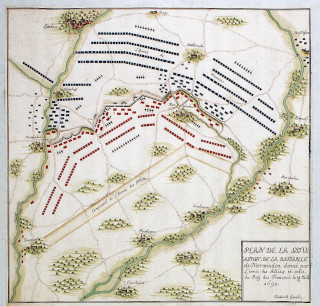
During the Nine Years’ War, units of the Irish Brigade of France fight at the Battle of Landen, also known as Neerwinden, on July 29, 1693 against the forces of William III of England, their nemesis from the Battle of the Boyne. It is fought around the village of Neerwinden in the Spanish Netherlands, now part of the municipality of Landen, Belgium.

After four years, all combatants are struggling to cope with the financial and material costs of the war. Hoping to end the war through a negotiated peace, Louis XIV of France decides to first improve his position by taking the offensive in the Rhineland, Catalonia and Flanders.

William has some 50,000 English, Dutch, German, and Spanish troops against about 80,000 French troops under Marshal Luxembourg, French commander in Flanders. William’s army has a strong defensive position to compensate for its numerical inferiority.

Luxembourg outmaneuvers the Allies. By doing so, he achieves local superiority and traps William’s army in an extremely dangerous position, with a river to their rear. Most of the fighting takes place on the Allied right, which protects the only bridge over the river, which is strongly fortified and holds the bulk of their artillery. On the French left flank, James FitzJames, 1st Duke of Berwick, and Patrick Sarsfield command in the assault on the village of Neerwinden, which they capture and lose twice before finally holding it.

The French assault the Allied position three times before the Gardes Françaises and the french cavalry under Antoine de Pas de Feuquières finally penetrate the Allied defences and drive William’s army from the field in a rout. The battle is, however, quite costly for both sides. The Irish win a measure of revenge against the victor of the Boyne, but it comes at a heavy price. Sarsfield, the defender of Limerick two years earlier, beloved by the Irish soldiers, is wounded and dies of his wounds three days later at Huy in Belgium, where he is buried in the grounds of St. Martin’s Church.

The French fail to follow up on their victory. The bulk of the Allied army escapes, although most of their artillery is abandoned. Like Steenkerque the previous year, Landen is yet another French victory that fails to achieve the decisive result needed to end the war. The Allies quickly replace their losses, leaving the overall position unchanged.

It is during this battle that, seeing the French determination to gain the high ground in spite of the murderous Allied volleys, William exclaims “Oh! That insolent nation!”


Leave a comment

Final Republican & Loyalist Prisoners Released from Maze Prison

maze-prison-release

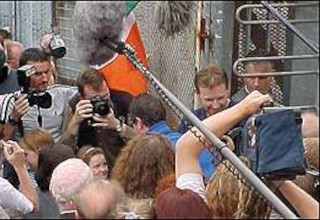
The final seventy-eight republican and loyalist prisoners are released from the Maze Prison in Northern Ireland on July 28, 2000 as the final phase of the Good Friday peace accord scheme to release 428 inmates early.

Some of the most prolific bombers and gunmen involved in the Troubles have been imprisoned in the Maze, originally called Long Kesh, since it opened in 1971.

One of the freed republicans, Seán Lynch, describes what he saw as the real and symbolic importance of the Maze. “We had achieved the status of political prisoners even if the British Government never admitted it. The prison struggle was a microcosm of the larger struggle.”

Founder member of the Ulster Defence Association, Thomas McKeown, released in 1990 is one of over 10,000 loyalists sent to the prison. He reflects, “We had it pretty easy. We made replica weapons and instruments from wood and conducted military parades and drill every morning. There were also political classes and other sorts of education.”

After the H-block hunger strikes of the 1980s there are numerous escape attempts and by 1994 the authorities have given in to many of the prisoners’ demands for freedom of association and high levels of autonomy. A total of 2,700 incidents of officers being threatened or attacked are reported. A granite memorial outside the gates bears the names of the 29 prison guards murdered since the prison opened in 1971.

On September 29, 2000, the remaining four prisoners at the Maze are transferred to other prisons in Northern Ireland and the Maze Prison is closed. Redundancy packages are arranged for staff. These are accepted by 300 who left in June 2000.

The future of the buildings is uncertain, but some republicans want it to be turned into a museum to commemorate their struggle.

A monitoring group is set up on January 14, 2003 to debate the future of the 360-acre site. There are many proposals, including a museum, a multi-purpose sports stadium and an office, hotel and leisure village. In January 2006, the government unveils a masterplan for the site incorporating many of these proposals, including a 45,000 seat national multi-sport stadium for association football, rugby and Gaelic games. In October 2006, demolition work begins in preparation for construction on the site, however, in January 2009 plans to build the new multi-purpose stadium are cancelled, with Minister of Culture, Arts and Leisure Gregory Campbell citing a lack of support and concerns for a net loss to the economy.

Discussion is still ongoing as to the listed status of sections of the old prison. The hospital and part of the H-Blocks are currently listed buildings, and will remain as part of the proposed site redevelopment as a “conflict transformation centre” with support from republicans such as Martin McGuinness and opposition from unionists, who consider that this risks creating “a shrine to the IRA.”

In January 2013, plans are approved by the Northern Ireland Minister of the Environment, Alex Attwood, for the site to be redeveloped as showgrounds as the result of an application by the Royal Ulster Agricultural Society with the objective of relocating Balmoral Show from its current location in Belfast. The site is now known as Balmoral Park.

In October 2019, the European Union withdraws £18m that had been approved to develop a peace centre, due to disagreements between Sinn Féin and the Democratic Unionist Party.

(Pictured: IRA prisoners walk out through the Maze turnstile, BBC News Online, July 28, 2000)


Leave a comment

Birth of Jonathan Rhys Meyers, Actor & Model

CREATOR: gd-jpeg v1.0 (using IJG JPEG v62), quality = 82

Jonathan Rhys Meyers, Irish actor and model, is born Jonathan Michael Meyers on July 27, 1977, in Dublin.

Rhys Meyers is born to Geraldine (née Meyers) and folk musician John O’Keeffe. The family moves to County Cork when he is almost a year old. At the age of three, his father leaves the family, leaving his mother alone to care for him and his three younger brothers.

Rhys Meyers grows up with a tumultuous childhood and attends North Monastery Christian Brothers school, from which he is permanently expelled at age sixteen. Happy to be out of school, he begins spending time in a local pool hall where he is discovered by Hubbard Casting. The casting agents are talent-spotting for the David Puttnam production of War of the Buttons (1994) and ask him to appear for an audition. After three days of auditions, however, he does not get the role and gives up on his acting aspirations. Soon after the failed audition, he receives a call to audition for a national ad campaign for Knorr soup, and though embarrassed by the attention from the ad, he soon finds himself considered for a major film.

Rhys Meyers movie acting debut is a very small role in the film A Man of No Importance (1994), where his simple cast credit is as “First Young Man.” His first lead role is in the film The Disappearance of Finbar (1996). During a 6-month postponement in production, he returns home to Cork and there receives a call about the film Michael Collins (1996). He travels to Dublin to meet with director Neil Jordan and successfully wins the role of Collins’s assassin. Jordan writes about his meeting with the actor, “I have found someone to play Collins’s killer. Jonathan Rhys Meyers, from County Cork, apparently, who looks like a young Tom Cruise. He comes into the casting session with alarming certainty. Obviously gifted.”

In addition to his role in Michael Collins, Rhys Meyers is also known for his roles in the films Velvet Goldmine (1998), Bend It Like Beckham (2002), Alexander (2004), Match Point (2005), Mission: Impossible III (2006) and his television roles as Elvis Presley in the biographical miniseries Elvis (2005), for which he wins a Golden Globe Award and earns a Primetime Emmy Award nomination, as King Henry VIII in the historical drama The Tudors (2007–10), which earns him two Golden Globe Award nominations, and in the NBC drama series Dracula (2013–14) as the title character. He also stars as Bishop Heahmund in the History Channel television series Vikings.

Rhys Meyers continues to star in other films, such as Albert Nobbs in 2011. In 2013, he appears as the villain Valentine Morgenstern in The Mortal Instruments: City of Bones, based on Cassandra Clare‘s novel, The City of Bones. He appears in the 2015 film Stonewall, directed by Roland Emmerich, in 2017, stars in The 12th Man, and in 2018 wins the Best Actor award at the Manchester Film Festival for his starring role in Damascus Cover.

Rhys Meyers has been the face of several Hugo Boss advertising campaigns. He has also been involved in several charitable causes, including the Hope Foundation, and the children’s charity, Barretstown. He is married to Mara Lane, and they have one son together. He still resides in County Cork.

In 2020, Rhys Meyers is listed as number 44 on The Irish Times list of Ireland’s greatest film actors.


Leave a comment

Birth of Mairéad Ní Mhaonaigh, Irish Fiddler & Vocalist

Compressed by jpeg-recompress

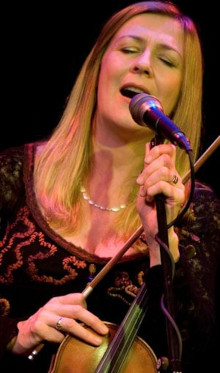
Mairéad Ní Mhaonaigh, Irish fiddler and lead vocalist for the Irish traditional music band Altan, is born on July 26, 1959 in Gweedore, County Donegal, where Gaeilge is her primary language and she learns her songs and tunes from her family and neighbours.

Ní Mhaonaigh’s father, Proinsias Ó Maonaigh, is a noted fiddler, song writer and school teacher and is her first main influence. Her mother, Kitty Rua is also raised in a musical house that holds frequent house dances. It is no surprise that she and her siblings, Gearóid and Anna, all play music together.

In the early 1980s, Ní Mhaonaigh qualifies as a Primary school teacher and teaches in Saint Oliver Plunkett National School in Malahide, County Dublin. She and her husband, Frankie Kennedy, record Ceol Aduaidh (Music from the North) for Irish label Gael Linn in 1983. This timeless recording is the genesis of what later becomes Altan. The recording features her brother Gearóid Ó Maonaigh on guitar, Fintan Mc Manus on bouzouki, Ciaran Curran on bouzouki and Eithne Ní Bhraonáin (now known as Enya) on keyboards. The album quietly gains praise among enthusiasts of traditional Irish music worldwide, which leads the way for a career in music.

Ní Mhaonigh’s teaching career comes to a halt after she and her husband take a career break in 1987 and formed Altan. The band goes on to become one of the most acclaimed Irish traditional bands touring the world. They record for Green Linnet Records in the United States and tour North America extensively.

In 1994, Frankie Kennedy passes away to cancer, which is a tremendous loss to Ní Mhaonigh. She continues with the band at her late husband’s request and signs to multinational record label Virgin Records London in late 1994. This marks the first traditional Irish band to be signed to a major record label and propels Altan and Ní Mhaonigh into a wider audience of followers.

Altan travels all over the world headlining shows from Tokyo, the Sydney Opera House, the Hollywood Bowl to the National Concert Hall, Dublin.

Ní Mhaonaigh, along with fronting Altan, remains close her roots between touring and returns to her native County Donegal to play, sing and teach her music to a new generation. She helps set up Cairdeas na bhFidléirí (The Fellowship / Friendship of Fiddlers) in the early 1980s to promote and preserve the fiddle music of County Donegal.

In 2009, Ní Mhaonaigh releases her first solo album, Imeall (Edge/Theshold), as a limited edition. After many years of playing with the band and numerous requests for a solo recording she finally gets time to record the album after parting with her second husband Dermot Byrne, with whom she has her daughter Nia. She tours the album between Altan commitments with her co-producer and recording engineer Manus Lunny.

The album prompts one reviewer, Paul O’Connor, to remark, “Her identified success as the leader of Altan has dominated our sense of her to the point that we aren’t cognisant of how good she is as an artist, musician, composer in her own right.”

This new focus on Ní Mhaonaigh as an artist in her own right, prompts The Donegal Association in Dublin to grant her “Donegal Person of the Year 2009” at a gala dinner in Dublin’s prestigious Burlington Hotel.

Ní Mhaonaigh is awarded the top recognition in traditional Irish music by her fellow peers in 2018, when she is awarded TG4 Gradam Ceoil’s Traditional Musician of the Year. The following year, she is honoured in her own county at the now world famous “Cup o’Tae Festival” which is held annually in Ardara, County Donegal.

Ní Mhaonaigh is also a member of String Sisters, which is a Grammy listed folk supergroup of six of the world’s leading female fiddlers. Together they have released two albums – the Grammy-longlisted Live and Between Wind and Water. She is a member of T with the Maggies, which is a vocal supergroup of Donegal singers comprised of Maighread and Tríona Ní Dhomhnaill and Moya Brennan of Clannad fame.

Recently Ní Mhaonaigh has recorded with a group of thirteen County Donegal-based female fiddlers which is called ‘SíFiddlers.’

(From: Mairéad Ní Mhaonaigh’s website, http://www.mairead.ie)


Leave a comment

The Irish Convention

irish-convention-1917

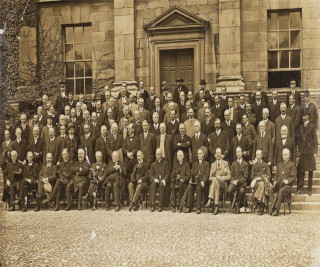
The Irish Convention, an attempt by David Lloyd George, Prime Minister of the United Kingdom, to arrive at a political settlement, meets at Regent House, Trinity College Dublin beginning on July 25, 1917. The opposition of Sinn Féin and the Ulster unionists ultimately render it irrelevant.

The Irish Convention is an assembly which sits in Dublin from July 1917 until March 1918 to address the Irish question and other constitutional problems relating to an early enactment of self-government for Ireland, to debate its wider future, discuss and come to an understanding on recommendations as to the best manner and means this goal can be achieved. It is a response to the dramatically altered Irish political climate after the 1916 Easter rebellion and is proposed by Lloyd George in May 1917 to John Redmond, leader of the Irish Parliamentary Party, announcing that “Ireland should try her hand at hammering out an instrument of government for her own people.”

The Convention is publicly called in June 1917, to be composed of representative Irishmen from different political parties and spheres of interest. After months of deliberations, the Convention’s final report, which had been agreed upon in March 1918, is seriously undermined. With the urgent need for military manpower on the Western Front following the German Spring Offensive, the government decides in April 1918 to simultaneously introduce Home Rule and apply conscription to Ireland. This “dual policy” of conscription and devolution heralds the end of a political era.

(Pictured: Group portrait of the members of the Irish Convention at Trinity College, taken on August 21, 1917 | National Library of Ireland, NPA Conv.)