seamus dubhghaill

Promoting Irish Culture and History from Little Rock, Arkansas, USA


Leave a comment

Death of Gerald O’Sullivan, Victoria Cross Recipient

Gerald Robert O’Sullivan VC (Irish: Gearóid Roibeard Ó Súilleabháin), Irish recipient of the Victoria Cross, the highest and most prestigious award for gallantry in the face of the enemy that can be awarded to British and Commonwealth forces, dies on August 21, 1915, at Scimitar Hill, Gallipoli, Ottoman Turkey.

O’Sullivan is born in Frankfield, Douglas, County Cork, on November 8, 1888. His father is a career soldier in the Argyll and Sutherland Highlanders. Known as ‘Jerry’, he is educated at Wimbledon College from which he graduates in 1906. He desires a career in the British Army and attends the Royal Military Academy Sandhurst.

Commissioned into the Royal Inniskilling Fusiliers in 1909, O’Sullivan spends much of the next three years serving in China with his unit, 2nd Battalion. From 1912, the battalion is based in British India but on the outbreak of World War I is brought back to England.

The Royal Inniskilling Fusiliers form part of 29th Division, intended for service in the Gallipoli campaign. Now a captain in the 1st Battalion, O’Sullivan commands a company during the landing at X Beach on the Gallipoli peninsula on April 25, 1915, and acquits himself well during the early stages of the fighting. On June 18, 1915, the Turks mount an attack on positions adjacent to those of O’Sullivan’s company, forcing the troops manning the defenses to abandon it. He leads his company in a counterattack to reclaim the lost position which exchanges hands several times during the next few hours. The commanding officer in the area, Brigadier General W. R. Marshall, eventually directs O’Sullivan to lead a party of Inniskilling and South Wales Borderers soldiers to capture the position which is achieved at dawn the following day.

Two weeks later, O’Sullivan is involved in a further action near Krithia, and this results in his recommendation for the Victoria Cross (VC). The citation, published in The London Gazette on September 1, 1915, reads as follows:

“For most conspicuous bravery during operations south-west of Krithia on the Gallipoli Peninsula. On the night of July 1-2, 1915, when it was essential that a portion of a trench which had been lost should be regained, Captain O’Sullivan, although not belonging to the troops at this point volunteered to lead a party of bomb throwers to affect the recapture. He advanced in the open under a very heavy fire and in order to throw his bombs with greater effect, got up on the parapet, where he was completely exposed to the fire of the enemy occupying the trench. He was finally wounded, but not before his inspiring example had led his party to make further efforts, which resulted in the recapture of the trench. On the night of June 18-19, 1915, Captain O’Sullivan had saved a critical situation in the same locality by his personal gallantry and good leading.”

The wounds O’Sullivan receives in the action of July 1-2 necessitates his evacuation to Egypt for medical treatment, but he quickly recovers and returns to his unit on August 11, 1915. The 29th Division is now at Suvla Bay and preparing for a new offensive. The Inniskillings are tasked with the capture of a feature known as Hill 70 or Scimitar Hill. During this battle, on August 21, 1915, he leads a charge of 50 men to the hilltop but is killed.

O’Sullivan has no known grave and is remembered on the Helles Memorial to the Missing. His VC is delivered to his mother who lives in Dorchester, and his name also appears on the memorial there.


Leave a comment

Birth of Bernardo O’Higgins, Chilean Independence Leader

Bernardo O’Higgins, Chilean independence leader who freed Chile from Spanish rule in the Chilean War of Independence, is born on August 20, 1778, in Chillán, a town in southern Chile, then a colony of Spain.

As noted in his Certificate of Baptism, O’Higgins is the illegitimate son of Ambrosio O’Higgins, 1st Marquess of Osorno, a Spanish officer originally from County Meath who becomes Royal Governor of Chile and later viceroy of Peru. His mother is Isabel Riquelme, a prominent lady of Chillán. His father has only indirect contact with his son, who uses his maternal surname until his father’s death. At 12, he is sent to Lima for his secondary education. Four years later he goes to Spain. At 17 he is sent to England for further education. In London he becomes imbued with a sense of nationalist pride in Chile, a pride largely fostered by his contact with several political activists, of whom Francisco de Miranda, the Venezuelan champion of Latin American independence, exerts the greatest influence on him. Along with several other future revolutionary leaders, he belongs to a secret Masonic lodge, established in London by Miranda, the members of which are dedicated to the independence of Latin America. In 1799 he leaves England for Spain, where he comes into contact with Latin American clerics who also favour independence and doubtless further strengthened his views. His political position is remarkable in view of the fact that his father is viceroy of Peru.

O’Higgins’s father dies in 1801, leaving him a large hacienda near Chillán and by 1803 he is working the estate. This interlude is possibly the most satisfying period of his life. The hacienda begins to prosper almost immediately, and he is soon maintaining a house in Chillán. In 1806 he becomes a member of the local town council.

Before O’Higgins has time to settle into his agrarian way of life, however, the foundations of Chilean society are threatened. In 1808 Napoleon invades Spain, which, occupied with its own defense, leaves its colonies, including Chile, largely uncontrolled. The first steps toward national independence begin to be taken throughout Spanish America. On September 18, 1810, a national junta, composed of local leaders who replaced the governor-general, is established in Santiago, and by 1811 Chile has its own congress. O’Higgins is a member, and during the next two years he plays a key role in the country’s turbulent political affairs.

By early 1813 Chile has a constitution and a junta that seems able to control the country and to avert the threat of civil war. In 1814, however, the viceroy of Peru sponsors an expedition to reestablish royal authority. Within a few months, O’Higgins rises from the rank of colonel of militia to general in chief of the independentist forces. Soon he is also appointed governor of the province of Concepción, in which the early fighting takes place. But the war goes badly, and he is superseded in command. In October 1814, at Rancagua, the Chilean patriots led by him lose decisively to the royalist forces, which, for the next three years, occupy the country.

Several thousand Chileans, including O’Higgins, cross the Andes into Argentina in flight from the royalists. He spends the next three years preparing for the reconquest of Chile. In January 1817 he returns to Chile with the Argentine general José de San Martín and a combined army consisting of Argentine troops and Chilean exiles. At Chacabuco, on February 12, 1817, they decisively defeat the Spanish, and, with Chile largely reconquered, O’Higgins is elected interim Supreme Director.

For the next six years, as Supreme Director, O’Higgins maintains, on balance, a successful administration. He creates a working governmental organization and provides the essentials of the new nation — peace and order. Under adverse circumstances he succeeds in building a national navy and in mounting a major military expedition against Peru to fight the royalists.

O’Higgins, however, is not politically astute. By 1820 he has antagonized the conservative church and the unruly aristocracy with his reforms. Later he alienates the business community. He does not perceive the importance of a solid political base, and, because his support is based on his prestige as a war leader in a threatened country, his fall is assured once the danger of war has disappeared. He is associated with a grand scheme of continental independence that is essentially Argentine in its conception. By the time of his resignation, under pressure, in January 1823, a growing Chilean nationalism has rendered him and his Argentine colleagues much less attractive than they had been in 1817.

In 1809, at the age of 31, O’Higgins observes, “The career to which I seem inclined by instinct and character, is that of labourer.” In rural life, he would have come to be “a good campesino and a useful citizen.” As Supreme Director, he has the positive attributes of solid moral principles, an eagerness to work hard, and singular honesty. In the countryside, as he himself understands, these virtues would be ample, but in public administration they are not enough.

From 1823 until his death, O’Higgins lives in exile in Peru, dividing his time between his hacienda and Lima. His last years are poignantly similar to his first. In his youth, circumstances required that he live away from home; now in maturity, circumstances again conspire to keep him abroad. In both periods, he longs to return home.

In 1842, the National Congress of Chile finally votes to allow O’Higgins to return to Chile. After traveling to Callao to embark for Chile, however, he begins to succumb to cardiac problems and is too weak to travel. His doctor orders him to return to Lima, where on October 24, 1842, aged 64, he dies.

After his death, O’Higgins’s remains are first buried in Peru, before being repatriated to Chile in 1869. He had wished to be buried in the city of Concepción, but this is never to be. For a long time they remain in a marble coffin in the Cementerio General de Santiago, and in 1979 his remains are transferred by Augusto Pinochet to the Altar de la Patria, in front of the Palacio de La Moneda. In 2004, his body is temporarily stored at the Chilean Military School during the building of the Plaza de la Ciudadanía, before being finally laid to rest in the new underground Crypt of the Liberator.

Little is known of O’Higgins’s personal life. Though he never marries, he manages to acquire a family, in the same manner as his father had. His natural son, Pedro Demetrio O’Higgins, is his companion in exile.

O’Higgins is a liberal in the 19th-century sense of the term and an admirer of the British constitutional system. Although not as conservative as some contemporary Chilean leaders, he is not a democrat either. While his reputation since his death has fluctuated with the political predilections of governments and historians, his leading role in establishing Chile as a republic remains unquestioned.

(From: “Bernardo O’Higgins” by Jay Kinsbruner, Encyclopædia Britannica, http://www.britannica.com)


Leave a comment

Birth of Poet Francis Edward Ledwidge

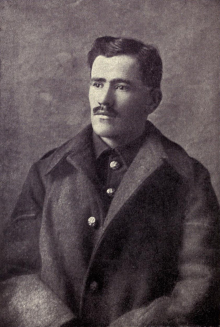
Francis Edward Ledwidge, Irish poet sometimes known as the “poet of the blackbirds,” is born on August 19, 1887, to a poor family in Slane, County Meath. He is later also known as a World War I war poet.

Ledwidge starts writing at an early age and is first published in a local newspaper at the age of fourteen. Finding work as a labourer and miner, he is also a trade union activist and a keen patriot and nationalist, associated with Sinn Féin. He becomes friendly with a local landowner, the writer Lord Dunsany, who gives him a workspace in the library of Dunsany Castle and introduces him to literary figures including William Butler Yeats and Katharine Tynan, with whom he has a long-term correspondence. He is elected to a local authority post and helps organise the local branch of the Irish Volunteers, while Dunsany edits and helps him secure publication for a first volume of his poetry.

Having sided with the faction of the Irish Volunteers which oppose participation in the war, he enlists in the Royal Inniskilling Fusiliers in October 1914, and continues to write poetry on assignment, sending work to Lord Dunsany and to family and other friends. The poems he writes on active service reveal his pride at being a soldier, as he believes, in the service of Ireland. He often wonders whether he would find a soldier’s death.

On July 31, 1917, a group from Ledwidge’s battalion of the Royal Inniskilling Fusiliers are road-laying in preparation for an assault during the Third Battle of Ypres, near the village of Boezinge, Ypres Salient, Belgium.

According to Irish author and lecturer Alice Curtayne, “Ledwidge and his comrades had been toiling since the early morning at roadmaking. The army’s first need was men; their second, guns; their third roads. These latter consisted mainly of heavy beech planks bolted together, which could be rapidly laid down. No advance could be supported in that sodden land without a sufficiency of these communications tracks, six or seven feet wide. Supplies were conveyed by pack mules over the wooden paths. Survivors concur in placing the road work done by B Company that day one mile northeast of Hellfire Corner, so called because it was very exposed to German shelling. There was a violent rainstorm in the afternoon, shrouding the region in a gray monochrome. Sullenly, the enemy’s long-range guns continued to fling their shells far behind the lines. Roadwork could not be suspended, however, as the tracks were in use as fast as they were laid down. Tea was issued to the men and drenched to the skin, they stopped to swallow it. A shell exploded beside Ledwidge, and he was instantly killed.”

A Roman Catholic military chaplain, Father Devas, is the first on the scene. That night, Father Devas writes in his diary, “Crowds at Holy Communion. Arranged for service but washed out by rain and fatigues. Walk in rain with dogs. Ledwidge killed, blown to bits, at Confession yesterday and Mass and Holy Communion this morning. R.I.P.”

Ledwidge is first buried at Carrefour de Rose, and later re-interred in the nearby Artillery Wood Military Cemetery, at Boezinge, where the Welsh poet Hedd Wyn, who was killed in action on the same day, also lies buried.

Dunsany arranges for the publication of more of Ledwidge’s poems, and a collected edition in 1919. Further poems, from the archives at Dunsany Castle and some material held by family, are later published by Ledwdige’s biographer, Alice Curtayne, and by one of the Ledwidge memorial societies. Ledwidge is selected as one of twelve prominent war poets for the exhibition Anthem for Doomed Youth at the Imperial War Museum in London in 2002, and memorialised at an event in Inchicore, Dublin, in 2017, with his work set to music by Anúna. A museum of his life and work is opened in his birthplace cottage in 1982. Some of his manuscripts are held in the National Library of Ireland and more in the archives of Dunsany Castle.


1 Comment

The Great Portlaoise Escape

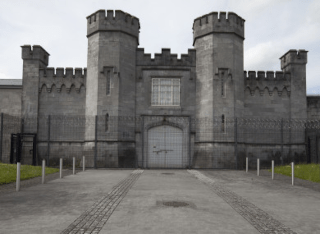
Nineteen republican prisoners blast their way out of Portlaoise Prison in County Laois on August 18, 1974.

The escape is a timely reminder of the determination, tenacity and ingenuity with which Irish Republican Army (IRA) Volunteers throughout the country fight against British rule in Ireland. It is also a reminder to the Fine Gael/Labour Coalition Government in Leinster House that their collaboration with the British and their attempts to defeat republicanism will not be an easy task.

The determination of republicans to escape from Portlaoise is demonstrated by the escape. In May 1974, an underground escape was planned but the 80-foot tunnel was uncovered and the prisoners’ hopes were dashed. However, almost immediately plans swung into place for a more daring escape operation.

A member of the Escape Committee spots a weakness in the jail security in the area of the prison where the laundry house is situated. The laundry leads to an outside stairway and down into the courtyard, where the Governor’s House and Warders’ Mess are located.

The prisoners discover that they can gain access to the laundry area quite easily. It is a doorway at the top of the courtyard which leads out onto the streets of Portlaoise town itself that give the prisoners hope that their plan will work. However, the Escape Committee decides that they need explosives to get through this gate and send word outside to this effect. The IRA on the outside, agreeing that the plan is “viable,” send in the materials and the plan is on.

The date for the escape is set for August 18, 1974 and planning proceeds inside the prison. The prisoners set themselves to work making prison guard uniforms. The idea is that when the escapees are running through the courtyard, the troops on the roof of the jail will not be able to distinguish between the escapees and the real guards and so will not open fire. This pre-planning proves to be a brilliant ploy as it gives those escaping vital seconds to clear the courtyard and make good their escape.

On the Friday before the plan is to proceed, a number of republicans are arrested in Portlaoise. This seems a bad omen and raises questions as to whether the authorities are suspicious that an escape is planned. However, the Escape Committee and those involved in the operation decide to press ahead with the plan anyway.

Sunday, August 18 duly arrives. According to prisoners who are in Portlaoise Prison at the time, no one can eat anything that day as the tension is unbearable. At 12:30 p.m., the designated time to put the plan into action, arrives and Liam Brown approaches the guard at the gate of the lower landing and asks to be let in. This is the signal for the first team of escapees to rush forward and get the key to the laundry. The guard is quickly overpowered and gives up the key with little resistance.

With this first stage of the plan successfully completed, the escapees open the door to the stairwell and rush through to the courtyard, followed by up to 25 other prisoners. As the prisoners race to the top of the yard to place the bomb at the outside gate, the soldiers on the roof are confused by the uniforms and cannot open fire.

The bomb then explodes, blasting the door to pieces. As the prisoners make the final dash for freedom, the soldiers fire warning shots over the heads of the fleeing republicans. Some of the prisoners drop to the ground fearing the worst but as the guards race from their mess they call on the soldiers to stop firing.

Those who are captured are brought into the Wing again and the governor demands a head count. The prisoners, however, refuse to comply, adding to the confusion and thwarting the prison authorities’ attempts to identify the escapees. It is only after the guards threaten to send in the riot squad several hours later that the prisoners allow a head count to be taken. When they realise that 19 men had escaped, the joy the prisoner experience is immense as they thought only 14 had got away.

In an attempt to capture the escapees, the Dublin Government launches a statewide search operation. Every outhouse in County Wexford is searched. The Irish Naval Service is even called in and put on the alert. The searches go on for over a week but to no avail. The nineteen men had gotten clean away.

Those who escape are Liam Brown, Paddy Devenny and Micky Nolan from Belfast; Tom McFeely and Ian Milne from County Derry; Thomas McGinty and Eddie Gallagher from County Donegal; Patrick Thornberry, Kevin McAllister and Martin McAllister from County Armagh; Francis Hughes and Kevin Mallon from County Tyrone; Oliver McKiernan from County Fermanagh; Bernard Hegarty and Sam O’Hare from County Louth; Michael Kinsella and Seán Kinsella from County Monaghan; Seán Morris from County Meath; and Tony Weldon from Dublin.

(From: “30 years on: The Great Portlaoise Escape,” An Phoblacht, http://www.anphoblacht.com, August 26, 2004)


Leave a comment

Resignation of Attorney General Patrick Connolly

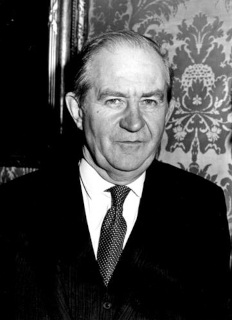
Patrick James Connolly, Irish barrister who serves as Attorney General of Ireland from March 1982 to August 1982, resigns on August 17, 1982, after Malcolm McArthur, wanted for, and later convicted of murder is found to be his house guest. The fallout from the incident leads to one of the most famous acronyms in Irish politics.

Connolly is born on May 25, 1927, the elder of the two sons of a headmaster and a teacher in Fingal, County Dublin. He is educated at St. Joseph’s College, University College Dublin and the King’s Inns, after which he is called to the Bar in 1949. His practice, which focuses on personal injury cases, is widely successful. On March 9, 1982, Taoiseach Charles Haughey names him as Attorney General of Ireland.

Connolly resigns on August 17, 1982 after Malcolm MacArthur, who had been a house-guest of Connolly’s, is arrested for murder. MacArthur, the domestic partner of Connolly’s friend Brenda Little, had committed a horrific double murder in the midst of a botched carjacking and robbery in 1982. Though Connolly is not implicated in the murder and is completely unaware of McArthur’s activities, he is forced to resign at midnight the night of MacArthur’s arrest and never again serves in government.

The much reviled, and correspondingly much loved Taoiseach, Charles Haughey, describes the incident as “a bizarre happening, an unprecedented situation, a grotesque situation, an almost unbelievable mischance.” Conor Cruise O’Brien, one of Haughey’s political opponents who despises the most corrupt Taoiseach in Irish history coins the phrase GUBU – Grotesque, Unprecedented, Bizarre, Unbelievable – to describe not just what happened but Haughey’s overall response.

Connolly returns to practice at the Irish bar and to work as a senior counsel in Dublin. A life-long bachelor, he dies at the age of 88 on January 7, 2016. Though he never marries, he has a very close relationship with his extended family, including his nephew and two nieces who speak at his funeral Mass. He is buried in Deans Grange Cemetery.


Leave a comment

The Convening of the Second Dáil

The Second Dáil (Irish: An Dara Dáil) is Dáil Éireann as it convenes on August 16, 1921, following the dissolution of the First Dáil. The Second Dáil runs until June 8, 1922.

From 1919 to 1922, Dáil Éireann is the revolutionary parliament of the self-proclaimed Irish Republic. The Second Dáil consists of members elected at the 1921 Irish elections, but with only members of Sinn Féin taking their seats. On January 7, 1922, it ratifies the Anglo-Irish Treaty by 64 votes to 57 which ends the Irish War of Independence and leads to the establishment of the Irish Free State on December 6, 1922.

Since 1919, those elected for Sinn Féin at the 1918 Irish general election had abstained from the House of Commons and established Dáil Éireann as a parliament of a self-declared Irish Republic, with members calling themselves Teachtaí Dála or TDs. In December 1920, in the middle of the Irish War of Independence, the British Government passes the Government of Ireland Act 1920, which enacts partition by establishing two home rule parliaments in separate parts of Ireland. These provisions arise out of discussions held at the Irish Convention held in 1917, from which Sinn Féin abstains. In May 1921 the first elections to the House of Commons of Northern Ireland and the House of Commons of Southern Ireland are held, by means of the single transferable vote. On May 10, 1921, the Dáil passes a resolution that the elections scheduled to take place later in the month in both parts of the country will be “regarded as elections to Dáil Éireann.”

In the elections for Southern Ireland, all seats are uncontested, with Sinn Féin winning 124 of the 128 seats, and Independent Unionists winning the four seats representing the Dublin University. In the 1921 Northern Ireland general election, the Ulster Unionist Party (UUP) wins 40 of the 52 seats, with Sinn Féin and the Nationalist Party winning 6 seats each. Of the six seats won by Sinn Féin in Northern Ireland, five are held by people who had also won seats in Southern Ireland.

The Second Dáil responds favourably to the proposal from King George V on June 22, 1921, for a truce, which becomes effective from noon on July 11, 1921. This is upheld by nearly all of the combatants while the months-long process of arranging a treaty gets under way. The Truce allows the Dáil to meet openly without fear of arrest for the first time since September 1919, when it had been banned and driven underground.

During the Second Dáil the Irish Republic and the British Government of David Lloyd George agree to hold peace negotiations. As President of Dáil Éireann, Éamon de Valera is the highest official in the Republic at this time but is notionally only the head of government. In August 1921, to strengthen his status in the negotiations, the Dáil amends the Dáil Constitution to grant him the title President of the Republic, and he thereby becomes head of state.

On September 14, 1921, the Dáil ratifies the appointment of Arthur Griffith, Michael Collins, Robert Barton, Eamonn Duggan and George Gavan Duffy as envoys plenipotentiary for the peace conference in England. These envoys eventually sign the Anglo-Irish Treaty on December 6. The debate on the Treaty starts on December 14 and continues until January 7, 1922. On that date, the Dáil approves the treaty by 64 in favour to 57 against. As the leader of the anti-Treaty minority, de Valera resigns as President. He allows himself to be nominated again but is defeated on a vote of 60–58. He is succeeded as president by Arthur Griffith. The anti-Treaty deputies continue to attend the Dáil, with de Valera becoming the first Leader of the Opposition in the Dáil.

The ratification specified by the Treaty is by “a meeting summoned for the purpose of the members elected to sit in the House of Commons of Southern Ireland.” The Dáil vote does not fulfil this because four unionists are absent and one Northern Ireland member is present. The requisite approval comes at a separate meeting on January 14, 1922, attended by the unionists and boycotted by anti-Treaty TDs. The meeting also approves a Provisional Government led by Collins, which runs in parallel to Griffith’s Dáil government and with overlapping membership. The Government of Ireland Act 1920 requires the Commons to be summoned by the Lord Lieutenant and its members to take an oath of allegiance to the king, whereas the meeting on January 14 is summoned by Griffith and the members present do not take an oath.

Under the terms of the Treaty, a Constituent Assembly is to be elected to draft a Constitution for the Irish Free State to take effect by December 6, 1922. The assembly is also to serve as a “Provisional Parliament” to hold the Provisional Government responsible. This election is held on June 16, 1922, pursuant to both a resolution by the Second Dáil on May 20 and a proclamation by the Provisional Government on 27 May 27.

The Third Dáil is elected at the general election held on June 16, 1922. This election is required to be held under the Anglo-Irish Treaty signed on December 6, 1921.

(Pictured: Some members of the Second Dáil at the Grosvenor Hotel in London, seated (L to R) Éamon de Valera and Arthur Griffith, National Library of Ireland, NPA-RPH-10)


2 Comments

Unveiling of the Daniel O’Connell Monument in Dublin

The Daniel O’Connell monument in Dublin is unveiled on August 15, 1882. The monument is designed and sculpted by John Henry Foley and completed by his assistant, Thomas Brock following Foley’s sudden death in 1874. It is often believed to be Foley’s greatest work.

Situated on the south side of O’Connell Street, the monument consists of three bronze sections separated by a granite pedestal. The statue of O’Connell stands at the top of the monument, above four winged victories at the base of the monument, each representing a virtue attributed to O’Connell: courage, fidelity, patriotism, and eloquence.

O’Connell, born in County Kerry in 1775 and often known as the Emancipator or the Liberator, was a major Irish political leader at the beginning of the 19th century best known for campaigning for Catholic emancipation and for arguing for the repeal of the Acts of Union 1800, which united Great Britain and Ireland in one ‘United Kingdom.’

O’Connell engineered the widespread mobilization of the Catholic majority in Ireland and once emancipation was achieved held “monster meetings” attended by hundreds of thousands of people, pushing for the re-creation of an independent Kingdom of Ireland to govern itself with the then ruling monarch.

As a Catholic born into a once-wealthy family that had been dispossessed of its lands, O’Connell studied as a law student thanks to a wealthy uncle and, although he may have had better opportunities in life than many of his fellow Irish Catholics, nonetheless he faced discrimination because of his religion. He was prevented from reaching the uppermost circles of his profession because he was Catholic.

O’Connell did not support the Irish Rebellion of 1798 or Robert Emmet‘s 1803 attempt to break the bond with Britain. Throughout his life, O’Connell never supported the use of violence, but rather he believed the Irish should instead assert themselves politically.

While the O’Connell statue in Dublin is already a large political statement with his figure towering over Dublin, there are many hidden traits to the monument that reinforce his importance in Irish history while the added bullet holes from the 1916 Easter Rising enshrine another part of the city’s political history permanently into its sights.

In the monument, O’Connell is stationed pointing toward parliament buildings, symbolizing the challenge he gave them over the Acts of Union, while at his feet lies a pile of books which are thought to symbolize the fact that he came to this fight as an educated man with the power to use this knowledge in his arguments.

At his feet also is a cluster of statues thought to be the people of Ireland, led by the “Maid of Erin,” a woman who acted as the personification of Ireland and who stands on top of broken shackles, further symbolizing O’Connell’s significance as the liberator and his support from the Irish people.

(From: “Secrets of the Daniel O’Connell monument unveiled in Dublin on this day in 1882” by Frances Mulraney, August 15, 2018, IrishCentral.com)


Leave a comment

Enactment of the Papist Act 1778

The Papists Act 1778, an Act of the Parliament of Great Britain, is enacted on August 14, 1778, and grants rights of leasing and inheritance to those who have taken the oath of allegiance, the first rolling back of the Penal Laws and the first Act for Roman Catholic relief. Later in 1778 it is also enacted by the Parliament of Ireland.

Before the Act, a number of “Penal laws” had been enacted in Britain and Ireland, which varied between the jurisdictions from time to time but effectively excluded those known to be Roman Catholics from public life.

By this Act, an oath is imposed, which besides a declaration of loyalty to the reigning sovereign, contains an abjuration of the Pretender, and of certain doctrines attributed to Roman Catholics, such as that excommunicated princes may lawfully be murdered, that no faith should be kept with heretics, and that the Pope has temporal as well as spiritual jurisdiction in Great Britain.

Those taking this oath are exempted from some of the provisions of the Popery Act 1698. Although it does not grant freedom of worship, it allows Catholics to join the army and purchase land if they take an oath of allegiance. The section as to taking and prosecuting priests is repealed, as well as the penalty of perpetual imprisonment for keeping a school. Roman Catholics are also enabled to inherit and purchase land, nor is an heir who conformed to the Established church any longer empowered to enter and enjoy the estate of his “papist” kinsman.

The passing of this act is the occasion of the Gordon Riots (1780) in which the violence of the mob is especially directed against William Murray, 1st Earl of Mansfield, who had objected to various prosecutions under the statutes now repealed.

This Act remains on the statute book until it is repealed by the Promissory Oaths Act 1871.

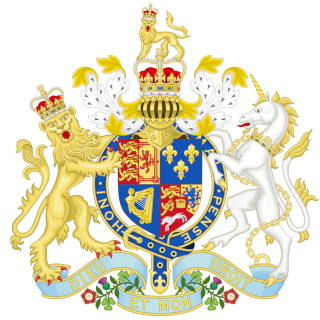
(Pictured: The royal coat of arms of Great Britain, 1714-1801, used by King George I, George II and George III)


Leave a comment

Birth of Cornelius Denvir, Mathematician & Lord Bishop of Down and Connor

Cornelius Denvir, Roman Catholic Prelate, mathematician, natural philosopher and Lord Bishop of Down and Connor, is born on August 13, 1791, at Ballyculter, County Down. He is noted for ministering in Belfast amidst growing sectarian tension, taking a moderate and non-confrontational stance, to the annoyance of his pro-Catholic followers. He is also a professor at Maynooth College as well as Down and Connor Diocesan College, and is active in the local scientific community.

Denvir is educated at Dr. Nelson’s Classical School in Downpatrick, being described by peers as an enthusiastic child with a love for sight-seeing. According to one biographer, young Denvir also shows interest in the catechism by attending local visits from the then Bishop of Down and Connor, Dr. Patrick MacMullan, who is resident in Downpatrick. In September 1808, he enrolls at Maynooth College, and is appointed chair of Natural Philosophy and Mathematics there in August 1813.

As chair of mathematics and natural philosophy at Maynooth College, Denvir is noted for changing the style of education at the college from pure logic-based reasoning in Mathematics to a more holistic, topical approach. He is also noted for emphasising experimentation and the importance of the scientific method in teaching natural philosophy, with several sources noting his well-stocked labs.

While at Maynooth College Denvir teaches both Nicholas Callan, the inventor and physicist, and Dominic Corrigan, the noted Irish physician. According to several accounts, both speak fondly of their old professor, to the point of Callan gifting Denvir one of his induction coils in thanks.

Denvir is ordained first as deacon in June 1813, then a priest in May 1814, performing his liturgical duties in conjunction with his academic ones. In 1826, he leaves Maynooth College to become the parish priest of Downpatrick. In 1833 he becomes a professor at the newly founded St. Malachy’s College, teaching classes in Latin, Greek and Mathematics. He continues his duties as parish priest and professor until 1835, when he is appointed Bishop of Down and Connor in succession to Dr. William Crolly.

As 22nd Lord Bishop of Down and Connor, Denvir emphasises the teaching of the Catechism to youth as well as emphasising the importance of scripture to the diocese. In 1841 he helps fund the start of construction of St. Malachy’s Church in Belfast, which is completed in 1845. In his later years, he falls under criticism by other Belfast Catholics, who claim he is neglectful of his duties, especially those relating to expanding and defending Catholicism in the face of growing Protestant influence. Some accounts attribute his shortcomings to poor health and temperament, while others suggest that he backs away from expansion to avoid conflict with Protestant groups.

Denvir suffers from personal finance problems during his time as Bishop. The construction of St. Malachy’s Church puts him into deep personal debt, which he is apparently arrested for some time after 1844. He is also criticised for selling seats in the newly constructed church to offset costs. He is also described as reluctant in asking for funds from parishioners, severely limiting his resources with which to care for the church.

Denvir is appointed Commissioner of National Education in 1853. He is noted for being supportive of non-denominational education and investigating reports of proselytism in public primary education. He later resigns this position in 1857 on request of the Holy See to focus on expanding the local Catholic school system.

In 1860, after years of illness compounded by age, Denvir is assigned Dr. Patrick Dorrian as a coadjutor bishop to assist in his episcopal duties. While ill health is said to be the predominant reason for the appointment of a coadjutor, contemporary newspaper accounts suggest there also might be an ideological reason for the appointment. In The Spectator it is noted in December 1859 “it may be, because he is too liberal for the Cullen epoch.”

In May 1865, Denvir resigns as Bishop and is succeeded by Dorrian. He dies one year later on July 10, 1866, in his residence on Donegall St., after suffering from fainting fits a few days prior. He is buried in Ballycruttle Church.


Leave a comment

Death of E. M. O’R. Dickey, Wood Engraver & Painter

E. M. O’R. Dickey, wood engraver and oil painter who is active at the beginning of the twentieth century, dies on August 12, 1977. He is a founder member of the Society of Wood Engravers.

Edward Montgomery O’Rorke Dickey is born in Belfast on July 1, 1894, the son of Edward O’Rorke Dickey. He later marries Eunice Emmeline Howard and they have one son, Daniel. He is educated at Wellington College and Trinity College, Cambridge. He studies painting under Harold Gilman at the Westminster School of Art.

Dickey is art master at Oundle School in Oundle, Northamptonshire, England, and then becomes professor of fine art and director of King Edward VII School of Art, Armstrong College, Durham University from 1926 to 1931. He is then staff inspector of art from 1931 to 1957 for the Ministry of Education.

At the beginning of World War II Dickey is seconded from the Ministry of Information and, from 1939 to 1942, is secretary of the War Artists’ Advisory Committee. He is a full member of the committee from 1942 to 1945. During this period he establishes a close relationship with Eric Ravilious. He is appointed a CBE in 1952.

Dickey becomes the first curator of The Minories in Colchester, Essex, a post he holds for five years from 1957 to 1962.

Dickey is a founder member of the Society of Wood Engravers in 1920, and exhibits with them from 1920 to 1924. He is at his most active in the early 1920s and virtually all his engravings date from this period.

In 1922 Dickey contributes a wood engraving to Contemporary English Woodcuts, an anthology of wood engravings produced by Thomas Balston, a director at Gerald Duckworth and Company and an enthusiast for the new style of wood engravings. Campbell Dodgson, Keeper of Prints and Drawings at the British Museum, writes about him in his introduction to the book Mr. Hagreen and Mr. Dickey are among the engravers who rely very much upon the effective use of white lines and spaces. This is a limited edition of 550 copies, as is the only book that he illustrates with wood engravings, Workers by the Irish writer Richard Rowley, published by Balston at Duckworth in 1923.

Dickey devotes more time to working in oils. He is one of the most experimental painters in Ireland technically and stylistically. He paints extensively on the continent, and shows at the Royal Academy of Arts and the New English Art Club. He is elected to the London Group in 1920. He has several one-man exhibitions, at the Leicester Galleries in 1923, at the Manchester City Art Gallery in 1924, and the Beaux Arts Gallery in 1935.

There are a number of examples of Dickey’s oil paintings in public collections.

Dickey’s lasting legacy, rather than his wood engravings and oils, is his distinguished contribution to arts administration and art education.

(Pictured: “Kentish Town Railway Station” by Edward Montgomery O’Rorke Dickey, oil on canvas, 1919, Hollytrees Museum, United Kingdom)