McNamara and Newman are particularly outspoken on the issue of a proposed anti-abortion amendment to the Constitution of Ireland. While other bishops advocate people vote with their conscience in the referendum on the issue, McNamara and Newman instruct Catholics that they have a duty to “vote yes” to the referendum.
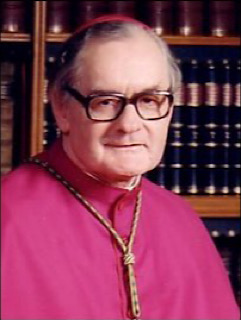
In 1984, the Archdiocese of Dublin becomes vacant when Archbishop Ryan is given a senior appointment in the Roman Curia. Ryan is expected to be made a cardinal as a result of the appointment but dies suddenly in office before a consistory can be held. McNamara’s selection to replace the more liberal Ryan in Dublin creates media reports linking his appointment to the ongoing tensions between the papal nuncio in Ireland, Archbishop Gaetano Alibrandi, and the liberal Fine Gael–Labour Partycoalition under Garret FitzGerald. Relations between Alibrandi and the coalition break down, with the government requesting that Alibrandi be removed because of his suspected closeness to Irish republicans in Sinn Féin and to the opposition Fianna Fáil party and in particular its leader, Charles Haughey. Critics accused Alibrandi of engineering McNamara’s appointment in the belief that the outspoken McNamara can help derail the coalition’s liberal policies on divorce and contraception.
McNamara, as expected, takes a far more outspoken stance of issues than had Ryan previously. While the coalition succeeds in liberalising the law on contraception, its efforts to amend the constitution on divorce are defeated.
McNamara’s service in Dublin is short-lived. Already suffering from what proves to be terminal cancer, he dies on April 8, 1987 after a three year battle with the disease, months after the Fine Gael minority government is defeated in the 1987 Irish general election. He is succeeded as archbishop by a university lecturer, Desmond Connell.
In the early 2000s, amid growing scandals within the Catholic Church in Ireland about clerical sex abuse, it is revealed that as archbishop McNamara had sought legal advice as to the Church’s liability arising from such abuse.
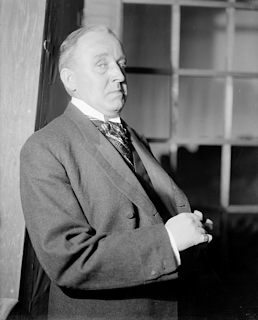
John Dudley Digges, Irish stage actor, director, and producer as well as a film actor, is born in Ranelagh, Dublin, on June 9, 1879. Although he gains his initial theatre training and acting experience in Ireland, the vast majority of his career is spent in the United States, where over the span of 43 years he works in hundreds of stage productions and performs in over 50 films.
Digges is the child of James Digges and Catherine Forsythe. He becomes acquainted with theatre directors William and Frank Fay and takes an interest in acting. He joins W. G. Fay’s Irish National Dramatic Company, along with others including Máire Nic Shiubhlaigh, James H. Cousins, Frederick Ryan and Maire Quinn (who becomes his wife). Their first production, Cathleen Ni Houlihan, with Maud Gonne in the lead role, and Déirdre, is on April 2, 1902. The company, which has no funds to speak of, acquires a couple of bare rooms at 34 Lower Camden Street, which with the help of friends from Irish-revival societies they turn into a small theatre. However, this proves too small for the plays they are planning to stage. They rehearse at the Coffee Palace in Westmoreland Street and also use the Molesworth Hall for productions.
In 1903, the playwrights and most of the actors and staff from these productions go on to form the Irish National Theatre Society, which has its registered offices in Camden Street. The society founds the Abbey Theatre.
Digges goes to the United States with a group of fellow-actors in 1904, and becomes successful as both actor and producer. He is stage manager for a time to both Charles Frohman and George Arliss, and by the 1920s he has become a notable performer on Broadway. One of his best-known roles there is as Ficsur in the original 1921 production of Ferenc Molnár‘s Liliom (later adapted into the musical Carousel by Rodgers and Hammerstein). In 1924, in Woodstock, New York, he founds the Maverick Theater with the assistance of Hervey White, who had established the Maverick Arts Colony. He is also artistic director of a company that includes Helen Hayes and Edward G. Robinson.
Digges expands his career into films by 1929, and over nearly two decades he performs in more than 50 films, including the original pre-Hays Code adaptation of The Maltese Falcon (1931). He Is cast in that feature as Casper Gutman, the character later portrayed by Sydney Greenstreet in the 1941 version. In The Invisible Man (1933) he plays the Chief Detective who plots to capture the title character, opposite the unseen Claude Rains. He plays the role of the Heavenly Examiner in both the original Broadway production and the 1930 screen version of Sutton Vane‘s Outward Bound. He also works as a director on Broadway.
Digges marries only once, to Irish actress Maire Quinn. The couple wed on August 27, 1907, in New York City and remain together until Maire’s death in August 1947. On October 24, 1947, just two months after his wife’s death, he dies of a stroke in his Manhattan apartment at 1 West 64th Street. He is survived by three siblings, all living in Ireland: a sister, Mrs. Mai Gannen, and two brothers, James and Ernst. Following a requiem mass at Blessed Sacrament Roman Catholic Church on October 28, he is buried next to his wife at Gate of Heaven Cemetery in Hawthorne, New York.
(Pictured: Digges as Boss Mangan in the 1920 Broadway production Heartbreak House, which he also directs)
In 1921, McCaughey’s family moves to the Ardoyne district in north Belfast. Hus father is a founding member of the Irish republican Dungannon Clubs and organizes the first branch of Sinn Féin in County Tyrone. As a teenager he joins the Gaelic League and Sinn Féin and also becomes a long time student and teacher of the Irish language in the Glens of Antrim. He joins the IRA in 1935 and in 1938 is promoted to Officer Commanding (O/C) of its Northern Command, headquartered near the town of Carrickmore, County Tyrone, which is the ancestral home of Joseph McGarrity and Patrick McCartan, both leaders of the Irish republican organization Clan na Gael. In December 1939, he is arrested and imprisoned at the Curragh Camp. After being released in 1940 he returns to the Northern Command of the IRA. He is held in high regard and is considered to be one of the best officers of the northern IRA. At the time of his arrest in Rathmines, Dublin, on September 2, 1941, he is acting Chief of Staff.
In September 1941, McCaughey is found guilty by a Dublin court of having detained and assaulted Stephen Hayes, IRA Chief of Staff, who was accused of being a spy for the Irish Free State government. Hayes escapes and later testifies against him at a Military Court. He is sentenced to death by firing squad. His sentence is commuted to a life sentence of penal servitude.
Imprisoned in Portlaoise Prison on July 24, 1941, McCaughey joins other IRA prisoners in the ongoing blanket protest. Refusing to wear a criminal’s prison clothes, he is kept in solitary confinement and spends nearly five years naked except for a blanket. This form of resistance by Irish republican prisoners is also used in the 1980s blanket protests in the Maze prison (also known as “Long Kesh”) and the HM Prison Armagh (women’s prison) in Northern Ireland. He and other Irish republican prisoners endure years of hardships. Sitting month after month, year after year in bleak solitary cells, they are taken out once a week for a bath, and for the rest of the week live the life of an animal trapped in a burrow. That they do not go mad is a remarkable comment on mans capacity for survival. During his almost five years in Portlaoise, he Is never permitted to have visitors.
McCaughey commences a hunger strike on April 19, 1946. After ten days, he stops taking water and dies on May 11, 1946, the twenty-third day of his protest. An inquest is held in the prison at which the prison doctor admits that during his over four and a half years of imprisonment that McCaughey had never been allowed out in the fresh air or sunlight and that “he would not treat his dog the way Seán McCaughey had been treated in Portlaoise.”
McCaughey is the last person to die on hunger strike in the Irish state. There is a long history of hunger striking in Ireland – within the 20th century a total of 22 Irish republicans die on hunger strike with survivors suffering long-term health and psychological effects. Four men die during the 1920 Cork hunger strike. The largest hunger strike in Irish history is the 1923 Irish hunger strikes, during which five men die. Ten men die during the 1981 Irish hunger strike.
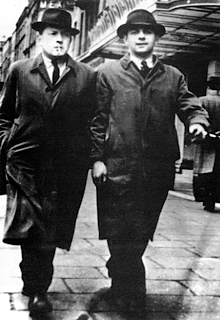
(Pictured: Seán McCaughey (right) and Charlie McGlade, O’Connell Street, Dublin, 1941)
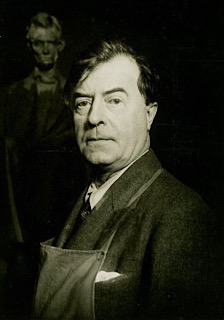
O’Connor’s father, Andrew O’Connor (1846–1924), of Lanarkshire, Scotland, is a stonecutter who becones a professional sculptor. As a teenager, he apprentices to his father, helping him to design monuments for cemeteries.
O’Connor is involved in a minor controversy in 1909 when he is commissioned to design a statue for Commodore John Barry, of the American Revolutionary-era navy. His first design is heatedly attacked by Irish American groups. He submits a second version, but it too is ultimately rejected, and the sculptor John J. Boyle received the commission.
Maude is born on May 22, 1941, in Casla, County Galway, and reared in the Irish language. Her mother, Máire Nic an Iomaire, is a school teacher, and she receives her primary education from her on a small island off the coast of Rosmuc. Her father, John Maude, is from Cill Bhriocáin township near Rosmuc. She attends secondary school at Coláiste Chroí Mhuire, Spiddal, an all-Irish language school in County Galway. She later credits one of her Irish language teachers there, Sister Ailbhe, as an early influence in cultivating her writing confidence.
Maude begins writing modern literature in Irish in secondary school and develops a rhythm of poetry closely attuned to the rhythms of the Conamara Theas dialect of Connacht Irish, spoken in her native district. Though not conventionally religious, she admits in an interview that she has a deep interest in spirituality and that this has left its mark on her poetry. She is noted as a highly effective reciter of her own verse. Géibheann is the best-known of her poems, and is studied at Leaving Certificate Higher Level Irish in the Republic of Ireland. A posthumous collected edition, Caitlín Maude, Dánta, is published in 1984, Caitlín Maude: file in 1985 in Ireland and Italy, and Coiscéim in 1985.
Maude is widely known as an actress. She acts at the university, at An Taibhdhearc in Galway and the Damer Theatre in Dublin, and is particularly successful in a production of An Triail by Máiréad Ní Ghráda at the Damer Theatre in 1964. She plays the protagonist, Máire Ní Chathasaigh, an unmarried mother who experiences family rejection, a stay in a Magdalene laundry, and ultimately murders her infant child followed by suicide. In 2017, Former Irish Minister For JusticeMáire Geoghegan-Quinn cites this performance as “pathbreaking”: “Caitlín Maude played the role, when nobody talked about the issue and when, as we know, women were still devalued, still caricatured, still incarcerated and disenfranchised if they became mothers out of wedlock.” Maude herself is a playwright and co-authors An Lasair Choille with poet Michael Hartnett.
Maude is very active in the Celtic Revival. She founds An Bonnán Buí, an Irish-speaking social club in the 1970s in Dublin. As a member of the Dublin Metropolitan Gaelgeoir community, she is active in many direct action campaigns by the language revival organization Gluaiseacht Chearta Sibhialta na Gaeltachta, including the campaign that forces the Irish State to establish a Gaelscoil (Irish-medium primary school) Scoil Santain in the suburb of Tallaght, County Dublin. A second Irish language school, Scoil Chaitlin Maude, opens in Tallaght in 1985 shortly after her death. It begins as a two-room school with 35 children and has grown to a 16 room new building serving 345 children as of 2023.
Maude is also a distinguished sean-nós singer. She makes one album in this genre, Caitlín, released in 1975 on Gael Linn Records and now available as a CD. It contains both traditional songs and a selection of readings of her poetry.
Maude marries Cathal Ó Luain in 1969. They have one child Caomhán, their son.
Maude dies of complications from cancer on June 6, 1982, at the age of 41. She is buried in Bohernabreena graveyard, which overlooks the city from the Wicklow Mountains.
In 2001, a new writers’ centre in Galway is named after her: Ionad Scríbhneoirí Chaitlín Maude, Gaillimh.
Since Maude’s death, critics in several languages have continued to study her literary works. Irish writer and The Irish Times columnist Michael Harding cites her as one of a few examples of groundbreaking women to “spin the hurt and wound of their oppression, and weave new loves songs and laments.” Irish Studies professor Sarah McKibben notes that Maude’s innovation in the poem represents an instance of recent Irish writers transgressing “literary, nationalistic, sociolinguistic and gender norms to craft new ways of writing in Irish.”
According to Louis de Paor, “Although no collection of her work was published during her lifetime, Caitlín Maude had a considerable influence on Irish language poetry and poets, including Máirtín Ó Direáin, Micheál Ó hAirtnéide, Tomás Mac Síomóin, and Nuala Ní Dhomhnaill. That influence is a measure of the dramatic force of her personality, her exemplary ingenuity and commitment to the language, and her ability as a singer to embody the emotional disturbance at the heart of a song. Her collected poems are relatively slight, including incomplete drafts and fragments, but reveal a poetic voice confident of its own authority, drawing on the spoken language of the Connemara Gaeltacht but rarely on its conventions of oral composition or, indeed, on precedents in Irish poetry in either language. The best of her work is closer to the American poetry of the 1960s in its use of looser forms that follow the rhythms of the spoken word and the sense of the poem as direct utterance without artifice, a technique requiring a high degree of linguistic precision and formal control.”
Maude’s work has also been translated into English and Spanish. Spanish language critic Pura Coloma notes that Maude’s work played a role in preserving Connemaran culture, as she “utilizes her own style to replicate the deep rhythms and tonalities of the regional voice.”
On June 5, 1976, a bomb explodes at the door of the Times Bar on York Road, killing two Protestants. The pub is frequented by members of the Ulster Defence Association (UDA), a legal loyalist paramilitary group. Irish republicans are blamed for the bombing. Shortly after, the UVF Brigade Staff (its Shankill Road-based leadership) decide to hit back by attacking the Chlorane Bar. It is a hastily arranged operation devised by its military commander “Bunter,” whom investigative journalistMartin Dillon refers to as “Mr. F.” The Chlorane Bar is located at 23 Gresham Street in Belfast’s city centre, near Smithfield Market. Its clientele is mixed (Protestant and Catholic), which is unusual during The Troubles. On August 17, 1973, the Chlorane Bar had been firebombed, however, no one was injured as the pub was closed at the time of the attack. Later that same month, the Ulster Freedom Fighters (UFF), a cover name sometime used by the UDA, claim responsibility for a car bomb which exploded in Gresham Street. Although there were no human casualties, a pet shop located near the bomb’s epicentre was damaged in the blast and a number of animals inside the building were either killed or injured.
The attack is planned and executed by the UVF platoons based at the Brown Bear and the Windsor Bar respectively. These are two pubs located on the Shankill Road and regularly frequented by UVF members. Dillon sometimes refers to the former platoon as the “Brown Bear Team” because the members generally meet at that particular pub, which faces Shankill Library on the corner of Mountjoy Street. To carry out the attack, along with the procuring of weapons and masks, a black taxi is hijacked by two young men outside the Long Bar on the Shankill Road to transport the gunmen to the Chlorane Bar. Taxi driver Mark Hagan and a passenger are held hostage at the Windsor Bar.
The Chlorane Bar is likely chosen for its nearness to the Shankill Road, affording the attackers a speedy getaway. There is not much of a security presence that evening in the area. The driver of the taxi, with four specifically chosen armed men seated in the rear of the vehicle in the manner of genuine passengers, makes his way from the Shankill Road to North Street and turns south into Gresham Street. Upon arrival outside the Chlorane Bar, the four gunmen don their masks, devised from yellow money bags, and exit the taxi.
At 10:00 p.m., the four masked gunmen storm through Chlorane Bar’s front door leading to the public bar. There are about sixteen customers inside the pub at the time. One of the four gunmen is Robert “Basher” Bates, a member of the violent Shankill Butchers gang led by Lenny Murphy, who is in police custody at the time the attack against the Chlorane takes place. Bates is the only one of the four to have been from the “Brown Bear Team.” The hit squad is commanded by a “Mr. G,” leader of the Windsor Bar UVF platoon, with “Mr. D” as his second-in-command and “Mr. C” completing the team. Entering the bar in single file, “Mr. G” orders everybody to stand up, and then asks the startled customers whether there are any “Prods” (Protestants) among them. William Greer, a Protestant, thinking the gunmen are from the Irish Republican Army, quickly flees to the men’s toilet where he places his feet up against the door. Customer Frederick Graham and his girlfriend, Pat Mahood, assume the same thing. “Mr. G” tells the customers to separate into two groups, with the Protestants standing at the bottom end of the bar, and the Catholics at the top.
When one man, Edward Farrell, admits to being a Catholic, the UVF men open fire. Farrell tries to run toward the toilet but is shot dead. The Catholic owner of the Chlorane, 64-year-old James Coyle, is standing behind the bar when he is hit at close-range. The bullet enters his heart and he dies instantly. The gunmen continue firing and two Protestant men, Daniel McNeil and Samuel Corr, are also struck by the hail of bullets. McNeil is killed on the spot and Corr is fatally wounded. Another Catholic man, John Martin, is shot and dies of his injuries on June 23. Several other customers are hit as gunfire is sprayed around the bar. One customer pretends to be dead, however, a gunman walks over to where he lay and deliberately fires three shots into his thigh, knee, and below the ankle. The man later recounts that he had then looked up to see “men lying shot all over the place.” William Greer, hiding in the toilet, is shot when one of the gunmen fire through the door. He survives despite being hit in the leg and neck. There are more customers upstairs in the lounge area, but although they hear the gunshots, the gunmen never go near them. Dillon maintains that it had not been the UVF unit’s intention to kill any Protestants.
“Mr. G” calls a halt to the shooting, saying “that’s it,” and the four-man UVF team nonchalantly walks out of the pub and re-enters the hijacked black taxi, which is parked so the driver has easy access to North Street. This route offers a quick return to the Shankill. After the four men get into the back seat, the driver (“Mr. H”) drives off. As the taxi passes by the Catholic Unity Flats area, three shots are fired from the vehicle. Two young men walking nearby get a look at the driver. He is described as being around 38 to 40 years old and having shoulder-length, black curly hair. Upon the taxi’s return to the Shankill, Mark Hagan and the passenger are released. They immediately go to the Tennent Street Royal Ulster Constabulary (RUC) Station off the Shankill where they report the taxi’s hijacking. The shooting team proceeds to the Long Bar pub where “Mr. I” (commander of UVF 1st Battalion) procures a forty-ounce bottle of vodka for “Mr. G” and “Mr. D” – their payment for leading the operation.
Having heard the gunshots, a barmaid serving in the upstairs lounge goes downstairs to investigate and discovers the body of her employer, James Coyle, lying on the floor behind the bar and those of the other dead and wounded. The first policeman on the scene is Constable George McElnea, from the RUC Special Patrol Group in Tennent Street. He quickly notices the pile of bodies near the men’s toilet as Samuel Corr stumbles toward him, gravely injured. McElnea places Corr on a bench and offers what assistance he can but to no avail. Corr dies of his gunshot wounds before the ambulance arrives. Alan McCrum, a Scenes of Crime officer, appears at the Chlorane fifteen minutes after the shootings. He retrieves 24 spent bullet casings from the floor and determines that most of the shots had been fired at the rear of the pub. Later ballistic testing establishes that the weapons used in the attack were a .22 caliber pistol, a 9 mm pistol, and two .45 snub-nosed revolvers. Police believe one of the victims, Daniel McNeil, had tenuous UVF connections, although he is not an active member.
The hijacked black taxi is found by police the following morning in a cul-de-sac in Beresford Street, off the Shankill Road. A cyclist, who had witnessed the masked gunmen entering the Chlorane Bar, describes the four men as having been in the 20 to 30 age group, all about 5’10 in height and well-built. The last gunman to enter had shoulder-length brown hair. The witness had gone to a nearby British Army post where he told soldiers what he had seen.
Ten days after the gun attack, the Chlorane Bar is blown up by a bomb. Three weeks after the attack the Provisional IRA, using their sometime cover-name of the “Republican Action Force“, enter Walker’s Bar in Templepatrick and kill three Protestant civilians in retaliation for the Chlorane attack. As part of this series of deadly tit for tat attacks on pubs, the UVF responds by killing six customers at the Catholic-owned Ramble Inn outside Antrim.
No one is ever charged with the shootings. In February 1979, Bates is convicted of the murders he had committed as part of the Shankill Butchers, and given ten life sentences. In his statement to the police following his arrest in 1977, he recounts his role in the Chlorane Bar attack. He alleges while working as a barman in the Long Bar on the evening of June 5, 1976, he is approached by the UVF military commander, “Mr. F”, who informs him of a job in which he is to take part that same evening. It is decided to attack the city centre pub in retaliation for the IRA’s earlier bombing of The Times pub. Bates goes on to say that “Mr. I” provides the weapons which are used in the shooting and “Mr. J” (UVF Provost Marshal) procures the masks. Bates claims that his revolver malfunctions and therefore he never fires his gun during the attack. However, forensic evidence proves that two .45 revolvers had been fired inside the Chlorane. Upon his release from the HM Prison Maze, Bates is gunned-down in June 1997 by the son of James Curtis Moorhead, a UDA man he had killed in 1977.
The United Irish rebels, under Fr. John Murphy’s command, have been encamped on land belonging to a Mr. Donovan at the foot of Carrigrew Hill on June 2 and 3. This small respite from hostilities and marching affords the rebels some rest and time to re-group from previous skirmishes. Some of the rebels take leave to visit their families during these two days before re-joining the camp in advance of their move north toward Gorey.
On the morning of the June 4, Lieutenant-General Loftus and Lieutenant-Colonel Walpole march out of Gorey with 1,200 men with the intention of attacking the rebel encampment at Carrigrew Hill. Loftus leads his 600 men out the Ballycanew road to attack the camp from the east while Walpole heads due south via Clough to attack the camp on its northern side.
Having received advanced warnings of the British plans, the poorly equipped rebel army of 10,000 to 12,000 men sets out from Carrigrew Hill and marches through Ballyoughter on to Tubberneering. Their aim is to defeat the Crown forces in Gorey and release rebel prisoners that have been captured and imprisoned there.
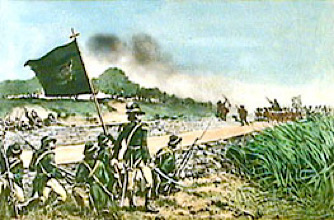
On approaching Tubberneering, a vanguard of rebels is warned by a scouting party returning from Clough that the British forces are heading their way. The vanguard sets up an ambush with musketeers on top of the rock at Tubberneering and pikemen laying in wait inside the ditch along the road south of Cain bridge.
The battle is an ambush of a British force of 400 men under Lieutenant-Colonel Walpole, containing one troop of regular cavalry (the 4th Royal Irish Dragoon Guards) and militia and yeomanry auxiliaries. They are ambushed in a narrow defile by United Irish rebels, led by Fr. John Murphy. Walpole and one hundred men are killed, while the rest throw away their weapons and uniforms and flee. The regular dragoons make an attempt to fight back but are in a bad place for cavalry so they withdraw. This defeat allows three cannon to be captured which are subsequently used against British troops at the Battle of Arklow. The rebels are unable to take Arklow however. The day after the engagement at Tubberneering, the United Irishmen attempt to take New Ross in the south of County Wexford but are repulsed at a heavy cost.
McKelvey is second among six children and second of three sons of William McKelvey, painter and decorator, originally from Roseville, Craigavad, County Down, and his wife Mary, daughter of Frank Baird, farmer, from Ballywee, County Antrim. He is baptised at Saint Matthew’s Parish Church.
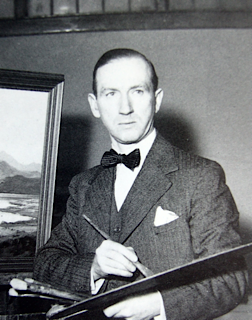
McKelvey attends Mayo Street national school in Belfast. When he is sixteen he became a lithographer apprentice to the firm David Allen & Sons. They produce postcards, posters and notices. He enrolls in the Belfast School of Art part-time by attending evening classes until he leaves his employment in 1911 to study full-time. Alfred Rawlings Baker, his art master, has great influence on him during his time at art college. He receives numerous awards for his artwork including the Sir Charles Brett Prize, the Fitzpatrick Prize, and the Taylor Art Competition.
McKelvey returns to David Allen & Sons in 1917 for a short period of time before he begins to focus on painting and opens his own studio in 1920. The studio is located in Rea’s Building, Royal Avenue, Belfast.
By 1918 McKelvey’s work is exhibited at the Royal Hibernian Academy (RHA) and in 1921 he is elected a member of the Belfast Art Society. He is appointed an associate of the RHA in 1923, being granted full membership in 1930. During his career he is considered on a par with Paul Henry and James Humbert Craig, two of the most successful Irish landscape painters of the time. He is elected as one of the first academicians of the Ulster Academy of Arts when it is founded in 1930. He dies in Belfast on June 30, 1974.
Pilkington is born to John Pilkington and Margaret Mary Pilkington (née Torsney), the second of twelve children born to the couple. Only nine of his siblings survive into adulthood. He receives his education at the local Marist Brothers convent school and the Day Trades Preparatory School. Later he is a student at the Department of Agriculture Forestry College in County Wicklow. When the Irish War of Independence begins, the college is closed and he is forced to return to Sligo. He then gains employment with Wehrly Brothers Ltd., a jewelry and watchmaking store in Sligo.
Several notable incidents occur in Pilkington’s military career. On October 25, 1920, at Moneygold, eight miles from Sligo (between Grange and Cliffoney), IRA men led by him ambush a nine-man Royal Irish Constabulary (RIC) patrol, killing four (Sergeant Patrick Perry, Constables Patrick Keown, Patrick Laffey, Patrick Lynch) and wounding two others (Constables Clarke and O’Rourke). In January 1922, he makes clear his opposition to the IRAs General Headquarters (GHQ) support for the Anglo-Irish Treaty. “We intend to cut away from this headquarters, all of you (pointing to the staff and officers of the GHQ) want to build up a Free State Army so you can march in step into the British Empire. Do it openly. We stand by the Republic.” On April 6, 1922, a meeting addressed by Arthur Griffith in Sligo, is proclaimed illegal by Pilkington, who is the local Anti-Treaty IRA divisional commander. His troops take over a number of buildings in the town. Seán Mac Eoin brings Provisional Government troops from Athlone and on the day of the meeting, he is joined by further troops led by J. J. “Ginger” O’Connell. A tense situation ensues but, at the last minute, Pilkington backs down and the meeting goes ahead. On September 4, 1922, an Anti-Treaty IRA unit under Pilkington takes the Dromhaire barracks in County Sligo after the Free State garrison surrenders.
On August 27, 1923, Pilkington runs unsuccessfully in the general election for the 4th Dáil as a Republican candidate, polling 2,089 first preference votes.
Pilkington is a prominent member of the Anti-Treaty IRA for many years, but his most important role as part of the Anti-Treaty IRA comes on April 20, 1923. The Executive of the Anti-Treaty IRA meets in Poulacappal (four miles southwest of Callan and three miles from Mullinahone). Present in addition to Pilkington (who is replacing Liam Lynch) are Frank Aiken, Sean Hyde, Sean Dowling, Bill Quirke, Tom Barry, Tom Ruane (replacing Michael Kilroy), Tom Sullivan (replacing Sean Lehane), Sean McSwiney, Tom Crofts, P. J. Ruttledge and Sean O’Meara (substitute for Séumas Robinson). Frank Aiken is elected Chief-of-Staff and an Army Council of Aiken, Pilkington and Barry is appointed. Aiken proposes that peace should be made with the Pro-Treaty Government on the basis that “the sovereignty of the Irish Nation and the integrity of its territory is inalienable.” This is passed by nine votes to two.
Pilkington becomes a Catholic priest after his foray into politics and due to the disillusionment of the Irish War of Independence. He joins the Redemptorist Order and becomes known as Father William Pilkington CSsR. He serves as a priest in the Archdiocese of Cape Town, South Africa, priest of Monmouthshire, Wales, and retires to Bishop Eton Monastery, Liverpool.
In 1954, Pilkington is guest of honour at a dinner sponsored by Clan na Gael and the IRA Veterans of America in New York City where he says he is returning to the mission fields of Africa, but he remains faithful to the All Ireland Republic. He dies at Bishop Eton Monastery on March 26, 1977, and is buried in Liverpool.
F. J. McCormick (real name Peter Christopher Judge), an Irish actor who becomes known for his work at Dublin‘s Abbey Theatre, is born in Skerries, County Dublin, on June 1, 1890. He acquires the stage name “F.J. McCormick” to disguise his identity from his current and future employers, and to avoid parental disapproval. He joins the Abbey at age 19, and acts in some 500 productions there. He is especially remembered for his work in the plays of Seán O’Casey.
After living in Skerries in his early years, at age ten McCormick moves to Dublin and proceeds to live there for the majority of the duration of his life. He is educated locally in Skerries. His father, Michael Judge, is a maltser and later becomes a brewery manager. He is of medium height, with “expressive eyes” and thick brown hair. As a young man, he begins writing by contributing articles to the press. He works briefly as a post office clerk in London but returns to Dublin to work as a junior clerk in the Civil Service. He resigns from his public service career in 1918 and decides to embrace acting as a full-time career as a member of the Abbey Theatre at age 19.
McCormick’s mother dies when he is 2 years old. He and his family move to Dublin when he is 10 or 12 years old. He is raised in Skerries and attends the Holy Faith Convent for primary education. He describes his childhood in Skerries “as a very happy one.” He marries Eileen Crowe on December 2, 1925, in Rathdown. They meet at the Abbey where Crowe is also an actor. In describing their performances together, Seamus De Burca writes, “F. J. McCormick and Eileen Crowe lived a life together of perfect bliss.” The couple has two children, a son, David, and a daughter, Marie.
After moving briefly to London, McCormick returns to Dublin, where he works in the Civil Service. He also takes acting roles in the Workmen’s Club on York Street, and for the first time under the pseudonym by which he becomes known for roles with the Queen’s Theatre, Dublin. By May 1919, he has a leading role in an independent production of The Curate of St. Chad’s by Constance Powell Anderson at the Abbey Theatre. An attack on Irish acting by Edward Martyn is answered by McCormick in the pages of the journal Banba in June 1921.
McCormick acts in over 500 plays at the Abbey Theatre, becoming particularly associated with the plays of Sean O’Casey staged there. From 1923 to 1925, he is also stage manager at the Abbey. Of his performance as Seumus Sheilds in The Shadow of a Gunman, O’Casey says that the actor created a character greater than that which he had written. He plays Capt. Brennan in the filmed version of O’Casey’s The Plough and the Stars but it is his return to film in Carol Reed‘s Odd Man Out (1947) that sees him singled out for praise in contemporaneous reviews. The Irish Times writes that “the acting of the Irish players was unremittingly professional, and, in the case of F. J. McCormick, as Shell, a weak-minded and elderly corner-boy, quite outstanding.” The Times of London finds “it is Mr. F. J. McCormick as a sly, bird-like creature, who stops just the right side of informing, who catches most surely at the imagination.”
In their review of the film Hungry Hill (1947), The New York Times writes, “As the butler who served John Brodrick, his sons, and their sons in turn, the late F. J. McCormick is truly magnificent, giving an even more subtle portrayal of Irish character than he did as the wily tramp in Odd Man Out.”
In the last five years of McCormick’s life he continues to work in the Abbey where he acts in over 70 plays before his death. He only stars in one play in the theatre in the final year of his life, the play They Got What They Wanted playing the role of Bartley Murnaghan. He secures more leading roles in the film industry. He dies in Dublin at the age of 56 from a brain tumour on April 24, 1947. He is buried in Dean’s Grange Cemetery, Deansgrange, County Dublin. He continues to work right up until his death.
It is said that people regarded McCormick as one of the greatest actors in his era. This comes from his work in 500 plays and 4 films over his career. A year after his death, Barry Fitzgerald says he only knew of two actors with the gift that McCormick had and they were Charles Laughton and Charlie Chaplin.
There are many popular plays and films that McCormick is part of which are still remembered to this day by many, some of them include the original The Plough and the Stars in 1926 where he originates the role of Commandant Jack Clitheroe. He also plays the role of Captain Brennan in the John Ford film version of the play in 1936. In his appreciation for McCormick, Gabriel Fallon remembers him as both a great actor and a great man.
It is said that McCormick was one of the most versatile actors of his generation, his early death was a huge loss to the Irish arts and more specifically the Abbey Theatre where he carried most of his work.