seamus dubhghaill

Promoting Irish Culture and History from Little Rock, Arkansas, USA


Leave a comment

Death of Irish Artist Sarah Henrietta Purser

sarah-purser-by-john-butler-yeats

Sarah Henrietta Purser, Irish artist mainly noted for her work with stained glass, dies in Dublin on August 7, 1943.

The Purser family had come to Ireland from Gloucestershire in the eighteenth century. Purser is born in Kingstown (now Dún Laoghaire) in County Dublin on March 22, 1848. She is raised in Dungarvan, County Waterford, one of the numerous children of Benjamin Purser, a prosperous flour miller and brewer, and his wife Anne Mallet. She is related to Sir Frederic William Burton, RHA (1816-1900), who is a son of Hannah Mallet. Two of her brothers, John and Louis, become professors at Trinity College Dublin. Her niece Olive Purser, daughter of her brother Alfred, is the first woman scholar at Trinity.

At thirteen Purser attends the Moravian school, Institution Evangélique de Montmirail, Switzerland where she learns to speak fluent French and begins painting. In 1873 her father’s business fails and she decides to become a full-time painter. She attends classes at the Dublin Metropolitan School of Art and joins the Dublin Sketching Club, where she is later appointed an honorary member. In 1874 she distinguishes herself in the National Competition. In 1878 she again contributes to the Royal Hibernian Academy, and for the next fifty years becomes a regular exhibitor, mainly portraits, and shows an average of three works per show.

In 1878-1879, Purser studies at the Académie Julian in Paris where she meets the German painter Louise Catherine Breslau, with whom she becomes a lifelong friend.

Purser becomes wealthy through astute investments, particularly in Guinness, for which several of her male relatives have worked over the years. She is very active in the art world in Dublin and is involved in the setting up of the Municipal Gallery of Modern Art, persuading the Irish government to provide Charlemont House in Parnell Square to house the gallery.

Purser works mostly as a portraitist. Through her talent and energy and owing to her friendship with the Gore-Booths, she is very successful in obtaining commissions. When the Lord Lieutenant of Ireland commissions her to portray his children in 1888, his choice reflects her position as the country’s foremost portraitist. Various portraits painted by Purser are held in the National Gallery of Ireland.

Purser finances An Túr Gloine (The Tower of Glass), a stained-glass cooperative, at 24 Upper Pembroke and runs it from its inauguration in 1903 until her retirement in 1940. Michael Healy is the first of a number of distinguished recruits, such as Catherine O’Brien, Evie Hone, Wilhelmina Geddes, Beatrice Elvery and Ethel Rhind. She is determined the stained-glass workshop should adhere to true Arts and Crafts philosophy. An Túr Gloine archive is held in the Centre for the Study of Irish Art, National Gallery of Ireland.

Purser does not produce many items of stained glass herself. Most of the stained-glass works are painted by other members of the co-operative, presumably under her direction. Two early works are St. Ita (1904) for St. Brendan’s Cathedral, Loughrea and The Good Shepard (1904) for St. Columba’s College, Dublin. Her last stained-glass work is believed to be The Good Shepard and the Good Samaritan (1926) for the Church of Ireland at Killucan, County Westmeath.

Until her death Purser lives for many years in Mespil House, a Georgian mansion with beautiful plaster ceilings on Mespil Road, on the banks of the Grand Canal. Here she is “at home” every Tuesday afternoon to Dublin’s writers and artists. Her afternoon parties are a fixture of Dublin literary life.

Purser dies in Dublin on August 7, 1943, and is buried in Mount Jerome Cemetery beside her brothers John and Louis. Mespil House is demolished after her death and developed into apartments.

Purser is the second woman to sit on the Board of Governors and Guardians, National Gallery of Ireland, 1914-1943. She is made an Honorary Member of the Royal Hibernian Academy in 1890, becoming the first female Associate Member in 1923 and the first female Member in 1924. Also, in 1924 she initiates the movement for the launching of the Friends of the National Collection of Ireland. Archives relating to Sarah Purser are housed in the Centre for the Study of Irish Art, National Gallery of Ireland.

(Pictured: Portrait of Sarah Purser by John Butler Yeats, c. 1880–1885)


Leave a comment

The Battle of Utoy Creek

*

The 10th Tennessee Infantry (Irish) fights at the Battle of Utoy Creek on August 6, 1864, during the American Civil War. Known as the “Bloody Tinth,” it is one of only two Irish Catholic regiments in the Confederate States Army, although their elected officers are mostly Ulster Scots Protestants. They are deployed as sharpshooters through the tough campaigns at Chickamauga, Chattanooga and Atlanta.

The Battle of Utoy Creek is fought August 4–7, 1864, during the Atlanta Campaign of the American Civil War. Major General William Tecumseh Sherman‘s Union armies have partially encircled the city of Atlanta, Georgia, which is being held by Confederate forces under the command of General John Bell Hood. Sherman has at this point adopted a strategy of attacking the railroad lines into Atlanta, hoping to cut off his enemies’ supplies. This is the third direct attack on Confederate positions during the campaign and the effect of success would have ended the siege and won Atlanta on August 6, 1864.

After failing to envelop Hood’s left flank at the Battle of Ezra Church, Sherman still wants to extend his right flank to hit the railroad between East Point and Atlanta. He transfers Maj. Gen. John McAllister Schofield‘s XXIII Corps of the U.S. Army of the Ohio from his left to his right flank and sends him to the north bank of Utoy Creek.

Although Schofield’s troops are at Utoy Creek on August 2, they, along with the XIV Corps, Army of the Cumberland, do not cross until August 4. An initial attack by the Regular Brigade against James Patton Anderson‘s Division CSA of Stephen Dill Lee‘s Corps is unsuccessful. In addition, the Confederates dismount a brigade of cavalry, Armstrong’s, in the front of the federals in a deception plan, a feinted attack that is successful in delaying the combined force of the XXIII and XIV Corps USA.

Schofield makes an additional movement to exploit this situation on the morning of August 5. Although initially successful, Schofield has to regroup his forces, which takes the rest of the day. The delay allows the Confederates to strengthen their defenses with an abatis, which slows the Union attack when it restarts on the morning of August 6. The Federals are repulsed with heavy losses by William Brimage Bate‘s division and fail in an attempt to break the main defenses to gain the railroad.

On August 7, the Union troops move toward the Confederate main line skirmishing and extending to their right and entrench. Several attacks are made at Sandtown Road (Campbellton at Adams Park) on August 10 and East Point on August 18. Here US Forces remain, as far south as the Atlanta Christian College, until late August 1864 when the failure of Schofield’s offensive operations convinces Sherman to move on the Confederate lines of communication and supply.


1 Comment

RTÉ Television Centre Bombing

File written by Adobe Photoshop? 5.0

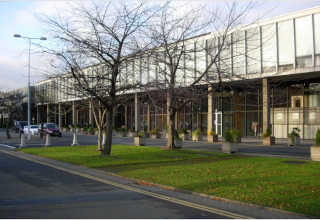
At the beginning of “The Troubles” in Northern Ireland, the Ulster Volunteer Force (UVF) plants their first bomb in the Republic of Ireland, damaging the RTÉ Television Centre in Donnybrook, Dublin, on August 5, 1969. No injuries result from the bombing.

The RTÉ Television Centre is a television studio complex which is owned by Raidió Teilifís Éireann (RTÉ) and has been home to Ireland’s national public service broadcaster since 1961. The building houses the main production studios for RTÉ Television, the control rooms for all RTÉ’s TV channels, and RTÉ’s main newsroom.

At 1:30 AM on the morning of August 5, a bomb explodes at the RTÉ Television Centre causing damage primarily to the western end of the studios. The explosion is heard over a wide area of Dublin. Only a skeleton staff are on duty and nobody is injured. The bombing takes place during the protest campaign by the Northern Ireland Civil Rights Association but before the 1969 Northern Ireland riots.

The bomb, which is believed to be a time bomb placed at the rear wall of the studio building, causes no structural damage to the building but destroys the wardrobe department and shatters windows in a large section of the building, including the large structural plate glass panels which are a feature of the building.

Army explosive experts are called in to investigate the cause of the explosion and determine who planted it.


Leave a comment

Death of John Dillon, Irish Parliamentary Party Leader

john-dillon

John Dillon, a Member of Parliament (MP) for over 35 years and the last leader of the Irish Parliamentary Party in the struggle to secure Home Rule by parliamentary means, dies in a London nursing home on August 4, 1927. Through the 1880s he is perhaps the most important ally of the greatest 19th-century Irish nationalist, Charles Stewart Parnell, but, following Parnell’s involvement as co-respondent in a divorce case, he repudiates Parnell for reasons of political prudence.

Dillon is born in Blackrock, Dublin, a son of the former “Young IrelanderJohn Blake Dillon (1814–1866). Following the premature death of both his parents, he is partly raised by his father’s niece, Anne Deane. He is educated at Catholic University School, at Trinity College, Dublin and at the Catholic University of Leuven in Belgium. He afterwards studies medicine at the Royal College of Surgeons in Dublin, then ceases active involvement in medicine after he joins Isaac Butt‘s Home Rule League in 1873

Dillon is a member of the British House of Commons during 1880–1883 and 1885–1918. For his vigorous work in the Irish National Land League, which seeks fixed tenure, fair rents, and free sale of Irish land, he is imprisoned twice between May 1881 and May 1882. He is Parnell’s fellow inmate in Kilmainham Gaol in Dublin from October 1881. For six months in 1888 he is imprisoned for aiding William O’Brien, author of the “plan of campaign” against high rent charges by English absentee landlords in Irish farming districts.

When Parnell is named co-respondent in Captain William Henry O’Shea’s divorce suit in 1890, Dillon and O’Brien at first affirm their support of him, but they finally decide that he will thenceforth be a liability as party leader. The party then splits, the anti-Parnellite majority forming the Irish National Federation, of which Dillon serves as chairman from 1896. In 1900, however, he agrees to join a reunited party under the Parnellite John Redmond.

During the prime ministry of Arthur James Balfour (1902–1905), Dillon comes to believe that the British Conservative government intends to grant Irish reforms without independence, thereby “killing Home Rule by kindness.” In 1905 he advises Irishmen to vote for Liberal Party candidates for Parliament, and, after the Liberals had taken office that year, he supports their reform program.

Throughout World War I Dillon vehemently opposes the extension of British military conscription to Ireland, both because that measure would strengthen the agitation by the more extreme nationalist Sinn Féin party and because he never accepted the view that British imperial interests necessarily coincided with those of Ireland. After the Easter Rising in Dublin in 1916, he protests against the harsh measures that ensue and, in the House of Commons, makes a passionate speech in defense of the Irish rebels.

Upon Redmond’s death on March 6, 1918, Dillon, who had broken with him over Irish support for the British war effort, succeeds him as Irish Parliamentary Party leader. By that time, however, the party has been discredited and in the 1918 Irish general election Sinn Féin wins easily. On losing his House of Commons seat to Éamon de Valera, the future president of the Republic of Ireland, he retires from politics.

Dillon dies in a London nursing home at the age of 76, on August 4, 1927. He is buried four days later in Glasnevin Cemetery in Dublin. There is a street named after him in Dublin’s Liberties area, beside the old Iveagh Markets. One of his six children is James Mathew Dillon (1902–1986), a prominent Irish politician and leader of the National Centre Party and of Fine Gael (1957–1966) and also serves as Minister for Agriculture (1954-1957).


Leave a comment

The Ealing Bombing

ealing-bombing

The Real Irish Republican Army (IRA), a dissident Irish republican organisation and splinter of the Provisional Irish Republican Army, detonates a car bomb containing 100 lbs. of homemade plastic explosives in Ealing, West London, England on August 3, 2001.

The bomb is in a grey Saab 9000 near the Ealing Broadway station, restaurants and pubs on Uxbridge Road, which explodes shortly after midnight, injuring seven people. Debris from the blast spreads more than 220 yards. The bomb is timed to target leaving karaoke pub-goers, but while most escape injury, the explosion still causes significant damage to property, estimated to be around £200,000. The adjacent Ealing Broadway shopping centre is also damaged by flooding arising from the water main under the car bomb being ruptured.

Experts regard the bomb to be designed to look spectacular on CCTV for the purposes of “armed propaganda” rather than to cause large numbers of injuries. However, anti-terrorist detectives claim that the attack is planned to be a massacre and to cause as much carnage as the Omagh bombing three years earlier.

The bombing is the last successful Irish republican bombing on British soil outside Northern Ireland, of whom dissidents have waged an armed campaign since the Good Friday Agreement was signed in 1998, ending the Troubles.

The attack is condemned by British Prime Minister Tony Blair, Sinn Féin President Gerry Adams and others. It also comes during a crucial time for the Northern Ireland peace process with disagreements regarding the Provisional IRA’s decommissioning process. The attack comes months after the Real IRA bombed the BBC Television Centre three miles away. Two days prior to the attack, a 20 kg Real IRA bomb is discovered at Belfast International Airport. After Ealing, the bombers target a new attack on Birmingham on November 3, which ultimately fails.

In November 2001, three men, Noel Maguire, Robert Hulme and his brother Aiden Hulme, are arrested in connection with the Ealing, BBC and Birmingham bomb attacks. They are all later convicted at the Old Bailey on April 8, 2003. Robert and Aiden Hulme are each jailed for twenty years. Noel Maguire, whom the judge says played “a major part in the bombing conspiracy,” is sentenced to twenty-two years.

Two other men, James McCormack of County Louth and John Hannan of Newtownbutler, County Fermanagh, had already admitted the charge at an earlier hearing. McCormack, who plays the most serious part of the five, is jailed for twenty-two years. John Hannan, who is seventeen at the time of the incidents, is given sixteen years of detention.


Leave a comment

Birth of John Tyndall, Experimental Physicist

File source: //commons.wikimedia.org/wiki/File:John_Tyndall_(scientist).jpg

John Tyndall, Irish experimental physicist who, during his long residence in England, is an avid promoter of science in the Victorian era, is born on August 2, 1820, in Leighlinbridge, County Carlow.

Tyndall is born into a poor Protestant Irish family. After a thorough basic education, he works as a surveyor in Ireland and England from 1839 to 1847. When his ambitions turn from engineering to science, he spends his savings on gaining a Ph.D. from the University of Marburg in Marburg, Hesse, Germany (1848–1850), but then struggles to find employment.

In 1853 Tyndall is appointed Professor of Natural Philosophy at the Royal Institution, London. There he becomes a friend of the much-admired physicist and chemist Michael Faraday, entertains and instructs fashionable audiences with brilliant lecture demonstrations rivaling the biologist Thomas Henry Huxley in his popular reputation and pursuing his research.

An outstanding experimenter, particularly in atmospheric physics, Tyndall examines the transmission of both radiant heat and light through various gases and vapours. He discovers that water vapor and carbon dioxide absorb much more radiant heat than the gases of the atmosphere and argues the consequent importance of those gases in moderating Earth’s climate, that is, in the natural greenhouse effect. He also studies the diffusion of light by large molecules and dust, known as the Tyndall effect, and he performs experiments demonstrating that the sky’s blue color results from the scattering of the Sun’s rays by molecules in the atmosphere.

Tyndall is passionate and sensitive, quick to feel personal slights and to defend underdogs. Physically tough, he is a daring mountaineer. His greatest fame comes from his activities as an advocate and interpreter of science. In collaboration with his scientific friends in the small, private X Club, he urges greater recognition of both the intellectual authority and practical benefits of science.

Tyndall is accused of materialism and atheism after his presidential address at the 1874 meeting of the British Association for the Advancement of Science, when he claims that cosmological theory belongs to science rather than theology and that matter has the power within itself to produce life. In the ensuing notoriety over this “Belfast Address,” his allusions to the limitations of science and to mysteries beyond human understanding are overlooked. He engages in a number of other controversies such as spontaneous generation, the efficacy of prayer and Home Rule for Ireland.

In his last years Tyndall often takes chloral hydrate to treat his insomnia. When bedridden and ailing, he dies from an accidental overdose of this drug on December 4, 1893, at the age of 73 and was buried at Haslemere, Surrey, England.

Tyndall is commemorated by a memorial, the Tyndalldenkmal, erected at an elevation of 7,680 ft. on the mountain slopes above the village of Belalp, where he had his holiday home, and in sight of the Aletsch Glacier, which he had studied.


Leave a comment

Death of Hunger Striker Kevin Lynch

kevin-lynch

Kevin Lynch, Irish republican hunger striker and member of the Irish National Liberation Army (INLA), dies on August 1, 1981 at Maze Prison in County Down, Northern Ireland following 71 days on hunger strike.

Lynch is born on May 25, 1956 in Park near Dungiven, County Londonderry, Northern Ireland, the youngest in a family of eight children born to Paddy and Bridie Lynch. His older brother, Frank, is an amateur boxer and he also participates in the sport as well as Gaelic football and hurling. He is a member of the winning Dungiven GAC team which wins the Féile na nGael Division 3 in Thurles, County Tipperary in 1971. In 1972 he captains the Derry Hurling team to an Under-16 All-Ireland title at Croke Park in Dublin by defeating the Armagh GAA club.

Lynch stands as a Anti H-Block candidate in the Waterford constituency during the June 1981 general election in the South and polls extremely well despite missing out on election.

Lynch is tried, convicted and sentenced to ten years for conspiracy to obtain arms, taking part in a punishment shooting and conspiring to take arms from the security forces. He is sent to the Maze Prison in County Down in December 1977. He becomes involved with the blanket protest and joins the 1981 hunger strike at the Maze on May 23, 1981. He dies at Maze Prison 71 days later on August 1, 1981.

The Dungiven hurling team is renamed Kevin Lynch’s Hurling Club in his honour following his death.


Leave a comment

Death of Andrew Johnson, 17th President of the United States

andrew-johnson

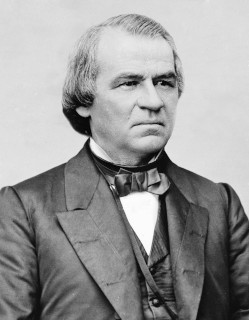
Andrew Johnson, the 17th President of the United States (1865 – 1869), dies on July 31, 1875, at his daughter Mary’s farm near Elizabethton, Tennessee after suffering two strokes.

Johnson assumes the presidency at the time of the assassination of Abraham Lincoln as he is Lincoln’s Vice President. He is a Democrat who runs with Lincoln on the National Union ticket, coming to office as the American Civil War concludes. He favors quick restoration of the seceded states to the Union without protection for the former slaves. This leads to conflict with the Republican-dominated Congress, culminating in his impeachment by the House of Representatives in 1868. He is acquitted in the Senate by one vote. His main accomplishment as president is the Alaska Purchase.

Johnson is born in poverty in Raleigh, North Carolina on December 29, 1808. His grandfather emigrated to the United States from County Antrim in what is now Northern Ireland. He never attends school and is apprenticed as a tailor and works in several frontier towns before settling in Greeneville, Tennessee. He serves as alderman and mayor there before being elected to the Tennessee House of Representatives in 1835. After brief service in the Tennessee Senate, he is elected to the U.S. House of Representatives in 1843, where he serves five two-year terms.

On October 17, 1853, Johnson becomes the 15th Governor of Tennessee serving for four years until November 3, 1857. He is elected by the legislature to the United States Senate on October 8, 1857. During his congressional service, he seeks passage of the Homestead Act of 1862 which is enacted soon after he leaves his Senate seat in 1862.

Southern slave states secede to form the Confederate States of America, which includes Tennessee, but Johnson remains firmly with the Union. He is the only sitting senator from a Confederate state who does not resign his seat upon learning of his state’s secession. In 1862, Lincoln appoints him as military governor of Tennessee after most of it has been retaken. In 1864, he is a logical choice as running mate for Lincoln, who wishes to send a message of national unity in his re-election campaign. Their ticket easily wins the election. He is sworn in as Vice President on March 4, 1865. He gives a rambling speech, after which he secludes himself to avoid public ridicule. Six weeks later, the assassination of Lincoln elevates him to the presidency.

Johnson implements his own form of Presidential Reconstruction, a series of proclamations directing the seceded states to hold conventions and elections to reform their civil governments. Southern states return many of their old leaders and pass Black Codes to deprive the freedmen of many civil liberties, but Congressional Republicans refuse to seat legislators from those states and advance legislation to overrule the Southern actions. Johnson vetoes their bills, and Congressional Republicans override him, setting a pattern for the remainder of his presidency.

Johnson opposes the Fourteenth Amendment which gives citizenship to former slaves. In 1866, he goes on an unprecedented national tour promoting his executive policies, seeking to break Republican opposition. As the conflict grows between the branches of government, Congress passes the Tenure of Office Act in 1867 restricting his ability to fire Cabinet officials. He persists in trying to dismiss Secretary of War Edwin Stanton but ends up being impeached by the House of Representatives and narrowly avoiding conviction in the Senate. He does not win the 1868 Democratic presidential nomination and leaves office the following year.

Johnson returns to Tennessee after his presidency and gains some vindication when he is elected to the Senate in 1875, making him the only former president to serve in the Senate. In late July 1875, convinced some of his opponents are defaming him in the Ohio gubernatorial race, he decides to travel there to give speeches. He begins the trip on July 28 and breaks the journey at his daughter Mary’s farm near Elizabethton, where his daughter Martha is also staying. That evening he suffers a stroke but refuses medical treatment until the following day. When he does not improve two doctors are sent for from Elizabethton. He seems to respond to their ministrations but suffers another stroke on the evening of July 30 and dies early the following morning at the age of 66.

President Ulysses S. Grant has the “painful duty” of announcing the death of the only surviving past president. Northern newspapers, in their obituaries, tend to focus on Johnson’s loyalty during the war, while Southern ones pay tribute to his actions as president. Johnson’s funeral is held on August 3 in Greeneville. He is buried with his body wrapped in an American flag and a copy of the U.S. Constitution placed under his head, according to his wishes. The burial ground is dedicated as the Andrew Johnson National Cemetery in 1906 and, with his home and tailor’s shop, is part of the Andrew Johnson National Historic Site.


2 Comments

Birth of Irish Artist Charles Harper

skellig-arrival-by-charles-harper

Irish artist Charles Harper is born on July 30, 1943, on Valentia Island in County Kerry. He studies at the National College of Art and Design, Limerick School of Art and Design and the Graphic Studio in Dublin. He is taught by Maurice MacGonigal and Seán Keating. He also studies filmmaking in Germany.

Harper exhibits regularly in Ireland and abroad. His paintings are well known for their metaphoric themes, including boats, the human form, landscape and angels usually in painterly expressive form.

Harper is influenced by Francis Bacon and David Hockney which is apparent in his portrait work. In his treatment of the human head, the influence of Bacon is obvious as is the work of the Irish artist Louis Le Brocquy. He is also influenced by the Irish artist Patrick Collins. For Harper the actual act of painting is what matters as he sees the actual process as one of exploration and discovery. He says, “the process, the making excites me more than any end product.”

Harper represents Ireland at International Biennials in many countries throughout his career. He receives many national awards for his painting, including first prize for his work commemorating the 1916 Easter Rising at the Municipal Gallery of Modern Art in Dublin, the Carrols Open Award at the Irish Exhibition of Living Art in Dublin and The Arts councils Bonn an Uachtarain de Hide at the Oireachtas Art Exhibition. More recently he is awarded the BulBulia Award at the Royal Hibernian Academy in 2008.

Harper’s work is included in many important public and private collections including the San Francisco Museum of Modern Art, the Irish Museum of Modern Art and the Irish Arts Council. He is also a member of Aosdána and the Royal Hibernian Academy.

“Painting being a cultural and creative activity should be accessible to all. Though it may also confuse the viewer. I find this totally understandable and acceptable, as art should challenge our perception and established aesthetic.”

(Pictured: Skellig Arrival, acrylic on linen by Charles Harper)


1 Comment

The Battle of Landen

CREATOR: gd-jpeg v1.0 (using IJG JPEG v62), quality = 85

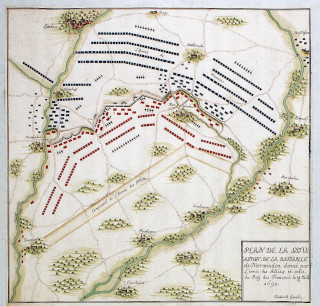
During the Nine Years’ War, units of the Irish Brigade of France fight at the Battle of Landen, also known as Neerwinden, on July 29, 1693 against the forces of William III of England, their nemesis from the Battle of the Boyne. It is fought around the village of Neerwinden in the Spanish Netherlands, now part of the municipality of Landen, Belgium.

After four years, all combatants are struggling to cope with the financial and material costs of the war. Hoping to end the war through a negotiated peace, Louis XIV of France decides to first improve his position by taking the offensive in the Rhineland, Catalonia and Flanders.

William has some 50,000 English, Dutch, German, and Spanish troops against about 80,000 French troops under Marshal Luxembourg, French commander in Flanders. William’s army has a strong defensive position to compensate for its numerical inferiority.

Luxembourg outmaneuvers the Allies. By doing so, he achieves local superiority and traps William’s army in an extremely dangerous position, with a river to their rear. Most of the fighting takes place on the Allied right, which protects the only bridge over the river, which is strongly fortified and holds the bulk of their artillery. On the French left flank, James FitzJames, 1st Duke of Berwick, and Patrick Sarsfield command in the assault on the village of Neerwinden, which they capture and lose twice before finally holding it.

The French assault the Allied position three times before the Gardes Françaises and the french cavalry under Antoine de Pas de Feuquières finally penetrate the Allied defences and drive William’s army from the field in a rout. The battle is, however, quite costly for both sides. The Irish win a measure of revenge against the victor of the Boyne, but it comes at a heavy price. Sarsfield, the defender of Limerick two years earlier, beloved by the Irish soldiers, is wounded and dies of his wounds three days later at Huy in Belgium, where he is buried in the grounds of St. Martin’s Church.

The French fail to follow up on their victory. The bulk of the Allied army escapes, although most of their artillery is abandoned. Like Steenkerque the previous year, Landen is yet another French victory that fails to achieve the decisive result needed to end the war. The Allies quickly replace their losses, leaving the overall position unchanged.

It is during this battle that, seeing the French determination to gain the high ground in spite of the murderous Allied volleys, William exclaims “Oh! That insolent nation!”