Devine, also known as “Red Mickey” because of his red hair, is born into a family from the Springtown Camp, on the outskirts of Derry, a former United States military base from the World War II. In 1960, when he is six years of age, the Devine family, including his grandmother, sister Margaret and parents Patrick and Elizabeth, move to the then newly built Creggan estate to the north of Derry city centre. He is educated at Holy Child Primary School and St. Joseph’s Boy’s School, both in the Creggan.
After British soldiers shoot dead two unarmed civilians, Dessie Beattie and Raymond Cusack, Devine joins the James Connolly Republican Club in Derry in July 1971. Bloody Sunday has a deep impact on him. In the early 1970s, he joins the Irish Labour Party and Young Socialists.
Devine helps found the Irish National Liberation Army (INLA) in 1975. In 1976, after an arms raid in County Donegal in the Republic of Ireland, he is arrested in Northern Ireland. He is convicted and sentenced to twelve years in prison. He joins the blanket protest before joining the hunger strike.
Devine participates in a brief hunger strike in 1980, which is called off without fatalities. On June 22, 1981, he joins Joe McDonnell, Kieran Doherty, Kevin Lynch, Martin Hurson, Thomas McElwee and Paddy Quinn on hunger strike at the Maze Prison. He dies on August 20, after sixty days on hunger strike.
McCourt is born to Malachy McCourt, Sr., who falsely claims to have been in the Irish Republican Army (IRA) during the Irish War of Independence, and Irish Catholic mother Angela Sheehan from Limerick. In the midst of the Great Depression, the family moves back to Ireland. Unable to find steady work in Belfast or Dublin and beset by his father’s alcoholism, the family returns to their mother’s native Limerick, where they sink even deeper into poverty.
In October 1949, at the age of 19, McCourt leaves Ireland, taking a boat from Cork to New York City. In 1951, he is drafted during the Korean War and sent to Bavaria for two years initially training dogs, then as a clerk. Upon his discharge from the US Army, he returned to New York City, where he held a series of jobs on docks, in warehouses, and in banks. Using his G.I. Bill education benefits, he talks his way into New York University by claiming he is intelligent and reads a great deal. He is admitted on one year’s probation provided he maintains a B average. He graduates in 1957 from NYU with a bachelor’s degree in English.
A New York city schoolteacher for more than thirty years, McCourt achieves literary fame later in life with his best-selling childhood memoir of the misery and squalor of his childhood, Angela’s Ashes. With a first printing of just 25,000 copies, the book becomes an instant favourite with critics and readers and is perhaps the ultimate case of the non-celebrity memoir, the extraordinary life of an ordinary man.
McCourt is also the author of ‘Tis (1999), which continues the narrative of his life, picking up from the end of Angela’s Ashes and focusing on his life after returning to New York. He subsequently writes Teacher Man (2005) which details his teaching experiences and the challenges of being a teacher.
It is announced in May 2009 that McCourt has been treated for melanoma and that he is in remission, undergoing home chemotherapy. On July 19, 2009, he dies from the cancer, with meningeal complications, at a hospice in Manhattan, New York City.
Moriarty is the son of David Moriarty and Bridget Stokes. He receives his early education in a classical school of his native Diocese of Ardfert and Aghadoe, and later is sent to Boulogne-sur-Mer in northern France. From there he passes to Maynooth College and, after a distinguished course in theology, is elected to the Dunboyne establishment, where he spends two years.
While yet a young priest Moriarty is chosen by the episcopal management of the Irish College in Paris, as vice-president of that institution, a position he occupies for about four years. So satisfactory is his work that, on the death of Father John Hand, he is appointed President of All Hallows College in Dublin, and for years guides, fashions, and makes effective the discipline and teaching of that well known institution. It is during this time he gives evidence of the noble oratory, so chaste, elevated, various and convincing, that has come to be associated with his name.
In 1854 Moriarty is appointed coadjutor, with the right of succession, to the bishopric of Ardfert and Aghadoe, as titular bishop of the Diocese of Antigonea. Two years later he succeeds to his native see. His work as bishop is testified to by several churches and schools, a diocesan college St. Brendan’s College, Killarney in 1860 and many conventual establishments. He finds time to conduct retreats for priests and his addresses which have come down to us under the title “Allocutions to the Clergy” are characterized by profound thought, expressed in an elevated and oratorical style.
In his political views Moriarty runs counter to much of the popular feeling of the time, and is a notable opponent of the Fenian organization, which he denounces strongly, particularly following the uprising in 1867 in his diocese where in an infamous sermon he attacks the Fenian leadership brandishing them criminals, swindlers and God’s heaviest curse. He also declares that “when we look down into the fathomless depth of this infamy of the heads of the Fenian conspiracy, we must acknowledge that eternity is not long enough, nor hell hot enough to punish such miscreants.” Despite this, however, he claims to admire Daniel O’Connell.
While most republicans attempt to work around the hostility of the high clergy of the Roman Church and the fire and brimstone rhetoric of the likes of Moriarty, out of sensitivity to the religious tendencies of the Irish majority, one Fenian by the name of John O’Neill, dares to fire back. O’Neill retorts, “It is better to be in hell with Fionn than in heaven with pale and flimsy angels.”
Moriarty’s principal works are “Allocutions to the Clergy” and two volumes of sermons.
In 1887 Gogarty’s father dies of a burst appendix, and he is sent to Mungret College, a boarding school near Limerick. He is unhappy in his new school, and the following year he transfers to Stonyhurst College in Lancashire, England, which he likes little better, later referring to it as “a religious jail.” He returns to Ireland in 1896 and boards at Clongowes Wood College while studying for examinations with the Royal University of Ireland. In 1898 he switches to the medical school at Trinity College, having failed eight of his ten examinations at the Royal.
A serious interest in poetry and literature begins to manifest itself during his years at Trinity. In 1900 he makes the acquaintance of W. B. Yeats and George Moore and begins to frequent Dublin literary circles. In 1904 and 1905 he publishes several short poems in the London publication The Venture and in John Eglinton‘s journal Dana. His name also appears in print as the renegade priest Fr. Oliver Gogarty in George Moore’s 1905 novel The Lake.
In 1905 Gogarty becomes one of the founding members of Arthur Griffith‘s Sinn Féin, a non-violent political movement with a plan for Irish autonomy modelled after the Austro-Hungarian dual monarchy.
In July 1907 his first son, Oliver Duane Odysseus Gogarty, is born, and in autumn of that year he leaves for Vienna to finish the practical phase of his medical training. Returning to Dublin in 1908, he secures a post at Richmond Hospital, and shortly afterwards purchases a house in Ely Place opposite George Moore. Three years later, he joins the staff of the Meath Hospital and remains there for the remainder of his medical career.
As a Sinn Féiner during the Irish War of Independence, Gogarty participates in a variety of anti-Black and Tan schemes, allowing his home to be used as a safe house and transporting disguised Irish Republican Army (IRA) volunteers in his car. Following the ratification of the Anglo-Irish Treaty, he sides with the pro-Treaty government and is made a Free State Senator. He remains a senator until the abolition of the Seanad in 1936, during which time he identifies with none of the existing political parties and votes according to his own whims.
Gogarty maintains close friendships with many of the Dublin literati and continues to write poetry in the midst of his political and professional duties. He also tries his hand at playwriting, producing a slum drama in 1917 under the pseudonym “Alpha and Omega”, and two comedies in 1919 under the pseudonym “Gideon Ouseley,” all three of which are performed at the Abbey Theatre. He devotes less energy to his medical practice and more to his writing during the twenties and thirties.
With the onset of World War II, Gogarty attempts to enlist in the Royal Air Force (RAF) and the Royal Army Medical Corps (RAMC) as a doctor. He is denied on grounds of age. He then departs in September 1939 for an extended lecture tour in the United States, leaving his wife to manage Renvyle House, which has since been rebuilt as a hotel. When his return to Ireland is delayed by the war, he applies for American citizenship and eventually decides to reside permanently in the United States. Though he regularly sends letters, funds, and care-packages to his family and returns home for occasional holiday visits, he never again lives in Ireland for any extended length of time.
Gogarty suffers from heart complaints during the last few years of his life, and in September 1957 he collapses in the street on his way to dinner. He dies on September 22, 1957. His body is flown home to Ireland and buried in Cartron Church, Moyard, near Renvyle.
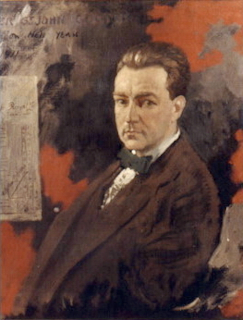
(Pictured: 1911 portrait of Oliver St. John Gogarty painted by Sir William Orpen, currently housed at the Royal College of Surgeons in Ireland)
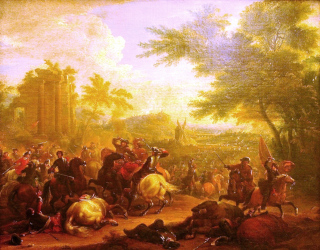
By August 1705, the French occupy most of Savoy, with the exception of Turin. In order to relieve the pressure, Prince Eugene tries to cross the river Adda at Cassano and threaten Milan. Although the French are taken by surprise, they manage to hold the bridge after six hours of intense conflict, both sides suffering heavy casualties.
The deep and fast-flowing river Adda has limited crossing points, especially for large bodies of men. The town of Cassano is on the right bank, with a stone bridge protected by a small fortification or redoubt. The area is also divided by numerous small streams and irrigation channels, the most significant being the Retorto, an irrigation canal running parallel to the Adda. This is connected to the left bank by another bridge, protected by another strongpoint.
Assuming Prince Eugene is still heading for Mantua, Vendôme orders his brother Philippe to leave his positions around Cassano and intercept him. In fact, the Imperial troops had marched overnight from Romanengo and are approaching the town when spotted by one of Vendôme’s cavalry patrols early the next morning. Realising their intentions, Vendôme heads to Cassano, along with approximately 2,000 reinforcements.
On arrival, he finds Philippe’s troops unprepared and in an extremely dangerous position, the bulk of their force caught between the Retorto canal and the Adda, and the main bridge blocked by their transport. Vendôme orders the baggage thrown into the river and forms a line running from the Retorto on the left, his centre around the main bridge, and his extreme right resting on the road leading to the nearby village of Rivolta d’Adda. Armand St. Hilaire, the French artillery commander, positions his guns inside the town, allowing him to fire directly on the bridge.
Around 2:00 in the afternoon, Austrian grenadiers attack the French positions around the Retorto. They initially succeed in capturing the bridge before being repulsed by St. Hilaire’s guns and a counterattack. Vendôme sends four regiments of the French Irish Brigade to reinforce his left, but after a fierce struggle, the Imperialists capture the canal’s sluice gates. After these are closed, the water level in the canal is lowered enough for men to wade across it.
Prince Eugene orders Leopold I, Prince of Anhalt-Dessau, and his Prussians into the canal to assault the French left. They manage to seize the further bank but suffer heavily in doing so. The battle surges back and forth across the river for several hours, in the course of which Vendôme has his horse killed under him, while Prince Eugene is wounded twice and has to leave the field. The fighting lasts another four to five hours, until ended by sheer exhaustion, with the opposing forces back at their starting positions.
The battle is inconclusive. While the French prevent the Imperialists crossing the Adda, Prince Eugene succeeds in delaying an assault on Turin until June 1706. Combined with having to transfer forces to Northern France following their defeat at Ramillies in May 1706, the French siege is broken in September, and fighting in Northern Italy ends in March 1707.
(Pictured: The battle of Cassano 1705 (War of the Spanish Succession), painted by Jean Baptiste Martin (1659-1735). Oil on canvas, Heeresgeschichtliches Museum, Vienna, Austria)
Molesworth Phillips, sailor and companion of Captain James Cook, is born in Swords, County Dublin on August 15, 1755.
Phillips is the son of John Phillips of Swords. His father is a natural son of Richard Molesworth, 3rd Viscount Molesworth, whence Phillips acquires his Christian name. He first enters the Royal Navy, but on the advice of his friend Sir Joseph Banks he accepts a commission as second lieutenant in the Royal Marines on January 17, 1776. In this capacity he is selected to accompany Captain Cook on his last voyage, extending over nearly three years. He sails with Cook from Plymouth on July 12, 1776, and is with the marines who escort Cook when he lands at Hawaii on February 14, 1779.
In John Webber‘s painting “The Death of Captain Cook” Phillips is represented kneeling and firing at a native who is clubbing Cook. Phillips is himself wounded, but, after swimming back to the boat, he turns back and helps another wounded marine to the boats.
On November 1, 1780, Phillips is promoted to captain. On January 10, 1782, he marries Susanna Elizabeth, third daughter of Dr. Charles Burney (1726-1814), and sister of Frances Burney and of James Burney, Phillips’s friend, who, like him, had accompanied Cook on his last voyage. He has no further active service, but is promoted brevetmajor on March 1, 1794, and brevet lieutenant colonel on January 1, 1798. From 1784, for the sake of his wife’s health, he lives for a time at Boulogne, but after the French Revolution he resides chiefly at Mickleham, Surrey, not far from Juniper Hall, where Frances Burney entertains numbers of French emigres. From 1796 to 1799, during the alarm of a French invasion of Ireland, Phillips feels it his duty to reside on the Irish estates at Beleotton, which he had inherited from an uncle. On January 6, 1800, his wife dies.
After the Treaty of Amiens, Phillips visits France in 1802, and he is one of those who are seized by Napoleon on the renewal of the war. He is detained in France until the peace of 1814. During this detention he makes friends with the Prince of Talleyrand and other well-known Frenchmen. After his return to England, he becomes acquainted with Robert Southey, Mary and Charles Lamb, who describe him as “the high-minded associate of Cook, the veteran colonel, with his lusty heart still sending cartels of defiance to old Time,” and with John Thomas Smith (1766-1833), whom he supplies with various anecdotes for his Nollekens and his Times.
Phillips dies of cholera at his house in Lambeth on September 11, 1832, and is buried in St. Margaret’s, Westminster, where an inscription commemorates him and James and Martin Burney (1788-1852).
(Pictured: Etching of Molesworth Phillips by Andrew Geddes, circa 1825, bequeathed by Frederick Leverton Harris, 1927, National Portrait Gallery, London)
Hone is born in Dublin on April 24, 1718, the son of a Dublin-based Dutch merchant. He moves to England as a young man and, after marrying Molly Earle, daughter of the John Campbell, 4th Duke of Argyll, in 1742, eventually settles in London, by which time he has acquired a reputation as a portrait painter. While his paintings are popular, his reputation is particularly enhanced by his skill at producing miniatures and enamels. He interrupts his time in London by spending two years (1750–52) studying in Italy.
As a portrait painter, several of Hone’s works are now held at the National Portrait Gallery in London. His sitters include magistrate Sir John Fielding and Methodist preacher John Wesley, and General Richard Wilford and Sir Levett Hanson in a double portrait. He often uses his son John Camillus Hone (1745-1836) in some of his works, including his unique portrait of “The Spartan Boy,” painted in 1774.
Hone courts controversy in 1775 when his satirical picture The Conjurer (National Gallery of Ireland, Dublin) is seen to attack the fashion for Italian Renaissance art and to ridicule Sir Joshua Reynolds, leading the Royal Academy to reject the painting. It also originally includes a nude caricature of fellow Academician Angelica Kauffman in the top left corner, which is painted out by Hone after Kauffman complains to the academy. The combination of a little girl and an old man has also been seen as symbolic of Kauffman and Reynolds’s closeness, age difference, and rumoured affair. To show that his reputation is undamaged, Hone organises a one-man retrospective in London, the first such solo exhibition of an artist’s work.
The Hone family is related to the old Dutch landed family the van Vianens, who hold the hereditary title of Vrijheer. His great-grand-nephew shares the same name and is also a notable Irish painter, known as Nathaniel Hone the Younger (1831–1917). He is also a relation to painter Evie Hone.
Nathaniel Hone the Elder dies in London at the age of 66 on August 14, 1784.
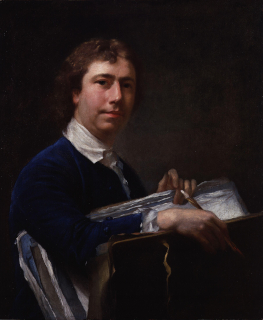
(Pictured: Oil on canvas self-portrait by Nathaniel Hone, circa 1760)
Jaffe is born into a Jewish family, one of four boys and five girls born to Daniel Joseph and Frederiké Jaffe. In 1852, his parents bring their family to Belfast. His father, along with his older brothers, Martin, John and Alfred, set up a business exporting linen. He is educated at Mr. Tate’s school in Holywood, County Down, and later in Hamburg and Switzerland.
Jaffe marries Paula Hertz, daughter of Moritz Hertz from Braunschweig, on March 8, 1879. They have two sons, Arthur Daniel and William Edward Berthold Jaffe. Daniel Joseph Jaffé is his nephew, son of his brother Martin.
From 1867 to 1877 Jaffe lives and works in New York. In 1877, his brothers retire so he returns to Belfast to head the family business, The Jaffe Brothers, at Bedford Street. He builds it up to become the largest linen exporter in Ireland. He is a member of the Belfast Harbour Commission and becomes a naturalised citizen in 1888. In 1894, he successfully agitates for the reporting and destruction of shipwrecks in the North Atlantic Ocean.
Jaffe is a Justice of the Peace, a governor of the Royal Hospital, a member of the Irish Technical Education Board and a member of the Senate of Queen’s College, which later becomes Queen’s University Belfast. He is the German consul in Belfast. He is an active member of the committee which gets the Public Libraries Act extended to Belfast, leading to the first free library being established there. In 1910 he erects the Jaffe Spinning Mill on the Newtownards Road, also known as Strand Spinning. This provides work for 350 people, rising to 650 in 1914 when the company expands to make munitions. He is lavishly charitable and contributes to Queen’s College.
Jaffe takes a keen interest in the Jewish community of Belfast. He is life-president of the Belfast Hebrew Congregation, which worships at the Great Victoria Street, Belfast synagogue. His father established it on July 7, 1871. Between 1871 and 1903 the congregation increases from fifty-five to over a thousand. He pays most of the £4,000 cost of building the synagogue in Annesley Street. He opens it in 1904 wearing his mayoral regalia. Three years later with his wife, they set up the Jaffe Public Elementary School on the Cliftonville Road.
The outbreak of war sees anti-German sentiment and when the RMS Lusitania passenger liner is torpedoed by a German U-boat of the coast of County Cork on May 7, 1915, resulting in the death of 1,000 people, anti-German feeling in Britain and Ireland rise to breaking point. Even though he is loyal to the Crown, and his eldest son Arthur and his nephew are serving in the British Army, Jaffe is accused of being a German spy. Society women refuse support for the Children’s Hospital so long as Jaffe and his wife remain on the board. He is “overwhelmed with pain and sorrow.”
After twenty-five years of service, Jaffe resigns his post as Alderman of Windsor Ward for Belfast City Council in June 1916 when he is almost 70 years of age and takes up residence in London, where he dies on April 29, 1929. Lady Jaffe is too ill to attend his funeral, and she dies a few months later, in August 1929.
The 20-minute blockade of the Ligoniel Road is in response to the local branch of the loyalist Apprentice Boys of Derry organisation being refused permission to drive their bus past the nationalist Ardoyne the previous day.
Billy Hutchinson, the Progressive Unionist PartyAssembly member for Belfast North says, “Nationalists are saying that the Apprentice Boys can’t come down the Crumlin Road on a bus because it is seen to be a parade.” He adds further, “I think loyalists are saying if the Apprentice Boys can’t go down on a bus why should the Wolfe Tone band be allowed to go down on a bus?”
On August 11, police officers prevent the Ligoniel Walker Club of the Apprentice Boys of Derry from driving their bus down the Crumlin Road past the Ardoyne shops because it constitutes a parade and breaches a ruling by the Parades Commission. The club is prevented by the Commission from marching through the area and tries in vain to broker a last minute compromise to use their bus.
Gerry Kelly, Sinn Féin Assembly member for Belfast North, describes the loyalist protest as a “nonsense,” adding he does not believe that nationalist residents had objected to the organisation using their bus. “That is a decision the RUC (Royal Ulster Constabulary) took on the ground. I don’t think there would have been a problem from the people of Ardoyne,” he adds.
The Apprentice Boys vow to seek a judicial review into the decision to prevent them from traveling through the area to get to their main parade in Derry.
After a six and a half hour stand-off, Apprentice Boys representative Tommy Cheevers brands the Parades Commission a “farce.”
(From: “Hunger strike march blocked by loyalists” from The Irish Times, Sunday, August 12, 2001 | Photo credit: PA:Press Association)
A worse-than-expected storm on the third day of the race wreaks havoc on over 303 yachts that started the biennial race resulting in 24 yachts being abandoned, of which five are lost and believed to be sunk due to high winds and severe sea conditions. The nineteen fatalities consist of fifteen yachtsmen and four spectators.
Rescue efforts begin after 6:30 AM on August 14, once the winds drop to severe gale Force 9 on the Beaufort scale. Emergency services, naval forces, and civilian vessels from around the west side of the English Channel are summoned to aid what becomes the largest ever rescue operation in peacetime. This involves some 4,000 people, including the entire Irish Naval Service‘s fleet, lifeboats, commercial boats, tugs, trawlers, tankers and helicopters.
The handicap winner is the yacht Tenacious, designed by Sparkman & Stephens, owned and skippered by Ted Turner. The winner on elapsed time in the race is the 77-foot Condor of Bermuda, skippered by Peter Blake, which gains around 90 minutes on the leader at the Fastnet rock, the Kialoa IV, by chancing a spinnaker. Jim Kilroy of the Kialoa IV has broken his ribs and there is damage to the yacht’s runners. Condor of Bermuda breaks the Fastnet record by nearly eight hours (71h 25m 23s).
The disaster results in a major rethink of racing, risks and prevention.
(Pictured: Memorial to those who died in the 1979 Fastnet Race, Lissarnona, Cape Clear Island, Cork, Ireland)





 seamus dubhghaill