seamus dubhghaill

Promoting Irish Culture and History from Little Rock, Arkansas, USA


1 Comment

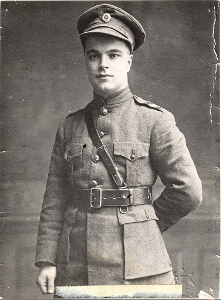
Execution of IRA Officer Joe McKelvey

joe-mckelvey

Joe McKelvey, Irish Republican Army (IRA) officer, is executed by firing squad along with three other Anti-Treaty militants, on December 8, 1922, during the Irish Civil War.

McKelvey is born into a nationalist family in Stewartstown, County Tyrone. He has a keen interest in the Gaelic Athletic Association and the Irish language. He studies as an accountant and gains some of the qualifications necessary for this profession, but never fully qualifies. He works for a time at the Income Tax Office on Queen’s Square in Belfast and later finds work in Belfast’s engineering industry with Mackies on Springfield Road. He joins the Irish Republican Brotherhood and the Irish Volunteers, which after 1919, become known as the Irish Republican Army (IRA). He is a founding member of the O’Donovan Rossa Club, Belfast, founded in 1916 on the Falls Road. Each year the club honours him with a juvenile hurling blitz, an invitational competition which is participated in by clubs throughout Ireland.

McKelvey participates in the Irish War of Independence (1919–1921) against the British, in which he commands the IRA’s Belfast Brigade. On August 22, 1920, he helps to organise the killing of Royal Irish Constabulary (RIC) Detective Oswald Swanzy in Lisburn. The killing itself is carried out by IRA men from Cork, but McKelvey arranges a taxi to carry the assassins to and from the scene and disposes of their weapons. In reprisal for this shooting, 300 Catholic homes in Lisburn are burned out. McKelvey is forced to lie low in Dublin for some time after these events.

In March 1921, the IRA is re-organised by its leadership in Dublin into Divisions and McKelvey is appointed commander of the Third Northern Division, responsible for Belfast and the surrounding area. In May 1921, McKelvey’s command suffers a severe setback, when fifty of his best men are sent to County Cavan to train and link up with the IRA units there, only to be surrounded and captured by the British Army on Lappanduff hill on May 9. In most of Ireland, hostilities are ended with a truce declared on July 11, 1921.

McKelvey is alone among the leadership of the Belfast IRA in going against the acceptance of the Anglo-Irish Treaty. Most of his comrades support Michael Collins‘ assurances that, although the Treaty accepts the partition of Northern Ireland from the rest of the country, this is only a temporary concession which will be dealt with later. McKelvey does not accept this. As a result, he leaves his command as head of the IRA Third Northern Division and joins the Anti-Treaty IRA in Dublin.

In March 1922, McKelvey participates in the anti-Treaty IRA‘s repudiation of the authority of the Dáil, the civil government of the Irish Republic declared in 1919, and is elected to the IRA Army Executive. In April 1922 he helps command the occupation of the Four Courts in defiance of the new Irish Free State. This action helps to spark the civil war between pro- and anti-Treaty factions. McKelvey is among the most hardline of the anti-Treaty republicans and briefly, in June 1922, becomes IRA Chief of Staff, replacing Liam Lynch.

On June 28, 1922, the new Irish Free State government shells the Four Courts to assert its authority over the militants defending it. The Republicans in the Four Courts surrender after two days of fighting and McKelvey is captured. He is held for the following five months in Mountjoy Prison in Dublin.

On December 8, 1922, Joe McKelvey is executed by firing squad along with three other Anti-Treaty militants, Rory O’Connor, Liam Mellows, and Richard Barrett. The executions are ordered in reprisal for the Anti-Treaty IRA’s murder of Sean Hales, a Pro-Treaty member of the Third Dáil.


Leave a comment

The Good Friday Agreement Comes Into Operation

good-friday-agreement-signing

The Good Friday Agreement, a major political development in the Northern Ireland peace process, comes into operation on December 2, 1999, as the British and Irish governments formally notify each other that all the necessary arrangements are in place.

The notification ceremony takes place at Iveagh House, St. Stephen’s Green, headquarters of the Department of Foreign Affairs and Trade, at a joint signing by Minister for Foreign Affairs and Trade David Andrews and Secretary of State for Northern Ireland Peter Mandelson.

Northern Ireland‘s present devolved system of government is based on the agreement. The agreement also creates a number of institutions between Northern Ireland and the Republic of Ireland, and between the Republic of Ireland and the United Kingdom.

The agreement is made up of two inter-related documents, both agreed upon in Belfast on Good Friday, April 10, 1998. The first is a multi-party agreement by most of Northern Ireland’s political parties. The second is an international agreement between the British and Irish governments, known as the British-Irish Agreement.

The agreement sets out a complex series of provisions, or strands, relating to a number of areas:

Strand 1 addresses the status and system of government of Northern Ireland within the United Kingdom and establishes two major institutions – the Northern Ireland Assembly and the Northern Ireland Executive.

Strand 2 addresses the relationship between Northern Ireland and the Republic of Ireland and the institutions to be created between them – the North/South Ministerial Council, the North/South Inter-Parliamentary Association, and the North/South Consultative Forum.

Strand 3 addresses the relationship between the Republic of Ireland and the United Kingdom and institutions to be created between Ireland and Great Britain – the British/Irish Intergovernmental Conference, the British-Irish Council, and an expanded British-Irish Parliamentary Assembly.

Issues relating to sovereignty, civil and cultural rights, decommissioning of weapons, justice, and policing are central to the agreement.

The agreement is approved by voters across the island of Ireland in two referendums held on May 22, 1998. In Northern Ireland, voters are asked whether they support the multi-party agreement. In the Republic of Ireland, voters are asked whether they will allow the state to sign the agreement and allow necessary constitutional changes to facilitate it. The people of both jurisdictions need to approve the agreement in order to give effect to it.

The Good Friday Agreement comes into force on December 2, 1999. The Democratic Unionist Party (DUP) is the only major political group in Northern Ireland to oppose the Good Friday Agreement.

(Pictured: British Prime Minister Tony Blair and Irish Taoiseach Bertie Ahern sign the Good Friday Agreement)


Leave a comment

Ernest Walton Awarded Nobel Prize for Physics

ernest-walton

Ernest Thomas Sinton Walton, Irish physicist, is awarded the Nobel Prize in Physics on November 15, 1951, for his work with John Cockcroft with “atom-smashing” experiments done at Cambridge University in the early 1930s, and so becomes the first person in history to artificially split the atom.

Walton is born on October 6, 1903, in Abbeyside, Dungarvan, County Waterford to a Methodist minister father, Rev John Walton and Anna Sinton. In those days a general clergyman’s family moves once every three years, and this practice carries Ernest and his family to Rathkeale, County Limerick, and to County Monaghan. He attends day schools in counties Down and Tyrone, and at Wesley College Dublin before becoming a boarder at Methodist College Belfast in 1915, where he excels in science and mathematics.

In 1922, Walton wins scholarships to Trinity College, Dublin for the study of mathematics and science. He is awarded bachelor’s and master’s degrees from Trinity in 1926 and 1927, respectively. Walton receives seven prizes for excellence in physics and mathematics, including the Foundation Scholarship in 1924. Following graduation he is awarded an 1851 Research Fellowship from the Royal Commission for the Exhibition of 1851 and is accepted as a research student at Trinity College, Cambridge, under the supervision of Sir Ernest Rutherford, Director of Cambridge University’s Cavendish Laboratory. At the time there are four Nobel Prize laureates on the staff at the Cavendish lab and a further five are to emerge, including Walton and John Cockcroft. Walton is awarded his PhD in 1931 and remains at Cambridge as a researcher until 1934.

During the early 1930s, Walton and John Cockcroft collaborate to build an apparatus that splits the nuclei of lithium atoms by bombarding them with a stream of protons accelerated inside a high-voltage tube. The splitting of the lithium nuclei produces helium nuclei. This is experimental verification of theories about atomic structure that have been proposed earlier by Rutherford, George Gamow, and others. The successful apparatus, a type of particle accelerator now called the Cockcroft-Walton generator, helps to usher in an era of particle-accelerator-based experimental nuclear physics. It is this research at Cambridge in the early 1930s that wins Walton and Cockcroft the Nobel Prize in physics in 1951.

Walton is associated with the Dublin Institute for Advanced Studies for over 40 years, serving long periods on the board of the School of Cosmic Physics and on the Council of the Institute. Following the 1952 death of John J. Nolan, the inaugural chairman of the School of Cosmic Physics, Walton assumes the role, and serves in that position until 1960, when he is succeeded by John H. Poole.

Although he retires from Trinity College Dublin in 1974, he retains his association with the Physics Department at Trinity up to his final illness. His is a familiar face in the tea-room. Shortly before his death he marks his lifelong devotion to Trinity by presenting his Nobel medal and citation to the college. Ernest Walton dies in Belfast on June 25, 1995, aged 91. He is buried in Dean’s Grange Cemetery, Dún Laoghaire–Rathdown.


Leave a comment

Birth of Writer John McGahern

John McGahern, regarded as one of the most important Irish writers of the latter half of the twentieth century, is born in Knockanroe about half a mile from Ballinamore, County Leitrim, on November 12, 1934. Known for the detailed dissection of Irish life found in works such as The Barracks, The Dark, and Amongst Women, The Observer hails him as “the greatest living Irish novelist” before his death in 2006.

McGahern is the eldest child of seven. Raised alongside his six young siblings on a small farm in Knockanroe, McGahern’s mother runs the farm with some local help whilst maintaining a job as a primary school teacher in the local school. His father, a Garda sergeant, lives in the Garda barracks at Cootehall in County Roscommon, a somewhat sizeable distant away from his family at the time. In 1944, when McGahern is ten years old, his mother dies of cancer, resulting in the unrooting of the McGahern children to their new home with their father in the Garda barracks at Cootehall.

In the years following his mother’s death, McGahern completes his primary schooling in the local primary school, and ultimately wins a scholarship to the Presentation Brothers secondary school in Carrick-on-Shannon. Having travelled daily to complete his second level education, McGahern continues to accumulate academic accolades by winning the county scholarship in his Leaving Certificate enabling him to continue his education to third level.

Following his second level success, McGahern is offered a place at St. Patrick’s College of Education in Drumcondra where he trains to be a teacher. Upon graduation from third level education, McGahern begins his career as a primary schoolteacher at Scoil Eoin Báiste primary school in Clontarf where, for a period, he teaches the eminent academic Declan Kiberd, before returning to third level education in University College Dublin where he graduates in 1957. He is first published by the London literary and arts review magazine, X, which publishes in 1961 an extract from his unpublished first novel, The End or Beginning of Love.

McGahern’s first published novel, The Barracks (1963), chronicles the life of the barrack’s Garda sergeant’s second wife, Elizabeth Reegan, who is in the decline of health due to cancer. The Barracks is adapted for the stage in 1969 by Hugh Leonard.

McGahern marries his first wife, Finnish-born Annikki Laaski, in 1965 and in the same year publishes his second novel, The Dark, which is banned by the Irish Censorship Board for its alleged pornographic content along with its implied sexual abuse by the protagonist’s father. Due to the controversy, which is stirred by the book’s publication, McGahern is dismissed from his teaching post and forced to move to England where he works in a variety of jobs, including on building sites, before returning to Ireland to live and work on a small farm near Fenagh in County Leitrim.

After the publications of The Leavetaking (1974) and The Pornographer (1975), his fifth and perhaps best-known novel, Amongst Women, is published in 1990. The novel details the story of Michael Moran, an Irish Republican Army (IRA) veteran of the Irish War of Independence and the Irish Civil War, who now dominates his family in the unforgiving farmlands of County Leitrim, near Mohill.

John McGahern dies from cancer at the age of 71 in the Mater Hospital in Dublin on March 30, 2006. He is buried in St. Patrick’s Church Aughawillan alongside his mother.


Leave a comment

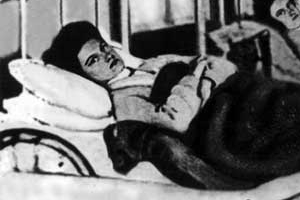
Death of Mary Mallon, Better Known as “Typhoid Mary”

typhoid-mary

Mary Mallon, better known as Typhoid Mary, dies in North Brother Island, East River, New York, on November 11, 1938. She is the first person in the United States identified as an asymptomatic carrier of the pathogen associated with typhoid fever. She is presumed to have infected 51 people, three of whom die, over the course of her career as a cook. She is twice forcibly isolated by public health authorities and dies after a total of nearly three decades in isolation.

Mallon is born on September 23, 1869, in Cookstown, County Tyrone, Northern Ireland. She immigrates to the United States in 1883 at the age of fifteen and lives with her aunt and uncle.

From 1900 to 1907, Mallon works as a cook in the New York City area for seven families. In 1900, she works in Mamaroneck, New York, where, within two weeks of her employment, residents develop typhoid fever. In 1901, she moves to Manhattan, where members of the family for whom she works develop fevers and diarrhea, and the laundress dies. Mallon then goes to work for a lawyer but leaves after seven of the eight people in that household become ill.

In 1906, she takes a position in Oyster Bay, Long Island, and within two weeks ten of the eleven family members are hospitalized with typhoid. She changed jobs again and similar occurrences happen in three more households. She works as a cook for the family of a wealthy New York banker, Charles Henry Warren. When the Warrens rent a house in Oyster Bay for the summer of 1906, Mallon goes along as well. From August 27 to September 3, six of the eleven people in the family come down with typhoid fever. The disease at that time is “unusual” in Oyster Bay, according to three medical doctors who practice there. Mallon is subsequently hired by other families and outbreaks follow her.

In late 1906, one family hires a typhoid researcher named George Soper to investigate. Soper publishes the results on June 15, 1907, in the Journal of the American Medical Association. He believes Mallon might be the source of the outbreak, but she repeatedly turns him away.

The New York City Health Department sends physician Sara Josephine Baker to talk to Mallon. A few days later, Baker arrives at Mallon’s workplace with several police officers, who take her into custody.

Mallon attracts so much media attention that she is called “Typhoid Mary” in a 1908 issue of the Journal of the American Medical Association. Later, in a textbook that defines typhoid fever, she is again called “Typhoid Mary.”

The New York City Health Inspector determines her to be a carrier. Under sections 1169 and 1170 of the Greater New York Charter, Mallon is held in isolation for three years at a clinic located on North Brother Island.

Upon her release, Mallon is given a job as a laundress. In 1915, Mallon starts another major outbreak, this time at Sloane Hospital for Women in New York City. Twenty-five people are infected and two die. She again leaves, but the police are able to locate and arrest her when she brings food to a friend on Long Island. After arresting her, public health authorities return her to quarantine on North Brother Island on March 27, 1915.

Mallon spends the rest of her life in quarantine at the Riverside Hospital. Six years before her death, she is paralyzed by a stroke. On November 11, 1938, at the age of 69, she dies of pneumonia. An autopsy finds evidence of live typhoid bacteria in her gallbladder. Mallon’s body is cremated, and her ashes are buried at Saint Raymond’s Cemetery in the Bronx.


Leave a comment

Free State Government Purchases Copyright to “The Soldiers Song”

amhran-na-bhfiann

The Irish Free State government purchases the copyright of Peadar Kearney‘s The Soldiers Song on October 20, 1933, which becomes the Irish national anthem Amhrán na bhFiann. The song has three verses, but only the choral refrain is officially designated the national anthem.

A Soldiers’ Song is composed in 1907, with words by Peadar Kearney and music by Kearney and Patrick Heeney. The text is first published in Irish Freedom by Bulmer Hobson in 1912. It is used as a marching song by the Irish Volunteers and is sung by rebels in the General Post Office (GPO) during the Easter Rising of 1916. Its popularity increases among rebels held in Frongoch internment camp after the Rising, and the Irish Republican Army (IRA) in the Irish War of Independence (1919–21). After the establishment of the Irish Free State in 1922, a large proportion of the IRA’s men and apparatus become the National Army. The Soldiers’ Song remains popular as an Army tune and is played at many military functions.

The Free State does not initially adopt any official anthem. The delicate political state in the aftermath of the Irish Civil War provokes a desire to avoid controversy. Ex-Unionists continue to regard God Save the King as the national anthem, as it has been for the rest of the British Empire. W. T. Cosgrave, President of the Executive Council of the Irish Free State expresses opposition to replacing The Soldiers’ Song, which is provisionally used within the State.

There is concern that the lack of an official anthem is giving Unionists an opportunity to persist with God Save the King. The Soldiers’ Song is widely if unofficially sung by nationalists. On July 12, 1926, the Executive Council of the Irish Free State decides to adopt it as the National Anthem, with Cosgrave the driving force in the decision. However, this decision is not publicised.

In 1928, the Army band establishes the practice of playing only the chorus of the song as the Anthem, because the longer version is discouraging audiences from singing along.

The anthem is played by Radio Éireann at close down from its inception in 1926. Cinemas and theatres do so from 1932 until 1972. Peadar Kearney, who has received royalties from publishers of the text and music, issues legal proceedings for royalties from those now performing the anthem. He is joined by Michael Heeney, brother of Patrick Heeney, who had died in 1911. In 1934, the Department of Finance acquires the copyright of the song for the sum of £1,200. Copyright law changes in 1959, such that the government has to reacquire copyright in 1965, for £2,500. As per copyright law, the copyright expires in December 2012, following the 70th anniversary of Kearney’s death. In 2016, three Fianna Fáil senators introduce a private member’s bill intended to restore the state’s copyright in the anthem.


Leave a comment

The Guildford Four Are Released From Prison

guildford-four-release

After serving 15 years in prison, the Guildford Four, Gerry Conlon, Patrick Armstrong, Carole Richardson, and Paul Hill, are released on October 19, 1989, in what is considered to be one of the biggest-ever miscarriages of justice in Britain.

On October 5, 1974, an Irish Republican Army (IRA) bomb kills four people in a Guildford pub frequented by British military personnel, while another bomb in Woolwich kills three. British investigators rush to find suspects and soon settle on Gerry Conlon and Paul Hill, two residents of Northern Ireland who are in the area at the time of the terrorist attack.

Under the recently rewritten Prevention of Terrorism Act, British investigators are allowed to hold and interrogate terrorist suspects for five days without any hard evidence. Conlon and Hill, who are nonpolitical petty criminals, are among the first suspects held under the new law. During their prison stay, investigators fabricate against them an IRA conspiracy that implicates a number of their friends and family members. The officers then force the two suspects to sign confessions under physical and mental torture. In October 1975, Gerry Conlon, Paul Hill, Paddy Armstrong, and Carole Richardson are sentenced to life in prison – mandatory for adults convicted of murder. Seven of their relatives and friends, called the Maguire Seven, are sentenced to lesser terms on the basis of questionable forensic evidence.

In 1989, detectives from Avon and Somerset Constabulary, investigating the handling of the case, find three significant pieces of evidence in relation to Surrey Police‘s handling of the Guildford Four and their statements.

Firstly, typed notes from Patrick Armstrong’s police interviews which had been heavily edited. Deletions and additions had been made, and the notes had been rearranged. These notes, and their amendments, are consistent with hand-written and typed notes presented at the trial, which suggest that the hand-written notes are made after the interviews had been conducted. The notes presented had been described in court as contemporaneous records.

Secondly, a series of manuscript notes relating to an interview with Hill, which show that Hill’s fifth statement is taken in breach of Judges’ Rules and may well have been inadmissible as evidence. The information is not made available to the Director of Public Prosecutions or the prosecution. Further, the officers involved had denied under oath that such an interview had happened.

Thirdly, detention records are inconsistent with the times and durations of the claimed interviews reported by the Surrey police.

In the face of growing public protest and after the disclosure of exonerating evidence, including the admittance of guilt in the bombings by an imprisoned IRA member, the group’s conviction is declared “unsafe and unsatisfactory.” The Guildford Four are cleared of all charges and released after 15 years in prison. The following year a British appeals court also overturns the convictions of the Maguire Seven, who were jailed on the basis of forensic evidence that is shown to have no relevant scientific basis.

(Pictured: Gerry Conlon on his release from prison in 1989)


Leave a comment

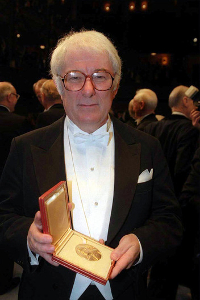
Seamus Heaney Awarded Nobel Prize in Literature

seamus-heaney

Seamus Heaney, poet, playwright, translator, and lecturer, is awarded the Nobel Prize in Literature on October 15, 1995.

Heaney is born in April 1939 near Castledawson, County Derry, Northern Ireland, where his family engages in farming and selling cattle. His education includes studies at Queen’s University Belfast, where he also serves as a lecturer in the late 1960s. He makes his debut as a poet then, but continues to divide his time between his own writing and academia. He works at Carysforth College in Dublin, at Harvard University in Cambridge, Massachusetts, and at Oxford University.

Heaney’s poetry is often down-to-earth. For him, poetry is like the earth – something that must be plowed and turned. Often he paints the gray and damp landscape from the British Isles. Peat moss has a special place in his poetry. The poems often are connected with daily experiences, but they also derive motifs from history, all the way back to prehistoric times. Heany’s profound interest in the Celtic and the pre-Christian as well as in Catholic literary tradition has found expression in a number of essays and translations.

Heaney is awarded the Nobel Prize in Literature in 1995 for what the Nobel committee describes as “works of lyrical beauty and ethical depth, which exalt everyday miracles and the living past.” He is on holiday in Greece with his wife, Marie, when the news breaks. No one, not even journalists or his own children, can locate him until he appears at Dublin Airport two days later, though an Irish television camera traces him to Kalamata. Asked how it feels having his name added to the Irish Nobel pantheon featuring William Butler Yeats, George Bernard Shaw, and Samuel Beckett, Heaney responds, “It’s like being a little foothill at the bottom of a mountain range. You hope you just live up to it. It’s extraordinary.” He and Marie are immediately whisked straight from the airport to Áras an Uachtaráin for champagne with President Mary Robinson.


Leave a comment

Birth of Mick Doyle, Rugby Union Player & Coach

mick-doyle

Mick Doyle, Irish rugby union international player and coach, is born in Castleisland, County Kerry, on October 13, 1941.

Doyle begins playing rugby union at Newbridge College, County Kildare. He goes on to study veterinary science at University College Dublin, who he also represents at rugby. He makes his Ireland debut against France on January 23, 1965, scoring a try in the game. While representing Ireland he also studies at the University of Cambridge where he gains a Blue in the 1965 Varsity match against the Oxford University RFC. Doyle also studies at the University of Edinburgh and plays club rugby for Edinburgh Wanderers before returning to Ireland.

Doyle goes on to earn the distinction of never being dropped during his 20-cap international career as a flanker. Doyler, as he is affectionately known, scores the winning try against Wales in the 1967 Five Nations Championship, tours Australia with Ireland in 1967 and South Africa with the British and Irish Lions the following year.

His last game for Ireland is against Australia in October 1968, when he lines out alongside his brother Tommy. He coaches Leinster to Interprovincial Championship success five times between 1979 and 1983 before he succeeds Willie John McBride as Ireland coach during the 1984–85 season. Under In 1985, under Doyle’s stewardship, Ireland wins the Triple Crown and Five Nations Championship.

Doyle leads Ireland to the inaugural 1987 Rugby World Cup, but that joy is tinged with sadness as he suffers a heart attack at the opening dinner. He battles illness and adversity and his recovery from a brain problem is chronicled in his book 0.16.

In later years, apart from working in his veterinary practice, Doyle is a regular contributor to rugby matters on RTÉ Radio One.

Mick Doyle is killed in an automobile accident in Dungannon, County Tyrone, on May 11, 2004.


Leave a comment

Canonisation of Sir Oliver Plunkett

oliver-plunkett

Sir Oliver Plunkett is canonised in Rome by Pope Paul VI on October 12, 1975, the first new Irish saint in almost seven hundred years, and the first of the Irish martyrs to be beatified. For the canonisation, the customary second miracle is waived.

Plunkett is born on November 1, 1625, in Loughcrew, County Meath, to parents with Hiberno-Norman ancestors. Until his sixteenth year, his education is entrusted to his cousin Patrick Plunkett, Abbot of St. Mary’s, Dublin, and brother of Luke Plunkett, the first Earl of Fingall, who later becomes successively Bishop of Ardagh and of Meath. As an aspirant to the priesthood, Plunkett sets out for Rome in 1647.

Plunkett is admitted to the Pontifical Irish College in Rome and proves to be an able pupil. He is ordained a priest in 1654 and deputed by the Irish bishops to act as their representative in Rome. Meanwhile, the Cromwellian conquest of Ireland (1649–1653) has defeated the Roman Catholic cause in Ireland. As a result, it is impossible for Plunkett to return to Ireland for many years, so he petitions to remain in Rome. At the Congregation of Propaganda Fide on July 9, 1669, he is appointed Archbishop of Armagh and is consecrated on November 30 at Ghent. He returns to Ireland on March 7, 1670, as the English Restoration of 1660 has begun on a basis of toleration.

Plunkett sets about reorganising the ravaged Roman Church and builds schools both for the young and for clergy. The Penal Laws have been relaxed in line with the Declaration of Breda in 1660 and he is able to establish a Jesuit College in Drogheda in 1670, which becomes the first Catholic-Protestant integrated school in Ireland.

On the enactment of the Test Act in 1673, to which Plunkett does not agree for doctrinal reasons, the college is closed and demolished. Plunkett goes into hiding, travelling only in disguise, and refuses a government edict to register at a seaport to await passage into exile.

In 1678 the so-called Popish Plot, concocted in England by clergyman Titus Oates, leads to further anti-Roman Catholic action. Archbishop Peter Talbot of Dublin is arrested, and Plunkett again goes into hiding. Despite being on the run and with a price on his head, Plunkett refuses to leave his flock.

Plunkett is arrested in Dublin in December 1679 and imprisoned in Dublin Castle. He is tried at Dundalk for conspiring against the state by allegedly plotting to bring 20,000 French soldiers into the country, and for levying a tax on his clergy to support 70,000 men for rebellion. The trial soon collapses as the prosecution witnesses are themselves wanted men and afraid to appear in court. Plunkett is moved to Newgate Prison in London in order to face trial at Westminster Hall. The first grand jury finds no true bill, but he is not released. The second trial is generally regarded as a serious miscarriage of justice as Plunkett is denied defending counsel.

Archbishop Plunkett is found guilty of high treason in June 1681 “for promoting the Roman faith,” and is condemned to death. Plunkett is hanged, drawn, and quartered at Tyburn on July 1, 1681, the last Roman Catholic martyr to die in England. His body is initially buried in two tin boxes in the courtyard of St. Giles in the Fields church. The remains are exhumed in 1683 and moved to the Benedictine monastery at Lamspringe, near Hildesheim in Germany. His head is brought to Rome, and from there to Armagh, and eventually to Drogheda where it has rested in St. Peter’s Church since June 29, 1921. Most of the body is brought to Downside Abbey, England, where the major part is located today, with some parts remaining at Lamspringe.