seamus dubhghaill

Promoting Irish Culture and History from Little Rock, Arkansas, USA


Leave a comment

Pro-Abortion Dutch Ship “Aurora” Sails into Dublin Docks

aurora-the-abortion-shipPro-choice activists sail into Dublin docks aboard the controversial pro-abortion Dutch ship Aurora on June 14, 2001. Although the trawler is equipped to carry out abortions, the purpose of its visit to Ireland is to fuel debate on the need for Irish legislation to provide women with choice.

Abortion is perhaps the last taboo in Irish society. The question of abortion still has the power to unleash emotive arguments among both pro-life and pro-choice camps. The arrival of the Aurora thrusts the issue back into the frontline of public debate.

The 1990s are a time of spectacular change in the Republic of Ireland, where the will of the Roman Catholic church traditionally has had a direct influence on family life. Contraception became widely available and a referendum overturned the constitutional bar on divorce. But abortion on Irish soil remains outlawed in all but the most extreme circumstances. As it stands, a woman is only entitled to have her pregnancy terminated if otherwise she is likely to commit suicide. Pro-choice campaigners call the law hypocritical and point to the fact that every year an estimated 6,300 women travel across the Irish Sea to Great Britain, where they pay up to £1,000 to have the procedure done privately.

The 35-metre ship, a cannibalised Dutch deep-sea fishing boat, is chartered by the feminist action group Women on Waves, with the aim of carrying out abortions on board. A shipping container which has been converted into an abortion clinic, complete with gynaecological chair, has been welded to the deck of the Aurora. The mobile clinic is capable of carrying out 20 operations a day.

Originally, the ship had planned to sail 12 miles out into international waters, where it would carry out the terminations. Once there, doctors on board would also be able to distribute the RU486 abortion pill. But a question mark hangs over the mission after it is revealed that Dutch authorities did not issue the floating clinic with the appropriate paperwork that would allow it to carry out abortions.

While the Aurora‘s voyage makes news beyond Irish shores, reaction among pro-life campaigners in Ireland is mostly muted. Many feel that by keeping quiet they will starve the mission of publicity. But some organisations, such as Human Life International Ireland (HLII), do speak out. HLII has plans to launch what it calls a “Life” boat to shadow the Aurora. Spokesman for the group, David Walshe, says the aim is not to protest but to act as “a non-confrontational witness to the sanctity of human life.”

Until 1983, abortion is outlawed in Ireland under a 19th Century act instituted during British rule. In 1983 a constitutional amendment is enacted that outlaws abortion in all circumstances. But in 1992 the Supreme Court of Ireland pronounces that if a woman were suicidal she would be entitled to a termination. The law has remained largely unchanged since then and the Irish government shows no appetite for tackling the issue head-on.

(From: “Abortion ship in stormy waters,” BBC News Online, June 14, 2001)


Leave a comment

Death of IRA Blanket Protester Kieran Nugent

kieran-nugent

Kieran Nugent, volunteer in the Provisional Irish Republican Army, dies from a heart attack on May 4, 2000. He is best known for being the first person to start the blanket protest against the British Government’s treatment of republican prisoners.

Born in 1958, Nugent’s adolescence comes at a time when Northern Ireland is exploding into turmoil. On March 20, 1973, at the age of 15, he is standing with a friend on the corner of Merrion Street and Grosvenor Road when a car pulls up beside them and one of the occupants asks them for directions. Another occupant of the vehicle then opens fire with a submachine gun. Nugent is seriously wounded after being shot eight times in the chest, arms and back by the Ulster loyalists in the car. His friend, Bernard McErlean, aged 16, is killed.

At some point afterwards, Nugent joins the Provisional IRA. At the age of sixteen he is arrested by the British Army and spends five months on remand in Crumlin Road Gaol. When he is eventually tried, the case against him is withdrawn and he is released. He becomes an active volunteer until his arrest and internment, without trial, on February 9, 1975.

Nugent spends nine months in Cage 4 at the Long Kesh Detention Centre until November 12, 1975. He is arrested and imprisoned again on May 12, 1976, following the hijacking of a bus. On September 14, 1976, he is sentenced to three years and becomes the first Republican prisoner convicted since the withdrawal of Special Category Status for those convicted through juryless courts, due to the new British policy of ‘criminalisation’ introduced that March. Among other things, this change in policy means convicted paramilitaries can no longer wear their own clothes. Viewing himself as a political prisoner and not a criminal, he refuses to wear the uniform saying the prison guards would have to “…nail it to my back.” This begins the blanket protest.

Nugent is soon joined by Jackie McMullan, the next prisoner to don the blanket, followed by six more Irish republican prisoners from the Beechmount area of Belfast. By Christmas 1976 the number of participants has risen to over forty prisoners. Most incoming republican prisoners emulate Nugent, and this starts five years of prison protests in pursuit of political status, which culminates in the 1981 Irish hunger strike and the death of eleven, including seven IRA and three Irish National Liberation Army prisoners.

Nugent, the father of four, is found dead of a heart attack at his home in Anderstown, Belfast on May 4, 2000.


Leave a comment

Formation of the Northern Ireland Civil Rights Association

northern-ireland-civil-rights-association

The Northern Ireland Civil Rights Association (NICRA), an organisation that campaigns for civil rights in Northern Ireland during the late 1960s and early 1970s, is formed in Belfast on April 9, 1967. The civil rights campaign attempts to achieve reform by publicising, documenting, and lobbying for an end to discrimination in areas such as elections (which are subject to gerrymandering and property requirements), discrimination in employment, in public housing and alleged abuses of the Special Powers Act.

Since Northern Ireland’s creation in 1922, the Catholic minority suffers from varying degrees of discrimination from the Protestant and Unionist majority. Many nationalist historians regard the ethos of Northern Ireland as unambiguously sectarian, however, academic and author Senia Paseta posits that discrimination was never as calculated as republicans maintained nor as fictional as unionists claimed. In fact, laws against religious discrimination are enshrined in the Government of Ireland Act 1920, Northern Ireland’s constitution. No government of Northern Ireland, even if they want to, can create laws which overtly discriminated against any religious body of peoples.

The genesis of NICRA lay in a meeting in Maghera in August 1966 between the Wolfe Tone Societies which is attended by Cathal Goulding, then chief of staff of the Irish Republican Army (IRA). During its formation, NICRA’s membership extends to trade unionists, communists, liberals, socialists, with republicans eventually constituting five of the thirteen members of its executive council. The organisation initially also has some unionists, with Young Unionist Robin Cole taking a position on its executive council. Official Sinn Féin and Official Irish Republican Army influence over NICRA grows in later years, but only as the latter’s importance declines, when violence escalated between late 1969 until 1972, when NICRA ceased its work.

Events escalate in Northern Ireland until August 1969, when the annual Apprentice Boys of Derry march is attacked as it marches through the city’s walls and past a perimeter with the nationalist Bogside. Initially some loyalist supporters throw pennies down from the walls onto Catholics in the Bogside. Catholics then throw nails and stones at loyalists leading to an intense confrontation. The Royal Ulster Constabulary (RUC) intervenes, and a three-day riot known as the Battle of the Bogside ensues. Rioting quickly spreads throughout nationalist areas in Northern Ireland, where at least seven are killed and hundreds wounded. Thousands of Catholics are driven from their homes by loyalists. These events are often seen as the start of the Troubles.

In a subsequent official inquiry, Lord Leslie Scarman concludes, “We are satisfied that the spread of the disturbances [in Derry in August 1969] owed much to a deliberate decision of some minority groups to relieve police pressure on the rioters in Londonderry. Amongst these groups must be included NICRA, whose executive decided to organise demonstrators in the province so as to prevent reinforcement of the police in Londonderry.” In December 1969 and January 1970, both Sinn Féin and the IRA split into “Official” and “Provisional” wings, with the “Official” wings retaining influence in NICRA.

The British government introduces internment on August 9, 1971, at the request of Northern Ireland Prime Minister Brian Faulkner. The British Army, in co-operation with the RUC, intern 342 people. One hundred sixteen of those interned are innocent of involvement with the IRA and are quickly released.

The introduction of internment is not a closely guarded secret, with newspaper editorials appearing and discussion on television. The IRA goes underground or flees across the border. As a result, fewer than 100 arrests are from the IRA. By this stage, support for NICRA begins to wane, however NICRA continues to organise anti-internment marches. In Derry on January 30, 1972, NICRA takes part in a mass anti-internment march which had also been banned. Fourteen unarmed demonstrators are shot and killed by British troops during the march which becomes known as Bloody Sunday.


Leave a comment

Death of Helena Molony, Feminist & Labour Activist

helena-moloney

Helena Mary Molony, prominent Irish republican, feminist and labour activist, dies in Dublin on January 28, 1967. She fights in the 1916 Easter Rising and later becomes the second woman president of the Irish Trades Union Congress (ITUC).

Molony is born in Dublin on January 15, 1883, to Michael Molony, a grocer, and Catherine McGrath. Her mother dies early in her life. Her father later remarries, but both became alcoholics, something which influences her years later.

In 1903, inspired by a pro-nationalist speech given by Maud Gonne, Molony joins Inghinidhe na hÉireann and begins a lifelong commitment to the nationalist cause. In 1908 she becomes the editor of the organisation’s monthly newspaper, Bean na hÉireann (Woman of Ireland). The newspaper brings together a nationalist group – Constance Markievicz designs the title page and writes the gardening column, Sydney Gifford writes for the paper and is on its production team and contributors include Eva Gore-Booth, Susan L. Mitchell, and Katharine Tynan, as well as Patrick Pearse, Thomas MacDonagh, George William Russell, Roger Casement, Arthur Griffith and James Stephens.

Molony is central to the school meals activism of the movement. With Maud Gonne, Marie Perolz and others, she organises the supply of daily school meals to children in impoverished areas, and pressures Dublin Corporation and other bodies to provide proper meals to the starved children of Dublin city.

Molony also has a career as an actress and is a member of the Abbey Theatre. However, her primary commitment is to her political work. She is a strong political influence, credited with bringing many into the movement, including Constance Markievicz and Dr. Kathleen Lynn.

As a labour activist, Molony is a close colleague of Markievicz and of James Connolly. In November 1915 Connolly appoints her secretary of the Irish Women Workers’ Union, in succession to Delia Larkin. This union had been formed during the strike at Jacob’s Biscuit Factory that was part of the 1913 Dublin lock-out. She manages the union’s shirt factory in Liberty Hall, founded to give employment to the strikers put out of work and blacklisted after the strike. She is friendly with the family of Thomas MacDonagh and his wife, Muriel, and is the godmother of their daughter Barbara, whose godfather is Patrick Pearse.

Fianna Éireann, the cadet body of the Irish Volunteers, is founded by Constance Markievicz in Molony’s home at 34 Lower Camden Street, Dublin, on August 16, 1909. Markievicz works closely with Molony and Bulmer Hobson in organising the fledgling Fianna. It is during this period of working together in building the Fianna that Molony and Hobson grow close and became romantically linked. However, the relationship does not last.

Molony is a prominent member of Cumann na mBan, the republican women’s paramilitary organisation formed in April 1914 as an auxiliary of the Irish Volunteers. Members of Cumann na mBan train alongside the men of the Irish Volunteers in preparation for the armed rebellion against the English forces in Ireland.

During the 1916 Easter Rising, Molony is one of the Citizen Army soldiers who attacks Dublin Castle. During the defence of City Hall, her commanding officer, Sean Connolly, is killed and she is captured and imprisoned until December 1916.

After the Irish Civil War, Molony becomes the second female president of the Irish Trades Union Congress. She remains active in the republican cause during the 1930s, particularly with the Women’s Prisoner’s Defense League and the People’s Rights Association.

Molony retires from public life in 1946 but continued to work for women’s labour rights. She dies in Dublin on January 28, 1967.


Leave a comment

Birth of Suffragist Winifred Carney

winifred-carney

Maria Winifred Carney, also known as Winnie Carney, suffragist, trade unionist and Irish independence activist, is born into a lower-middle class Catholic family in Bangor, County Down on December 4, 1887. Her father is a Protestant who leaves the family. Her mother and six siblings move to Falls Road in Belfast when she is a child.

Carney is educated at St. Patrick’s Christian Brothers School in Donegall Street in Belfast, later teaching at the school. She enrolls at Hughes Commercial Academy around 1910, where she qualifies as a secretary and shorthand typist, one of the first women in Belfast to do so. However, from the start she is looking towards doing more than just secretarial work.

In 1912 Carney is in charge of the women’s section of the Northern Ireland Textile Workers’ Union in Belfast, which she founds with Delia Larkin in 1912. During this period, she meets James Connolly and becomes his personal secretary. She becomes Connolly’s friend and confidant as they work together to improve the conditions for female labourers in Belfast. Carney then joins Cumann na mBan, the women’s auxiliary of the Irish Volunteers, and attends its first meeting in 1914.

Carney is present with Connolly in Dublin‘s General Post Office (GPO) during the Easter Rising in 1916. She is the only woman present during the initial occupation of the building. While not a combatant, she is given the rank of adjutant and is among the final group to leave the GPO. After Connolly is wounded, she refuses to leave his side despite direct orders from Patrick Pearse and Connolly. She leaves the GPO with the rest of the rebels when the building becomes engulfed in flames. They make their new headquarters in nearby Moore Street before Pearse surrenders.

After her capture, Carney is held in Kilmainham Gaol before being moved to Mountjoy Prison and finally to an English prison. By August 1916 she is imprisoned in HM Prison Aylesbury alongside Nell Ryan and Helena Molony. The three request that their internee status be revoked so that they could be held as normal prisoners with Countess Markievicz. Their request is denied, however Carney and Molony are released two days before Christmas 1916.

Carney is a delegate at the 1917 Belfast Cumann na mBan convention. She stands for Parliament as a Sinn Féin candidate for Belfast Victoria in the 1918 United Kingdom general election but loses to the Labour Unionists. Following her defeat, she decides to continue her work at the Irish Transport and General Workers’ Union until 1928. By 1924 she has become a member of the Labour Party. In the 1930s she joins the Socialist Party of Northern Ireland.

Following the Irish Civil War, Carney becomes much more disillusioned with politics. She is very critical and outspoken of Éamon de Valera and his governments.

In 1928 she marries George McBride, a Protestant Orangeman and former member of the Ulster Volunteers. Ironically, the formation of the Ulster Volunteers prompts the formation of the Irish Volunteers, of which Carney was a member. She alienates anyone in her life that does not support her marriage to McBride.

A number of serious health problems limit Carney’s political activities in the late 1930s. She dies in Belfast on November 21, 1943, and is buried in Milltown Cemetery. Her resting place is located years later, and a headstone is erected by the National Graves Association, Belfast. Because she married a Protestant and former Orangeman, she is not allowed to have his name on her gravestone due to the religious differences.

In 2013, the Seventieth Anniversary of Carney’s death is remembered by the Socialist Republican Party. Almost one hundred people attend as a short parade follows, marking and commemorating the work she did for the cause. She is placed in high esteem among the other hundreds of radical women, who stand up for what they believe in, regardless of the consequences they face.


Leave a comment

Enactment of the Parliament (Qualification of Women) Act 1918

parliament-qualifications-of-women-act-1918

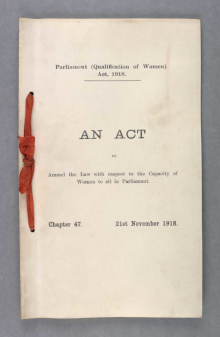
The Parliament (Qualification of Women) Act 1918, an Act of the Parliament of the United Kingdom, is given royal assent on November 21, 1918. It gives women over the age of 21 the right to stand for election as a Member of Parliament (MP). At 27 words, it is the shortest UK statute.

The Representation of the People Act 1918, passed on February 6, 1918, extends the franchise in parliamentary elections, also known as the right to vote, to women aged 30 and over who reside in the constituency or occupied land or premises with a rateable value above £5, or whose husbands do.

In March 1918, the Liberal Party MP for Keighley dies, causing a by-election on April 26. There is doubt as to whether women are eligible to stand for parliament. Nina Boyle makes known her intention to stand as a candidate for the Women’s Freedom League at Keighley and, if refused, to take the matter to the courts for a definitive ruling. After some consideration, the returning officer states that he is prepared to accept her nomination, thus establishing a precedent for women candidates. However, he rules her nomination papers invalid on other grounds: one of the signatories to her nomination is not on the electoral roll and another lives outside the constituency. The Lords of Appeal in Ordinary are asked to consider the matter and conclude that the Great Reform Act 1832 had specifically banned women from standing as parliamentary candidates and the Representation of the People Act had not changed that.

Parliament hurriedly passes the Parliament (Qualification of Women) Act in time to enable women to stand in the general election of December 1918. The act consists of only 27 operative words: “A woman shall not be disqualified by sex or marriage for being elected to or sitting or voting as a Member of the Commons House of Parliament.”

In the December 14, 1918, election to the House of Commons, seventeen women candidates stand, among them well-known suffragette Christabel Pankhurst, representing the Women’s Party in Smethwick. The only woman elected is the Sinn Féin candidate for Dublin St. Patrick’s, Constance Markievicz. However, in line with Sinn Féin abstentionist policy, she does not take her seat.

The first woman to take her seat in the House of Commons is Nancy Astor on December 1, 1919. She is elected as a Coalition Conservative MP for Plymouth Sutton on November 28, 1919, taking the seat her husband had vacated.

As Members of Parliament, women also gain the right to become government ministers. The first woman to become a cabinet minister and Privy Council member is Margaret Bondfield who is Minister of Labour in the second MacDonald ministry (1929–1931).


Leave a comment

Founding of the Irish Women’s Franchise League

irish-womens-franchise-league

The Irish Women’s Franchise League (IWFL), an organisation for women’s suffrage, is established in Dublin on November 4, 1908. Its founder members include Hanna Sheehy-Skeffington, Francis Sheehy-Skeffington and James H. Cousins. Thomas MacDonagh is also a member. The IWFL has 1,000 members by 1912 but only about fifty of these are active.

In the early 20th century, the Irish Parliamentary Party under John Redmond and his deputy John Dillon is opposed to votes for women, as is the British prime minister, H. H. Asquith.

In June 1912, after a meeting of a number of women’s organisations, Hanna Sheehy-Skeffington and Margaret Cousins with six other members of the IWFL smash government windows in the General Post Office (GPO) and other government buildings. They are arrested, charged, and jailed. The following month Asquith makes a visit to Dublin to address a meeting in the Theatre Royal. Frank Sheehy-Skeffington manages to gain entrance and demands votes for women before being thrown out. Meanwhile Asquith’s carriage is attacked by British suffragists Mary Leigh and Gladys Evans. In that attack John Redmond is injured. Leigh and Evans go on hunger strike in Mountjoy Gaol, and are joined by the imprisoned Irish IWFL members in solidarity.

In March 1913 a bust of John Redmond in the Royal Hibernian Academy is defaced by a suffragist protesting against the failure of the Irish Parliamentary Party to support a Women’s Franchise Bill in the House of Commons. In contrast, as a mark of solidarity with the women, James Connolly travels from Belfast to Dublin to speak at one of the IWFL’s weekly meetings which is held in the Phoenix Park, and members of the Irish Transport and General Workers’ Union (ITGWU) provide protection and offer escorts to women as they leave the meetings.

Hanna Sheehy-Skeffington loses her teaching job in 1913 when she is arrested and put in prison for three months after throwing stones at Dublin Castle. While in jail she starts a hunger strike but is released under the Prisoners (Temporary Discharge of Ill Health) Act 1913 and is soon rearrested.

The league keeps a neutral stance on Home Rule, but is opposed to World War I. After the killing of Francis Sheehy-Skeffington by a British officer in 1916, it supports Sinn Féin.

The Irish Women’s Franchise League publishes a paper, The Irish Citizen, from 1912 to 1920. The paper is edited originally by James H. Cousins.


Leave a comment

Closing of the Magdalene Laundries

magdalene-laundries

The last of the Magdalene Laundries in Ireland, also known as the Magdalene Asylums, closes on September 25, 1996.

The Magdalene Laundries are institutions usually run by Roman Catholic orders, which operate from the 18th to the late 20th centuries. They are run ostensibly to house “fallen women,” a term primarily referring to prostitutes in the late 18th century. By the end of the 19th century, Magdalene laundries are filled with many different kinds of women, including girls who are “not prostitutes at all”, but either “seduced women” or women who have yet to engage in sexual activity.

Several religious institutes establish even more Irish laundries, reformatories and industrial schools, sometimes all together on the same plot of land, with the aim to “save the souls primarily of women and children.” Examples are Sisters of Our Lady of Charity of Refuge and the Congregation of the Sisters of Mercy, who run the largest laundries in Dublin. These large complexes become a massive interlocking system, carefully and painstakingly built up over a number of decades. Consequently, Magdalene laundries become part of Ireland’s “larger system for the control of children and women.”

An estimated 30,000 women are confined in these institutions in the 19th and 20th centuries. It is unknown how many women resided in the Magdalene institutions after 1900. Vital information about the women’s circumstances, the number of women, and the consequence of their incarceration is unknown. Due to the religious institutes’ “policy of secrecy,” their penitent registers and convent annals remain closed to this day, despite repeated requests for information.

In Dublin in 1993, the Sisters of Our Lady of Charity sell part of the land in their convent to a property developer to cover money lost in share dealings on the stock exchange. This leads to the discovery of 133 corpses in a mass grave. The Sisters arrange to have the remains cremated and reburied in another mass grave at Glasnevin Cemetery, splitting the cost of the reburial with the developer who had bought the land. It later transpires that there are 22 more corpses than the sisters had applied for permission to exhume. In all, 155 corpses were exhumed and cremated.

Discovery of the mass grave leads to media revelations about the operations of the secretive institutions. A formal state apology is issued in 2013, and a £50 million compensation scheme for survivors is set up by the Irish Government. The religious orders which operate the laundries have rejected activist demands that they financially contribute to this programme.


Leave a comment

OHCHR Mary Robinson Criticises U.S. for Violating Human Rights

mary-robinsonOn August 30, 2002, the United Nations High Commissioner for Human Rights, Mary Robinson, criticises the United States for violating human rights in its war on terrorism and of trying to scale back plans to save the world’s poorest people.

Robinson becomes the United Nations High Commissioner for Human Rights on September 12, 1997, following her nomination to the post by Secretary-General of the United Nations Kofi Annan and the endorsement of the General Assembly.

She assumes responsibility for the UN human rights programme at the time when the Office of the High Commissioner and the Centre for Human Rights are consolidated into a single Office of the High Commissioner for Human Rights (OHCHR).

As High Commissioner, Robinson gives priority to implementing the Secretary-General’s reform proposal to integrate human rights into all the activities of the United Nations. During her first year as High Commissioner, she travels to Rwanda, South Africa, Colombia and Cambodia, among other countries. In September 1998, she becomes the first High Commissioner to visit China and signs an agreement with the Government for OHCHR to undertake a wide-ranging technical-cooperation programme to improve human rights in that country. She also strengthens human rights monitoring in such conflict areas as Kosovo in the Federal Republic of Yugoslavia. Her term of office expires in 2002 after sustained pressure from the United States leads her to declare she is no longer able to continue her work.

Robinson comes to the United Nations after a distinguished, seven-year tenure as President of Ireland. She is the first Head of State to visit Rwanda in the aftermath of the 1994 genocide there. She is also the first Head of State to visit Somalia following the crisis there in 1992, and receives the CARE Humanitarian Award in recognition of her efforts for that country.

Before she is elected President of Ireland in 1990, Robinson serves as Senator for 20 years. Born on May 21, 1944 in Ballina, County Mayo, she is called to the bar in 1967 and two years later becomes the youngest Reid Professor of Constitutional Law at Trinity College, Dublin. In 1973, she becomes a member of the English Bar (Middle Temple). She becomes a Senior Counsel in 1980, and serves as a member of the Advisory Commission of Inter-Rights (1984-1990) and as a member of the International Commission of Jurists (1987-1990).

Educated at Trinity College, Robinson holds law degrees from the King’s Inns in Dublin and from Harvard University. She has been awarded numerous honorary degrees, medals and prizes from universities and humanitarian organizations around the world. In July 2009, she is awarded the Presidential Medal of Freedom, the highest civilian honour awarded by the United States, by U.S. President Barack Obama.


Leave a comment

Operation Demetrius

long-kesh-internment-camp

Operation Demetrius, a British Army operation in Northern Ireland begins on August 9, 1971, during the Troubles. The operation involves the mass arrest and internment (imprisonment without trial) of 342 people suspected of being involved with the Irish Republican Army (IRA), which is waging a campaign for a united Ireland against the British state.

Operation Demetrius, proposed by the Government of Northern Ireland and approved by the Government of the United Kingdom, begins throughout Northern Ireland in the early morning hours of Monday, August 9 and progresses in two parts:

  1. Arrest and movement of the detainees to one of three regional holding centers: Girdwood Barracks in Belfast, Abercorn Barracks in Ballykinler, County Down, or HM Prison Magilligan near Limavady, County Londonderry.
  2. The process of identification and questioning, leading either to release of the detainee or movement into detention at HM Prison Crumlin Road or aboard HMS Maidstone, a prison ship in Belfast Harbour.

The operation sparks four days of violence in which 20 civilians, two IRA members and two British soldiers are killed. All of those arrested are Irish nationalists, the vast majority of them Catholic. Due to faulty intelligence, many have no links with the IRA. Ulster loyalist paramilitaries are also carrying out acts of violence, which are mainly directed against Catholics and Irish nationalists, but no loyalists are included in the sweep.

The introduction of internment, the way the arrests are carried out, and the abuse of those arrested, lead to mass protests and a sharp increase in violence. Amid the violence, about 7,000 people flee or are forced out of their homes. The interrogation techniques used on some of the internees are described by the European Commission of Human Rights in 1976 as torture, but the superior court, the European Court of Human Rights (ECHR), rules on appeal in 1978 that, although the techniques are “inhuman and degrading”, they do not, in this instance, constitute torture. It is later revealed that the British government had withheld information from the ECHR and that the policy had been authorized by British government ministers. In December 2014, in light of the new evidence, the Irish government asks the ECHR to revise its 1978 judgement. The ECHR declines the request in 2018.

The backlash against internment contributes to the decision of the British Government under Prime Minister Edward Heath to suspend the Northern Ireland Government and replace it with direct rule from Westminster, under the authority of a British Secretary of State for Northern Ireland. This takes place in 1972.

Following the suspension of the Northern Ireland Government and Parliament, internment is continued by the direct rule administration until December 5, 1975. During this time 1,981 people are interned, 1,874 are nationalist while 107 are loyalist. The first loyalist internees are detained in February 1973.

(Pictured: The entrance to Compound 19, one of the sections of Long Kesh internment camp)