seamus dubhghaill

Promoting Irish Culture and History from Little Rock, Arkansas, USA


Leave a comment

Death of IRA Hunger Striker Michael Gaughan

michael-gaughan

Michael Gaughan, a Provisional Irish Republican Army (IRA) member, dies on hunger strike on June 3, 1974, in HM Prison Parkhurst on the Isle of Wight, England.

Gaughan, the eldest of six children, is born in Ballina, County Mayo, on October 5, 1949. He grows up at Healy Terrace and is educated at St. Muredach’s College, Ballina. After finishing his schooling, he emigrates from Ireland to England in search of work.

While in London, Gaughan becomes a member of the Official Irish Republican Army through Official Sinn Féin‘s English wing Clann na hÉireann and becomes an IRA volunteer in a London-based Active Service Unit. In December 1971, he is sentenced at the Old Bailey to seven years imprisonment for his part in an IRA fundraising mission to rob a bank in Hornsey, north London, which yields just £530, and for the possession of two revolvers.

Gaughan is initially imprisoned at Wormwood Scrubs, where he spends two years before being transferred to the top security HM Prison Albany on the Isle of Wight. While at Albany Prison, he requests political status, which is refused, and he is then placed in solitary confinement. He is later transferred to Parkhurst Prison, where four of the Belfast Ten are on hunger strike for political status.

On March 31, 1974, Gaughan, along with current Sinn Féin MLA Gerry Kelly, Paul Holme, Hugh Feeney and fellow Mayoman Frank Stagg, go on hunger strike to support the fight of Dolours and Marion Price to obtain political status and to be transferred to a jail in Ireland. The prisoners’ demands are as follows:

  • The right to political status
  • The right to wear their own clothes
  • A guarantee that they would not be returned to solitary confinement
  • The right to educational facilities and not engage in penal labour
  • The setting of a reasonable date for a transfer to an Irish prison

British policy at this time is to force-feed hunger strikers. According to the National Hunger Strike Commemoration Committee, “six to eight guards would restrain the prisoner and drag him or her by the hair to the top of the bed, where they would stretch the prisoner’s neck over the metal rail, force a block between his or her teeth and then pass a feeding tube, which extended down the throat, through a hole in the block.”

After visiting Gaughan in jail, his brother John describes his condition, “His throat had been badly cut by force feeding and his teeth loosened. His eyes were sunken, his cheeks hollow and his mouth was gaping open. He weighed about six stone.”

During his hunger strike, Gaughan’s weight drops from 160 lbs. to 84 lbs. He is force-fed for the first time on April 22, and this occurs 17 times during course of his hunger strike. The last time he is force-fed is the night before his death. After a hunger strike that lasts 64 days, Michael Gaughan dies on Monday, June 3, 1974, at the age of 24.

The cause of Gaughan’s death is disputed. The British government states that he died of pneumonia. The Gaughan family state that he died after prison doctors injured him fatally when food lodged in a lung punctured by a force-feeding tube. His death causes controversy in English medical circles, as some forms of treatment can be classed as assault if given without the express permission of the patient.

The timing of Gaughan’s death comes just one week after the British Government had capitulated to the demands of Ulster loyalist hunger strikers. After his death, the British government’s policy of force-feeding ends and the remaining hunger strikers are given assurances that they will be repatriated to Irish prisons. However, these promises are reneged on by the British government.

Gaughan’s body is initially removed from London and on June 7-8 over 3,000 mourners line the streets of Kilburn and march behind his coffin, which is flanked by an IRA honour guard, to a Requiem Mass held in the Church of the Sacred Heart of Jesus.

Following the Requiem Mass, his body is transported to Dublin, where again it is met by mourners and another IRA honour guard who bring it to the Church of the Immaculate Conception on Merchant’s Quay, where thousands file past as it lay in state. The following day, his body is removed to Ballina, County Mayo. A funeral mass takes place on June 9, at St. Muredach’s Cathedral, and the procession then leads to Leigue Cemetery. Gaughan is given a full IRA funeral and is laid to rest in the republican plot, where Frank Stagg would join him after being reburied in November 1976. His funeral is attended by over 50,000 people and is larger than the funeral of former president Éamon de Valera the following year.

Leave a comment

Real IRA Designated Foreign Terrorist Organization

real-irish-republican-army

On May 16, 2001, the United States Department of State designates the Real Irish Republican Army, a splinter group of the Irish Republican Army (IRA) charged with killing 29 people in the August 1998 Omagh bombing, as a “foreign terrorist organisation,” a legal term that brings financial and other sanctions. Under U.S. law, any assets the Real IRA has in the United States are frozen, it is illegal to support the organization, and Real IRA members are not eligible for U.S. visas.

The Real IRA broke off from the main Irish Republican Army and its political wing Sinn Féin in 1998 to oppose the decision by Sinn Féin to support the Northern Ireland peace process and work to end 30 years of fighting in Northern Ireland.

As a result of the FTO designation many activities, including fund-raising, of the Real IRA or its two so-called “front groups” or “political pressure groups” — the “32 County Sovereignty Movement” and the “Irish Republican Prisoner Welfare Association” — are now illegal.

A senior State Department official notes that this is the first time a group with “heavy ties” to the United States, with sympathizers and supporters coming from the United States, has been designated as a terrorist organization. But, in the words of this official, the “British and Irish government publicly asked us to look into this.” The “rigorous” review, begun in the fall of 2000, included volumes of evidence and was an inner-agency process that required the signature of the Secretary of the Treasury, the Attorney General and the Secretary of State.

A second State Department official points out that Irish nationalists have typically received the most support from South Boston, New York City and Chicago, where there are heavy concentrations of Irish Americans.

According to the State Department Patterns of Global Terrorism report in 2000, the Real IRA was formed in February-March 1998, has between 150-200 hard-line members and is dedicated to removing British forces from Northern Ireland and unifying Ireland.

The State Department report goes on to accuse the Real IRA of carrying out the bombing of Hammersmith Bridge and a rocket attack against Secret Intelligence Service (MI-6) headquarters in London in 2000.

State Department officials say they absolutely anticipate the Real IRA to challenge the FTO designation in court. The designation comes as the Irish Republic prepares to prosecute Michael McKevitt, the Real IRA’s alleged leader.

Other designated FTOs include 29 organizations: the Abu Nidal Organization, the Abu Sayyaf group, the Palestinian Liberation Front, Al-Qaeda and Tupac Amaru Revolutionary Movement, to name a few.


Leave a comment

The Dunmanway Killings

dunmanway-massacre

The Dunmanway killings, also known as the Dunmanway murders or the Dunmanway massacre, takes place in and around Dunmanway, County Cork between April 26-28, 1922. The event refers to the killing (and in some cases, disappearances) of thirteen Protestant men and boys.

The killings happen in a period of truce after the July 1921 end of the Irish War of Independence and before the outbreak of the Irish Civil War in June 1922. All the dead and missing are Protestants, which has led to the killings being described as sectarian. Six are killed as purported British informants and loyalists, while four others are relatives killed in the absence of the target. Three other men are kidnapped and executed in Bandon as revenge for the killing of an Irish Republican Army (IRA) officer Michael O’Neill during an armed raid. One man is shot and survives his injuries.

On April 26, 1922, a group of anti-Treaty IRA men, led by Michael O’Neill, arrive at the house of Thomas Hornibrook, a former magistrate, at Ballygroman, East Muskerry, Desertmore, Bandon (near Ballincollig on the outskirts of Cork City), seeking to seize his car. Hornibrook is in the house at the time along with his son, Samuel, and his nephew, Herbert Woods, a former Captain in the British Army. O’Neill demands a part of the engine mechanism that had been removed by Hornibrook to prevent such theft. Hornibrook refuses to give them the part, and after further efforts, some of the IRA party enter through a window. Herbert Woods then shoots O’Neill, wounding him fatally. O’Neill’s companion, Charlie O’Donoghue, takes him to a local priest who pronounces him dead. The next morning O’Donoghue leaves for Bandon to report the incident to his superiors, returning with “four military men,” meeting with the Hornibrooks and Woods, who admit to shooting O’Neill.

It is not clear who orders the attacks or carries them out. However, in 2014 The Irish Times releases a confidential memo from the then-Director of Intelligence Colonel Michael Joe Costello (later managing director of the Irish Sugar Company) in September 1925 in relation to a pension claim by former IRA volunteer Daniel O’Neill of Enniskeane, County Cork, stating: “O’Neill is stated to be a very unscrupulous individual and to have taken part in such operations as lotting [looting] of Post Offices, robbing of Postmen and the murder of several Protestants in West Cork in May 1922. A brother of his was shot dead by two of the latter named, Woods and Hornbrooke [sic], who were subsequently murdered.”

Sinn Féin and IRA representatives, from both the pro-Treaty side, which controls the Provisional Government in Dublin and the anti-Treaty side, which controls the area the killings take place in, immediately condemn the killings.

The motivation of the killers remains unclear. It is generally agreed that they were provoked by the fatal shooting of O’Neill by Woods, whose house was being raided on April 26. Some historians have claimed there were sectarian motives; others claim that those killed were targeted only because they were suspected of having been informers during the Irish War of Independence and argue that the dead were associated with the so-called “Murragh Loyalist Action Group,” and that their names may have appeared in captured British military intelligence files which listed “helpful citizens” during the war.

(Pictured: Herbert Woods, centre, whose decision to shoot sparks the massacre)


Leave a comment

The 1979 Bessbrook Bombing

File source: http://commons.wikimedia.org/wiki/File:Coalisland.jpg

The Bessbrook bombing takes place on the April 17, 1979, when four Royal Ulster Constabulary (RUC) officers are killed when the Provisional Irish Republican Army (IRA) explodes an estimated 1,000-pound roadside van bomb at Bessbrook, County Armagh.

The bombing occurs during a period of heightened IRA activity. The previous two years are some of the less active and less violent years during the Troubles. The British policy of criminalization seems to be working but the IRA is gearing up for a new offensive. In 1976, 295 people are killed compared with 111 in 1977 and 80 in 1978 but in 1979 the number increases to 120 with 76 being British security force members compared to just 34 in 1978. The entire IRA “battalion structure” has been reconstructed using more smaller, tight knit cells making the IRA more secretive, harder to infiltrate and makes them much more effective at carrying out larger operations. The only brigade area which does not go under this reconstruction is the South Armagh Brigade which is viewed by the IRA Army Council as an independent Republic. In fact, by the mid-1970s South Armagh has become so dangerous for the British security forces, who are snipped at and have bombs thrown at them whenever they enter the area on foot, they have to be airlifted into the area and ground patrols are stopped altogether effectively giving up the ground to the South Armagh PIRA.

While the four Protestant members of the Royal Ulster Constabulary are on an evening patrol, they are all killed when a Provisional IRA unit detonates a remote-controlled bomb hidden in a parked van. The IRA unit detonates the well-hidden bomb at the exact second the RUC mobile patrol is passing giving the officers no chance of survival. The dead RUC men are, Paul Gray (25), Robert Lockhart (44), Richard Baird (28) and Noel Webb (30). The bomb is estimated at 1,000 lbs. and is believed to be the largest bomb used by the IRA up to that date.

In January 1981, Patrick Joseph Traynor (27) from Crossmaglen is found guilty of the four murders and a range of other charges. He is jailed for life on each of the four murder charges and is sentenced to 12 years for the related crimes.

The IRA continues to intensify their campaign. On August 29, 1979, the IRA carries out two separate attacks in Northern Ireland and the Republic of Ireland that shock the world and give huge media coverage to their campaign. The first is the killing of Lord Mountbatten and his grandson when the boat they are on off the County Sligo coast is blown up by a remote-controlled bomb. The second is the Warrenpoint Ambush where the IRA kills 18 British soldiers in a double bomb attack, the highest loss of life for the British Army during the Troubles. The IRA carries out several of these type of large attacks against the British forces throughout the 1980s like the 1983 Ballygawley land mine attack which kills four soldiers, the 1988 Lisburn van bombing which kills six soldiers and the Ballygawley bus bombing also carried out in 1988 which kills eight soldiers and injures 28.


Leave a comment

The Baltic Exchange Bombing

IRA Bombing of the Baltic Exchange

The Baltic Exchange bombing, an attack by the Provisional Irish Republican Army (PIRA) on London‘s financial centre, takes place on April 10, 1992, the day after the General Election which re-elects John Major from the Conservative Party as Prime Minister. The one-ton bomb, concealed in a large white truck and consisting of a fertilizer device wrapped with a detonation cord made from 100 lbs. of Semtex, is the biggest detonated on mainland Britain since World War II. The bombing kills three people, injures 91 others, and causes massive damage, destroying the Baltic Exchange building and severely damaging surroundings.

Since the PIRA’s campaign in the early 1970s, many commercial targets are attacked on the mainland which cause economic damage and severe disruption. Since 1988, Gerry Adams of Sinn Féin and John Hume of the Social Democratic and Labour Party are engaged in private dialogue to create a broad Irish nationalist coalition. British Prime Minister John Major refuses to openly enter into talks with Sinn Féin until the IRA declares a ceasefire. The risk of an IRA attack on London increases due to the lack of progress with political talks, resulting in a warning being circulated to all police forces in Britain highlighting intelligence reports of a possible attack, as it is believed that the IRA has enough personnel, equipment and funds to launch a sustained campaign in England.

On April 10, 1992, at 9:20 PM, a huge bomb is detonated in front of the Baltic Exchange building at 24-28 St. Mary Axe. The façade of the offices is partially destroyed, and the rest of the building is extensively damaged. The bomb also causes heavy damage to surrounding buildings. It causes £800 million worth of damage, £200 million more than the total damage caused by the 10,000 explosions that had occurred during the Troubles in Northern Ireland up to that point.

The IRA gives a telephone warning twenty minutes before the explosion, saying there is a bomb inside a van outside the London Stock Exchange. This is a half mile away from the actual location by the Baltic Exchange.

The homemade explosive is inside a white Ford Transit van parked in St. Mary Axe. The components are developed in South Armagh, shipped from Ireland, and assembled in England. The attack is planned for months and marks a dangerous advance to the British of the IRA’s explosives manufacturing capabilities. The bomb is described as the most powerful to hit London since the Luftwaffe raids of World War II.

A few hours later another similarly large bomb goes off in Staples Corner in north London, also causing major damage.

The next day, the IRA claims responsibility in a statement from Dublin. It is believed the IRA are trying to send a message to the Conservative Party who won the election, which also sees Sinn Féin leader Gerry Adams lose his unused seat in the Westminster Parliament.

Many of the damaged buildings are once again badly damaged by the Bishopsgate bombing the following year. Both incidents contribute to the formation of the “Ring of Steel” in the city to protect it from further terrorism.

The Exchange sells its badly damaged historic building to be redeveloped under the auspices of English Heritage as a Grade II* site. However, the City and English Heritage later allow it to be demolished, seeking instead a new landmark building. The site, together with that of the UK Chamber of Shipping at 30–32 St. Mary Axe, is now home to the skyscraper commissioned by Swiss Re commonly referred to as The Gherkin.

The stained glass of the Baltic Exchange war memorial, which suffered damage in the bomb blast, has been restored and is in the National Maritime Museum in London.

(Pictured: The scene of devastation following the IRA bomb which destroyed London’s Baltic Exchange. Image credit: Gulf News Archives)


Leave a comment

Passage of the Special Powers Act 1922

special-powers-act-1922

The Civil Authorities (Special Powers) Act (Northern Ireland) 1922, often referred to simply as the Special Powers Act, is passed by the Parliament of Northern Ireland on April 7, 1922, shortly after the establishment of Northern Ireland, and in the context of violent conflict over the issue of the partition of Ireland. Its sweeping powers make it highly controversial, and it is seen by much of the Northern Irish nationalist community as a tool of Ulster unionist oppression. The Act is eventually repealed by the Northern Ireland (Emergency Provisions) Act 1973, following the abolition of Northern Ireland’s parliament and the imposition of direct rule by the British government.

At the start of the twentieth century, the people of Ireland are divided into two mutually hostile factions. Nationalists, the much larger group, are mostly Roman Catholic, identify primarily as Irish, and want some form of Irish home rule or independence from Britain. Unionists, the smaller group, concentrates primarily in the province of Ulster, are mostly Protestant, identify primarily as British (although many see themselves as Irish and British), and are committed to remaining within the United Kingdom.

Partition is formally established with the Government of Ireland Act 1920. This also establishes the Parliament of Northern Ireland, which comes into being the following year. Partition is followed by high levels of inter-communal violence, especially in Belfast. The Irish Republican Army (IRA), although it spends most of these years fighting in the Irish Civil War, aims to use armed force to end partition and compel the United Kingdom to withdraw sovereignty from Northern Ireland.

The Act is presented as being necessary to re-establish peace and law and order in Northern Ireland and enables the government to “take all such steps and issue all such orders as may be necessary for preserving the peace and maintaining order,” although it is specified that the ordinary course of law should be interfered with as little as possible. Because it is presented as emergency legislation, the Act is initially current only for one year and has to be renewed annually. In 1928, however, it is renewed for five years and when this period expires in 1933 the Act is made permanent.

Despite rhetoric accompanying the Act which asserts that it is for the purpose of restoring public order, its provisions continue to be used for the entire period of the Northern Irish parliament’s existence. Because the Ulster Unionist Party is the only party ever to form a government in this parliament, the Act is used “almost exclusively on the minority population.” Initially, regulations under the Act are used mostly to curb immediate violence and disorder. One of the most controversial of these is internment without trial.

After the troubles of the early 1920s dies down, the provision for internment is not used until the IRA’s Border Campaign of the 1950s, in which several hundred republicans are interned. Following the outbreak of The Troubles in 1968, many within the Protestant community call for the reintroduction of internment. This occurs in 1971 and authorises internment of those suspected to be involved in terrorism. Although there are loyalist as well as republican terrorists at this time, of the 1,981 men interned, only 107 are loyalists. Due to inadequate intelligence-gathering, many of the interned republicans are members of the Official Irish Republican Army rather than the recently formed Provisional Irish Republican Army (PIRA), which is much more heavily involved in terrorist activity at the time.

Internment ends in 1975 but is credited with increasing support and sympathy for the PIRA amongst the Catholic community and outside of Northern Ireland. It helps to create political tensions which culminate in the 1981 Irish Hunger Strike and the death of MP Bobby Sands. Imprisonment under anti-terrorism laws specific to Northern Ireland continue until the 1998 Good Friday Agreement, but these laws require the right to a fair trial be respected.


Leave a comment

Ian Paisley’s Retirement from the Power-Sharing Assembly

ian-paisley

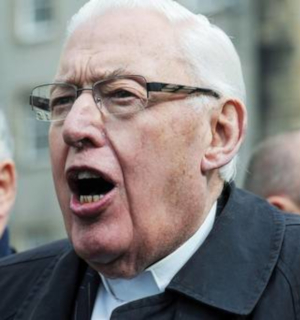
On March 23, 2011, Ian Paisley calls for a new era of sharing and reconciliation in an emotional farewell at his final sitting of the power-sharing Assembly he helped to create at Stormont. Dr. Paisley continues his political career in the House of Lords.

Protestant and Catholic leaders in Northern Ireland‘s unity government celebrate their first full four-year term in power and lauded Paisley, the unlikely peacemaker who made it possible, on his effective retirement day.

Paisley, a stern anti-Catholic evangelist who spent decades rallying pro-British Protestants against compromise, stuns the world in 2007 by agreeing to forge a coalition alongside senior Irish Republican Army (IRA) veterans. Their polar-opposite combination governs Northern Ireland with surprising harmony for the four years leading up to his retirement.

The Northern Ireland Assembly that elects the administration is dissolved on March 14, 2011, in preparation for a May 5 election in the British territory. The 84-year-old Paisley makes his last debate in an elected chamber on March 6, 2011, noting that this local government is not ending in chaos and acrimony, as 1999-2002 attempts at power-sharing repeatedly had done.

At this point, Paisley has already stepped down as a member of the British and European parliaments and as leader of the Democratic Unionists, a party of hard-line Protestant protesters that he founded in 1970 and watched grow over the previous decade into the most popular in Northern Ireland.

Those lauding him include Peter Robinson, who succeeded him in 2008 as leader of both the government and the Democratic Unionists and Sinn Féin‘s Martin McGuinness, the senior Catholic politician who spends decades as a commander of Paisley’s archenemy, the IRA.

The IRA kills nearly 1,800 people in a failed 1970-1997 effort to force Northern Ireland out of the United Kingdom. Northern Ireland remains part of the United Kingdom when the overwhelmingly Catholic rest of Ireland gains its independence in 1922. The outlawed IRA formally renounces violence and disarms in 2005, clearing the way for its allied Sinn Féin party to recognize the legal authority of Northern Ireland and its police.

Still, few observers expected Paisley to agree to a pact so quickly after the IRA-Sinn Féin peace moves or to get along so warmly with McGuinness during their year in partnership.

McGuinness, whose organization once considered Paisley a prime target for assassination, addressing his remarks to the stooped, silver-haired Paisley across the chamber, notes that Ulster wits had christened the two of them “the Chuckle Brothers.” He adds, “And I would like to think that we showed leadership. I think my relationship with him will undoubtedly go down in the history books.”

(From: “Northern Ireland power-sharing marks 1st full term,” the Associated Press and CTV News, March 23, 2011)


Leave a comment

The Milltown Cemetery Attack

milltown-cemetery-attack

The Milltown Cemetery attack, also known as the Milltown Cemetery killings or the Milltown Massacre, takes place on March 16, 1988 at Milltown Cemetery in Belfast, Northern Ireland.

On March 6, 1988, Provisional Irish Republican Army members Daniel McCann, Seán Savage and Mairéad Farrell are shot dead by the Special Air Service (SAS) in Gibraltar, in Operation Flavius. The three were allegedly preparing a bomb attack on British military personnel there, but their deaths outrage republicans as the three are unarmed and shot without warning. Their bodies arrive in Belfast on March 14 and are taken to their family homes.

The “Gilbraltar Three” are scheduled to be buried in the republican plot at Milltown Cemetery on March 16. For years, republicans had complained about heavy-handed policing of IRA funerals, which had led to violence. In a change from normal procedure, the security forces agree to stay away from the funeral in exchange for guarantees that there will be no three-volley salute by IRA gunmen. The British Army and Royal Ulster Constabulary (RUC) would instead keep watch from the sidelines. This decision is not made public.

Present at the funeral are thousands of mourners and top members of the IRA and Sinn Féin, including Sinn Féin leader Gerry Adams and Martin McGuinness. Two RUC helicopters hover overhead.

Michael Stone, a loyalist and member of the Ulster Defence Association (UDA), learns there are to be no police or armed IRA members at the cemetery. As the third coffin is about to be lowered into the ground, Stone throws two grenades, which have a seven-second delay, toward the republican plot and begins shooting. The first grenade explodes near the crowd and about 20 yards from the grave. There is panic and confusion, and people dive for cover behind gravestones.

As Stone runs towards the nearby motorway, a large crowd begins chasing him and he continues shooting and throwing grenades. Some of the crowd catches Stone and begin beating him, but he is rescued by the police and arrested. Three people are killed and more than 60 wounded in the attack. The “unprecedented, one-man attack” is filmed by television news crews and causes shock around the world.

Three days later, two British Army corporals drive into the funeral procession of one of the Milltown victims. The non-uniformed soldiers are dragged from their car by an angry crowd, beaten and then shot dead by the IRA, in what becomes known as the corporals killings.

In March 1989, Stone is convicted for the three murders at Milltown, for three paramilitary murders before, and for other offences, receiving sentences totaling 682 years. He is released after serving 13 years as a result of the Good Friday Agreement.

(Pictured: The funeral at Milltown Cemetery in Belfast moments before the attack by Michael Stone)


Leave a comment

Killing of PSNI Officer Stephen Carroll

stephen-carroll

Stephen Carroll, a Police Service of Northern Ireland (PSNI) officer, is killed by the Continuity Irish Republican Army on March 9, 2009 in Craigavon, County Armagh, Northern Ireland. Carroll’s killing marks the first time a serving police officer has been killed since the Good Friday Agreement in 1998.

Two days prior to the attack the Real Irish Republican Army shoots dead two British soldiers outside the Massereene Barracks in Antrim, County Antrim. This period marks a significant escalation in the campaign by dissident republicans.

The Continuity IRA smashes a window with a brick knowing the PSNI would respond. At about 9:45 PM two police vehicles arrive at the scene. The officers are fired upon as they attempt to exit their vehicles. A gunman shoots Carroll from 50 metres away with an AK-47 while in his patrol car. Carroll is shot in the head.

The Continuity IRA claims responsibility saying their North Armagh Battalion is responsible for the attack and that “As long as there is British involvement in Ireland, these attacks will continue.”

On March 10 there is a one-minute silence in the Northern Ireland Assembly. Prime Minister Gordon Brown states that “These are murderers who are trying to distort, disrupt and destroy a political process that is working for the people of Northern Ireland.” Chief Constable Sir Hugh Orde calls it a “sad day” and says the gunmen are “criminal psychopaths.”

Richard Walsh, the spokesman for Republican Sinn Féin, a party linked to the Continuity IRA, says the killings are “an act of war” rather than murder. “We have always upheld the right of the Irish people to use any level of controlled and disciplined force to drive the British out of Ireland. We make no apology for that.” He also describes the PSNI as “an armed adjunct of the British Army.”

Deputy First Minister of Northern Ireland Martin McGuinness says those responsible are “traitors to the island of Ireland” and that “they have betrayed the political desires, hopes and aspirations of all of the people who live on this island.”


Leave a comment

The Clonbanin Ambush

*

The Irish Republican Army (IRA) ambush a British Army convoy near the townland of Clonbanin, County Cork on March 5, 1921, during the Irish War of Independence.

The IRA force is comprised of almost 100 volunteers from counties Cork and Kerry, armed with rifles, hand grenades and a machine gun. Their target is a British Army convoy of three lorries, an armoured car and a touring car carrying Brigadier General Hanway Robert Cumming. The convoy is travelling from Killarney to Buttevant and comprises almost 40 soldiers of the East Lancashire Regiment.

When the convoy enters the ambush position, IRA volunteers open fire from elevated positions on both sides of the road. The three lorries and touring car are disabled, and the armoured car becomes stuck in the roadside ditch, although those inside continue to fire its machine guns. As Cumming jumps from his car, he is shot in the head and dies instantly. He is one of the highest ranked British officers to die in the Irish War of Independence.

The battle lasts slightly over an hour. As the IRA forces withdraw from one side of the road, a British officer and six soldiers attempted to flank the IRA on the other side. After a brief exchange of fire, they retreat.

The IRA are not believed to have sustained any casualties.

(Pictured: Two British officers surnamed Lawson and Adams with Brigadier General H. R. Cumming in Kenmare County Kerry shortly before their deaths at the hands of the IRA in 1921)