seamus dubhghaill

Promoting Irish Culture and History from Little Rock, Arkansas, USA


Leave a comment

Final Republican & Loyalist Prisoners Released from Maze Prison

maze-prison-release

The final seventy-eight republican and loyalist prisoners are released from the Maze Prison in Northern Ireland on July 28, 2000 as the final phase of the Good Friday peace accord scheme to release 428 inmates early.

Some of the most prolific bombers and gunmen involved in the Troubles have been imprisoned in the Maze, originally called Long Kesh, since it opened in 1971.

One of the freed republicans, Seán Lynch, describes what he saw as the real and symbolic importance of the Maze. “We had achieved the status of political prisoners even if the British Government never admitted it. The prison struggle was a microcosm of the larger struggle.”

Founder member of the Ulster Defence Association, Thomas McKeown, released in 1990 is one of over 10,000 loyalists sent to the prison. He reflects, “We had it pretty easy. We made replica weapons and instruments from wood and conducted military parades and drill every morning. There were also political classes and other sorts of education.”

After the H-block hunger strikes of the 1980s there are numerous escape attempts and by 1994 the authorities have given in to many of the prisoners’ demands for freedom of association and high levels of autonomy. A total of 2,700 incidents of officers being threatened or attacked are reported. A granite memorial outside the gates bears the names of the 29 prison guards murdered since the prison opened in 1971.

On September 29, 2000, the remaining four prisoners at the Maze are transferred to other prisons in Northern Ireland and the Maze Prison is closed. Redundancy packages are arranged for staff. These are accepted by 300 who left in June 2000.

The future of the buildings is uncertain, but some republicans want it to be turned into a museum to commemorate their struggle.

A monitoring group is set up on January 14, 2003 to debate the future of the 360-acre site. There are many proposals, including a museum, a multi-purpose sports stadium and an office, hotel and leisure village. In January 2006, the government unveils a masterplan for the site incorporating many of these proposals, including a 45,000 seat national multi-sport stadium for association football, rugby and Gaelic games. In October 2006, demolition work begins in preparation for construction on the site, however, in January 2009 plans to build the new multi-purpose stadium are cancelled, with Minister of Culture, Arts and Leisure Gregory Campbell citing a lack of support and concerns for a net loss to the economy.

Discussion is still ongoing as to the listed status of sections of the old prison. The hospital and part of the H-Blocks are currently listed buildings, and will remain as part of the proposed site redevelopment as a “conflict transformation centre” with support from republicans such as Martin McGuinness and opposition from unionists, who consider that this risks creating “a shrine to the IRA.”

In January 2013, plans are approved by the Northern Ireland Minister of the Environment, Alex Attwood, for the site to be redeveloped as showgrounds as the result of an application by the Royal Ulster Agricultural Society with the objective of relocating Balmoral Show from its current location in Belfast. The site is now known as Balmoral Park.

In October 2019, the European Union withdraws £18m that had been approved to develop a peace centre, due to disagreements between Sinn Féin and the Democratic Unionist Party.

(Pictured: IRA prisoners walk out through the Maze turnstile, BBC News Online, July 28, 2000)

Leave a comment

Death of Alex “Hurricane” Higgins, Snooker World Champion

alex-hurricane-higgins

Alexander Gordon “Alex” Higgins, Northern Irish professional snooker player, who is remembered as one of the most iconic figures in the game, dies in Belfast, Northern Ireland on July 24, 2010. He is nicknamed “Hurricane Higgins” because of his fast play.

Higgins is born in Belfast on March 18, 1949.  He starts playing snooker at the age of eleven, often in the Jampot club in his native Sandy Row area of south Belfast and later in the YMCA in the nearby city centre. At age fourteen and weighing seven and a half stone (47.6 kg), he leaves for England and a career as a jockey. However, he never makes the grade because, in his youth, he drinks a lot of Guinness and eats a lot of chocolate, making him too heavy to ride competitively. He returns to Belfast and by 1965, at the age of sixteen, he has compiled his first maximum break. In 1968 he wins the All-Ireland and Northern Ireland Amateur Championships.

Higgins turns professional at the age of 22, winning the World Snooker Championship at his first attempt in 1972, against John Spencer winning 37–32. Higgins is then the youngest ever winner of the title, a record retained until Stephen Hendry‘s 1990 victory at the age of 21. In April 1976, Higgins reaches the final again and faces Ray Reardon. Higgins leads 11–9, but Reardon makes four centuries and seven breaks over 60 to pull away and win the title for the fifth time with the score of 27–16. Higgins is also the runner-up to Cliff Thorburn in 1980, losing 18–16, after being 9–5 up. Higgins wins the world title for a second time in 1982 after beating Reardon 18–15 (with a 135 total clearance in the final frame). It was an emotional as well as professional victory for him. Higgins would have been ranked No. 1 in the world rankings for the 1982-1983 season had he not forfeited ranking points following disciplinary action.

Throughout his career, Higgins wins 20 other titles, one of the most notable being the 1983 UK Championship. In the final he trails Steve Davis 0–7 before producing a famous comeback to win 16–15. He also wins the Masters twice, in 1978 and in 1981, beating Cliff Thorburn and Terry Griffiths in the finals respectively. Another notable victory is his final professional triumph in the 1989 Irish Masters at the age of 40 when he defeats a young Stephen Hendry, which becomes known as “The Hurricane’s Last Hurrah.”

Higgins comes to be known as the “People’s Champion” because of his popularity, and is often credited with having brought the game of snooker to a wider audience, contributing to its peak in popularity in the 1980s. He has a reputation as an unpredictable and difficult character. He is a heavy smoker, struggles with drinking and gambling, and admits to using cocaine and marijuana.

First diagnosed with throat cancer in 1998, Higgins is found dead in bed in his flat on July 24, 2010. The cause of death is a combination of malnutrition, pneumonia, and a bronchial condition. Higgins’ funeral service is held in Belfast on August 2, 2010. He is cremated and his ashes are interred in Carnmoney Cemetery in Newtownabbey, County Antrim.


Leave a comment

Birth of John Miller Andrews, 2nd Prime Minister of Northern Ireland

john-miller-andrews

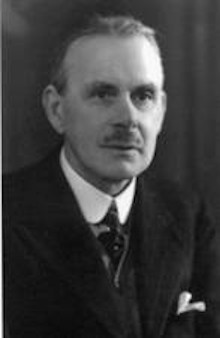
John Miller Andrews, the second Prime Minister of Northern Ireland, is born in Comber, County Down on July 17, 1871. He is the eldest child in the family of four sons and one daughter of Thomas Andrews, flax spinner, and his wife Eliza Pirrie, a sister of William Pirrie, 1st Viscount Pirrie, chairman of Harland & Wolff. He is named after his maternal great-uncle, John Miller of Comber (1795–1883).

Andrews is educated at the Royal Belfast Academical Institution. In business, Andrews is a landowner, a director of his family linen-bleaching company and of the Belfast Ropeworks. His younger brother, Thomas Andrews, who dies in the 1912 sinking of the RMS Titanic, served as managing director of the Harland and Wolff shipyard in Belfast. Another brother, Sir James Andrews, 1st Baronet, was Lord Chief Justice of Northern Ireland.

In 1902 Andrews marries Jessie, eldest daughter of Bolton stockbroker Joseph Ormrod at Rivington Unitarian Chapel, Rivington, near Chorley, Lancashire, England. They have one son and two daughters. His younger brother, Sir James, marries Jessie’s sister.

Andrews is elected as a member of parliament in the House of Commons of Northern Ireland, sitting from 1921 until 1953 (for Down from 1921–29 and for Mid Down from 1929–1953). He is a founder member of the Ulster Unionist Labour Association, which he chairs, and is Minister of Labour from 1921 to 1937. He is Minister of Finance from 1937 to 1940, succeeding to the position on the death of Hugh MacDowell Pollock. Upon the death of James Craig, 1st Viscount Craigavon in 1940, he becomes leader of the Ulster Unionist Party (UUP) and the second Prime Minister of Northern Ireland.

In April 1943 backbench dissent forces Andrews from office. He is replaced as Prime Minister by Basil Brooke, 1st Viscount Brookeborough. He remains, however, the recognised leader of the UUP for a further three years. Five years later he becomes the Grand Master of the Orange Order. From 1949, he is the last parliamentary survivor of the original 1921 Northern Ireland Parliament, and as such is recognised as the Father of the House. He is the only Prime Minister of Northern Ireland not to have been granted a peerage. His predecessor and successor receive hereditary viscountcies, and later prime ministers are granted life peerages.

Throughout his life Andrews is deeply involved in the Orange Order. He holds the positions of Grand Master of County Down from 1941 and Grand Master of Ireland (1948–1954). In 1949 he is appointed Imperial Grand Master of the Grand Orange Council of the World.

Andrews is a committed and active member of the Non-subscribing Presbyterian Church of Ireland. He regularly attends Sunday worship, in the church built on land donated by his great-grandfather, James Andrews, in his hometown Comber. He serves on the Comber Congregational Committee from 1896 until his death on August 5, 1956, holding the position of Chairman from 1935 onwards. He is buried in the small graveyard adjoining the church.


Leave a comment

Trimble Rejects Power Sharing Compromise

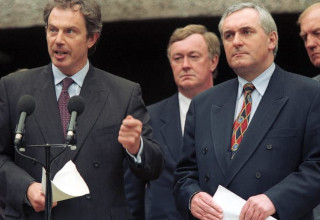
blair-ahern-stormont-castle-1999On July 14, 1999, Ulster Unionists under David Trimble reject a compromise for the creation of a power sharing government placing the Northern Ireland peace process in grave trouble. The proposals would have seen inclusive self-government introduced in Northern Ireland on Sunday, July 18, 1999.

Early in the day the government rushes legislation through the House of Commons providing for the suspension of the Executive if the Irish Republican Army (IRA) fails to decommission all its arms by May 2000 in line with a timetable, yet to be drawn up. It refuses to accept any Ulster Unionist amendments. But within 12 hours, British Prime Minister Tony Blair signals that three new amendments will be included to tighten the so-called failsafe mechanism when the bill is debated in the House of Lords in the evening.

The first amendment makes clear that decommissioning must proceed in line with a timetable to be drawn up by General John de Chastelain. The second provides for the automatic suspension of the Executive, while the third provides for the party in default to be clearly identified.

They fail to sway Trimble, who criticises The Way Forward as a hastily concocted scheme. However, he does leave the door open for further negotiations to save the agreement. “If there was a clear watertight scheme, in which there was at the outset an unequivocal commitment to change and a process that genuinely guaranteed to deliver that change, we would have to consider whether a scruple over a period of days could be justified.”

Sinn Féin is furious with party president Gerry Adams saying, “Those who may genuinely want to deal with the issue of guns are going about it in absolutely the worst and wrong way.” The party wants the assembly to be wound up immediately, and all members’ wages to be stopped. It wants the British and Irish governments to continue to implement all aspects of the agreement which are within their control. Adams is enraged by Blair’s move to amend the failsafe legislation. His party says it will consider applying for judicial review of the amended bill, believing it to compromise the International Commission on Decommissioning and unlawfully conflict with the agreement.

Blair and Taoiseach Bertie Ahern announce on the following day that the 15-month-old and ailing Good Friday Agreement will go into a review procedure involving all the political parties and be effectively parked over the summer.

Trimble, leader of the Ulster Unionists, resists intense government pressure as he refuses to back the British and Irish governments’ blueprint providing for a power-sharing executive the following week and IRA decommissioning in the summer. He repeats his party’s view that Sinn Féin can only join his cabinet once the IRA has started to hand over its weapons.

The outcome is a bitter personal setback for Blair. In a last-minute televised appeal to the Unionists not to “close the door’ on an agreement, he appears to acknowledge that they will have to try to find another way forward. “I believe in the end we will get an agreement on this. Whether we manage it by tomorrow morning, that is more difficult,” he says.

Trimble complains he had too little time to secure backing within his split party for The Way Forward, which the governments issued twelve days earlier after a week of intense negotiations at Stormont Castle. Blair’s handling of the affair is questioned.

Trimble’s problem with the legislative failsafe is that it punishes all parties for an IRA transgression of a decommissioning timetable, yet to be drawn up. It provides for the executive to be suspended, rather than carry on with Sinn Féin’s two ministerial posts allocated to other parties. The nationalist Social Democratic and Labour Party (SDLP), which could have given Trimble cover on the issue of expulsion, declines to say whether it will vote for Sinn Féin’s expulsion, which infuriates Ulster Unionists.

Negotiations to save the Good Friday Agreement have gone through four deadlines during the year. There are fears that the latest delay might lead to Sinn Féin withdrawing its declaration on IRA arms.

(Pictured: British Prime Minister Tony Blair and Taoiseach Bertie Ahern present a joint British-Irish blueprint for implementation of the Good Friday Agreement at Stormont Castle in Belfast, June 2, 1999 | Sean Gallup | Getty Images)


Leave a comment

The Ballygawley Land Mine Attack

ballygawley-land-mine-attack

The Ballygawley land mine attack is a bomb attack carried out by the Provisional Irish Republican Army (IRA) on July 13, 1983. The IRA explodes a land mine under an Ulster Defence Regiment‘s (UDR) mobile patrol at Ballygawley Road, near Dungannon, County Tyrone, Northern Ireland. Four UDR soldiers are killed in the incident.

After the 1981 Irish hunger strike, floods of recruits sign up to join the IRA. Republicans in County Tyrone are especially angry over the death of Martin Hurson who was from the small Tyrone village of Cappagh and was one of Cappagh’s most famous sons. Cappagh becomes a Republican stronghold in the 1980s. Many young men flock to join the East Tyrone Brigade to avenge Hurson’s death. Some of those who join after being radicalized by the Hunger Strike go onto become famous IRA Volunteers like Declan Arthurs and Martin McCaughey who were both small children when the conflict broke out in 1969.

Sinn Féin member Francie Molloy said the following on Hurson’s funeral and the effect his death had on the young people of Cappagh:

“There was people everywhere. The village was black with them. It was the first sign in Tyrone of thousands and thousands of people assembling to honor the remains of a native son coming home. Martin was young when he went to jail and young when died on hunger strike. His death just made young people more determined that they were going to replace him. They saw ten men dead as the British government taking people out of the struggle. I think the young people of Cappagh and surrounding areas decided there and then that they were going to replace every one of them and replace them tenfold. And that is what they did. The number of young people who joined up in response was massive.”

On July 13, 1983, four British Army (Ulster Defence Regiment) soldiers (Ronald Alexander, Thomas Harron, John Roxborough, and Oswald Neely), all Protestant members of the 6th Battalion UDR, are travelling in their mobile patrol along a road in Tyrone close to the small town of Ballygawley. IRA Volunteers from the East Tyrone Brigade plant a 500 lb. land mine along the road the UDR patrol is traveling. The IRA unit notices the UDR takes a similar route every so often and has spotted weakness in the patrol. The IRA Volunteers are watching the UDR patrol while being well hidden. Once the UDR patrol is close to the land mine the IRA Volunteers detonate the land mine by remote control killing the four UDR soldiers almost immediately. This is the highest casualty rate suffered by the UDR in a single incident during The Troubles and worst attack suffered by the security forces since 1981. The attack is carried out by an Active Service Unit (ASU) of the IRA’s East Tyrone Brigade which is one of the most active and successful Brigade areas in the IRA during the 1980s.

Within five years the IRA’s East Tyrone Brigade launches two more high-profile attacks in Ballygawley. In 1985, during the Attack on Ballygawley barracks, an IRA unit led by Patrick Joseph Kelly and Jim Lynagh attacks the Ballygawley RUC barracks, shooting dead two RUC officers who are at the front of the station. A 200 lb. bomb destroys the entire barracks and injures three more RUC officers. In 1988, the IRA kills eight British soldiers and injures twenty-eight others during the Ballygawley bus bombing. Many Republicans see this as revenge for the Loughgall ambush the year before when the Special Air Service (SAS) shot dead eight IRA Volunteers.


Leave a comment

First “Twelfth of July” Sectarian Riots in Belfast

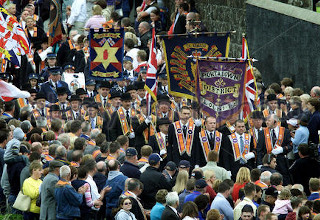
orange-order-paradeThe first recorded “Twelfth of Julysectarian riots erupt in Belfast on July 12, 1813 as clashes break out between Orange marchers and Irish nationalists. Several Orangemen open fire on a crowd in Hercules Street, killing two Protestants and wounding four other people.

The Twelfth, also called the Glorious Twelfth or Orangemen’s Day, is an Ulster Protestant celebration held on July 12. It is first held in the late 18th century in Ulster. It celebrates the Glorious Revolution (1688) and victory of Protestant King William of Orange over Catholic King James II at the Battle of the Boyne in 1690, which begins the Protestant Ascendancy in Ireland.

On and around the Twelfth, large parades are held by the Orange Order and Ulster loyalist marching bands, streets are bedecked with British flags and bunting, and large towering bonfires are lit. Today the Twelfth is mainly celebrated in Ulster, especially in Northern Ireland where it is a public holiday, but smaller celebrations are held in other parts of the world where Orange lodges have been established. The Twelfth involves thousands of participants and spectators.

In Ulster, where about half the population is from a Protestant background and half from a Catholic background, the Twelfth has been accompanied by violence since its beginning. Orange marches through Irish Catholic and Irish nationalist neighbourhoods are usually met with opposition from residents, who see the Orange Order and its marches as sectarian, triumphalist and supremacist. This sometimes leads to violence.

The Order is also politically a unionist/loyalist organisation. Violence related to the Twelfth in Northern Ireland escalates during the 30-year ethno-political conflict known as the Troubles. The Drumcree conflict is the most well-known dispute involving Orange marches.

Attempts have recently been made to downplay the political aspects of the marches and present the Twelfth as a cultural, family-friendly event at which tourists are welcome. The majority of events pass off peacefully, however, there is a small contingency who occasionally stir up trouble.

When July 12 falls on a Sunday, as it does this year, the parades are held on the following day instead.


Leave a comment

British Troops Shoot Derry Rioters

File written by Adobe Photoshop? 4.0

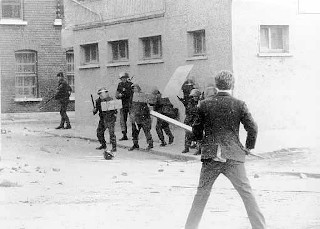
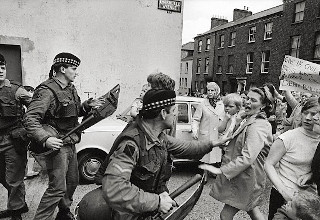
During street disturbances on July 8, 1971, British soldiers shoot dead two Catholic civilians in Derry, County Londonderry, Northern Ireland. Some of the worst violence in the town for three years flares up when a crowd of 200 gather in Lecky Street at the news of the shootings. As a result, the Social Democratic and Labour Party (SDLP) withdraws from Stormont in protest.

British troops are the target of sporadic rioting in the Republican Bogside area of Derry in the four days leading up to the rioting.

At about 1:00 AM on the morning of July 8, 1971, in the Bogside area of Derry, Seamus Cusack, 28, a local man who is a welder and former boxer, is shot in the upper part of the leg by a soldier of the Crown Forces. He dies about forty minutes later in Letterkenny Hospital in the Republic of Ireland.

Cusack’s death gives rise to further disturbances in the city. Troops open fire, initially with rubber bullets and CS gas, but they fail to disperse the crowd. The rioters retaliate by throwing three nail bombs. The army returns fire. During this exchange, George Desmond Beattie, 19, is shot in the stomach by a soldier and dies instantly at about 3:15 PM. Five soldiers are reportedly injured during the skirmishes.

There is a lull in the violence after Beattie is shot and a group of factory girls march in silence through the area carrying black bags.

Army marksmen claim one of the men they shot was armed with a rifle and another was about to throw a petrol or nail bomb. It is unclear which incident Cusack is involved in, but an inquest hears that he could have been saved if he had gone to a local hospital instead of one 20 miles south of the border in County Donegal. Apparently, his rescuers fear they would be arrested by police if he had been taken to the local hospital.

In the evening the Ministry of Defence announces that an additional 500 men from the First King’s Own Scottish Borderers are to be sent to Northern Ireland the following day. This brings to 1,400 the total number of men drafted to Northern Ireland over the previous ten days in preparation for the upcoming traditional The Twelfth celebrations on July 12.


Leave a comment

The Drumcree Conflict of 1998

orangemen-drumcree-march

The Drumcree conflict or Drumcree standoff is a dispute over yearly Orange Order parades in the town of Portadown, County Armagh, Northern Ireland. The town is mainly Protestant and hosts numerous Protestant/loyalists marches each summer but has a significant Catholic minority. The Orange Order, a Protestant unionist organization, insists that it should be allowed to march its traditional route to and from Drumcree Church on the Sunday before The Twelfth. However, most of the route is through the mainly Catholic/Irish nationalist section of town. The residents, who see the march as sectarian, triumphalist and supremacist, seek to ban it from their area. The Orangemen see this as an attack on their traditions as they have marched the route since 1807, when the area was mostly farmland.

In 1995 and 1996, residents succeed in stopping the march. This leads to a standoff at Drumcree between the security forces and thousands of Orangemen/loyalists. Following a wave of loyalist violence, police allow the march through. In 1997, security forces lock down the Catholic area and let the march through, citing loyalist threats to kill Catholics if they are stopped. This sparks widespread protests and violence by Irish nationalists. From 1998 onward, the march is banned from Garvaghy Road and the army seals off the Catholic area with large steel, concrete and barbed wire barricades. Each year there is a major standoff at Drumcree and widespread loyalist violence. Since 2001 things have been relatively calm but moves to get the two sides into face-to-face talks have failed.

Early in 1998 the Public Processions (Northern Ireland) Act 1998 is passed, establishing the Parades Commission. The Commission is responsible for deciding what route contentious marches should take. On June 29, 1998, the Parades Commission decides to ban the march from Garvaghy Road.

On Friday, July 3, about 1,000 soldiers and 1,000 police are deployed in Portadown. The soldiers build large barricades made of steel, concrete and barbed wire across all roads leading into the nationalist area. In the fields between Drumcree Church and the nationalist area they dig a trench, fourteen feet wide, which is then lined with rows of barbed wire. Soldiers also occupy the Catholic Drumcree College, St. John the Baptist Primary School and some properties near the barricades.

On Sunday, July 5, the Orangemen march to Drumcree Church and state that they will remain there until they are allowed to proceed. About 10,000 Orangemen and loyalists arrive at Drumcree from across Northern Ireland. A loyalist group calling itself “Portadown Action Command” issues a statement which reads, “As from midnight on Friday 10 July 1998, any driver of any vehicle supplying any goods of any kind to the Gavaghy Road will be summarily executed.”

Over the next ten days, there are loyalist protests and violence across Northern Ireland in response to the ban. Loyalists block roads and attack the security forces as well as Catholic homes, businesses, schools and churches. On July 7, the mainly Catholic village of Dunloy is “besieged” by over 1,000 Orangemen. The County Antrim Grand Lodge says that its members have “taken up positions” and “held” the village. On July 8, eight blast bombs are thrown at Catholic homes in the Collingwood area of Lurgan. There are also sustained attacks on the security forces at Drumcree and attempts to break through the blockade. On July 9, the security forces at Drumcree are attacked with gunfire and blast bombs. They respond with plastic bullets. The police recorded 2,561 “public order incidents” throughout Northern Ireland.

On Sunday, July 12, brothers Jason (aged 8), Mark (aged 9) and Richard Quinn (aged 10) are burned to death when their home is petrol bombed by loyalists. The boys’ mother is a Catholic and their home is in a mainly-Protestant section of Ballymoney. Following the murders, William Bingham, County Grand Chaplain of Armagh and member of the Orange Order negotiating team, says that “walking down the Garvaghy Road would be a hollow victory, because it would be in the shadow of three coffins of little boys who wouldn’t even know what the Orange Order is about.” He says that the Order has lost control of the situation and that “no road is worth a life.” However, he later apologizes for implying that the Order is responsible for the deaths. The murders provoke widespread anger and calls for the Order to end its protest at Drumcree. Although the number of protesters at Drumcree drops considerably, the Portadown lodges vote unanimously to continue their standoff.

On Wednesday, July 15, the police begin a search operation in the fields at Drumcree. A number of loyalist weapons are found, including a homemade machine gun, spent and live ammunition, explosive devices, and two crossbows with more than a dozen homemade explosive arrows.


Leave a comment

1973 Northern Ireland Assembly Election

politics-of-northern-ireland

Elections to the Northern Ireland Assembly take place on June 28, 1973, following the publication of the British government‘s white paper Northern Ireland Constitutional Proposals which proposes a 78-member Northern Ireland Assembly, elected by proportional representation. The election leads to power-sharing between unionists and nationalists in Northern Ireland for the first time.

From June 7, 1921, until March 30, 1972, the devolved legislature for Northern Ireland is the Parliament of Northern Ireland, which always has an Ulster Unionist Party (UUP) majority and always elects a UUP government. The Parliament is suspended on March 30, 1972.

Shortly after this first parliament is abolished, attempts begin to restore devolution on a new basis that will see power shared between Irish nationalists and unionists. To this end a new parliament, the Northern Ireland Assembly, is established by the Government of the United Kingdom on May 3, 1973.

Following the June 28 elections, the Northern Ireland Constitution Act 1973, which receives the Royal Assent on July 18, 1973, abolishes the suspended Parliament of Northern Ireland and the post of Governor and makes provision for a devolved administration consisting of an Executive chosen by the Assembly.

One hundred eight members are elected by single transferable vote from Northern Ireland’s eighteen Westminster constituencies, with five to eight seats for each depending on its population. The Assembly meets for the first time on July 31, 1973.

A cross-community coalition of the Ulster Unionist Party under Brian Faulkner, the Social Democratic and Labour Party (SDLP) and the Alliance Party of Northern Ireland is agreed in November 1973 and, following the Sunningdale Agreement, a power-sharing Executive is established from January 1, 1974.

After opposition from within the Ulster Unionist Party and the Ulster Workers’ Council strike over the proposal of an all-Ireland council, the Executive and Assembly collapses on May 28, 1974, when Brian Faulkner resigns as Chief Executive. The Northern Ireland Assembly is abolished by the Northern Ireland Act 1974.

In 1982 another Northern Ireland Assembly is established at Stormont, initially as a body to scrutinise the actions of the Secretary of State, the British minister with responsibility for Northern Ireland. It receives little support from Irish nationalists and is officially dissolved in 1986.

The Northern Ireland Act 1998 formally establishes the Assembly in law, in accordance with the Good Friday Agreement. The first election of Members of the Northern Ireland Assembly is on June 25, 1998, and it first meets on July 1, 1998. However, it only exists in “shadow” form until December 2, 1999, when full powers are devolved to the Assembly. Since then, the Assembly has operated intermittently and has been suspended on five occasions.


Leave a comment

Rioting Erupts In Belfast & Derry

belfast-rioting-1970

Intense riots between Protestants and Roman Catholics erupt in Derry and Belfast on June 27, 1970. During the evening, loyalist paramilitaries make incursions into republican areas of Belfast. This leads to a prolonged gun battle between republicans and loyalists. The rioting in both Belfast and Derry takes place despite the presence of more than 8,000 British soldiers, backed up by armored vehicles and helicopters.

The rioting follows the June 26 jailing of Bernadette Devlin, the 23‐year‐old Roman Catholic leader, who had recently been reelected to Parliament in London. She had been convicted of riotous behavior during violence in Derry in August 1969 and sentenced to six months in prison.

The rioting in Belfast begins after Catholic youths hurl stones and disrupt a parade by the militantly Protestant Orange Order. About 100 persons are injured badly enough to be treated in hospitals. A bakery and a butcher shop in a shopping center are set afire and a police station is wrecked with iron bars and clubs. The scene of the rioting is at the intersection of Mayo Street and Springfield Road in a mixed Protestant‐Catholic area.

Armed British soldiers, in visors and helmets and carrying riot shields, separate ugly, shouting mobs of Catholics and Protestants. The troops use tear gas in an effort to break up the crowd and at one point send 1,000 people, including women and children, fleeing with tears streaming down their faces.

There is civilian sniping and firing by British troops in two riot areas — the Springfield Road area and the Crumlin Road area – where rival crowds from segregated slum streets clash later in the afternoon.

At night British soldiers seal off the riot areas to all but military vehicles. Armored cars with machine guns ready stand in the streets, which are littered with glass and stones. Hundreds of soldiers in full battle dress stand against the seedy red‐brick shops and houses.

However, the crowds continue to gather. Buses are set afire, and late at night the army uses tear gas again to drive the mobs away. As rioting erupts in other parts of Belfast, 4,000 British soldiers are said to have been sent into the riot areas. The police are harassed by a half dozen fires around the city. Some of the fires are started with battery devices according to the police.

In Derry, Catholic youths attack soldiers and policemen with stones, bottles and gasoline bombs. The youths begin re‐erecting the barricades that had shielded the Catholic Bogside slum area during rioting the previous year. Ninety-two soldiers are injured and a paint shop near Bogside is set ablaze after looting by children who appear to be no more that 11 or 12 years old.

The wave of agitation begins in October 1968, when a largely Catholic civil rights movement takes to the streets to demand an end to anti‐Catholic discrimination in voting rights, jobs and housing. The Unionist Government in Belfast, which considers itself aligned with the Conservative Party in London, responds reluctantly to the street violence. However, under intense prodding by the Labor Government, it enacts many of the demanded reforms.

However, a Protestant backlash ensues, encouraged by the fiery evangelical preacher, the Rev. Ian Paisley. Paisley fans the latent fear that Northern Ireland‘s Catholics seek to unite Ireland into a Catholic state under Dublin. In the view of many observers, the Protestants have never shared power nor prestige with the Catholic minority, while the Catholics have taken an ambiguous view on whether they wanted to be British or Irish.

(From: “New Rioting Flares in Northern Ireland; 4 Dead and 100 Hurt” by John M. Lee, The New York Times, June 28, 1970)