seamus dubhghaill

Promoting Irish Culture and History from Little Rock, Arkansas, USA


Leave a comment

RAF Chinook Helicopter Crash on Mull of Kintyre

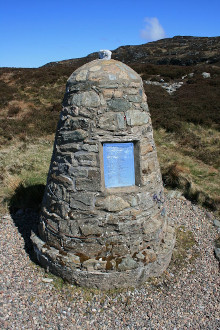
1994-chinook-crash-memorialA Chinook helicopter of the Royal Air Force (RAF) crashes on the Mull of Kintyre, Scotland, in foggy conditions on June 2, 1994. The crash results in the deaths of all twenty-five passengers and four crew on board. Among the passengers are almost all the United Kingdom‘s senior Northern Ireland intelligence experts who are travelling from Belfast to a security conference in Inverness. The accident is the RAF’s worst peacetime disaster.

Earlier in the day, the helicopter and crew carry out a trooping flight, as it is considered to be unsafe for British troops to move around in certain parts of Northern Ireland using surface transport at the time due to the threat posed by Provisional Irish Republican Army attacks. This mission is safely accomplished and they return to Joint Helicopter Command Flying Station Aldergrove at 3:20 PM. The helicopter takes off for Inverness at 5:42 PM. Weather en route is forecast to be clear except in the Mull of Kintyre area. The crew makes contact with military air traffic control (ATC) in Scotland at 5:55 PM.

Around 6:00 PM, the helicopter flies into a hillside in dense fog. The pilots are Flight Lieutenants Jonathan Tapper, 28, and Richard Cook, 30, both United Kingdom Special Forces pilots. There are two other crew. The helicopter is carrying 25 British intelligence experts from MI5, the Royal Ulster Constabulary and the British Army, from RAF Aldergrove (outside Belfast, Northern Ireland) to attend a conference at Fort George, near Inverness, Scotland. At the time of the accident Air Chief Marshal Sir William Wratten calls it “the largest peacetime tragedy the RAF had suffered.”

In the immediate aftermath of the accident, one commentator states that the loss of so many top level Northern Ireland intelligence officers in one stroke is a huge blow to the John Major government, “temporarily confounding” its campaign against the IRA. That the crash kills so many British intelligence experts, without any witnesses in the foggy conditions, leads to considerable speculation and conspiracy theories being devised on the issue on the potential of a cover-up having been performed. Among these are accusations that wake turbulence from a top-secret hypersonic U.S. aircraft had been responsible for the crash, while another postulates that it is a deliberate assassination of the intelligence operatives on board in connection with the then on-going Northern Ireland peace process.

In 1995, an RAF board of inquiry rules that it is impossible to establish the exact cause of the accident. This ruling is subsequently overturned by two senior reviewing officers, who state the pilots were guilty of gross negligence for flying too fast and too low in thick fog. This finding proves to be controversial, especially in light of irregularities and technical issues surrounding the then-new Chinook HC.2 variant which were uncovered. A Parliamentary inquiry conducted in 2001 finds the previous verdict of gross negligence on the part of the crew to be “unjustified.” In 2011, an independent review of the crash clears the crew of negligence.

(Pictured: Memorial on Mull of Kintyre, Scotland to the crash victims of the 1994 RAF Chinook crash)


Leave a comment

Founding of the Royal Ulster Constabulary

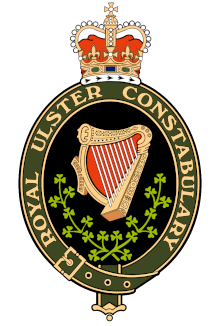
royal-ulster-constabulary-badgeThe Royal Ulster Constabulary (RUC), the police force in Northern Ireland from 1922 to 2001, is founded on June 1, 1922 as a successor to the Royal Irish Constabulary (RIC).

At its peak the force has around 8,500 officers with a further 4,500 who are members of the RUC Reserve. During the Troubles (late 1960s-1998), 319 members of the RUC are killed and almost 9,000 injured in paramilitary assassinations or attacks, mostly by the Provisional Irish Republican Army, which by 1983 makes the RUC the most dangerous police force in the world in which to serve. During the same period, the RUC kills 55 people, 28 of whom are civilians.

The RUC is superseded by the Police Service of Northern Ireland (PSNI) in 2001. The former police force is renamed and reformed, as is provided for by the final version of the Police (Northern Ireland) Act 2000. The RUC has been accused by republicans and Irish nationalists of one-sided policing and discrimination, as well as collusion with loyalist paramilitaries. Conversely, it is praised as one of the most professional policing operations in the world by British security forces.

Allegations regarding collusion prompt several inquiries, the most recent of which is published by Police Ombudsman For Northern Ireland Nuala O’Loan on January 22, 2007. The report identifies police, Criminal Investigation Department (CID) and Special Branch collusion with loyalist terrorists under 31 separate headings, in her report on the murder of Raymond McCord, Jr. and other matters, but no member of the RUC has been charged or convicted of any criminal acts as a result of these inquiries. Ombudsman O’Loan states in her conclusions that there is no reason to believe the findings of the investigation were isolated incidents.


1 Comment

Official Irish Republican Army Declares Ceasefire

official-ira-ceasefire-1972The Official Irish Republican Army (IRA) announces a ceasefire on May 29, 1972. This marks the end of the Official IRA’s paramilitary campaign. The organization, however, reserves the right of self-defence against attacks by the British Army and sectarian groups. The Provisional Irish Republican Army dismisses the truce as having “little effect” on the situation.

Secretary of State for Northern Ireland, William Whitelaw, welcomes the move and a spokesperson says it is “a step in the right direction.”

A statement is read out from Dublin after the previous night’s meeting of the executive of the Northern Republican Clubs, a political movement allied to the IRA. It states, “The overwhelming desire of the great majority of all the people of the north is for an end to military actions by all sides.”

It goes on to say that a suspension of activities will be a chance to prevent all-out civil war in Ulster. The group insists it will continue a campaign of civil disobedience and the political struggle until its demands are met, namely:

The Royal Ulster Constabulary (RUC) and British Army are the first to benefit from such a ceasefire as they have been the primary targets of the IRA. Residents of Belfast in particular have been worn down by the four-year campaign of violence and this news is very welcome there.

Father Hugh O’Neill, who leads a Londonderry peace movement, says, “Please God, everyone will now sit down and begin to talk.”


Leave a comment

Birth of Singer Jimmy McShane

jimmy-mcshane

James Harry McShane, Irish singer best known as the front man of Italian band Baltimora that had the hit song “Tarzan Boy,” is born in Derry, County Londonderry, Northern Ireland on May 23, 1957.

McShane learns at a young age to play bass and guitar. As a teenager, he is allegedly shunned by his family after they learn of his homosexuality. Later as a young man in the late 1970s, he leaves Northern Ireland to study at a stage school in London, where he learns to dance, sing and recite.

Hired as a stage dancer and backing singer, McShane soon goes around Europe with Dee D. Jackson and her band. During a visit to Italy with the band, he is attracted to the country’s underground dance scene, which leads to him settling in Milan in 1984. He tells Dick Clark on American Bandstand in 1986 that he fell in love with Italy from that moment. He also learns the Italian language.

McShane makes his debut playing in small clubs in his hometown and is presented to various audiences, without success. In view of his low artistic success, he decides to work as an Emergency Medical Technician (EMT) for the Red Cross until he meets Italian record producer and keyboardist Maurizio Bassi, with whom he creates Baltimora. The act finds success with its most popular single, “Tarzan Boy”, released in 1985.

In the United States, McShane is overwhelmed with the success of “Tarzan Boy”. Some sources state lead vocals are performed by Maurizio Bassi, the group’s keyboardist, with McShane actually providing the backing vocals. This still remains uncertain, and McShane lip synchs while appearing in the “Tarzan Boy” music video, and not Bassi. Both the music and the lyrics of Baltimora are written mostly by Bassi and Naimy Hackett, though McShane writes the lyrics to some of their songs, such as the single “Survivor in Love.”

After the release of “Survivor in Love,” with no label support for a follow-up album and due to its poor success, Bassi decides it is time to move on to other projects and Baltimora disbands.

The single “Tarzan Boy” bounces back into the Billboard Hot 100 chart in March 1993 as a remix, climbing to No. 51, at the time of its appearance in a Listerine commercial. The song is also featured in the films Teenage Mutant Ninja Turtles III (1993), Beverly Hills Ninja (1997) and is then referenced in A Million Ways to Die in the West (2014).

McShane is diagnosed with AIDS in Milan in 1994. A few months later he returns to Northern Ireland to spend his final year, and dies in his native Derry on March 29, 1995 at the age of 37. A family spokesman issues the following statement after his death: “He faced his illness with courage and died with great dignity.” In the centre of Derry, a commemorative plaque is bestowed upon the grave of McShane and his father, who had died three years prior.


Leave a comment

Bill Clinton Begins Four Day Irish Visit

clinton-guildhall-square

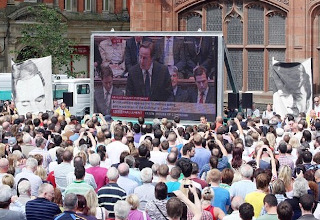
Former U.S. president Bill Clinton begins a four-day visit to the Republic of Ireland and Northern Ireland on May 20, 2001 to try to advance the peace process. He spends time both north and south of the border, fulfilling engagements in Belfast, Derry, Enniskillen and Dublin.

Clinton’s goal is to use his influence to try to enhance the electoral fortunes of the parties that support the Good Friday Agreement, particularly David Trimble‘s Ulster Unionist Party, who are under pressure from Ian Paisley‘s anti-agreement Democratic Unionist Party (DUP).

Clinton arrives at Farranfore Airport, County Kerry, before heading to a round of golf at Ballybunion Golf Club with the former Irish deputy prime minister and Labour Party leader Dick Spring. He spends the night at Dromoland Castle, County Clare, before two days of public engagements in Dublin.

Trimble has vowed to quit as head of the Stormont Executive, where his party shares power with Sinn Féin, if the Irish Republican Party (IRA) has not started to get rid of its guns by July 1. Paisley, however, has accused Trimble and British Prime Minister Tony Blair of breaking their promises to the people of Northern Ireland by allowing into government a party linked to a terrorist group, without prior arms decommissioning.

While Clinton is no longer the most powerful man in the world, his charisma and his past efforts to keep the peace process moving are still appreciated by many. He receives Northern Ireland political leaders countless times at the White House and gives support and encouragement by phone during difficult periods of the peace talks.

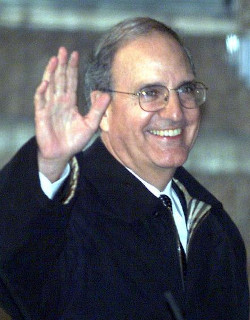
Clinton delivers a lecture at Trinity College Dublin and attends a gala for peace and reconciliation at Dublin Castle, before travelling to Derry and then on to Belfast, where he receives an honorary degree from the former peace talks chairman George Mitchell, now chancellor of Queen’s University Belfast.

The leader of the Social Democratic and Labour Party (SDLP), John Hume, who welcomes Clinton to Derry, says the former president has done a great deal of good for all the people of Ireland. But the Democratic Unionist Party (DUP) deputy leader, Peter Robinson, claims that Clinton and Blair could have a negative effect on Trimble’s campaign. “As a unionist, I wouldn’t like to be sitting next to either of them just before an election,” he said. “Blair’s name is associated with the now-broken pledges he wrote on a board here just before the [Good Friday agreement] referendum, so for him to come over and moralise now won’t do much good. And Clinton is so disgraced and powerless that, while he might prop up the nationalist SDLP and Sinn Féin vote, he’ll have no impact on unionists voters.”

(Pictured: Bill Clinton and SDLP leader John Hume at public address at Guildhall Square in Derry. Sinn Féin leader Gerry Adams and Chelsea Clinton are in the second row.)


Leave a comment

The Dublin and Monaghan Bombings

dublin-and-monaghan-bombings

The Dublin and Monaghan bombings of May 17, 1974 are a series of co-ordinated bombings in Dublin and Monaghan, Ireland. Three car bombs explode in Dublin at Parnell Street, Talbot Street and South Leinster Street during the evening rush hour and a fourth car bomb explodes in Monaghan, just south of the border with Northern Ireland, almost ninety minutes later. The bombs kill 33 civilians and a full-term unborn child, and injure almost 300. The bombings are the deadliest attack of the conflict known as the Troubles, and the deadliest attack in the Republic of Ireland‘s history. Most of the victims are young women, although the ages of the dead range from pre-born up to 80 years.

The Ulster Volunteer Force (UVF), an Ulster loyalist paramilitary group from Northern Ireland, claims responsibility for the bombings in 1993. It has launched a number of attacks in the Republic since 1969. There are allegations taken seriously by inquiries that elements of the British state security forces help the UVF carry out the bombings, including members of the Glenanne gang. Some of these allegations have come from former members of the security forces. The Irish parliament‘s Joint Committee on Justices calls the attacks an act of international terrorism involving British state forces. The month before the bombings, the British government lifts the UVF’s status as a proscribed organisation.

The bombings happen during the Ulster Workers’ Council strike. This is a general strike called by hardline loyalists and unionists in Northern Ireland who oppose the Sunningdale Agreement. Specifically, they oppose the sharing of political power with Irish nationalists and the proposed role for the Republic in the governance of Northern Ireland. The Republic’s government had helped bring about the Agreement. The strike brings down the Agreement and the Northern Ireland Assembly on May 28.

No one has ever been charged with the bombings. A campaign by the victims’ families leads to an Irish government inquiry under Justice Henry Barron. His 2003 report criticises the Garda Síochána‘s investigation and says the investigators stopped their work prematurely. It also criticises the Fine Gael/Labour Party government of the time for its inaction and lack of interest in the bombings. The report says it is likely that British security force personnel or MI5 intelligence is involved but has insufficient evidence of higher-level involvement. However, the inquiry is hindered by the British government’s refusal to release key documents. The victims’ families and others are continuing to campaign to this day for the British government to release these documents.

(Pictured: Some of the damage caused by the second car bomb on Talbot Street, Dublin)


Leave a comment

The Battle at Springmartin

kelly-bar-bombing

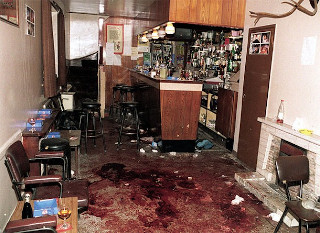
The Battle at Springmartin, a series of gun battles in Belfast, Northern Ireland, begins on May 13, 1972, and continues into the following day. It involves the British Army, the Provisional Irish Republican Army (IRA), and the Ulster Volunteer Force (UVF).

The night before the bombing, snipers from the UVF West Belfast Brigade take up position along the second floor of an abandoned row of flats at the edge of the Ulster Protestant Springmartin estate. The flats overlooked the Catholic Ballymurphy estate. Rifles, mostly World War II stock, are ferried to the area from dumps in the Shankill Road.

The violence begins shortly after 5:00 PM on Saturday, May 13, 1972, when a car bomb, planted by Ulster loyalists, explodes without warning outside the crowded Kelly’s Bar, at the junction of the Springfield Road and Whiterock Road. The pub is in a mainly Irish Catholic and nationalist area of Ballymurphy and most of its customers are from the area. At the time of the blast, the pub is crowded with men watching an association football match between England and West Germany on colour television. Following the blast, the UVF snipers open fire on the survivors. This begins the worst fighting in Northern Ireland since the suspension of the Parliament of Northern Ireland and the imposition of direct rule from London.

Sixty-three people are injured, eight of them seriously. John Moran, age 19, who had been working at Kelly’s as a part-time barman, dies of his injuries on May 23.

For the rest of the night and throughout the next day, local IRA units fight gun battles with both the UVF and British Army. Most of the fighting takes place along the interface between the Catholic Ballymurphy and Ulster Protestant Springmartin housing estates, and the British Army base that sits between them. Five civilians (four Catholics, one Protestant), a British soldier and a member of the IRA Youth Section are killed in the violence. Four of the dead are teenagers.

At first, the British Army claims that the blast had been an “accident” caused by a Provisional IRA bomb. The Secretary of State for Northern Ireland, William Whitelaw, tells the House of Commons on May 18 that the blast is caused by a Provisional IRA bomb that exploded prematurely. However, locals suspect that the loyalist Ulster Defence Association (UDA) had planted the bomb. Republican sources say that IRA volunteers would not risk storing such a large number of explosives in such a crowded pub. It later emerges that the bomb had indeed been planted by loyalists.

A memorial plaque on the site of the former pub names three members of staff who lost their lives as a result of the bomb and the gun battles that followed. It reads:

This plaque marks the spot
where Kelly’s Bar once stood
and here on 13th May 1972
a no warning Loyalist car bomb exploded.
As a result, 66 people were injured
and three innocent members of staff
of Kelly’s Bar lost their lives.
They were:
Tommy McIlroy (died 13th May 1972)
John Moran (died from his injuries 23rd May 1972)
Gerard Clarke (died from his injuries 6th September 1989)
Ar dheis Dé go raibh a namacha”


Leave a comment

Birth of Norman Whiteside, Northern Ireland Footballer

norman-whiteside

Norman Whiteside, former Northern Ireland international footballer who played in two World Cups, is born in Belfast, Northern Ireland on May 7, 1965. He plays both as a midfielder and as a striker.

Whiteside grows up on Shankill Road, and because of his aggressive, physical playing style he is later nicknamed the “Shankill Skinhead” by Manchester United supporters. The family later moves to 10 Danube Street. He remains relatively unscathed by The Troubles as his Protestant parents keep a firm watch on their children to ensure that they do not stray far from home and that none of them become involved with Ulster loyalism. At around seven years of age, he joins the Boys’ Brigade, and quickly shows his natural talent for football, scoring ten goals in a game against boys almost twice his age. He is educated at Cairnmartin High School and becomes famous in the Shankill area as a footballing prodigy by the age of eleven.

Whiteside is said to have been discovered by Ipswich Town scout Jim Rodgers, who is told by manager Bobby Robson to wait until Whiteside grows older. Instead, it is Manchester United’s 80-year-old Ulster scout Bob Bishop, who previously unearthed Belfast-born George Best and Sammy McIlroy for the club, who first offers him a trial at an English club. He finds that he has been offered schoolboy terms at the club during a school trip to the United States, on which he and his classmates meet President Jimmy Carter in the Oval Office, a rare and extraordinary occasion for children from a disadvantaged background.

Whiteside signs professional forms in 1982 at the age of 17 and quickly becomes a key member of the Manchester United club. He scores 68 goals in 278 league and cup appearances for the club over the next seven years, picking up two FA Cup winners medals in 1983 and 1985, as well as playing in the 1982 FA Youth Cup final, the 1983 League Cup final, and the FA Charity Shield in 1983.

Whiteside remains with United until July 1989, when he is sold to Everton F.C. for £600,000. However intense running sessions run by coach Mick Lyons take their toll on his right knee, and on September 20, 1990, he takes a knock in a practice match, which requires him to have another operation on his right knee. After the return of Howard Kendall as manager in November 1990, he manages to appear in a few reserve team games, but this only delays the inevitable, and he is forced to retire from the game at the age of 26 in June 1991.

Upon retirement, Whiteside studies to become a podiatrist, graduating with a degree from the University of Salford, and serves Northwich Victoria F.C. as their assistant manager/physio from October 1991 until March 1992. He quits the role as he does not enjoy the amount of time spent travelling between games. He instead became an after-dinner speaker and also works for the Professional Footballers’ Association, while taking a postgraduate course at Manchester Metropolitan University. He later takes up private practice as a podiatrist in Manchester. Since 1994, he has also worked at the corporate hospitality department at Old Trafford. In 2003, he releases a book entitled My Memories of Manchester United. With the help of writer Rob Bagchi, he releases his autobiography entitled Determined in August 2007, published by Headline Publishing Group, and with a foreword by actor James Nesbitt.

Whiteside holds records as the youngest player to take part in a World Cup, the youngest player to score in a League Cup and FA Cup final, and the youngest player to score a senior goal for Manchester United. Winning 38 caps for Northern Ireland, he plays at the 1982 and 1986 World Cups and also helps his country to win the last ever British Home Championship in 1983–1984.


Leave a comment

Death of IRA Blanket Protester Kieran Nugent

kieran-nugent

Kieran Nugent, volunteer in the Provisional Irish Republican Army, dies from a heart attack on May 4, 2000. He is best known for being the first person to start the blanket protest against the British Government’s treatment of republican prisoners.

Born in 1958, Nugent’s adolescence comes at a time when Northern Ireland is exploding into turmoil. On March 20, 1973, at the age of 15, he is standing with a friend on the corner of Merrion Street and Grosvenor Road when a car pulls up beside them and one of the occupants asks them for directions. Another occupant of the vehicle then opens fire with a submachine gun. Nugent is seriously wounded after being shot eight times in the chest, arms and back by the Ulster loyalists in the car. His friend, Bernard McErlean, aged 16, is killed.

At some point afterwards, Nugent joins the Provisional IRA. At the age of sixteen he is arrested by the British Army and spends five months on remand in Crumlin Road Gaol. When he is eventually tried, the case against him is withdrawn and he is released. He becomes an active volunteer until his arrest and internment, without trial, on February 9, 1975.

Nugent spends nine months in Cage 4 at the Long Kesh Detention Centre until November 12, 1975. He is arrested and imprisoned again on May 12, 1976, following the hijacking of a bus. On September 14, 1976, he is sentenced to three years and becomes the first Republican prisoner convicted since the withdrawal of Special Category Status for those convicted through juryless courts, due to the new British policy of ‘criminalisation’ introduced that March. Among other things, this change in policy means convicted paramilitaries can no longer wear their own clothes. Viewing himself as a political prisoner and not a criminal, he refuses to wear the uniform saying the prison guards would have to “…nail it to my back.” This begins the blanket protest.

Nugent is soon joined by Jackie McMullan, the next prisoner to don the blanket, followed by six more Irish republican prisoners from the Beechmount area of Belfast. By Christmas 1976 the number of participants has risen to over forty prisoners. Most incoming republican prisoners emulate Nugent, and this starts five years of prison protests in pursuit of political status, which culminates in the 1981 Irish hunger strike and the death of eleven, including seven IRA and three Irish National Liberation Army prisoners.

Nugent, the father of four, is found dead of a heart attack at his home in Anderstown, Belfast on May 4, 2000.


2 Comments

Resignation of John Miller Andrews, 2nd Prime Minister of Northern Ireland

john-miller-andrews

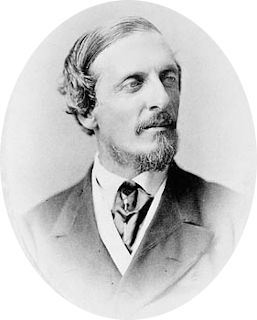
John Miller Andrews, the second Prime Minister of Northern Ireland, resigns on April 28, 1943 and is succeeded by Sir Basil Brooke, later Lord Brookeborough.

Andrews is born in Comber, County Down, on July 17, 1871, the eldest child in the family of four sons and one daughter of Thomas Andrews, flax spinner, and his wife Eliza Pirrie, a sister of William Pirrie, 1st Viscount Pirrie, chairman of Harland & Wolff. He is named after his maternal great-uncle, John Miller of Comber (1795–1883). As a young man, with his parents and family, he is a committed and active member of the Non-subscribing Presbyterian Church of Ireland. He regularly attends Sunday worship in the church built on land donated by his great-grandfather James Andrews in his home town Comber.

Andrews is educated at the Royal Belfast Academical Institution. In business, he is a landowner, a director of his family linen-bleaching company and of the Belfast Ropeworks. His younger brother, Thomas Andrews, who dies in the 1912 sinking of the RMS Titanic, is managing director of the Harland and Wolff shipyard in Belfast. Another brother, Sir James Andrews, 1st Baronet, is Lord Chief Justice of Northern Ireland.

In 1902 Andrews marries Jessie Ormrod, eldest daughter of Bolton stockbroker Joseph Ormrod at Rivington Unitarian Chapel, Rivington, near Chorley, Lancashire, England. They have one son and two daughters. His younger brother, Sir James, marries Jessie’s sister.

Andrews is elected as a member of parliament in the House of Commons of Northern Ireland, sitting from 1921 until 1953 (for Down from 1921–1929 and for Mid Down from 1929–1953). He is a founder member of the Ulster Unionist Labour Association, which he chairs, and is Minister of Labour from 1921 to 1937. He is Minister of Finance from 1937 to 1940, succeeding to the position on the death of Hugh MacDowell Pollock. On the death of James Craig, 1st Viscount Craigavon, in 1940, he becomes leader of the Ulster Unionist Party (UUP) and the second Prime Minister of Northern Ireland.

In April 1943 backbench dissent forces him from office. He is replaced as Prime Minister by Sir Basil Brooke. Andrews remains, however, the recognised leader of the UUP for three more years. Five years later he becomes the Grand Master of the Orange Order.  Throughout his life he is deeply involved in the Orange Order. He holds the positions of Grand Master of County Down from 1941 and Grand Master of Ireland (1948–1954). In 1949 he is appointed Imperial Grand Master of the Grand Orange Council of the World.

From 1949, he is the last parliamentary survivor of the original 1921 Northern Ireland Parliament, and as such is recognised as the Father of the House. He is the only Prime Minister of Northern Ireland not to have been granted a peerage. His predecessor and successor received hereditary viscountcies, and later prime ministers are granted life peerages.

Andrews serves on the Comber Congregational Committee from 1896 until his death, holding the position of Chairman from 1935 onward. He dies in Comber on August 5, 1956 and is buried in the small graveyard adjoining the Non-subscribing Presbyterian Church of Ireland.