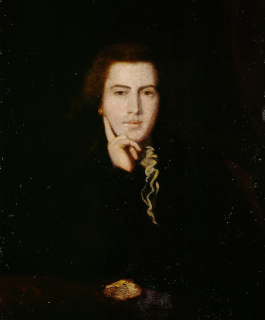
Hand, the son of John Hand, is baptised in Shinrone. Among his immediate neighbours are the Kearney family, ancestors of United States PresidentBarack Obama. He is a descendant of either the families of Mag Fhlaithimh (of south Ulaidh and Mide) or Ó Flaithimhín (of the Síol Muireadaigh) who, through mistranslation became Lavin or Hand.
In 1774, Hand moves to Lancaster, Pennsylvania, where he practices medicine. On March 13, 1775, he marries Catherine Ewing. Lancaster is the region of some of the earliest Irish and Scotch-Irish settlements in Pennsylvania. As a people, they are well known for their anti-English and revolutionary convictions. He is active in forming the Lancaster CountyAssociators, a colonial militia. He is a 32nd degree Freemason, belonging to the Montgomery Military Lodge number 14.
Hand enters the Continental Army in 1775 as a lieutenant colonel in the 1st Pennsylvania Regiment under Colonel William Thompson. He is promoted to colonel in 1776 and placed in command of the 1st Continental, then designated the 1st Pennsylvania. Promoted to brigadier general in March 1777, he serves as the commander of Fort Pitt, fighting British loyalists and their Indian allies. He is recalled, after over two years at Fort Pitt, to serve as a brigade commander in Major GeneralLa Fayette‘s division.
In 1778, Hand attacks the Lenape, killing Captain Pipe‘s mother, brother, and a few of his children during a military campaign. Failing to distinguish among the Native American groups, he had attacked the neutral Lenape while trying to reduce the Indian threat to settlers in the Ohio Country, because other tribes, such as the Shawnee, had allied with the British.
After a few months, he is appointed Adjutant General of the Continental Army and serves during the Siege of Yorktown in that capacity. In recognition of his long and distinguished service, he is promoted by brevet to major general in September 1783. He resigns from the Army in November 1783.
Hand returns to Lancaster and resumes the practice of medicine. A Federalist, he is also active in civil affairs. Beginning in 1785, he owns and operates Rock Ford plantation, a 177-acre farm on the banks of the Conestoga River, one mile south of Lancaster, Pennsylvania. The Georgian brick mansion remains today, and the farm is a historic site open to the public.
Hand dies from typhoid fever, dysentery or pneumonia at Rock Ford on September 3, 1802, although medical records are unclear with some sources stating he died of cholera. There is no evidence Lancaster County suffered from a cholera epidemic in 1802. He is buried in St. James’s Episcopal Cemetery in Lancaster, the same church where he had served as a deacon.
Coghill is the son of John Coghill of Knaresborough, North Yorkshire, judge of the prerogative court and one of the masters in chancery. His mother is the daughter of Tobias Cramer, of Ballyfoyle, County Kilkenny. Two elder sisters and a younger brother, James, survive infancy. He spends his childhood in Dublin.
Coghill occupies a prominent place in the life of Dublin, and is remarkable for his early display of ability. At the age of fourteen he enters the University of Dublin, graduating at the age of eighteen as a Bachelor of Laws. At the age of nineteen he is returned to Parliament and at the age of 26 he becomes judge of the prerogative court.
In Parliament, from 1692 to 1713 Coghill is a representative of the borough of Armagh, and from 1713 until his death in 1739, a representative of the University of Dublin. He is politically close to William Conolly, speaker of the Irish House of Commons, who dies in 1729. Upon Conolly’s death he succeeds him as a commissioner of the revenue. Over the following years he plays a prominent role in parliament, particularly on financial matters. He also builds up a close relationship with John Perceval, the British Prime Minister‘s chief advisor on Irish affairs.
Coghill becomes Chancellor of the Exchequer in 1735 and is regarded as an honest and able supporter of Irish interests. Outside parliament he is very active on boards, commissions and trusts, takes a hand in the building of Dr. Steevens’ Hospital and is pro-vice-chancellor of Trinity College Dublin. He lives in Belvedere House, now in the grounds of St. Patrick’s College, Dublin. He suffers from gout for a large part of his life.
From his father, Coghill, who never married, had inherited a lease from the Corporation of lands in Clonturk, where he erects a house which is afterwards known as Drumcondra House. He moves into Drumcondra House and lives there with his unmarried sister Mary until his death in 1738. He is buried in the family vault in St. Andrew’s Church, Dublin.
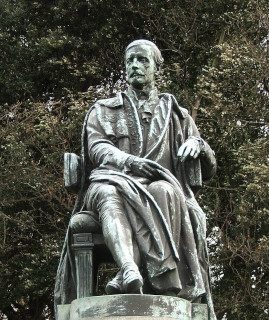
Upon Coghill’s death Mary is left, for her lifetime, his lands in the barony of Coolock, rents from his properties in Clonturk, all his household goods, and his coach, chariot and horses. In 1743, she erects the parish church of Clonturk, now Drumcondra Church, and places in it a statue of her brother by the Dutch sculptor Peter Scheemakers.
The Republic of Ireland Act 1948 is an Act of the Oireachtas which declares that Ireland may be officially described as the Republic of Ireland, and vests in the President of Ireland the power to exercise the executive authority of the state in its external relations, on the advice of the Government of Ireland. The Act is signed into law on December 21, 1948 and comes into force on April 18, 1949, Easter Monday, the 33rd anniversary of the beginning of the Easter Rising.
The Act repeals the External Relations Act 1936. Under that Act, King George VI acts as the Irish head of state in international relations by accredited ambassadors and on the State’s behalf accepts credentials appointing foreign ambassadors to the State. The Republic of Ireland Act removes this last remaining practical role from the King and vests it instead in the President of Ireland, making the then President of Ireland, Seán T. O’Kelly, unambiguously the Irish head of state.
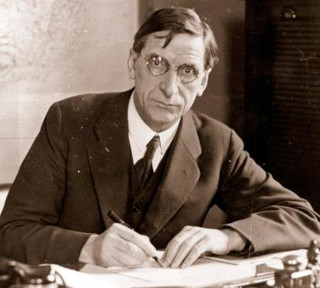
In 1945, when asked if he plans to declare a Republic, the then TaoiseachÉamon de Valera replies, “we are a republic.” He also insists that Ireland has no king, but simply uses an external king as an organ in international affairs. However, that is not the view of constitutional lawyers including de Valera’s Attorneys General, whose disagreement with de Valera’s interpretation only come to light when the state papers from the 1930s and 1940s are released to historians. Nor is it the view in the international arena, who believe that Ireland does have a king, George VI, who had been proclaimed King of Ireland in December 1936, and to whom they accredit ambassadors to Ireland. King George, in turn, as “King of Ireland” accredits all Irish diplomats. All treaties signed by the Irish Taoiseach or Minister for External Affairs are signed in the name of King George.
In October 1947, de Valera asks his Attorney General, Cearbhall Ó Dálaigh, to draft a bill to repeal the External Relations Act. By 1948 a draft of the bill includes a reference to the state as being a republic. In the end, the draft bill is never submitted to the Oireachtas for approval.
The bill to declare Ireland a republic is introduced in 1948 by the new Taoiseach, John A. Costello of the Fine Gael party. Costello makes the announcement that the bill is to be introduced when he is in Ottawa, during an official visit to Canada. David McCullagh suggests that it is a spur of the moment reaction to offence caused by the Governor General of Canada, Lord Alexander, who is of Northern Irish descent, who allegedly places loyalist symbols before an affronted Costello at a state dinner. What is certain is that an agreement that there be separate toasts for the King and for the President of Ireland is broken. The Irish position is that a toast to the King, instead of representing both countries, would not include Ireland. Only a toast to the King is proposed, to the fury of the Irish delegation. Shortly afterwards Costello announces the plan to declare the republic.
However, according to all but one of the ministers in Costello’s cabinet, the decision to declare a republic had already been made before Costello’s Canadian visit. Costello’s revelation of the decision is because the Sunday Independent had discovered the fact and was about to “break” the story as an exclusive. The evidence of what really happens remains ambiguous. There is no record of a prior decision to declare a republic before Costello’s Canadian trip.
At any rate, the Act is enacted with all parties voting for it. De Valera does suggest that it would have been better to reserve the declaration of the republic until Irish unity had been achieved, a comment hard to reconcile with his 1945 claim that the Irish state was already a republic. Speaking in Seanad Éireann Costello tells senators that as a matter of law, the King is indeed “King of Ireland” and Irish head of state and the President of Ireland is in effect no more than first citizen and a local notable, until the new law comes into force.
The United Kingdom responds to the Republic of Ireland Act by enacting the Ireland Act 1949. This Act formally asserts that the Irish state had, when the Republic of Ireland Act came into force, ceased “to be part of His Majesty’s dominions” and accordingly is no longer within the Commonwealth. Nonetheless the United Kingdom statute provides that Irish citizens will not be treated as aliens under British nationality law. This, in effect, grants them a status similar to the citizens of Commonwealth countries.
Croker is the only son of John Croker, the surveyorgeneral of customs and excise in Ireland. He is educated at Trinity College, Dublin, where he graduates in 1800. Immediately afterwards he enters Lincoln’s Inn and, in 1802, he is called to the Irish bar.
Croker enters the Parliament of the United Kingdom in 1808 as member for Downpatrick, obtaining the seat on petition, though he had been unsuccessful at the poll. In 1810 he is appointed to the office of First Secretary to the Admiralty, which he holds without interruption under various administrations for more than twenty years. From the beginning he has the backing of Arthur Wellesley, 1st Duke of Wellington, and the friendship continues between them until Wellesley’s death in 1852.
From 1831 to 1854 Croker is one of the chief writers for the Quarterly Review, to which he contributes about 270 articles on a variety of subjects. His literary tastes are largely those of the 18th century, as may be seen from his severe criticism of John Keats’s Endymion, Alfred Tennyson’s Poems of 1832, and of course the first two volumes of Macaulay’s The History of England from the Accession of James the Second (1848). For some years before his death he accumulates material for an annotated edition of Alexander Pope’s works. This is passed to Whitwell Elwin, who begins the edition later completed by William John Courthope. Croker also edits the collected letters or memoirs of various 18th-century figures.
Croker dies at the age of 76 on August 10, 1857 at St. Albans Bank, Hampton.
(Pictured: Portrait of John Wilson Croker, by William Owen (died 1825), given to the National Portrait Gallery, London in 1872)
Tod is born on May 18, 1836, in Edinburgh into a well-known Irish Presbyterian family, her uncle being the Rev. Hope Masterton Waddell, one of the earliest Irish Presbyterian missionaries who served with the Scottish Missionary Society in Jamaica and whose great grandfather is the Rev. Charles Masterton, one of the most distinguished minsters of the General Synod of Ulster who ministers at Connor and Rosemary Street, Belfast. She is very proud of her Presbyterian heritage and of her Scottish ancestry.
The daughter of James Banks Tod, an Edinburgh merchant, Tod spends her early years in Edinburgh. She is educated at home by her mother, Maria Isabella Waddell, who comes from County Monaghan. The family moves to Belfast in the 1850s following the death of her father. She and her mother join Elmwood Presbyterian Church. Her Presbyterian background no doubt contributes to her radical views on social issues and women’s rights. She earns her living from writing and journalism, contributing, for example, to the Dublin University Magazine, an independent literary, cultural and political magazine, and to the Banner of Ulster, a Presbyterian newspaper.
Tod becomes one of the leading pioneers in the fight to improve the position of women. She is the only woman called to give evidence to a Select Committee of Enquiry on the reform of the married women’s property law in 1868 and serves on the executive of the Married Women’s Property Committee in London from 1873 to 1874. She successfully campaigns for the repeal of the Contagious Diseases Acts of 1864, 1866 and 1869 which enacted that a woman suspected of being a prostitute could be arrested and forced to undergo medical examination for venereal disease. She sees this legislation as an infringement of a woman’s civil liberties.
Tod is also a strong supporter of the temperance movement and, along with her friend Margaret Byers, forms the Belfast Women’s Temperance Association in 1874. Perhaps she is best known for her tireless campaign to extend the educational provision for middle-class women. For example, in 1878 she organises a delegation to London to put pressure on the Government to include girls in the Intermediate Education Act of 1878. The Ladies’ Collegiate School in Belfast, Alexandra College in Dublin and the Belfast Ladies Institute owe their existence largely to her. She writes a paper entitled “An Advanced Education for Girls in the Upper and Middle Classes” which is presented in 1867 at a meeting of the National Association for the Promotion of Social Science and is among the pamphlets held in the Presbyterian Historical Society of Ireland library.
Tod is also an active campaigner for women’s right to vote, embarking on her first campaign in 1872 and addressing meetings in Belfast, Carrickfergus, Coleraine and Londonderry. Following a meeting in Dublin a suffrage committee is established that later becomes the Dublin Women’s Suffrage Society and in 1873 she forms the North of Ireland Women’s Suffrage Society. She extends her meetings to London, Glasgow and Edinburgh and is a frequent visitor to London to lobby politicians during the parliamentary session.
Tod is very much a staunch opponent of Home Rule, establishing a branch of the London-based Women’s Liberal Federation in Belfast and the Liberal Women’s Unionist Association. She sees unionism as the way to progress. “I knew that all the social work in which I had taken so prominent a part for 20 years was in danger and most of it could not exist a day under a petty legislature of the character which would be inevitable,” she says. “What we dread is the complete dislocation of all society, especially in regard to commercial affairs and organised freedom of action.”
Tod suffers from ill-health in her later days and dies in Belfast of pulmonary illness on December 8, 1896. She is buried in Balmoral Cemetery in South Belfast.
Jack Lynch, Irish politician and Taoiseach of Ireland from 1966 to 1973 and from 1977 to 1979, resigns as Taoiseach and leader of Fianna Fáil on December 5, 1979.
The year 1979 proves to be the year in which Lynch finally realises that his grip on power has slipped. The first direct elections to the European Parliament take place in June and see the electorate severely punishing the ruling Fianna Fáil party. A five-month postal strike also led to deep anger amongst people all over the country. On 27 August 1979, the Provisional Irish Republican Army assassinates Earl Mountbatten of Burma in County Sligo. On the same day the IRA kills 18 British soldiers at Warrenpoint in County Down.
A radical security review and greater cross-border co-operation are discussed with the new British Prime Minister, Margaret Thatcher. These discussions lead Síle de Valera, a backbench TD, to directly challenge the leadership in a speech at the Liam Lynch commemoration at Fermoy, County Cork, on September 9. Although Lynch quickly tries to impose party discipline, attempting to discipline her for opposing party policy at a parliamentary party meeting held on September 28, de Valera correctly points out that she had not opposed the party policy regarding the North which called for the declaration of the British intent to withdraw from the north. The result is embarrassing for Lynch.
The visit of Pope John Paul II to Ireland in September proves to be a welcome break for Lynch from the day-to-day running of the country. In November, just before he departs on a visit to the United States, he decides that he will resign at the end of the year. This would allow him to complete his term as President of the European Community. The defining event which makes up his mind is the news that Fianna Fáil had lost two by-elections on November 7 in his native Cork (Cork City and Cork North-East).
In addition, during the trip Lynch claims in an interview with The Washington Post that a five-kilometre air corridor between the border had been agreed upon during the meeting with Thatcher to enhance security co-operation. This is something highly unsavory to many in Fianna Fáil. When Lynch returns, he is confronted openly by Síle de Valera, Dr. Bill Loughnane, a noted hardline Republican backbencher, along with Tom McEllistrim, a member of Charles Haughey‘s gang of five, at a parliamentary party meeting. Lynch stated that the British do not have permission to overfly the border. Afterwards Loughnane goes public with the details of the meeting and accuses Lynch of deliberately misleading the party. An attempt to remove the whip from Loughnane fails.
At this stage Lynch’s position has become untenable, with supporters of Haughey caucusing opinion within the party. George Colley, the man whom Lynch sees as his successor, comes to him and encourages him to resign sooner. Colley is convinced that he has enough support to defeat the other likely candidate, Charles Haughey, and that Lynch should resign early to catch his opponents on the hop. Lynch agrees to this and resigns as leader of Fianna Fáil on December 5, 1979, assured that Colley has the votes necessary to win. However, Haughey and his supporters have been preparing for months to take over the leadership and Lynch’s resignation comes as no surprise. He narrowly defeats Colley in the leadership contest and succeeds Lynch as Taoiseach.
Lynch remained on in Dáil Éireann as a TD until his retirement from politics at the 1981 Irish general election.
Nominated by the Labour Party and supported by the Green Party and the Workers’ Party, Robinson becomes Ireland’s first woman president in 1990 by mobilizing a liberal constituency and merging it with a more conservative constituency opposed to the Fianna Fáil party. As president, she adopts a much more prominent role than her predecessors and she does much to communicate a more modern image of Ireland. Strongly committed to human rights, she is the first head of state to visit Somalia after it suffers from civil war and famine in 1992 and the first to visit Rwanda after the genocide in that country in 1994.
Shortly before her term as president expires, Robinson accepts the post of United Nations High Commissioner for Human Rights (UNHCHR). As high commissioner, she changes the priorities of her office to emphasize the promotion of human rights at the national and regional levels. She was the first UNHCHR to visit China, and she also helps to improve the monitoring of human rights in Kosovo. In 2001 she serves as secretary-general of the World Conference against Racism held in Durban, South Africa. In 1998 she is elected chancellor of Trinity College, a post she holds until 2019.
After stepping down as UNHCHR, Robinson founds the nongovernmental organization Realizing Rights: The Ethical Globalization Initiative (2002–2010). Its central concerns include equitable international trade, access to health care, migration, women’s leadership and corporate responsibility. She is also a founding member of the Council of Women World Leaders, serves as honorary president of Oxfam International, a private organization that provides relief and development aid to impoverished or disaster-stricken communities worldwide, and is a member of the Club of Madrid, which promotes democracy. She also holds various posts at the United Nations, and in 2010, she establishes the Mary Robinson Foundation—Climate Justice, which operates until 2019.
Croker is the son of Eyre Coote Croker (1800–1881) and Frances Laura Welsted (1807–1894). He is taken to the United States by his parents when he is just two years old. There are significant differences between this family and the typical family leaving Ireland at the time. They are Protestant and are not land tenants. Upon arrival in the United States, his father is without a profession but has a general knowledge of horses and soon becomes a veterinary surgeon. During the American Civil War, he serves in that same capacity under General Daniel Sickles.
Croker is educated in New York public schools but drops out at age twelve or thirteen to become an apprentice machinist in the New York and Harlem Railroad machine shops. Not long after, he becomes a valued member of the Fourth Avenue Tunnel Gang, a street gang that attacks teamsters and other workers that gather around the Harlem line’s freight depot. He eventually becomes the gang’s leader. He joins one of the Volunteer Fire Departments in 1863, becoming an engineer of one of the engine companies. That is his gateway into public life.
James O’Brien, a Tammany associate, takes notice of Croker after he wins a boxing match against Dick Lynch whereby, he knocks out all of Lynch’s teeth. He becomes a member of Tammany Hall and active in its politics. In the 1860s he is well known for being a “repeater” at elections, voting multiple times at the polls. He is an alderman from 1868–1870 and Coroner of New York City from 1873–1876. He is charged with the murder of John McKenna, a lieutenant of James O’Brien, who is running for United States Congress against the Tammany-backed Abram S. Hewitt. John Kelly, the new Tammany Hall boss, attends the trial and Croker is freed after the jury is undecided. He moves to Harrison, New York by 1880. He is appointed the New York City Fire Commissioner in 1883 and 1887 and city Chamberlain from 1889-1890.
After the death of Kelly, Croker becomes the leader of Tammany Hall and almost completely controls the organization. As head of Tammany, he receives bribe money from the owners of brothels, saloons and illegal gambling dens. He is chairman of Tammany’s Finance Committee but receives no salary for his position. He also becomes a partner in the real estate firm Meyer and Croker with Peter F. Meyer, from which he makes substantial money, often derived from sales under the control of the city through city judges. Other income comes by way of gifts of stock from street railway and transit companies, for example. At the time, the city police are largely still under the control of Tammany Hall, and payoffs from vice protection operations also contribute to Tammany income.
Croker survives Charles Henry Parkhurst‘s attacks on Tammany Hall’s corruption and becomes a wealthy man. Several committees are established in the 1890s, largely at the behest of Thomas C. Platt and other Republicans, to investigate Tammany and Croker, including the 1890 Fassett Committee, the 1894 Lexow Committee, during which Croker leaves the United States for his European residences for three years, and the Mazet Investigation of 1899.
Croker’s greatest political success is his bringing about the 1897 election of Robert Anderson Van Wyck as first mayor of the five-borough “greater” New York. During Van Wyck’s administration Croker completely dominates the government of the city.
In 1899, Croker has a disagreement with Jay Gould‘s son, George Jay Gould, president of the Manhattan Elevated Railroad Company, when Gould refuses his attempt to attach compressed-air pipes to the Elevated company’s structures. He owns many shares of the New York Auto-Truck Company, a company which would benefit from the arrangement. In response to the refusal, he uses Tammany influence to create new city laws requiring drip pans under structures in Manhattan at every street crossing and the requirement that the railroad run trains every five minutes with a $100 fine for every violation. He also holds 2,500 shares of the American Ice Company, worth approximately $250,000, which comes under scrutiny in 1900 when the company attempts to raise the price of ice in the city.
After Croker’s failure to carry the city in the 1900 United States presidential election and the defeat of his mayoralty candidate, Edward M. Shepard, in 1901, he resigns from his position of leadership in Tammany and is succeeded by Lewis Nixon. He departs the United States in 1905.
Croker operates a stable of thoroughbred racehorses during his time in the United States in partnership with Michael F. Dwyer. In January 1895, they send a stable of horses to England under the care of trainer Hardy Campbell, Jr. and jockey Willie Simms. Following a dispute, the partnership is dissolved in May but Croker continues to race in England. In 1907, his horse Orby wins Britain’s most prestigious race, The Derby. Orby is ridden by American jockey John Reiff whose brother Lester had won the race in 1901. Croker is also the breeder of Orby’s son, Grand Parade, who wins the Derby in 1919.
In 1745 Loftus marries Frances Monroe, daughter of Henry Monroe of Roe’s Hall, County Down. Frances is a leading figure in Dublin society who wields some political influence and is a much stronger character than her rather ineffectual husband, whom she seems to dominate completely. She dies in 1774.
There is a portrait of the couple, with Lady Ely’s nieces, Dorothea (Dolly) and Frances Monroe, the daughters of her brother Henry Monroe of Roe’s Hall, by the celebrated Swiss painter Angelica Kauffman, who visits Ireland in 1771. Dolly Monroe is one of the greatest beauties of the age, whose admirers include Henry Grattan and Oliver Goldsmith. She marries the politician William Richardson and dies without issue in 1793. Her sister Frances marries Henry Read.
Loftus marries secondly Anne Bonfoy, daughter of Captain Henry Bonfoy and Anne Eliot, and sister of Edward Craggs-Eliot, 1st Baron Eliot. He has no issue by either marriage and at his death on May 8, 1783, his estates pass to his nephew Charles Loftus, 1st Marquess of Ely, the son of his sister Elizabeth and Sir John Tottenham, 1st Baronet. His widow dies in 1821, having outlived her mother, who lives to be 97, by only five years.
(Pictured: Henry Loftus (1709-1783), 1st Earl of Ely, and his wife Frances Monroe (d.1821), Countess of Ely, circa 1775, source National Trust, Upton House)
Although there are no discussions between the pair, Kenny confirms he will meet with Foster in Dublin on Tuesday, November 15. The pair are also due to meet in Armagh on Friday, November 18 for a North/South ministerial meeting, where Brexit-related issues are expected to dominate the agenda.
Speaking afterwards, Fitzgerald, whose grandfather served as a soldier in the British army and whose father was a colonel in the Irish Army, says it has been an important engagement. “So many people across the island lost their lives; 50,000 families affected by loss of a loved one during the First World War. We have had a government minister here since 2012 and I think it is really important to come together, to remember together and to look at our shared histories.”
Meanwhile, Heather Humphreys, the Minister for Arts, Heritage, Regional, Rural and Gaeltacht Affairs, dedicates the France-Ireland Memorial at Glasnevin Cemetery. Humphreys is joined by the French Minister of State for Veterans and Remembrance at the Ministry of Defence Jean-Marc Todeschini for the ceremony. The memorial is a gift to Ireland from France in recognition of Irish sacrifices made “in the defence and freedom of France, particularly in the First World War.”
(From: “Taoiseach, Tánaiste attend Remembrance Sunday ceremonies,” Raidió Teilifís Éireann (RTÉ), http://www.rte.ie, November 13, 2016 | Pictured: Taoiseach Enda Kenny lays a wreath of green laurels in Enniskillen)