seamus dubhghaill

Promoting Irish Culture and History from Little Rock, Arkansas, USA


4 Comments

Republic of Ireland’s First World Cup Finals Match

The Republic of Ireland plays their first ever match in the finals of the World Cup, drawing 1-1 with England in Cagliari, Sardinia on June 11, 1990.

At Italia ’90 the Irish team is drawn in a very tough Group F that includes European champions the Netherlands, African footballing power Egypt, and England. This is something of a coincidence as the English and the Dutch were also in Ireland’s UEFA Euro 1988 group. The tournament organisers are fearful that this grouping might lead to crowd disorder particularly between the English and Dutch fans. The group is based on the Italian islands of Sicily and Sardinia and security is very tight with alcohol bans in place on match days.

Ireland’s first match at a World Cup finals competition is against their longtime foe England. The English are seeking revenge for their surprise defeat by the Irish in the opening group match at Euro ’88. Once again Bobby Robson‘s English team is expected to beat Ireland and his players underline that by taking an early lead through an eight-minute goal from Gary Lineker. Despite Ireland getting a greater foothold in the second half an equaliser is elusive until an error by Steve McMahon allows Kevin Sheedy to score in the 73rd minute.

Ireland’s next matches are against Egypt and the Netherlands, both played in Palermo and both ending in a draw. The Irish team finishes group play with 0 wins, 0 losses and 3 draws. England registers the only win in the group, beating Egypt. The three European teams progress into the next round.

In the knock-out round Ireland avoids drawing West Germany, the ultimate winner of the 1990 World Cup. They draw Romania as their first opponent and end regulation in yet another draw in Genoa. A penalty shoot-out follows and after the first eight penalties the teams are still tied at 4-4. Irish goalkeeper Packie Bonner blocks Romania’s fifth penalty kick. David O’Leary steps up confidently and sends his kick past the goalkeeper and into the net. Ireland has advanced to the quarterfinals at the first attempt.

Ireland bows out at the quarterfinals stage losing by a single goal to the hosts, Italy, at the Stadio Olimpico in Rome. It is a very strange campaign in that Ireland does not win any of their matches, scores only two goals, and plays in some really poor matches in terms of quality of play. Notwithstanding this the Irish over-achieves which is fully appreciated by the Irish supporters. The green army stays on in the Stadio Olimpico long after the final whistle to laud manager Jack Charlton and his gallant squad.

(From: “Ireland at 1990 World Cup Finals in Italy,” Soccer-Ireland.com, http://www.soccer-ireland.com | Photograph by Ray McManus / SPORTSFILE)
Leave a comment

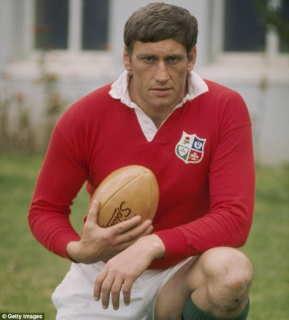
Birth of Willie John McBride, Rugby Union Footballer

William James McBride, former rugby union footballer better known as Willie John McBride, is born at Toomebridge, County Antrim, Northern Ireland on June 6, 1940. He plays as a lock for Ireland and the British and Irish Lions. He plays 63 tests for Ireland including eleven as captain, and tours with the Lions five times, a record that gives him 17 Lions test caps. He also captains the most successful ever Lions side, which tours South Africa in 1974.

Owing to his father’s death when he is four years old, McBride spends most of his spare time helping out on his family farm. Because of this he does not start playing rugby until he is seventeen. He is educated at Ballymena Academy and plays for the school’s First XV. After he leaves he joins Ballymena R.F.C.

In 1962 McBride is selected to play for Ireland. His first Test on February 10, 1962 is against England at Twickenham Stadium. Later that year he is selected to tour South Africa with the British and Irish Lions.

McBride continues to play for Ireland throughout the 1960s and plays for Ireland when they first defeat South Africa in 1965, and when Ireland defeats Australia in Sydney, the first time a Home Nations team had defeated a major southern hemisphere team in their own country. He is again selected for the Lions in 1966, this time touring New Zealand and Australia. He tours South Africa with the Lions again in 1968.

McBride is selected to play for the Lions in their 1971 tour of New Zealand. Despite being criticized by some as being “over the hill,” he is made pack leader and helps the Lions to a test series win over New Zealand, their first and last series win over New Zealand. He receives an MBE in 1971 for services to rugby football.

McBride’s leadership qualities lead to his appointment as captain of the British and Irish Lions in their 1974 tour to South Africa. The test series is won 3–0, with one match drawn, the first Lions series ever won in South Africa. It is one of the most controversial and physical test match series ever played. At the time there are only substitutions if a doctor agrees that a player is physically unable to continue and there are no video cameras and sideline officials to keep the punching, kicking and head butting to a minimum. If the South Africans are to resort to foul play then the Lions decide “to get their retaliation in first.” The signal for this is to call “99,” which is a signal for the Lions to clobber their nearest rival players.

In 1975 as his international career is ending McBride plays his last game for Ireland at Lansdowne Road. The game is against France, and near the end of the match he scores his first test try for Ireland. It is the crowning moment of a great playing career. His last international game is against Wales on March 15, 1975. After retiring from playing the game, McBride coaches the Irish team and is manager of the 1983 Lions tour to New Zealand. Despite the test results being mainly poor, team camaraderie is high and some good wins are recorded in other games.

In 1997 McBride is an inaugural inductee into the International Rugby Hall of Fame. He has been asked to present test jerseys and give motivational speeches to Lions players prior to matches. In 2004 he is named in Rugby World magazine as “Rugby Personality of the Century.” He is a major supporter of the Wooden Spoon Society.

McBride is awarded a CBE in the 2019 New Year Honours list for services to Rugby Union.


Leave a comment

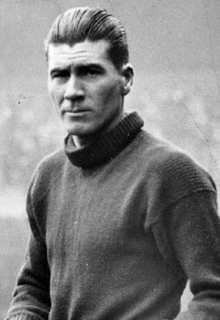
Death of Elisha Scott, Northern Irish Goalkeeper

Elisha Scott, Northern Irish football goalkeeper, dies in Belfast on May 16, 1959. He plays for Liverpool from 1912 to 1934 and still holds the record as their longest-serving player.

Scott is born in Belfast on August 24, 1893. He plays for Linfield and Broadway United before Liverpool manager Tom Watson signs him on September 1, 1912, following a recommendation from Scott’s older brother Billy Scott. Liverpool only gets the opportunity to sign Scott when Everton decides that the 19-year-old is too young.

Scott is reported as signed by Crewe Alexandra in August 1913, presumably under some sort of loan arrangement. He succeeds Thomas Charles Allison as deputy for the first-choice keeper, Arthur Box, and plays for them in the early part of the 1913-14 season.

Scott finally makes his Liverpool debut on January 1, 1913, at St. James’ Park. The team plays Newcastle United to a 0–0 draw.

During the early days of his career, Scott is understudy to Kenny Campbell and only appears occasionally. World War I interrupts his career for four years. He finally gets a chance of a run in the Liverpool goal at the end of the season. His goalkeeping position is set in stone when Campbell is allowed to leave in April 1920. He establishes himself as Liverpool’s number one. He is a major part of the back-to-back Championship winning teams of 1922 and 1923, missing just three games of the first title and none in the second.

Numerous stories about Scott exist in Liverpool folklore. One such story relates to a 1924 game, after Scott has just made a phenomenal save at Ewood Park against Blackburn Rovers. A man appearing from the crowd goes over to Scott and kisses him. He is part of one of the legendary rivalries of the day along with Everton’s Dixie Dean. The two of them are the main topic of discussion when the day of the Merseyside derby is approaching. Everton declares that Dean will score while Liverpool disagrees, saying Scott will not let a single shot past. A famous story, possibly apocryphal, associated with the two men is that of how they once encountered each other in Belfast city centre the day before an Ireland versus England game. Dean, famed for his remarkable heading ability, touches his hat and nods to Scott as they are about to pass. Scott responds by diving as if to try to save an imaginary header, much to the initial shock and then delight of the locals who witness it while a mildly shocked Dean smiles and quietly continues on his walk.

Towards the end of the decade, Scott loses his starting position to another Liverpool goalkeeper, Arthur Riley, but he never gives up the battle for the position of goalkeeper. However, at the beginning of the 1930s it becomes more and more difficult for Scott to get into the line-up. Eventually he asks if he can return to his homeland when his old team Belfast Celtic offers him a player-manager role in 1934. Liverpool consents. He plays the last of his 467 appearances at Chelsea on February 21, 1934, where Chelsea defeats Liverpool 2–0.

Upon Liverpool’s final home match of the season Scott heads to the director’s box to give his adoring fans a farewell speech. He plays his final game for the Belfast club in 1936 at the age of 42. In his time as manager of the Celtics, he wins ten Irish League titles, six Irish Cups, three City Cups, eight Gold Cups and five County Antrim Shields.

Scott dies in Belfast on May 16, 1959, and is buried in Belfast City Cemetery.


Leave a comment

Birth of John O’Keeffe, Gaelic Footballer

John O’Keeffe, former Gaelic footballer, is born on April 15, 1951 in Tralee, County Kerry. He plays with the local Austin Stacks GAA sports club and is a member of the Kerry GAA senior inter-county team from 1969 until 1984. He is a highly talented midfielder, and one of the most stylish and accomplished full-backs in Gaelic football history. He later becomes the Ireland international rules football team manager.

O’Keeffe’s father, Frank (1923-2014), is also a Gaelic footballer who plays as a left corner-forward for the Kerry senior team.

O’Keeffe wins seven All-Ireland Senior Football Championship medals and twelve Munster Senior Club Football Championship medals. Other honours won include seven National Football League medals and eight GAA Interprovincial Championship (Railway Cup) medals between Munster GAA and Combined Universities GAA. He also wins a Munster Junior Championship medal in 1969.

O’Keeffe is among the leading recipients of GAA GPA All Stars Awards, with five awards from 1973, 1975, 1976, 1978, and 1979. He is also named the Texaco Footballer of the Year in 1975.

O’Keeffe retires reluctantly on medical advice after the 1984 Munster Final with a serious hip complaint, having played relatively few games in the previous eighteen months. He has hip replacement surgery some twenty years later. His last game for Kerry is in the full back position against Tipperary in the 1984 Munster Senior Club Football Championship semi-final. He always maintains that his most dangerous opponent is likely Dublin‘s Jimmy Keaveney, with whom he enjoys several battles. His performance against Offaly‘s Matt Connor in the 1982 All-Ireland final is all the more remarkable considering he has little or no training preparation owing to injury. He is consistently named as full back in various GAA players/managers best ever team selections, particularly in the years leading up to the GAA’s Centenary and beyond.

O’Keeffe is captain of the Austin Stacks team that wins the 1976 County Senior Football Championship. He also wins medals in 1973, 1974, 1979 and 1986 (following a brief comeback), as well as a Munster Club Championship in 1976 and an All-Ireland in 1977. He also wins a County Minor Hurling Championship with the club in 1967. He also captains the St. Brendan’s College, Killarney side to the school’s first Hogan Cup title in 1969.

With the University College Dublin GAA team, O’Keeffe wins a Dublin County Championship in 1974, and the Leinster Club Championships and All-Ireland Club Championships in 1973-74 and 1974-75. He also wins Sigerson Cup medals in 1973, 1974, and 1975.

O’Keeffe teaches history, Social, Personal and Health Education (SPHE), and Physical Education at Tralee Christian Brothers School before retiring after forty years in 2011.

In May 2020, the Irish Independent places O’Keeffe at number ten in its “Top 20 footballers in Ireland over the past 50 years.”


Leave a comment

Richard Donovan, First Person to Run Marathon at North & South Pole

richard-donovan

Richard Donovan, runner, commercial race organizer, and sports administrator, becomes the first person in history to run a marathon at both the North and South Pole, completing his North Pole run on April 5, 2002.

Donovan is born in Galway in 1966. He organises and is first to complete the inaugural South Pole Marathon in January 2002, then completes the first marathon-length run at the North Pole in April of that year in a time of 3:48:12. He uses the publicity from this to launch his North Pole Marathon venture, offering runners an adventure tourism experience, with the 2018 event costing €16,000.

Between January 30 and February 5, 2009, Donovan claims a world’s best for running seven marathons, on seven different continents, in fewer than seven days. Starting February 1, 2012 he improves on this by completing the 7 on 7 in under 120 hours.

Donovan also completes transcontinental runs across North America in 2015 and Europe in 2016, adding South America in 2017. In addition to the North Pole Marathon, he organizes a number of other commercial events.


Leave a comment

Ireland Awarded the 2003 Special Olympics World Summer Games

On March 31, 1999, Ireland is selected as the location for the 2003 Special Olympics World Summer Games. It is the first time the event has been staged outside the United States. The organising committee, which is formed in 1999 following the success of the bid, is chaired by entrepreneur Denis O’Brien. The chief executive is Mary Davis.

The Games are hosted in Dublin, with participants staying in 177 towns, cities and villages and the Aran Islands in the lead up to the Games before moving to Dublin for the events. Events are held from June 21-29, 2003 at many venues including Morton Stadium, the Royal Dublin Society, the National Basketball Arena, all in Dublin. Croke Park serves as the central stadium for the opening and closing ceremonies, even though no competitions take place there. Belfast is the venue for roller skating events at the King’s Hall, as well as the Special Olympics Scientific Symposium held on June 19-20.

Approximately 7,000 athletes from 150 countries compete in the Games in 18 official disciplines and three exhibition sports. The participants from Kosovo are the region’s first team at an international sporting event. A 12-member team from Iraq receives special permission to attend the games, despite ongoing war in their home nation. This is the largest sporting event held in 2003.

The opening ceremony is held in Croke Park and features an array of stars and is hosted by Patrick Kielty. The ceremony is officially opened by President of Ireland Mary McAleese and attended by Taoiseach Bertie Ahern. Performances include U2, The Corrs and the largest Riverdance troupe ever assembled on one stage. There are 75,000 athletes and spectators in attendance at the opening ceremonies. Irish and international celebrities such as Arnold Schwarzenegger and Jon Bon Jovi walk with the athletes, with Muhammad Ali as a special guest and Manchester United and Republic of Ireland football player Roy Keane taking the athletes oath with one of the Special Olympians. Nelson Mandela officially opens the Games.

The Games Flame is lit at the culmination of the Law Enforcement Torch Run, in which more than 2,000 members of the Garda Síochána and the Police Service of Northern Ireland participate. This is a series of relays carrying the Special Olympics Torch, the “Flame of Hope,” from Europe to the Games’ official opening.

The 2003 Games are the first to have their opening and closing schemes broadcast on live television, and Raidió Teilifís Éireann provides extensive coverage of the events through their ‘Voice of the Games’ radio station which replaces RTÉ Radio 1 on medium wave for the duration of the event. There is also a nightly television highlight programme. A daily newspaper, the Games Gazette, was published for each day of the Games.

Among the activities carried out during the Games are thorough medical checks on the athletes, some of whom have previously undiagnosed conditions uncovered, as some of the athletes come from countries with limited medical facilities or have difficulty communicating their symptoms.

Among the contributors to the Games is the Irish Prison Service. Prisoners from Mountjoy Prison, Midlands Prison, Wheatfield Prison and Arbour Hill Prison construct podiums and make flags, towels, signs, benches and other equipment.


Leave a comment

Birth of Sir Peter O’Sullevan, Horse Racing Commentator

Sir Peter O’Sullevan, Irish-British horse racing commentator for the BBC, and a correspondent for the Press Association, the Daily Express, and Today, is born Newcastle, County Down on March 3, 1918. He is the BBC’s leading horse racing commentator from 1947 to 1997, during which time he describes some of the greatest moments in the history of the Grand National.

O’Sullevan is the son of Colonel John Joseph O’Sullevan DSO, resident magistrate at Killarney, and Vera (née Henry). As an infant, the family returns to his parents’ home at Kenmare, County Kerry and he is raised in Surrey, England. He is educated at Hawtreys Preparatory School, Charterhouse School, and later at Collège Alpin International Beau Soleil in Switzerland.

In the late 1940s O’Sullevan is involved in some of the earliest television commentaries on any sport and makes many radio commentaries in his earlier years (including the Grand National before it is televised for the first time in 1960). On television, he commentates on many of the major events of the racing year, including the Cheltenham Festival until 1994, The Derby until 1979, and the Grand National, Royal Ascot and Glorious Goodwood until he retires in 1997. During his career, he commentates on around 30 runnings of the Prix de l’Arc de Triomphe in Paris and racing from the United States and Ireland as well as trotting from Rome during the 1960s.

During his 50 years of commentating on the Grand National, O’Sullevan commentates on numerous historic victories. These include Bob Champion‘s run on Aldaniti in 1981 after recovering from cancer, 100/1 outsider Foinavon‘s win in 1967, and the three-times winner Red Rum in 1973, 1974 and 1977. He also commentates on the 1993 Grand National, which is declared void after 30 of the 39 runners fail to realise there had been a false start, and seven go on to complete the course. As the runners approach the second-last fence in the so-called “race that never was,” O’Sullevan declares it “the greatest disaster in the history of the Grand National.”

O’Sullevan becomes known as the “Voice of Racing.” In a television interview before his 50th and last Grand National in 1997, he reveals that his commentary binoculars came from a German submarine. He is knighted the same year – the only sports broadcaster at the time to have been bestowed that honour. He is also a racehorse owner, including of Be Friendly, who wins the King’s Stand Stakes at Ascot, and Prix de l’Abbaye de Longchamp. He is twice successful in the Haydock Sprint Cup (then Vernons Sprint) in 1966 and 1967. Another horse he owns is Attivo, whose victory in the 1974 Triumph Hurdle at the Cheltenham Festival is described by O’Sullevan as the most difficult race to call.

Attivo also wins the Chester Cup and the Northumberland Plate during the 1970s. O’Sullevan’s final race commentary comes at Newbury Racecourse for the 1997 Hennessy Gold Cup, and he visits the winners’ enclosure as a winning owner in the race which follows courtesy of Sounds Fyne’s victory in the Fulke Walwyn Chase. He is succeeded as the BBC’s lead commentator by Jim McGrath.

After his retirement, O’Sullevan is actively involved in charity work, fundraising for causes which revolve around the protection of horses and farm animals, including the International League for the Protection of Horses (ILPH), the Thoroughbred Rehabilitation Centre and Compassion in World Farming. The National Hunt Challenge Chase Cup (run at the Cheltenham Festival) is named after him in 2008 to celebrate his 90th birthday. In 2010, Aintree Racecourse names O’Sullevan as one of the eight inaugural “Grand National Legends.” His name is inscribed on a commemorative plaque at the course, alongside the likes of Ginger McCain and Captain Martin Becher.

O’Sullevan meets his wife Patricia, daughter of Frank Duckworth of Manitoba, Canada, at a ball in Manchester in 1947. She dies of Alzheimer’s disease in 2010.

O’Sullevan dies of cancer at his home in London on July 29, 2015.


Leave a comment

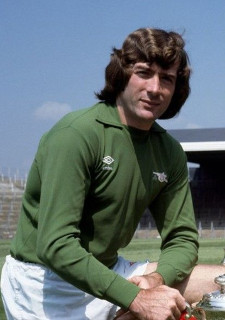
Pat Jennings Becomes First to Make 1,000 Senior Appearances

On February 26, 1983, Northern Irish footballer Pat Jennings becomes the first player in English football to make 1,000 senior appearances, celebrating this milestone with a clean sheet in a goalless league draw for Arsenal at West Bromwich Albion.

Jennings is born in Newry, County Down, Northern Ireland on June 12, 1945. After playing for Shamrock Rovers‘ under-18 side at the age of 11, he concentrates on Gaelic football until he is sixteen years old, when he makes his soccer comeback with his hometown side Newry Town. After impressing with the team, he moves to English Third Division side Watford in May 1963. He again impresses in his first season in England, playing every league game for his club. He makes his international debut with the Northern Ireland national football team at the age of eighteen while playing for Watford. This game, on April 15, 1964, is a British Home Championship match against Wales, with Northern Ireland winning the game 3–2. George Best makes his international debut in the same game. Jennings is signed by Tottenham Hotspur for £27,000 in June 1964.

Jennings spends thirteen years at White Hart Lane, where he plays in 472 league games for Spurs, and 591 in all competitions. He wins the FA Cup in 1967, the League Cup in 1971 and 1973, and the UEFA Cup in 1972. In the 1967 Charity Shield he scores once from his own area, kicking the ball from his hands and sending a large punt down the field that bounces over Manchester United goalkeeper Alex Stepney and into the net. In 1973 the Football Writers’ Association names him as its footballer of the year. Three years later he wins Professional Footballers’ Association‘s version of the award, the first goalkeeper to receive this accolade, and to this date remains only one of two, along with Peter Shilton.

In August 1977, he is transferred to Tottenham’s arch-rivals, Arsenal, with Tottenham thinking he is nearing the end of his career. However, he sees off rivals for the goalkeeper’s jersey to play for Arsenal for another eight years. While at Highbury, he helps Arsenal to four Cup finals in three successive years, the FA Cup final in 1978, 1979, and 1980, as well as the European Cup Winners’ Cup final that year. However, Arsenal only manages to win the second of these finals, a 3–2 victory against Manchester United. In total, he makes 327 appearances for Arsenal, 237 of them in the League, between 1977 and his eventual retirement from first-team club football in 1985.

Despite his retirement from club football in 1985, Jennings returns to Tottenham Hotspur, playing mostly in their reserve side to maintain his match sharpness for Northern Ireland’s 1986 FIFA World Cup campaign. He plays his final international game at the 1986 World Cup, on his 41st birthday, making him at the time the World Cup’s oldest-ever participant. The match is Northern Ireland’s final group game, a 3–0 defeat against Brazil. In total, he participates in the qualifying stages of six World Cups between 1966 and 1986.

Jennings final appearance for Tottenham is in the Football League Super Cup against Liverpool in January 1986. He is also briefly on Everton‘s books, having been signed as goalkeeping cover for the 1986 FA Cup Final against Liverpool, Neville Southall having been injured playing for Wales.

Jennings works as a goalkeeping coach at Tottenham since 1993. In 2003 he is inducted into the English Football Hall of Fame in recognition of the skills he demonstrated in the English league. He and his family have lived for many years in Broxbourne, Hertfordshire, where his son attended The Broxbourne School along with the sons of fellow Spurs players Chris Hughton, Osvaldo Ardiles and Ray Clemence. He is still associated with the Spurs and hosts Corporate Hospitality fans in the Pat Jennings Lounges at White Hart Lane and Windsor Park, Belfast.


Leave a comment

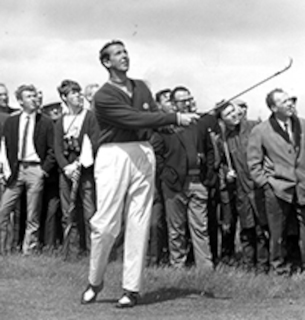
Birth of Joe Carr, Irish Amateur Golfer

Joseph Benedict Carr, Irish amateur golfer, is born in Inchicore, a suburb of Dublin, on February 22, 1922.

Carr is the fifth of seven children born to George and Margaret Mary “Missie” Waters. At ten days old, he is adopted by his maternal aunt, Kathleen, and her husband, James Carr, who are childless and have recently returned home from India. The Carrs have just been appointed steward and stewardess of the Portmarnock Golf Club, allowing young Joe to play golf from a very early age.

Carr wins his first major tournament, the East of Ireland Amateur, at the age of 19 in 1941, which starts one of Ireland’s greatest golfing careers. He goes on to win twelve East of Ireland titles, twelve West of Ireland titles, six Irish Amateur Close Championships, four Irish Amateur Opens, and three South of Ireland titles.

Carr wins The Amateur Championship three times, in 1953, 1958, and 1960, and is runner-up in 1968. He is a semi-finalist at the United States Amateur Championship in 1961, and is low amateur at The Open Championship in both 1956 and 1958 and finishes 8th overall in 1960. In 1967, he becomes the first Irishman to play in the Masters Tournament, making the cut. He receives the Bob Jones Award in 1961, the USGA‘s highest honour, which is given for “distinguished sportsmanship in golf.” He is the first non-American to win the award.

Internationally, Carr represents Ireland in numerous amateur golfing events. He is a member of a record eleven Walker Cup teams from 1947 to 1967, including non-playing captain in 1965 and playing captain in 1967, amassing a record of 5–14–1. After several years of playing against the United States’ top-ranked players, he is moved down in the order for the 1961 event, only to be paired against Jack Nicklaus who wins the match. He plays and captains on multiple Eisenhower Trophy teams, and represents Ireland in the Men’s Home Internationals every year from 1947 to 1969. He retires from competitive golf in 1971, after his son Roddy plays for the winning Great Britain & Ireland Walker Cup team.

In 1991, Carr is named Captain of The Royal and Ancient Golf Club of St. Andrews, the first Irishman to hold the post. In July 2007, he is elected to the World Golf Hall of Fame in the Lifetime Achievement category, and is inducted in November 2007.

From 1992 until his death on June 3, 2004, Carr is president of Mount Juliet Golf Club in Thomastown, County Kilkenny. Mount Juliet still hosts the annual J.B. Carr Trophy for its members.


Leave a comment

Birth of Irish Footballer Liam Brady

William Brady, former Irish footballer who also serves as assistant manager of the Republic of Ireland national football team from 2008 to 2010, is born in Dublin on February 13, 1956.

Brady is raised in Dublin and attends St. Aidan’s C.B.S., leaving before his Intermediate Certificate. He alleges at the time that he had been expelled for missing a school Gaelic football match to play a schoolboy soccer international, however the school denies this.

Brady is a talented offensive midfielder renowned for his left foot and elegant technical skills such as his high-quality passing, vision, and close control, which makes him an excellent playmaker. He combines these abilities with significant tenacity, an eye for goal from midfield, and accurate penalty-taking. In addition to his footballing ability, he also stands out throughout his career for his professionalism.

Brady starts his career at Arsenal F.C., moving to London to join the side on schoolboy forms in 1971, at the age of 15. He turns professional on his 17th birthday in 1973, and makes his debut on October 6, 1973 against Birmingham City F.C. as a substitute for Jeff Blockley. Arsenal reaches three FA Cup finals in a row between 1978 and 1980. Arsenal wins only the 1979 final against Manchester United F.C., with Brady starting the move that ends in Alan Sunderland‘s famous last-minute winner.

Brady spends two seasons with Juventus F.C. in Italy, picking up two Italian Championship medals, in 1981 and 1982. He scores the only goal (a penalty) in the 1–0 win against Catanzaro that wins the 1982 title.

Brady makes his debut for the Republic of Ireland national football team on October 30, 1974, in a 3–0 win against the Soviet Union at Dalymount Park in a European Championship qualifier. Due to a suspension accrued before UEFA Euro 1988 he is not eligible to play within the tournament. During qualifications for the 1990 FIFA World Cup he retires from the international game. As Ireland advances to the World Cup he declares himself available to play once again. However, manager Jack Charlton goes on to declare that only those who played in the qualifiers will make the trip to Italy. Brady wins 72 international caps for the Republic of Ireland with 70 within the starting line-up, scoring 9 goals.

Brady goes on to manage two clubs – Celtic F.C. and then Brighton and Hove Albion F.C. – together with being the assistant manager of Ireland’s national football team. He also holds the post of Head of Youth Development at Arsenal F.C. from 1996 to 2013, and is a frequent television pundit with RTÉ Sport.

While at Arsenal F.C., and particularly early in his career, Brady is nicknamed “Chippy”, not for his ability to chip the ball but for his fondness for fish and chips. He also becomes involved in an anti-drugs campaign in the early 1990s, called “give drugs the boot”, encouraging young boys to play sport as a healthy pastime.