The Black and Tans (Irish: Dúchrónaigh), special constables recruited into the Royal Irish Constabulary (RIC) as reinforcements during the Irish War of Independence, arrive in Ireland on March 25, 1920. Recruitment begins in Great Britain in January 1920 and about 10,000 men enlist during the conflict. The vast majority are unemployed former British soldiers from Britain who had fought in World War I. Some sources count a small number of Irishmen as Black and Tans.
The British administration in Ireland promotes the idea of bolstering the RIC with British recruits. They are to help the overstretched RIC maintain control and suppress the Irish Republican Army (IRA), although they are less well trained in ordinary policing. The nickname “Black and Tans” arises from the colours of the improvised uniforms they initially wear, a mixture of dark green RIC (which appears black) and khaki British Army. They serve in all parts of Ireland, but most are sent to southern and western regions where fighting is heaviest. By 1921, Black and Tans make up almost half of the RIC in County Tipperary, for example.
Few Black and Tans are sent to what becomes Northern Ireland, however. The authorities there raise their own reserve force, the Ulster Special Constabulary (USC). For the most part, the Black and Tans are “treated as ordinary constables, despite their strange uniforms, and they live and work in barracks alongside the Irish police.” They spend most of their time manning police posts or on patrol—”walking, cycling, or riding on Crossley Tenders.” They also undertake guard, escort and crowd control duties. While some Irish constables get along well with the Black and Tans, “it seems that many Irish police did not like their new British colleagues” and se them as “rough.”
Alexander Will, from Forfar in Scotland, is the first Black and Tan to die in the conflict. He is killed during an IRA attack on the RIC barracks in Rathmore, County Kerry, on July 11, 1920.
The Black and Tans gain a reputation for brutality and become notorious for reprisal attacks on civilians and civilian property, including extrajudicial killings, arson and looting. Their actions further sway Irish public opinion against British rule and draw condemnation in Britain.
The Black and Tans are sometimes confused with the Auxiliary Division, a counterinsurgency unit of the RIC, also recruited during the conflict and made up of former British officers. However, sometimes the term “Black and Tans” covers both groups. Some sources say the Black and Tans are officially named the “RIC Special Reserve,” but this is denied by other sources, which say they are not a separate force but “recruits to the regular RIC” and “enlisted as regular constabulary.”
More than a third leave the service before they are disbanded along with the rest of the RIC in 1922, an extremely high wastage rate, and well over half receive government pensions. Over 500 members of the RIC died in the conflict and more than 600 are wounded. Some sources state that 525 police are killed in the conflict, including 152 Black and Tans and 44 Auxiliaries. This figure of total police killed also includes 72 members of the Ulster Special Constabulary killed between 1920 and 1922 and 12 members of the Dublin Metropolitan Police.
Many Black and Tans are left unemployed after the RIC is disbanded and about 3,000 are in need of financial assistance after their employment in Ireland is terminated. About 250 Black and Tans and Auxiliaries, among over 1,300 former RIC personnel, join the Royal Ulster Constabulary. Another 700 joined the Palestine Police Force which is led by former British Chief of Police in Ireland, Henry Hugh Tudor. Others are resettled in Canada or elsewhere by the RIC Resettlement branch. Those who return to civilian life sometimes have problems re-integrating. At least two former Black and Tans are hanged for murder in Britain and another, Scott Cullen, wanted for murder, commits suicide before the police can arrest him.
(Pictured: Sir Hamar Greenwood inspects a group of Black and Tans in 1921)
According to a study of the region, Cork is “by far the most violent county in Ireland” during the War of Independence and has several active guerrilla brigades. Of these, the 3rd Cork Brigade is one of the most effective and it is a unit from this Brigade that carries out the Upton ambush.
Up until the end of 1920, the British had been unable to move troops by train, due to a nationwide boycott by railway workers of trains carrying the British military. However, the strike is lifted in December 1920. While this helps the British military’s mobility, it also gives the IRA a new target: trains carrying soldiers. A week before the Upton ambush, the local IRA had made a successful attack on a train travelling from Killarney to Millstreet near Drishanbeg, killing one sergeant and wounding five more soldiers.
Five days after the Drishanbeg ambush, plans are made for an attack at Upton and Innishannon railway station on a train traveling between Cork city and Bandon. The ambushers, led by Charlie Hurley, are thirteen strong. Seven are armed with rifles and the remainder with revolvers or semi-automatic pistols. They take up position at the station ten minutes before the train pulls in, imprisoning the station master, clearing the station and taking cover behind sacks of grain and flour taken from a store.
The train is carrying approximately 50 British soldiers of the Essex Regiment, who are mingled with civilian passengers throughout the train’s carriages. The IRA party is therefore quite heavily outnumbered and out-gunned, but are unaware of this, as two IRA scouts, who were supposed to have been on the train and signaled to them the British numbers, never turn up. They also wrongly believe that the British troops are all in the central carriage. As a result, when the IRA opens fire on the train, there are heavy civilian casualties, including two commercial travelers killed by the first volley. The New York Times reports that “a shower of bullets was rained on the train, practically every compartment being swept.”
The firefight lasts only ten minutes, but in that time six civilian passengers are killed and ten wounded. Six British soldiers are injured, three of them seriously. Two IRA volunteers are killed outright and another is fatally wounded. Two more are badly wounded but survive. Charlie Hurley, who had led the ambush, is struck in the face by a bullet. IRA leader Tom Barry later writes, “Through some miracle, the nine unwounded and two wounded got away across country, in small parties, with the British following close behind.” Three civilian passengers, one unwounded and two wounded, are detained by the British on suspicion of belonging to the ambush party.
The Upton ambush is part of what Tom Barry describes as “twelve dark days” for the 3rd Cork Brigade of the IRA. Between February 4 and February 16, eleven members of the Brigade are killed. One is shot dead by British troops when they raid a safehouse on February 4, another dies in an accidental shooting on February 7, two more (brothers James and Timothy Coffey) are assassinated in their beds on February 14 by Black and Tans or Auxiliaries, three die at Upton on February 15 and four are killed on February 16 when they are arrested by the Essex Regiment in Kilbrittain while digging a trench and shot dead. Of the eleven dead, only those at Upton are killed in combat.
The Upton attack also highlights the dangers, and particularly the risk to civilians, of attacking trains carrying troops. Only a month later at the Headford Ambush in neighbouring County Kerry, an IRA column successfully attacks a train-load of troops, but again, there are civilian casualties alongside the IRA and British Army losses. One of the three men captured by the British at Upton is reported to give information leading to the 3rd Cork Brigade’s main column of over 100 fighters almost being encircled at the Crossbarry Ambush. Hurley is killed in this action.
The Upton ambush is later made famous in a popular 1960s Irish ballad titled “The Lonely Woods of Upton.”
(Pictured: A portion of the cover of an Italian magazine from 1921 that reported on the Upton ambush)
Hope is born in Templepatrick, County Antrim, on August 25, 1764 to a Presbyterian family originally of Covenanter stock. He is apprenticed as a linen weaver but attends night school in his spare time. Influenced by the American Revolution, he joins the Irish Volunteers, but upon the demise of that organisation and further influenced by the French Revolution, he joins the Society of the United Irishmen in 1795.
Hope quickly establishes himself as a prominent organiser and is elected to the central committee in Belfast, becoming close to leaders such as Samuel Neilson, Thomas Russell, and Henry Joy McCracken. He is almost alone among the United Irish leaders in targeting manufacturers as well as landowners as the enemies of all radicals. In 1796, he is sent to Dublin to assist the United Irish organisation there to mobilise support among the working classes, and he is successful in establishing several branches throughout the city and especially in The Liberties area. He also travels to counties in Ulster and Connacht, disseminating literature and organizing localities.
Upon the outbreak of the 1798 rebellion in Leinster, Hope is sent on a failed mission to Belfast by Henry Joy McCracken to brief the leader of the County Down United Irishmen, Rev. William Steel Dickson, with news of the planned rising in County Antrim, unaware that Dickson had been arrested only a couple of days before. He manages to escape from Belfast in time to take part in the Battle of Antrim where he plays a skillful and courageous role with his “Spartan Band,” in covering the retreat of the fleeing rebels after their defeat.
Hope manages to rejoin McCracken and his remaining forces after the battle at their camp upon Slemish mountain, but the camp gradually disperses, and the dwindling band of insurgents are then forced to go on the run. He successfully eludes capture, but his friend McCracken is captured and executed on July 17. Upon the collapse of the general rising, he refuses to avail of the terms of an amnesty offered by Charles Cornwallis, 1st Marquess Cornwallis on the grounds that to do so would be “not only a recantation of one’s principles, but a tacit acquiescence in the justice of the punishment which had been inflicted on thousands of my unfortunate associates.”
Hope lives the years following 1798 on the move between counties Dublin, Meath and Westmeath but is finally forced to flee Dublin following the failure of Robert Emmet‘s rebellion in 1803. He returns to the north and evades the authorities attentions in the ensuing repression by securing employment with a sympathetic friend from England. He is today regarded as the most egalitarian and socialist of all the United Irish leadership.
After suffering poor health for some years, Hope dies on February 10, 1847 at his son Henry’s home, 1 Lancaster St., Belfast. He is buried in the Mallusk Cemetery, Newtownabbey, County Antrim. The headstone is raised by his friends, Henry Joy McCracken’s sister Mary Ann, and the Shankill Road United Irishman Isreal Milliken. The historian Richard Robert Madden, who had encouraged Hope to write his memoirs, supplies the inscription. The headstone features the outline of a large dog, which supposedly brought provisions to him and his compatriots when they were hiding following the Battle of Antrim.
The Clonfin Ambush is carried out by the Irish Republican Army (IRA) on February 2, 1921, during the Irish War of Independence. It takes place in the townland of Clonfin between Ballinalee and Granard in County Longford. The IRA ambushes two lorries carrying members of the British Auxiliary Division, sparking a lengthy gun battle in which four Auxiliaries are killed and eight wounded. The Auxiliaries eventually surrender, and their weapons are seized. The IRA commander, Seán Mac Eoin, wins some praise for helping the wounded Auxiliaries. Following the ambush, British forces burn a number of houses and farms in the area, and shoot dead an elderly farmer.
The IRA’s North Longford Flying Column, twenty-one strong and led by Seán Mac Eoin, is formed in late 1920. In that year they kill four Royal Irish Constabulary (RIC) constables. In November, a company of the Auxiliary Division – a paramilitary police force made up of ex-military officers – has been stationed in the county to put down the local IRA and are reinforced in January 1921. Whereas previously the IRA had tried to operate in relatively large numbers, often attacking police barracks, from this point forward, their GHQ in Dublin orders smaller but more frequent attacks to be made.
The ambush site, on the road between Granard and Ballinalee, is well chosen. Mac Eoin selects a position where the ambushers have excellent cover and are barely visible to the British. The plan is to explode a mine as the lorries pass. The British assessment is that “the ambush was most cleverly laid.”
The IRA detonates the roadside improvised explosive device (IED) as two British lorries are passing a bridge, killing the driver of the first lorry instantly. The IRA unit then opens fire on the lorries, triggering a firefight lasting two hours. One of the Auxiliaries gets away and manages to summon reinforcements.
During the fighting, four members of the IRA party work their way around the flank of the Auxiliaries, killing their commander, Lt. Commander Francis Craven. After his death, the remaining policemen surrender. A total of four Auxiliaries are killed and eight wounded.
MacEoin’s treatment of his prisoners is humane. He congratulates them on the fight they had put up and prevents his fighters from assaulting the Auxiliaries. He also has water brought from nearby houses for the British wounded. When he is later captured by the British, three Auxiliaries testify at his court-martial to his generous treatment of them at Clonfin. Mac Eoin’s humane treatment reportedly delays the IRA’s getaway, and they are almost caught by 14 lorries of British reinforcements as they escape across Clonfin Wood. The IRA had captured 18 rifles, 20 revolvers ammunition, a Lewis gun and 800 rounds of ammunition.
In the aftermath of the ambush, British forces raid the nearby towns of Killoe, Ballinamuck, Drumlish, Ballinalee, Edgeworthstown, Granard and Ardagh. A number of houses and farms are burned. They shoot dead an elderly farmer, Michael Farrell, in reprisal for the ambush.
The IRA flying column lays low after the ambush and does not attempt any more attacks until the end of the month. MacEoin, the Longford IRA leader, is captured at Mullingar railway station in early March and charged with the murder of RIC DI MGrath. He is released in July under the terms of the Truce which ends hostilities. In his absence, the Longford IRA are not able to sustain the intensity of their campaign.
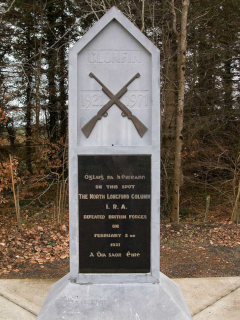
A stone monument is erected at the site of the ambush in 1971 to mark the 50th anniversary of the event. The IRA combatants are MacEoin (Ballinalee), Sean Duffy (Ballinalee), James J. Brady (Ballinamuck), Tom Brady (Cartronmarkey), Paddy Callaghan (Clonbroney), Seamus Conway (Clonbroney), Pat Cooke (Tubber), Seamus Farrelly (Purth), Paddy Finnegan (Molly), Larry Geraghty (Ballymore), Mick Gormley (Killoe), Hugh Hourican (Clonbroney), Jack Hughes (Scrabby), Mick Kenny (Clonbroney), Paddy Lynch (Colmcille), John McDowell (Clonbroney), Jack Moore (Streete), Mick Mulligan (Willsbrook), Michael F. Reynolds (Killoe), Sean Sexton (Ballinalee) and Jim Sheeran (Killoe).
(Pictured: The stone monument located at Clonfin, near the village of Ballinalee, County Longford, marking the site of the ambush. Erected in 1971 to mark the 50th anniversary of the event, the limestone monument features strong military, anti-British language and symbolism.)
In April 1916, during World War I, Irish republicans launch an uprising against British rule in Ireland, called the Easter Rising. They proclaim an Irish Republic. After a week of heavy fighting, mostly in Dublin, the rising is put down by British forces. About 3,500 people are taken prisoner by the British, many of whom had played no part in the Rising. Most of the Rising’s leaders are executed. The rising, the British response, and the British attempt to introduce conscription in Ireland, leads to an even greater public support for Irish republicanism.
In the 1918 Irish general election, the Irish republican party Sinn Féin wins a landslide victory in Ireland, gaining 73 out of 105 seats in the British Parliament. However, in its election manifesto, the party has vowed to set up a separate government in Ireland rather than sit in the British Parliament. At a meeting in Dublin on January 21, 1919, Sinn Féin establishes an independent parliament called Dáil Éireann and declares independence from the United Kingdom.
That same day, an ambush is carried out by Irish Volunteers from the 3rd Tipperary Brigade. It involves Seán Treacy, Dan Breen, Seán Hogan, Séumas Robinson, Tadhg Crowe, Patrick McCormack, Patrick O’Dwyer and Michael Ryan. Robinson is the commander of the group that carries out the attack and Treacy coordinates the planning of the attack. The unit involved acts on its own initiative as had they had to wait for a response, even if it is affirmative, it might come too late.
In December 1918, they receive information that there are plans to move a consignment of gelignite from TipperaryBritish Army barracks to the Soloheadbeg quarry. They begin plans to intercept the consignment and Dan Breen’s brother Lars, who works at the quarry, receives information that the consignment is to be moved around January 16, 1919. They anticipate that there would be between two and six armed escorts, and they discuss different plans. If the escort is small, they believe they can overpower the RIC officers without firing a shot. Gags and ropes are hidden in the quarry, so that should officers surrender they can be bound and gagged. The planning for the ambush takes place in the ‘Tin Hut,’ a deserted semi-derelict house at Greenane.
Each day from January 16 to 21, the men chosen for the ambush take up their positions from early in the morning to late afternoon and then spend the night at the deserted house. Seven of the Volunteers are armed with revolvers while Treacy is armed with a small automatic rifle. On a rainy January 21, around noon, Patrick O’Dwyer sees the transport leaving the barracks. The consignment of 160 lbs. of gelignite is on a horse-drawn cart, led by two council men and guarded by two RIC officers armed with carbine rifles. O’Dwyer cycles quickly to where the ambush party is waiting and informs them. Robinson and O’Dwyer hide about 20 yards in front of the main ambush party of six, in case they rush through the main ambush position.
When the transport reaches the position where the main ambush party is hiding, masked Volunteers step out in front of them with their guns drawn and call on the RIC to surrender. The officers can see at least three of the ambushers. One officer gets down behind the cart and the other apparently fumbles with his rifle. According to the Volunteers, the officers raise their rifles to fire at them, but the rifles do not fire. The Volunteers immediately fire at the officers, and it is believed that Treacy fires the first shot. Both officers, James McDonnell and Patrick O’Connell, native Roman Catholics, are killed. MacDonnell (50) of Belmullet, County Mayo, is a widower with five children. O’Connell is unmarried and a native of Coachford, County Cork.
As planned, Hogan, Breen and Treacy take the horse and cart with the explosives and speed off. Tadhg Crowe and Patrick O’Dwyer take the guns and ammunition from the dead officers, while Robinson, McCormack and Ryan guard the two council workers, Ned Godfrey and Patrick Flynn, before releasing them once the gelignite is far enough away. Initially the explosives are hidden in a field in Greenane. They are moved several times and are later divided up between the battalions of the brigade.
The ambush is later seen as the beginning of the Irish War of Independence. The British government declares South Tipperary a Special Military Area under the Defence of the Realm Act two days later. There is strong condemnation from the Catholic Church in Ireland. The parish priest of Tipperary calls the dead officers “martyrs to duty.”
A meeting of the Executive of the Irish Volunteers takes place shortly thereafter. On January 31, An t-Óglach, the official publication of the Irish Volunteers, states that the formation of Dáil Éireann “justifies Irish Volunteers in treating the armed forces of the enemy – whether soldiers or policemen – exactly as a National Army would treat the members of an invading army.”
In February 1919 at a Brigade meeting in Nodstown, Tipperary, Brigade officers draft a proclamation, signed by Séumas Robinson as OC, ordering all British military and police forces out of South Tipperary and, should they stay, they will be held to have “forfeited their lives.” GHQ refuses to sanction the proclamation and demands it not be publicly displayed. Despite this it is still posted in several places in Tipperary.
In order to avoid capture, Breen, Treacy, Hogan and the other participants are forced to stay on the move for the following months, often hiding in the barns and attics of sympathisers.
A monument (pictured) has been erected at the site of the ambush, and each year a ceremony of remembrance is held there.
Brady leaves little record of his life before photography. Speaking to the press in the last years of his life, he states that he was born between 1822 and 1824 in Warren County, New York, near Lake George. He is the youngest of three children to Irish immigrant parents, Andrew and Samantha Julia Brady. In official documents before and during the war, however, he claims to have been born in Ireland.
At age 16, Brady moves to Saratoga, New York, where he meets portrait painter William Page and becomes Page’s student. In 1839, the two travel to Albany, New York, and then to New York City, where he continues to study painting with Page, and also with Page’s former teacher, Samuel F. B. Morse. Morse had met Louis-Jacques-Mandé Daguerre in France in 1839 and returned to the United States to enthusiastically push the new daguerreotype invention of capturing images. At first, Brady’s involvement was limited to manufacturing leather cases that hold daguerreotypes. But soon he becomes the center of the New York artistic colony that wishes to study photography. Morse opens a studio and offers classes. Brady is one of the first students.
In 1844, Brady opens his own photography studio at the corner of Broadway and Fulton Street in New York, and by 1845, he begins to exhibit his portraits of famous Americans, including the likes of Senator Daniel Webster and poet Edgar Allan Poe. In 1849, he opens a studio at 625 Pennsylvania Avenue in Washington, D.C., where he meets Juliet Handy, whom he marries in 1850 and lives with on Staten Island. His early images are daguerreotypes, and he wins many awards for his work. In the 1850s ambrotype photography becomes popular, which gives way to the albumen print, a paper photograph produced from large glass negatives most commonly used in American Civil War photography.
In 1850, Brady produces The Gallery of Illustrious Americans, a portrait collection of prominent contemporary figures. The album, which features noteworthy images including the elderly Andrew Jackson at the Hermitage, is not financially rewarding but invites increased attention to his work and artistry. In 1854, Parisian photographer André-Adolphe-Eugène Disdéri popularizes the carte de visite and these small pictures rapidly become a popular novelty, with thousands being created and sold in the United States and Europe.
At first, the effect of the American Civil War on Brady’s business is a brisk increase in sales of cartes de visite to departing soldiers. He readily markets to parents the idea of capturing their young soldiers’ images before they might be lost to war by running an ad in The New York Daily Tribune. However, he is soon taken with the idea of documenting the war itself. He first applies to an old friend, General Winfield Scott, for permission to have his photographers travel to the battle sites, and eventually, he makes his application to President Abraham Lincoln himself. Lincoln grants permission in 1861, with the proviso that Brady finances the project himself.
His efforts to document the American Civil War on a grand scale by bringing his photographic studio onto the battlefields earns Brady his place in history. His first popular photographs of the conflict are at the First Battle of Bull Run, in which he gets so close to the action that he barely avoids capture. While most of the time the battle has ceased before pictures are taken, he comes under direct fire at the First Battle of Bull Run, Petersburg, and Fredericksburg.
Brady also employs Alexander Gardner, James Gardner, Timothy H. O’Sullivan, William Pywell, George N. Barnard, Thomas C. Roche, and seventeen other men, each of whom is given a traveling darkroom, to go out and photograph scenes from the American Civil War. He generally stays in Washington, D.C., organizing his assistants and rarely visiting battlefields personally.
This may be due, at least in part, to the fact that Brady’s eyesight has begun to deteriorate in the 1850s. Many of the images in Brady’s collection are, in reality, thought to be the work of his assistants. He is criticized for failing to document the work, though it is unclear whether it is intentional or due simply to a lack of inclination to document the photographer of a specific image. Because so much of his photography is missing information, it is difficult to know not only who took the picture, but also exactly when or where it was taken.
In October 1862 Brady opens an exhibition of photographs from the Battle of Antietam in his New York gallery, titled The Dead of Antietam. Many images in this presentation are graphic photographs of corpses, a presentation new to America. This is the first time that many Americans see the realities of war in photographs, as distinct from previous “artists’ impressions.”
Brady, through his many paid assistants, takes thousands of photos of American Civil War scenes. Much of the popular understanding of the Civil War comes from these photos. There are thousands of photos in the U.S. National Archives and Records Administration and the Library of Congress taken by him and his associates. The photographs include Lincoln, Ulysses S. Grant, and soldiers in camps and battlefields. The images provide a pictorial cross reference of American Civil War history. He is not able to photograph actual battle scenes, as the photographic equipment in the day is still in the infancy of its technical development and requires that a subject be still for a clear photo to be produced.
Following the conflict, a war-weary public loses interest in seeing photos of the war, and Brady’s popularity and practice decline drastically.
During the war, Brady spends over $100,000 (equivalent to $1,691,000 in 2020) to create over 10,000 plates. He expects the U.S. government to buy the photographs when the war ends. When the government refuses to do so he is forced to sell his New York City studio and go into bankruptcy. The United States Congress grants Brady $25,000 in 1875, but he remains deeply in debt. The public was unwilling to dwell on the gruesomeness of the war after it has ended, and so private collectors are scarce.
Depressed by his financial situation and loss of eyesight and devastated by the death of his wife in 1887, Brady dies penniless in the charity ward of Presbyterian Hospital in New York City on January 15, 1896, from complications following a streetcar accident. His funeral is financed by veterans of the 7th New York Infantry Regiment. He is buried in the Congressional Cemetery, which is located in Barney Circle, a neighborhood in the Southeast quadrant of Washington, D.C.
Brady photographs 18 of the 19 American presidents from John Quincy Adams to William McKinley. The exception is the 9th President, William Henry Harrison, who dies in office three years before Brady starts his photographic collection. He photographs Abraham Lincoln on many occasions. His Lincoln photographs have been used for the $5 bill and the Lincoln penny. One of his Lincoln photos is used by the National Bank Note Company as a model for the engraving on the 90c Lincoln Postage issue of 1869.
(Pictured: “Mathew B. Brady,” oil on canvas by Charles Loring Elliott, 1857, Metropolitan Museum of Art, New York)
Martha Nowlan, a cashier in a local restaurant, and James Brennan, a 10-year-old boy of Mary Street, are killed and five others are wounded when soldiers open fire on O’Connell Bridge, where they have been mounting checks for motor vehicle permits and licences. An English journalist who observes the incident says he saw a soldier on a lorry put his rifle to his shoulder and fire. Nowlan, 22, from Phibsborough, is shot through the left lung and is pronounced dead on arrival at Jervis Street Hospital. Brennan is shot through the centre of the forehead with the bullet coming through the top of his skull.
The incident follows an attack on a lorry carrying six Auxiliary cadets the day before on nearby Bachelor’s Walk. According to an official account, four bombs and a number of revolver shots were directed at the lorry, which was heading in the direction of the Phoenix Park. None of the cadets were killed and only one suffered minor injuries. Onlookers view the police officers’ escape as something of a miracle as the attack extended over a distance of 100 yards and involved two separate groups.
Women and men are seen throwing themselves on the path to avoid the bullets and splinters. A tram conductor named J. Doyle is also slightly wounded in the incident.
Luis Roberto de Lacy, a Spanish professional soldier of Irish descent who serves in the Spanish and French Imperial armies, is born on January 11, 1775, in San Roque, Cádiz, Spain.
De Lacy is born to Lieutenant-Colonel Patrick de Lacy, an officer in the Ultonia or Ulster Regiment, a foreign unit or Infantería de línea extranjera of the Spanish army. Patrick dies sometime before 1785 and his wife, Antonia, remarries Jean Gautier, another Ultonia officer. His grandfather, General Patrick de Lacy y Gould, came from Limerick. Along with many relatives, he was part of the post-1691 Irish diaspora known as the Flight of the Wild Geese.
De Lacy is commissioned into the Ultonia regiment when he is ten, although his age is recorded as thirteen to satisfy minimum requirements. Issuing commissions to children is not unusual, as they are considered private investments and often used to provide pensions for orphans. Although by now the Ultonia is no longer “Irish,” many of the officers are Spanish-born descendants of the original Irish emigrants, including his uncle Francis and various cousins.
In 1789, de Lacy joins an expedition to Puerto Rico, accompanied by his stepfather. They apparently quarrel and, on their return, de Lacy walks to Porto, in Portugal, intending to take ship to the Maluku Islands, before his stepfather brings him home.
Promoted captain, de Lacy takes part in the War of the Pyrenees against France, which ends with the April 1795 Peace of Basel. He is posted to the Canary Islands in 1799, where he fights a duel with the local Capitán-General. Despite being transferred to El Hierro, he continues their feud. He is court-martialed as a result and sentenced to one year in the Royal Prison at the Concepción Arsenal at Cádiz.
De Lacy’s jailers allegedly consider him mentally unbalanced. As a result, he is stripped of his commission and barred from re-enlisting in the Spanish army. He moves to France in order to continue his career and is appointed captain in the Irish Legion, a French army unit formed in Brittany and intended to support an Irish rising. Although many of its officers are Irish exiles or of Irish descent, the rank and file are mostly Polish.
De Lacy arrives in Madrid shortly before the May 1808 revolt known as the Dos de Mayo. He deserts and is reinstated in the Spanish army as colonel of the Burgos regiment.
In July 1809, de Lacy is given command of the Isla de León, an important defensive position in Cádiz, home of the Regency Council that rules Spain in Ferdinand’s absence. He leads the 1st Division at the Battle of Ocaña on November 19, 1809. The collapse of the Spanish cavalry under Manuel Freire de Andrade exposes him to a flank attack that practically annihilates his division. A second defeat at Alba de Tormes on November 29 leaves the Spanish unable to confront the French in open battle and they resort to guerrilla tactics.
Although Cádiz is besieged by the French from February 1810 to August 1812, support from the Royal Navy allows the Council to send small amphibious expeditions intended to bolster resistance elsewhere. De Lacy leads landings in Algeciras, Ronda, Marbella and Huelva and although unable to hold them, this absorbs French resources. In March 1811, his troops support an Anglo-Spanish attempt to break the siege of Cádiz. The resulting Battle of Barrosa is a significant victory, although command failures mean the siege continues.
After the loss of Tarragona in June 1811, de Lacy replaces the Marquess of Campoverde as Capitán-General of Catalonia, a position held by his uncle Francis from 1789 to 1792. French efforts to capture Valencia weaken them elsewhere and provide the Spanish opportunities for partisan warfare. He leads a series of incursions into the French departments of Haute-Garonne and Ariège. These restore local morale and force the French to send reinforcements.
Most major towns, including Barcelona, Tarragona and Lleida, remain in French hands and in early 1812, Napoleon makes Catalonia part of France. The focus on guerrilla tactics lead to an increasingly bitter war of reprisals and executions by both sides, which severely impact the civilian population. Many of the partisan bands are beyond central control and their operations often indistinguishable from simple brigandage. This leads to conflict between de Lacy and local Catalan leaders and in January 1813, he moves to Santiago de Compostela as Captain General of the Kingdom of Galicia. He assumes command of the Reserva de Galicia, which he focuses on disciplining and reorganising. Following Allied victory at Vitoria in June 1813, the French withdraw from Spain and Ferdinand returns to Madrid in April 1814.
Ferdinand rejects a previous commitment to accept the Spanish Constitution of 1812 and establishes an absolutist regime. Spain also faces colonial wars in the Americas, which begin in 1810 and continue until 1833. This destabilises the regime and leads to a series of attempted coups, by military officers like de Lacy backed by progressive civilian elements, often linked by Freemasonry.
Following failed attempts in 1815 and 1816, de Lacy returns to Barcelona and assisted by a former subordinate, Francisco Milans del Bosch, plan another. This begins on April 5, 1817, but quickly collapses. De Lacy is captured, court-martialed, and sentenced to death. Following public protests against the sentence, he is secretly taken to Palma de Mallorca, held at Bellver Castle and executed there by firing squad on July 5, 1817.
In 1820, a revolt led by Colonel Rafael del Riego forces Ferdinand to restore the 1812 Constitution. This begins the Trienio Liberal, a period of liberalisation that ends in 1823, when a French army allows Ferdinand to re-assert control. However, in 1820 the reconstituted Cortes Generales declares de Lacy a martyr. Along with others including Riego, he is commemorated on a plaque in the Palacio de las Cortes, Madrid, which can still be seen today. De Lacy is buried at the Cementiri de Sant Andreu, in Barcelona.
An attack is made on the RIC barracks in the town, and the British military garrison in Waterford quickly dispatches forty troops in four Crossley tenders. However the ambush has been badly planned with the result that the British troops are able to make a determined counterattack. Two IRA volunteers, Thomas O’Brien and Michael McGrath, are reportedly taken away and shot by members of the Devon Regiment. Two other volunteers are wounded. One British soldier and one Black and Tan are wounded.
A memorial is later erected on the ambush site. In later years, local Gaelic Athletic Association (GAA) fields are named after the two dead IRA men.
(Pictured: Members of the Irish Republican Army East Waterford Brigade)
Montgomery is born into a wealthy family in Swords, Dublin, on December 2, 1738. He attends Trinity College Dublin before dropping out to become a Junior Non-Commissioned Officer (NCO) in the British Army. He serves with distinction during the Seven Years’ War, more commonly known as the French and Indian War, and is promoted several times, finally attaining the rank of captain before the end of the war. He is released from duty due to his health and returns to Great Britain to recover. In Britain, he discusses politics and affiliates with the Whigs political party in Parliament, who later supports American independence. When his health finally recovers, he resigns his commission from the British Army and moves to New York, settling into the life of a farmer. On July 24, 1773, he marries Janet Livingston, who is from an anti-British patriot family. He continues to cement his beliefs and begins to identify as an “American” rather than a “Briton.”
Eventually, Montgomery’s political beliefs turn into political action. In May 1775, he is elected as one of the ten deputies to represent Dutchess County in the New York Provincial Congress and is chosen to organize the militias and defenses of New York. After George Washington is chosen to be the commander of the Continental Army in June of the same year, the New York Provincial Congress is asked to choose two people for the rank major general and brigadier general for service in the new army. Philip Schuyler is appointed to the rank of major general. Montgomery protests the promotion, arguing that Schuyler does not have enough combat experience to be an effective leader. Later, the New York Provincial Congress appoints Montgomery as brigadier general because of his military experience. General Washington personally appoints the reluctant Montgomery to be Schuyler’s second in command. This move is just in time as Schuyler falls ill during at the start of the invasion of Canada, thus giving Montgomery control of the campaign.
Once in command, Montgomery begins a successful campaign in Canada as General Benedict Arnold is marching through the wilderness of modern-day Maine to meet him in Quebec. He captures numerous strongpoints and eventually the city of Montreal falls to the Patriots. His numerous victories and kind treatment of British prisoners take a toll on the Patriot militias under his command, who demand rest and the same provisions given to the British prisoners. The commanding general is reluctant to lead his soldiers, who he has seen as undisciplined. It takes a personal letter from General Washington to reassure him that there is insubordination and lack of discipline all throughout the Continental Army and that resignation is not the answer. Nevertheless, he continues to Quebec to meet Arnold and his army.
When Montgomery and his men arrive outside Quebec, his force consists of some 300 men compared to Arnold’s 1,000 men. Now a major general, he establishes siege lines around the city of Quebec and demands the surrender of the defenders within. The terms of surrender are rejected numerous times, leaving him and Arnold with no other choice but to assault the city. He hopes that snow will hide the movement of his troops, thus, he plans on waiting for snowfall in order to attack. General Arnold, however, is worried about his men. A December 31 enlistment expiration is looming, that could drastically reduce the size of the assaulting force. Montgomery discovers waiting for the right time is not an option and coordinates an attack for the early hours of December 31, 1775. That morning, Montgomery leads a group of his men toward the interior of Quebec. With sword drawn and lantern out, the Patriots advance toward a blockhouse where the British and Canadian defenders notice this movement and let loose a volley of grapeshot and muskets, which instantly kills Montgomery and the men close to him.
Montgomery’s body is discovered after the failed attacks by the Continentals. The British defenders of Quebec bring his body to General Guy Carleton, who orders it be buried with respect and dignity. He is laid to rest in Quebec on January 4, 1776. News of his death causes widespread mourning, both in America and in the British Isles. Many Patriots elevate his status to a hero and martyr for independence and the American cause, while British members of parliament, especially the Whigs, use his death to mark the failures in the British response to the insurrection in their colonies. In July 1818 his remains are reinterred in New York.




 seamus dubhghaill