More than 30 people are killed or fatally wounded in a day of violence in Dublin on November 21, 1920, during the Irish War of Independence. It goes down in Irish history as the first “Bloody Sunday,” though unfortunately not the last.
Through the centuries the British have crushed Irish revolutionary movements through the use of spies and informers. Michael Collins, Minister for Finance of the Irish Republic, head of the secretive Irish Republican Brotherhood and Irish Republican Army (IRA) Chief of Intelligence, is in the process of beating the British at their own game. The day begins in the early morning hours with an IRA operation, organised by Collins, to assassinate members of the “Cairo Gang” – a team of undercover British intelligence agents working and living in Dublin. IRA members go to a number of addresses and kill or fatally wounded 16 men, mostly British Army intelligence officers. Five other men are wounded.
When word of the success of the operation gets back to Collins, knowing the caliber of the men in England‘s infamous “Black and Tan” force, he sends a message to the Gaelic Athletic Association, telling them to cancel that day’s Gaelic football match between Dublin and Tipperary. However, it is too late, and the match goes on.
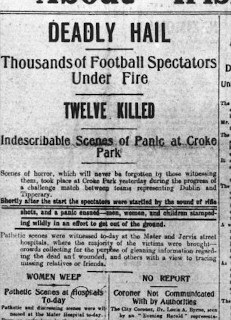
Later that afternoon, lashing out blindly, the Black and Tans surround Croke Park during the match and move in. Their supposed purpose is to attempt to capture members of Sinn Féin who might be in the crowd, but they soon open fire indiscriminately on the players and spectators. They kill or fatally wound fourteen civilians and wound at least sixty others before members of the Auxiliary Division, another brutal force created to crush the Irish insurrection, finally manages to get them to cease-fire.
That evening, two Irish republicans and members of Collins’ squad, Dick McKee and Peadar Clancy, who had helped plan the earlier assassinations, along with a third man, a civilian named Conor Clune, who happened to be caught with the others, are beaten and shot dead in Dublin Castle by their captors, who claim they were killed during an escape attempt.
Overall, Bloody Sunday is considered a victory for the IRA, as Collins’s operation severely damages British intelligence, while the later reprisals do no real harm to the guerrillas but increase support for the IRA at home and abroad.
(Pictured: The headline of the Dublin Evening Herald reads ‘Latest Stories about Irish Tragedies’, 22nd November 1920. The newspaper reports on the massacre at a Croke Park football match, shootings in Dublin, and the discovery of a priest’s corpse in a Galway bog. Photo by Hulton Archive/Getty Images)
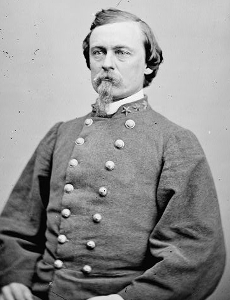
Finegan comes to Florida in the 1830s, first establishing a sawmill at Jacksonville and later a law practice at Fernandina, where he becomes the business partner of David Levy Yulee and begins construction of the Florida Railroad to speed transportation of goods and people from the new state’s east coast to the Gulf of Mexico.
Finegan’s successes are perhaps attributable to his first marriage on July 28, 1842, to the widow Rebecca Smith Travers. Her sister, Mary Martha Smith, is the wife of Florida’s territorial governor, Robert Raymond Reid, an appointee of President Martin Van Buren. In 1852, he is a member of the Committee of Vigilance and Safety of Jacksonville, Florida.
By the outbreak of the American Civil War, Finegan had built his family a forty-room mansion in Fernandina on the site of the modern Atlantic Elementary School. At Florida’s secession convention, he represents Nassau County alongside James G. Cooper.
In April 1862, Finegan assumes command of the District of Middle and Eastern Florida from Brigadier General James H. Trapier. Soon thereafter, he suffers some embarrassment surrounding the wreck of the blockade runnerKate at Mosquito Inlet (the modern Ponce de Leon Inlet). Her cargo of rifles, ammunition, medical supplies, blankets, and shoes is plundered by civilians. Attempts to recover these items takes months before he issues a public appeal. Eventually, most of the rifles are found, but the other supplies are never recovered. Also in 1862, recognizing the importance of Florida beef to the Confederate cause, he gives cattle baron Jacob Summerlin permission to select thirty men from the state troops under his command to assist in rounding up herds to drive north.
At this time, the principal Confederate military post in east Florida is dubbed “Camp Finegan” to honor the state’s highest-ranking officer. It is about seven miles west of Jacksonville, south of the rail line near modern Marietta.
In 1863, Finegan complains of the large quantity of rum making its way from the West Indies into Florida. Smugglers are buying it in Cuba for a mere seventeen cents per gallon, only to sell it in the blockaded state for twenty-five dollars per gallon. He urges Governor John Milton to confiscate the “vile article” and destroy it before it can impact army and civilian morals.
In February 1864, General P. G. T. Beauregard begins rushing reinforcements to Finegan after Confederate officials become aware of a build-up of Union Army troops in the occupied city of Jacksonville. As Florida is a vital supply route and source of beef to the other southern states, they cannot allow it to fall completely into Union hands.
On February 20, 1864, Finegan stops a Union Army advance from Jacksonville under General Truman Seymour that is intent upon capturing the state capitol at Tallahassee. Their two armies clash at the Battle of Olustee, where Finegan’s men defeat the Union Army and force them to flee back beyond the St. Johns River. Critics have faulted Finegan for failing to exploit his victory by pursuing his retreating enemy, contenting himself by salvaging their arms and ammunition from the battlefield. His victory, however, is one rare bright spot in an otherwise gloomy year for the dying Confederacy.
Some Finegan detractors believe he did little more to contribute to the Confederate victory at Olustee than to shuttle troops forward to General Alfred H. Colquitt of Georgia, whom they credit for thwarting the Union Army advance. They point out that Finegan was quickly relieved of his command over the state troops, replaced by Major GeneralJames Patton Anderson. But this change in command is necessary as Finegan is ordered to lead the “Florida Brigade” in the Army of Northern Virginia, where he serves effectively until near the end of the war.
Finegan returns to Fernandina after the war to discover his mansion has been seized by the Freedmen’s Bureau for use as an orphanage and school for black children. It takes some legal wrangling, but he is eventually able to recover this property. He has to sell most of his lands along Lake Monroe to Henry Shelton Sanford for $18,200 to pay his attorneys and other creditors. He does retain a home site at Silver Lake. Adding to his sorrows is the untimely death of his son Rutledge on April 4, 1871, precipitating a move to Savannah, Georgia. There, he feels at home with the large Irish population and works as a cotton broker.
It is while living in Savannah that Finegan marries his second wife, the widow Lucy C. Alexander, a Tennessee belle. They eventually settle on a large orange grove in Orange County, Florida. Finegan dies on October 29, 1885, at Rutledge, Florida. According to the Florida Union, his death is the result of “severe cold, inducing chills, to which he succumbed after brief illness.” The paper describes him as “hearty, unaffected, jovial, clear-headed, and keen-witted.” He is buried at the Old City Cemetery in Jacksonville.
When the Irish Rebellion of 1798 breaks out in Ireland, Wolfe Tone urges the French Directory to send effective assistance to the Irish rebels. All that can be promised is a number of raids to descend simultaneously around the Irish coast. One of these raids under General Jean Joseph Amable Humbert succeeds in landing a force near Killala, County Mayo, and gains some success in Connacht (particularly at Castlebar) before it is subdued by General Gerard Lake and Charles Cornwallis. Wolfe Tone’s brother Matthew is captured, tried by court-martial and hanged. A second raid, accompanied by James Napper Tandy, comes to a disastrous end on the coast of County Donegal.
Wolfe Tone takes part in a third raid, under Admiral Jean-Baptiste-François Bompart, with General Jean Hardy in command of a force of 2,800 men. He certainly knows before departing that the odds against them are incredibly long. Most of the United Irish organization has already spent itself in Wexford, Ulster, and other places. There is one slim reed of hope for success – the news from Hubert, who is sweeping the British before him in Mayo with his 1,000 Frenchmen and Irish rebel allies. Wolfe Tone once said he would accompany any French force to Ireland even if it were only a corporal’s guard, so he sails off with Hardy’s Frenchmen aboard the Hoche.
They are intercepted by a large British fleet at Buncrana on Lough Swilly on October 12, 1798. Escape aboard one of the small, fast ships is Wolfe Tone’s only hope to avoid a hangman’s noose but he refuses to transfer from the large, slow Hoche, which has little choice but certain sinking or capture. He refuses offers by Napoleon Bonaparte and other French officers of escape in a frigate before the Battle of Tory Island. “Shall it be said,” he asks them, “that I fled while the French were fighting the battle of my country?”
The Hoche withstands an attack by five British ships for several hours, with Wolfe Tone commanding one of her batteries. Inevitably the masts and rigging of the Hoche are shot away and she strikes her colors. Wolfe Tone is dressed in a French adjutant general‘s uniform, but there is little chance of him avoiding detection with so many former acquaintances among the British. He is thrown into chains taken prisoner when the Hoche surrenders.
When the prisoners are landed at Letterkenny Port a fortnight later, Sir George Hill recognises Wolfe Tone in the French adjutant general’s uniform in Lord Cavan’s privy-quarters at Letterkenny. At his trial by court-martial in Dublin on November 8, 1798, Wolfe Tone makes a speech avowing his determined hostility to England and his intention “by frank and open war to procure the separation of the countries.” Recognising that the court is certain to convict him, he asks that “the court should adjudge me to die the death of a soldier, and that I may be shot.” His request to be shot is denied.
On November 10, 1798, Wolfe Tone is found guilty and sentenced to be hanged on November 12. Before this sentence is carried out, either he attempts suicide by slitting his throat or British soldiers torture and mortally wound him. Military surgeon Benjamin Lentaigne treats him just hours before he is due to be hanged. The story goes that he is initially saved when the wound is sealed with a bandage, and he is told if he tries to talk the wound will open and he will bleed to death.
A pamphlet published in Latin by Dr. Lentaigne some years after Wolfe Tone’s official “suicide” refers to an unusual neck wound suffered by an unnamed patient which indicates that “a bullet passed through his throat.” This leads to speculation that Wolfe Tone may have been shot.
Theobald Wolfe Tone dies on November 19, 1798, at the age of 35 in Provost’s Prison, Dublin, not far from where he was born. He is buried in Bodenstown Graveyard in County Kildare, near his birthplace at Sallins, and his grave is in the care of the National Graves Association.
(Pictured: “Capture Of Wolfe Tone Date 1798,” a drawing by Mary Evans Picture Library, the UK’s leading source for historical images)
After the Belgian Congo becomes independent (as Republic of the Congo) in 1960, a civil war breaks out in Katanga, the southern, mineral-rich province of Congo. A local political leader, Moïse Tshombe, declares Katanga an independent state. United Nations peacekeeping troops are invited to help restore order and to end the Katanga secession.
The Luba people or “Baluba” ethnic group do not support the Katangese secession. As a result, they come under attack from pro-Katangese and allied forces. On October 4, several villages are attacked by Katangese gendarmes and European mercenaries and many Baluba are massacred. This leaves them suspicious of and hostile to any white European troops. Irish troops are sent to the area to secure it and encourage local people to return.
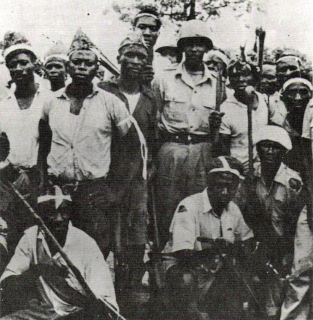
On November 8, 1960, an eleven-man section from the Irish Army’s 33rd Battalion arrives at the bridge over the Luweyeye River. They are forced to leave their vehicles when they encounter a blockade on the road. While clearing it, they encounter about 100 Luba militiamen armed with bows, poison-tipped arrows, spears and clubs, as well as some guns. While the Irish troops had arrived to protect the Baluba, the militia undoubtedly mistakes them for Katangese mercenaries. Lieutenant Kevin Gleeson, advancing unarmed with his platoon sergeant, Hugh Gaynor, attempt to greet them peacefully, but is hit with a barrage of poison-tipped arrows.
Gleeson and Gaynor are overtaken, beaten and hacked to death. The surprised Irish soldiers, who had not been deployed in a defensive formation after dismounting from their vehicles, retreat behind trees on either side of the road and open fire on the tribesmen with their Gustav submachine guns, Lee–Enfield rifles and Bren light machine guns. The Baluba however advance on them, and the Irish are cut off from their vehicles. Despite taking heavy losses, the Baluba overrun the Irish soldiers, and fierce hand-to-hand fighting breaks out, during which most of the Irish troops are killed.
The surviving Irish troops regroup by a ridge but are surrounded by the Baluba. They fight to hold them off, but their position is rapidly overrun and all but three of them are killed. The three survivors manage to escape. One of them, Anthony Browne, reaches a nearby village and gives all the money he has to the village women, hoping they will get him help, but is instead mobbed and beaten to death by the village men. His body is recovered two years later. The two surviving soldiers manage to hide and are found by other UN troops the following day.
A total of nine Irish soldiers die: Lt. Kevin Gleeson of Carlow, Sgt. Hugh Gaynor of Blanchardstown, Cpl. Peter Kelly of Templeogue, Cpl. Liam Dougan of Cabra, Pt. Matthew Farrell of Jamestown, Dublin, Tpr. Thomas Fennell of Donnycarney, Tpr. Anthony Browne of Rialto, Pte. Michael McGuinn of Carlow, and Pte. Gerard Killeen of Rathmines. Some 25 Baluba are also killed.
The bodies of the Irish dead are flown to Casement Aerodrome in Baldonnel, where they lay in state. Lt. Kevin Gleeson’s coffin is placed on a gun carriage, while those of the rest are placed on army trucks. Following a funeral procession through Dublin, they are buried at Glasnevin Cemetery.
A stone commemorating Lt. Gleeson can be found in his hometown of Carlow while a plaque commemorating Sgt. Hugh Gaynor can be found in his hometown of Blanchardstown.
The notoriety of the attack, and the allegations of mutilation and cannibalism that circulate in the Irish popular press in its aftermath, lead to the word “baluba” (sometimes spelled “balooba”) becoming a synonym for any “untrustworthy and barbaric” individual in certain parts of Ireland.
Following the Battle of Gettysburg in July 1863, the Union and Confederate armies drift south and for three months spar with one another on the rolling plains of northern Virginia. In late October, GeneralRobert E. Lee withdraws his Confederate army behind the Rappahannock River, a line he hopes to maintain throughout the winter. A single pontoon bridge at the town of Rappahannock Station is the only connection Lee retains with the northern bank of the river.
The Union Army of the Potomac‘s commander, Maj. Gen. George G. Meade, divides his forces just as Lee expects. He orders Maj. Gen. John Sedgwick to attack the Confederate position at Rappahannock Station while Maj. Gen. William H. French forces a crossing five miles downstream at Kelly’s Ford. Once both Sedgwick and French are safely across the river, the reunited army is to proceed to Brandy Station.
The operation goes according to plan. Shortly after noon on November 7, French drives back Confederate defenders at Kelly’s Ford and crosses the river. As he does so, Sedgwick advances toward Rappahannock Station. Lee learns of these developments sometime after noon and immediately puts his troops in motion to meet the enemy. His plan is to resist Sedgwick with a small force at Rappahannock Station while attacking French at Kelly’s Ford with the larger part of his army. The success of the plan depends on his ability to maintain the Rappahannock Station bridgehead until French is defeated.
Sedgwick first engages the Confederates at 3:00 PM when Maj. Gen. Albion P. Howe‘s division of the VI Corps drives in Confederate skirmishers and seizes a range of high ground three-quarters of a mile from the river. Howe places Union batteries on these hills that pound the enemy earthworks with a “rapid and vigorous” fire. Confederate guns across the river return the fire, but with little effect.
Maj. Gen. Jubal Early’s division occupies the bridgehead defenses that day. Early posts Brig. Gen.Harry T. Hays‘s Louisiana brigade and Captain Charles A. Green’s four-gun Louisiana Guard Artillery in the works and at 4:30 PM reinforces them with three North Carolina regiments led by ColonelArchibald C. Godwin. The addition of Godwin’s troops increases the number of Confederate defenders at the bridgehead to nearly 2,000.
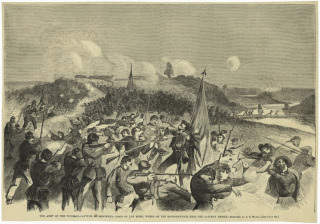
Sedgwick continues shelling the Confederates throughout the late afternoon, but otherwise he shows no disposition to attack. As the day draws to a close, Lee becomes convinced that the movement against the bridgehead is merely a feint to cover French’s crossing farther downstream. He is mistaken. At dusk the shelling stops, and Sedgwick’s infantry rushes suddenly upon the works. Col. Peter Ellmaker’s brigade advances adjacent to the railroad, precedes by skirmishers of the 6th Maine Volunteer Infantry. At the command “Forward, double-quick!” they surge over the Confederate works and engage Hays’s men in hand-to-hand combat. Without assistance, the 6th Maine breaches the Confederate line and plants its flags on the parapet of the easternmost redoubt. Moments later the 5th Wisconsin Infantry Regiment swarms over the walls of the western redoubt, likewise, wresting it from Confederate control.
On the right, Union forces achieve comparable success. Just minutes after Ellmaker’s brigade penetrates Hays’s line, Col. Emory Upton‘s brigade overruns Godwin’s position. Upton reforms his lines inside the Confederate works and sends a portion of the 121st New York Volunteer Infantry to seize the pontoon bridge, while the rest of his command wheels right to attack the confused Confederate horde now massed at the lower end of the bridgehead.
Confederate resistance dissolves as hundreds of soldiers throw down their arms and surrender. Others seek to gain the opposite shore by swimming the icy river or by running the gauntlet of Union rifle fire at the bridge. Confederate troops south of the Rappahannock look on hopelessly as Union soldiers herd their comrades to the rear as prisoners of war.
In all, 1,670 Confederates are killed, wounded, or captured in the brief struggle, more than eighty percent of those engaged. Union casualty figures, by contrast, are small: 419 in all. The battle is as humiliating for the South as it is glorious for the North. Two of the Confederacy’s finest brigades, sheltered behind entrenchments and well supported by artillery, are routed and captured by an enemy force of equal size.
The Civil War Trust and its partners have acquired and preserved 856 acres of the battlefield where the First and Second Battles of Rappahannock Station were fought. The battleground for both battles is located along the Rappahannock River at Remington, VA and features visible earthworks as well as bridge and mill ruins. The earthworks at Remington are no longer there and more than 75% of the battlefield has been developed over.
Irish Republican Army (IRA) fighters from West Waterford, under Column O/C George Lennon, ambush a British army patrol at Piltown (Kinsalebeg), County Waterford, on November 1, 1920 during the Irish War of Independence. Two soldiers are killed, six wounded, and thirty captured although those captured are later released. Royal Irish Constabulary (RIC) Constable Maurice Prendiville promises to leave the RIC but is fatally shot the following month at the Youghal Bridge.
Involved is the IRA West Waterford Brigade, specifically the newly formed Deise Flying Column under O/C Lennon of Dungarvan, as well as Volunteers from the local Ardmore battalion. Returned Great War veteran John Riordan plans the successful engagement involving a feint attack on the RIC barracks in Ardmore.
The British garrison in Youghal subsequently dispatches nearly twenty troops in a single lorry. They are ambushed at Kinsalebeg and suffer two dead and six wounded. The ambush results in the capture of several rifles and a large quantity of ammunition which are used to equip the flying column. Captured are RIC constables O’Neill and Prendiville who give their word that they will resign. Prendiville is subsequently killed from a shot from the Waterford side of the Youghal Bridge.
(Pictured: Piltown Cross Ambush Memorial unveiled in 2008)
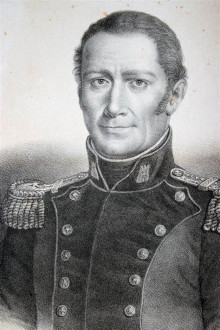
He is born John MacKenna, the son of William MacKenna of Willville House near Monaghan and Eleanora O’Reilly and, on his mother’s side, a nephew to CountAlejandro O’Reilly. Count O’Reilly takes an interest in the young Mackenna and takes him to Spain where he studies at the Royal School of Mathematics in Barcelona. He also trains in the Royal Military Academy as a Military Engineer between 1785 and 1791.
In 1787 Mackenna is accepted into the Irish Brigade of the Spanish Army, and joins the army fighting in Ceuta in northern Africa, under Lieutenant Colonel Luis Urbina, and is promoted to Second Lieutenant. In 1791 he resumes his studies in Barcelona and acts as liaison with mercenaries recruited in Europe. The following year he is promoted to Lieutenant in the Royal Regiment of Engineers. In the War of the Pyrenees against the French, he fights in Rosselló under General Ricardos and there meets the future liberator of Argentina, José de San Martín. For his exploits in defence of the Plaza de Rozas, he is promoted to captain in 1795.
For the purpose of a new assignment, in October 1796, Mackenna leaves Spain for South America. He arrives in Buenos Aires and then travels to Mendoza and to Chile across the Andes and then to Peru. Once in Lima, he contacts Ambrosio O’Higgins, another Irishman, at that time Viceroy of Perú, who names him Governor of Osorno and puts him in charge of the reconstruction works for the southern Chilean town.
In this capacity, Mackenna convinces the families of Castro, on Chiloé Island, to move to Osorno to found a colony there. He builds the storehouse and two mills, as well as the road between Osorno and present-day Puerto Montt. His successful administration provokes jealousy from Chile’s captain-general Gabriel de Avilés, who fears that Mackenna and Ambrosio O’Higgins will create an Irish colony in Osorno. Both Irishmen are loyal to the Spanish crown, though Mackenna has good relations with O’Higgins’ son Bernardo, the future emancipator of Chile, and is also connected with the VenezuelanFrancisco de Miranda and his group of supporters of South American independence. When Ambrosio O’Higgins dies in 1801, Avilés is appointed viceroy of Peru. It takes him eight years to remove Mackenna, O’Higgins’s protégé, from Osorno.
In 1809 Mackenna marries Josefina Vicuña y Larraín, an eighteen-year-old Chilean woman from a family with revolutionary connections, with whom he has three children. After the Declaration of Chilean Independence in 1810, he adheres to the Patriot side and is commissioned by the first Chilean government to prepare a plan for the defense of the country and oversees the equipment of the new Chilean Army. At this juncture he trains the first military engineers for the new army.
The following year Mackenna is called to the defence committee of the new Republic of Chile, and in 1811 is appointed governor of Valparaíso. Owing to political feuds with José Miguel Carrera and his brothers, he is dismissed from the post and taken prisoner. He is a firm ally of Bernardo O’Higgins, who appoints him as one of the key officers to fight the Spanish army of General José Antonio Pareja. His major military honour is attained in 1814 at the Battle of Membrillar, in which the general assures a temporary collapse of the royal forces.
As a reward for his victory, Mackenna is appointed commandant-general by Bernardo O’Higgins, but after a coup d’état led by Luis Carrera he is exiled to Argentina in 1814, when Carrera comes to power. Mackenna dies in Buenos Aires on November 21, 1814, following a duel with Carrera.
A bust of General Mackenna is publicly presented to Monaghan County Museum on August 5, 2004 by his direct descendant, Luis Valentín Ferrada. At the presentation ceremony, MacKenna, the man “unreservedly regarded as the greatest of County Monaghan’s exiles” is commemorated in speeches by Most Rev. Dr. Joseph Duffy, Bishop of Clogher and by his descendant Senor Ferrada who declares, “In this city of Monaghan, very near to Willville House, the tombs of my ancestors are in the old cemetery. There, my own blood is interred in the sacred earth.”
Corby is born to Daniel Corby, an Irish immigrant, and his wife Elizabeth, a Canadian. He attends public school until age 16, then joins his father’s real estate business. In 1853, he enrolls in the 10-year-old college of Notre Dame in South Bend, Indiana, and begins study for the priesthood three years later. Following ordination, he teaches at Notre Dame and serves as a local parish priest.
Corby leaves his position at Notre Dame and joins the predominately Catholic Irish Brigade in 1861. He spends the next three years as chaplain of the 88th New York Volunteer Infantry, which is one of the five original regiments in the Irish Brigade. He is perhaps best known for giving general absolution to the Irish Brigade on the second day of the Battle of Gettysburg. Of the Brigade’s original 3,000 men, only about 500 remain. Of the men Corby absolves that day, 27 are killed, 109 are wounded, and 62 are listed as missing. The scene of Corby blessing the troops is depicted in the 1891 painting Absolution under Fire by Paul Wood, and dramatized in the 1993 film Gettysburg. His memoir of the Irish Brigade becomes a best-seller.
Following his service in the Civil War, Corby returns to Notre Dame and serves as its vice-president (1865–1866) and twice as its president (1866–1872, 1877-1881). Under his first administration, enrollment at Notre Dame increases to more than 500 students. In 1869 he opens the law school, which offers a two-year course of study, and in 1871 he begins construction of Sacred Heart Church, today the Basilica of the Sacred Heart, Notre Dame. The institution is still small, and he teaches in the classroom and knows most students and faculty members. In 1869, the entire student body and the faculty present him with the gift of a black horse and, when he leaves the presidency three years later, they present him with a matching carriage.
Corby becomes president again following the short term of Fr. Patrick Colovin. When he returns to the presidency, Notre Dame has not yet become a significant academic institution. His presidency sees the April 1879 fire that destroys the old Main Building of the school. He sends all students home and promises that they will return to a “bigger and better Notre Dame.” He overcomes the $200,000 fire loss and rebuilds the Main Building, which now stands with its “Golden Dome.” During his administration, he also constructs Washington Hall, in which he takes much pride, and starts the construction of St. Edward’s Hall for the minims program.
In addition to his presidency, Corby is also serving as the Holy Cross Provincial, when Rev. Edward Sorin, who had become Superior General of the Congregation, writes to him to tell him that he will have to relinquish one of his positions. He wants to remain president but is overruled by Sorin. Famous throughout the U.S. Catholic world as chaplain for the Irish Brigade, known as the “Fighting Irish,” it may be that the nickname followed Corby back to Notre Dame, where it stuck.
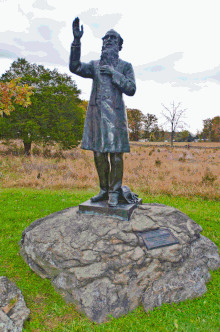
A statue by Samuel Murray, depicting Corby with right hand raised in the gesture of blessing, stands upon the same boulder at the Gettysburg Battlefield on which the priest stood while blessing the troops that second morning of the battle. It is the first statue of a non-general erected on the Gettysburg Battlefield, and is dedicated in 1910.
Corby is widely remembered among military chaplains and celebrated by Irish American fraternal organizations. Corby Hall at Notre Dame is named for him, and a copy of the Gettysburg statue stands outside the building. An organization of Notre Dame alumni is named The William Corby Society.
(Pictured: Statue of Father William Corby by Samuel Murray, Gettysburg Battlefield, Gettysburg, Pennsylvania)
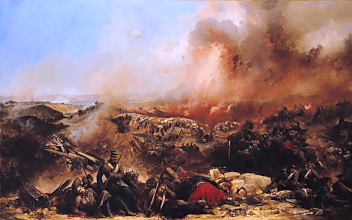
“On 18 June 1855 after the attack on the Redan at Sevastopol, Crimea, Alexander went out from the trenches under very heavy fire and brought in several wounded men. On 6 September, when he was with a working party in the most advanced trench, he went out under heavy fire and helped to bring in a captain who was severely wounded.”
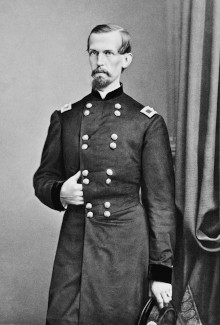
Corcoran is the only child of Thomas Corcoran, an officer in the British Army, and Mary McDonagh. Through his mother, he claims descent from Patrick Sarsfield, hero of the Williamite War in Ireland and leader of the Wild Geese. In 1846 he takes an appointment to the Revenue Police, enforcing the laws and searching for illicit stills and distilling activities in Creeslough, County Donegal. He also joins a guerrilla group called the Ribbonmen.
On August 30, 1849, Corcoran emigrates from Sligo to the United States and settles in New York City where he finds work as a clerk in the tavern owned by John Heaney, whose niece, Elizabeth, he marries in 1854.
Corcoran enlists as a Private in the 69th New York Militia. By 1859 he is appointed colonel of the regiment. The regiment is a state militia unit at the time composed of citizens, not soldiers, and is involved in the maintenance of public order. On October 11, 1860, he refuses to march the regiment on parade for the 19-year-old Prince of Wales, who is visiting New York City at the time, protesting the British imposition of the Irish Famine. He is removed from command and a court martial is pending over that matter when the Civil War begins.
Corcoran also becomes involved in Democratic politics at Tammany Hall. He becomes district leader, a member of the judicial nominations committee, an elected school inspector for his ward, and a member of the Fourteenth Ward General Committee. He is one of the founders of the Fenian Brotherhood in America.
With the outbreak of war, the court martial is dropped and Corcoran is restored to his command because he had been instrumental in bringing other Irish immigrants to the Union cause. He leads the 69th to Washington, D.C. and serves for a while in the Washington defenses building, Fort Corcoran. In July 1861 he leads the regiment into action at the First Battle of Bull Run and is taken prisoner.
While Corcoran is imprisoned, the United States makes threats to execute captured Confederateprivateers. Corcoran and several other Union prisoners are selected by lot for execution if the United States carries out its threats against the privateers. This event is known as the Enchantress Affair, but no executions are ever carried out by either side. Corcoran is then offered a parole under the conditions that he does not take up arms against the Confederacy. Intending to resume his place in the Union army upon his release he refuses the offer of parole. He is appointed Brigadier General of volunteers in July and exchanged in August 1862. His role in the Enchantress Affair and his refusal for parole gains him some attention and upon his release he is invited to dinner with President Abraham Lincoln.
In April 1863 Corcoran is involved in an incident that ends with Corcoran shooting and killing Edgar A. Kimball, commander of the 9th New York Volunteer Infantry Regiment. Corcoran attempts to pass through the 9th New York’s area without giving the required password after receiving the challenge from a sentry. When Kimball intervenes on the side of the sentry, Corcoran shoots him. Corcoran is not charged with a crime or reprimanded and continues to serve.
Corcoran returns to the army and sets about recruiting more Irish volunteers. He raises and takes command of what becomes known as the Corcoran Legion. Placed in command of the 1st Division, VII Corps he is engaged in the Battle of Deserted House and takes part in the Battle of Suffolk. In late 1863 he is placed in command of a division in the XXII Corps and returns to serve in the Washington defenses. While riding alone in Fairfax, Virginia he is thrown from a runaway horse and suffers a fractured skull. He dies at the age of 36 at the William Gunnell House on December 22, 1863.
New York City MayorMichael Bloomberg unveils Ireland’s national monument to the Fighting 69th in Ballymote on August 22, 2006. The monument is sculpted by Philip Flanagan. The inscription around the top of the monument reads “Michael Corcoran 1827–1863” Around the base is inscribed “New York Ballymote Creeslough Bull Run.” Underneath the monument is a piece of steel from the World Trade Center, donated by the family of Michael Lynch, who died in the tower on September 11, 2001. Lynch’s family are also from County Sligo.



 seamus dubhghaill