seamus dubhghaill

Promoting Irish Culture and History from Little Rock, Arkansas, USA


1 Comment

The Battle of Kilrush

james-butler-earl-of-ormonde

The Battle of Kilrush, a battle at the start of the Irish Confederate Wars in Ireland, takes place on April 15, 1642, soon after the Irish Rebellion of 1641.

The battle is fought between a Royalist army under the James Butler, 12th Earl of Ormonde, and Richard Butler, 3rd Viscount Mountgarret, who leads Confederate Irish troops raised during the Irish Rebellion of 1641. Ormonde and Mountgarret are cousins, both being members of the Butler dynasty.

Ormonde’s troops leave Dublin on April 2 and march unopposed from Naas to Athy and on to Maryborough, now Portlaoise, arriving on April 8. There they resupply the royalist garrisons and send cavalry forces to support those at Carlow and Birr, before returning to Athy on April 13. Setting out at 6:00 AM on April 15, and having decided to avoid a battle on their return march to Dublin, the government troops are blocked by Mountgarret’s rebel militias at Kilrush, two miles south of Suncroft, between Kilcullen and Moone in southeastern County Kildare.

The land is remarkably flat, with the exception of two ridges that run nearly parallel northward from a castle, with a marsh lying between. The army of Ormonde, consisting of 2,500 foot soldiers and 500 horses, assembles on the high grounds of Ardscull, Fontstown, and Kilrush, while the rebel army under Mountgarret, consisting of 8,000 foot soldiers and 400 horses, proceeds in the same direction along the heights of Birtown, Ballyndrum, Glasshealy, and Narraghmore. Mountgarret, having the advantage in numbers, and anxious for battle, outmarches Ormonde’s forces, and posts himself on Bull Hill and Kilrush, completely intercepting Ormonde’s further progress to Dublin. A general engagement becomes unavoidable. The left wing of the Irish is broken by the first charge. The right wing, animated by their leaders, maintains the contest for some time, but eventually falls back to neighbouring Battlemount. Here they break, flee and are pursued with great slaughter across the grounds they had marched over the previous day. Ormonde’s army then marches on to Dublin, arriving on April 17.

Ormonde’s army suffers twenty fatalities and approximately forty wounded in the Battle of Kilrush. Mountgarret’s rebel army loses more than 700, among which are several colonels. The victory is considered of such consequence that Ormonde is presented with a jewel valued at £50 by the Irish Government.

(Pictured: Sir Peter Lely’s oil painting of James Butler, 12th Earl of Ormonde)


Leave a comment

The Headford Ambush

headford-ambush

The Headford Ambush is carried out by the Irish Republican Army (IRA) on March 21, 1921, during the Irish War of Independence. The battle lasts almost an hour and fourteen people are killed – nine British soldiers, two IRA volunteers and three civilians.

The guerrilla war in County Kerry escalates rapidly in the spring of 1921. The county is occupied by the British Army, Auxiliary Division and Black and Tans paramilitary police, as well as the Royal Irish Constabulary (RIC). For the previous several months they have been burning suspected Republicans’ property and shooting suspected IRA sympathisers. By early 1921, they have begun rounding up male inhabitants of nearby towns and villages and searching for IRA suspects.

On January 23, in response to the IRA’s assassination of RIC District Inspector Sullivan, 1,000 soldiers and armed police surround Ballymacelligott, arrest 240 men and march them to Tralee for questioning. British forces, especially the Auxiliaries, also carry out a number of reprisal shootings of local civilians. The IRA sets up full-time guerrilla units, known as flying columns, to avoid arrest and to assemble units capable of taking on British patrols. IRA GHQ in Dublin also sends an organizer, Andy Cooney, to Kerry to oversee the setting up of flying columns. On March 2, under Cooney’s direction, the 2nd Kerry Brigade sets up its own flying column under Dan Allman and Tom McEllistrim. On March 5, McEllistrim leads 20 volunteers from the column to a successful ambush at Clonbanin, in which they co-operate with Cork IRA units, killing four British soldiers including Brigadier General Hanway Robert Cumming. Buoyed by their success in Cork, the 2nd Kerry Brigade tries on a number of occasions to ambush British forces in Kerry itself.

On March 21, an IRA party of the 2nd Kerry Brigade is billeted about four miles from the Headford railway junction when they hear that British troops are returning by train from Kenmare to Tralee. As the train does not go directly to Tralee, the British have to change trains at Headford, making them vulnerable to ambush. Allman, commanding 30 volunteers, reaches the junction only 12 minutes before the train, which is carrying 30 soldiers of the 1st Royal Fusiliers. The railway staff just has time to flee before the train pulls into the platform, where its passengers have to change trains for Tralee. Alongside the soldiers, the train is packed with cattle and pig farmers on their way back from the market in Kenmare. Most of the civilians have already got off when the British soldiers begin to disembark. Allman himself tries to disarm a Fusilier but shoots him when he resists. This is the signal for the IRA to open fire on the British troops.

One of the first British casualties is Lieutenant CE Adams DCM, who is shot dead when he appears at the carriage door, as are several other soldiers who are standing in front of the engine. The surviving British troops open fire from the train while those who have got off scramble underneath it for cover. In the ensuing close-quarter firefight, conducted at a range of just 20 yards, three civilians and two IRA volunteers, including Allman, are killed. Two-thirds of the British force is estimated to have been killed or wounded. Most of those killed are hit in the initial firing. Afterwards, the IRA gunmen have no direct field of fire into the troops who are hidden under the train.

MacEllistrim calls on the survivors to surrender and when they refuse, the IRA begins to move in to finish off those who keep shooting by throwing hand grenades under the train. Just as they are doing so, another train pulls into the junction carrying another party of British troops. The IRA column has used most of its ammunition and is forced to retreat, escaping toward the hills in the south.

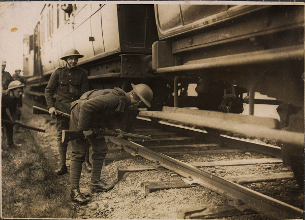
(Pictured: British soldiers searching a train in County Kerry, 1921)


Leave a comment

The Assassination of Tomás Mac Curtain

Tomas-mac-curtain

Tomás Mac Curtain, Sinn Féin Lord Mayor of Cork, is assassinated in Cork, County Cork on March 20, 1920, which is also his 36th birthday.

Thomas Curtin is born at Ballyknockane, Mourne Abbey, County Cork, on March 20, 1884, the son of Patrick Curtin, a farmer, and Julia Sheehan. He attends Burnfort National School. In 1897 the family moves to Cork City, where he attends the North Monastery school.

Mac Curtain, as he later becomes known, is active in a number of cultural and political movements beginning around the turn of the 20th century. He joins the Blackpool, Cork branch of Conradh na Gaeilge, becoming its secretary in 1902. He has interests in music, poetry, history, archaeology and Irish history. He works in his early career as a clerk, and in his free time teaches Irish. In 1911 he joins Fianna Éireann and is a member of the Irish Volunteers.

He meets Elizabeth Walsh (Eibhlís Breathnach) at a Gaelic League meeting, and they marry on June 28, 1908. They have six children, five of whom survive into adulthood. The family lives over 40 Thomas Davis Street, where Mac Curtain runs a small clothing and rainwear factory.

In April 1916, at the outset of the Easter Rising, Mac Curtain commands a force of up to 1,000 men of the Irish Volunteers who assemble at various locations around County Cork. From the volunteer’s headquarters at Sheares Street in the city, Mac Curtain and his officers await orders from the volunteer leadership in Dublin, but conflicting instructions and confusion prevail and as a result the Cork volunteers never enter the fray. A tense stand-off develops when British forces surround the volunteer hall and continued for a week until a negotiated agreement leads to the surrender of the volunteers’ arms to the then Lord Mayor of Cork Thomas Butterfield on the understanding that they will be returned at a later date. This does not happen however, and Mac Curtain is jailed in Wakefield Prison, in the Frongoch internment camp in Wales, and in Reading Gaol. After the general amnesty of participants in the Rising 18 months later, Mac Curtain returns to active duty as a Commandant of what is now the Irish Republican Army.

By 1918 Mac Curtain is a brigade commander, the highest and most important rank in the IRA. During the Conscription Crisis of 1918, he actively encourages the hiring of the women of Cumann na mBan to cater for Volunteers. He is personally involved with Michael CollinsSquad that, along with a Cork battalion, attempt to assassinate Lord John French, whose car is missed as the convoy passes through the ambush positions. Despite the setback he remains brigadier of No.1 Cork when he is elected Lord Mayor. He is elected in the January 1920 council elections as the Sinn Féin councillor for NW Ward No. 3 of Cork and is chosen by his fellow councillors to be the Lord Mayor. He begins a process of political reform within the city.

In January 1919, the Irish War of Independence starts, and Mac Curtain becomes an officer in the IRA. On March 20, 1920, his 36th birthday, Mac Curtain is shot dead in front of his wife and son by a group of men with blackened faces, who are found to be members of the Auxilaries along with unknown members of the Royal Irish Constabulary (RIC) by the official inquest into the event. In the wake of the killing, which is in revenge for the shooting of a policeman, Mac Curtain’s house in Blackpool is ransacked.

The killing causes widespread public outrage. The coroner’s inquest passes a verdict of willful murder against British Prime Minister David Lloyd George and against certain members of the RIC. Michael Collins later orders his squad of assassins to uncover and assassinate the police officers involved in the attack. RIC District Inspector Oswald Swanzy, who had ordered the attack, is fatally shot, with Mac Curtain’s own revolver, while leaving a Protestant church in Lisburn, County Antrim on August 22, 1920, sparking what is described by Tim Pat Coogan as a “pogrom” against the Catholic residents of the town.

Tomás Mac Curtain is buried in St. Finbarr’s Cemetery, Cork.


Leave a comment

The Crossbarry Ambush

SAMSUNG DIGITAL CAMERADuring the Irish War of Independence, Tom Barry and the West Cork Flying Column of the Irish Republican Army (IRA) rout a superior force from the Essex Regiment of the British Army at Crossbarry, County Cork on March 19, 1921.

A force of one hundred IRA members under the leadership of Barry are involved in a major skirmish with up to 1,000 British troops at Crossbarry. English intelligence has determined that Barry’s West Cork Brigade is based near Crossbarry and plans a major encirclement and assault. Poor planning and timing ensures that the British forces get separated before attacking Barry’s men. Barry is a brilliant guerrilla fighter and strategist who directs an attack against an initial force of approximately 140 men, before he orders his men to break out.

Charlie Hurley, one of the Brigade commanders who is injured during the Upton train ambush, is staying in a house with a pro-republican family, where he is recuperating from serious wounds he had received at Upton a month earlier. When he realises that he is surrounded by the British forces, he flees the house, as Tom Barry comments in his book, to reduce the danger to those in the house. He is shot dead by the pursuing troops. Barry remarks that Hurley “went to meet his death like a true Irishman.” A ballad exists that commemorates him. In addition, the Gaelic Athletic Association (GAA) grounds in Bandon, County Cork are named after him.

Reports as to casualties differ. The IRA claims that over thirty British are killed while official British figures are ten killed and six IRA men killed. Whatever the numbers, it is probably the largest single military engagement in the Irish War of Independence as the IRA knew major battles with British troops would be a disaster for them and rarely got involved in full frontal action. While the casualties may not seem that large, Crossbarry is a major morale victory for the IRA who had “defeated” a British force of over one thousand. Prime Minister David Lloyd George states that the Crossbarry and Kilmichael ambushes convinced him of the need for a truce and a treaty with the Irish rebels.

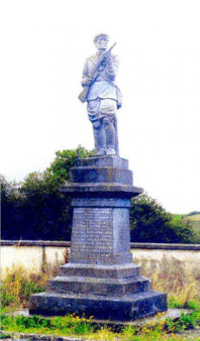
(Pictured: Crossbarry Ambush Memorial, Crossbarry, County Cork)


Leave a comment

The Selton Hill Ambush

selton-hill-ambush-memorial

The Selton Hill Ambush takes place on March 11, 1921, during the Irish War of Independence. An Irish Republican Army (IRA) flying column is ambushed by members of the Royal Irish Constabulary (RIC) Auxiliary Division at Selton Hill, County Leitrim. Six IRA officers of the Leitrim Brigade are killed.

Seán Connolly is an IRA activist from County Longford, but he is also used by IRA GHQ to organise the surrounding areas of County Roscommon and County Leitrim. When Michael Collins orders Connolly into the county, he warns that it is “the most treacherous county in Ireland.” As Connolly is running a training camp at Selton Hill in early 1921, his position is given to the RIC. The RIC District Inspector, Thomas Gore-Hickman, has been alerted to Connolly’s position by a local doctor who had served in the British Army. The doctor had reportedly been told of the training camp by a local member of the Orange Order.

The events at Selton Hill take place one week after the Sheemore ambush, in which British troops from the Bedfordshire and Hertfordshire Regiment, based in Boyle suffer several casualties and at least one fatality. On March 11, at Selton Hill, a large force of RIC and Auxiliaires, based in Mohill and troops from the Bedfordshire and Hertfordshire Regiment surround and then attack the IRA camp. Six IRA volunteers are killed. The RIC suffers no losses. The IRA dead are Sean Connolly, Seamus Wrynne, Joseph O’Beirne, John Reilly, Joseph Reilly, and Capt. M.E. Baxter.

Ernie O’Malley later claims the volunteers’ bodies are “taken to Mohill by soldiers who shouted, “fresh meat!” as they were driving through the town.” He is also quoted as saying, “Men from the Bedfordshire Regiment were seen by a badly wounded IRA officer, Bernie Sweeney who survived, to use rifle butts on the skulls of two wounded men.” He also states that the location of the column was given to the local District Inspector of the RIC by a doctor who had been in the British Army, who received the information by a local Orangeman. The IRA officer who survives is Bernie Sweeney, from Ballinamore, who survives by hiding in a drain, where the cold water prevents him from bleeding to death. He is rescued and hidden from the Black and Tans and Auxiliaries by locals.

The IRA learn their position had been given away by the doctor and the Orangeman. The latter is later killed by the IRA. The doctor escapes to England and later dies in an accident.

The border country of the north midlands often proves to be a treacherous place for IRA training camps. On May 8, 1921, a camp of Belfast IRA volunteers based in the Lappanduff hills in neighbouring County Cavan, is also surprised. One volunteer is killed, thirteen captured, and arms and ammunition are seized by the British forces.

(Pictured: Selton Hill Ambush Memorial, south of the village of Fenagh, County Leitrim)


Leave a comment

Birth of Civil War Officer John O’Neill

john-oneill

John Charles O’Neill, Irish-born officer in the American Civil War and member of the Fenian Brotherhood, is born on March 9, 1834, in Drumgallon, Clontibret, County Monaghan. He is best known for his activities leading the Fenian raids on Canada in 1866 and 1871.

O’Neill receives some schooling in Drumgallon. He emigrates to New Jersey in 1848 at the height of the Great Famine in Ireland. He receives an additional year of education there and works in a number of jobs. In 1857 he enlists in the 2nd United States Dragoons and serves in the Utah War (May 1857 – July 1858), apparently deserting afterwards to California.

In California, he joins the 1st Cavalry and serves as a sergeant in the American Civil War with this regiment until December 1862, at which time he is commissioned as an officer in the 5th Indiana Cavalry. He is credited as being a daring fighting officer, but believes he has not received due promotion, which leads to a transfer to the 17th United States Colored Infantry as captain. He leaves the Union Army prior to the end of the conflict, marrying Mary Crow, with whom he has several children.

While in Tennessee, O’Neill joins the militant Irish American movement, the Fenian Brotherhood, which eschews politics in favor of militant action to expel the British presence in Ireland. He attaches himself to the group led by William Randall Roberts, who wishes to attack Canada.

O’Neill, ranked as colonel, travels to the Canada–US border with a group from Nashville to participate in the Fenian raids. The assigned commander of the expedition does not appear, so O’Neill takes command. On June 1, 1866, he leads a group of six hundred men across the Niagara River and occupies Fort Erie.

The following day, north of Ridgeway, Ontario, O’Neill’s group encounters a detached column of Canadian volunteers, commanded by Lt-Col. Alfred Booker. The inexperienced Canadians are routed by the Civil War veterans. O’Neill withdraws back to Fort Erie and fights a battle against a detachment led by John Stoughton Dennis. With overwhelming numbers of Canadian forces closing in, O’Neill oversees a successful evacuation on the night of June 2-3 back to United States territory. He is later charged with violating the neutrality laws of the United States, but the charges are later dropped.

The penetration of O’Neill’s organisation by British and Canadian spies ensures that his next venture into Canada, the Battle of Eccles Hill, in 1870 is known in advance, and Canada is accordingly prepared. After the Battle of Trout River ends in a disorganized rout, O’Neill is arrested by United States Marshal George P. Foster and charged with violating neutrality laws. He is sentenced to two years in prison in July 1870 but he and other Fenians are pardoned by President Ulysses S. Grant that October.

Though he renounces the idea of further attacks on Canada, he changes his mind at the urging of an associate of Louis Riel, William Bernard O’Donoghue. With the latter, and without the backing of the bulk of the Fenians, he leads an attack on the Hudson’s Bay Company‘s post at Pembina, Manitoba, on October 5, 1871. The area is then disputed between America and Canada. He is arrested by American troops.

In 1874 O’Neill embarks on a lecture tour along the east coast, encouraging the poor Irish that they would have a better standard of living if they would resettle with him in Nebraska. The first Irish colony in Nebraska is set up in Holt County in the town that bears his name today – O’Neill, Nebraska. His legacy is in the communities that exist in Nebraska today. These settlements are thriving and successful farming communities. John O’Neill can claim credit for the spirit of generosity that is still part of these communities today.

In 1877, while on a speaking tour in Little Rock, Arkansas, O’Neill becomes ill and returns to his home in Nebraska. His condition continues to deteriorate and, after been admitted to St. Joseph’s Hospital Omaha in November 1877, suffers a paralytic stroke and dies on January 8, 1878.


Leave a comment

The Boston Massacre

boston-massacre-1770

The Boston Massacre, a riot known as the Incident on King Street by the British, takes place in Boston, Massachusetts on March 5, 1770. British Army soldiers shoot and kill several people while under attack by a mob.

The incident is heavily publicized by leading Patriots, such as Paul Revere and Samuel Adams, to encourage rebellion against the British authorities. British troops have been stationed in Boston, capital of the Province of Massachusetts Bay, since 1768 in order to protect and support crown-appointed colonial officials attempting to enforce unpopular Parliamentary legislation.

Amid ongoing tense relations between the population and the soldiers, a mob forms around a British sentry, who is subjected to verbal abuse and harassment. He is eventually supported by eight additional soldiers, who are subjected to verbal threats and repeatedly hit by clubs, stones and snowballs. Without orders, they fire a ragged series of shots into the crowd, striking eleven men. Three Americans, ropemaker Samuel Gray, mariner James Caldwell, and Crispus Attucks, die instantly. Samuel Maverick, a 17-year-old apprentice ivory turner, is struck by a ricocheting musket ball at the back of the crowd and dies a few hours later, in the early morning of the next day. An Irish immigrant, Patrick Carr, dies two weeks later. Christopher Monk, another apprentice, is one of those seriously wounded in the attack. Although he recovers to some extent, he is crippled and eventually dies in 1780, purportedly due to the injuries he had sustained in the attack a decade earlier.

The crowd eventually disperses after Acting Governor Thomas Hutchinson promises an inquiry, but the crowd re-forms the next day, prompting the withdrawal of the troops to Castle Island. Eight soldiers, one officer, and four civilians are arrested and charged with murder. Defended by lawyer and future American president John Adams, six of the soldiers are acquitted, while the other two are convicted of manslaughter and given reduced sentences. The men found guilty of manslaughter are sentenced to branding on their hand. Depictions, reports, and propaganda about the event, notably the colored engraving produced by Paul Revere, further heighten tensions throughout the Thirteen Colonies.

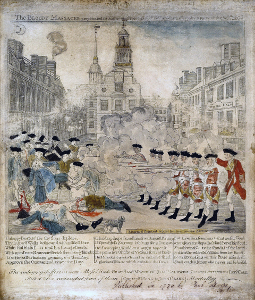
(Pictured: Famous depiction of the Boston Massacre engraved by Paul Revere (copied from an engraving by Henry Pelham), colored by Christian Remick, and printed by Benjamin Edes. The Old State House is depicted in the background.)


4 Comments

Murder of Frank Shawe-Taylor

castle-taylor-ardrahan

Frank Shawe-Taylor, Irish land agent and ex-High Sheriff of County Galway, is shot and killed in an Irish Republican Army (IRA) ambush on March 3, 1920, during the Irish War of Independence. Shawe-Taylor is a member of the Taylor family of Castle Taylor, Ardrahan, County Galway. He is related to Lady Gregory and Captain John Shawe-Taylor. He serves as High Sheriff of County Galway in 1915.

Land disputes in Ireland had been a contentious issue for much of the 19th century, with tenants of landlords insisting on fixity of tenure, which later grows into a demand to own their own land. In addition, The Wyndham Land Act of 1903 enables the transfer of about 9 million acres, up to 1914, from landlords to tenants. However, tenure and ownership of land is still a live issue on the eve of the Irish War of Independence.

Shawe-Taylor is a land agent to a local landlord and is himself a tenant. Early in January 1920, a group of local IRA soldiers, including Mick Kelly, Bill Freaney and Larry Lardner, approach Shawe-Taylor on behalf of some local people who are requesting a road to travel to Mass. While Shawe-Taylor himself is amenable to their demands, his landlord refuses them outright and makes this known via Shawe-Taylor.

On March 3, 1920, Shawe-Taylor and his driver, Barrett, are making their way to Galway to attend the fair. At 6:00 AM the coach reaches Egan’s Pub, Coshla, where they find the road blocked. The donkey cart of a local, Johnny Kelly, has been stolen and placed across the road. From behind the wall, at least two shooters fire at Barrett and Shawe-Taylor, wounding Barrett and killing Shawe-Taylor. This results in a huge security presence in the area, which in turn leads to more unrest with the locals. This increases with the arrival of the Black and Tans, whose irregular methods result in shootings, assaults, rapes and deaths. Moorpark House is placed under Royal Irish Constabulary protection out of fear of further killings.

Other people who subsequently die as a result of the unrest in Galway include Ellen Quinn, a pregnant mother of six and a tenant of Lady Gregory, Fr. Michael Griffin, Tom Egan and brothers Patrick and Harry Loughnane. In addition, there are numerous incidents of violence, many of which are recorded with horror by Lady Gregory in her journal, who remarks that “the country has gone wild since the killing of Frank Shawe-Taylor.”

No one is ever tried for Frank Shawe-Taylor’s killing, though the identities of those involved are known to some locals at the time. His widow eventually sells their property and, with her young children, moves to England.

Shawe-Taylor is buried in St. Mary’s graveyard, Athenry. The music critic, Desmond Shawe-Taylor (1907–1995) and British racing driver Brian Shawe-Taylor (1915–1999) are his sons. His grandson is Desmond Shawe-Taylor, Surveyor of the Queen’s Pictures since 2005.

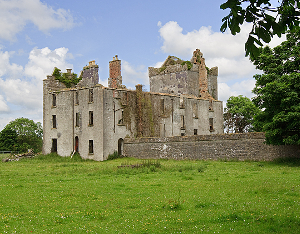
(Pictured: Castle Taylor, near to Ardrahan and Caranavoodaun, Galway, Ireland | Photo © Mike Searle (cc-by-sa/2.0))


3 Comments

Death of General Daniel Florence O’Leary

daniel-florence-oleary

Daniel Florence O’Leary (Irish: Dónall Fínín Ó Laoghaire), a military general and aide-de-camp under Simón Bolívar, dies in Bogotá, Colombia on February 24, 1854.

O’Leary is born around 1800 in Cork, County Cork. His father is Jeremiah O’Leary, a butter merchant. Little is known of his early life.

In 1817, O’Leary travels to London to enlist in a regiment being formed by Henry Wilson. Wilson is recruiting officers and NCOs to go to South America and form a Hussar regiment in service to Simón Bolívar, who goes on to liberate much of South America from Spanish rule.

O’Leary sails for Venezuela with Wilson near the end of 1817, arriving in March 1818. Unlike many of the Irish who fight for Simón Bolívar in his many campaigns to win South American independence, he has not served in the Napoleonic Wars. He first meets Bolívar away from the front shortly his arrival and Bolívar is apparently impressed with the young Irish officer.

In March 1819, O’Leary sees his first action and is promoted to captain. In July, after Bolívar’s famous crossing through the Casanare Swamps and over the Andes, he receives a saber wound in the battle of Pantano de Vargas but he quickly recovers and takes part in the Battle of Boyacá on August 9. Shortly after this, he becomes aide-de-camp to Bolívar. Two years later, after much more fighting, Venezuela is freed.

During the next few years, as the fight continues to free the rest of South American from Spanish domination, O’Leary performs many dangerous missions for “The Liberator,” rising ever higher in his esteem. He continues to serve Bolívar well through the political and military intrigues that follow the freeing of South America from the Spanish.

After Bolívar’s death in December 1830, O’Leary disobeys orders to burn the general’s personal documents and is exiled to Jamaica by the new Venezuelan government. There he writes extensive memoirs that are later edited by his son, Simon Bolivar O’Leary, and published in the 1870s and 1880s. Simon is the eldest of six children O’Leary has with his South American wife. He also writes his own very extensive memoirs, spanning thirty-four volumes, of his time fighting in the revolutionary wars with Bolívar.

In 1833, O’Leary is able to return to Venezuela. He holds a number of diplomatic posts for the Venezuelan government for the next 20 years, and on at least two occasions is able to visit his boyhood home of Cork.

Daniel O’Leary dies in Bogotá on February 24, 1854. The Venezuelans name a plaza after him in Caracas. In 1882, they obtain permission to take O’Leary’s body from Bogotá to Caracas, where it is laid to rest in the National Pantheon of Venezuela to lie forever in death next to the man he had served so faithfully in life, Don Simón Bolívar. A bust and plaque honouring O’Leary are presented by the Venezuelan Government to the people of Cork and unveiled on May 12, 2010 by the Venezuelan Ambassador to Ireland, Dr. Samuel Moncada.


Leave a comment

Death of Denis “Dinny” Lacey

dinny-lacey

Denis “Dinny” Lacey, Irish Republican Army (IRA) officer during the Irish War of Independence and anti-Treaty IRA officer during the Irish Civil War, dies at Glen of Aherlow, County Tipperary on February 18, 1923.

Lacey is born on May 31, 1889 in the village of Attybrick, near Annacarty, County Tipperary. He joins the Irish Volunteers in 1913 and is sworn into the secretive Irish Republican Brotherhood (IRB) in 1914. He is introduced to the IRB by Seán Treacy. During the War of Independence (1919–1921) he is selected to command an IRA flying column of the 3rd Tipperary Brigade, in September 1920. The flying column mounts two successful ambushes of British forces – killing six British soldiers at Thomastown near Golden, and four Royal Irish Constabulary (RIC) men at Lisnagaul in the Glen of Aherlow.

In April 1921, following another ambush of British troops near Clogheen, he captures RIC inspector Gilbert Potter, whom he later executes in reprisal of the British hanging of republican prisoners.

In December 1921, Lacey’s unit splits over the Anglo-Irish Treaty. He opposes the Treaty and most of his men follow suit. He takes over command of the 3rd Tipperary Brigade as Séamus Robinson is appointed to commanded the anti-Treaty IRA’s Second Southern Division. In the ensuing civil war (June 1922-May 1923), he organises guerrilla activity in the Tipperary area against Pro-Treaty Irish Free State forces.

Denis Lacey is killed in an action against Free State troops at Ballydavid, near Bansha in the Glen of Aherlow on February 18, 1923. He is 33 years old at the time of his death. Over 1,000 Free State troops drawn from Cahir, Cashel, Clonmel, and Tipperary, under the command of General John T. Prout, with the intention of breaking up Lacey’s guerrilla unit, converge on the Glen where he and four other men from his column are billeted. Lacey and one of his men are killed and others are captured. Two National Army soldiers are killed in the action.

A memorial in Annacarty commemorates Lacey’s war service and subsequent death in action.