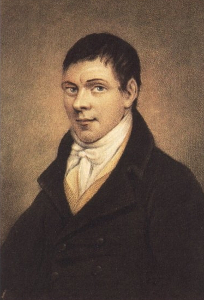
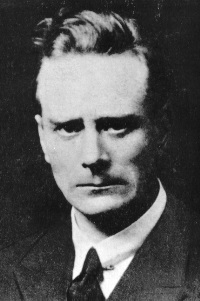
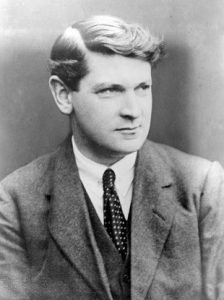
Dwyer is born in Camara, a townland in the Glen of Imaal County Wicklow in 1772 and he participates in the Irish Rebellion of 1798. However, unlike most of the leaders and soldiers in that Rising, he does not either leave the country or return to his normal life, nor is he captured. He retreats into the Wicklow Mountains with a band of men and drives the British to distraction in their attempts to apprehend him. A reward is placed on Dwyer’s head and another for each of his men, but he leads the British authorities on a merry chase for five years, with many daring narrow escapes, each adding to his legend. Some call him the “Outlaw of Glenmalure.”
In 1803, he plans to assist Robert Emmet in his rising but he never receives the signal to join the rising. At this point he recognizes the futility of his situation, and he also wishes to relieve the suffering of a number of his family members, including his sister, whom has been jailed for no offense other than their family relationship to him. Some claim that when he contacts the British to ask terms of surrender, he is promised he and his men will be sent to the United States. If so, and not for the first time, their word to an Irishman proves worthless. After two years of brutal treatment in Kilmainham Gaol, under the infamous Edward Trevor, Dwyer is transported to Botany Bay.
Dwyer and his family, along with a number of his men, set sail for Australia on board the Tellicherry on August 25, 1805, arriving in Sydney on February 14, 1806. However, the story of Michael Dwyer does not end there. In Sydney, Dwyer runs afoul of the Governor, a certain Capt. William Bligh, of HMS Bounty fame. Bligh accuses Dwyer of being the leader of a rebellious plot involving other United Irishmen in the area, which, if true, would certainly not be out of character. Bligh ships Dwyer off to Norfolk Island, one of the worst hellholes of the British penal system in Australia.
After six months he is transferred to Tasmania, where he remains for another two years. In 1808, Bligh leaves the Governorship and Dwyer finally makes it back to his family in Sydney and is granted 100 acres of land nearby. Like many transported Irish rebels, he eventually becomes part of the local establishment and, in a bit of irony, the “Outlaw of Glenmalure” is appointed constable.
Michael Dwyer dies in 1825, but his wife lives to be 93, not dying until 1861. With her passes the last connection to the “Boys of ’98” in Australia. Dwyer remains a legend among the people of the Wicklow Mountains to this day.
Mellows is born at Hartshead Military Barracks, Ashton-Under-Lyne, Lancashire, England, to William Joseph Mellows, a British Armynon-commissioned officer, and Sarah Jordan, of Inch, County Wexford. His family moves to 10 Annadale Avenue, Fairview, Dublin, in February 1895 when Sergeant Mellows is transferred there, however Liam remains in Wexford with his grandfather Patrick Jordan due to ill health. He attends the military school in Wellington Barracks in Cork and the Portobello garrison school in Dublin but ultimately refuses a military career much to his father’s disappointment, instead working as a clerk in several Dublin firms, including the Junior Army & Navy Stores on D’Olier Street.
A nationalist from an early age, Mellows approaches Thomas Clarke, who recruits him to Fianna Éireann, an organisation of young republicans.
Mellows leads roughly 700 Volunteers in abortive attacks on Royal Irish Constabulary stations at Oranmore and Clarinbridge in County Galway and takes over the town of Athenry. However, his men are very badly armed and supplied and they disperse after a week, when British troops and the cruiser HMS Gloucester are sent west to attack them.
After this insurrection fails, Mellows escapes to the United States, where he is arrested and detained without trial in The Tombs in Lower Manhattan, New York, on a charge of attempting to aid the German side in World War I. After his release in 1918, he works with John Devoy and helps to organise Éamon de Valera’s fund-raising visit to America in 1919–1920.
Mellows returns to Ireland to become Irish Republican Army “Director of Supplies” during the Irish War of Independence, responsible for buying arms. At the 1918 general election of December, he is elected to the First Dáil as a Sinn Féin candidate for both East Galway and for North Meath. He considers the Anglo-Irish Treaty as signed to be a betrayal of the Irish Republic. A conference of 9 TDs is deputed to meet privately on January 5, 1922, to resolve the dispute and to achieve a unified front by compromise. The four other anti-Treaty TDs say there is agreement but Mellows does not and is seen thereafter by pro-Treaty TDs as one of their most implacable opponents. The following day the Dáil votes to approve the Treaty by a majority of 64 to 57.
Mellows is one of the more strident TDs on the approach to the Irish Civil War. In June 1922, he and fellow republicans Rory O’Connor, Joe McKelvey and Richard Barrett, among others, enters the Four Courts, which has been occupied by anti-Treaty forces since April. However, they are bombarded by pro-Treaty Free State forces and surrender after two days. Mellows has a chance to escape along with Ernie O’Malley but does not take it. Imprisoned in Mountjoy Gaol, Mellows, O’Connor, McKelvey and Barrett are executed by firing squad on December 8, 1922, in reprisal for the shooting of TD Seán Hales. Mellows is buried in Castletown cemetery, County Wexford, a few miles from Arklow. An annual commemoration ceremony is held at his grave site, in which a wreath is laid by a member of the Liam Mellows Commemoration committee.
Mellows is commemorated by statues in Oranmore and Eyre Square in Galway, in the official name of the Irish Defence Forces army barracks at Renmore and in the naming of Mellows Bridge in Dublin. Mellows Avenue in Arklow is named in his honour. He is also commemorated in the names of two hurling clubs, one in Galway and one in Wexford, and by Unidare RFC in Ballymun and their “Liam Mellows Perpetual Cup.”
The young men become increasingly impatient with the slow pace of O’Connell’s repeal campaign and soon begin to contemplate armed insurrection. Davis, along with John Dillon and Charles Duffy, found The Nation, the newspaper of the movement in 1842. In its pages the idea of total separation from England is soon openly suggested, and Lane becomes one of the paper’s contributors. He contributes articles and later poems to the paper, his best known poems being Carrig Dhoun and Kate of Araglen which are written under the pen name “Domhnall na Glanna” or “Domhnall Gleannach.”
Finally, in 1846, the issue of physical force split the Young Irelanders from O’Connell’s Repeal Association. Lane supports the split. Davis, Lane, and small group of their friends soon become known by the name which has survived to this day: the Young Ireland Party.
Lane and his college classmate Michael Joseph Barry are the most prominent Young Irelanders in Cork, and are interned in Cork City Gaol after the Young Ireland Rebellion of 1848. Lane spends four months in prison. After his release, he returns to Cork and does not appear to have much political involvement thereafter.
The London-born son of a British scholar and an Irish mother, Childers is a lifelong Protestant, itself an anomaly since Irish nationalism maps strongly to Catholicism. In his early years his loyalty was with the British Empire. In his twenties, Childers volunteers for the Second Boer War, and he later says the rank savagery and underlying injustice of England’s war “changed the whole current of my life and made me a Liberal and a Nationalist.”
Laying down the sword, Childers takes up the pen and writes several books of military history. He also writes a novel, The Riddle of the Sands, that has a claim of being the first spy novel. The Riddle of the Sands has never gone out of print since it was published in 1903.
Both in fiction and nonfiction, Childers’ warnings against the German challenge to British hegemony are prophetic, but he is himself becoming a man divided. In 1914 he runs German guns to Irish nationalists aboard his yacht Asgard and then signs up for the royal navy when World War I erupts. The British crackdown on the Easter Rising during the war completes his radicalization. He moves to Dublin and turns his eloquence against the British.
After Collins’s assassination, emergency laws promulgate the death sentence for anyone caught armed without authorization. Childers is a writer, not a partisan, but he is arrested in early November with a small sidearm, a gift Collins had given him back when they were on the same side. It is a time of bloody justice, and they throw the book at him.
Childers knows as well as Collins had that the internecine conflict would have to end. He faces his execution with awe-inspiring forgiveness. Summoning his 16-year-old son to prison the night before his execution, Childers extracts a promise from the boy that he will find everyone who signed his death warrant and shake their hands. This son, young Erskine Hamilton Childers, eventually becomes President of Ireland.
Childers himself likewise shakes the hands of his own firing squad, one by one. His last words, reported in a number of slightly different variations, are lightheartedly addressed to them: “Take a step or two forwards, lads. It will be easier that way.”
In 1910, at the age of 17, he starts an apprenticeship in O’Neill’s hardware trade in Mitchelstown, where he joins the Gaelic League and the Ancient Order of Hibernians. Later he works at Barry’s Timber Merchants in Fermoy. In the aftermath of the 1916 Easter Rising, he witnesses the shooting and arrest of David, Thomas and Richard Kent of Bawnard House by the Royal Irish Constabulary. After this, he determines to dedicate his life to Irish republicanism. In 1917 he is elected First Lieutenant of the Irish Volunteer Company, which resides in Fermoy.
In Cork in 1919, Lynch re-organises the Irish Volunteers, the paramilitary organisation that becomes the Irish Republican Army (IRA), becoming commandant of the Cork No. 2 Brigade of the IRA during the guerrilla Irish War of Independence. He is captured, along with the other officers of the Cork No. 2 Brigade, in a British raid on Cork City Hall in August 1920. He provides a false name and is released three days later. In September 1920, he and Ernie O’Malley command a force that takes the British Army barracks at Mallow. The arms in the barracks are seized and the building is partially burned. In April 1921, the IRA is re-organised into divisions based on regions. Lynch’s reputation is such that he is made commander of the 1st Southern Division.
The war formally ends with the signing of the Anglo-Irish Treaty between the Irish negotiating team and the British government in December 1921. Lynch is opposed to the Treaty, on the ground that it disestablishes the Irish Republic proclaimed in 1916 in favour of Dominion status for Ireland within the British Empire. He becomes Chief of Staff of the IRA in March 1922, much of which is also against the Treaty.
Although Lynch opposes the seizure of the Four Courts in Dublin by a group of hardline republicans, he joins its garrison in June 1922 when it is attacked by the newly formed National Army. This marks the beginning of the Irish Civil War. The ‘Munster Republic’ falls in August 1922, when Free State troops land by sea in Cork and Kerry. The Anti-Treaty forces then disperse and pursue guerrilla tactics.
Lynch contributes to the growing bitterness of the war by issuing what are known as the “orders of frightfulness” against the Provisional government on November 30, 1922. This General Order sanctions the killing of Free State Teachta Dála (TDs) and Senators, as well as certain judges and newspaper editors in reprisal for the Free State’s killing of captured republicans. Lynch is heavily criticised by some republicans for his failure to co-ordinate their war effort and for letting the conflict peter out into inconclusive guerrilla warfare. Lynch makes unsuccessful efforts to import mountain artillery from Germany to turn the tide of the war.
In March 1923, the Anti-Treaty IRA Army Executive meets in a remote location in the Nire Valley. Several members of the executive propose ending the civil war. However, Lynch opposes them and narrowly carries a vote to continue the war.
On April 10, 1923, a National Army unit is seen approaching Lynch’s secret headquarters in the Knockmealdown Mountains. Lynch is carrying important papers that could not fall into enemy hands, so he and his six comrades begin a strategic retreat. To their surprise, they run into another unit of 50 soldiers approaching from the opposite side. Lynch is hit by rifle fire from the road at the foot of the hill. Knowing the value of the papers they carry, he orders his men to leave him behind.
When the soldiers finally reach Lynch, they initially believe him to be Éamon de Valera, but he informs them, “I am Liam Lynch, Chief-of-Staff of the Irish Republican Army. Get me a priest and doctor, I’m dying.” He is carried on an improvised stretcher manufactured from guns to “Nugents” pub in Newcastle, at the foot of the mountains. He is later brought to the hospital in Clonmel and dies that evening. He is laid to rest two days later at Kilcrumper Cemetery, near Fermoy, County Cork.
Finegan is born November 17, 1814, at Clones, County Monaghan. He comes to Florida in the 1830s, first establishing a sawmill at Jacksonville and later a law practice at Fernandina Beach. At the latter place, he becomes the business partner of David Levy Yulee and begins construction of the Florida Railroad to speed transportation of goods and people from the new state’s east coast to the Gulf of Mexico.
By the outbreak of the American Civil War, Finegan has built his family a forty-room mansion in Fernandina Beach at the site of the modern Atlantic Elementary School. At Florida’s secession convention, Finegan represents Nassau County alongside James Graham Cooper.
In April 1862, Finegan assumes command of Middle and East Florida from Brigadier General James H. Trapier. Soon thereafter, he suffers some embarrassment surrounding the wreck of the blockade runnerKate at Mosquito Inlet. Her cargo of rifles, ammunition, medical supplies, blankets, and shoes is plundered by civilians. Eventually, most of the rifles are found, but the other supplies are never recovered.
In 1863, Finegan complains of the large quantity of rum making its way from the West Indies into Florida. Smugglers are buying it in Cuba for a mere seventeen cents per gallon, only to sell it in the blockaded state for twenty-five dollars per gallon. He urges Governor John Milton to confiscate the “vile article” and destroy it before it can impact army and civilian morals.
In February 1864, General P.G.T. Beauregard begins rushing reinforcements to Finegan after Confederate officials become aware of a build-up of Federal troops in the occupied city of Jacksonville. As Florida is a vital supply route and source of beef to the other southern states, they cannot allow it to fall completely into Union hands.
On February 20, 1864, Finegan stops a Federal advance from Jacksonville under General Truman Seymour that is intent upon capturing the state capitol at Tallahassee. Their two armies clash at the Battle of Olustee, where Finegan’s men defeat the Union Army and force them to flee back beyond the St. Johns River. Critics have faulted Finegan for failing to exploit his victory by pursuing his retreating enemy, contenting himself by salvaging their arms and ammunition from the battlefield. However, his victory is one rare bright spot in an otherwise gloomy year for the dying Confederacy.
Finegan is relieved of his command over the state troops and replaced by Major General James Patton Anderson. This change in command is necessary as Finegan is ordered to lead the “Florida Brigade” in the Army of Northern Virginia, where he serves effectively until near the end of the war.
Finegan returns to Fernandina Beach after the war to discover his mansion has been seized by the Freedmen’s Bureau for use as an orphanage and school for black children. It took some legal wrangling, but he is eventually able to recover the property. The untimely death of his son Rutledge on April 4, 1871, precipitates a move to Savannah, Georgia. There, Finegan feels at home with the large Irish population and works as a cotton broker.
It is while living in Savannah that Finegan marries his second wife, the widow Lucy C. Alexander, a Tennessee belle. They eventually settle on a large orange grove in Orange County, Florida. Finegan dies on October 29, 1885, at Rutledge, Florida. According to The Florida Times-Union, his death is the result of “severe cold, inducing chills, to which he succumbed after brief illness.” He is buried at the Old City Cemetery in Jacksonville.
After the Battle of Pea Ridge, Kiernan insists on joining the fighting ranks, and in that capacity is seemingly appointed a Major in the 6th Missouri Volunteer Infantry. In May 1863 at Port Gibson, Mississippi, he is wounded in the left lung and left on the battlefield for dead. Recovered and imprisoned, he effects an escape back to Union forces and resigns his commission. On August 1, 1863, he is commissioned a Brigadier General of the United States Volunteers by President Abraham Lincoln, commanding a post at Miliken’s Bend on the Mississippi River. However, ill-health as a result of his battlefield wounds forces him to resign on February 3, 1864.
In May 1865 Kiernan gains a U.S. consular post at Chinkiang, China. He manages to make the trip there, but his health does not allow him to perform the duties. He returns to New York where he becomes an examining physician for the Bureau of Pensions, a position he holds until his death.
James Lawlor Kiernan dies on November 26, 1869. The official cause of death is “congestion of the lungs.” Perhaps he is killed by that Confederate ball that wounded him six years earlier. He is buried in Green-Wood Cemetery in Brooklyn, New York.
O’Duffy does an apprenticeship as an engineer in Wexford before working as an engineer and architect in Monaghan. In 1919 he becomes an auctioneer. He is a leading member of the Gaelic Athletic Association in Ulster in the 1910s. In 1912 he is appointed secretary of the Ulster provincial council. He is also a member of Harps’ Gaelic Football Club.
Professionally, O’Duffy becomes the second Commissioner of the Garda Síochána, the police force of the new Irish Free State, after the Civic Guard Mutiny and the subsequent resignation of Michael Staines. He holds this post until 1933, when he is dismissed by Éamon de Valera. In his political life O’Duffy is an early member of Sinn Féin, founded by Arthur Griffith. He is elected as a Teachta Dála (TD) for his home county of Monaghan during the 1921 election.
After a split in 1923 he becomes associated with Cumann na nGaedheal and becomes head of a veteran’s group then known as the Army Comrades Association. O’Duffy changes its name to “National Guard” and begins to stage fascist-style rallies and adopts a fascist salute. Its members begin to wear blue uniform shirts and become known as the Blueshirts. When government opposition groups form Fine Gael in September 1933, he becomes its first president, reaching the apex of his political power.
Subsequently, the government bans O’Duffy’s National Guard, as well as the group he creates to replace it, the Young Ireland Association, which he in turn replaces with the League of Youth, but their blue shirts indicate its continued fascist ideology. Fine Gael’s other leaders soon tire of his inflammatory rhetoric and the frequent violent behavior of the Blueshirts but are still surprised when their opposition causes him to resign his party leadership in September 1934. He is then ousted as leader of the Blueshirts as well but does retain a small loyal following.
Eoin O’Duffy takes no further part in Irish politics and dies in Dublin on November 30, 1944. In spite of his later politics, he is given a state funeral for his earlier contributions to the Irish government. He is buried in Dublin’s Glasnevin Cemetery.
Michael Collins, soldier and politician who was a leading figure in the struggle for, and achievement of Irish independence in the early 20th century, is born near Clonakilty, County Cork, on October 16, 1890.
Michael Collins is born to a successful farmer, Michael John Collins, and Mary Anne O’Brien. When the couple marries, she is twenty-three years old, and he is sixty. The couple have eight children, with Michael being the youngest.
Raised in a beautiful but remote part of southwest Ireland, Collins is educated at local primary schools. At the Lisavair National School, Collins is inspired by his teacher, Denis Lyons, a member of a secret organization, the Irish Republican Brotherhood (IRB), whose aim is to gain Ireland’s independence from Great Britain. Collins is also influenced by the stories of local men who had taken part in the Irish Rebellion of 1798, a conflict that sparks a feud between the Irish Protestants and Catholics. From these stories Collins learns of Irish pride, rebellion, executions, and the general harsh treatment imposed on his country by the British.
In 1906 Collins goes to London to enter the civil service as a postal clerk. For ten years Collins lives in London, where he becomes active in various Irish organizations, including the Gaelic League, a society that promotes the use of the Irish language. Also, during this time, Collins is influenced by the writings of Arthur Griffith, an Irish nationalist who founded the Irish political party Sinn Féin. In 1909 Collins himself becomes a member of the IRB, and later becomes the IRB treasurer for the South of England.
Collins returns to Ireland in 1916 to take part in the Easter Rising, a rebellion against British rule. After the rebellion is crushed, Collins is interned in North Wales along with most of the other rebels from the IRB. When the internees are released in December 1916, he goes to Dublin, where his sharp intelligence and dynamic energy soon secure him a leadership position in the reviving revolutionary movement.
Collins plays the most important role in this struggle. As director of intelligence of the IRA, he cripples the British intelligence system in Ireland and replaces it with an effective Irish network. At the same time, he performs other important military functions, heads the IRB, and, as minister of finance in the Republican government, successfully raises and hands out large sums of money on behalf of the rebel cause. Despite constant efforts, the British are unable to capture Collins or stop his work. The “Big Fellow” becomes an idolized and near-legendary figure in Ireland, and he wins a reputation in Britain and abroad for ruthlessness, resourcefulness, and daring.
After the truce of July 1921, Collins reluctantly agrees to Irish president Éamon de Valera‘s request to serve on the peace-making talks headed by Arthur Griffith. During the autumn negotiations in London, the British government firmly rejects any settlement that involves recognition of the republic. Instead, its representatives offer Dominion status for Ireland with the right of exclusion for loyalistNorthern Ireland. Collins decides to accept these terms, in the belief that rejection would mean renewal of the war and quick defeat for Ireland, and that the proposed treaty will soon lead to unity and complete freedom for his country. Using these arguments, he and Griffith persuade their side to sign the treaty on December 6, 1921, and Dáil Éireann to approve it on January 7, 1922.
De Valera and many Republicans refuse to accept the agreement, however, believing that it means a betrayal of the republic and a continued domination by Britain. As the British evacuate southern Ireland, Collins and Griffith do their best to maintain order and enforce the treaty signed with the British. They find their efforts frustrated by the opposition of an armed Republican minority. Collins seeks desperately to satisfy the forces that oppose the treaty without abandoning the treaty altogether, but he finds it impossible to make a workable compromise.
In late June 1922, after the population had supported the settlement in an election, Collins agrees to use force against the opposition. This action sparks a civil war, a bitter conflict in which the forces of the infant Irish Free State eventually overcome the extreme Republicans in May 1923. However, Collins does not live to see the end of the war. He is killed in an ambush in West Cork on August 22, 1922, just ten days after the death of Arthur Griffith.
Much of Collins’s success as a revolutionary leader is due mainly to his realism and extraordinary efficiency. He also possesses an amazing vision and humanity in his character, however, which appeals to friend and foe alike. The treaty that costs him his life does not end the argument, as he had hoped, but it does make possible the peaceful gaining of full political freedom for most of Ireland.
On the afternoon of October 3, the Diamantis is torpedoed by U-35 and sinks 40 miles west of the Scilly Islands. Because the lifeboats are not suited for use in the bad weather, Lott decides to take all crew members aboard and lands them the next day at Dingle.
The realities of World War II reach the shores of the Dingle Peninsula as a crowd of local people are amazed when they see a German submarine coming within 10 yards of the shore at Ventry. What they do not know at the time is that they are witnessing a most humane and unwarlike act by the German captain on board the submarine.
Twenty-eight Greek sailors from the Diamantis are landed at Ventry, two at a time in a small lifeboat. The submarine pulls away, none of the German crew having set foot on neutral Irish soil. The Greeks are brought to a local farmhouse owned by Thomas Cleary and his mother Joan.
In 1984, Werner Lott makes a nostalgic first trip to Dingle and even meets Jimmy Fenton of Ballymore, one of the locals who had witnessed the drama of that night.
“I was about 11 at the time and I remember we had just come home from school when the excitement began. I had to run about a quarter of a mile to the harbour when I spotted the sub. I think the first person there was a local customs man called Browne.”
After all this time the German captain hears how grateful the Greeks are to him. “Their English was bad but they kept saying ‘German gut man’,” says Fenton.
In a major interview, Captain Lott, who is reared in an African colony where his father is one of the first white doctors, describes how he came so close to Dingle shore during World War II, how he was shortly afterwards taken prisoner himself and how a life long friendship with Lord Louis Mountbatten began.