Lacey is born on May 31, 1889 in the village of Attybrick, near Annacarty, County Tipperary. He joins the Irish Volunteers in 1913 and is sworn into the secretive Irish Republican Brotherhood (IRB) in 1914. He is introduced to the IRB by Seán Treacy. During the War of Independence (1919–1921) he is selected to command an IRA flying column of the 3rd Tipperary Brigade, in September 1920. The flying column mounts two successful ambushes of British forces – killing six British soldiers at Thomastown near Golden, and four Royal Irish Constabulary (RIC) men at Lisnagaul in the Glen of Aherlow.
In April 1921, following another ambush of British troops near Clogheen, he captures RIC inspector Gilbert Potter, whom he later executes in reprisal of the British hanging of republican prisoners.
In December 1921, Lacey’s unit splits over the Anglo-Irish Treaty. He opposes the Treaty and most of his men follow suit. He takes over command of the 3rd Tipperary Brigade as Séamus Robinson is appointed to commanded the anti-Treaty IRA’s Second Southern Division. In the ensuing civil war (June 1922-May 1923), he organises guerrilla activity in the Tipperary area against Pro-Treaty Irish Free State forces.
Denis Lacey is killed in an action against Free State troops at Ballydavid, near Bansha in the Glen of Aherlow on February 18, 1923. He is 33 years old at the time of his death. Over 1,000 Free State troops drawn from Cahir, Cashel, Clonmel, and Tipperary, under the command of General John T. Prout, with the intention of breaking up Lacey’s guerrilla unit, converge on the Glen where he and four other men from his column are billeted. Lacey and one of his men are killed and others are captured. Two National Army soldiers are killed in the action.
A memorial in Annacarty commemorates Lacey’s war service and subsequent death in action.
Initially sent by editor John Delane to Malta to cover British support for the Ottoman Empire against Russia in 1854, Russell despises the term “war correspondent” but his coverage of the conflict brings him international renown, and Florence Nightingale later credits her entry into wartime nursing to his reports. The Crimean medical care, shelter and protection of all ranks by Mary Seacole is also publicised by Russell and by other contemporary journalists, rescuing her from bankruptcy.
His dispatches are hugely significant as for the first time the public can read about the reality of warfare. Shocked and outraged, the public’s backlash from his reports leads the Government to re-evaluate the treatment of troops and leads to Florence Nightingale’s involvement in revolutionising battlefield treatment.
On September 20, 1854, Russell covers the battle above the Alma River, writing his missive the following day in an account book seized from a Russian corpse. The story, written in the form of a letter to Delane, is supportive of the British troops and pays particular attention to the battlefield surgeons’ “humane barbarity” and the lack of ambulance care for wounded troops. He later covers the Siege of Sevastopol where he coins the phrase “thin red line” in referring to British troops at Balaclava.
Following Russell’s reports of the appalling conditions suffered by the Allied troops conducting the siege, including an outbreak of cholera, Samuel Morton Peto and his partners build the Grand Crimean Central Railway, which is a major factor leading to the success of the siege.
Russell spends December 1854 in Constantinople on holiday, returning in early 1855. He leaves Crimea in December 1855 to be replaced by the Constantinople correspondent of The Times.
In 1856 Russell is sent to Moscow to describe the coronation of Tsar Alexander II and in the following year is sent to India where he witnesses the final re-capture of Lucknow.
Russell retires as a battlefield correspondent in 1882 and founds the Army and Navy Gazette. He is knighted in May 1895 and is appointed a Commander of the Royal Victorian Order (CVO) by King Edward VII on August 11, 1902.
Sir William Howard Russell dies on February 11, 1907, and is buried in Brompton Cemetery, London.
The SS Tuscania, a luxury liner of the Cunard Line subsidiary Anchor Line converted for troop use, is torpedoed and sunk on February 5, 1918 off Rathlin Island, north of Ireland by the German U-boatUB-77. The ship is transporting over 2,000 American troops to the war in Europe. Over 200 people lose their lives.
SS Tuscania makes international headlines for rescuing passengers and crew from the burning Greek steamer SS Athinai on September 20, 1915. In 1916, SS Tuscania is refitted and pressed into service as a troopship. She makes the news again in March 1917 by evading a submarine and a suspected Imperial German Navyarmed merchant cruiser.
On January 24, 1918, SS Tuscania departs Hoboken, New Jersey, with 384 crew members and 2,013 United States Army personnel aboard. On the morning of February 5, 1918, she turns south for the North Channel en route to Liverpool. The German submarine UB-77 sights SS Tuscania′s convoy during the day and stalks it until early evening. Under the cover of darkness at about 6:40 PM, the submarine′s commanding officer, Korvettenkapitän Wilhelm Meyer, orders two torpedoes fired at SS Tuscania. The second of these strikes home, sending her to the bottom of the Irish Sea within about four hours. SS Tuscania sinks nearly three years to the day after her maiden voyage as a passenger liner. Approximately 210 of the troops and crew are lost, while many others are rescued by the Royal Navydestroyers HMS Mosquito and HMS Pigeon.
The destruction of country houses in Ireland is a phenomenon of the Irish revolutionary period (1919–1923), which sees at least 275 country houses deliberately burned down, blown up, or otherwise destroyed by the Irish Republican Army.
The vast majority of the houses, known in Ireland as Big Houses, belong to the Anglo-Irish aristocracy of the Protestant Ascendancy. The houses of some Roman Catholic unionists, suspected informers, and members or supporters of the new Irish Free State government are also targeted. Although the practice by the IRA of destroying country houses begins in the Irish War of Independence, most of the buildings are destroyed during the Irish Civil War (1922–23).
Attacks are planned and organised, and generally focused on Irish peers who have sat in the House of Lords, members of the Senate of the Irish Free State and former Irish Unionist Party politicians. The assault on the “Big Houses” is part of a wider campaign against Free State supporters as a reprisal for the executions policy of the Government.
At least 76 country houses are destroyed in the War of Independence as thirty “Big Houses” are burned in 1920 and another 46 in the first half of 1921, mostly in the conflict’s Munster heartland which includes counties Cork, Kerry, Tipperary, Clare and Limerick. It is believed that 199 country houses are destroyed during the Irish Civil War. Some houses are destroyed in the fighting of the early months of the war, but the campaign against them begins in earnest in late 1922.
In most cases, no one is injured during the destruction of the house. It is recorded that in several cases, members of the IRA help the targeted family to remove their possessions from the house before it is destroyed. When Dermot Bourke’s house is attacked on January 29, 1923, he describes the IRA guerrillas as being “excessively polite” and apologetic. Nonetheless, there are incidents of violence and deaths in such attacks. The Church of Ireland Gazette records numerous instances of Unionists and Loyalists being shot, burned out or otherwise forced from their homes during the early 1920s.
Today, most of the targeted buildings are in ruins or have been demolished. Some have been restored by their owners, albeit often smaller in size, or have been rebuilt and are now used for other purposes.
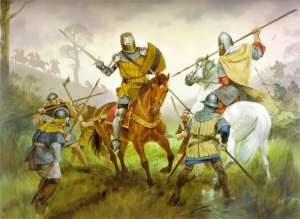
Edward Bruce, Earl of Carrick, lands in Ireland in May 1315 and is proclaimed king of the island in June. Bruce continues on his march south, when on January 26, 1316, the Scottish army is advancing from Castledermot when it encounters the English. The Hiberno-Norman forces, summoned by the justiciar of Ireland, consists of men such as John FitzThomas FitzGerald, Maurice FitzThomas FitzGerald, Thomas FitzJohn FitzGerald, John and Arnold Poer, Maurice de Rocheford and Miles and David de la Roche. Though these forces heavily outnumber those of Bruce, internal strife breaks out in the Anglo-Irish ranks, a fact that Bruce can take advantage of. Though suffering heavy losses, the Scots hold the battlefield, effectively winning the battle.
The official English account of the battle blames unfortunate terrain and bad luck for the government forces’ loss, not an entirely convincing explanation. The same account also claims that the Scots lost many of their greatest men, while their opponents only lost one man.
After the battle the Scots plunder the nearby town of Athy before withdrawing to Leix, while the Anglo-Irish forces keep them under surveillance from nearby Castledermot, while their leader withdraws to Dublin. Here John Hotham, the king’s envoy to Ireland, makes a great effort to ensure the loyalty of the Irish nobles. By May, however, Bruce has returned to his safe base in Ulster, while Hotham has returned to his new position in England as Bishop of Ely.
When Lally is selected as commander-in-chief of the French expedition to India in 1756, he is one of the greatest living soldiers of France. Lally’s force is delayed and does not leave France until May 1757. Further delays occur en route and he finally lands at Pondicherry, India, on April 28, 1758. In less than two months, Lally clears the English forces from a huge area around Pondicherry and captures almost 300 pieces of artillery. Lally next lays siege to Madras, but his naval support abandons him, and, in January 1759, the English are reinforced, forcing Lally to retire toward Pondicherry. Forces away from India are conspiring against Lally now, as the merchant fleets of the French have been rendered useless by the English navy.
Lally’s army, burdened by a lack of naval support and funds resulting in his troops having not been paid in six months, attempts to regain the fort at Wandiwash, now in Tamil Nadu. He is attacked by Sir Eyre Coote’s forces and decisively defeated. The French general Marquis de Bussy-Castelnau and the French are then restricted to Pondicherry where, facing starvation, they surrender on January 16, 1761.
This is the Third Carnatic War fought between the French and the British. Having made substantial gains in Bengal and Hyderabad, the British, after collecting huge amount of revenue, are fully equipped to face the French in Wandiwash, whom they defeat.
According to the 19th century book Annals of the Wars of the Eighteenth Century by Author Eduard Cust, the French Army consists of 300 European Cavalry, 2,250 European infantry, 1,300 soldiers, 3,000 Marathas and 16 pieces of artillery while the English deploy about 80 European Horses, 250 Native horses, 1,900 European Infantry, 2,100 soldiers and 26 pieces of artillery. The Battle of Wandiwash involves the capture of Chettupattu, Thiruvannamalai, Tindivanam and Perumukkal.
(Pictured: The Vandavasi fort in Vandavasi, Tamil Nadu, India, where the decisive Battle of Wandiwash takes place.)
Mayne attends school at Regent House School, a school for students aged 4 to 18. While at Regent he discovers his skill and love for the game of rugby. He also enjoys cricket and golf and becomes a marksman with the rifle club. He goes on to Queen’s University Belfast to study law. At university he takes up boxing and becomes the Irish Universities Heavyweight Champion in August 1936. He also wins the Scrabo Golf Club President’s cup in 1937. He graduates from Queen’s University in 1939.
During 1938, Mayne travels to Africa on the 1938 British Lions Tour to South Africa. He plays on a team that tours around Africa playing other local clubs. While traveling, it is discovered that Mayne has a wild side and on various occasions finds himself in trouble. His “go to” is to trash the hotel rooms of his teammates. The team includes some of the best players from around Ireland and Britain.
In 1939, with outbreak of World War II, Mayne joins the Supplementary Reserves in Newtownards and receives a commission in the Royal Artillery. He serves in several units in Ireland and England, generally with light and heavy anti-aircraft units. He volunteers for the No. 11 (Scottish) Commando unit which is sent to the Middle East. There he sees action during the Syria-Lebanon campaign. Specifically, during the Battle of the Litani River, he draws attention from Captain David Stirling who is forming the new Special Air Service (SAS). Sterling recruits Mayne for the new SAS while he is in jail for striking his commanding officer.
From November 1941 to the end of 1942, Mayne is involved in several raids behind enemy lines with the SAS. He uses jeeps to go to various Axis bases and begin blowing up planes and fuel dumps. It is claimed that he personally destroyed 100 planes during these missions. In addition to serving in the Middle East, he serves as well in Sicily, Italy, Belgium, the Netherlands, Germany, Norway and France. In most of these locations he works with the resistance behind the enemy lines. In France he helps to train the French Resistance.
By the end of the war, Mayne has been promoted to the rank of Lieutenant Colonel and has also received the British Army’s Distinguished Service Order with three bars, which means he received the award four times. After the war he joins the British Antarctic Survey in the Falkland Islands. He returns home to Newtownards when back issues, which started while he was serving in the Middle East, become more difficult for him.
Mayne is initiated into Eklektikos Lodge No. 542 in Newtownards in 1945. He is a very enthusiastic mason and joins a second lodge in Newtownards, Friendship Lodge No. 447. On the evening of December 13, 1955, he attends a meeting of Friendship Lodge and then joins some of his masonic brothers at a local bar. At about 4:00 AM on December 14, he is found dead in his Riley RM roadster in Mill Street, Newtownards, having reportedly collided with a farmer’s vehicle.
At his funeral hundreds of mourners turn out to pay their respects and to see him interred in a family plot in the town’s old Movilla Abbey graveyard. After his death his masonic jewel is preserved for many years by an old school friend before it is presented to Newtownards Borough Council where it is displayed in the Mayoral Chamber of the Council Offices.
O’Neill is born on March 9, 1834, in Drumgallon, Clontibret, County Monaghan, where he receives some schooling. He emigrates to New Jersey in 1848 at the height of the Great Famine. He receives an additional year of education there and works various jobs. In 1857 he enlists in the 2nd United States Dragoons and serves in the Utah War (May 1857 – July 1858), apparently deserting afterwards to California.
In California, O’Neill joins the 1st Cavalry, and serves as a sergeant in the American Civil War with this regiment until December 1862, at which time he is commissioned as an officer in the 5th Indiana Cavalry. He is credited as being a daring fighting officer but believes he has not received due promotion, which leads to a transfer to the 17th United States Colored Infantry as captain. He leaves the Union Army prior to the end of the conflict, marrying Mary Crow, with whom he has several children.
While in Tennessee, O’Neill joins the militant Irish American movement, the Fenian Brotherhood, which eschews politics in favor of militant action to expel the British presence in Ireland. He attaches himself to the group led by William Randall Roberts, who wishes to attack Canada.
O’Neill, ranked as colonel, travels to the Canada–US border with a group from Nashville to participate in the Fenian raids. The assigned commander of the expedition does not appear, so O’Neill takes command. On June 1, 1866, he leads a group of six hundred men across the Niagara River and occupies Fort Erie.
The following day, north of Ridgeway, Ontario, O’Neill’s group encounters a detached column of Canadian volunteers, commanded by Lt-Col. Alfred Booker. The inexperienced Canadians are routed by the Civil War veterans. O’Neill withdraws back to Fort Erie and fights a battle against a detachment led by John Stoughton Dennis. With overwhelming numbers of Canadian forces closing in, O’Neill oversees a successful evacuation on the night of June 2-3 back to United States territory. He is later charged with violating the neutrality laws of the United States, but the charge is dropped.
The split between two factions of the Fenians remain, and penetration of O’Neill’s organisation by British and Canadian spies ensures that his next venture into Canada in 1870 is known in advance, and Canada is accordingly prepared. After the Battle of Trout River ends in a disorganized rout, O’Neill is arrested by United States MarshalGeorge P. Foster and charged with violating neutrality laws. That leads to O’Neill’s imprisonment in July 1870 with a sentence of two years, but he and other Fenians are pardoned by President Ulysses S. Grant that October.
Though O’Neill renounces the idea of further attacks on Canada, he changes his mind at the urging of an associate of Louis Riel, William Bernard O’Donoghue. With the latter, and without the backing of the bulk of the Fenians, he leads an attack on the Hudson’s Bay Company‘s post at Pembina, Manitoba, on October 5, 1871. The area is then disputed between America and Canada. He is arrested by American troops.
Following his military career, O’Neill works for a firm of land speculators in Holt County, Nebraska. He dies of a paralytic stroke on January 7, 1878, and is buried in Omaha, Nebraska.
Markievicz, who inherits the title of “countess” from her noble Polish husband, and 45 other MPs are in jail when the first meeting takes place on January 21, 1919. They are described in Gaelic as being “imprisoned by the foreign enemy” when their names are read out during roll call at the Mansion House.
The 27 MPs who attend the Dáil’s first session ratify the Proclamation of the Irish Republic of Easter 1916, which had not been adopted by an elected body but merely by the Easter rebels claiming to act in the name of the Irish people. They also claim there is an “existing state of war, between Ireland and England” in a Message to the Free Nations of the World.
When Markievicz is released in April 1919, she becomes Minister for Labour. Having also been part of the suffragette movement, her deep political convictions contrast deeply with Nancy Astor, Viscountess Astor, the first woman to sit in the House of Commons. She believes Astor, a Tory who is elected in a 1919 Plymouth by-election after her husband is forced to give up the seat when he becomes a peer, is “out of touch.”
Her political views are also influenced by Irish poet William Butler Yeats, who is a regular visitor to the family home, Lissadell House in County Sligo. She becomes involved in the women’s suffrage movement after studying art in London, where she meets and marries Count Casimir Markievicz. In 1903, the couple, who has one son, settles in Dublin, where she becomes involved in nationalist politics. She joins both Sinn Féin and Inghinidhe na hÉireann.
Like Astor, Markievicz has an irrepressible personality and is in no mood to play coy and simply blend in. She comes to her first Sinn Féin meeting wearing a satin ball-gown and a diamond tiara after attending a function at Dublin Castle, the seat of British rule in Ireland.
Markievicz spends a year in the Dáil before walking out along with Éamon de Valera, the future dominant figure in Irish politics, after opposing the Anglo-Irish Treaty. The document, which grants southern Ireland independence but keeps the north as part of the UK, splits Sinn Féin and triggers the Irish War of Independence.
Following the conflict, which the Pro-Treaty forces win, Markievicz is elected again to the Dáil, but does not take her seat in protest. In 1927, she is elected for a third time as part of de Valera’s new party Fianna Fáil, which pledges to return to the Irish parliament. But before she can take her seat, she dies at age 59 on July 15, 1927, of complications related to appendicitis.
The Continental Army has previously suffered several defeats in New York and has been forced to retreat through New Jersey to Pennsylvania. Morale in the army is low. To end the year on a positive note, George Washington, Commander-in-Chief of the Continental Army, devises a plan to cross the Delaware River on the night of December 25–26 and surround the Hessian garrison.
Because the river is icy and the weather severe, the crossing proves dangerous. Two detachments are unable to cross the river, leaving Washington with only 2,400 men under his command in the assault, 3,000 less than planned.
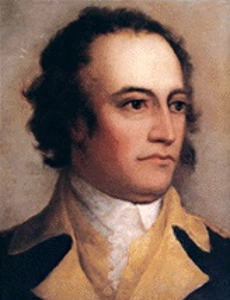
Washington’s army marches 9 miles south to Trenton. One division commanded by John Sullivan, the third son of Irish settlers from the Beara Peninsula in County Cork, secures the important bridge over the Assunpink Creek to the south of the town. This prevents escape and ensures the high number of Hessian prisoners captured.
The Hessians have lowered their guard, thinking they are safe from the American army, and have no long-distance outposts or patrols. Washington’s forces catch them off guard and, after a short but fierce resistance, most of the Hessians surrender, with negligible losses to the Americans. Almost two thirds of the 1,500-man garrison are captured, and only a few troops escaped across Assunpink Creek.
Despite the battle’s small numbers, the American victory inspires rebels in the colonies. With the success of the revolution in doubt a week earlier, the army had seemed on the verge of collapse. The dramatic victory inspires soldiers to serve longer and attracted new recruits to the ranks.