seamus dubhghaill

Promoting Irish Culture and History from Little Rock, Arkansas, USA


Leave a comment

Death of Brendan McGahon, Fine Gael Politician

Brendan McGahon, Irish Fine Gael politician who serves as a Teachta Dála (TD) for the Louth constituency from 1982 to 2002, dies on February 8, 2017, following a brief illness. Often described as “colourful,” with a reputation as a social conservative, he is first elected to Dáil Éireann at the November 1982 Irish general election and retains his seat until retiring at the 2002 Irish general election.

McGahon is born in Dundalk, County Louth, on November 22, 1936, and is educated at St. Mary’s College, Dundalk. His grandfather, T.F. McGahon, is one of the inaugural members of Dundalk Urban District Council when it is created along with other Irish local authorities by the British Government in 1898. T.F. McGahon is a leading member of the Irish Parliamentary Party (IPP). He starts a local newspaper, the Dundalk Democrat, which is supportive of the IPP. He is a critic of the Irish War of Independence campaign, of Sinn Féin, and of the then Irish Republican Army (IRA), arguing that the campaign will result in the partition of Ireland. He is later succeeded on the council by his son, O.B. McGahon, who in turn is followed by his nephew, Hugh McGahon. The family subsequently supports the National League Party and the Independent TD James Coburn and joins Fine Gael when Coburn joins the party. They are also prominent members of the Ancient Order of Hibernians.

McGahon marries Celine Lundy, a widow from Newry, County Down, and takes over the running of the family newspaper business in the 1960s. He plays soccer for Dundalk F.C. in the League of Ireland Premier Division for a number of years.

McGahon succeeds his cousin Hugh on Dundalk Town Council and on Louth County Council at the 1979 Irish local elections. He is an unsuccessful candidate at the 1981 Irish general election and at the February 1982 Irish general election. He is first elected to Dáil Éireann for Louth at the November 1982 Irish general election, defeating incumbent Fine Gael TD, Bernard Markey. He is re-elected at the next five general elections.

A notable aspect of McGahon’s political career is his stand against the Provisional IRA when that organisation’s campaign of violence is at its height. At great personal risk, he refuses to close his newsagents shop in Dundalk during the funerals of the hunger strikers in 1981. He takes another huge risk a few years later when he gives evidence in the High Court in support of The Sunday Times, which is being sued for libel by Thomas Murphy for accusing him of directing an IRA bombing campaign in Britain. Local Gardaí are ordered not to get involved in the case, but McGahon is not deterred from giving evidence that helps the newspaper to defend the claims being made against it by Murphy.

A maverick and outspoken TD, McGahon is known to speak his mind on many issues including divorce, crime, and single mothers. He once advocates that pedophiles should be castrated as part of their prison sentence and is the only TD to oppose the referendum to abolish the death penalty from the Constitution. He also argues that those under 21 years of age should not be able to drive or drink. He is a member of the World Anti-Communist League and opposes the decriminalisation of homosexuality. In 1993, he is the only TD to oppose the decriminalisation of homosexuality and says in the Dáil that:

“I regard homosexuals as being in a sad category, but I believe homosexuality to be an abnormality, some type of psycho-sexual problem that has defied explanation over the years. I do not believe that the Irish people desire this normalisation of what is clearly an abnormality. Homosexuality is a departure from normality and while homosexuals deserve our compassion, they do not deserve our tolerance. That is how the man in the street thinks. I know of no homosexual who has been discriminated against. Such people have a persecution complex because they know they are different from the masses or normal society. They endure inner torment, and it is not a question of the way others view them. The lord provided us with sexual organs for a specific purpose. Homosexuals are like left-hand drivers driving on the right-hand side of the road.”

On the other hand, McGahon speaks out strongly against the influence of the drink industry and defies his own party whip to vote with his left-wing friend Tony Gregory in favour of banning of hare coursing. He is also on good personal terms with members of the Oireachtas such as Michael D. Higgins and David Norris despite holding fundamentally opposed views to them.

McGahon does not contest the 2002 Irish general election and retires from politics.

McGahon lives in Ravensdale, County Louth. His son Conor is a Louth County Councillor from 1991 to 1999 and his brother Johnny is a Louth County Councillor from 1995 to 2004. Johnny’s nephew, John McGahon, is elected to Louth County Council at the 2014 Irish local elections and to Seanad Éireann in 2020.

McGahon dies at the age of 80 on February 8, 2017, following a short illness. Following a Mass at St. Patrick’s Cathedral on February 11, he is buried afterwards in St. Patrick’s Cemetery.

Leave a comment

Birth of Hugh Logue, Economist & SDLP Politician

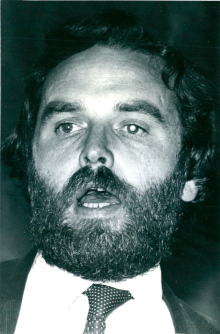
Hugh Anthony Logue, former Social Democratic and Labour Party (SDLP) politician and economist who now works as a commentator on political and economic issues, is born on January 23, 1949, in Derry, County Londonderry, Northern Ireland. He is also a director of two renewable energy companies in Europe and the United States. He is the father of author Antonia Logue.

Logue grows up outside the village of Claudy in County Londonderry, the eldest of nine children born to Denis Logue, a bricklayer, and Kathleen (née Devine). He gains a scholarship to St. Columb’s College which he attends from 1961 to 1967. In 1967, he commences at St. Joseph’s Teacher Training college (Queen’s University) in Belfast from which he qualifies as a teacher of Mathematics in 1970. He first comes to prominence as a member of the executive of the Northern Ireland Civil Rights Association (NICRA), the only SDLP member of the executive. He stands as a candidate in elections to the new Northern Ireland Assembly in 1973 and is elected for Londonderry, at the age of 24, the youngest candidate elected that year. With John Hume and Ivan Cooper, he is arrested by the British Army during a peaceful demonstration in Londonderry in August 1971. Their conviction is ultimately overturned by the Law Lords R. (Hume) v Londonderry Justices (972, N.I.91) requiring the then British Government to introduce retrospective legislation to render legal previous British Army actions in Northern Ireland.

The Northern Ireland State Papers of 1980 show that together with John Hume and Austin Currie, Logue plays a key role in presenting the SDLP’S ‘Three Strands’ approach to the Thatcher Government’s Secretary of State for Northern Ireland Humphrey Atkins in April 1980. The “Three Strands” approach eventually becomes the basis for the Good Friday Agreement. The Irish State papers from 1980 reveal that he is a confidante of the Irish Government of that time, briefing it regularly on the SDLP’s outlook.

Logue is also known for his controversial comments at Trinity College Dublin at the time of the power sharing Sunningdale Agreement, which many blame for helping to contribute to the Agreement’s defeat, to wit, that: [Sunningdale was] “the vehicle that would trundle Unionists into a united Ireland.” The next line of the controversial speech says, “the speed the vehicle moved at was dependent on the Unionist community.” In an article in The Irish Times in 1997 he claims that this implies that unity is always based on consent and acknowledged by Unionist Spokesman John Laird in the NI Assembly in 1973.

Logue unsuccessfully contests the Londonderry seat in the February 1974 and 1979 Westminster Elections. He is elected to the 1975 Northern Ireland Constitutional Convention and the 1982 Northern Ireland Assembly. He is a member of the New Ireland Forum in 1983. In the 1980s he is a member of the Irish Commission for Justice and Peace and plays a prominent part in its efforts to resolve the 1981 Irish hunger strike. His role is credited in Ten Men Dead: The Story of the 1981 Irish Hunger Strike by David Beresford, Biting the Grave by P. O’Malley and, more recently, in Blanketmen: An Untold Story of the H-block Hunger Strike (New Island Books, 2016) and Afterlives: The Hunger Strike and the Secret Offer that Changed Irish History (Lilliput Press, 2011) by former Provisional Irish Republican Army volunteer Richard O’Rawe. Following the New Ireland Forum in 1984 and John Hume’s decision to represent the redrawn Londonderry constituency as Foyle and a safe seat, Logue leaves the Dublin-based, National Board for Science and Technology and joins the European Commission in 1984 in Brussels.

Following the 1994 Irish Republican Army (IRA) ceasefire, Logue, along with two EU colleagues, is asked by EU President Jacques Delors to consult widely throughout Northern Ireland and the Border regions and prepare recommendations for a Peace and Reconciliation Fund to underpin the peace process. Their community-based approach becomes the blueprint for the Peace Programme. In 1997, then EU President Jacques Santer asks the team, led by Logue, to return to review the programme and advise for a renewed Peace II programme. Papers published by National University Galway in 2016 from Logue’s archives indicate that he is the originator of the Peace Fund concept within the European Commission.

At the European Commission from 1984 to 1998, Logue creates Science and Technology for Regional Innovation and Development in Europe (STRIDE). In 1992, he is joint author with Giovanni de Gaetano, of RTD potential in the Mezzogiorno of Italy: the role of science parks in a European perspective and, with A. Zabaniotou and University of Thessaloniki, Structural Support For RTD.

Further publications by Logue follow: Research and Rural Regions (1996) and RTD potential in the Objective 1 regions (1997). With the fall of the Berlin Wall, his attention turns to Eastern Europe and in March 1998 publishes a set of studies Impact of the enlargement of the European Union towards central central and Eastern European countries on RTD- Innovation and Structural policies.

Logue convenes the first EU seminar on “Women in Science” in 1993 and jointly publishes with LM Telapessy Women in Scientific and Technological Research in the European Community, highlighting the barriers to women’s advancement in the Research world.

As the former vice-chairman of the North Derry Civil Rights Association, Logue gives evidence at the Saville Inquiry into Bloody Sunday. He is special adviser to the Office of First and Deputy First Minister from 1998 to 2002 and as an official of the European Commission. In 2002–03, he is a fellow of the Institute for British – Irish Studies at University College Dublin (UCD). In July 2006, he is appointed as a board member of the Irish Peace Institute, based at the University of Limerick and in 2009 is appointed Vice Chairman. He is a Life Member of the Institute of International and European Affairs.

On December 17, 2007, Logue is appointed as a director to InterTradeIreland (ITI), the North-South Body established under the Good Friday Agreement to promote economic development in Ireland. There he chairs the ITI’s Fusion programme, bringing north–south industrial development in Innovation and Research. Integrating Ireland economically is a theme of his writing throughout his career, most recently in The Irish Times and in earlier publications as economic spokesman for the SDLP. He is economist at the Dublin-based National Board for Science and Technology from 1981 to 1984.

Logue, after leaving the European Commission in 2005, becomes involved in Renewable Energy and is chairman of Priority Resources as well as a director of two companies, one in solar energy, the other in wind energy. In November 2011, he is elected to the main board of European Association of Energy (EAE).

In November 2023, Logue is awarded an honorary doctorate by the University of Galway in recognition of “a lifetime dedicated to civil rights, human rights, equality and peace in Northern Ireland, Ireland and Europe.” He donates an archive of material, more than 20 boxes of manuscripts, documents, photographs and political ephemera, on the development of the SDLP from the early 1970s to the University of Galway.


Leave a comment

Founding of the 32 County Sovereignty Movement

The 32 County Sovereignty Movement, often abbreviated to 32CSM or 32csm, is an Irish republican group founded by Bernadette Sands McKevitt on December 7, 1997, at a meeting of like-minded Irish republicans in Finglas, Dublin. It does not contest elections but acts as an advocacy group, with branches or cumainn organised throughout the traditional counties of Ireland.

The 32CSM has been described as the “political wing” of the now defunct Real Irish Republican Army (RIRA), but this is denied by both organisations. The group originates in a split from Sinn Féin over the Mitchell Principles.

Those present at the initial meeting are opposed to the direction taken by Sinn Féin and other mainstream republican groups in the Northern Ireland peace process, which leads to the Belfast Agreement (also known as the Good Friday Agreement) the following year. The same division in the republican movement leads to the paramilitary group now known as the Real IRA breaking away from the Provisional Irish Republican Army at around the same time.

Most of the 32CSM’s founders had been members of Sinn Féin. Some had been expelled from the party for challenging the leadership’s direction, while others felt they had not been properly able to air their concerns within Sinn Féin at the direction its leadership had taken. Bernadette Sands McKevitt, wife of Michael McKevitt and a sister of hunger striker Bobby Sands, is a prominent member of the group until a split in the organisation.

The name refers to the 32 counties of Ireland which are created during the Lordship and Kingdom of Ireland. With the partition of Ireland in 1920–22, twenty-six of these counties form the Irish Free State which is abolished in 1937 and is now known as Ireland since 1949. The remaining six counties of Northern Ireland remain part of the United Kingdom. Founder Bernadette Sands McKevitt says in a 1998 interview with the Irish Mirror that people did not fight for “peace” – “they fought for independence” – and that the organisation reaffirms to the republican position in the 1919 Irish Declaration of Independence.

Before the referendums on the 1998 Good Friday Agreement, the 32CSM lodges a legal submission with the United Nations challenging British sovereignty in Ireland. The referendums are opposed by the 32CSM but are supported by 71% of voters in Northern Ireland and by 94% in the Republic of Ireland. It is reported in February 2000 that the group established a “branch” in Kilburn, London.

In November 2005, the 32CSM launches a political initiative titled Irish Democracy, A Framework for Unity.

On May 24, 2014, Gary Donnelly, a member of the 32CSM, is elected to the Derry City and Strabane District Council. In July 2014, a delegation from the 32CSM travels to Canada to take part in a six-day speaking tour. On arrival the delegation is detained and refused entry into Canada.

The 32CSM has protested against what it calls “internment by remand” in both jurisdictions in Ireland. Other protests include ones against former Democratic Unionist Party (DUP) leader Ian Paisley in Cobh, County Cork, against former British Prime Minister John Major being given the Keys to Cork city, against a visit to the Republic of Ireland by Police Service of Northern Ireland (PSNI) head Sir Hugh Orde, and against the Israeli occupation of Palestine and Anglo-American occupation of Iraq.

In 2015, the 32CSM organises a demonstration in Dundee, Scotland, in solidarity with the men convicted of shooting Constable Stephen Carroll, the first police officer to be killed in Northern Ireland since the formation of the PSNI. The organisation says the “Craigavon Two” are innocent and have been victims of a miscarriage of justice.

The group is currently considered a Foreign Terrorist Organization (FTO) in the United States, because the group is considered to be inseparable from the Real IRA, which is designated as an FTO. At a briefing in 2001, a spokesman for the U.S. Department of State states that “evidence provided by both the British and Irish governments and open-source materials demonstrate clearly that the individuals who created the Real IRA also established these two entities to serve as the public face of the Real IRA. These alias organizations engage in propaganda and fundraising on behalf of and in collaboration with the Real IRA.” The U.S. Department of State’s designation makes it illegal for Americans to provide material support to the Real IRA, requires U.S. financial institutions to block the group’s assets and denies alleged Real IRA members visas into the U.S.

The 32CSM also operates outside of the island of Ireland to some extent. The Gaughan/Stagg Cumann covers England, Scotland and Wales, and has an active relationship of mutual promotion with a minority of British left-wing groups and anti-fascist organisations. The James Larkin Republican Flute Band in Liverpool, and the West of Scotland Band Alliance, the largest section of which is the Glasgow-based Parkhead Republican Flute Band, are also supporters of the 32CSM. As of 2014, the 32CSM’s alleged paramilitary wing, the Real IRA, is reported to have been still involved in attempts to perpetrate bombings in Britain as part of the Dissident Irish Republican campaign, which has been ongoing since 1998.


1 Comment

Birth of Fra McCann, IRA Volunteer & Sinn Féin Politician

Fra McCann, Irish politician, is born in Belfast, Northern Ireland, on June 19, 1953. He becomes active in the Irish republican movement and is imprisoned in the 1970s for membership of the Provisional Irish Republican Army. He also takes part in the blanket protest while in prison. In 1987, he is elected to Belfast City Council in a by-election, representing Sinn Féin.

McCann grows up in the Falls Road area of West Belfast. He is educated at St. Comgalls Primary School on Divis Street and later at St. Peters Secondary School off the Whiterock Road.

McCann is interned on the prison ship HMS Maidstone from February 14 until March 14, 1972, when he is moved to Long Kesh Detention Centre.

McCann is released from Long Kesh on May 9, 1972, then rearrested in November 1972 and re-interned until December 1975. During this period of internment, he is sentenced to nine months for escaping from Long Kesh through a tunnel. During this escape, IRA volunteer Hugh Coney is murdered by British soldiers.

McCann is arrested again in November 1976 and imprisoned in Crumlin Road Gaol where he spends six months on remand before being sentenced to three years. He joins the blanket protest in Crumlin Road Gaol where he and his comrades are held in solitary confinement until August 1978 when they are moved to the H-Blocks in Long Kesh, joining hundreds more on the blanket protest. He is released on November 22, 1979.

Upon his release, McCann travels throughout Ireland with other ex-prisoner’s highlighting the inhumanity in the H-Blocks. He travels throughout the United States in 1980 during which time he is arrested and spends 17 days in prison in New York. In 1981, he travels to Canada where he helps form H-Block committees and raises awareness about the hunger strike.

On his return to Ireland McCann is elected to sit on the National H-Block Committee and speaks at many events in support of the hunger strike. In the aftermath of the hunger strike he helps reorganise Sinn Féin in the Falls area.

McCann is elected to Belfast City Council in 1987 and sits on the Strategic Policy and Resources Committee and the Parks and Leisure committee. He is elected to the Northern Ireland Assembly representing Belfast West in 2003 and again in 2007, 2012 and 2018. While there he sits on the Finance and Personnel Committee and the Committee for Social Development.

In June 2006, McCann is charged with assault and disorderly behaviour following an incident in west Belfast. The incident occurs as the Police Service of Northern Ireland (PSNI) are attempting to arrest a teenager for attempted robbery. However, he claims heavy-handedness by the police and states, “I tried to put myself between one of the officers and the girl when the police officer radioed for assistance.” He is released on bail.

In October 2021, McCann announces that he would be stepping down as Member of the Legislative Assembly (MLA) for Belfast West and would not be contesting the next election.


Leave a comment

The 1981 Irish General Election

The 1981 Irish general election to the 22nd Dáil is held on Thursday, June 11, 1981, following the dissolution of the 21st Dáil on May 21 by President Patrick Hillery on the request of Taoiseach Charles Haughey. The general election takes place in 41 Dáil constituencies throughout Ireland for 166 seats in Dáil Éireann, the house of representatives of the Oireachtas. The number of seats in the Dáil is increased by 18 from 148 under the Electoral (Amendment) Act 1980.

The 22nd Dáil meets at Leinster House on June 30 to nominate the Taoiseach for appointment by the president and to approve the appointment of a new government of Ireland. Garret FitzGerald is appointed Taoiseach, forming the 17th Government of Ireland, a minority coalition government of Fine Gael and the Labour Party.

The general election of 1981 is the first one of five during the 1980s. The election also sees three new leaders of the three main parties fight their first general election. Charles Haughey had become Taoiseach and leader of Fianna Fáil at the end of 1979, Garret FitzGerald is the new leader of Fine Gael and Frank Cluskey is leading the Labour Party.

Haughey and Fianna Fáil seem extremely popular with the electorate in early 1981. He is expected to call the election at the time of the Fianna Fáil ardfheis on February 14, but the Stardust fire causes the ardfheis to be postponed, and the Republican hunger strike in the Maze Prison begins in March. By the dissolution in May, much of the earlier optimism in the party has filtered out. The Anti H-Block movement fields abstentionist candidates in solidarity with the hunger strikers, undermining the Republican credentials of Fianna Fáil.

Fianna Fáil’s manifesto promises more spending programmes and Fine Gael puts forward a series of tax-cutting plans.

Fianna Fáil loses seats as a result of sympathy to the Anti H-Block candidates and the attractive tax proposals of Fine Gael. It is the worst performance for Fianna Fáil in twenty years. Meanwhile, Labour Party leader Frank Cluskey loses his seat, necessitating a leadership change with Michael O’Leary succeeding Cluskey. A Fine Gael–Labour Party coalition government comes to power. Fine Gael and the Labour Party form the 17th Government of Ireland, a minority coalition government, with Garret FitzGerald becoming Taoiseach.

(Pictured: Fine Gael’s Garret FitzGerald, who is appointed Taoiseach following the 1981 Irish General Election)


2 Comments

The 32 County Sovereignty Movement Launches Major Recruitment Campaign

The 32 County Sovereignty Movement, often abbreviated to 32CSM or 32csm, an Irish republican group that is founded by Bernadette Sands McKevitt, launches a major recruitment campaign in west Belfast on April 17, 1999.

The objectives of the 32CSM are:

  • The restoration of Irish national sovereignty.
  • To seek to achieve unity among the Irish people on the issue of restoring national sovereignty and to promote the revolutionary ideals of republicanism and to this end involve itself in resisting all forms of colonialism and imperialism.
  • To seek the immediate and unconditional release of all Irish republican prisoners throughout the world.

The 32CSM does not contest elections but acts as a pressure group, with branches, or cumainn, organised throughout the traditional counties of Ireland. It has been described as the “political wing” of the now defunct Real Irish Republican Army (Real IRA or RIRA), but this is denied by both organisations. The group originates in a split from Sinn Féin over the Mitchell Principles.

The organisation is founded on December 7, 1997, at a meeting of like-minded Irish republicans in the Dublin suburb of Finglas. Those present are opposed to the direction taken by Sinn Féin and other mainstream republican groups in the Northern Ireland peace process, which eventually leads to the Good Friday Agreement, also known as the Belfast Agreement, the following year. The same division in the republican movement leads to the paramilitary group now known as the Real IRA breaking away from the Provisional Irish Republican Army at around the same time.

Most of the 32CSM’s founders had been members of Sinn Féin, with some having been expelled from the party for challenging the leadership’s direction, while others felt they had not been properly able to air their concerns within Sinn Féin at the direction its leadership had taken. Bernadette Sands McKevitt, wife of Michael McKevitt and a sister of hunger striker Bobby Sands, is a prominent member of the group until a split in the organisation.

The name refers to the 32 counties of Ireland which were created during the Lordship of Ireland and Kingdom of Ireland. With the partition of Ireland in 1920–22, twenty-six of these counties form the Irish Free State which is abolished in 1937 and is now known as Ireland since 1949. The remaining six counties of Northern Ireland remain part of the United Kingdom. Founder Bernadette Sands McKevitt says in a 1998 interview with The Mirror that people did not fight for “peace” – “they fought for independence” – and that the organisation reaffirms to the republican position in the 1919 Irish Declaration of Independence.

Before the referendums on the 1998 Good Friday Agreement, the 32CSM lodges a legal submission with the United Nations challenging British sovereignty in Ireland. The referendums are opposed by the 32CSM but are supported by 71% of voters in Northern Ireland and by 94% in the Republic of Ireland. It is reported in February 2000 that the group had established a “branch” in Kilburn, London.

In November 2005, the 32CSM launches a political initiative titled Irish Democracy, A Framework for Unity.

On May 24, 2014, Gary Donnelly, a member of the 32CSM, is elected to the Derry and Strabane super council. In July 2014, a delegation from the 32CSM travels to Canada to take part in a six-day speaking tour. On arrival the delegation is detained and refused entry into Canada.

The 32CSM has protested against what it calls “internment by remand” in both jurisdictions in Ireland. Other protests include ones against former Democratic Unionist Party (DUP) leader Ian Paisley in Cobh, County Cork, against former British Prime Minister John Major being given the Keys to Cork city, against a visit to the Republic of Ireland by Police Service of Northern Ireland (PSNI) head Sir Hugh Orde, and against the Israeli occupation of Palestine and Anglo-American occupation of Iraq.

In 2015, the 32CSM organises a demonstration in Dundee, Scotland, in solidarity with the men convicted of shooting Constable Stephen Carroll, the first police officer to be killed in Northern Ireland since the formation of the PSNI. The organisation says the “Craigavon Two” are innocent and are victims of a miscarriage of justice.

The 32CSM also operates outside of the island of Ireland to some extent. The Gaughan/Stagg Cumann covers England, Scotland and Wales, and has an active relationship of mutual promotion with a minority of British left-wing groups and anti-fascist organisations. The James Larkin Republican Flute Band in Liverpool and the West of Scotland Band Alliance, the largest section of which is the Glasgow-based Parkhead Republican Flute Band, are also supporters of the 32CSM. As of 2014, the 32CSM’s alleged paramilitary wing, the Real IRA, is reported to still be involved in attempts to perpetrate bombings in Britain as part of the dissident Irish republican campaign, which has been ongoing since 1998.

The 32CSM is currently considered a foreign terrorist organization (FTO) in the United States, because it is considered to be inseparable from the Real IRA, which is designated as an FTO. At a briefing in 2001, a spokesman for the U.S. Department of State states that “evidence provided by both the British and Irish governments and open-source materials demonstrate clearly that the individuals who created the Real IRA also established these two entities to serve as the public face of the Real IRA. These alias organizations engage in propaganda and fundraising on behalf of and in collaboration with the Real IRA.” The U.S. Department of State’s designation makes it illegal for Americans to provide material support to the Real IRA, requires U.S. financial institutions to block the group’s assets and denies alleged Real IRA members travel visas into the United States.


Leave a comment

Birth of Declan Arthurs, Provisional Irish Republican Army Volunteer

Declan Arthurs, a Volunteer in the Provisional Irish Republican Army‘s (IRA) East Tyrone Brigade in the mid-1980s, is born in Galbally, County Tyrone, Northern Ireland, on October 28, 1965.

Arthurs is one of six children, and the fourth of Paddy and Amelia Arthurs. He works on the family farm learning how to drive diggers. He works as an agricultural contractor for the farm. He has one young daughter.

Arthurs joins the East Tyrone Brigade of the Provisional IRA in 1982 in the wake of Martin Hurson‘s death on the 1981 Irish Hunger Strike. Hurson is also from Galbally like Arthurs, and Arthurs and his friends look up to Hurson. At the time he joins so do other young men from the same area, like Tony Gormley, Eugene Kelly, Seamus Donnelly and Martin McCaughey.

Over a year and a half year period in the mid-1980s the East Tyrone Brigade attacks and bombs Royal Ulster Constabulary (RUC) barracks and stations in Ballygawley, Tynan, The Birches, Coalisland, Dungannon, Carrickmore and Castlederg. They bomb hotels and other businesses in Kildress, Ballyronan, Dungannon and Cookstown.

Arthurs takes part in two of the IRA’s biggest attacks of the 1980s. At the attack on the Ballygawley barracks in December 1985 and the attack on the RUC Birches barracks in August 1986, Arthurs is a key member of the team who drives a digger past a security fence, stops it outside the barracks, lights a fuse, runs to safety and wrecks the barracks with a 200-pound bomb in the JCB Digger.

Arthurs is killed along with seven other IRA Volunteers who are ambushed by the Special Air Service (SAS) during the Loughgall Ambush on May 8, 1987. Before the SAS fires he lights the 40-second fuse on the bomb and it destroys most of the station, injuring a number of British decoys inside. The Loughgall ambush is supposed to be a carbon copy attack of the bombing of The Birches barracks, with the IRA expecting no resistance. One of the photos of the aftermath of the ambush shows that Arthurs died with the Zippo lighter he used to light the fuse still in his hand.

Amelia Arthurs, Declan’s mother, says of the ambush in an interview to journalist Peter Taylor, “He was mowed down. He could have been taken prisoner. They knew that the ‘boys’ were coming and they lay in wait. The SAS never gave them a chance. Declan died for his country and I’m very proud of him. He was caught up in a war and he died.”

Arthurs is buried in St. John’s Cemetery, Galbally, beside IRA Volunteer Seamus Donnelly who also died in the Loughgall ambush.


Leave a comment

Death of 1981 Hunger Striker Thomas McElwee

Thomas McElwee, Irish republican volunteer in the Provisional Irish Republican Army (IRA), dies on August 8, 1981, at the age of 23 after 62 days on hunger strike at Long Kesh Prison.

McElwee, the sixth of twelve children, is born on November 30, 1957, into the small, whitewashed home built by his father, along the Tamlaghtduff Road in Bellaghy, County Derry, Northern Ireland. He attended St. Mary’s primary in Bellaghy, and then Clady intermediate. After leaving school he goes to Magherafelt technical college for a while but later changes his mind and goes to Ballymena training centre to begin an apprenticeship as a motor mechanic. Harassment from loyalist workers there forces him to leave and he then goes to work with a local mechanic.

McElwee and his cousin Francis Hughes form an independent Republican unit, which for several years carries out ambushes on British Army patrols as well as bomb attacks in neighbouring towns such as Magherafelt, Castledawson, and Maghera.

In October 1976, McElwee takes part in a planned bombing blitz on the town of Ballymena. Along with several colleagues, he is transporting one of the bombs, which explodes prematurely and blinds him in his right eye. He is transferred from the Ballymena hospital to the Royal Victoria Hospital in Belfast for emergency surgery to save his remaining eye. It is three weeks before he is able to see at all.

After six weeks McElwee is transferred again, this time to the military wing of the Musgrave Park Hospital. One week before Christmas, he is charged and sent to Crumlin Road Gaol.

At McElwee’s subsequent trial in September 1977, having spent over eight months on remand in Crumlin Road, he is charged and sentenced to 20 years’ imprisonment for possession of explosives and the murder of Yvonne Dunlop, who is killed when one of the firebombs destroys the shop where she is employed. His murder charge is reduced to manslaughter on appeal, although the original jail term stands. He returns to the blanket protest he had joined immediately after his trial, in the H-Blocks of Long Kesh.

Imprisonment is particularly harsh for McElwee and his brother Benedict who are frequently singled out for brutality by prison warders, outraged at the stubborn refusal of the two to accept any form of criminal status. On one occasion he is put on the boards for fourteen days for refusing to call a prison warder ‘sir.’ In a letter smuggled out to his sister Mary, Benedict writes of the imprint of a warder’s boot on his back and arms after a typical assault. However, throughout the brutality and degradation they have to endure serves only to deepen yet further, and harder, their resistance to criminalisation.

McElwee joins the 1981 Irish hunger strike on June 7, 1981, and died on August 8, 1981, after 62 days on the strike. Indicative of the callousness of the British government towards prisoners and their families alike, he is denied the comfort of his brother’s presence at that tragic moment. He dies after 62 days of slow agonising hunger strike with no company other than prison warders – colleagues of those who had brutalised, degraded and tortured him for three-and-a-half years.

In 2009, Republican Sinn Féin (RSF) name their Waterford cumann after McElwee, replacing that of George Lennon, O/C of the Waterford Flying Column who led the IRA anti-Treaty Republicans into Waterford City in March 1922. The Waterford RSF had adopted the Lennon name without the permission of his son who noted that his father had, in later years, become a committed pacifist and opponent of the Vietnam War.

McElwee is the main subject of the song Farewell to Bellaghy, which also mentions his cousin Francis Hughes, other members of the independent Republican unit and deceased volunteers of the South Derry Brigade of the Provisional IRA. He is also the subject of The Crucifucks‘ song The Story of Thomas McElwee.


Leave a comment

The Beginning of the 1980 Hunger Strike

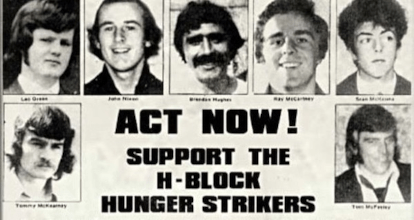
Irish political prisoners confined in the infamous H-Blocks of Long Kesh Detention Centre commence a hunger strike on October 27, 1980. The hunger strike is to continue until their demands for political status and for an end to British torture are met, or until death.

It begins with seven republican volunteers: Brendan Hughes, the IRA commanding officer in the prison, Sean McKenna, Tommy McKearney, Tommy McFeely, Leo Green, and Raymond McCartney, all of the Irish Republican Army (IRA), and John Nixon of the Irish National Liberation Army (INLA).

On December 1, three female prisoners, Mary Doyle, Mairéad Farrell and Mairéad Nugent, join the strike in Armagh Prison. Thirty more republican prisoners join later.

Despite being deceived into ending prematurely after 53 days, it sets the scene for a second hunger strike the following March, led by Bobby Sands. The first hunger strike announcement is made in a statement which is reprinted in full below.

“We the Republican POWs in the H-Blocks, Long Kesh, demand the right of political recognition and that we be accorded the status of political prisoners. We claim this right as captured combatants in the continuing struggle for national liberation and self-determination. We refute most strongly the tag of criminal with which the British have attempted to label us and our struggle, and we point to the devisive, partitionist institution of the six-county state as the sole criminal aspect of the present conflict.

“All of us were arrested under repressive laws, interrogated and often tortured in RUC barracks, and processed through special non-jury courts, where we were sentenced to lengthy terms of imprisonment. After this we were put in the H-Blocks and were expected to bow the knee before the British administration and wear their criminal uniform. Attempts to criminalise us were designed to depoliticise the Irish national struggle.

“We don’t have to recite again the widespread, almost total forms of punishment, degradations and deprivations we have been subjected to. All have failed to break our resistance.

“For the past four years we have endured this brutality in deplorable conditions. We have been stripped naked and robbed of our individuality, yet we refuse to be broken. Further repression only serves to strengthen our resolve and that of our gallant female comrades’ enduring the same hardships in Armagh jail.

“During this period many individuals, religious figures and political organisations and sections of the media have condemned the way we have been treated. Yet despite appeals for a resolution of the H-Block protest, the British government has remained intransigent and has displayed vindictive arrogance in dealing with the problem. They refuse to treat this issue in a realistic manner which is just another reflection of their attitude to the entire Irish question.

“Bearing in mind the serious implications of our final step, not only for us but for our people, we wish to make it clear that every channel has now been exhausted, and not wishing to break faith with those from whom we have inherited our principles, we now commit ourselves to a hunger strike.

“We call on the Irish people to lend us their support for our just demands and we are confident that this support will be very much in evidence in the coming days.

“We call on all solidarity and support groups to intensify their efforts and we also look forward with full confidence to the support of our exiled countrymen in America and Australia.

“We declare that political status is ours of right and we declare that from Monday, October 27th, 1980, a hunger strike by a number of men representing H- Blocks 3, 4, and 5 will commence.

“Our widely recognised resistance has carried us through four years of immense suffering, and it shall carry us through to the bitter climax of death, if necessary.”

Signed: PRO, H-Block blanket men, Long Kesh camp

(From: “The 1980 H-Block hunger strike,” Irish Republican News, http://www.republican-news.org, October 31, 2020)


2 Comments

IRA Volunteer Mick Fitzgerald Dies on Hunger Strike

Michael Fitzgerald also known as Mick Fitzgerald, dies on hunger strike in Cork County Gaol on October 17, 1920. He is among the first members of the Irish Republican Army and plays an important role in organizing it. His death is credited with bringing world-wide attention to the Irish cause for independence.

Born in December 1881 in Ballyoran, Fermoy, County Cork, Fitzgerald is educated at the Christian Brothers School in the town and subsequently finds work as a mill worker in the locality. He joins the Irish Volunteers in 1914 and plays an important role in building the local organisation which is soon to become the Irish Republican Army (IRA). He soon rises to the rank of Battalion Commandant, 1st Battalion, Cork No.2 Brigade.

On Easter Sunday, April 20, 1919, Fitzgerald leads a small group of IRA volunteers who capture Araglin, Cork Royal Irish Constabulary Barracks located on the border with County Tipperary. He is subsequently arrested and sentenced to three months imprisonment at Cork County Gaol. He is released from prison in August 1919 and immediately returns to active IRA duty. He is involved in the holding up of a party of British Army troops at the Wesleyan Church in Fermoy. The troops are disarmed although one of them is killed. Arrested and held on remand, Fitzgerald feels that the only chance he has for release is via a hunger strike.

Fitzgerald, along with Terence MacSwiney and nine other IRA volunteers, are arrested on August 8, 1920. On August 11, MacSwiney begins a hunger strike in Brixton Gaol. Fitzgerald and the other nine volunteers at Cork County Gaol join in. At the age of 24, he is the first to die on October 17, 1920 as a result of his sixty-seven day fast. His death is followed by the deaths of Joe Murphy and Terence MacSwiney. Their deaths are credited with bringing world-wide attention to the Irish cause for independence.

Fitzgerald is buried at Kilcrumper Cemetery, on the outskirts of Fermoy, County Cork. In addition, a road is named after him in Togher, Cork.

During a November 2008 visit to Fermoy, Sinn Féin Vice-President Pat Doherty lays a wreath at Fitzgerald’s grave. Doherty says Fitzgerald’s sacrifice was like that of the hunger strikers in 1981. He says it is a great honour for him to pay homage to a man “to whom we owe so much.” Also buried in the Republican Plot in Fermoy is General Liam Lynch, who was Chief of Staff of the IRA when he was shot dead by Irish Free State troops in the Knockmealdown Mountains on April 12, 1923. His last wish was to be buried with his great friend and comrade, Mick Fitzgerald.