William Grattan Tyrone Power, Irish stage actor, comedian, author and theatrical manager known professionally as Tyrone Power, is born in Kilmacthomas, County Waterford, on November 20, 1797. He is an ancestor of actor Tyrone Power and is also referred to as Tyrone Power I.
The young Power takes to the stage, achieving prominence throughout the world as an actor and manager. He is well known for acting in such Irish-themed plays as Catherine Gore‘s King O’Neil (1835), his own St. Patrick’s Eve (1837), Samuel Lover‘s Rory O’More (1837) and The White Horse of the Peppers (1838), Anna Maria Hall‘s The Groves of Blarney (1838), Eugene Macarthy’s Charles O’Malley (1838), and William Bayle Bernard‘s His Last Legs (1839) and The Irish Attorney (1840). In his discussion of these works, Richard Allen Cave argues that Power, both in his acting as well as his choice of plays, seeks to rehabilitate the Irishman from the derogatory associations with “stage Irishmen.”
Power has a number of notable descendants by his wife Anne, daughter of John Gilbert of the Isle of Wight:
Sir Tyrone Guthrie, British theatrical director (1900–1971)
Maurice Henry Anthony O’Reilly Power (1821–1849), trained as a barrister but later took up acting
Frederick Augustus Dobbyn Nugent Power (1823–1896), civil engineer, left a large estate of £197,000, equivalent to £15.6 million or 28 million US dollars in 2006
Clara Elizabeth Murray Power (born 1825)
Mary Jane Power (born 1827)
Harold Littledale Power (1833–1901), actor, wine merchant, mine agent & engineer
Tyrone Power, Sr. (1869–1931), English theatre and silent movie star
Tyrone Power (1914–1958), American Hollywood star of the 1930s to 1950s
Romina Power (born 1951), American singer and film actress
Power is said to have purchased the land that is later occupied by Madison Square Garden, New York, shortly before his death. The lawyer who holds the papers cannot be found so the Power family is unable to claim right to the property.
Power is lost at sea on March 17, 1841, when the SS President disappears without trace in the North Atlantic shortly after departing for England. Anne Power is buried in the churchyard of St. Mary The Virgin Church in High Halden, Kent, England.
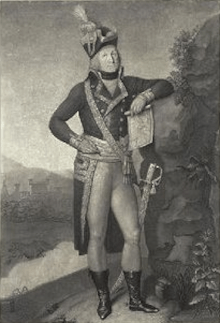
General Charles Edward Saul Jennings, Irish soldier and revolutionary who serves France in the eighteenth century and is sometimes romanticised as Brave Kilmaine, is born on October 19, 1751, in Sauls Court, Dublin.
Jennings is the second son of Theobald Jennings, a physician of Polaniran (Ironpool), Tuam, County Galway, and Eleonore Saul, daughter of Laurence Saul, a wealthy Dublin distiller. Educated privately in Dublin, he leaves Ireland in 1769, settling in Tonnay-Charente in the south of France, where his father had set up practice. His father had, several years previously, assumed the fictitious title of ‘baron of Kilmaine’ in the hope of improving his position in French society, and he subsequently assumes the same title.
In 1774 Jennings joins the Royal Dragoons as a trooper, transferring in 1778 into the Légion de Lauzun, a corps made up mostly of foreign volunteers. After the campaign in Senegal (1778–79) he returns to France and is commissioned as a sous-lieutenant. He then campaigns with Gilbert du Motier, Marquis de Lafayette, during the American Revolutionary War and teaches cavalry tactics at Metz on his return. Promoted to captain in 1788, at the outbreak of the French Revolution, he is stationed at Verdun and, despite a short period in prison, continues to serve with his regiment. In 1791, when several of the regiment’s officers flee from France, he remains and is one of the first officers to swear allegiance to the national assembly.
Promoted to Chef d’escadron in April 1792, Jennings serves under Charles François Dumouriez during the invasion of the Netherlands, distinguishing himself at the Battle of Valmy and the Battle of Jemappes, where he reinforces the French centre at a critical point, ensuring victory. A series of rapid promotions follow. He is made a colonel in January 1793, a general of brigade in March 1794, and a general of division in May1794.
After a series of reverses in the summer of 1793, in which the French lose the fortress-towns of Condé and Valenciennes, the committee of public safety appoints Jennings to command the Armée du Nord on May 15, 1793, with the rank of full general. In August, in order to preserve his force in the face of overwhelming opposition, he retreats from a position 120 miles north of Paris known as ‘Caesar’s camp.’ Although the allied army swings away to invest Dunkirk, he is arrested and imprisoned for endangering the city, and remains in prison until after the fall of Robespierre in July 1794. Within a few days, due to the turbulent political situation, he is rearrested and not released until December 1794. In May 1795 he cooperates with Napoléon Bonaparte in suppressing the Jacobin uprising in Faubourg Saint-Antoine in Paris and, having reestablished his credentials, commands the cavalry during the invasion of Italy (1796). Bonaparte regards him highly, and he distinguishes himself at the Battle of Lodi on May 10, 1796, seizing the city of Milan five days later. He defeats a large Austrian force in the Battle of Borghetto before investing and taking the fortress-town of Mantua in February 1797.
When peace terms are agreed with Austria, Jennings returns to France, taking command of the centre column of the Armée d’Angleterre, which had been raised to invade Britain and Ireland. However, his deteriorating health makes some observers question his suitability for such an appointment. An associate of Thomas Paine and James Napper Tandy, and a friend of Wolfe Tone, he is forced to watch the gradual reduction of his army as Napoleon diverts troops for his campaign in Egypt. Tone is at first suspicious of him, given that many Irish-born French officers had deserted the revolutionary cause but comes to admire him.
After the defeat of Admiral Bombard’s expedition to Ireland and Tone’s arrest on November 3, 1798, Jennings requests that the French government should take a senior British prisoner as hostage and subject him to the same treatment as Tone. After Tone’s death he assists Matilda Tone and her children. In early 1799 he is appointed military governor of Switzerland but is forced to resign due to his failing health.
In a fragile condition Jennings leaves Switzerland and returns to Passy in Paris, where his domestic griefs and chagrins add to the poignancy of his bodily sufferings, for his constitution is now completely broken up. He dies of dysentery on December 11, 1799, at the age of 48. He is buried with full military honours.
Jennings is historically honored at the Arc de Triomphe in Paris, where his name can be seen on the inside triumphal arch, on the Northern pillar, Column 05. Underneath the Arc is the Tomb of the Unknown Soldier (World War I). There is a personal portrait of Jennings in the ‘Hotel de Ville’ (City Hall) at Tonnay-Charente, where his father Dr. Theobald Jennings practiced as a physician.
A monument was erected in Jennings’s memory in Tonnay-Charente in the 19th century. Rue du Général Kilmaine, a street in Tonnay-Charente, is named in his honour in the 19th century.
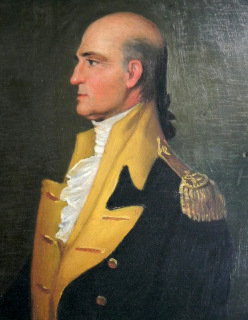
Hand, the son of John Hand, is baptised in Shinrone. Among his immediate neighbours are the Kearney family, ancestors of United States PresidentBarack Obama. He is a descendant of either the families of Mag Fhlaithimh (of south Ulaidh and Mide) or Ó Flaithimhín (of the Síol Muireadaigh) who, through mistranslation became Lavin or Hand.
In 1774, Hand moves to Lancaster, Pennsylvania, where he practices medicine. On March 13, 1775, he marries Catherine Ewing. Lancaster is the region of some of the earliest Irish and Scotch-Irish settlements in Pennsylvania. As a people, they are well known for their anti-English and revolutionary convictions. He is active in forming the Lancaster CountyAssociators, a colonial militia. He is a 32nd degree Freemason, belonging to the Montgomery Military Lodge number 14.
Hand enters the Continental Army in 1775 as a lieutenant colonel in the 1st Pennsylvania Regiment under Colonel William Thompson. He is promoted to colonel in 1776 and placed in command of the 1st Continental, then designated the 1st Pennsylvania. Promoted to brigadier general in March 1777, he serves as the commander of Fort Pitt, fighting British loyalists and their Indian allies. He is recalled, after over two years at Fort Pitt, to serve as a brigade commander in Major GeneralLa Fayette‘s division.
In 1778, Hand attacks the Lenape, killing Captain Pipe‘s mother, brother, and a few of his children during a military campaign. Failing to distinguish among the Native American groups, he had attacked the neutral Lenape while trying to reduce the Indian threat to settlers in the Ohio Country, because other tribes, such as the Shawnee, had allied with the British.
After a few months, he is appointed Adjutant General of the Continental Army and serves during the Siege of Yorktown in that capacity. In recognition of his long and distinguished service, he is promoted by brevet to major general in September 1783. He resigns from the Army in November 1783.
Hand returns to Lancaster and resumes the practice of medicine. A Federalist, he is also active in civil affairs. Beginning in 1785, he owns and operates Rock Ford plantation, a 177-acre farm on the banks of the Conestoga River, one mile south of Lancaster, Pennsylvania. The Georgian brick mansion remains today, and the farm is a historic site open to the public.
Hand dies from typhoid fever, dysentery or pneumonia at Rock Ford on September 3, 1802, although medical records are unclear with some sources stating he died of cholera. There is no evidence Lancaster County suffered from a cholera epidemic in 1802. He is buried in St. James’s Episcopal Cemetery in Lancaster, the same church where he had served as a deacon.
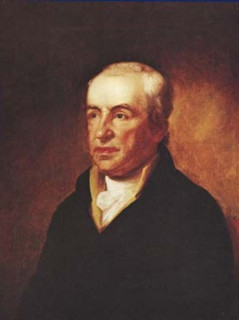
Dunlap is born in 1747 in Strabane, County Tyrone, in what is now Northern Ireland. When he is ten years old, he goes to work as an apprentice to his uncle, William Dunlap, a printer and bookseller in Philadelphia. In 1766, William Dunlap leaves the business in the care of his nephew, who eventually purchases the business. Initially he makes a living by printing sermons, broadsides and handbills. In November 1771, he begins the publication of the Pennsylvania Packet, or General Advertiser, a weekly newspaper. In 1773 he marries Elizabeth Hayes Ellison.
In 1776, Dunlap secures a lucrative printing contract for the Continental Congress. In July 1776, fighting between the American colonists and the British forces had been going on for over a year. On July 2, the Second Continental Congress votes on the Lee Resolution to secede. Two days later, they approve the final wording of a public declaration regarding their decision, which ultimately comes to be known as the Declaration of Independence. President of Congress John Hancock signs the fair copy with Secretary of Congress Charles Thomson attesting it. That evening Hancock orders Dunlap to print broadside copies of the declaration. He prints perhaps 200 broadsides, since known as the Dunlap broadsides, which are the first published versions of the Declaration.
Dunlap also prints items for Pennsylvania’s revolutionary government. In 1777 he takes over the printing of the Journals of the Continental Congress from Robert Aitken, but loses the contract in 1779 after printing in his newspaper a letter from Thomas Paine that leaks news of the secret French aid to the Americans.
In 1784, Dunlap’s paper becomes a daily with a new title: the North American and United States Gazette. It is not the first daily in the United States as the Pennsylvania Evening Post is the first in 1783, but it becomes the first successful daily.
Continuing to serve the changing needs of the government, Dunlap and his partner David Claypoole print the Constitution of the United States on September 19, 1787 for use by the Constitutional Convention, and later publish it for the first time in the Pennsylvania Packet.
Dunlap’s major financial success comes from real estate speculation. During the American Revolutionary War, he purchases property confiscated from Loyalists who refuse to take Pennsylvania’s new loyalty oath. After the war, he purchases land in Kentucky. By 1795, when he is forty-eight, he is able to retire with a sizable estate. Retirement does not agree with him, however. According to his friend, Dr. Benjamin Rush, he becomes a drunkard in his final years. He dies in Philadelphia on November 27, 1812.
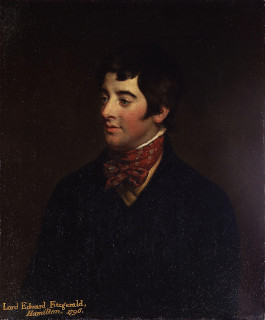
Fitzgerald is first elected to the Parliament of Ireland in 1783. His enthusiasm for the French Revolution leads to dismissal from the army in 1792. Four years later he joins the Society of United Irishmen, a nationalist organization that aspires to free Ireland from English control. This group appoints him to head the military committee formed to plan an uprising and obtain aid from the French revolutionary regime.
Although the French delay in supplying arms and troops, Fitzgerald’s committee proceeds with its plans for a general rebellion. The insurrection is set for May 23, 1798. In March his co-conspirators are seized by government agents, making him the most important United Irish leader still at liberty. On May 9 a reward of £1,000 is offered by Dublin Castle for his apprehension.
FitzGerald’s hiding place in a house in Thomas Street, Dublin is disclosed by a Catholic barrister and informant named Francis Magan. On May 18 Major Henry Sirr leads a military party to the house where FitzGerald is in bed suffering from a fever. Alerted by the commotion, he jumps out of bed and, ignoring the pleas of the arresting officers Captain William Bellingham Swan and Captain Daniel Frederick Ryan to surrender peacefully, FitzGerald stabs Swan and mortally wounds Ryan with a dagger in a desperate attempt to escape. He is secured only after Major Sirr shoots him in the shoulder.
FitzGerald is conveyed to New Prison, Dublin where he is denied proper medical treatment. After a brief detention in Dublin Castle he is taken to Newgate Prison, Dublin where his wound, which had now become infected, becomes mortally inflamed. His wife, whom the government probably has enough evidence to convict of treason, had fled the country, never to see her husband again, but his brother Henry and his aunt Lady Louisa Conolly are allowed to see him in his last moments.
FitzGerald dies at the age of 34 on June 4, 1798, as the rebellion rages outside. He is buried the next day in the cemetery of St. Werburgh’s Church, Dublin. An Act of Attainder confiscating his property is passed as 38 Geo. 3 c. 77 but is eventually repealed in 1819.
(Pictured: Portrait of Edward FitzGerald by Hugh Douglas Hamilton, 1796. National Portrait Gallery, London.)
The Articles of Confederation is approved, after much debate between July 1776 and November 1777, by the Second Continental Congress and sent to the states for ratification. The Articles come into force on March 1, 1781, after being ratified by all thirteen states. A guiding principle of the Articles is to preserve the independence and sovereignty of the states. The weak central government established by the Articles receives only those powers which the former colonies had recognized as belonging to king and parliament.
The document provides clearly written rules for how the states’ “league of friendship” is to be organized. During the ratification process, the Congress looks to the Articles for guidance as it conducts business, directs the war effort, conducts diplomacy with foreign nations, addresses territorial issues and deals with Native American relations. Little changes politically once the Articles of Confederation go into effect, as ratification does little more than legalize what the Continental Congress had already been doing. That body is renamed the Congress of the Confederation however most Americans continue to call it the Continental Congress, since its organization remains the same.
As the Confederation Congress attempts to govern the continually growing American states, delegates discover that the limitations placed upon the central government render it ineffective at doing so. As the government’s weaknesses become apparent, especially after Shays’ Rebellion, some prominent political thinkers in the fledgling nation begin asking for changes to the Articles. Their hope is to create a stronger national government.
Initially, some states meet to deal with their trade and economic problems. However, as more states become interested in meeting to change the Articles, a meeting is set in Philadelphia on May 25, 1787. This becomes the Constitutional Convention. It is quickly agreed that changes will not work, and instead the entire Articles needs to be replaced. On March 4, 1789, the government under the Articles is replaced with the federal government under the Constitution of the United States. The new Constitution provides for a much stronger federal government by establishing a chief executive (the President), courts, and taxing powers.
Clinton’s parents are Colonel Charles Clinton and Elizabeth Denniston Clinton, Presbyterian immigrants who had left County Longford in Ireland in 1729 to escape an Anglo-Irish regime that imposed severe disabilities on religious dissenters. His political interests are inspired by his father, who is a farmer, surveyor, and land speculator, and serves as a member of the New York colonial assembly. He is the brother of General James Clinton and the uncle of New York’s future governor, DeWitt Clinton. He is tutored by a local Scottish clergyman.
Clinton serves in the French and Indian War, rising to the rank of lieutenant in the colonial militia. He begins a legal practice after the war and serves as a district attorney for New York City. He becomes Governor of New York in 1777 and remains in that office until 1795. He supports the cause of independence during the American Revolutionary War and serves in the Continental Army despite his gubernatorial position. During and after the war, he is a major opponent of Vermont‘s entrance into the union due to disputes over land claims.
Opposed to the ratification of the Constitution of the United States, Clinton becomes a prominent Anti-Federalist and advocates for the addition of the United States Bill of Rights. In the early 1790s, he emerges as a leader of the incipient Democratic-Republican Party and serves as the party’s vice-presidential candidate in the 1792 presidential election. He receives the third most electoral votes in the election, as President George Washington and Vice President John Adams both win re-election. He does not seek re-election in 1795 but serves as governor again from 1801 to 1804. He is the longest-serving governor in U.S. history until Terry Branstad surpasses his record in 2015.
George Clinton dies in Washington, D.C. on April 20, 1812, leaving the office of vice president vacant for the first time in U.S history. He is buried in the Old Dutch Churchyard in Kingston, New York. His nephew, DeWitt Clinton, continues the Clinton New York political dynasty after his uncle’s death.
(Pictured: Portrait of George Clinton by Ezra Ames, 1814)
The British become aware of Conyngham’s plans and manage to maneuver him out of his ship with the help of the Dutch. After the loss of his ship, he heads back to France, hoping to connect with an ally to the United States. It is there he meets Benjamin Franklin, who helps him in his adventures many times in the future. They form a lasting relationship, and Conyngham eventually awards Franklin the nickname “the Philosopher” for his intellectual fortitude and resourcefulness. Franklin is entrusted with several commissions of the Continental Navy, and on March 1, 1777, Conyngham is appointed Captain of the luggerSurprise.
Conyngham scores a first victory that would warm the heart of any Irishmen, capturing the British merchant shipPrince of Orange on May 3, 1777. Later that year he is commissioned a captain in the Continental Navy and given command of the USS Revenge. He begins a series of highly successful raids into British waters from the port of Dunkirk, thus earning his sobriquet “The Dunkirk Pirate.”
In 1778 Conyngham sets sail for the West Indies and terrorizes British vessels there before finally returning to Philadelphia on February 21, 1779. He and his men had claimed 60 prize vessels in just 18 months. When he sets sail again his luck runs out and his ship is captured by the British vessel HMS Galatea on April 27, 1779. Conyngham was taken to prison in England and treated harshly by his British captors.
After two failed escape attempts, Conyngham tunnels his way out of Mill Prison in Plymouth and manages to make his way to the continent. He joins John Paul Jones on a cruise on the Alliance before returning to the United States. He is captured by the British again in March 1780 and spends another year in Mill Prison.
After the war Conyngham fails in his efforts to continue his naval career or to gain recognition from the United States Congress for his service during the war. He had lost the commission papers given to him by colonial representatives in Paris in 1777. It is said that he assists in the defense of Philadelphia against his old British foes during the War of 1812.
Gustavus Conyngham dies in Philadelphia seven years later on November 27, 1819. Nearly a century later, John Sanford Barnes, a retired navy captain and naval historian, acquires a cache of autographs and documents from a sale by Charavay of Paris. In the collection is Conyngham’s commission from Benjamin Franklin. Barnes publishes his discovery in September 1902, proving that the “Dunkirk Pirate” had never been a pirate at all, but one of the first heroes of the United States Navy.
(Pictured: Captain Gustavus Conyngham, Continental Navy. Painting by V. Zveg, 1976, based on a miniature by Louis Marie Sicardi. Courtesy of the U.S. Navy Art Collection, Washington, D.C. U.S. Naval Historical Center Photograph.)
The Irish Volunteers are a part-time military force whose original purpose is to guard against invasion and to preserve law and order when regular troops are being sent to America during the American Revolutionary War. Members are mainly drawn from the Protestant urban and rural middle classes and the movement soon begins to take on a political importance.
The first corps of Volunteers is formed in Belfast and the movement spreads rapidly across Ireland. By 1782 there are 40,000 enlisted in the Volunteers, half of them in Ulster. Strongly influenced by American ideas, though loyal to the Crown, the Volunteers demand greater legislative freedom for the Dublin Parliament.
The Dungannon Convention is a key moment in the eventual granting of legislative independence to Ireland.
At the time, all proposed Irish legislation has to be submitted to the Privy Council of the United Kingdom for its approval under the great seal of England before being passed by the Parliament of Ireland. English Acts emphasise the complete dependence of the Irish parliament on its English counterpart and English Houses claim and exercise the power to legislate directly for Ireland, even without the agreement of the parliament in Dublin.
The Ulster Volunteers, who assemble in Dungannon, County Tyrone, demand change. Prior to this, the Volunteers received the thanks of the Irish parliament for their stance but in the House of Commons, the British had ‘won over’ a majority of that assembly, which led to a resistance of further concessions. Thus, the 315 volunteers in Ulster at the Dungannon convention promised “to root out corruption and court influence from the legislative body,” and “to deliberate on the present alarming situation of public affairs.”
The Convention is held in a church and is conducted in a very civil manner. The Volunteers agree, almost unanimously, to resolutions declaring the right of Ireland to legislative and judicial independence, as well as free trade. A week later, Grattan, in a great speech, moves an address of the Commons to His Majesty, asserting the same principles but his motion is defeated. So too is another motion by Henry Flood, declaring the legislative independence of the Irish Parliament.
However, the British soon realise they can resist the agitation no longer. It is through ranks of Volunteers drawn up outside the parliament house in Dublin that Grattan passes on April 16, 1782, amidst unparalleled popular enthusiasm, to move a declaration of the independence of the Irish parliament. After a month of negotiations, legislative independence is granted to Ireland.
(Pictured: The original Irish Parliament Building which now houses the Bank of Ireland, College Green, opposite the main entrance to Trinity College, Dublin)
Hobart marries firstly Margaretta, daughter of Edmund Bourke, in 1792. They have one son, who dies in infancy, and a daughter, Lady Sarah, who marries Prime Minister Lord Goderich and is the mother of George Robinson, 1st Marquess of Ripon. After Margaretta’s death in 1796 he marries secondly the Hon. Eleanor Agnes, daughter of William Eden, 1st Baron Auckland, in 1799. There are no children from this marriage.
Robert Hobart dies at Hamilton Place, London, on February 4, 1816 at the age of 55, after falling from his horse. He is succeeded in the earldom by his nephew, George. Lady Buckinghamshire dies in October 1851, at the age of 74.