seamus dubhghaill

Promoting Irish Culture and History from Little Rock, Arkansas, USA


Leave a comment

Death of Mary Harris “Mother” Jones, Union Organizer & Activist

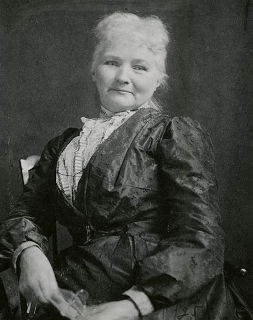
Mary G. Harris Jones, known as Mother Jones, an Irish-born American schoolteacher and dressmaker who becomes a prominent union organiser, community organiser, and activist, dies in Silver Spring, Maryland, on November 30, 1930. She is once deemed “the most dangerous woman in America” because of her union activities.

Jones is the daughter of Richard Harris, a Roman Catholic tenant farmer and railway labourer, and Ellen (née Cotter) Harris. She is baptised on August 1, 1837, in Cork, County Cork. Her exact date of birth is uncertain. She and her family are victims of the Great Famine, as are many other Irish families of the time. The famine forces more than a million families, including the Harrises, to immigrate to North America when she is ten years old. She lives in the United States and Canada, where she attends and later teaches in a Roman Catholic normal school in Toronto. In the United States she teaches in a convent school in Monroe, Michigan and works as a seamstress. In 1861 she marries George Jones, an iron-moulder and labour union member in Memphis, Tennessee. After the death of her husband and their four children in a yellow fever epidemic in 1867, she relocates to Chicago, Illinois, where she becomes involved with an early industrial union, the Knights of Labor. Her seamstress shop is destroyed in the Great Chicago Fire of 1871.

In the 1890s Jones becomes known as ‘Mother’ Jones and begins a long association with socialist causes and the United Mine Workers of America. She attends the founding convention of Social Democracy of America, later known as the Cooperative Brotherhood, in 1897 and in the same year organises support and publicity for striking bituminous coal miners in West Virginia, including a children’s march and parades of farmers delivering food to the miners’ camp. These types of defiant mass action become her trademark. Notable activities include organising women in support of an 1899 anthracite coal strike in eastern Pennsylvania, directing strikes of young women working in textile mills, a 1903 ‘children’s crusade’ against child labour which includes a ninety-mile march from Philadelphia to New York City, participating in 1905 in the founding convention of the Industrial Workers of the World, a radical labour union committed to the organisation of unskilled workers, campaigning for the release of Mexican revolutionaries imprisoned in American jails, and testifying in 1915 in congressional hearings against the abuse of corporate power by Rockefeller interests.

Jones reportedly meets with James Connolly, Irish socialist and labour organiser, in New York City in 1910. She is arrested for the first time for violating a federal injunction during a miners’ strike in West Virginia in 1902. In 1904, during a Colorado miners’ campaign, she has to avoid the authorities to escape possible deportation. During a 1914 strike in Ludlow, Colorado, she is imprisoned without trial for nine weeks. In 1919 she is arrested in Pennsylvania during a steelworkers’ strike for defending freedom of speech and the right of workers to organise unions. She remains active in the labour movement and radical causes into her nineties.

During her later years, Jones lives with her friends Walter and Lillie May Burgess on their farm in what is now Adelphi, Maryland. She celebrates her self-proclaimed 100th birthday there on May 1, 1930, and is filmed making a statement for a newsreel.

Jones dies on November 30, 1930, at the Burgess farm then in Silver Spring, Maryland, though now part of Adelphi. There is a funeral Mass at St. Gabriel’s Catholic Church in Washington, D.C. She is buried in the Union Miners Cemetery in Mount Olive, Illinois, alongside miners who died in the 1898 Battle of Virden.

In 1932, about 15,000 Illinois mine workers gather in Mount Olive to protest against the United Mine Workers, which soon becomes the Progressive Mine Workers of America. Convinced that they have acted in the spirit of Mother Jones, the miners decide to place a proper headstone on her grave. By 1936, the miners have saved up more than $16,000 and are able to purchase “eighty tons of Minnesota pink granite, with bronze statues of two miners flanking a twenty-foot shaft featuring a bas-relief of Mother Jones at its center.” On October 11, 1936, also known as Miners’ Day, an estimated 50,000 people arrive at Mother Jones’s grave to see the new gravestone and memorial. Since then, October 11 is not only known as Miners’ Day but is also referred to and celebrated in Mount Olive as “Mother Jones’s Day.”

The farm where she died begins to advertise itself as the “Mother Jones Rest Home” in 1932, before being sold to a Baptist church in 1956. The site is now marked with a Maryland Historical Trust marker, and a nearby elementary school is named in her honor.

Leave a comment

Birth of Alexander Campbell, Ulster Scots Minister

Alexander Campbell, an Ulster Scots immigrant who becomes an ordained minister in the United States, is born on September 12, 1788, near Ballymena, in the parish of Broughshane, County Antrim.

Campbell is the eldest son of Thomas Campbell and Jane Campbell (née Corneigle), who marry in 1787 and later have four daughters and two younger sons. His father, the son of soldier Archibald Campbell and his wife Alice McNally, is born on February 1, 1763, at Sheepbridge, near Newry, County Down. The Presbyterian minister William Campbell may have been a relation.

Archibald Campbell is born Catholic but joins the Church of Ireland, while his son joins the seceding branch of the Presbyterian church and studies at the University of Glasgow, graduating with a Master of Arts degree in 1786, although he does not appear in the published records of the university. He becomes a teacher but is determined to become a minister, and studies in the Anti-Burgher Divinity Hall in Whitburn, West Lothian (or the Seceder Theological Seminary in Whithorn, Wigtownshire, according to another source) for two months each year for five years. He is ordained a minister in the seceding congregation of Ahorey, County Armagh, probably in 1798. Although at first a member of the Anti-Burgher party in his church, Thomas Campbell begins to believe that divisions between and within denominations are prejudicial to true Christianity. He writes a report in 1804 suggesting that Burgher and Anti-Burgher Presbyterians in Ireland should unite. When this is vetoed in 1805 by the General Associate Synod of Scotland, Thomas Campbell, then moderator of the Irish Seceding Synod, initiates an unsuccessful move to seek independence from Scottish control. His experiences with church authorities undoubtedly increase his belief in the need to rediscover the scriptural basis of religion, freed from man-made creeds.

In 1804, Thomas Campbell sets up an academy at Richhill, County Armagh. In 1798, he is one of the founders of the Evangelical Society of Ulster in which clergymen from differing sects cooperate but resigns when this enterprise is frowned on by seceding authorities.

In poor health in 1806, Thomas Campbell resigns from Ahorey, and goes to the United States in 1807, where he preaches in small congregations around Washington, Pennsylvania. He is soon accused of doctrinal unsoundness, of disciplinary laxity and of administering the sacraments to non-Presbyterians. His appeal to the Associate Synod of North America is unsuccessful, and in 1809 he ceases to be a minister of the seceder church. His liberal views on Christian unity and on the paramount importance of the Bible attract supporters, and in 1809 they found the Christian Association of Washington. He publishes a declaration and address in which he sets out the principles of this body. His followers claim it represents a “second reformation” or a “restoration.” It forms the basis of the doctrine of what becomes America’s most important indigenous religious development, and is regarded as significant in the history of the wider ecumenical movement. He publishes a great many other tracts and articles. Thomas Campbell dies in Bethany, West Virginia, on January 4, 1854.

Thomas had married Jane Corneigle in 1787 and their eldest son Alexander is born on September 12, 1788, in Broughshane, County Antrim, where his father is teaching. His parents intend him for the ministry, and he receives a good education, partly from his father, and religious training from both parents. He is greatly influenced by his strongminded and pious mother. In October 1808 his family sets sail for America to join his father. The ship is wrecked on the island of Islay, off Scotland. All on board are saved, partly thanks to Alexander’s strength and leadership. Rather than continuing the voyage by other means, Alexander spends eight months in the University of Glasgow to prepare himself for the ministry.

In the summer of 1809, the family finally arrives in Pennsylvania, among many emigrants from Ulster. On January 1, 1812, Campbell is ordained as a minister by his father’s Brush Run Church, and quickly takes over the leadership of the fledgling church. By 1812, most of their followers, thenceforth often called Campbellites, have undergone baptism by immersion; a union with the Baptist denomination results, but does not survive after 1830, by which date Campbell’s work on a translation of the Greek New Testament has convinced him that baptism is unscriptural. Controversy between the two groups continues for many years.

A very able preacher and debater, whose public discussions attract much attention, Campbell attacks the creeds and governance of established churches. In 1823, he founds the journal the Christian Baptist. Subsequently in 1830, after the break with the Baptists, he starts the Millennial Harbinger. Both periodicals are largely written by Campbell and his father, Thomas, and are widely influential. He is convinced that church unity will usher in a millennial age of peace and harmony. Primitive Christianity is thus to bring about a utopian future. His book Christianity Restored (1835) is widely read, in Britain as well as in the United States. In 1826, a translation of the Greek New Testament is printed by Campbell’s press in Bethany, West Virginia. Largely based on recent translations by others, it nonetheless contains variant readings by Campbell and furthers his aim of providing followers with authoritative texts on which to base their beliefs. In 1841, he founds Bethany College, West Virginia, and is its president until his death in Bethany on March 4, 1866, when he leaves it $10,000 and a large library.

In 1832, several fledgling churches join the Campbellites, and form a new body called the Christian Church, or Disciples of Christ, which today has over 3,000 congregations in the United States. The two guiding principles of the lifelong beliefs of the Campbells are in the end irreconcilable. An emphasis on the literal interpretation of scripture allows believers to form beliefs at variance from those of co-religionists, and neither Alexander Campbell’s great authority in the denomination nor Thomas Campbell’s emphasis on the need for church unity are enough to prevent the fissions inevitable in a church that so strongly opposes man-made creeds. There are now at least six major divisions of the Church of Christ, one of several alternative names.

On March 2, 1811, Campbell marries Margaret Brown, and thenceforth derives his income from the large farm that had belonged to her family. They have eight children, who all die in their father’s lifetime. Margaret Brown Campbell dies on October 22, 1827. On July 31, 1828, in fulfilment of his wife’s dying request, the widower marries the English-born Selina Huntington Bakewell, and has six children with her. Four of those children survive him. Selina Campbell writes a memoir of her husband, published in 1882, and lives until 1897.

(From: “Campbell, Alexander” by Linde Lunney, Dictionary of Irish Biography, http://www.dib.ie, last revised May 2021)


Leave a comment

Birth of Artist Paul Henry

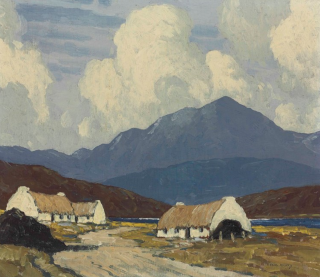
Paul Henry, Irish artist noted for depicting the Connacht province landscape in the west of Ireland in a spare Post-Impressionist style, is born at 61 University Road, Belfast, on April 11, 1876.

Henry is the third of four sons of the Rev. Robert Mitchell Henry, minister of the Reformed Presbyterian Church, and his wife Kate Ann Berry, eldest of four daughters of Thomas Berry, minister of the Baptist church, Athlone. His father becomes a Baptist in 1858 and pastor of Great Victoria Street Baptist Church, Belfast, resigning in 1875 to join the Plymouth Brethren.

Henry begins to draw in pencil and watercolours at the age of four, even before entering the kindergarten at Methodist College Belfast (MCB), in 1882 where he first begins drawing regularly. At the age of fifteen he moves to the Royal Belfast Academical Institution. He studies art at the Belfast School of Art before going to Paris in 1898 to study at the Académie Julian and at James McNeill Whistler‘s Académie Carmen.

Henry marries the painter Emily Grace Mitchell on September 17, 1903, in London at St Peter’s Anglican church, Bayswater. He returns to Ireland in 1910. From then until 1919 he lives on Achill Island, where he learns to capture the peculiar interplay of light and landscape specific to the west of Ireland. In 1919, he moves to Dublin and in 1920 he is one of the founders of the Society of Dublin Painters, originally a group of ten artists. He designs several railway posters, some of which, notably Connemara Landscape, achieves considerable sales. He separates from his wife in 1929. His second wife is the artist Mabel Young.

In the 1920s and 1930s, Henry is Ireland’s best-known artist, one who has a considerable influence on the popular image of the west of Ireland. Although he seems to cease experimenting with his technique after leaving Achill and his range is limited, he creates a large body of fine images whose familiarity is a testament to its influence.

Henry’s use of colour is affected by his red-green colour blindness. He loses his sight in 1945 and does not regain his vision before his death.

Henry dies on August 24, 1958, at his home at 1 Sidmonton Square, Bray, County Wicklow, and is buried at St. Patrick’s Church, Enniskerry, County Wicklow. He is survived by his wife, Mabel. His papers and sketchbooks are in the libraries of the National Gallery of Ireland and Trinity College Dublin.

A commemorative exhibition of Henry’s work is held at Trinity College, Dublin, in 1973 and the National Gallery of Ireland holds a major exhibition of his work in 2004.

A painting by Henry is featured on an episode of the BBC‘s Antiques Roadshow, broadcast on November 12, 2006. The painting is given a value of approximately £40,000–60,000 by the Roadshow. However, due to the buoyancy of the Irish art market at the time, it sells for €260,000 on December 5, 2006, in James Adams’ and Bonhams’ joint Important Irish Art sale.

Pictured: “Roadside Cottages, below Mweelrea Mountain” by Paul Henry, RHA, oil on panel, 1940)


Leave a comment

Birth of James Sheridan Knowles, Dramatist & Actor

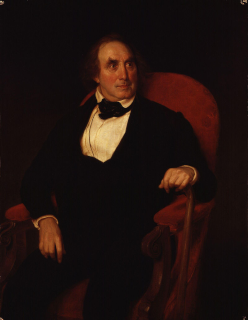
James Sheridan Knowles, Irish dramatist and actor, is born in Cork, County Cork, on May 12, 1784. A relative of Richard Brinsley Sheridan, he enjoys success writing plays for the leading West End theatres. Later in his career he also produces several novels.

Knowles’s father is the lexicographer James Knowles, cousin of Richard Brinsley Sheridan. The family moves to London in 1793, and at the age of fourteen he publishes a ballad entitled The Welsh Harper, which, set to music, is very popular. His talents secure him the friendship of William Hazlitt, who introduces him to Charles Lamb and Samuel Taylor Coleridge. He serves for some time in the Wiltshire and afterwards in the Tower Hamlets militia, leaving the service to become a pupil of Dr. Robert Willan. He obtains the degree of M.D. and is appointed vaccinator to the Jennerian Society.

Although Dr. Willan offers him a share in his practice, Knowles decides to give up medicine for the stage, making his first appearance as an actor probably at Bath, and plays Hamlet at the Crow Street Theatre, Dublin. At Wexford he marries, in October 1809, Maria Charteris, an actress from the Edinburgh Theatre. In 1810, he writes Leo, a successful play in which Edmund Kean appears. Another play, Brian Boroihme, written for the Belfast Theatre in the next year, attracts crowds. Nevertheless, his earnings are so small that he is obliged to become assistant to his father at the Royal Belfast Academical Institution. In 1817 he moves from Belfast to Glasgow, where, besides keeping a flourishing school, he continues to write for the stage.

Knowles first important success is Caius Gracchus, produced at the Belfast Theatre in 1815. His Virginius, written for William Charles Macready, is first performed in 1820 at Covent Garden. In William Tell (1825), he writes for Macready one of his favourite parts. His best-known play, The Hunchback, is produced at Covent Garden in 1832, and he wins praise acting in the work as Master Walter. The Wife is brought out at the same theatre in 1833. The Daughter, better known as The Wrecker’s Daughter, in 1836, and The Love Chase in 1837. His 1839 play Love is praised by Mary Shelley for its “inspiring situations founded on sentiment and passion.” His second wife is the actress, Emma Knowles.

In his later years Knowles forsakes the stage for the pulpit and, as a Baptist preacher, attracts large audiences at Exeter Hall and elsewhere. He publishes two polemical works: the Rock of Rome and the Idol Demolished by Its Own Priests in both of which he combats the special doctrines of the Roman Catholic Church. He is for some years in the receipt of an annual pension of £200, bestowed by Sir Robert Peel in 1849. In old age he befriends the young Edmund Gosse, whom he introduces to Shakespeare. He makes a happy appearance in Gosse’s Father and Son.

Knowles dies at Torquay on November 30, 1862. He is buried under a huge tomb at the summit of the Glasgow Necropolis.

A full list of the works of Knowles and of the various notices of him can be found in The Life of James Sheridan Knowles (1872), privately printed by his son, Richard Brinsley Knowles (1820–1882), who is well known as a journalist. It is translated into German.


Leave a comment

Baptism of Mary Harris “Mother” Jones, Union Organizer & Activist

Mary G. Harris Jones, known as Mother Jones, an Irish-born American schoolteacher and dressmaker who becomes a prominent union organiser, community organiser, and activist, is baptised on August 1, 1837, in Cork, County Cork. Her exact date of birth is uncertain. She is once deemed “the most dangerous woman in America” because of her union activities.

Jones is the daughter of Richard Harris, a Roman Catholic tenant farmer and railway labourer, and Ellen (née Cotter) Harris. She and her family are victims of the Great Famine, as are many other Irish families of the time. The famine forces more than a million families, including the Harrises, to immigrate to North America when she is ten years old. She lives in the United States and Canada, where she attends and later teaches in a Roman Catholic normal school in Toronto. In the United States she teaches in a convent school in Monroe, Michigan and works as a seamstress. In 1861 she marries George Jones, an iron-moulder and labour union member in Memphis, Tennessee. After the death of her husband and their four children in a yellow fever epidemic in 1867, she relocates to Chicago, Illinois, where she becomes involved with an early industrial union, the Knights of Labor. Her seamstress shop is destroyed in the Great Chicago Fire of 1871.

In the 1890s Jones becomes known as ‘Mother’ Jones and begins a long association with socialist causes and the United Mine Workers of America. She attends the founding convention of Social Democracy of America, later known as the Cooperative Brotherhood, in 1897 and in the same year organises support and publicity for striking bituminous coal miners in West Virginia, including a children’s march and parades of farmers delivering food to the miners’ camp. These types of defiant mass action become her trademark. Notable activities include organising women in support of an 1899 anthracite coal strike in eastern Pennsylvania, directing strikes of young women working in textile mills, a 1903 ‘children’s crusade’ against child labour which includes a ninety-mile march from Philadelphia to New York City, participating in 1905 in the founding convention of the Industrial Workers of the World, a radical labour union committed to the organisation of unskilled workers, campaigning for the release of Mexican revolutionaries imprisoned in American jails, and testifying in 1915 in congressional hearings against the abuse of corporate power by Rockefeller interests.

Jones reportedly meets with James Connolly, Irish socialist and labour organiser, in New York City in 1910. She is arrested for the first time for violating a federal injunction during a miners’ strike in West Virginia in 1902. In 1904, during a Colorado miners’ campaign, she has to avoid the authorities to escape possible deportation. During a 1914 strike in Ludlow, Colorado, she is imprisoned without trial for nine weeks. In 1919 she is arrested in Pennsylvania during a steelworkers’ strike for defending freedom of speech and the right of workers to organise unions. She remains active in the labour movement and radical causes into her nineties.

During her later years, Jones lives with her friends Walter and Lillie May Burgess on their farm in what is now Adelphi, Maryland. She celebrates her self-proclaimed 100th birthday there on May 1, 1930, and is filmed making a statement for a newsreel.

Jones dies on November 30, 1930, at the Burgess farm then in Silver Spring, Maryland, though now part of Adelphi. There is a funeral Mass at St. Gabriel’s in Washington, D.C. She is buried in the Union Miners Cemetery in Mount Olive, Illinois, alongside miners who died in the 1898 Battle of Virden.

In 1932, about 15,000 Illinois mine workers gather in Mount Olive to protest against the United Mine Workers, which soon becomes the Progressive Mine Workers of America. Convinced that they have acted in the spirit of Mother Jones, the miners decide to place a proper headstone on her grave. By 1936, the miners have saved up more than $16,000 and are able to purchase “eighty tons of Minnesota pink granite, with bronze statues of two miners flanking a twenty-foot shaft featuring a bas-relief of Mother Jones at its center.” On October 11, 1936, also known as Miners’ Day, an estimated 50,000 people arrive at Mother Jones’s grave to see the new gravestone and memorial. Since then, October 11 is not only known as Miners’ Day but is also referred to and celebrated in Mount Olive as “Mother Jones’s Day.”

The farm where she died begins to advertise itself as the “Mother Jones Rest Home” in 1932, before being sold to a Baptist church in 1956. The site is now marked with a Maryland Historical Trust marker, and a nearby elementary school is named in her honor.