seamus dubhghaill

Promoting Irish Culture and History from Little Rock, Arkansas, USA


Leave a comment

Birth of Mario Rosenstock, Actor, Comedian, Impressionist & Musician

Mario Rosenstock, Irish actor, comedianimpressionist and musician, is born in London, England, on August 31, 1970.

Rosenstock first comes to the attention of the Irish public playing the role of Dr. David Hanlon in the soap opera Glenroe in the 1990s.

However, he is now best known for the popular Gift Grub segments which have featured on The Ian Dempsey Breakfast Show on Today FM since May 1999 which Rosenstock creates alongside Paul McLoone, a radio presenter with Today FM and frontman of the Northern Irish pop-punk/new-wave band, The Undertones.

Gift Grub is a series of comic sketches, impersonations and parodies that featured Rosenstock assuming the personae of Bertie AhernRonan KeatingColin Farrell and Roy Keane among many others. He also provides the manic voice of Right Price Tiles radio spokesperson “Daft Dave.”

Rosenstock performs an impersonation of José Mourinho in a parody of a song from the musical Joseph and the Amazing Technicolor Dreamcoat. This spreads like wildfire on Internet message boards and eventually it is played on a Sky Sports broadcast. Mourinho hears the song and enjoys the impersonation so much he asks Rosenstock to perform a private show for him and the Chelsea F.C. squad. Rosenstock later releases, with Mourinho’s blessing, a single version of “José and his Amazing Technicolor Overcoat.” He also releases another song (“I Sign a Little Player or Two“) on the internet with a parody of Mourinho in an interview then breaking into song.

In 2005, Rosenstock stars as Keano in the comedy musical play I, Keano, which concerns Keane storming out of the Republic of Ireland national football squad during preparations for the 2002 FIFA World Cup.

In 2005, Rosenstock achieves the Christmas number one single in the Irish Singles Chart, with a parody of Will Young‘s song Leave Right Now (which itself is a Christmas number-one in 2003). The parody concerned Roy Keane’s controversial departure from Manchester United and his falling-out with Alex Ferguson

Between December 2007 and May 2009, Rosenstock works on a puppet comedy series entitled Special 1 TV (originally known as I’m on Setanta Sports), which is presented as a parody weekly football talk show hosted by “José Mourinho.” He voices all the puppet characters on the sketch, with the exception of “Rafael Benitez,” who is performed by Keith Burke, including the main character Mourinho, his studio co-hosts “Sven-Göran Eriksson” and “Wayne Rooney,” and regular phone-in callers like “Alex Ferguson,” “Arsène Wenger,” “Roy Keane” and “Mick McCarthy,” as well as the non-football-related characters, Nelson MandelaWillie NelsonBarack Obama and Tom Cruise.

Rosenstock receives the Outstanding Achievement Award at the 11th annual PPI (Phonographic Performance Ireland) Radio Awards in 2011.

In November 2012 his new show called The Mario Rosenstock Show starts on RTÉ2. A second series of the show begins to air in September 2013.

Rosenstock is married, with two children. His uncle, Gabriel Rosenstock, is one of Ireland’s most notable Irish language poets and member of Innti with Michael DavittNuala Ní Dhomhnaill and Liam Ó Muirthile. Rosenstock’s grandfather George is a doctor and writer from Schleswig-Holstein, Germany. He never speaks German again after the war out of shame. His grandmother is a nurse from AthenryCounty Galway.


Leave a comment

Death of Al Smith, Irish American Four Term Governor of New York

Alfred Emanuel Smith, Irish American politician who serves four terms as the 42nd governor of New York and is the Democratic Party‘s presidential nominee in 1928 United States presidential election, dies on October 4, 1944, in New York City.

Smith is born at 174 South Street, New York City, on December 30, 1873, and raised in the Fourth Ward on the Lower East Side of Manhattan. He resides there for his entire life. His mother, Catherine (née Mulvihill), is the daughter of Maria Marsh and Thomas Mulvihill, who are immigrants from County Westmeath, Ireland. His father, baptised Joseph Alfred Smith in 1839, is a Civil War–veteran and the son of Emanuel Smith, an Italian marinaro.

Although Smith remains personally untarnished by corruption, he — like many other New York Democrats — is linked to the notorious Tammany Hall political machine that controls New York City politics during his era. He serves in the New York State Assembly from 1904 to 1915 and holds the position of Speaker of the Assembly in 1913. He also serves as sheriff of New York County from 1916 to 1917. He is first elected governor of New York in 1918, loses his 1920 bid for re-election, and is elected governor again in 1922, 1924, and 1926. He is the foremost urban leader of the efficiency movement in the United States and is noted for achieving a wide range of reforms as the New York governor in the 1920s.

Smith is the first Roman Catholic to be nominated for president of the United States by a major party. His 1928 presidential candidacy mobilizes both Catholic and anti-Catholic voters. Many Protestants, including German American Lutherans and Southern Baptists, fear his candidacy, believing that the Pope in Rome would dictate his policies. He is also a committed “wet” (i.e., an opponent of Prohibition in the United States) and as New York governor, he repeals the state’s prohibition law. As a “wet,” he attracts voters who want beer, wine and liquor without having to deal with criminal bootleggers, along with voters who are outraged that new criminal gangs have taken over the streets in most large and medium-sized cities. Incumbent Republican Secretary of Commerce Herbert Hoover is aided by national prosperity, the absence of American involvement in war and anti-Catholic bigotry, and he defeats Smith in a landslide in 1928.

Smith then enters business in New York City and becomes involved in the construction and promotion of the Empire State Building. He seeks the 1932 Democratic presidential nomination but is defeated by Franklin D. Roosevelt, his former ally and successor as governor of New York. During the Roosevelt presidency, he becomes an increasingly vocal opponent of Roosevelt’s New Deal.

Smith is an early and vocal critic of the Nazi regime in Germany. He supports the Anti-Nazi boycott of 1933 and addresses a mass-meeting at Madison Square Garden against Nazism in March 1933. His speech is included in the 1934 anthology Nazism: An Assault on Civilization. In 1938, he takes to the airwaves to denounce Nazi brutality in the wake of Kristallnacht. His words are published in The New York Times article “Text of the Catholic Protest Broadcast” of November 17, 1938.

Like most New York City businessmen, Smith enthusiastically supports American military involvement in World War II. Although he is not asked by Roosevelt to play any role in the war effort, he is an active and vocal proponent of FDR’s attempts to amend the Neutrality Act in order to allow “Cash and Carry” sales of war equipment to be made to the British. He speaks on behalf of the policy in October 1939, to which FDR responds directly: “Very many thanks. You were grand.”

In 1939, Smith is appointed a Papal Chamberlain of the Sword and Cape, one of the highest honors which the Papacy bestows on a layman.

Smith dies of a heart attack at the age of 70 at the Rockefeller Institute Hospital on October 4, 1944. He had been broken-hearted over the death of his wife from cancer five months earlier, on May 4, 1944. He is interred at Calvary Cemetery, a Catholic cemetery in Maspeth and Woodside, Queens, New York City.

Smith is memorialized by The Alfred E. Smith Foundation, founded by Cardinal Francis Spellman. Today it is a significant fund raiser for charity. Each election year, presidential candidates are expected to attend, make witty remarks, and profound commentary about Smith. In 2008, then candidate Barack Obama speaks eloquently of “a man who fought for many years to give Americans nothing more than fair shake and a chance to succeed. He touched the lives of millions as a result.”

(Pictured: Official Gubernatorial portrait of Alfred E. “Al” Smith by Douglas Volk)


Leave a comment

Enda Kenny Meets Barack Obama & Joe Biden in Washington, D.C.

On March 15, 2016, acting Taoiseach Enda Kenny is in Washington, D.C. for the traditional festivities to mark Saint Patrick’s Day.

Kenny holds a meeting with U.S. President Barack Obama. This is President Obama’s last Saint Patrick’s Day in the White House and, pending government formation negotiations, it may also be Kenny’s last as Taoiseach. Obama criticises the vicious nature of the current U.S. political cycle and pledges to continue to push for immigration reform while he is still in office. He is speaking as he attends several engagements with Kenny to mark Saint Patrick’s Day.

Earlier in the day at a breakfast reception at Number One Observatory Circle, the official residence of the vice president of the United States, Kenny tells Vice President Joe Biden that Ireland will be able to put together a stable government during the next “short period ahead.” The recent General Election is mentioned several times during speeches from both men. Biden says that he is surprised at the outcome saying, “he did a hell of a job, is still the most popular guy, and he lost.” Biden says Kenny had assured him that it was “going to work out.”

The traditional Speaker’s Lunch to mark Saint Patrick’s Day is hosted for the first time by Paul Ryan, the Speaker of the United States House of Representatives.

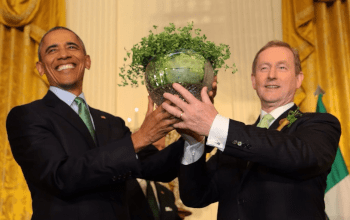
In the evening, Kenny presents the traditional bowl of shamrock to Obama at a reception at the White House. The bowl is mouth-blown and hand-cut at the House of Waterford Crystal factory in Ireland. The piece is designed by Tom Cooke and inspired by the General Post Office (GPO) in Dublin. It features the five themes of the Irish 2016 Centenary Programme – Remembering, Reconciling, Presenting, Imagining and Celebrating – which are inscribed on the piece.

Kenny also presents Obama with a pair of cufflinks modeled on the buttons of the coat Michael Collins was wearing when he was killed, and a limited-edition, fine-press collection of poetry and art, to celebrate the centenary of the 1916 Easter Rising, published by Stoney Road Press, in association with An Post and Poetry Ireland. First Lady Michelle Obama receives a ring designed by Paul Kelly, inspired by the Ring of Kerry, and a hamper of Irish food items. Daughters Malia and Sasha Obama are given two Newbridge Silverware compact mirrors.

Speaking to reporters after visiting the Oval Office, Kenny says Fine Gael is talking to like-minded parties and individuals on government formation and is working on drawing-up a set of priorities. “We’re actually determining our set of priorities that will be important in the discussions that Fine Gael will have in putting together a government. Some of that comes from our own programme, some of it comes from the parties and the alliances that we’ve been talking to. And some of it clearly comes from the concerns raised by people during the course of the election, like housing and homelessness, health issues and so on.”

Kenny adds, “We expect to have that finalised next week and that gives us really the basis for negotiations and for discussions about putting a government together.”

The following day, Kenny returns to Ireland for a short time before traveling to Brussels for a European Council meeting on Saint Patrick’s Day.

(From: “Kenny meets Obama and Biden in Washington,” RTÉ News, http://www.rte.ie, March 15, 2016)


Leave a comment

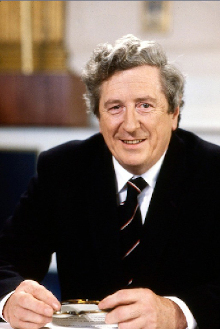
Birth of Garret FitzGerald, Eighth Taoiseach of Ireland

Garret Desmond FitzGerald, Fine Gael politician, economist and barrister who serves twice as Taoiseach (1981 to 1982 and 1982 to 1987), is born into a very politically active family in Ballsbridge, Dublin on February 9, 1926, during the infancy of the Irish Free State. He serves as Senator for the Industrial and Commercial Panel from 1965 to 1969, a Teachta Dála (TD) from 1969 to 1992, Minister for Foreign Affairs from 1973 to 1977, Leader of Fine Gael from 1977 to 1987 and twice Leader of the Opposition between 1977 and 1982.

FitzGerald’s father, Desmond FitzGerald, is the Free State’s first Minister for External Affairs. He is educated at the Jesuit Belvedere College, University College Dublin and King’s Inns, Dublin, and qualifies as a barrister. Instead of practicing law, however, in 1959 he becomes an economics lecturer in the department of political economy at University College, Dublin, and a journalist.

FitzGerald joins Fine Gael, attaching himself to the liberal wing of the party. and in 1969 is elected to Dáil Éireann, the lower house of the Oireachtas, the Irish parliament. He later gives up his university lectureship to become Minister for Foreign Affairs in the coalition government of Liam Cosgrave (1973–1977). When the coalition government is resoundingly defeated in the 1977 Irish general election, Cosgrave yields leadership of Fine Gael to FitzGerald. In his new role as Leader of the Opposition and party leader, he proceeds to modernize and strengthen the party at the grass roots. He briefly loses power in 1982 when political instability triggers two snap elections.

By the time of the 1981 Irish general election, Fine Gael has a party machine that can easily match Fianna Fáil. The party wins 65 seats and forms a minority coalition government with the Labour Party and the support of a number of Independent TDs. FitzGerald is elected Taoiseach on June 30, 1981. To the surprise of many FitzGerald excludes Richie Ryan, Richard Burke and Tom O’Donnell, former Fine Gael stalwarts, from the cabinet.

In his prime ministry, FitzGerald pushes for liberalization of Irish laws on divorce, abortion, and contraception and also strives to build bridges to the Protestants in Northern Ireland. In 1985, during his second term, he and British Prime Minister Margaret Thatcher sign the Anglo-Irish (Hillsborough) Agreement, giving Ireland a consultative role in the governing of Northern Ireland. After his party loses in the 1987 Irish general election, he resigns as its leader and subsequently retires in 1992.

On May 5, 2011, it is reported that FitzGerald is seriously ill in a Dublin hospital. Newly elected Fine Gael Taoiseach Enda Kenny sends his regards and calls him an “institution.” On May 6 he is put on a ventilator. On May 19, after suffering from pneumonia, he dies at the Mater Private Hospital in Dublin at the age of 85.

In a statement, Irish President Mary McAleese hails FitzGerald as “a man steeped in the history of the State who constantly strove to make Ireland a better place for all its people.” Taoiseach Enda Kenny pays homage to “a truly remarkable man who made a truly remarkable contribution to Ireland.” Henry Kissinger, the former United States Secretary of State, who serves as an opposite number to FitzGerald in the 1970s, recalls “an intelligent and amusing man who was dedicated to his country.”

FitzGerald’s death occurs on the third day of Queen Elizabeth II‘s state visit to the Republic of Ireland, an event designed to mark the completion of the Northern Ireland peace process that had been “built on the foundations” of FitzGerald’s Anglo-Irish Agreement with Margaret Thatcher in 1985. In a personal message, the Queen offers her sympathies and says she is “saddened” to learn of FitzGerald’s death.

On his visit to Dublin, United States President Barack Obama offers condolences on FitzGerald’s death. He speaks of him as “someone who believed in the power of education; someone who believed in the potential of youth; most of all, someone who believed in the potential of peace and who lived to see that peace realised.”

FitzGerald is buried at Shanganagh Cemetery in Shankill, Dublin.

FitzGerald is the author of a number of books, including Planning in Ireland (1968), Towards a New Ireland (1972), Unequal Partners (1979), All in a Life: An Autobiography (1991), and Reflections on the Irish State (2003).


Leave a comment

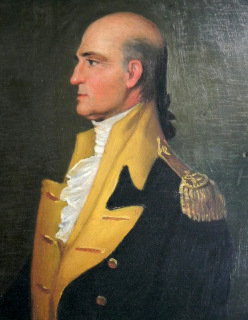
Birth of Edward Hand, Soldier, Physician & Politician

Edward Hand, Irish soldier, physician, and politician who serves in the Continental Army during the American Revolutionary War, is born in Clyduff, King’s County (now County Offaly) on December 31, 1744. He rises to the rank of general and later is a member of several Pennsylvania governmental bodies.

Hand, the son of John Hand, is baptised in Shinrone. Among his immediate neighbours are the Kearney family, ancestors of United States President Barack Obama. He is a descendant of either the families of Mag Fhlaithimh (of south Ulaidh and Mide) or Ó Flaithimhín (of the Síol Muireadaigh) who, through mistranslation became Lavin or Hand.

Hand earns a medical certificate from Trinity College, Dublin. In 1767, he enlists as a Surgeon’s Mate in the 18th (Royal Irish) Regiment of Foot. On May 20, 1767, he sails with the regiment from Cobh, County Cork, arriving at Philadelphia on July 11, 1767. In 1772, he is commissioned an ensign. He marches with the regiment to Fort Pitt, on the forks of the Ohio River, returning to Philadelphia in 1774, where he resigns his commission.

In 1774, Hand moves to Lancaster, Pennsylvania, where he practices medicine. On March 13, 1775, he marries Catherine Ewing. Lancaster is the region of some of the earliest Irish and Scotch-Irish settlements in Pennsylvania. As a people, they are well known for their anti-English and revolutionary convictions. He is active in forming the Lancaster County Associators, a colonial militia. He is a 32nd degree Freemason, belonging to the Montgomery Military Lodge number 14.

Hand enters the Continental Army in 1775 as a lieutenant colonel in the 1st Pennsylvania Regiment under Colonel William Thompson. He is promoted to colonel in 1776 and placed in command of the 1st Continental, then designated the 1st Pennsylvania. Promoted to brigadier general in March 1777, he serves as the commander of Fort Pitt, fighting British loyalists and their Indian allies. He is recalled, after over two years at Fort Pitt, to serve as a brigade commander in Major General La Fayette‘s division.

In 1778, Hand attacks the Lenape, killing Captain Pipe‘s mother, brother, and a few of his children during a military campaign. Failing to distinguish among the Native American groups, he had attacked the neutral Lenape while trying to reduce the Indian threat to settlers in the Ohio Country, because other tribes, such as the Shawnee, had allied with the British.

After a few months, he is appointed Adjutant General of the Continental Army and serves during the Siege of Yorktown in that capacity. In recognition of his long and distinguished service, he is promoted by brevet to major general in September 1783. He resigns from the Army in November 1783.

Hand returns to Lancaster and resumes the practice of medicine. A Federalist, he is also active in civil affairs. Beginning in 1785, he owns and operates Rock Ford plantation, a 177-acre farm on the banks of the Conestoga River, one mile south of Lancaster, Pennsylvania. The Georgian brick mansion remains today, and the farm is a historic site open to the public.

Hand dies from typhoid fever, dysentery or pneumonia at Rock Ford on September 3, 1802, although medical records are unclear with some sources stating he died of cholera. There is no evidence Lancaster County suffered from a cholera epidemic in 1802. He is buried in St. James’s Episcopal Cemetery in Lancaster, the same church where he had served as a deacon.


Leave a comment

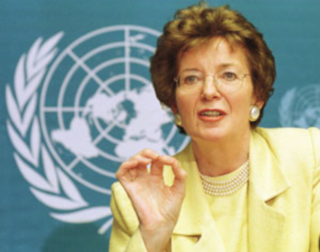
Mary Robinson Inaugurated 7th President of Ireland

Mary Robinson, Irish lawyer, independent politician, and diplomat born Mary Teresa Winifred Bourke, is inaugurated as the seventh President of Ireland on December 3, 1990, becoming the first woman to hold the office. She later serves as United Nations High Commissioner for Human Rights (UNHCHR) from September 1997 – September 2002.

Robinson is born on May 21, 1944, in Ballina, County Mayo. She is educated at Trinity College and the King’s Inns in Dublin and at Harvard Law School in the United States. She serves at Trinity College (University of Dublin) as Reid Professor of penal legislation, constitutional and criminal law, and the law of evidence (1969–1975) and lecturer in European Community law (1975–1990). In 1988 she and her husband establish the Irish Centre for European Law at Trinity College.

A distinguished constitutional lawyer and a renowned supporter of human rights, Robinson is elected to the Royal Irish Academy and is a member of the International Commission of Jurists in Geneva (1987–1990). She sits in Seanad Éireann, the upper house of the Oireachtas, for the University of Dublin constituency (1969–1989) and serves as whip for the Labour Party until resigning from the party over the Anglo-Irish Agreement of 1985, which she feels ignores unionist objections. She is also a member of the Dublin City Council (1979–1983) and runs unsuccessfully in 1977 and 1981 for Dublin parliamentary constituencies.

Nominated by the Labour Party and supported by the Green Party and the Workers’ Party, Robinson becomes Ireland’s first woman president in 1990 by mobilizing a liberal constituency and merging it with a more conservative constituency opposed to the Fianna Fáil party. As president, she adopts a much more prominent role than her predecessors and she does much to communicate a more modern image of Ireland. Strongly committed to human rights, she is the first head of state to visit Somalia after it suffers from civil war and famine in 1992 and the first to visit Rwanda after the genocide in that country in 1994.

Shortly before her term as president expires, Robinson accepts the post of United Nations High Commissioner for Human Rights (UNHCHR). As high commissioner, she changes the priorities of her office to emphasize the promotion of human rights at the national and regional levels. She was the first UNHCHR to visit China, and she also helps to improve the monitoring of human rights in Kosovo. In 2001 she serves as secretary-general of the World Conference against Racism held in Durban, South Africa. In 1998 she is elected chancellor of Trinity College, a post she holds until 2019.

After stepping down as UNHCHR, Robinson founds the nongovernmental organization Realizing Rights: The Ethical Globalization Initiative (2002–2010). Its central concerns include equitable international trade, access to health care, migration, women’s leadership and corporate responsibility. She is also a founding member of the Council of Women World Leaders, serves as honorary president of Oxfam International, a private organization that provides relief and development aid to impoverished or disaster-stricken communities worldwide, and is a member of the Club of Madrid, which promotes democracy. She also holds various posts at the United Nations, and in 2010, she establishes the Mary Robinson Foundation—Climate Justice, which operates until 2019.

Robinson is the recipient of numerous honours. In 2004 Amnesty International awards her its Ambassador of Conscience Award for her human rights work. In 2009 she receives the United States Presidential Medal of Freedom from President Barack Obama. Her memoir, Everybody Matters: My Life Giving Voice (cowritten with Tessa Robinson), is published in 2012.

(Pictured: Mary Robinson during her inauguration as president in 1990, photograph by Matt Kavanagh)


Leave a comment

Garrett FitzGerald Becomes 8th Taoiseach of Ireland

garret-fitzgerald

Garret FitzGerald succeeds Charles Haughey to become the eighth Taoiseach of Ireland on June 30, 1981. He serves in the position from June 1981 to March 1982 and December 1982 to March 1987.

FitzGerald is born into a very politically active family in Ballsbridge, Dublin on February 9, 1926, during the infancy of the Irish Free State. His father, Desmond FitzGerald, is the free state’s first Minister for External Affairs. He is educated at the Jesuit Belvedere College, University College Dublin and King’s Inns, Dublin, and qualifies as a barrister. Instead of practicing law, however, in 1959 he becomes an economics lecturer in the department of political economy at University College, Dublin, and a journalist.

FitzGerald joins Fine Gael, attaching himself to the liberal wing of the party. and in 1969 is elected to Dáil Éireann, the lower house of the Oireachtas, the Irish parliament. He later gives up his university lectureship to become Minister for Foreign Affairs in the coalition government of Liam Cosgrave (1973–1977). When the coalition government is resoundingly defeated in the 1977 Irish general election, Cosgrave yields leadership of Fine Gael to FitzGerald. In his new role as Leader of the Opposition and party leader, he proceeds to modernize and strengthen the party at the grass roots. He briefly loses power in 1982 when political instability triggers two snap elections.

By the time of the 1981 Irish general election, Fine Gael has a party machine that can easily match Fianna Fáil. The party wins 65 seats and forms a minority coalition government with the Labour Party and the support of a number of Independent TDs. FitzGerald is elected Taoiseach on June 30, 1981. To the surprise of many FitzGerald excluded Richie Ryan, Richard Burke and Tom O’Donnell, former Fine Gael stalwarts, from the cabinet.

In his prime ministry, FitzGerald pushes for liberalization of Irish laws on divorce, abortion, and contraception and also strives to build bridges to the Protestants in Northern Ireland. In 1985, during his second term, he and British Prime Minister Margaret Thatcher sign the Anglo-Irish (Hillsborough) Agreement, giving Ireland a consultative role in the governing of Northern Ireland. After his party loses in the 1987 Irish general election, he resigns as its leader and subsequently retires in 1992.

On May 5, 2011, it is reported that FitzGerald is seriously ill in a Dublin hospital. Newly elected Fine Gael Taoiseach Enda Kenny sends his regards and calls him an “institution.” On May 6 he is put on a ventilator. On May 19, after suffering from pneumonia, he dies at the Mater Private Hospital in Dublin at the age of 85.

In a statement, Irish President Mary McAleese hails FitzGerald as “a man steeped in the history of the State who constantly strove to make Ireland a better place for all its people.” Taoiseach Enda Kenny pays homage to “a truly remarkable man who made a truly remarkable contribution to Ireland.” Henry Kissinger, the former United States Secretary of State, who serves as an opposite number to FitzGerald in the 1970s, recalls “an intelligent and amusing man who was dedicated to his country.”

FitzGerald’s death occurs on the third day of Queen Elizabeth II‘s state visit to the Republic of Ireland, an event designed to mark the completion of the Northern Ireland peace process that had been “built on the foundations” of FitzGerald’s Anglo-Irish Agreement with Margaret Thatcher in 1985. In a personal message, the Queen offers her sympathies and says she is “saddened” to learn of FitzGerald’s death.

On his visit to Dublin, United States President Barack Obama offers condolences on FitzGerald’s death. He speaks of him as “someone who believed in the power of education; someone who believed in the potential of youth; most of all, someone who believed in the potential of peace and who lived to see that peace realised.”

FitzGerald is buried at Shanganagh Cemetery in Shankill, Dublin.

FitzGerald is the author of a number of books, including Planning in Ireland (1968), Towards a New Ireland (1972), Unequal Partners (1979), All in a Life: An Autobiography (1991), and Reflections on the Irish State (2003).


Leave a comment

Mary Robinson Elected Chancellor of the University of Dublin

File written by Adobe Photoshop? 4.0

United Nations High Commissioner for Human Rights, Mary Robinson, is elected Chancellor of the University of Dublin by the Trinity College Dublin senate on November 19, 1998. The University is the degree awarding body for Trinity College.

Robinson becomes the first woman in the university’s 406-year history to be elected to the position, making her the titular head of the University of Dublin of which Trinity College is the sole constituent, and represents it on ceremonial occasions. She is installed as Chancellor on December 17, 1998, replacing Dr. Francis Joseph Charles O’Reilly.

Born Mary Bourke in Ballina, County Mayo in 1944, the daughter of two physicians, she is educated at the University of Dublin (Trinity College), King’s Inns in Dublin and Harvard Law School to which she wins a fellowship in 1967. She graduates with a first class TCD law degree in 1967. She is Reid Professor of Constitutional and Criminal Law from 1969 to 1975, and lectures in European law from 1972 to 1990. She represents the university in Seanad Éireann from 1969 to 1989. She serves as the seventh (and first female) President of Ireland from 1990 to 1997.

The recipient of numerous honours and awards throughout the world including the Presidential Medal of Freedom from United States President Barack Obama, Robinson is a member of The Elders, former Chair of the Council of Women World Leaders and a member of the Club of Madrid. She is chair of the GAVI Alliance Board and President of the International Commission of Jurists.

She serves on several boards including the United Nations Global Compact, the Mo Ibrahim Foundation, is a member of the Royal Irish Academy and the American Philosophical Society and serves as President of the Mary Robinson Foundation – Climate Justice.


Leave a comment

OHCHR Mary Robinson Criticises U.S. for Violating Human Rights

mary-robinsonOn August 30, 2002, the United Nations High Commissioner for Human Rights, Mary Robinson, criticises the United States for violating human rights in its war on terrorism and of trying to scale back plans to save the world’s poorest people.

Robinson becomes the United Nations High Commissioner for Human Rights on September 12, 1997, following her nomination to the post by Secretary-General of the United Nations Kofi Annan and the endorsement of the General Assembly.

She assumes responsibility for the UN human rights programme at the time when the Office of the High Commissioner and the Centre for Human Rights are consolidated into a single Office of the High Commissioner for Human Rights (OHCHR).

As High Commissioner, Robinson gives priority to implementing the Secretary-General’s reform proposal to integrate human rights into all the activities of the United Nations. During her first year as High Commissioner, she travels to Rwanda, South Africa, Colombia and Cambodia, among other countries. In September 1998, she becomes the first High Commissioner to visit China and signs an agreement with the Government for OHCHR to undertake a wide-ranging technical-cooperation programme to improve human rights in that country. She also strengthens human rights monitoring in such conflict areas as Kosovo in the Federal Republic of Yugoslavia. Her term of office expires in 2002 after sustained pressure from the United States leads her to declare she is no longer able to continue her work.

Robinson comes to the United Nations after a distinguished, seven-year tenure as President of Ireland. She is the first Head of State to visit Rwanda in the aftermath of the 1994 genocide there. She is also the first Head of State to visit Somalia following the crisis there in 1992, and receives the CARE Humanitarian Award in recognition of her efforts for that country.

Before she is elected President of Ireland in 1990, Robinson serves as Senator for 20 years. Born on May 21, 1944 in Ballina, County Mayo, she is called to the bar in 1967 and two years later becomes the youngest Reid Professor of Constitutional Law at Trinity College, Dublin. In 1973, she becomes a member of the English Bar (Middle Temple). She becomes a Senior Counsel in 1980, and serves as a member of the Advisory Commission of Inter-Rights (1984-1990) and as a member of the International Commission of Jurists (1987-1990).

Educated at Trinity College, Robinson holds law degrees from the King’s Inns in Dublin and from Harvard University. She has been awarded numerous honorary degrees, medals and prizes from universities and humanitarian organizations around the world. In July 2009, she is awarded the Presidential Medal of Freedom, the highest civilian honour awarded by the United States, by U.S. President Barack Obama.


Leave a comment

Death of Robin Williams, Actor & Comedian

robin-williams

Robin McLaurin Williams, American actor and comedian, is found dead in his home in Paradise Cay, California on August 11, 2014, in what is believed to be suicide via asphyxiation.

Williams is born at St. Luke’s Hospital in Chicago, Illinois on July 21, 1951, the son of Robert Fitzgerald Williams, an Irish American and a senior executive in Ford Motor Company‘s Lincoln-Mercury Division. He had English, Irish, Scottish, Welsh, German, and French ancestry.

He starts as a stand-up comedian in San Francisco and Los Angeles in the mid-1970s. He is credited with leading San Francisco’s comedy renaissance. After rising to fame as an alien called Mork in the TV sci-fi sitcom series Mork & Mindy, he establishes a career in both stand-up comedy and feature film acting. He is known for his improvisational skills.

After his first starring film role in Popeye (1980), Williams stars or co-stars in various films that achieve both critical acclaim and financial success, including Good Morning, Vietnam (1987), Dead Poets Society (1989), Aladdin (1992), The Birdcage (1996), and Good Will Hunting (1997). He also stars in widely acclaimed films such as The World According to Garp (1982), Moscow on the Hudson (1984), Awakenings (1990), The Fisher King (1991), One Hour Photo (2002), and World’s Greatest Dad (2009), as well as box office hits such as Hook (1991), Mrs. Doubtfire (1993), Jumanji (1995) and Night at the Museum (2006).

Williams wins the 1997 Academy Award for Best Supporting Actor for his performance as psychologist Sean Maguire in Good Will Hunting. He also receives two Primetime Emmy Awards, seven Golden Globe Awards, two Screen Actors Guild Awards, and four Grammy Awards throughout his career.

On August 11, 2014, Williams commits suicide at his home in Paradise Cay, California, at the age of 63. His wife attributes his suicide to his struggle with diffuse Lewy body dementia. His body is cremated at Montes Chapel of the Hills in San Anselmo and his ashes are scattered in San Francisco Bay on August 21.

Williams’s death instantly becomes global news. The entertainment world, friends, and fans respond to his death through social and other media outlets. U.S. President Barack Obama said of Williams, “He was one of a kind. He arrived in our lives as an alien—but he ended up touching every element of the human spirit.”