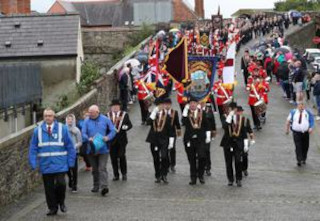
Fifty members and one band take part in the parade but the Commission forbids any music to be played between the two bridges on the Ormeau Road. In its ruling, the Commission says that since the last parade in August 1999, there has been “clear evidence of considerable efforts” by the Apprentice Boys to reach agreement with the residents’ group, the Lower Ormeau Concerned Community (LOCC). It says the LOCC has, in turn, engaged in dialogue with them which has been “sustained and meaningful, notwithstanding spasmodic breaks.” The Commission adds, “It is regrettable that it has not produced agreement or acquiescence. With regard to this decision, the Commission stresses that it provides no guarantees for the future. The Commission will continue to look for evidence of ongoing commitment by LOCC and the Apprentice Boys to find their own resolution to the local issues on the Ormeau Road.”
Apprentice Boys’ spokesman Tommy Cheevers says they are disappointed that agreement has not been reached with the residents. “This is the second time in five years that we will have managed to parade along our traditional route on the Ormeau Road,” he tells BBC Radio Ulster. “We would just ask that everybody accepts the rule of law, as we have had to do in the past when it went against us, and make sure it is peaceful.”
However, the ruling is criticised by LOCC spokesman Gerard Rice. He says he is “absolutely shocked” by the decision, adding he had already asked the Parades Commission for it to be reviewed. “We believe this was the wrong decision. We will ask the Parades Commission to overturn this decision. Failing that, we may go to the courts and ask for a judicial review.” The residents’ group meets with the Commission in the evening to discuss the ruling.
In 2000, the chairman of the Parades Commission praised the behaviour of the Apprentice Boys, after they abided by the decision barring their parade from the lower Ormeau Road. However, there have been violent confrontations at previous parades.
The Parades Commission is established in 1997 to determine whether conditions should be placed on contentious parades in Northern Ireland.
(From: “Green light for contentious parade,” BBC News, news.bbc.co.uk, April 6, 2001)
After the Irish Free State is formed and the Irish Civil War is concluded, the new state sets up a single radio channel named 2RN in 1926, launched by Douglas Hyde. The channel, operating out of Dublin, largely serves the Anglosphere population and at best reaches as far as County Tipperary, a situation that does not change until more powerful transmitters are adopted in the 1930s at Athlone.
In 1943, de Valera, at the time serving as Taoiseach and whose wife Sinéad Ní Fhlannagáin is a keen Conradh na Gaeilge activist, promotes the idea of a Gaeltacht station, but there is no breakthrough. By this time, 2RN has become Radio Éireann and still only has one channel, with limited broadcasting hours, often in competition for listeners with BBC Radio and Radio Luxembourg.
In the 1950s, a general liberalisation and commercialisation, indeed Americanisation begins to occur in Ireland, as a push is made to move Ireland from a rural-agrarian society with a protectionist cultural policy towards a market economy basis, with supply and demand the primarily basis of public communications. In 1960, RTÉ is established, and direct control of communications moves from a government ministry position to a non-governmental RTÉ Director-General position, first filled by Edward Roth
Gerry Collins, the Minister for Posts and Telegraphs, announces in Dáil Éireann in February 1971 that a new radio station for the Gaeltacht will be created. Raidió na Gaeltachta begins broadcasting at 3:00 PM on April 2, 1972, as part of an Easter Sunday programming. During the very first broadcast, the main station at Casla, County Galway is not yet finished and the studios in County Kerry and County Donegal are still under construction, so the broadcast originates from Galway. The first Ceannaire (Controller) Pádraic Ó Raghallaigh opens the show, which is followed by a recording from President Éamon de Valera. A recording of Seán Ó Riada‘s Irish language Mass, Ceol an Aifrinn, from the Seipéal Mhic Dara at Carraroe is also played.
At foundation, the station begins with a staff of seven, including six former teachers and a businessman, and broadcasts for only two hours a day and is only available in or near the three largest Gaeltacht districts. The local studio at Derrybeg in Gweedore, County Donegal aids the native Irish music scene there. In the 1970s, Raidió na Gaeltachta gives early coverage to Clannad and Mairéad Ní Mhaonaigh, later the singer for Altan. These groups gain popularity not only in Ireland, but on the international stage, selling millions of records during the 1980s especially. The station is dedicated to bringing the listener general news, both national and international, as well as Gaelic sports coverage and more localised affairs of significance to the community in the Gaeltacht.
For many years RnaG is the only Irish language broadcaster in the country. In recent years it has been joined by a television service, Telefís na Gaeilge (TG4), and by regional community radio stations Raidió na Life in Dublin, Raidió Fáilte in Belfast, and Raidió Rí-Rá.
The Games are hosted in Dublin, with participants staying in 177 towns, cities and villages and the Aran Islands in the lead up to the Games before moving to Dublin for the events. Events are held from June 21-29, 2003 at many venues including Morton Stadium, the Royal Dublin Society, the National Basketball Arena, all in Dublin. Croke Park serves as the central stadium for the opening and closing ceremonies, even though no competitions take place there. Belfast is the venue for roller skating events at the King’s Hall, as well as the Special Olympics Scientific Symposium held on June 19-20.
Approximately 7,000 athletes from 150 countries compete in the Games in 18 official disciplines and three exhibition sports. The participants from Kosovo are the region’s first team at an international sporting event. A 12-member team from Iraq receives special permission to attend the games, despite ongoing war in their home nation. This is the largest sporting event held in 2003.
The Games Flame is lit at the culmination of the Law Enforcement Torch Run, in which more than 2,000 members of the Garda Síochána and the Police Service of Northern Ireland participate. This is a series of relays carrying the Special Olympics Torch, the “Flame of Hope,” from Europe to the Games’ official opening.
The 2003 Games are the first to have their opening and closing schemes broadcast on live television, and Raidió Teilifís Éireann provides extensive coverage of the events through their ‘Voice of the Games’ radio station which replaces RTÉ Radio 1 on medium wave for the duration of the event. There is also a nightly television highlight programme. A daily newspaper, the Games Gazette, was published for each day of the Games.
Among the activities carried out during the Games are thorough medical checks on the athletes, some of whom have previously undiagnosed conditions uncovered, as some of the athletes come from countries with limited medical facilities or have difficulty communicating their symptoms.
The government had set this date as a final deadline for a restoration of power-sharing before direct rule from London is restored permanently and now has to rush emergency legislation through the House of Commons to prevent this.
“After a long and difficult time in our province, I believe that enormous opportunities lie ahead for our province,” Paisley tells reporters, as he sits at a conference table next to Adams. The agreement “marks the beginning of a new era of politics on this island,” Adams agrees, but adds that he finds it “disappointing” that Northern Ireland‘s political institution cannot be restored immediately.
British prime minister Tony Blair hails the agreement, saying “This is a very important day for the people of Northern Ireland but also for the people and the history of these islands.” After talking by phone with his Irish counterpart, Taoiseach Bertie Ahern, he tells reporters, “In a sense, everything we have done over the last ten years has been a preparation for this moment, because the people of Northern Ireland have spoken through the election. They have said we want peace and power-sharing, and the political leadership has then come in behind that and said we will deliver what people want.”
In Ireland, Ahern calls the day’s developments “unprecedented and very positive,” and says both governments will cooperate with the new May 8 date for devolution.
The Secretary of State for Northern Ireland, Peter Hain, says a one clause emergency bill will be put through parliament with the agreement of opposition parties, and will need royal assent before midnight the following evening to prevent the dissolution of the Stormont assembly. He describes the day’s events as “really, really momentous.”
“Today the clouds have lifted, and the people can see the future,” Hain tells BBC Radio 4‘s The World at One. “These pictures of Ian Paisley and Gerry Adams will resonate around the world. They are a graphic manifestation of the power of politics over bigotry and conflict, bitterness and horror.”
The crucial meeting sees delegations from the DUP and Sinn Féin spend an hour together inside a room at Stormont to hammer out the final agreement for a return to power-sharing. Afterwards, both leaders talk about the work still needing to be done, including regular meetings between Paisley and Sinn Féin’s Martin McGuinness as the de facto first and deputy first ministers.
Clearly conscious of the historical significance of their talks, Paisley and Adams speak of the suffering caused by the decades of inter-community violence and their responsibility to ensure permanent peace and reconciliation. Northern Ireland’s politicians must “never forget those who have suffered during the dark period from which we are, please God, emerging,” Paisley says. “I want to make it clear that I am committed to delivering not only for those who voted for the DUP but for all the people of Northern Ireland. We must not allow our justified loathing for the horrors and tragedies of the past to become a barrier to creating a better and more stable future for our children,” he adds.
Adams says there is now new hope for the future, following the previous “sad history of orange and green.” He adds, “There are still many challenges, many difficulties, to be faced. But let us be clear: the basis of the agreement between Sinn Féin and the DUP follows Ian Paisley’s unequivocal and welcome commitment to support and participate fully in the political institutions on May 8. We’ve all come a very long way in the process of peace making and national reconciliation. We are very conscious of the many people who have suffered. We owe it to them to build the best future possible.”
The proposal for the historic meeting comes after a frantic weekend of consultation in Belfast and Berlin, where Blair and Ahern are attending a ceremony to mark 50 years of the European Union. Both prime ministers had repeatedly insisted the assembly would be dissolved if no agreement on an executive had been reached by today’s legal deadline. Britain is forced into a last-minute change of strategy after Paisley’s DUP agrees in principle on March 24 to share power with Sinn Féin but demands an extension of the deadline for the formation of the executive until May.
The DUP, which is badly split, says they need the additional time to see if Sinn Féin will comply with its commitment to cooperate with the Police Service of Northern Ireland. Until now Paisley’s DUP has always refused to meet Sinn Féin. Each represents what used to be seen as the two extremes of Northern Ireland sectarian politics.
(From: “Paisley and Adams agree deal” by Peter Walker and Owen Bowcott, The Guardian (www.theguardian.com), March 26, 2007 | Pictured: Ian Paisley and Gerry Adams hold their first face-to-face talks. Photograph: Paul Faith/ PA)
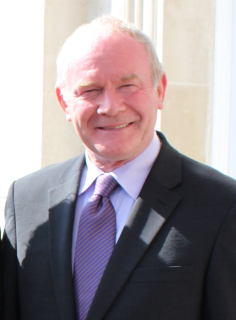
McGuinness is born James Martin Pacelli McGuinness on May 23, 1950 in Derry. He attends St. Eugene’s Primary School and later the Christian Brothers technical college, leaving school at the age of 15.
McGuinness joins the IRA about 1970, and by 1971 he is one of its leading organizers in Derry. In 1973 a Special Criminal Court in the Republic of Ireland sentences him to six months in prison after he is caught in a car containing large quantities of explosives and ammunition. Although the IRA keeps secret the membership of its seven-person Army Council, few doubt that McGuinness is one of its most important members from the 1970s through the 1990s. Even while reportedly planning attacks on civilians in Northern Ireland and on the British mainland, McGuinness is involved in spasmodic secret talks with British government ministers and officials to end the conflict. In 1972 McGuinness, with fellow IRA leader Gerry Adams, privately negotiates with British Secretary of State for Northern IrelandWilliam Whitelaw, but these and other talks over the next two decades are unsuccessful.
McGuinness contests seats in the British House of Commons on several occasions, losing in 1983, 1987, and 1992. However, in 1997 he is elected to the House of Commons to represent the constituency of Mid Ulster and, in line with party policy, he does not take his seat. He subsequently wins reelection to the seat in 2001, 2005, and 2010.
McGuinness is the IRA’s chief negotiator in the deliberations, also secret at first, that culminate in the Good Friday Agreement in 1998. This pact finally ends the conflict and eventually brings Sinn Féin into a coalition government to rule Northern Ireland. He is elected to the new Northern Ireland Assembly and in 1999 is appointed Minister of Education. In this post he eliminates the controversial eleven-plus examination, which determines which type of secondary school a child should attend. The test had been abolished in most of the rest of the United Kingdom more than 25 years earlier.
Disagreements over such issues as policing and the decommissioning of arms causes Northern Ireland’s Executive and Assembly to be suspended for some years, but a fresh agreement in 2006 paves the way for them to be revived. In elections in March 2007, both Sinn Féin and the antirepublican Democratic Unionist Party (DUP) gain seats, becoming the two largest parties in the Northern Ireland Assembly. McGuinness becomes Deputy First Minister, working with First Minister Ian Paisley, leader of the DUP. The two men, previously bitter enemies, perform so well together that they are dubbed the “Chuckle brothers.”
When Paisley retires in 2008, he is succeeded by the DUP’s Peter Robinson, who is considered to be even more militantly antirepublican. Once again, however, a shared need to rebuild the economy and attract international investment leads to cooperation between former opponents. In 2009 their government is in jeopardy as Sinn Féin and the DUP argue over the devolution of the police and justice system in Northern Ireland. McGuinness and Robinson are involved in the ensuing negotiations, and in February 2010 an agreement is reached for the transfer of powers from Britain to Northern Ireland in April.
In the Assembly elections in May 2011, McGuinness and Robinson are a formidable pair, and voters respond to their call for stability in a time of economic uncertainty. Sinn Féin gains an additional seat and increases its overall share of the vote, and McGuinness is assured an additional term as Deputy First Minister. In the autumn he steps down to run as Sinn Féin’s candidate for the presidency of Ireland. After finishing third in the election held on October 28, he returns to the position of Deputy First Minister a few days later. On June 27, 2012, in an event widely seen as having great symbolic importance for the ongoing reconciliation efforts in Northern Ireland, McGuinness and Elizabeth II shake hands twice, once in private and again in public, during a visit by the British monarch to Belfast.
In January 2017 McGuinness resigns as Deputy First Minister in response to First Minister Arlene Foster’s refusal to temporarily step down from her position during the investigation of a scandal relating to the government’s Renewable Heat Incentive (RHI), a mishandled program under which large amounts of state funds allegedly had been squandered. Foster had served as head of the department that oversaw the RHI before becoming First Minister. Under the power-sharing agreement the posts of First Minister and Deputy First Minister constitute a single joint office so that the resignation of one minister results in termination of the other’s tenure. When Sinn Féin chooses not to nominate a replacement for McGuinness within the required seven-day period, authority reverts to the British government’s Secretary of State for Northern Ireland in advance of a snap election on March 2.
Even before McGuinness’s resignation there had been speculation late in 2016 that he might step down for health reasons, and soon after resigning he confirms that he is suffering from amyloidosis, a rare disease brought about by deposits of abnormal protein in organs and tissue. With McGuinness removing himself from “frontline politics,” Michelle O’Neill leads Sinn Féin into the election. The disease claims McGuinness’s life only months later on March 21, 2017.
Simms is the owner of a paper mill in Ballyclare with his brother William Simms, one of twelve proprietors of the Northern Star. A close friend of Theobald Wolfe Tone, he is one of the founders of the Society of United Irishmen in Belfast in 1791 and the author of “Declaration and Resolutions of the Society of United Irishmen of Belfast.” He serves as the first Secretary of the Society, drafting many of its early letters, pamphlets and papers.
Following the French declaration of war on Britain in February 1793, the movement is outlawed and goes underground from 1794 as they become more determined to force a revolt against British rule. Simms, along with his brother William and Thomas Addis Emmet are arrested, but swiftly acquitted. The leadership is divided into those who wish to wait for French aid before rising and the more radical elements that wish to press ahead regardless. However, the suppression of a bloody preemptive rebellion, which breaks out in Leitrim in 1793, leads to the former faction prevailing and links are forged with the revolutionary French government with instructions to wait sent to all of the United Irish membership.
In 1795, along with Wolfe Tone, Samuel Neilson and Thomas Russell meet atop the summit of McArt’s Fort, overlooking Belfast, and, in Wolfe Tone’s words, “took a solemn obligation…never to desist in our efforts until we had subverted the authority of England over our country and asserted her independence.” The Simms brothers are again arrested in 1797 and held in Newgate Prison. From there he is transported along with Russell and Emmett to Fort George, Scotland. In his absence, the printing press and building housing the Northern Star is burned.
Upon his release, Simms is appointed as Commander of the United Army in Antrim. The appointment is met reluctantly however, as he feels his lack of military experience counts against him being an effective leader. In addition, many leaders are beginning to agitate for a rising without French aid. He is unwavering in his rejection of this idea. He resigns his position on June 1, 1798, after falling out with the leadership on this issue when most had changed their minds. He is replaced by Henry Joy McCracken who leads the Society in the Battle of Antrim. Simms is accused by many of cowardice and indecision for his refusal to launch an insurrection in Antrim.
Simms is nonetheless arrested and again imprisoned in Fort George with Emmet and William James MacNeven and is released in 1802. When Robert Emmet‘s failed coup is launched in 1803, the Simms brothers do not participate. He dies at the age of 82 in 1843.
Her father, William Joseph Smithson, is an actor and theatrical manager from Gloucestershire, England, and her mother is an actress whose full name is unknown. She also has a brother, Joseph Smithson, and a sister, name also unknown. In October 1801, she is left in the care of Reverend James Barrett, a priest of the Church of Ireland, parish of Drumcliffe. Barrett becomes her guardian and raises her as though she were his own daughter. He instructs her “in the precepts of religion,” and keeps everything connected with the stage from her view. After his death on February 16, 1808, the Smithsons send Harriet to a boarding school in Waterford.
On May 27, 1814, Smithson makes her first stage appearance at the Theatre Royal, Dublin, as Albina Mandevill in Frederick Reynolds‘s The Will. Her performance is well received. In 1815, she takes her parents’ place in Montague Talbot’s company in Belfast after they return to Dublin. The season opens on January 1, 1816, where she extends her range in roles, performing in multiple comedies. She then travels to Newry, Limerick, Dublin, and Birmingham, where she joins Robert Elliston‘s company. She spends the next two months playing over forty roles in various genres.
Four years later, January 20, 1818, Smithson makes her first London appearance at Drury Lane as Letitia Hardy in The Belle’s Stratagem. Her first performance receives mixed reviews from critics, but she quickly gains some favour of critics and performers as she obtains more experience. She joins the permanent company at the Royal Coburg Theatre later that year. However, she rejoins Drury Lane Company in the autumn of 1820. On February 20, 1821, she takes the lead female role in Thérèse by John Howard Payne, when the cast actress falls ill. Overall, the London public remembers her as The Times put it, “a face and features well adapted to her profession; but [an actress] not likely to make a great impression on a London audience, or to figure among stars of the first magnitude.”
In 1827, Smithson makes her Paris début as Lydia Languish in The Rivals at the Théâtre de l’Impératrice. Though she receives negative reviews for this role, she is highly praised for her beauty and ability in the subsequent performance of She Stoops to Conquer. On September 11, 1827, she is given the small part of Ophelia next to Charles Kemble in Shakespeare’s Hamlet. She leaves a long-lasting impression on the French through her interpretation of Ophelia’s madness, utilizing pantomime and natural presentation.
The tremendous success of Hamlet leads to the announcement of Romeo and Juliet, for September 15. Smithson is cast as Juliet, where she revolutionizes the women’s role in theatre by becoming as important as her male counterpart. Until this point, women’s lines in theatre are heavily cut and censored to reduce the role for the company’s “restricted talent.” Again, the production is widely well received. On September 18, Shakespeare’s Othello becomes the third Shakespeare tragedy to be performed by The English theatre. Her performance as Desdemona is less effective, but the production is popular enough to be repeated the following week. She is cast as Jane Shore in the renowned tragedyThe Tragedy of Jane Shore, a role in which she moves her audience to tears. The production soon becomes the most performed play in the English season. At the end of her time in France, she had acted in several productions with famous actors such as William Charles Macready, Edmund Kean, and Charles Kemble.
As opportunities to continue her work in Paris dwindle, Smithson returns to London to perform Jane Shore again. The production opens at Covent Garden on May 11, 1829, under unfavorable circumstances. Some audience members, who had read her reviews before she went to Paris, feel reluctant to attend the show. However, just seven days after her next performance as Juliet, in Shakespeare’s Romeo and Juliet, the press gives her glowing reviews.
After Covent Garden closes for the summer in 1832, Smithson tours England to minor theatres performing almost exclusively in tragedies. In June 1832, she joins the Theatre Royal Haymarket, where she has limited success and receives criticism about her weight.
In 1830, Smithson goes back to Paris to set up an English theatre under her own management. She obtains permission to perform at the Theatre-Italien where she performs several unsuccessful plays. A year later, she breaks her leg and is forced to put her career on hold until her leg heals, leaving her in great debt. She gives her last performance, as Ophelia, on December 15, 1836, before her health deteriorates.
Toward the end of her life, Smithson suffers from paralysis, which leaves her barely able to move or speak. She dies on March 3, 1854, at her home on the rue Saint-Vincent, and is buried at the Cimetière Saint-Vincent. Berlioz has her body is later reinterred at the Montmartre Cemetery when Cimetière Saint-Vincent undergoes redevelopment.
(Pictured: Oil on canvas portrait of Harriet Smithson by Claude-Marie-Paul Dubufe, located at the Musee Magnin, Dijon, France)
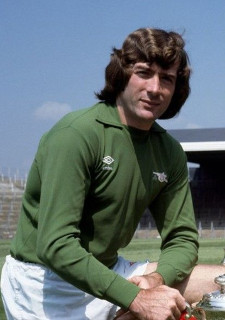
On February 26, 1983, Northern Irish footballerPat Jennings becomes the first player in English football to make 1,000 senior appearances, celebrating this milestone with a clean sheet in a goalless league draw for Arsenal at West Bromwich Albion.
Jennings is born in Newry, County Down, Northern Ireland on June 12, 1945. After playing for Shamrock Rovers‘ under-18 side at the age of 11, he concentrates on Gaelic football until he is sixteen years old, when he makes his soccer comeback with his hometown side Newry Town. After impressing with the team, he moves to English Third Division side Watford in May 1963. He again impresses in his first season in England, playing every league game for his club. He makes his international debut with the Northern Ireland national football team at the age of eighteen while playing for Watford. This game, on April 15, 1964, is a British Home Championship match against Wales, with Northern Ireland winning the game 3–2. George Best makes his international debut in the same game. Jennings is signed by Tottenham Hotspur for £27,000 in June 1964.
Jennings spends thirteen years at White Hart Lane, where he plays in 472 league games for Spurs, and 591 in all competitions. He wins the FA Cup in 1967, the League Cup in 1971 and 1973, and the UEFA Cup in 1972. In the 1967 Charity Shield he scores once from his own area, kicking the ball from his hands and sending a large punt down the field that bounces over Manchester United goalkeeper Alex Stepney and into the net. In 1973 the Football Writers’ Association names him as its footballer of the year. Three years later he wins Professional Footballers’ Association‘s version of the award, the first goalkeeper to receive this accolade, and to this date remains only one of two, along with Peter Shilton.
In August 1977, he is transferred to Tottenham’s arch-rivals, Arsenal, with Tottenham thinking he is nearing the end of his career. However, he sees off rivals for the goalkeeper’s jersey to play for Arsenal for another eight years. While at Highbury, he helps Arsenal to four Cup finals in three successive years, the FA Cup final in 1978, 1979, and 1980, as well as the European Cup Winners’ Cup final that year. However, Arsenal only manages to win the second of these finals, a 3–2 victory against Manchester United. In total, he makes 327 appearances for Arsenal, 237 of them in the League, between 1977 and his eventual retirement from first-team club football in 1985.
Despite his retirement from club football in 1985, Jennings returns to Tottenham Hotspur, playing mostly in their reserve side to maintain his match sharpness for Northern Ireland’s 1986 FIFA World Cup campaign. He plays his final international game at the 1986 World Cup, on his 41st birthday, making him at the time the World Cup’s oldest-ever participant. The match is Northern Ireland’s final group game, a 3–0 defeat against Brazil. In total, he participates in the qualifying stages of six World Cups between 1966 and 1986.
Jennings works as a goalkeeping coach at Tottenham since 1993. In 2003 he is inducted into the English Football Hall of Fame in recognition of the skills he demonstrated in the English league. He and his family have lived for many years in Broxbourne, Hertfordshire, where his son attended The Broxbourne School along with the sons of fellow Spurs players Chris Hughton, Osvaldo Ardiles and Ray Clemence. He is still associated with the Spurs and hosts Corporate Hospitality fans in the Pat Jennings Lounges at White Hart Lane and Windsor Park, Belfast.
The United States and the UK are forced to push back their plans for a second UN resolution on military action as more countries come out against the use of force in Iraq. Mary Robinson, the former United Nations High Commissioner for Human Rights, says she is fearful of the consequences of a war without UN backing.
In an interview with RTÉ News Ahern says the most important issue for this country is the primacy of the United Nations. He disagrees with the United States on whether or not they legally needed another UN Resolution before launching an attack on Iraq. He says other countries, including Ireland, have another point of view.
The Fianna Fáil parliamentary party unanimously passes a motion calling for a second resolution from the United Nations Security Council prior to the consideration of military action against Iraq. The motion also expresses “full confidence” in the efforts of the Taoiseach and the Minister for Foreign Affairs, Brian Cowen, to reach a peaceful outcome to the crisis.
The leading United States Congressman, Jim Walsh, welcomes the support that the Taoiseach has given to the United States in relation to Iraq. After a meeting with Sinn Féin in Belfast earlier in the day, he says that he recognises that it is a difficult time for the Irish people.
In the meantime, the UK has told its nationals in Iraq to leave the country immediately. In a statement the British Foreign & Commonwealth Office (FCO) says it has issued the alert because of increasing tension in the region and the risk of terrorist action. The office says anyone considering going to Iraq should remember that UK nationals were held hostage by the Baghdad government in the run-up to the 1991 Gulf War.
The British embassy in Kuwait City advises its citizens to leave Kuwait unless their presence in the emirate is essential. It also orders dependants of embassy staff to leave. “We advise you not to make any non-essential travel including holiday travel to Kuwait and, if already in Kuwait, to leave unless you consider your presence there is essential,” the embassy says in an advisory note.
An estimated 4,000 British nationals are resident in Kuwait. Britain has no diplomatic relations with President Saddam Hussein’s regime, and therefore cannot give consular assistance to British nationals inside Iraq. The current travel advisory for Israel warns against “any non-essential travel including holiday travel.”
(From: “More countries call for second UN Resolution” by RTÉ News, originally published Wednesday, February 19, 2003)
Robert William Gary Moore, Northern Irish musician, most widely recognised as a singer, songwriter, and virtuoso rock and blues guitarist, dies of a heart attack on February 6, 2011, in Estepona, Spain.
In a career dating back to the 1960s, Moore plays with musicians including Phil Lynott and Brian Downey during his teenage years, leading him to memberships of the Irish bands Skid Row and Thin Lizzy, and British band Colosseum II. Moore shares the stage with such blues and rock musicians as B. B. King, Albert King, Jack Bruce, Albert Collins, George Harrison, and Greg Lake, as well as having a successful solo career. He guests on a number of albums recorded by high-profile musicians.
Moore is born in Belfast, Northern Ireland on April 4, 1952. He starts performing at a young age, having picked up a battered acoustic guitar at the age of eight. He gets his first quality guitar at the age of 14, learning to play the right-handed instrument in the standard way despite being left-handed.
At the age of 16, aiming to become a musician, he moves to Dublin. Moore’s greatest influence in the early days is guitarist Peter Green of Fleetwood Mac who is a mentor to Moore when performing in Dublin. Other early musical influences are artists such as Albert King, Elvis Presley, Eric Clapton, The Shadows, and The Beatles. Later, having seen Jimi Hendrix and John Mayall’s Bluesbreakers in his hometown of Belfast, his own style develops into a blues-rock sound that becomes the dominant form of his career in music.
In Dublin, Moore joins the group Skid Row with Noel Bridgeman and Brendan “Brush” Shiels. It is with this group that he earns a reputation in the music industry, and his association with Phil Lynott begins.
Moore moves to England in 1970 and in 1973, under the name “The Gary Moore Band,” he releases his first solo album, Grinding Stone. Grinding Stone receives “Album of the Year” accolades on KTAC-FM/Seattle–Tacoma, Washington, in 1974.
In 1974 he joins Thin Lizzy after the departure of founding member Eric Bell. From 1975 to August 1978, he is a member of Colosseum II. In 1977, Moore rejoins Thin Lizzy, first as a temporary replacement for Brian Robertson, and on a permanent basis a year later.
Gary Moore dies of a heart attack in his sleep at the age of 58 during the early hours of February 6, 2011. At the time, he is on holiday with a girlfriend at the Kempinski Hotel in Estepona, Spain. Moore is laid to rest in St. Margaret’s Churchyard, Rottingdean, East Sussex, England, in a private ceremony with only family and close friends in attendance.






 seamus dubhghaill