Parnell receives her early education at home, later attending the Royal Dublin Society Art School and the South Kensington School of Design.
Following her father’s death in 1859, the family leaves Avondale, living in Dublin, Paris, and London. While studying in London, Parnell attends parliamentary sittings and writes accounts of them for an Irish-American journal. She helps to organize an American fund for the relief of famine in Ireland in 1879–1880.
When it becomes apparent that the men of the Irish National Land League are likely to be arrested, it is suggested that a women’s league in Ireland can take over the work in their absence. Public opinion at the time is against women in politics, but Anna and her sister, Fanny Parnell, establish the Central Land League of the Ladies of Ireland (LLL), of which she becomes organizing secretary and effective leader in January 1881.
When Charles Stewart Parnell and other leaders are imprisoned in 1881, as predicted, the Ladies’ Land League takes over their work. Offices are given to the ladies but they receive very little assistance. The women hold public meetings and encourage country women to be active in withholding rent, in boycotting, and in resisting evictions. They raise funds for the League and for the support of prisoners and their families. They distribute Land League wooden huts for shelter to evicted tenant families and by the beginning of 1882 they have five hundred branches, thousands of women members, and considerable publicity. Fanny Parnell dies in 1882 at the age of thirty three.
After his release from prison, Charles Stewart Parnell dissolves the Ladies’ Land League in August 1882. Anna, whose nationalist fervor exceeds that of her brother, parts with him on bad terms over politics. She lives the rest of her life in the south of England under an assumed name. She writes an angry account of her Land League experiences in Tale of a Great Sham, which is not published until 1986.
Anna Parnell never marries. She drowns at Ilfracombe, Devon, England on September 20, 1911.
Cavendish, who is married to Lucy Cavendish, the niece of British Prime MinisterWilliam Ewart Gladstone, and has worked as Gladstone’s personal secretary, arrives in Ireland on the day he is murdered. Cavendish and Burke are attacked as they walk to the Viceregal Lodge, which is the out-of-season residence of the Lord Lieutenant of Ireland. Thomas Myles, resident surgeon at nearby Dr. Steevens’ Hospital, is summoned to render medical assistance to the victims. The then Lord Lieutenant, Lord Spencer, describes suddenly hearing screams, before witnessing a man running to the Lodge grounds shouting “Lord Frederick Cavendish and Mr. Burke are killed.” Responsibility for the assassinations is claimed by a small hitherto unheard-of Republican organisation called the Irish National Invincibles.
The hunt for the perpetrators is led by Superintendent John Mallon, a Catholic man from Armagh. Mallon has a pretty shrewd idea of who has committed the crime and suspects a number of former Fenian activists. A large number of suspects are arrested and kept in prison by claiming they are connected with other crimes. By playing one suspect against another, Mallon gets several of them to reveal what they know.
James Carey, leader of The Invincibles, Michael Kavanagh, and Joe Hanlon agree to testify against the others. Joe Brady, Michael Fagan, Thomas Caffrey, Dan Curley, and Tim Kelly are convicted of the murders and all are hanged by William Marwood in Kilmainham Gaol in Dublin between May 14 and June 9, 1883. Others, convicted as accessories to the crime, are sentenced to long prison terms. The getaway driver, James Fitzharris, is acquitted of murder but is retried as an accessory and convicted.
Only the case of Tim Kelly gives any real difficulty as he is only nineteen and generally said to look much younger. By referring to him as “a child” his defence counsel creates enough unease for two juries to disagree. He is found guilty only after an unprecedented third trial.
Charles Stewart Parnell makes a speech condemning the murders in 1882, which increases his already huge popularity in both Britain and Ireland. He has just enabled some reforms under the Kilmainham Treaty four days prior to the murders. Parnell’s reputation increases in Ireland, being seen as a more moderate reformer who would never excuse such tactics.
However, Parnell’s policy of allying his party to Gladstone’s Liberal Party in 1886 to enable Home Rule is also ultimately defeated by the murders. Gladstone’s Minister, Lord Hartington, is the elder brother of Lord Frederick Cavendish. Infuriated by the manner of his brother’s early death, Hartington splits with Gladstone on the Home Rule bills of 1886 and 1893 and leads the breakaway Liberal Unionist Association which allies itself to Lord Salisbury‘s conservative governments. In the ensuing 1886 general election, the Conservatives and Liberal Unionists sweep the board. This delays Home Rule by twenty-eight years, when the Third Irish Home Rule Bill is passed in 1914 but never effected.
In March 1887, The Times prints letters purportedly from Parnell claiming sympathy with the murderers and that his public denunciation of them was insincere. It emerges that the letters are forgeries written by journalist Richard Pigott. Parnell is personally vindicated by the Parnell Commission in 1888–89.
The agreement extends the terms of the Second Land Act of 1881, with which Gladstone intends to make broad concessions to Irish tenant farmers. But the Act has many weaknesses and fails to satisfy Parnell and the Irish Land League because it does not provide a regulation for rent-arrears or rent-adjustments in the case of poor harvests or deteriorated economic conditions.
After the Second Land Act becomes law on August 22, 1881, Parnell, in a series of speeches in September and October, launches violent attacks on Chief Secretary for IrelandWilliam Forster and even on Gladstone. Gladstone warns him not to frustrate the Act, but Parnell repeats his contempt for the Prime Minister. On October 12, the Cabinet, fully convinced that Parnell is bent on ruining the Act, takes action to have him arrested in Dublin the next day.
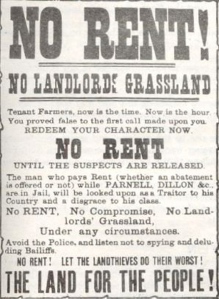
Parnell is conveyed to Kilmainham Gaol, where he joins several other prominent members of the Land League who have also protested against the Act and been jailed. There, together with William O’Brien, he enacts the No Rent Manifesto campaign. He is well aware that some in the Liberal Cabinet, in particular Joseph Chamberlain, are opposed to the mass internment of suspects then taking place across Ireland under the Protection of Person and Property Act 1881. The repressions do not have the desired effect, with the result that Forster becomes isolated within the Cabinet, and coercion becomes increasingly unpopular with the Liberal Party.
In gaol Parnell begins to turn over in his mind the possibility of coming to an arrangement with the Government. He has been corresponding with Katharine O’Shea who engages her husband, Captain William O’Shea, in April 1882 to act as a go-between for negotiations on behalf of Parnell. O’Shea contacts Gladstone on May 5 having been informed by Parnell that should the Government settle the rent-arrears problem on the terms he proposes, he is confident that he can curtail outrages. He further urges for the quick release of the League’s organizers in the West who will then work for pacification. This shocks Forster but impresses Gladstone.
Accordingly on May 2, Gladstone informs the House of Commons of the release of Parnell and the resignation of Forster. Gladstone always denies there has been a “Kilmainham Treaty,” merely accepting that he “had received informations.” He keeps his side of the arrangement by subsequently having the Arrears of Rent Act 1882 enacted. The government pays the landlords £800,000 in back rent owed by 130,000 tenant farmers.
Calling the agreement a “treaty” shows how Parnell manages to place a spin on the agreement in a way that strengthens Irish nationalism, since he manages to force concessions from the British while in gaol. Since real treaties are usually signed between two states, it leads to the idea that Ireland could become independent from Britain. After the “treaty” is agreed, those imprisoned with Parnell are released from gaol. This transforms Parnell from a respected leader to a national hero.
The Phoenix Park Murders, in which two top British officials in Ireland are assassinated, take place four days later and undo much of the goodwill generated by it in Britain. Though strongly condemned by Parnell, the murders show that he cannot control nationalist “outrages” as he has undertaken to do.
The Bill, like his Landlord and Tenant (Ireland) Act 1870, is very much the work of Gladstone, who excludes both the Irish MPs and his own ministers from participation in the drafting.
If passed, the 1886 Bill would create a unicameral assembly consisting of two Orders which could meet either together or separately. The first Order would consist of the 28 Irish representative peers plus 75 members elected through a highly restricted franchise. It could delay the passage of legislation for up to 3 years. The second Order would consist of either 204 or 206 members. All Irish MPs would be excluded from Westminster altogether.
Executive power would be possessed by the Lord Lieutenant of Ireland whose executive would not be responsible to either Order.
Britain would still retain control over a range of issues including peace, war, defence, treaties with foreign states, trade, and coinage. No special provision would be made for Ulster. Britain would retain control of the Royal Irish Constabulary (RIC) until it deems it safe for control to pass to Dublin. The Dublin Metropolitan Police would pass to Irish control.
When the bill is introduced, Charles Stewart Parnell has mixed reactions. He says that it has great faults but is prepared to vote for it. In his famous Irish Home Rule speech, Gladstone beseeches Parliament to pass it and grant Home Rule to Ireland in honour rather than being compelled to one day in humiliation. Unionists and the Orange Order are fierce in their resistance. For them, any measure of Home Rule is denounced as nothing other than Rome Rule.
The vote on the Bill takes place on 8 June 1886, after two months of debate. The Government of Ireland Bill is defeated by a vote of 341-311. In the staunchly loyalist town of Portadown, the so-called “Orange Citadel” where the Orange Order is founded in 1795, Orangemen and their supporters celebrate the Bill’s defeat by “Storming the Tunnel.”
Parliament is dissolved on June 26 and the U.K. general election of 1886 is called. Historians have suggested that the 1886 Home Rule Bill was fatally flawed by the secretive manner of its drafting, with Gladstone alienating Liberal figures like Joseph Chamberlain who, along with a colleague, resigned in protest from the ministry, while producing a Bill viewed privately by the Irish as badly drafted and deeply flawed.
Healy is born in Bantry, County Cork, the second son of Maurice Healy, clerk of the Bantry Poor Law Union, and Eliza Healy (née Sullivan). His father is transferred in 1862 to a similar position in Lismore, County Waterford. Timothy is educated at the Christian Brothers school in Fermoy, and is otherwise largely self-educated, in 1869, at the age of fourteen, he goes to live with his uncle Timothy Daniel Sullivan in Dublin.
Healy then moves to England in 1871, working first as a railway clerk and then from 1878 in London as parliamentary correspondent of The Nation, writing numerous articles in support of Charles Stewart Parnell, the newly emergent and more militant home rule leader, and his policy of parliamentary obstructionism. Healy takes part in Irish politics and becomes associated with Parnell and the Irish Parliamentary Party. After being arrested for intimidation in connection with the Irish National Land League, he is promptly elected as member of Parliament for Wexford Borough in 1880.
In Parliament, Healy becomes an authority on the Irish land question. The “Healy Clause” of the Land Act of 1881, which protects tenant farmers’ agrarian improvements from rent increases imposed by landlords, not only makes him popular throughout nationalist Ireland but also wins his cause seats in Protestant Ulster. He breaks with Parnell in 1886 and generally remains at odds with subsequent leaders of the Irish Parliamentary Party, though he is a strong supporter of proposals for Irish Home Rule. Meanwhile, he is called to the Irish bar in 1884 and becomes a queen’s counsel in 1899.
Healy believes that he has been awarded the Governor-Generalship for life. However, the Executive Council of the Irish Free State decides in 1927 that the term of office of Governors-General will be five years. As a result, he retires from the office and public life in January 1928 and publishes his extensive two volume memoirs later in that year. Throughout his life he is formidable because he is ferociously quick-witted, because he is unworried by social or political convention, and because he knows no party discipline. Towards the end of his life, he becomes more mellowed and otherwise more diplomatic.
Healy dies on March 26, 1931, at the age of 75, in Chapelizod, County Dublin. He is buried in Glasnevin Cemetery in Dublin.
Michael Davitt, Irish republican and agrarian agitator, is born in Straide, County Mayo, on March 25, 1846. Davitt is the founder of the Irish National Land League, which organizes resistance to absentee landlordism and seeks to relieve the poverty of the tenant farmers by securing fixity of tenure, fair rent, and free sale of the tenant’s interest.
Davitt is the son of an evicted tenant farmer. After their eviction, the family emigrates to England. In 1856, at the age of 10, he starts work in a cotton mill, where he loses an arm in a machinery accident a year later. In 1865, he joins the revolutionary Fenian Brotherhood, an international secret society that seeks to secure political freedom for Ireland. He becomes secretary of its Irish analogue, the Irish Republican Brotherhood (IRB), in 1868. Arrested in Paddington Station in London for sending firearms to Ireland on May 14, 1870, he is sentenced to 15 years in Dartmoor Prison and there lays plans to link Charles Stewart Parnell’s constitutional reform with Fenian activism to achieve political-agrarian agitation.
Paroled from prison in 1877, Davitt rejoins the IRB and goes to the United States, where the Fenian movement originated. There he is deeply influenced by Henry George’s ideas about the relationship between land monopoly and poverty.
Back in Ireland, using funds raised by John Devoy and Clan na Gael in the United States, Davitt wins Parnell’s cooperation in organizing the Land League in 1879, which leads, however, to his expulsion from the supreme council of the IRB in 1880. He is elected member of Parliament for County Meath in 1882 but is disqualified as he is a convict. He is also imprisoned for seditious speeches in 1881 and 1883.
Because of his public championing of Henry George’s theories of land reform, Parnell repudiates him. Davitt actively defends the Nationalists before the Parnell Commission, which meets between 1887 and 1889. When the Irish party splits in 1890 over Parnell’s involvement in Capt. William Henry O’Shea’s divorce case, Davitt is among the first to oppose Parnell’s continuance as leader.
Davitt is elected to Parliament in 1892 and 1893 but is unseated in both cases. He is elected again, for South Mayo in 1895, but resigns in 1899 in protest against the Second Boer War.
Davitt dies in Elphis Hospital, Dublin on May 30, 1906, at the age of 60, from blood poisoning. The fact that the Lord Lieutenant of Ireland attends his funeral is a public indication of the dramatic political journey this former Fenian prisoner has taken. There is no plan for public funeral, and hence Davitt’s body is brought quietly to the Carmelite Friary, Clarendon Street, Dublin. However, the next day over 20,000 people file past his coffin. His remains are taken by train to Foxford, County Mayo, and buried in the grounds of Straide Abbey at Straide, near his place of birth.
Davitt’s book, The Fall of Feudalism in Ireland (1904), is a valuable record of his time.
The first burial takes place at Glasnevin Cemetery in Glasnevin, Dublin, on February 22, 1832.
Prior to the establishment of Glasnevin Cemetery, Irish Catholics have no cemeteries of their own in which to bury their dead. The repressive Penal Laws of the eighteenth-century place heavy restrictions on the public performance of Catholic services, forcing Catholics to conduct a limited version of their own funeral services in Protestant churchyards or graveyards. This situation continues until an incident at a funeral held at St. Kevin’s Churchyard in 1823 provokes public outcry when a Protestant sexton reprimands a Catholic priest for proceeding to perform a limited version of a funeral mass. The outcry prompts Daniel O’Connell, champion of Catholic rights, to launch a campaign and prepare a legal opinion proving that there is actually no law forbidding praying for a dead Catholic in a graveyard. O’Connell pushes for the opening of a burial ground in which both Irish Catholics and Protestants can give their dead a dignified burial.
Glasnevin Cemetery is consecrated and opened to the public for the first time on February 21, 1832. The first burial, that of eleven-year-old Michael Carey from Francis Street in Dublin, takes place on the following day in a section of the cemetery known as Curran’s Square. The cemetery is initially known as Prospect Cemetery, a name chosen from the townland of Prospect, which surrounds the cemetery lands.
Originally covering nine acres of ground, the area of the cemetery has now grown to approximately 124 acres and is the final resting place of some 1.5 million people. The cemetery consists of two parts. The main part, with its trademark high walls and watchtowers, is located on one side of the road from Finglas to the city centre, while the other part, called St. Paul’s, is located across the road and beyond a green space, between two railway lines.
Glasnevin is one of the few cemeteries that allows stillborn babies to be buried in consecrated ground and contains an area called the Angels Plot for that purpose. In 1982, a crematorium is constructed within the cemetery grounds by Glasnevin Trust and has since been used for people of various religious denominations who wish to be cremated.
Glasnevin Cemetery remains under the care of the Dublin Cemeteries Committee and the development, expansion, and refurbishment of the cemetery is an ongoing task.
The Catholic Mass is celebrated by members of the parish clergy every Sunday at 9:45 AM. An annual blessing of the graves takes place each summer as it has since the founding of the cemetery in 1832.
Redmond is born at Ballytrent House, his grandfather’s old family mansion, in Kilrane, County Wexford. As a student at Clongowes Wood College, he exhibits the seriousness that many soon come to associate with him. After finishing at Clongowes, Redmond attends Trinity College, Dublin to study law, but his father’s ill health leads him to abandon his studies before taking a degree and, in 1876, goes to live with him in London. As a clerk in the House of Commons he increasingly identifies himself with the fortunes of Charles Stewart Parnell, one of the founders of the Irish Land League.
Redmond first attends political meetings with Parnell in 1879. Upon the death of his father, a Member of Parliament for Wexford, in 1880, Redmond writes to Parnell asking for adoption as the Nationalist Party, which becomes the Irish Parliamentary Party in 1882, candidate in the by-election to fill the open seat, but is disappointed to learn that Parnell has already promised the next vacancy to his secretary Timothy Healy. When a vacancy arises in New Ross, he wins election unopposed as the Parnellite candidate for the seat. He served as MP for New Ross from 1881 to 1885, for North Wexford from 1885 to 1891 and finally for Waterford City from 1891 until his death in 1918.
In 1890, the Irish Parliamentary Party splits over Parnell’s leadership when his long-standing adultery with Katharine O’Shea is revealed in a spectacular divorce case. Redmond stands by Parnell and works to keep the minority faction active. When Parnell dies in 1891, Redmond takes over leadership of the Parnellite faction of the split party, called the Irish National League (INL). The larger anti-Parnellite group forms the Irish National Federation (INF) under John Dillon.
Through the initiative of William O’Brien and his United Irish League (UIL), the INL and the INF re-unite on February 6, 1900, within the Irish Parliamentary Party. Redmond is elected its chairman, a position he holds until his death in 1918, a longer period than any other nationalist leader with the exceptions of Éamon de Valera and Daniel O’Connell.
The achievement of Home Rule is his life’s goal, having strongly supported William Gladstone’s Home Rule bills of 1886 and 1893. His best opportunity arises when the Irish Parliamentary Party holds the balance of power under H. H. Asquith in the period from 1910 onwards. Opposition by the Ulster Unionists frustrates his plans, his main worry being that Home Rule will result in the permanent exclusion of at least some of the Ulster counties. He also fears that the activities of the Irish Volunteers might hinder the enactment of Home Rule. To guard against this eventuality, he secures the control of the organisation in June 1914. He welcomes the Government of Ireland Act, 1914 as the only measure of Home Rule then possible. Its suspension for the duration of the war postpones addressing the issue of partition.
To ensure the success of the war effort and the speedier implementation of Home Rule, Redmond offers the services of the Irish Volunteers for the defence of the country, an offer rejected by the government. By encouraging the Volunteers to join the British army, he splits the organisation. The vast majority, totaling 170,000 and thereafter known as the National Volunteers, follow Redmond, many of them enlisting in the British army. Those who aspire to an Irish republic or who have lost faith in Home Rule remain as the Irish Volunteers, their numbers now reduced to about 10,000.
Consequently, the 1916 Easter Rising takes him completely by surprise. Committed to keeping Ireland within the Union, he regards the Rising as treason and a “German intrigue.” He has no sympathy with the leaders or their objective of a republic. Nevertheless, he pleads for leniency in the House of Commons.
An operation in March 1918 to remove an intestinal obstruction appears to progress well at first, but then he suffers heart failure. He dies a few hours later at a London nursing home on March 6, 1918. One of the last things he says to the Jesuit Father who is with him to the end is, “Father, I am a broken-hearted man.”
Katharine O’Shea, called Katie O’Shea by friends and Kitty O’Shea by enemies, dies on February 5, 1921 in Littlehampton, England. O’Shea is an English woman of aristocratic background whose decade-long secret affair with Charles Stewart Parnell leads to a widely publicized divorce in 1890 and, ultimately, his political downfall.
Katharine first meets Parnell in 1880, when she is separated from but still legally married to Captain William O’Shea, a Catholic Nationalist Member of Parliament (MP) for County Clare. As a result of her family’s connection to the Liberal Party, she acts as liaison between Parnell and William Gladstone during negotiations prior to the introduction of the First Irish Home Rule Bill in April 1886. During the summer of that year, Parnell moves into her home in Eltham, near the London-Kent border. Parnell fathers three of Katharine’s children.
Captain O’Shea is aware of the relationship and challenges Parnell to a duel in 1881, however, when Parnell accepts the challenge, O’Shea backs down. Initially, O’Shea forbids his ex-wife to see Parnell, although she says that he encourages her in the relationship. O’Shea keeps quiet publicly for several years, possibly in hopes of an inheritance from Katharine’s rich aunt who has been in failing health. When she dies in 1889, however, her money is left in trust to cousins.
Although their relationship is a subject of gossip in London political circles from 1881, later public knowledge of the affair in an England governed by “Victorian morality” with a “nonconformist conscience” creates a huge scandal, as adultery is prohibited by the Ten Commandments.
After the divorce proceedings in November 1890, in which Parnell is named as co-respondent, the court awards custody of Katharine’s two daughters by Parnell to her ex-husband. The divorce and eventual remarriage leads to Parnell being deserted by a majority of his own Irish Parliamentary Party and to his downfall as its leader in December 1890.
Catholic Ireland feels a profound sense of shock when Katharine breaks the vows of her previous Catholic marriage by marrying Parnell on June 25, 1891. The marriage, however, is short-lived. With Parnell’s political life and health essentially ruined, he dies in Katharine’s arms at the age of 45 in Hove, England, on October 6, 1891, less than four months after their marriage. The cause of death is determined to be cancer of the stomach, possibly complicated by coronary heart disease inherited from his grandfather and father.
Katharine publishes a biography of Parnell in 1914 as “Katharine O’Shea (Mrs. Charles Stewart Parnell),” though to her friends she is known as Katie O’Shea. Parnell’s enemies, in order to damage him personally, call her “Kitty O’Shea” because “kitty,” although a Hiberno-English version of Katharine, is also a slang term for a prostitute. After Parnell’s death, Katharine suffers from a nervous breakdown and disappears from public life. She dies on February 5, 1921 after spending her final years moving from rented house to rented house all over the south coast of England. Katharine O’Shea is buried in Littlehampton, Sussex, England.
Captain Henry Harrison, MP, who acts as Parnell’s bodyguard and aide-de-camp, devotes himself after Parnell’s death to the service of his widow. From her he hears a completely different version of the events surrounding the divorce issue from that which had appeared in the press in 1890. This forms the seed of two of Harrison’s later books defending Parnell which are published in 1931 and 1938. They have a major impact on Irish historiography, leading to a more favourable view of Parnell’s role in the O’Shea affair.