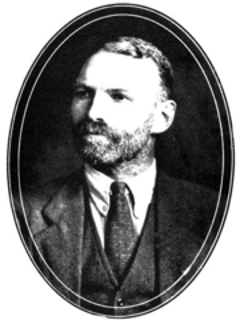
O’Brien moves with his family to Dublin in 1897 and quickly becomes involved in the Irish Socialist Republican Party (ISRP). He is described as “a very significant figure in the ISRP” by ISRP historian David Lynch. He is a member of the Socialist Party of Ireland, serving on its executive.
An important figure in the Labour Party in Ireland in its formative days, O’Brien resists James Larkin‘s attempt to gain control of the Party on release from prison. Taking Larkin to court over his occupation of ITGWU headquarters, the Larkin-O’Brien feud results in a split within the labour and trade union movements, and the formation of the Irish Congress of Trade Unions.
In 1930, O’Brien seeks to have Leon Trotsky granted asylum in Ireland, but the head of the Free State government, W. T. Cosgrave, refuses to allow it.
Active in politics and the trade union movement into his 60s, O’Brien retires in 1946 and dies on October 31, 1968.
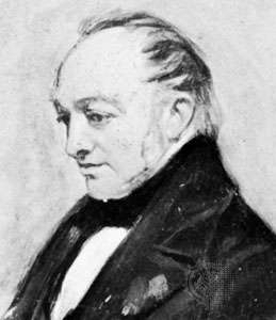
The son of an army major, Croker has little school education but does read widely while working in merchant trade. For some years Croker holds a position in the Admiralty, where his distant relative, John Wilson Croker, is his superior.
Croker devotes himself largely to the collection of ancient Irish poetry and Irish folklore. He assists in founding the Percy Society and the Camden Society. He and his wife’s testimonies about funereal customs, particularly the tradition of keening the deceased are among the earliest and most significant contributions to the understanding of the Irish languagelament and the accompanying traditions. The first part of his Fairy Legends and Traditions of the South of Ireland is published in 1825. It grows to six editions and is translated into German by the Brothers Grimm (Irische Elfenmärchen, 1826). Parts two and three follow in 1828, the latter including Croker’s translation of the long Grimm preface to part one.
Croker publishes Legends of the Lakes: Or, Sayings and Doings at Killarney in 1829, in which he features discussions of the music of his friend, the Irish piper James Gandsey.
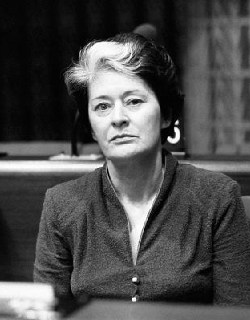
Harrington is educated locally at the Convent of Mercy in Kinsale, where she is one of only two girls in her class to sit the Leaving Certificate examination. Before entering politics, she works as a civil servant with the Department of Posts and Telegraphs. She marries Dan Desmond in 1958.
Desmond is elected to the European Parliament at the 1979 European Parliament election for the Munster constituency. However, her time in Europe is short-lived, as she returns to domestic politics when she is offered a position as Minister and the chance to impact upon national legislation. At the 1981 general election she switches her constituency to Cork South-Central. A Fine Gael–Labour Party coalition comes to power, and she is appointed Minister for Health and Social Welfare.
Desmond’s cabinet appointment is historic, as she is only the second woman to be a member of cabinet since the foundation of the state in 1922, and the first in any Fine Gael or Labour Party cabinet. Countess Markievicz had held the cabinet post of Minister for Labour in the revolutionary First Dáil in 1919, but only one woman had held cabinet office after the foundation of the state, Máire Geoghegan-Quinn of Fianna Fáil who was appointed as Minister for the Gaeltacht in 1979.
Desmond retires from full-time politics at the 1987 general election for health reasons. She dies suddenly in Cork, County Cork on January 6, 2005.
As dusk falls the ambush takes place on a road at Dus a’ Bharraigh in the townland of Shanacashel, Kilmichael Parish, near Macroom.
Just before the Auxiliaries in two lorries come into view, two armed IRA volunteers, responding late to Barry’s mobilisation order, drive unwittingly into the ambush position in a horse and sidecar, almost shielding the British forces behind them. Barry manages to avert disaster by directing the car up a side road and out of the way. The Auxiliaries’ first lorry is persuaded to slow down by the sight of Barry placing himself on the road in front of a concealed Command Post, wearing an IRA officer’s tunic given to him by Paddy O’Brien. Concealed on the south side of the road are six riflemen, whose instructions are to prevent the enemy taking up positions on that side. Another six riflemen are positioned some way off as an insurance group, should a third Auxiliary lorry appear.
The first lorry, containing nine Auxiliaries, slows almost to a halt close to their intended ambush position, at which point Barry gives the order to fire. He throws a Mills bomb that explodes in the open cab of the first lorry. A savage close-quarter fight ensues. According to Barry’s account, some of the British are killed using rifle butts and bayonets in a brutal and bloody encounter. This part of the engagement is over relatively quickly with all nine Auxiliaries dead or dying.
While this part of the fight is going on, a second lorry also containing nine Auxiliaries has driven into the ambush position. This lorry’s occupants, at a more advantageous position than Auxiliaries in the first lorry because of their distance from the ambushing group, dismount to the road and exchange fire with the IRA, killing Michael McCarthy. Barry then brings the Command Post soldiers who had completed the attack on the first lorry to bear on this group. Barry claimed these Auxiliaries called out a surrender and that some dropped their rifles but opened fire again with revolvers when three IRA men emerged from cover, killing volunteer Jim O’Sullivan instantly and mortally wounding Pat Deasy. Barry then orders his men to open fire and not stop until told to do so. Barry ignores a subsequent attempt by remaining Auxiliaries to surrender and keeps his men firing until he believes all the Auxiliaries are dead.
At the conclusion of the fight, it is observed that two IRA volunteers, Michael McCarthy and Jim O’Sullivan, are dead and that Pat Deasy, brother of Liam Deasy, is mortally wounded. Although the IRA fighters think they had killed all of the Auxiliaries, two actually survive, one very badly injured and another who escapes and is later captured and shot dead. Among the 16 British dead on the road at Kilmichael is Francis Crake, commander of the Auxiliaries in Macroom, probably killed at the start of the action by Barry’s Mills bomb.
Many IRA volunteers are deeply shaken by the severity of the action, referred to by Barry as “the bloodiest in Ireland,” and some are physically sick. Barry attempts to restore discipline by making them form-up and perform drill, before marching away. Barry himself collapses with severe chest pains on December 3 and is secretly hospitalized in Cork. It is possible that the ongoing stress of being on the run and commander of the flying column, along with a poor diet as well as the intense combat at Kilmichael contribute to his illness, diagnosed as heart displacement.
The political fallout from the Kilmichael ambush outweighs its military significance. While the British forces in Ireland can easily absorb 18 casualties, the fact that the IRA had been able to wipe out a whole patrol of elite Auxiliaries is for them deeply shocking. The British forces in the West Cork area take their revenge on the local population by burning several houses, shops and barns in Kilmichael, Johnstown and Inchigeelagh, including all of the houses around the ambush site. On December 3, three IRA volunteers are arrested by the British Essex Regiment in Bandon, beaten and killed, and their bodies dumped on the roadside.
For the British government, the action at Kilmichael is an indication that the violence in Ireland is escalating. Shortly after the ambush, barriers are placed on either end of Downing Street to protect the Prime Minister‘s office from IRA attacks. On December 10, as a result of Kilmichael, martial law is declared for the counties of Cork, Kerry, Limerick and Tipperary.
The British military now has the power to execute anyone found carrying arms and ammunition, to search houses, impose curfews, try suspects in military rather than civilian courts and to intern suspects without trial. On December 11, in reprisal for Kilmichael and other IRA actions, the centre of Cork city is burned by Auxiliaries, British soldiers and Black and Tans, and two IRA men are assassinated in their beds. In separate proclamations shortly afterwards, the authorities sanction “official reprisals” against suspected Sinn Féin sympathisers and the use of hostages in military convoys to deter ambushes.
(Pictured: The Kilmichael Ambush Monument at the ambush site)
Theobald Wolfe Tone, Irish republican and rebel who sought to overthrow English rule in Ireland and who led a French military force to Ireland during the Irish Rebellion of 1798, dies at Provost’s Prison, Dublin on November 19, 1798, from a stab wound to his neck which he inflicted upon himself on November 12. His attempted suicide is the result of being refused a soldier’s execution by firing squad and being sentenced to death by hanging.
Wolfe Tone is born in Dublin on June 20, 1763. The son of a coach maker, he studies law and is called to the Irish bar in 1789 but soon gives up his practice. In October 1791 he helps found the Society of United Irishmen, initially a predominantly Protestant organization that works for parliamentary reforms, such as universal suffrage and Roman Catholic emancipation. In Dublin in 1792 he organizes a Roman Catholic convention of elected delegates that forces Parliament to pass the Catholic Relief Act of 1793. He himself, however, is anticlerical and hopes for a general revolt against religious creeds in Ireland as a sequel to the attainment of Irish political freedom.
By 1794 Wolfe Tone and his United Irishmen friends begin to seek armed aid from Revolutionary France to help overthrow English rule. After an initial effort fails, he goes to the United States and obtains letters of introduction from the French minister at Philadelphia to the Committee of Public Safety in Paris. In February 1796 he arrives in the French capital, presents his plan for a French invasion of Ireland, and is favourably received. The Directory then appoints one of the most brilliant young French generals, Lazare Hoche, to command the expedition and makes Tone an adjutant in the French army.
On December 16, 1796, Wolfe Tone sails from Brest with 43 ships and nearly 14,000 men. But the ships are badly handled and, after reaching the coast of west Cork and Kerry, are dispersed by a storm. He again brings an Irish invasion plan to Paris in October 1797, but the principal French military leader, Napoleon Bonaparte, takes little interest. When insurrection breaks out in Ireland in May 1798, Wolfe Tone can only obtain enough French forces to make small raids on different parts of the Irish coast. In September he enters Lough Swilly, Donegal, with 3,000 men and is captured there.
At his trial in Dublin on November 10, Wolfe Tone defiantly proclaims his undying hostility to England and his desire “in fair and open war to produce the separation of the two countries.” He is found guilty and is sentenced to be hanged. Early in the morning of November 12, 1798, the day he is to be hanged, he cuts his throat with a penknife and dies at the age of 35 in Provost’s Prison, Dublin, not far from where he was born. He is buried in Bodenstown, County Kildare, near his birthplace, and his grave is in the care of the National Graves Association.
In 1790 Russell resumes his military career as a junior officer in the 64th Regiment of Foot and is posted to Belfast. The French Revolution in 1789 is warmly greeted in Belfast as are its ideals of liberty, equality, and fraternity. With his keen mind and radical ideas, Russell soon becomes a confidante of Henry Joy McCracken, James Hope, Samuel Neilson and others who are to play a prominent role in the United Irish movement. With them he develops ideas of parliamentary reform, to include the bulk of the people, and Catholic emancipation.
Russell leaves the army in July 1791 and attends a convention of the Whig Club in Belfast to mark Bastille Day. The convention is addressed by William Drennan, who proposes a brotherhood promoting separation from England and co-operation with the increasingly radical Cisalpine Club in the pursuit of political and social reforms. However, Russell notes the lack of trust between Dissenters and Catholics which is due to fears that Catholic radicalism can be bought off by religious concessions. Informing Wolfe Tone of his observations, within weeks leads to Wolfe Tone’s publication of Argument on Behalf of the Catholics of Ireland to address these suspicions. The pamphlet is extremely well received and provides the impetus for the founding of the Society of United Irishmen in Belfast on October 18, 1791.
Pressure from Dublin Castle later forces the United Irish movement to become a clandestine organisation as the would-be revolutionaries seek to continue their slow progress towards challenging the occupying British.
In 1795 Russell, Andrew Henderson, Henry Joy McCracken and Samuel Neilson lead a band of United Irishmen to the top of Cavehill overlooking the town of Belfast where they swear an oath “never to desist in our effort until we have subverted the authority of England over our country and asserted her independence” prior to Wolfe Tone’s exile to the United States. The event is noted in Dublin Castle although there is no immediate move to disband or arrest the members of the United Irishmen.
In 1796, Russell publishes an ambitious and far-sighted document, Letter to the People of Ireland, which lays out his vision of social and economic reform for the Irish nation. In addition to his stance on religious freedom, he makes clear his anti-slavery views in the Northern Star on March 17, 1792.
Russell takes an active part in organising the Society of United Irishmen becoming the United Irish commander in County Down. However, the outbreak of the French Revolution in 1793 leads to an ongoing campaign against the United Irishmen and in 1796 he is arrested and imprisoned as a “state prisoner” in Dublin. In March 1799 he and the other state prisoners are transferred to Fort George in Scotland, an extensive fortress some miles north of Inverness built in the wake of the failed Jacobite rebellion of 1745-46. He is released on condition of exile to Hamburg in June 1802 following a brief cessation in the war with France.
Not content to sit things out in Hamburg, Russell soon makes his way to Paris where he meets Robert Emmet who is planning another insurrection pending the French renewal of the war against England. He agrees to return to Ireland in March 1803 to organise the North in conjunction with James Hope. However, he meets with little success as much of the north is subdued following the suppression of the Irish Rebellion of 1798 and displays little appetite for a renewed outbreak. Finally, finding some support in the vicinity of Loughinisland, he prepares to take to the field on July 23, 1803, the date set by Emmett.
However, the plan is badly thought out and quickly collapses, forcing Russell to flee to Dublin before a shot is fired in anger. He manages to hide for a number of weeks, but Dublin is a hard place in which to hide in the days following the failure of Emmett’s rebellion as the shocked authorities have launched a massive campaign of raids and arrests in an effort to finally eradicate the United Irishmen.
Thomas Russell is promptly arrested and sent to Downpatrick Gaol where he is executed by hanging then beheaded on October 21, 1803.
The 2002 Bali bombings occur on October 12, 2002 in the tourist district of Kuta on the Indonesian island of Bali. The attack kills 202 people, including 88 Australians, 38 Indonesians, and people of more than 20 other nationalities. An additional 209 people are injured.
At 11:05 PM Central Indonesian Time, a suicide bomber inside the nightclub Paddy’s Pub, sometimes referred to as Paddy’s Irish Bar and owned Natalia Daly of Cork, County Cork, detonates a bomb in his backpack, causing many patrons, with or without injuries, to immediately flee into the street. Twenty seconds later, a second and much more powerful car bomb hidden inside a white Mitsubishi van is detonated by another suicide bomber outside the Sari Club, a renowned open-airthatched roof bar located opposite Paddy’s Pub.
The bombing occurs during one of the busiest tourist periods of the year in Kuta Beach, driven in part by many Australian sporting teams making their annual end-of-season holiday.
Damage to the densely populated residential and commercial district is immense, destroying neighbouring buildings and shattering windows several blocks away. The car bomb explosion leaves a one-metre-deep crater.
The local Sanglah Hospital is ill-equipped to deal with the scale of the disaster and is overwhelmed with the number of injured, particularly burn victims. There are so many people injured by the explosion that some of the injured have to be placed in hotel pools near the explosion site to ease the pain of their burns. Many of the injured are forced to be flown extreme distances to Darwin (1,100 mi) and Perth (1,600 mi) on the Australian continent for specialist burn treatment.
A comparatively small bomb detonates outside the U.S. consulate in Denpasar, which is believed to have exploded shortly before the two Kuta bombs, causes minor injuries to one person and minimal property damage. It is reportedly packed with human feces.
The final death toll is 202, mainly comprising Western tourists and holiday-makers in their 20s and 30s who are in or near Paddy’s Pub or the Sari Club, but also including many Balinese Indonesians working or living nearby, or simply passing by. Hundreds more people suffer horrific burns and other injuries. The largest group among those killed are holidayers from Australia with 88 fatalities. On October 14, the United Nations Security Council passes Resolution 1438 condemning the attack as a threat to international peace and security.
Various members of Jemaah Islamiyah, a violent Islamist group, are convicted in relation to the bombings, including three individuals who are sentenced to death. An audio-cassette purportedly carrying a recorded voice message from Osama bin Laden states that the Bali bombings are in direct retaliation for support of the United States‘ War on Terror and Australia‘s role in the liberation of East Timor. The recording does not claim responsibility for the Bali attack. However, former FBI agent Ali Soufan confirms that Al-Qaeda did in fact finance the attack.
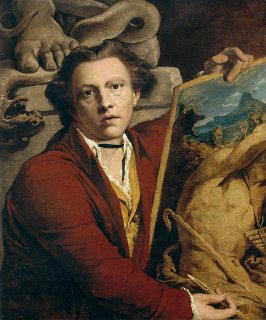
James Barry, Irish painter best remembered for his six-part series of paintings entitled The Progress of Human Culture in the Great Room of the Royal Society of Arts in London, is born in Water Lane (now Seminary Road) on the northside of Cork, County Cork on October 11, 1741.
Barry first studies painting under local artist John Butts. At the schools in Cork to which he is sent he is regarded as a child prodigy. About the age of seventeen he first attempts oil painting, and between that and the age of twenty-two, when he first goes to Dublin, he produces several large paintings.
The painting that first brings him into public notice, and gains him the acquaintance and patronage of Edmund Burke, is founded on an old tradition of the landing of Saint Patrick on the sea-coast of Cashel, although Cashel is an inland town far from the sea, and of the conversion and Baptism of the King of Cashel. It is exhibited in London in 1762 or 1763 and rediscovered in the 1980s in unexhibitable condition.
In late 1765 Barry goes to Paris, then to Rome, where he remains upwards of three years, from Rome to Florence and Bologna, and thence home through Venice. He paints two pictures while abroad, an Adam and Eve and a Philoctetes.
Soon after his return to England in 1771 Barry produces his painting of Venus, which is compared to the Triumph of Galatea of Raphael, the Venus of Urbino of Titian and the Venus de’ Medici. In 1773 he exhibits his Jupiter and Juno on Mount Ida. His Death of General Wolfe, in which the British and French soldiers are represented in very primitive costumes, is considered as a falling-off from his great style of art.
In 1773 Barry publishes An Inquiry into the real and imaginary Obstructions to the Acquisition of the Arts in England, vindicating the capacity of the English for the fine arts and tracing their slow progress to the Reformation, to political and civil dissensions, and lastly to the general direction of the public mind to mechanics, manufactures and commerce.
In 1774 a proposal is made through Valentine Green to several artists to ornament the Great Room of the Society for the encouragement of Arts, Manufactures and Commerce (now the Royal Society of Arts), in London’s Adelphi Theatre, with historical and allegorical paintings. This proposal is rejected at the time. In 1777 Barry makes an offer, which is accepted, to paint the whole on condition that he is allowed the choice of his subjects, and that he is paid by the society the costs of canvas, paints and models. He finishes the series of paintings after seven years to the satisfaction of the members of the society. He regularly returns to the series for more than a decade, making changes and inserting new features. The series of six paintings, The progress of human knowledge and culture, has been described by critic Andrew Graham-Dixon as “Britain’s late, great answer to the Sistine Chapel.”
Soon after his return from the continent Barry is chosen a member of the Royal Academy of Arts. In 1782 he is appointed professor of painting in the room of Edward Penny with a salary of £30 a year. In 1799 he is expelled from the Academy soon after the appearance of his Letter to the Society of Dilettanti, an eccentric publication, full of enthusiasm for his art and at the same time of contempt for the living professors of it. He remains the only academician ever to be expelled by the Academy until Brendan Neiland in July 2004.
After the loss of his salary, a subscription is set on foot by the Earl of Buchan to relieve Barry from his difficulties, and to settle him in a larger house to finish his painting of Pandora. The subscription amounts to £1000, with which an annuity is bought, but on February 6, 1806 he is seized with illness and dies on February 22. His remains are interred in St. Paul’s Cathedral, London on March 4, 1806.
(Pictured: James Barry, Self-portrait, 1803, oil on canvas. National Gallery of Ireland, Dublin.)
The Whiteboys, a secret Irish agrarian organisation in 18th-century Ireland which uses violent tactics to defend tenant farmer land rights for subsistence farming, is created on October 1, 1761. Their name derives from the white smocks the members wear in their nightly raids. They seek to address rack-rents, tithe collection, excessive priests’ dues, evictions and other oppressive acts. As a result they target landlords and tithe collectors. Over time, Whiteboyism becomes a general term for rural violence connected to secret societies. Because of this generalisation, the historical record for the Whiteboys as a specific organisation is unclear. There are three major outbreaks of Whiteboyism: 1761–64, 1770–76 and 1784–86.
Between 1735 and 1760 there is an increase in land used for grazing and beef cattle, in part because pasture land is exempt from tithes. The landlords, having let their lands far above their value, on condition of allowing the tenants the use of certain commons, now enclose the commons, but do not lessen the rent. As more landlords and farmers switch to raising cattle, labourers and small tenant farmers are forced off the land. The Whiteboys develop as a secret oath-bound society among the peasantry. Whiteboy disturbances had occurred prior to 1761 but were largely restricted to isolated areas and local grievances, so that the response of local authorities had been limited.
Their operations are chiefly in the counties of Waterford, Cork, Limerick, and Tipperary. This combination is not political. It is not directed against the government, but against the local landlords. Members of different religious affiliations take part.
The first major outbreak occurs in County Limerick in November 1761 and quickly spreads to counties Tipperary, Cork, and Waterford. A great deal of organisation and planning seems to have gone into the outbreak, including the holding of regular assemblies. Initial activities are limited to specific grievances and the tactics used non-violent, such as the levelling of ditches that closed off common grazing land, although cattle hamstringing is often practised as the demand for beef prompts large landowners to initiate the process of enclosure. As their numbers increase, the scope of Whiteboy activities begins to widen, and proclamations are clandestinely posted stipulating demands such as that rent not be paid, that land with expired leases not be rented until it has lain fallow for three years, and that no one pay or collect tithes demanded by the Anglican Church. Threatening letters are also sent to debt collectors, landlords, and occupants of land gained from eviction, demanding that they give up their farms.
March 1762 sees a further escalation of Whiteboy activities, with marches in military array preceded by the music of bagpipes or the sounding of horns. At Cappoquin they fire guns and march by the military barracks playing the Jacobite tune “The lad with the white cockade.” These processions are often preceded by notices saying that Queen Sive and her children will make a procession through part of her domain and demand that the townspeople illuminate their houses and provide their horses, ready saddled, for their use. More militant activities often follow such processions with unlit houses in Lismore attacked, prisoners released in an attack on Tallow jail and similar shows of strength in Youghal.
The events of March 1762, however, prompt a more determined response, and a considerable military force under Charles Moore, 1st Marquess of Drogheda is sent to Munster to crush the Whiteboys.
On April 2, 1762 a force of 50 militia men and 40 soldiers set out for Tallow. By mid-April at least 150 suspected Whiteboys have been arrested. Clogheen in County Tipperary bears the initial brunt of this assault as the local parish priest, Fr. Nicholas Sheehy, had earlier spoken out against tithes and collected funds for the defence of parishioners charged with rioting. An unknown number of “insurgents” are reported killed in the “pacification exercise” and Fr. Sheehy is unsuccessfully indicted for sedition several times before eventually being found guilty of a charge of accessory to murder, and hanged, drawn and quartered in Clonmel in March 1766.
In the cities, suspected Whiteboy sympathisers are arrested and in Cork, citizens form an association of about 2,000 strong which offer rewards of £300 for capture of the chief Whiteboy and £50 for the first five sub-chiefs arrested. They often accompany the military on their rampages. The leading Catholics in Cork also offer similar rewards of £200 and £40 respectively.
In the summer of 1647, Murrough O’Brien, 6th Baron Inchiquin, the Irish Protestant commander of the Protestant army of Cork, commences a campaign against the Irish Catholic strongholds in Munster. The counties of Limerick and Clare are raided, and he soon turns his attention to the bountiful eastern counties of Munster. In early September, his forces quickly take the Cahir Castle in Tipperary. This strong castle is well positioned to become a base for the Cork Protestant army, and it is used to raid and devastate the surrounding countryside. The Munster army under Lord Taaffe does not make any serious effort to oppose Inchiquin, probably the result of the political scheming of Donough MacCarty, 2nd Viscount Muskerry and other powerful Irish lords who hope to keep the Munster army intact for their own ends. As such, Inchiquin is allowed to make a major push towards the town and ecclesiastical centre of Cashel.
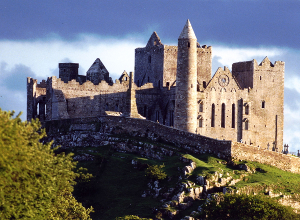
Inchiquin has already launched two minor raids against Cashel, and he now has the opportunity to launch a major assault. The Parliamentarian forces first storm nearby Roche Castle, putting fifty warders to the sword. This attack terrifies the local inhabitants of the region, some of whom flee to hiding places, while hundreds of others flee promptly to the Rock of Cashel, a stronger place than the town itself. Lord Taaffe has placed six companies in the fortified churchyard that sits upon the rock, and considers the place defensible, though he himself does not stay to put it to the test, leaving command to the Governor Lieutenant-Colonel Butler.
Arriving with his army at the Rock, Inchiquin calls for surrender within an hour. The defenders of the churchyard offer to negotiate but that is refused, and on the afternoon of September 15 the assault commences. The Parliamentarians are first reminded of earlier atrocities against Protestants, and then begin to deploy. The attack is led by around 150 dismounted horse officers with the remainder of the infantry following. Troops of horse ride along the flanks of the advancing force to encourage the infantry. The Irish soldiers attempt to drive off the attackers with pikes while the civilians inside hurl rocks down from the walls. In turn the attackers hurl firebrands into the compound, setting some of the buildings inside on fire. Although many are wounded, the Parliamentarians gradually fight their way over the walls, pushing the garrison into the church.
Initially, the Irish defenders manage to protect the Church, holding off the attackers trying to get through the doors, but the Parliamentarians then place numerous ladders against the many windows in the church and swarm the building. For another half an hour fighting rages inside the church, until the depleted defenders retreat up the bell tower. Only sixty soldiers of the garrison remain at this point, and they thus accept a call to surrender. However, after they have descended the tower and thrown their swords away, all are killed.
In the end all the soldiers and most of the civilians on the Rock are killed by the attackers. The Bishop and Mayor of Cashel along with a few others survive by taking shelter in a secret hiding place. Apart from these a few women are spared, after being stripped of their clothes, and a small number of wealthy civilians are taken prisoner, but these are the exceptions. Overall, close to 1,000 are killed, amongst them Lieutenant-Colonel Butler and catholic scholar Theobald Stapleton. The bodies in the churchyard are described by a witness as being five or six deep.
The slaughter is followed by extensive looting. There is much of value inside, for apart from pictures, chalices and vestments of the church, many of the slain civilians had also brought their valuables with them. The sword and ceremonial mace of the mayor of Cashel, as well as the coach of the bishop are captured. The plunder is accompanied by acts of iconoclasm, with statues smashed and pictures defaced. The deserted town of Cashel is also torched.
The atrocity at Cashel causes a deep impact in Ireland, as it is the worst single atrocity committed in Ireland since the start of fighting in 1641. Previously, the most infamous massacre amongst the Catholic population is that at Timolin in 1643, when 200 civilians are killed by James Butler, 1st Duke of Ormond‘s English Royalist army, but many more than this are killed at Cashel, and the Rock of Cashel is one of the chief holy places of Ireland. The slaughter of the garrison at Cashel and the subsequent devastation of Catholic held Munster earns Inchiquin the Irish nickname, Murchadh na Dóiteáin or “Murrough of the Burnings.”