seamus dubhghaill

Promoting Irish Culture and History from Little Rock, Arkansas, USA


Leave a comment

Birth of Maurice Walsh, Author of “The Quiet Man”

maurice-walsh

Maurice Walsh, Irish novelist best known for the short story The Quiet Man which is later made into an Oscar-winning movie, is born on April 21, 1879, in Ballydonoghue near Listowel, County Kerry.

Walsh is the third child of ten and the first son born to John Walsh, a local farmer, and his wife Elizabeth Buckley who live in a three-room thatched farmhouse. John Walsh’s main interests are books and horses and he himself does little work about the farm, preferring to have a hired man. The most famous of these hired men is Paddy Bawn Enright, whose name is immortalised by Walsh in his story The Quiet Man, although the name is not used in the later motion picture. John Walsh passes on to his son not only a love of books but also legends and folk tales that are later featured of many of Walsh’s books.

Walsh goes to school in Lisselton, a mile or so up the road from Ballydonoghue, and later goes to St. Michael’s College in Listowel to prepare for the Civil Service examination. He enters the service on July 2, 1901, as an Assistant Revenue Officer in the Customs and Excise Service. He is posted to Scotland before the year is out and, although he subsequently has a number of postings outside Scotland, he spends most of his time there while in the British service.

Walsh has a life-long interest in writing and, during his early years in Scotland, this interest starts to bear fruit. He submits some of his stories and has two published in the Irish Emerald in 1908. Later that year, on August 8, 1908, Walsh marries Caroline Begg in Dufftown, Banffshire, Scotland.

When the Irish Free State is formed in 1922, Walsh transfers to its excise service and moves to Dublin. Fighting is still going on there at the time, and he leaves his family in Scotland until it is safe for them to join him in 1923. The story The Key Above the Door is written during the months of separation although it is not published until some years later, appearing first in Chambers Journal as a serial between December 1925 and May 1926 and then in book form, published by W & R Chambers Ltd., in July 1926.

Sales of Walsh’s books grow steadily, especially in the wake of an unsolicited and generous letter from J. M. Barrie, the creator of Peter Pan, praising The Key Above the Door, which Chambers is subsequently able to use on dust covers of Walsh’s books.

Walsh retires from government service in 1933 but his success as a writer continues. In that same year he sells a story to The Saturday Evening Post, then a well-known weekly magazine published in the United States. That story, later to be incorporated in the collection of stories published under the title Green Rushes, is The Quiet Man.

Director John Ford reads the story in 1933 and soon purchases the rights to it for $10. Walsh is paid another $2,500 when Republic Pictures buys the idea and receives a final payment of $3,750 when the film is actually made. Filming commences on June 7, 1951, with John Wayne and Maureen O’Hara in the leading roles. All of the outdoor scenes are shot on location in County Mayo and County Galway. The inside scenes are filmed in late July at the Republic Studios in Hollywood. The Quiet Man wins the Academy Award for Best Director for John Ford, his fourth, and for Best Cinematography.

Walsh becomes President of the Irish branch of PEN International in 1938 and visits the United States for an international meeting that year as the Irish delegate. His wife Caroline is able to accompany him although she has been in failing health for some years and ultimately dies in January 1941. Walsh himself dies on February 18, 1964, in Blackrock, a suburb of Dublin, and is buried in the Esker cemetery at Lucan, County Dublin. President Éamon de Valera attended Walsh’s funeral Mass.

In 2013, The Quiet Man is selected for preservation in the United States National Film Registry by the Library of Congress as being “culturally, historically, or aesthetically significant.”


Leave a comment

Birth of Irish Revolutionary Leader Seán Mac Diarmada

sean-mac-diarmada

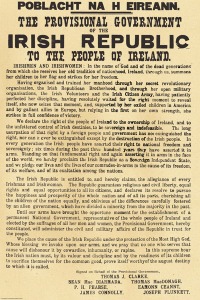
Seán Mac Diarmada, Irish political activist and revolutionary leader also known as Seán MacDermott, is born in Corranmore, near Kiltyclogher in County Leitrim on February 28, 1883. He is one of the seven leaders of the Easter Rising of 1916 and a signatory of the Proclamation of the Irish Republic.

Mac Diarmada is educated by the Irish Christian Brothers. He moves to Dublin in 1908, by which time he already has a long involvement in several Irish separatist and cultural organisations, including Sinn Féin, the Irish Republican Brotherhood (IRB), the Ancient Order of Hibernians, and the Gaelic League. He is soon promoted to the Supreme Council of the IRB and is eventually elected secretary.

In 1910, he becomes manager of the radical newspaper Irish Freedom, which he founds along with Bulmer Hobson and Denis McCullough. He also becomes a national organiser for the IRB and is taken under the wing of veteran Fenian Tom Clarke and the two become nearly inseparable. Shortly afterward, Mac Diarmada is stricken with polio and is forced to walk with a cane.

In November 1913, Mac Diarmada is one of the original members of the Irish Volunteers and continues to work to bring the organisation under IRB control. Mac Diarmada is arrested in Tuam, County Galway, in May 1915 under the Defense of the Realm Act 1914 for giving a speech against enlisting into the British Army.

Following his release in September 1915, Mac Diarmada joins the secret Military Committee of the IRB, which is responsible for planning the rising.

Due to his disability, Mac Diarmada has little participation in the fighting of Easter week but is stationed at the headquarters in the General Post Office (GPO), as one of the Provisional Republican Government. Following the surrender on April 29, 1916, he nearly escapes execution by blending in with the large body of prisoners but is eventually identified by Daniel Hoey of G Division. Following a May 9 court-martial, Mac Diarmada, at the age of 33, is executed by firing squad in Kilmainham Gaol. Before his execution, Mac Diarmada writes, “I feel happiness the like of which I have never experienced. I die that the Irish nation might live!”

In September 1919, Hoey is shot dead by Michael Collins‘s Squad. Likewise, the British Officer who ordered Mac Diarmada to be shot rather than imprisoned, is also killed in Cork on Collins’s order during the Irish War of Independence.

Seán MacDermott Street in Dublin, Sligo Mac Diarmada railway station in Sligo, and Páirc Seán Mac Diarmada, the Gaelic Athletic Association stadium in Carrick-on-Shannon, County Leitrim, are named in his honour. Sean MacDermott tower in Ballymun, demolished in 2005, is also named after him. In his hometown of Kiltyclogher a statue inscribed with his final written words is erected in the village centre and his childhood home has become a national monument.

Mac Diarmada will be portrayed by actor Colin Morgan in the 2016 Irish historical biopic drama film, The Rising, written by Kevin McCann and Colin Broderick.