seamus dubhghaill

Promoting Irish Culture and History from Little Rock, Arkansas, USA


Leave a comment

Birth of Pierce Brosnan, Actor & Producer

Pierce Brendan Brosnan, actor, film producer, and activist, is born at Our Lady of Lourdes Hospital in DroghedaCounty Louth, on May 16, 1953.

Brosnan is the only child of Thomas Brosnan, a carpenter, and May (née Smith, born circa 1934). He lives in NavanCounty Meath for twelve years and considers it his hometown. He goes to Primary School in St. Annes Primary School, Navan. Brosnan’s father abandons the family when he is an infant. When he is four years old, his mother moves to London to work as a nurse. From that point on, he is largely raised by his grandparents, Philip and Kathleen Smith. After their deaths, he lives with an aunt and then an uncle, but is subsequently sent to live in a boarding house. He is educated at Elliott School, now known as Ark Putney Academy, a coeducational secondary school with academy status in southwest London.

Brosnan, after leaving comprehensive school at age sixteen, begins training in commercial illustration. He then goes on to train at Drama Centre London for three years. Following a stage acting career he rises to popularity in the television series Remington Steele (1982–87), which blends the genres of romantic comedy, drama, and detective procedural. After the conclusion of Remington Steele, Brosnan appears in films such as the Cold War spy film The Fourth Protocol (1987) and the comedy Mrs. Doubtfire (1993).

In 1994, Brosnan becomes the fifth actor to portray secret agent James Bond in the Eon Productions film series, starring in four films, GoldenEyeTomorrow Never DiesThe World Is Not Enough and Die Another Day, from 1995 to 2002. He lends his likeness for Bond in the video games James Bond 007: Nightfire and James Bond 007: Everything or Nothing, providing his voice for the latter. During this period, he also takes the lead in other films including the epic disaster adventure film Dante’s Peak (1997) and the remake of the heist film The Thomas Crown Affair (1999). Since leaving the role of Bond, he has starred in such films as the musical/romantic comedy Mamma Mia! (2008), the Roman Polanski-directed political thriller The Ghost Writer (2010) and the action spy thriller The November Man (2014).

In 1996, along with Beau St. Clair, Brosnan forms Irish DreamTime, a Los Angeles-based production company. In later years, he has become known for his charitable work and environmental activism. He is married to Australian actress Cassandra Harris from 1980 until her death in 1991. He marries American journalist and author Keely Shaye Smith in 2001, and becomes an American citizen in 2004, holding dual citizenship in the United States and Ireland. He has earned two Golden Globe Award nominations, first for the television miniseries Nancy Astor (1982) and next for the dark comedy film The Matador (2005).


8 Comments

Birth of Philanthropist Vere Foster

Vere Henry Louis Foster, English educationist and philanthropist is born in Copenhagen on April 25, 1819.

Foster is the third son of Sir Augustus John Foster, 1st Baronet and his wife, Albinia Jane, daughter of George Vere Hobart, and granddaughter of George Hobart, 3rd Earl of Buckinghamshire. He is educated at Eton College, and matriculated at Christ Church, Oxford, on May 30, 1838.

Leaving Oxford without a degree, Foster joins the diplomatic service. From 1842 to 1843 he is attached to the diplomatic mission of Sir Henry Ellis in Rio de Janeiro, and from 1845 to 1847 to that of Sir William Gore Ouseley in Montevideo.

In 1847 Foster visits a family estate in County Louth, Ireland at the time of the Great Famine, with his eldest brother, Sir Frederick George Foster. They become involved in famine relief. In 1848 their father dies and Foster undergoes a crisis in his life, and he comes to concentrate on philanthropy in Ireland.

Foster makes three voyages to the United States as a steerage passenger in a ship of emigrants, finding the accommodations bad, and the treatment of emigrants exploitative. Through his cousin Vere Hobart, Lord Hobart, he is able to influence parliament and the Passengers Act 1851. He also takes practical steps to promote Irish emigration to the United States.

Later, Foster takes up the improvement of education in Ireland. This is a time of Catholic suspicion of the national education system introduced by Richard Whately. Foster contributes to the provision of better school accommodation and apparatus, and gives grants in aid of building several hundred new school-houses. He agitates for improved wages and conditions for teachers, and develops the “Vere Foster copy-books” to improve and standardise the teaching of writing. The immense popularity of these texts draw him to the Belfast printing firm Marcus Ward & Company, and into personal friendship with John Ward, one of the firm’s owners.

In 1867, Foster settles permanently in Belfast where he continues to work as the president of the Congress of the Irish National Teachers’ Organisation. He fundraises for the Royal Belfast Hospital, and helps to establish a school of art in the town, while continuing to promote emigration.

In 1879, with the Land War in Ireland, Foster concentrates on promoting female emigration to the United States and the British colonies. He is supported in his projects by both Catholic and Protestant clergy.

Vere Foster dies, unmarried, in Belfast on December 21, 1900. He is buried in Belfast City Cemetery.


Leave a comment

The Assassination of Thomas D’Arcy McGee

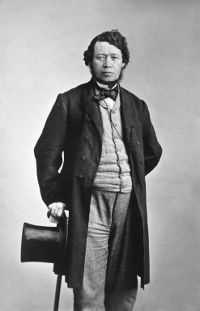
Thomas D’Arcy Etienne Hughes McGee, Irish-Canadian politician, Catholic spokesman, journalist, poet, and a Father of Canadian Confederation, is assassinated by Fenian elements on April 7, 1868, in OttawaOntarioCanada. He is to date the only Canadian victim of political assassination at the federal level.

McGee, born on April 13, 1825 in Carlingford, County Louth, grows up a Catholic Irishman who hates the British rule of Ireland and works for a peasant revolution to overthrow British rule and secure Irish independence. He escapes arrest and flees to the United States in 1848, where he reverses his political beliefs. He becomes disgusted with American republicanism and democracy, and becomes intensely conservative in his politics and in his religious support for the Pope.

McGee moves to Canada in 1857 and works hard to convince the Irish Catholics to cooperate with the Protestant British in forming a Confederation that will make for a strong Canada in close alliance with Britain. His fervor for Confederation garners him the title “Canada’s first nationalist.” He fights the Fenians in Canada, who are Irish Catholics who hate the British and resemble his younger self politically. McGee succeeds in helping create the Canadian Confederation in 1867.

On 7 April 1868, McGee, having participated in a parliamentary debate that goes on past midnight, walks back to the boarding house where he is staying. McGee is opening the door to Trotter’s Boarding House in Ottawa when he is shot by someone waiting for him on the inside. Several people run to the scene, however there is no sign of the assassin. It is later determined that McGee is assassinated with a shot from a handgun by Patrick J. Whelan.

McGee is given a state funeral in Ottawa and interred in a crypt at the Cimetière Notre Dame des Neiges in Montreal. His funeral procession in Montreal draws an estimated crowd of 80,000 out of a total city population of 105,000.

Patrick J. Whelan, a Fenian sympathiser and a Catholic, is accused, tried, convicted, and hanged for the crime on February 11, 1869, in Ottawa. The jury is decisively swayed by the forensic evidence that Whelan’s gun had been fired shortly before the killing, together with the circumstantial evidence that he had threatened and stalked McGee. Historian David Wilson points out that forensic tests conducted in 1972 show that the fatal bullet is compatible with both the gun and the bullets that Whelan owned. Wilson concludes, “The balance of probabilities suggests that Whelan either shot McGee, or was part of a hit-squad, but there is still room for reasonable doubt as to whether he was the man who actually pulled the trigger.”

The government of Canada’s Thomas D’Arcy McGee Building stands near the site of the assassination. The case is dramatised in the Canadian play Blood on the Moon by Ottawa actor/playwright Pierre Brault. The assassination of McGee is also a major component of Away, a novel about Irish immigration to Canada by Canadian novelist Jane Urquhart.


Leave a comment

Birth of Lawyer & Politician Philip Tisdall

philip-tisdall

Philip Tisdall, lawyer and politician who is a leading figure in the Irish Government for many years, is born on March 1, 1703, in County Louth.

Tisdall is the son of Richard Tisdall, who is MP for Dundalk in 1703–1713 and for Louth in 1717–1727, by his wife Marian Boyle, daughter of Richard Boyle, MP, a cousin of the Earl of Cork. His father is also Registrar of the Court of Chancery.

Tisdall is educated at Thomas Sheridan‘s school in Dublin, and at the University of Dublin, where he graduates Bachelor of Arts in 1722. He enters Middle Temple in 1723 and is called to the Irish Bar in 1733.

In 1736 he marries Mary Singleton, daughter of the Rev. Rowland Singleton and Elizabeth Graham, and niece and co-heiress of Henry Singleton, Chief Justice of the Irish Common Pleas, a marriage which brings him both wealth and influence. He quickly becomes one of the leaders of the Bar, partly through his legal ability and partly through his marriage into the wealthy and influential Singleton family. He is made a Bencher of the King’s Inns in 1742.

He sits in the Irish House of Commons as MP for Dublin University from 1739 to 1776 and then for the city of Armagh from 1776 until his death. He is elected as member for Armagh in 1768 but chooses to continue sitting for the University.

In 1742 Tisdall is appointed Third Serjeant, then Solicitor-General in 1751 and Attorney-General in 1760. He is also appointed judge of the Prerogative Court of Ireland, an office he holds from 1745 until his death. In 1763 he becomes Principal Secretary of State, and on February 28, 1764, he is appointed to the Privy Council of Ireland. For almost 20 years he is a crucial figure in the Irish Government, which relies on him on to manage the Irish House of Commons, a task which he performs with great skill and tact. Tisdall is almost all-powerful until 1767, when George Townshend, 1st Marquess Townshend, arrives as Lord Lieutenant of Ireland. Townshend has a mandate to restore the direct power of the Crown over Irish affairs and to bypass the Irish managers like Tisdall. To his credit, Townshend recognises that Tisdall’s support is still an asset to the Government and makes great efforts to conciliate him. Townshend lobbies hard for Tisdall to be appointed Lord Chancellor of Ireland, but comes up against the inflexible British reluctance, then and for many years after, to appoint an Irishman to this crucial office. He retains the confidence of successive Lords Lieutenants. In 1777, despite his age and failing health, he is asked to resume his role as Government leader in the House of Commons. He agrees, but dies at Spa, Belgium on September 11 of the same year.

Tisdall is strikingly dark in complexion, hence his nicknames “Black Phil” and “Philip the Moor,” and is described as “grave in manner and sardonic in temper.” Despite his somewhat forbidding appearance, he is a hospitable character, who is noted for entertaining lavishly, even when he is well into his seventies, both at his town house in South Leinster Street, and his country house at Stillorgan. John Scott, 1st Earl of Clonmell, who succeeds him as Attorney General, writes that Tisdall would have lived longer if he had adopted a more sedate lifestyle in his later years.


2 Comments

Birth of Cardinal Patrick Joseph O’Donnell

patrick-joseph-odonnell

Patrick Joseph O’Donnell, Cardinal of the Roman Catholic Church, is born in Glenties, County Donegal, on November 28, 1856. He serves as Archbishop of Armagh from 1924 until his death and is elevated to the cardinalate in 1925.

O’Donnell, son of Daniel O’Donnell, a farmer, and his wife, Mary (née Breslin), is one of nine children in a family that claim descent from the O’Donnells of Tyrconnell. He is educated in the High School, Letterkenny, the Catholic University, Dublin, and St. Patrick’s Pontifical University, Maynooth. He is ordained to the priesthood on June 29, 1880. In that same year he is appointed to the staff of St. Patrick’s College, Maynooth, holding the chairs of Dogmatic and Moral Theology. In 1884 he becomes dean of the revived post-graduate Dunboyne Institute and in 1885 is awarded his STD. From his desk in Maynooth he pours out a continuous stream of articles on moral theology and canon law.

O’Donnell becomes Bishop of Raphoe on February 26, 1888, and is consecrated by Cardinal Michael Logue on April 3 in Letterkenny. With superior qualities of mind and body, he is a benign figure who is yet gifted with sharp political acumen. He has the most distinguished episcopate, locally and nationally. He undertakes and completes prodigious building projects including a superbly sited neo-gothic cathedral, St. Eunan’s Diocesan College, and the Presentation Monastery and Loreto schools and an extension to Loreto Convent, all in Letterkenny.

He is appointed coadjutor Archbishop of Armagh on January 14, 1922, and succeeds Cardinal Logue on November 19, 1924. On December 14, 1925, Pope Pius XI makes O’Donnell a Cardinal.

O’Donnell takes an active part in the social, political, and economic life of Ireland. A staunch activist for social justice, as Bishop of Raphoe, he is a member of the first Committee of the Irish Agricultural Organisation Society, founded by Sir Horace Plunkett. In 1918, when representing the nationalist’s side at the Irish Convention, he opposes John Redmond‘s amendment intended to bring about unanimity on All-Ireland Home Rule.

Cardinal O’Donnell dies on October 22, 1927, in Carlingford, County Louth. The St. Connell’s Museum in his hometown of Glenties has a display about his life.


Leave a comment

Birth of Margaret Dobbs, Irish Scholar & Playwright

feis-na-ngleann

Margaret Emmeline Dobbs, Irish scholar and playwright best known for her work to preserve the Irish Language, is born in Dublin on November 19, 1871.

Dobbs’ father, Conway Edward Dobbs, is Justice of the Peace for County Antrim, High Sheriff for Carrickfergus in 1875, and High Sheriff for County Louth in 1882. The family spends time living in Dublin which is where Dobbs is born. She attempts to learn Irish. However, when her father dies in 1898 her mother, Sarah Mulholland, daughter of St. Clair Kelvin Mulholland Eglantine, moves the family back to Glenariff.

Dobbs’ interest in learning Irish continues and she finds it easier to learn in Donegal where the language is still spoken. Her first teacher is Hugh Flaitile. She attends the Irish College at Cloughaneely in the Donegal Gaeltacht. She brings the idea of promoting the language to the Glens of Antrim and her circle of friends. Dobbs is one of the small numbers of Protestant women interested in the Gaelic revival.

The “Great Feis” takes place in Antrim in 1904. Dobbs is a founding member of the Feis na nGleann committee and later a tireless literary secretary. In 1946, the Feis committee decides to honour her by presenting her with an illuminated address. It can be seen today at Portnagolan House with its stained-glass windows commemorating a great Irishwoman. During her speech she says, “Ireland is a closed book to those who do not know her language. No one can know Ireland properly until one knows the language. Her treasures are hidden as a book unopened. Open the book and learn to love your language.”

Dobbs writes seven plays, published by Dundalgan Press in 1920, though only three are ever performed. The Doctor and Mrs. McAuley wins the Warden trophy for one-act plays at the Belfast festival in 1913. However, her plays are generally not a success and after 1920 she never writes another. She continues to work on historical and archaeological studies and her articles are published in the Ulster Journal of Archaeology, in a German magazine for Celtic studies, in the French Revue Celtique, and in the Irish magazine Eriu.

Roger Casement is a good friend and, although Dobbs never makes her political opinions known, she contributes to his defence costs when he is accused of treason. She also is a member of the Gaelic League and in the executive of Cumann na mBan.

She dies in Portnagalon, County Antrim, on January 2, 1962.


Leave a comment

Death of Mochta of Louth, Disciple of St. Patrick

st-mochtas-house

Mochta of Louth, in Latin sources Maucteus or Mauchteus, the last surviving disciple of St. Patrick, dies on August 20, 535.

Mochta is, like Patrick, a native of Britain. His name is British and Adomnán‘s Life of Columba describes him as “a certain British stranger, a holy man and a disciple of the holy bishop Patrick.” Adomnán presents Mochta as having prophesied the birth of Colm Cille.

According to one account, Mochta is brought to Ireland as a child, along with his parents, by a druid named Hoam. The druid settles in County Louth, where Mochta is brought up as a member of the family. He goes to Rome to continue his studies and there the Pope consecrates him bishop and sends him back to Ireland with twelve companions. The first church he founds is at Kilmore. Departing from Kilmore, he leaves all his possessions to the monks, taking only “the fountain at the door.” He follows a stream, which becomes the River Fane, to Louth.

Mochta founds a monastery in Louth, originally the site of a shrine to the Celtic god Lugh. Mochta’s monastery gains a nationwide reputation. He is an accomplished scholar, especially learned in Sacred Scripture. He writes a rule for monks but no trace of it has survived. He begins a series of annals at Louth, which is continued by his successors, and becomes known as the Book of the Monks. In his old age, Patrick comes and spends some time with Mochta. After Patrick’s death, Mochta takes charge of Armagh for a brief period before turning it over to Benignus.

Both monastery and village are burned and plundered frequently by the Danes in the period 829-968. A round tower built for protection is blown down in 981. There are no physical remains of the early monastery. The ruined buildings at the site today (pictured) are the 13th century church of St. Mary’s Augustinian Priory and the stone roofed oratory known as St. Mochta’s House, which probably dates to the second half of the 12th century.

The Annals of Ulster report Mochta’s death twice, in 535 and 537, which indicates that he is considerably younger than Patrick, whose death the Annals date to 493. Scholars believe that he, the last of Patrick’s disciples then alive, dies at the age of 90. The entry for 535 dates his death to the 13th of the Calends of September, i.e. 20 August, and quotes the opening of a letter written by him: “Mauchteus, a sinner, priest, disciple of St. Patrick, sends greetings in the Lord.” However the remainder of this letter nor any other compositions of Mochta have survived.


Leave a comment

Death of Father Willie Doyle

father-willie-doyle

Father Willie Doyle, an Irish Jesuit priest, is killed in action on August 16, 1917, during the World War I.

Born William Joseph Gabriel Doyle in Dalkey, County Dublin, on March 3, 1873, Doyle is the youngest of seven children of Hugh and Christine Byrne Doyle. He is educated at Ratcliffe College, Leicester. After reading St. Alphonsus’ book Instructions and Consideration on the Religious State he is inspired to enter the priesthood and is ordained a Jesuit priest in 1907. He serves for five years on the mission staff.

Doyle serves in the Royal Army Chaplains’ Department of the British Army during World War I, appointed as a chaplain to 48 Brigade of the 16th Irish Division. During the Battle of Loos Doyle is caught in a German gas attack and for his conduct is mentioned in dispatches. A recommendation for a Military Cross is rejected as “he had not been long enough at the front.” Instead, Doyle is presented with the parchment of merit of the 49th Infantry Brigade (Irish). He is killed in the Battle of Langemarck, on August 16, 1917. Father Doyle’s body is never recovered but he is commemorated at Tyne Cot Memorial in Belgium.

General William Bernard Hickie, the commander-in-chief of the 16th Irish Division, describes Doyle as “one of the bravest men who fought or served out here.” Doyle is awarded the Military Cross for his bravery during the assault on the village of Ginchy. He is recommended for a posthumous Victoria Cross and Distinguished Service Order but is awarded neither. Doyle is proposed for canonisation in 1938, but this is not followed through.

A stained-glass window dedicated to his memory is present in St. Finnian’s Church, Dromin, County Louth.


Leave a comment

Oliver Plunkett Beatified by Pope Benedict XV

oliver-plunkett

Oliver Plunkett, Roman Catholic Archbishop of Armagh and Primate of All Ireland, is beatified by Pope Benedict XV on May 23, 1920.

Plunkett is born on November 1, 1625, in Loughcrew, County Meath, to well-to-do parents with Hiberno-Norman ancestors. He is ordained a priest in 1654 and deputed by the Irish bishops to act as their representative in Rome. Meanwhile, the Cromwellian conquest of Ireland (1649–1653) has defeated the Roman Catholic cause in Ireland. In the aftermath, the public practice of Roman Catholicism is banned, and Roman Catholic clergy are executed. As a result, it is impossible for Plunkett to return to Ireland for many years.

He eventually sets foot on Irish soil again on March 7, 1670, as the English Restoration of 1660 has begun on a basis of toleration. After arriving back in Ireland, he sets about reorganising the ravaged Roman Church and builds schools both for the young and for clergy, whom he finds “ignorant in moral theology and controversies.” The Penal Laws have been relaxed in line with the Declaration of Breda in 1660 and Plunkett is able to establish a Jesuit College in Drogheda in 1670.

On the enactment of the Test Act in 1673, to which Plunkett does not agree for doctrinal reasons, the college is closed and demolished. Plunkett goes into hiding, traveling only in disguise, and refusing a government edict to register at a seaport to await passage into exile. In 1678, the so-called Popish Plot, concocted in England by clergyman Titus Oates, leads to further anti-Roman Catholic action. Archbishop Peter Talbot of Dublin is arrested, and Plunkett again goes into hiding.

Despite being on the run and with a price on his head, Plunkett refuses to leave his flock. At some point before his final incarceration, he takes refuge in a church that once stood in the townland of Killartry, in the parish of Clogherhead in County Louth, seven miles outside Drogheda. He is arrested in Dublin in December 1679 and imprisoned in Dublin Castle. Plunkett is tried at Dundalk for conspiring against the state by allegedly plotting to bring 20,000 French soldiers into the country, and for levying a tax on his clergy to support 70,000 men for rebellion.

Plunkett is found guilty of high treason in June 1681 “for promoting the Roman faith” and is condemned to death. He is hanged, drawn, and quartered at Tyburn on July 1, 1681, the last Roman Catholic martyr to die in England.

Oliver Plunkett is beatified on May 23, 1920, and canonised in 1975, the first new Irish saint for almost seven hundred years, and the first of the Irish martyrs to be beatified. For the canonisation, the customary second miracle is waived. Plunkett has since been followed by 17 other Irish martyrs who were beatified by Pope John Paul II in 1992. Among them are Archbishop Dermot O’Hurley, Margaret Ball, and the Wexford Martyrs.