seamus dubhghaill

Promoting Irish Culture and History from Little Rock, Arkansas, USA


Leave a comment

The Omagh Car Bombing

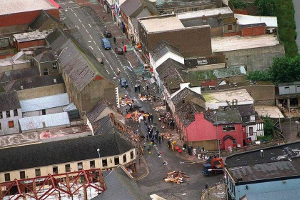
The Omagh bombing, a car bombing in Omagh, County Tyrone, Northern Ireland, takes place on August 15, 1998. It is carried out by a group calling themselves the Real Irish Republican Army, a Provisional Irish Republican Army (IRA) splinter group who opposes the IRA’s ceasefire and the Good Friday Agreement.

On the day of the bombing, the bombers drive a car, loaded with 230 kilograms (510 lb) of fertiliser-based explosives, across the Irish border. At approximately 2:19 PM they park the vehicle outside S.D. Kells’ clothes shop in Omagh’s Lower Market Street, on the southern side of the town centre, near the crossroads with Dublin Road. They are unable to find a parking space near the intended target, the Omagh courthouse. The two male occupants arm the bomb and, upon exiting the car, walk east down Market Street towards Campsie Road.

Three telephone calls are made warning of a bomb in Omagh, using the same codeword that had been used in the Real IRA’s bomb attack in Banbridge two weeks earlier. At 2:32 PM, a warning is telephoned to Ulster Television saying, “There’s a bomb, courthouse, Omagh, Main Street, 500 lb., explosion 30 minutes.” One minute later, the office receives a second warning saying, “Martha Pope (which is the RIRA’s code word), bomb, Omagh town, 15 minutes.” The caller claims the warning on behalf of “Óglaigh na hÉireann.” One minute later, the Coleraine office of the Samaritans receives a call stating that a bomb will go off on “Main Street” about 200 yards (180 m) from the courthouse. The recipients pass the information on to the Royal Ulster Constabulary (RUC) but are claimed to be inaccurate and police inadvertently move people towards the bomb.

The car bomb detonates at 3:10 PM in the crowded shopping area. The bombing kills 29 people, including a woman pregnant with twins, and injures some 220 others. Twenty-one people who are in the vicinity of the vehicle die at the scene. Eight more people die on the way to or in the hospital. The death toll is higher than that of any single incident during what are considered “the Troubles.”

The bombing causes outrage both locally and internationally, spurs on the Northern Ireland peace process, and deals a severe blow to the Dissident republican campaign. The Real IRA apologises and declares a ceasefire shortly afterwards. The victims include people from many backgrounds: Protestants, Catholics, a Mormon teenager, five other teenagers, six children, a mother pregnant with twins, two Spanish tourists, and others on a day trip from the Republic of Ireland. Both unionists and Irish nationalists are killed and injured.

It is alleged that the British, Irish and U.S. intelligence agencies have information which could have prevented the bombing, most of which comes from double agents inside the Real IRA. This information is not given to the local police, the Royal Ulster Constabulary (RUC). In 2008 it is revealed that British intelligence agency, Government Communications Headquarters, was monitoring conversations between the bombers as the bomb was being driven into Omagh.

A 2001 report by the Police Ombudsman says that the RUC Special Branch failed to act on prior warnings and slammed the RUC’s investigation of the bombing. The RUC has obtained circumstantial and coincidental evidence against some suspects, but it has not come up with anything to convict anyone of the bombing. Colm Murphy is tried, convicted, and then released after it is revealed that Garda Síochána forged interview notes used in the case. Murphy’s nephew, Sean Hoey, is also tried and found not guilty.

In June 2009, the victims’ families win a GB£1.6 million civil action against four defendants. In April 2014, Seamus Daly is charged with the murders of those killed, however, the case against him is withdrawn in February 2016.

Leave a comment

Murder of PSNI Officer Ronan Kerr

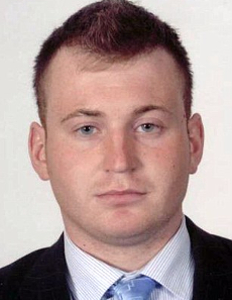
Police Constable Ronan Kerr, a Police Service of Northern Ireland (PSNI) officer, is killed by a booby trap car bomb planted outside his home in Killyclogher near Omagh on April 2, 2011. Responsibility for the attack is later claimed by a dissident republican group claiming to be made of former members of the Provisional Irish Republican Army.

Kerr is Roman Catholic, a group which at the time constitutes approximately 30% of PSNI officers, and is 25 years old at the time of his death. He is a member of a Gaelic Athletic Association club, the Beragh Red Knights. The guard of honour at Kerr’s funeral is formed of club members and PSNI officers, a funeral also attended by the leaders of Ireland’s four main churches.

Kerr’s murder is condemned by almost all sections of Northern Irish politics and society as well as bringing international condemnation. On April 6, a Peace Rally is organised in Belfast by the Irish Congress of Trade Unions, which is reported to be attended by up to 7,000 persons. Similar events are held in Omagh, Enniskillen, and London.

BBC Ireland correspondent Mark Simpson comments, in relation to the unified response of the community, “A murder designed to divide people has actually brought them closer together.” Graffiti praising the murder is daubed on walls in predominantly republican areas of Derry.

On July 26, 2011 five men are arrested in connection with the investigation. They are later released. On November 26, 2012, investigating detectives announce the arrest of a 22-year-old man in Milton Keynes. On November 27, a 39-year-old man in County Tyrone is arrested and questioned. However, as of 2017 no persons have been charged with Constable Kerr’s murder.


Leave a comment

Birth of Patrick Joseph McCall, Songwriter & Poet

patrick-joseph-mccall

Patrick Joseph McCall, Irish songwriter and poet known mostly as the author of lyrics for popular ballads, is born at 25 Patrick Street in Dublin on March 6, 1861. He is assisted in putting the Wexford ballads, dealing with the Irish Rebellion of 1798, to music by Arthur Warren Darley using traditional Irish airs. His surname is one of the many anglicizations of the Irish surname Mac Cathmhaoil, a family that were chieftains of Kinel Farry (Clogher area) in County Tyrone.

McCall is the son of John McCall (1822-1902), a publican, grocer, and folklorist from Clonmore near Hacketstown in County Carlow. He attends St. Joseph’s Monastery, Harold’s Cross, a Catholic University School.

He spends his summer holidays in Rathangan, County Wexford, where he spends time with local musicians and ballad singers. His mother came from Rathangan near Duncormick on the south coast of County Wexford. His aunt Ellen Newport provides much of the raw material for the songs and tunes meticulously recorded by her nephew. He also collects many old Irish airs but is probably best remembered for his patriotic ballads. Airs gathered at rural céilí and singsongs are delivered back to the Royal Irish Academy in Dublin.

He contributes to the Dublin Historical Record, the Irish Monthly, The Shamrock, and Old Moore’s Almanac (under the pseudonym Cavellus). He is a member of the group in Dublin which founds the National Literary Society and becomes its first honorary secretary.

He marries Margaret Furlong, a sister of the poet Alice Furlong, in 1901. They live in the suburb of Sutton, near Howth.

In 1902 he is elected as a Dublin City councillor, defeating James Connolly, and serves three terms. As a councillor he concerns himself with local affairs, particularly projects to alleviate poverty.

Patrick Joseph McCall dies on March 5, 1919, one day before his 58th birthday, in Sutton, Fingal, Dublin.


Leave a comment

Birth of George Sigerson, Physician & Writer

george-sigerson

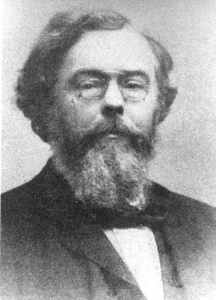
George Sigerson, Irish physician, scientist, writer, politician, and poet, is born at Holy Hill, near Strabane in County Tyrone on January 11, 1836. He is a leading light in the Irish Literary Revival of the late 19th century in Ireland.

Sigerson is the son of William and Nancy (née Neilson) Sigerson and has three brothers, James, John and William, and three sisters, Ellen, Jane, and Mary Ann. He attends Letterkenny Academy but is sent by his father, who developed the spade mill and who played an active role in the development of Artigarvan, to complete his education in France.

He studies medicine at the Queen’s College, Galway, and Queen’s College, Cork, and takes his degree in 1859. He then goes to Paris where he spends some time studying under Jean-Martin Charcot and Duchenne de Boulogne. Sigmund Freud is one of his fellow students.

Sigerson returns to Ireland and opens a practice in Dublin, specializing in neurology. He continues to visit France annually to study under Charcot. His patients included Maud Gonne, Austin Clarke, and Nora Barnacle. He lectures on medicine at the Catholic University of Ireland and is professor of zoology and later botany at the University College Dublin.

His first book, The Poets and Poetry of Munster, appears in 1860. He is actively involved in political journalism for many years, writing for The Nation. Sigerson and his wife Hester are by now among the dominant figures of the Gaelic Revival. They frequently hold Sunday evening salons at their Dublin home to which artists, intellectuals, and rebels alike attend, including John O’Leary, W.B. Yeats, Patrick Pearse, Roger Casement, and 1916 signatory Thomas MacDonagh. Sigerson is a co-founder of the Feis Ceoil and President of the National Literary Society from 1893 until his death. His daughter, Dora, is a poet who is also involved in the Irish literary revival.

Nominated to the first Seanad Éireann of the Irish Free State, Sigerson briefly serves as the first chairman on December 11-12, 1922, before the election of James Campbell, 1st Baron Glenavy. Sigerson dies at his home at 3 Clare Street, Dublin, on February 17, 1925, at the age of 89, after a short illness. On February 18, 1925, the day after his death, the Seanad Éireann pays tribute to him.

The Sigerson Cup, the top division of third level Gaelic football competition in Ireland is named in his honour. Sigerson donates the salary from his post at UCD so that a trophy can be purchased for the competition. In 2009, he is named in the Sunday Tribune‘s list of the “125 Most Influential People In GAA History.” The cup is first presented in 1911, with the inaugural winners being UCD GAA.


Leave a comment

Birth of Irish Playwright Brian Patrick Friel

brian-patrick-friel

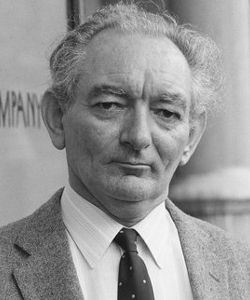
Brian Patrick Friel, Irish playwright, short story writer, and founder of the Field Day Theatre Company, is born on January 9, 1929, at Knockmoyle, near Omagh, County Tyrone. Prior to his death, he had been considered one of the greatest living English-language dramatists and referred to as an “Irish Chekhov” and “the universally accented voice of Ireland.” His plays have been compared favourably to those of contemporaries such as Samuel Beckett, Arthur Miller, Harold Pinter, and Tennessee Williams.

Friel is the son of Patrick “Paddy” Friel, a primary school teacher and councillor on Londonderry Corporation, the local city council in Derry. Friel’s mother, Mary McLoone, is postmistress of Glenties, County Donegal. The family moves to Derry when Friel is ten years old. There, he attends St. Columb’s College, the same school attended by Seamus Heaney, John Hume, Seamus Deane, Phil Coulter, Eamonn McCann, and Paul Brady.

Friel receives his B.A. from St. Patrick’s College, Maynooth (1945–48), and qualifies as a teacher at St. Joseph’s Training College in Belfast. He marries Anne Morrison in 1954, with whom he has four daughters and one son. Between 1950 and 1960, he works as a math teacher in the Derry primary and intermediate school system, taking leave in 1960 to pursue a career as a writer, living off his savings. In the late 1960s, the Friels move from 13 Malborough Street, Derry to Muff, County Donegal, eventually settling outside Greencastle, County Donegal.

Recognised for early works such as Philadelphia, Here I Come! and Faith Healer, Friel has 24 plays published in a more than half-century spanning career that culminates in his election to the position of Saoi of Aosdána. His plays are commonly featured on Broadway throughout this time. In 1980, Friel co-founds Field Day Theatre Company, and his play Translations is the company’s first production. With Field Day, Friel collaborates with Seamus Heaney, 1995 recipient of the Nobel Prize in Literature. Heaney and Friel first become friends after Friel sends the young poet a letter following the publication of Death of a Naturalist.

Friel is a member of the American Academy of Arts and Letters, the British Royal Society of Literature, and the Irish Academy of Letters. He is appointed to Seanad Éireann in 1987 and serves until 1989. In later years, Dancing at Lughnasa reinvigorates Friel’s oeuvre, bringing him Tony Awards, including Best Play, the Laurence Olivier Award for Best New Play, and the New York Drama Critics Circle Award for Best Play. It is also adapted into a film, starring Meryl Streep, directed by Pat O’Connor, script by Frank McGuinness.

After a long illness Friel dies at the age of 86 in the early morning of Friday, October 2, 2015, in Greencastle, County Donegal.


Leave a comment

The Government of Ireland Act 1920 Becomes Law

government-of-ireland-act-1920The Government of Ireland Act 1920, an Act of the Parliament of the United Kingdom also known as the Fourth Home Rule Bill, becomes law on December 23, 1920.

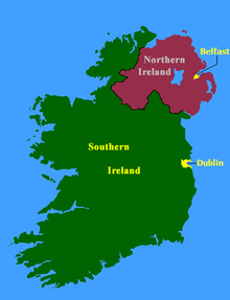
The Act is intended to establish separate Home Rule institutions within two new territories of Ireland – the six northeastern counties of Antrim, Armagh, Down, Fermanagh, Londonderry, and Tyrone are to form “Northern Ireland,” while the remaining 26 counties of the country are to form “Southern Ireland.” Each territory is to be self-governing, except in areas specifically reserved to the Parliament of the United Kingdom such as defence, foreign affairs, international trade, and currency. Provision is made for their future reunification under common Home Rule institutions.

Home Rule never takes effect in Southern Ireland due to the Irish War of Independence, which results instead in the Anglo-Irish Treaty and the establishment in 1922 of the Irish Free State. However, the institutions set up under this Act for Northern Ireland continue to function until they are suspended by the British parliament in 1972 as a consequence of the Troubles.

The final provisions of the 1920 Act remaining in force are repealed under the terms of the Northern Ireland Act 1998, after the Good Friday Agreement. In the republic, the Statute Law Revision Act 2007 repeals the Act almost 85 years after Constitution of the Irish Free State replaced it as the basic constitutional law.


1 Comment

Execution of “Half-Hanged MacNaghten”

half-hanged-macnaghten

John MacNaghten, Anglo-Irish land owner, gambler, and convicted murderer also known as “Half-Hanged MacNaghten,” is hanged at Strabane jail on December 15, 1761, for his involvement in the killing of Mary Anne Knox, daughter of Andrew Knox MP.

MacNaghten is born into a landed Anglo-Irish family and attends Raphoe Royal school in County Donegal. In 1740, he inherits his family estate worth £500 a year and that same year enters Trinity College, Dublin. MacNaghten marries the sister-in-law of the first earl of Massereene. However, he is quickly enamoured of the extravagant lifestyle of Ascendancy Dublin where he becomes a popular and colourful character. He develops an addiction to gambling and squanders away a large part of his inheritance, running up substantial gaming debts and by 1750 is threatened with arrest.

Following the death of his wife in childbirth, he is appointed to the lucrative post of tax collector for Coleraine but gambles away £800 of the King’s money. His estate is sequestered and by 1760 he is penniless.

He gains support trying to help overcome his addiction from a childhood friend, Andrew Knox. Knox is a wealthy land-owner and Member of Parliament (MP) for Donegal who lives on an estate at Prehen about two miles outside the city of Derry. Mary Ann, Knox’s 15-year-old daughter, is already a substantial heiress, having received some £6,000, and would collect a further legacy if her brother dies without issue. MacNaghten and Mary Ann develop a relationship as the former visits Prehen regularly. Nonetheless by 1761 their relationship has run into difficulties.

The practice of abduction and marriage is prevalent in 18th century Ireland among young men of social standing but with little property and, within their society, it is tolerated. So, on November 10, 1761, MacNaghten and his followers attempt to abduct Mary Ann from a carriage on a family journey to Dublin Parliament with the intention of eloping with her. The attempt fails miserably as MacNaghten shoots and mortally wounds her by mistake. He is taken to Lifford Courthouse in County Donegal, where a court finds MacNaghten guilty of murder and he is sentenced to execution by hanging.

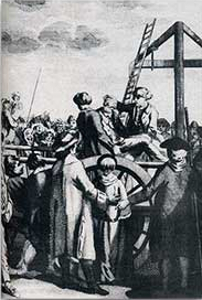
At Strabane jail on December 15, 1761, MacNaghten hurls himself from the gallows with such force that the rope breaks. He has the sympathy of the crowd who believe this is divine intervention for a man distraught with grief over the death of his love. Despite the belief that MacNaghten could not be hanged a second time, he fails to use the cover of a sympathetic crowd to make good his escape. Rather he defies the public mood of the people with the never-to-be-forgotten words, “I vow that no one will ever speak of me as Half-Hanged MacNaghten.” He returns himself to the jurisdiction of the hangman and, with a new rope, is dispatched into the arms of eternity.

John McNaghton is buried at Patrick Street graveyard, Strabane, County Tyrone.


1 Comment

Execution of IRA Officer Joe McKelvey

joe-mckelvey

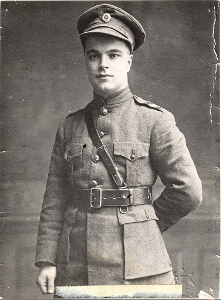
Joe McKelvey, Irish Republican Army (IRA) officer, is executed by firing squad along with three other Anti-Treaty militants, on December 8, 1922, during the Irish Civil War.

McKelvey is born into a nationalist family in Stewartstown, County Tyrone. He has a keen interest in the Gaelic Athletic Association and the Irish language. He studies as an accountant and gains some of the qualifications necessary for this profession, but never fully qualifies. He works for a time at the Income Tax Office on Queen’s Square in Belfast and later finds work in Belfast’s engineering industry with Mackies on Springfield Road. He joins the Irish Republican Brotherhood and the Irish Volunteers, which after 1919, become known as the Irish Republican Army (IRA). He is a founding member of the O’Donovan Rossa Club, Belfast, founded in 1916 on the Falls Road. Each year the club honours him with a juvenile hurling blitz, an invitational competition which is participated in by clubs throughout Ireland.

McKelvey participates in the Irish War of Independence (1919–1921) against the British, in which he commands the IRA’s Belfast Brigade. On August 22, 1920, he helps to organise the killing of Royal Irish Constabulary (RIC) Detective Oswald Swanzy in Lisburn. The killing itself is carried out by IRA men from Cork, but McKelvey arranges a taxi to carry the assassins to and from the scene and disposes of their weapons. In reprisal for this shooting, 300 Catholic homes in Lisburn are burned out. McKelvey is forced to lie low in Dublin for some time after these events.

In March 1921, the IRA is re-organised by its leadership in Dublin into Divisions and McKelvey is appointed commander of the Third Northern Division, responsible for Belfast and the surrounding area. In May 1921, McKelvey’s command suffers a severe setback, when fifty of his best men are sent to County Cavan to train and link up with the IRA units there, only to be surrounded and captured by the British Army on Lappanduff hill on May 9. In most of Ireland, hostilities are ended with a truce declared on July 11, 1921.

McKelvey is alone among the leadership of the Belfast IRA in going against the acceptance of the Anglo-Irish Treaty. Most of his comrades support Michael Collins‘ assurances that, although the Treaty accepts the partition of Northern Ireland from the rest of the country, this is only a temporary concession which will be dealt with later. McKelvey does not accept this. As a result, he leaves his command as head of the IRA Third Northern Division and joins the Anti-Treaty IRA in Dublin.

In March 1922, McKelvey participates in the anti-Treaty IRA‘s repudiation of the authority of the Dáil, the civil government of the Irish Republic declared in 1919, and is elected to the IRA Army Executive. In April 1922 he helps command the occupation of the Four Courts in defiance of the new Irish Free State. This action helps to spark the civil war between pro- and anti-Treaty factions. McKelvey is among the most hardline of the anti-Treaty republicans and briefly, in June 1922, becomes IRA Chief of Staff, replacing Liam Lynch.

On June 28, 1922, the new Irish Free State government shells the Four Courts to assert its authority over the militants defending it. The Republicans in the Four Courts surrender after two days of fighting and McKelvey is captured. He is held for the following five months in Mountjoy Prison in Dublin.

On December 8, 1922, Joe McKelvey is executed by firing squad along with three other Anti-Treaty militants, Rory O’Connor, Liam Mellows, and Richard Barrett. The executions are ordered in reprisal for the Anti-Treaty IRA’s murder of Sean Hales, a Pro-Treaty member of the Third Dáil.


Leave a comment

Birth of James Hamilton, First Governor of Northern Ireland

james-hamilton

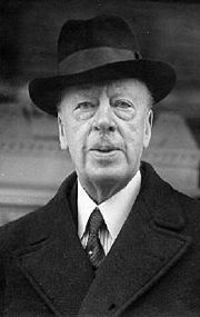
James Albert Edward Hamilton, 3rd Duke of Abercorn, is born in Hamilton Place, Piccadilly, London, on November 30, 1869. Styled Marquess of Hamilton between 1885 and 1913, he is a British peer and Unionist politician. He serves as the first Governor of Northern Ireland, a post he holds between 1922 and 1945. He is a great-grandfather of Diana, Princess of Wales.

Hamilton is the eldest son of James Hamilton, 2nd Duke of Abercorn, and godson of the Prince of Wales. His mother, Lady Mary Anna, is the fourth daughter of Richard Curzon-Howe, 1st Earl Howe. He is educated at Eton College and subsequently serves first in the Royal Inniskilling Fusiliers until 1892 when he joins the 1st Life Guards. He is later transferred as major to the North Irish Horse.

In early 1901 he accompanies his father on a special diplomatic mission to announce the accession of King Edward to the governments of Denmark, Sweden and Norway, Russia, Germany, and Saxony.

In the 1900 general election, Hamilton stands successfully as Unionist candidate for Londonderry City, and three years later he becomes Treasurer of the Household, a post he holds until the fall of Arthur Balfour‘s Conservative administration in 1905. After serving for a time as an Opposition whip, Hamilton succeeds his father as third Duke of Abercorn in 1913. In 1922, he is appointed governor of the newly created Northern Ireland. He also serves as Lord Lieutenant of Tyrone from 1917 until his death, having previously been a Deputy Lieutenant for County Donegal. Abercorn proves a popular royal representative in Northern Ireland and is reappointed to the post in 1928 after completing his first term of office. In 1931, he declines the offer of the governor generalship of Canada, and three years later he is again reappointed governor for a third term. He remains in this capacity until his resignation in July 1945.

Abercorn is made the last non-royal Knight of the Most Illustrious Order of Saint Patrick in 1922. In 1928 he becomes a Knight of the Most Noble Order of the Garter and is also the recipient of an honorary degree from the Queen’s University Belfast. He receives the Royal Victorian Chain in 1945, the same year he is sworn of the Privy Council.

Abercorn marries Lady Rosalind Cecilia Caroline Bingham, only daughter of Charles Bingham, 4th Earl of Lucan and his wife Lady Cecilia Catherine Gordon-Lennox at St. Paul’s Church, Knightsbridge, on November 1, 1894. They have three daughters and two sons.

Abercorn dies at his London home on September 12, 1953, and is buried at Baronscourt in County Tyrone.


Leave a comment

Ernest Walton Awarded Nobel Prize for Physics

ernest-walton

Ernest Thomas Sinton Walton, Irish physicist, is awarded the Nobel Prize in Physics on November 15, 1951, for his work with John Cockcroft with “atom-smashing” experiments done at Cambridge University in the early 1930s, and so becomes the first person in history to artificially split the atom.

Walton is born on October 6, 1903, in Abbeyside, Dungarvan, County Waterford to a Methodist minister father, Rev John Walton and Anna Sinton. In those days a general clergyman’s family moves once every three years, and this practice carries Ernest and his family to Rathkeale, County Limerick, and to County Monaghan. He attends day schools in counties Down and Tyrone, and at Wesley College Dublin before becoming a boarder at Methodist College Belfast in 1915, where he excels in science and mathematics.

In 1922, Walton wins scholarships to Trinity College, Dublin for the study of mathematics and science. He is awarded bachelor’s and master’s degrees from Trinity in 1926 and 1927, respectively. Walton receives seven prizes for excellence in physics and mathematics, including the Foundation Scholarship in 1924. Following graduation he is awarded an 1851 Research Fellowship from the Royal Commission for the Exhibition of 1851 and is accepted as a research student at Trinity College, Cambridge, under the supervision of Sir Ernest Rutherford, Director of Cambridge University’s Cavendish Laboratory. At the time there are four Nobel Prize laureates on the staff at the Cavendish lab and a further five are to emerge, including Walton and John Cockcroft. Walton is awarded his PhD in 1931 and remains at Cambridge as a researcher until 1934.

During the early 1930s, Walton and John Cockcroft collaborate to build an apparatus that splits the nuclei of lithium atoms by bombarding them with a stream of protons accelerated inside a high-voltage tube. The splitting of the lithium nuclei produces helium nuclei. This is experimental verification of theories about atomic structure that have been proposed earlier by Rutherford, George Gamow, and others. The successful apparatus, a type of particle accelerator now called the Cockcroft-Walton generator, helps to usher in an era of particle-accelerator-based experimental nuclear physics. It is this research at Cambridge in the early 1930s that wins Walton and Cockcroft the Nobel Prize in physics in 1951.

Walton is associated with the Dublin Institute for Advanced Studies for over 40 years, serving long periods on the board of the School of Cosmic Physics and on the Council of the Institute. Following the 1952 death of John J. Nolan, the inaugural chairman of the School of Cosmic Physics, Walton assumes the role, and serves in that position until 1960, when he is succeeded by John H. Poole.

Although he retires from Trinity College Dublin in 1974, he retains his association with the Physics Department at Trinity up to his final illness. His is a familiar face in the tea-room. Shortly before his death he marks his lifelong devotion to Trinity by presenting his Nobel medal and citation to the college. Ernest Walton dies in Belfast on June 25, 1995, aged 91. He is buried in Dean’s Grange Cemetery, Dún Laoghaire–Rathdown.