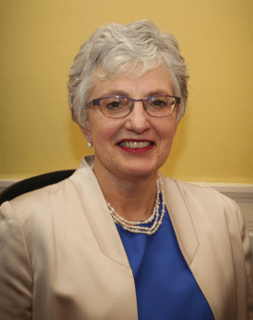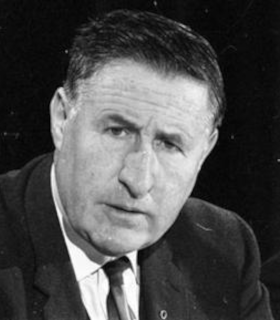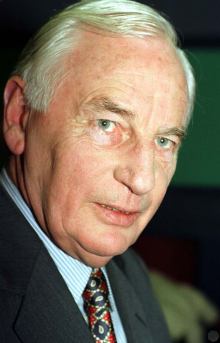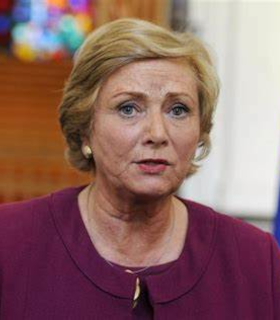
Zappone is nominated by Taoiseach Enda Kenny to the 24th Seanad in 2011, having been recommended by Eamon Gilmore, the then leader of Fine Gael‘s coalition partners, the Labour Party. With her Seanad nomination, she becomes the first openly lesbian member of the Oireachtas and the first member in a recognised same-sex relationship.
Zappone is elected to the Dáil for the Dublin South-West constituency at the 2016 Irish general election, becoming the first openly lesbian TD and, by her own reckoning, the world’s 32nd lesbian to be elected to a national parliament. In May 2016, after a delay in government formation, due to prolonged talks, she becomes Ireland’s first openly lesbian government Minister and the first Minister to have been openly gay at the time of appointment to cabinet, when Taoiseach Enda Kenny appoints her as the Minister for Children and Youth Affairs. She loses her seat at the February 2020 Irish general election and continues to serve as a minister until June 2020 on the election of a new government.
In July 2021, it is announced that Zappone is to be appointed to the newly created position of Special Envoy to the UN for Freedom of Opinion and Expression. It subsequently emerges that the proposed appointment had not been flagged in advance of the Cabinet meeting where it was proposed by Minister Simon Coveney, raising the concerns of the Taoiseach, Micheál Martin. However, he does not block the appointment, attracting criticism from within government, the opposition and the public, with Sinn Féin describing the appointment as “cronyism.”
In the following days it is reported that Zappone had lobbied for the creation of an appointment to the part-time position, which was not openly advertised or subject to a competition. Further controversy arises when it is reported that shortly prior to the announcement of her appointment, she had hosted a party for 50 guests, including politicians such as Leo Varadkar, at the Merrion Hotel, while the COVID-19 pandemic in the Republic of Ireland was ongoing. Comparisons are made between the party and the Oireachtas Golf Society scandal from earlier in the pandemic. On August 4, 2021, she announces that she will not take up the envoy role, saying “While I am honoured to have been appointed by the Government to be the Special Envoy on Freedom of Opinion and Expression, it is clear that criticism of the appointment process has impacted the legitimacy of the role itself. It is my conviction that a Special Envoy role can only be of real value to Ireland and to the global community if the appointment is acceptable to all parties.”
In September 2021, Zappone is invited to appear before the Oireachtas Committee on Foreign Affairs and Defence, but chooses not to attend. As a U.S. citizen and resident, the committee has no power to compel her attendance.
Derrig is born on November 26, 1897, in Westport, County Mayo. He is educated locally and later at University College Galway. During his time in college, he organises a corps of the Irish Volunteers. After the 1916 Easter Rising, he is arrested and imprisoned, and sent to the prisons of Woking, Wormwood Scrubs and Frongoch internment camp. He is arrested in 1918 and is accused of attempting to disarm a soldier. He is sentenced to five months imprisonment by a court in Belfast. When he is released, he supports Joseph MacBride at the 1918 Irish general election. He also graduates from college and becomes headmaster in a technical college in Mayo.
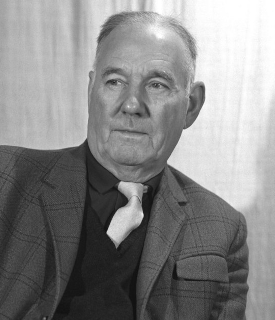
At the June 1927 Irish general election Derrig is elected to Dáil Éireann as a Fianna Fáil TD for Carlow–Kilkenny. In Éamon de Valera‘s first government in 1932 Derrig is appointed Minister for Education. He initiates a review of industrial and reformatory schools and the rules under the Children Act 1908, resulting in the critical 1936 Cussen Report that follows which he shelves, and a report in 1946-48 by the Irish American priest Father Edward J. Flanagan, which is also shelved. His lack of action wis noted in 2009 when the Ryan Report examines the subsequent management of these “residential institutions.” He is the first Minister to seek a report that could result in much-needed reforms. It is suggested that he does not want to follow British law reforms in the 1920s and 1930s, because of his strong anti-British views, and that Irish children have suffered needlessly as a result. From 1939 to 1943, he serves as Minister for Lands. He is re-appointed to Education in 1943 until 1948. During this period a bitter teachers’ strike, involving the Irish National Teachers Organisation (INTO), takes place, lasting from March 20 to October 30. Between 1951 and 1954, he becomes Minister for Lands again.
León Ó Broin, senior civil servant, historian, and author, is born Leo Byrne on November 10, 1902, at 21 Aungier Street, Dublin, the second of four sons of James P. Byrne, a potato factor’s bookkeeper, and Mary Byrne (née Killeen), daughter of a seaman who abandoned his family.
After early education in convent school, Ó Broin attends Synge Street CBS, where he is especially adept at languages. After working in several minor clerical employments, he becomes a clerk in the Kingsbridge headquarters of the Great Southern Railway. Joining a local Sinn Féin club, he canvasses for the party in the College Green ward during the 1918 Irish general election. Sent from an early age to Irish language classes by his father, he attends the Irish summer college in Spiddal, County Galway, and joins the Gaelic League, becoming by early 1921 secretary of central branch. He writes articles for the league’s successive weekly organs, each in its turn suppressed by the authorities. Despite regarding such writing as practice work within a language he is yet learning, he is selected best writer of Irish at the 1920 Dublin feis.
Arrested with his father and two brothers just before Christmas 1920 when Black and Tans discover a letter in Irish on his person during a house raid, Ó Broin is imprisoned for several weeks in Wellington Barracks. Leaving his railway job, he works as a clerk in the clandestine office of the Dáil ÉireannDepartment of Agriculture (1921–22). During the Irish Civil War, with departmental work at a standstill, he joins the National Army as a commissioned officer assigned to general headquarters staff at Portobello Barracks. Having recently commenced legal studies at the King’s Inns and University College Dublin (UCD), he handles army legal matters, such as compensation claims for damage to property.
Called to the bar in 1924, Ó Broin enters the civil service. Assigned to the Department of Education (1925–27), he was involved in launching the Irish language publishing imprint An Gúm, intended to redress the paucity of reading material, apart from school texts, in the language. Transferred to the Department of Finance (1927), he serves as estimates officer and parliamentary clerk and is assistant secretary of the economy committee established by the Cumann na nGaedheal government to make recommendations on reductions in current expenditure. Appointed private secretary to the Minister for Finance (1931–32), he serves both Ernest Blythe and the first Fianna Fáil minister, Seán MacEntee. Promoted to assistant principal (1932), and to principal officer (1939), he represents the department on the Irish Folklore Commission, and serves on the interdepartmental committee that, after the disastrous Kirkintilloch bothy fire in 1937, investigates seasonal migration to Scotland. During the emergency he is regional commissioner for Galway and Mayo (1940–45), one of eight such officers charged with organising contingency preparations for dealing with the likely collapse of central administration in the event of invasion by any of the wartime belligerents.
Transferred out of Finance, Ó Broin becomes assistant secretary (1945–48) and secretary (1948–67) of the Department of Posts and Telegraphs, administering both the postal service and telecommunications. He works closely with Fianna Fáil minister Patrick Little to improve the range and quality of music offered by the broadcasting service, playing a large part in the decision to form and adequately staff a full Radio Éireann symphony orchestra. He represents Ireland in several post-war conferences in Europe and America that reorganise the international regulation of broadcasting activities. He is elected to the European Broadcasting Union‘s administrative council (1953). He establishes and serves on a departmental committee in 1953 that studies all facets of launching a television service.
A devout but liberal Catholic, Ó Broin is prominent for many years in the Legion of Mary, founded by his close friend and civil-service colleague Frank Duff. President of a legion presidium of writers, actors, and artists, he is first editor (1937–47) of the quarterly organ Maria Legionis. Sharing Duff’s ecumenism, he belongs to the Mercier Society, the Pillar of Fire Society, and Common Ground, groups organised by Duff in the early 1940s to facilitate discussion between Catholics and, respectively, protestants, Jews, and secular intellectuals. The first two are suspended amid disapproval by the Catholic Archbishop of Dublin, John Charles McQuaid.
On retirement from the civil service in 1967, Ó Broin concentrates on the parallel career of research and writing that he had cultivated over many years. Having begun writing articles and short stories in Irish from his earliest years in the Gaelic League, he publishes his first collection of short stories, Árus na ngábhad, in 1923. With the establishment of An Gúm, he publishes three more collections of original short stories and translations of such masters of the genre as Alexander Pushkin, Prosper Mérimée, Guy de Maupassant, and Jerome K. Jerome. He translates several popular modern novels, including Robert Louis Stevenson‘s Kidnapped and H. G. Wells‘s The War of the Worlds. Active as secretary, actor, and writer with the state-subsidised Gaelic Drama League (An Comhar Drámaíochta), which produces Irish language plays, he publishes many plays in Irish, both original and translated. His best-selling book in Irish is Miss Crookshank agus coirp eile (1951), about the mummified corpses in the vaults of St. Michan’s Church, Dublin.
Ó Broin writes prolifically on modern Irish history and biography. His Irish language biography of Charles Stewart Parnell (1937), the first full-scale study of its kind in Irish since the commencement of the language revival, is a landmark publication, praised for the quality of its prose by such critics as Frank O’Connor and Seán Ó Faoláin. His biography of Robert Emmet, published in Irish in 1954, and awarded the Douglas Hyde prize, pioneers the scholarly subversion of the romantic myth surrounding its subject, and includes consideration of the political and social context. The subjects of subsequent biographies include Richard Robert Madden, Charles Gavan Duffy, Joseph Brenan, Michael Collins, and Frank Duff.
Ó Broin takes a largely biographical approach to historical writing, researching neglected aspects of pivotal historical events, and basing his studies on previously unexploited primary sources, often the papers of a single individual, whose career serves as the linchpin of his narrative, filtering events through the perspective of that person. Another vein of his scholarship is his primary research into the history of Irish separatism, especially with sources in the Irish State Paper Office.
Ó Broin receives an honorary LL. D from the National University of Ireland (NUI) in 1967. Elected a member of the Royal Irish Academy (RIA) in 1971, he is a council member (1974–76) and senior vice-president (1976–77) and chairs the group whose recommendations results in the academy’s establishment of the National Committee on International Affairs. He is president of the Irish Historical Society (1973–74), and a member of the Irish Manuscripts Commission.
In 1925 Ó Broin marries Cait Ní Raghallaigh, an office assistant reared in Baltinglass, County Wicklow, whom he met in the Gaelic League. They have two sons and three daughters. After residing in the south city suburbs, they move to Booterstown, County Dublin in the 1930s, and from there to the Stillorgan Road in the 1950s.
Ó Broin dies February 26, 1990, in Dublin, and is buried in Deans Grange Cemetery. His papers are in the National Library of Ireland (NLI). His eldest son, Eimear Ó Broin, is an accomplished musicologist and assistant conductor of the several Radio Éireann orchestras (1953–89).
(From: “Ó Broin, León” by Lawrence William White, Dictionary of Irish Biography, http://www.dib.ie)
In the 1960s Gallagher changes allegiance and becomes a member of Fianna Fáil. He is elected to Mayo County Council in 1967 and is elected to Dáil Éireann on his third attempt at the 1973 Irish general election for the Mayo West constituency. He does not remain on the backbenches for very long. He joins the Fianna Fáil front bench in 1974 as spokesperson on Fisheries. He remains in that position until 1977 when the party returns to power, and he is appointed Minister for the Gaeltacht. He is an active Minister with an interest in Irish language affairs.
Following the 1987 Irish general election, Gallagher is not appointed to cabinet. He is, however, appointed as Minister of State at the Department of the Gaeltacht, while Haughey has appointed himself as Minister for the Gaeltacht. As a result, he retires from politics at the following general election in 1989. After his retirement, he works to advance the Irish language cause and also serves as chairman of the Gaelic Athletic Association in Mayo.
Gallagher dies on November 4, 2001, at the age of 78 in Castlebar, County Mayo. He is buried at Polranny Cemetery, Achill Sound, County Mayo. He is survived by his wife Hannah, twelve children and thirty grandchildren.
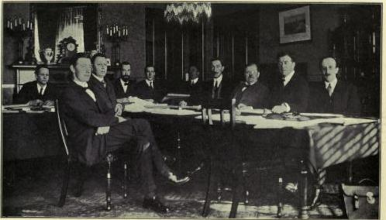
Shortly after the British evacuate their troops from Dublin Castle in January 1922, Michael Collins sets about establishing a committee to draft a new constitution for the nascent Irish Free State which would come into being in December 1922. Collins chairs the first meeting of that committee and at that point is its chairman, but is assassinated before the constitution is finalised. Darrell Figgis, the vice-chairman becomes acting Chair. The committee produces three draft texts, designated A, B and C. Draft A is signed by Figgis, James McNeill and John O’Byrne. Draft B is signed by James G. Douglas, C.J. France and Hugh Kennedy and it differs substantially from draft A only in proposals regarding the Executive. Draft C is the most novel of the three. It is signed by Alfred O’Rahilly and James Murnaghan, and provides for the possibility of representation for the people of the northern counties in the Dáil in the event of that area opting out of the proposed free state.
On March 31, 1922, an act of the United Kingdom Parliament called the Irish Free State (Agreement) Act 1922 is passed. It gives the force of law to the Anglo-Irish Treaty, which had been negotiated between the British government and Irish leaders in 1921. It also provides by for the election of a body to be called the “House of the Parliament,” sometimes called the “Provisional Parliament,” to which the Provisional Government establishes under that act will be responsible. The act gives no power to the Provisional Parliament to enact a constitution for the Irish Free State. In due course, “the House of the Parliament,” provided for by that act, is elected and meets on September 9, 1922, and calling itself Dáil Éireann, proceeds to sit as a constituent assembly for the settlement of what becomes the Constitution of the Irish Free State.
The Constitution establishes a parliamentary system of government under a form of constitutional monarchy, and contains guarantees of certain fundamental rights. It is intended that the constitution would be a rigid document that, after an initial period, could be amended only by referendum. However, amendments are made to the Constitution’s amendment procedure, so that all amendments can be and are in fact made by a simple Act of the Oireachtas (parliament).
The Free State’s Provisional Government puts the “Public Safety Bill” before Dáil Éireann on September 27, 1922, which passes by 41 votes to 18. This is emergency legislation which allows for the execution of those captured bearing arms against the State. The legislation passes to the National Army powers of punishment for anyone “taking part in or aiding and abetting attacks on the National Forces,” having possession of arms or explosives “without the proper authority” or disobeying an Army General Order.
The legislation gives the Military Courts the right to impose the sentence of death, imprisonment or penal servitude on those found to be guilty of such offences, the sentence only requiring the signatures of two officers. By time the bill is a year old, 81 men are executed under its terms and over 12,000 men and women imprisoned.
The reason for such punitive legislation is the dragging on of the Irish Civil War caused by the Anglo-Irish Treaty. A pro-Treaty offensive against the anti-Treaty Irish Republican Army (IRA) in the summer of 1922 appears to have won the war for the government but the anti-Treatyites or republicans subsequently fall back on guerrilla tactics which the newly formed Free State or National Army have great difficulty in suppressing. Ernest Blythe, the Minister for Finance in the Provisional Government, later recalls, “there was for some time a feeling that the Civil War would speedily end as major resistance was broken, but actually it began to assume a chronic character.”
In the week preceding the Dáil’s motion, on September 21, six National Army soldiers are killed in a prolonged engagement with Republican fighters near Ballina, County Mayo. On the same day, the Free State barracks in Drumshambo, County Leitrim, is attacked and taken and one soldier is killed. On September 22, a National Army soldier is killed and several soldiers and three civilians injured in a gun and grenade attack by Republicans on Free State troops on Eden Quay in central Dublin. And on the day of the Bill itself coming before the Dáil, in County Kerry several hundred anti-Treaty IRA guerrillas attack the town of Killorglin and are only repulsed after 24 hours of fighting, when Free State troops arrive from Tralee.
At the time and since, the legislation passed in 1922 is known as the Public Safety Bill. However, no such Bill or Act can be found in the records of the Irish state. The Provisional Government have no legal right under the Treaty to enact new legislation without royal assent, the King being represented in the person of the Governor-General. And in theory the Provisional Government’s powers do not apply after the Treaty formally passes into law on December 6, 1922.
So technically speaking the Public Safety Bill is not a law but simply a resolution passed in the Dáil. However, since there was, as yet no Governor-General who could give his assent and as the government felt the situation was too grave for legal niceties, the legislation setting up military courts was passed anyway. It is not until August 1923, when the Free State passes an Act of Indemnity for all actions committed during the Irish Civil War and also pass new, formal special powers legislation – The Emergency Powers Act – that retrospectively legalises what it had enacted in the autumn of 1922.
After an amnesty of two weeks, in which anti-Treaty fighters could surrender without consequences, the legislation comes into force in mid-October. Republicans at first do not believe that the government is serious about enforcing what its foes term “the Murder Bill.” It is in practice nearly two months before it is used in earnest.
On November 17, 1922, four IRA men who had been captured in Dublin are shot by firing squad. By the end of the week, Erskine Childers, who had served as secretary to the delegation which signed the Treaty but later organized Republican propaganda against it, is also dead. He had been captured at his home in County Wicklow on November 11 in possession of a small pistol Michael Collins had given him before he departed for Treaty negotiations in London. He is sentenced and shot on November 24. On November 30 another three Republican prisoners are executed in Dublin.
Liam Lynch, IRA Chief of Staff, issues a general order that Teachtaí Dála (TDs) who had voted for the Bill be shot on sight. On December 6, in retaliation for the executions, IRA members assassinate the TD Sean Hales in Dublin. In reprisal for that four senior republicans, Rory O’Connor, Liam Mellows, Richard Barrett and Joe McKelvey, who had been captured long before the Public Safety legislation is passed are summarily shot.
The legislation passed on September 27, 1922, may well have helped, as its supporters claimed, to break anti-Treaty resistance and to bring the Irish Civil War to an end. However, it also helped to convert the conflict into a feud as bitter and as personal as a vendetta.
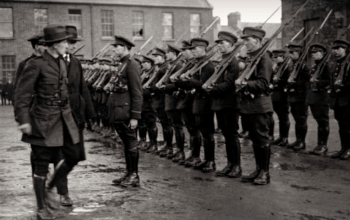
(From: “The passing of legislation allowing for executions during the Irish Civil War” by John Dorney, The Irish Story (www.theirishstory.com), September 27, 2013 | Photo: Richard Mulcahy, shown inspecting soldiers in Dublin, argued that permitting official executions would prevent National Army troops from carrying out unofficial killings)
Boland is born in Dublin on October 15, 1917. He attends St. Joseph’s, Fairview, leaving in 1933. He is the son of Gerald Boland, a founder-member of Fianna Fáil, and the nephew of Harry Boland. Despite this, he fails to get elected to Dáil Éireann on his first two attempts, standing in the Dublin County constituency at the 1951 Irish general election and again at the 1954 Irish general election. Double success follows at the 1957 Irish general election, when he is not only elected to the 16th Dáil but is appointed to the cabinet as Minister for Defence on his very first day in the Dáil. This is due to the retirement of his father who had served in every Fianna Fáil government since 1932.
The Defence portfolio is largely considered a safe and uncontroversial position, so Boland makes only a small impact. As a Minister, he proudly displays a fáinne (gold ring) on the lapel of his jacket, which indicates that he is able and willing to speak the Irish language. He frequently conducts his governmental business in Irish. In 1961, he is moved from Defence to become the Minister for Social Welfare. He remains there until the retirement in 1966 of the Taoiseach, Seán Lemass, when Fianna Fáil faces the first leadership contest in its history. He is then appointed Minister for Local Government which post he holds until he leaves government in 1970.
The leadership race immediately erupts as a two-horse battle between Charles Haughey and George Colley. Both of these men epitomise the new kind of professional politician of the 1960s. Things change when Neil Blaney indicates his interest in running. Boland supports him in his campaign, as both men hail from the republican and left wing of the party. There is talk at one point of Boland himself entering the leadership race. In the end Jack Lynch is chosen as a compromise, and he becomes the new Taoiseach. Boland is made Minister for Local Government in the new cabinet.
In 1969, events in Northern Ireland cause political chaos over the border in Ireland. It is the start of The Troubles in Northern Ireland and Fianna Fáil’s policy with regard to the North is coming into question. One crisis meeting is held after another, in which the possibility of decisive action is discussed. The “hawks” in the cabinet urge a symbolic invasion of Northern Ireland to protect nationalists near the border, and to draw international attention, while the “doves”, who ultimately prevail, urged caution. These cabinet meetings are heated events. On one occasion Boland is alleged to have been so angry that he resigns not only his cabinet position but also his Dáil seat and goes home to his farm in County Dublin to make hay. The resignations are rejected by Taoiseach Jack Lynch after a calming-down period. In what becomes known as the Arms Crisis, two ministers, Charles Haughey and Neil Blaney, are sacked from the government in May 1970, for allegedly being involved in a plot to import arms for Republicans in the North. Boland resigns in solidarity with them and in protest about the government’s position on the North. Later that year his criticism of the Taoiseach (whom Boland and many others within the Party maintain had authorized the arms importation) leads to his expulsion from the Fianna Fáil party.
One of Boland’s most famous incidents takes place at the Fianna Fáil Ardfheis in 1971. Just before Jack Lynch’s speech Boland storms a nearby podium, interrupting Patrick Hillery in the middle of his speech. He openly defies the party leadership and his opponents, holding his arms wide open and shouting to the crowd, “Come on up and put me down.” While there is a lot of booing and clapping in an effort to drown him out, many of his supporters start cheering and chanting “We want Boland.” An enraged Patrick Hillery grabs his microphone and famously replies, “If you want a fight, you can have it…You can have Boland, but you can’t have Fianna Fáil.” At this point the government supporters are ecstatic with cheering and Boland is carried out of the hall.
After this episode Boland founds his own political party, Aontacht Éireann (Irish Unity). It wins very little support, and he fails to be elected to the Dáil in 1973, which effectively ends his political career. He and his colleagues resign from the party in 1976 after it is taken over by a number of far-right individuals. He remains an outspoken critic of the Republic’s Northern Ireland policy, particularly the Sunningdale Agreement. He makes one last attempt to reclaim a Dáil seat, standing unsuccessfully in the Dublin South-West constituency at the 1981 Irish general election. He then retires from public life completely.
In 1996, Boland sues the Irish Independent for libel after a January 20, 1993, article incorrectly states that he had appeared before the court in the Arms Trial in 1970 and had been dismissed as a Minister by Taoiseach Jack Lynch. He is awarded £75,000 in damages.
Kevin Boland dies at the age of 83 in Dublin on September 23, 2001, following a short illness.
Griffith, a Roman Catholic, is born at 61 Upper Dominick Street, Dublin on March 31, 1871, of distant Welsh lineage. He is educated by the Irish Christian Brothers. He works for a time as a printer before joining the Gaelic League (Conradh na Gaeilge), which is aimed at promoting the restoration of the Irish language.
After a short spell in South Africa, Griffith founds and edits the Irish nationalist newspaper The United Irishman in 1899. In 1904, he writes The Resurrection of Hungary: A Parallel for Ireland, which advocates the withdrawal of Irish members from the Parliament of the United Kingdom and the setting up of the institutions of government at home, a policy that becomes known as Sinn Féin (ourselves). On November 28, 1905, he presents “The Sinn Féin Policy” at the first annual Convention of the National Council. The occasion is marked as the founding date of the Sinn Féin party. Although the organization is still small at the time, Griffith takes over as president of Sinn Féin in 1911.
Griffith is arrested following the Easter Rising of 1916, despite not having taken any part in it. On his release, he works to build up Sinn Féin, which wins a string of by-election victories. At the party’s Ardfheis (annual convention) in October 1917, Sinn Féin becomes an unambiguously republican party, and Griffith resigns the presidency in favour of the 1916 leader Éamon de Valera, becoming vice-president instead. Griffith is elected as a member of parliament (MP) for East Cavan in a by-election in June 1918, and is re-elected in the 1918 Irish general election, when Sinn Féin wins a huge electoral victory over the Irish Parliamentary Party and, refusing to take their seats at Westminster, set up their own constituent assembly, Dáil Éireann.
In the Dáil, Griffith serves as Minister for Home Affairs from 1919 to 1921, and Minister for Foreign Affairs from 1921 to 1922. In September 1921, he is appointed chairman of the Irish delegation to negotiate a treaty with the British government. After months of negotiations, he and the other four delegates sign the Anglo-Irish Treaty, which creates the Irish Free State, but not as a republic. This leads to a split in the Dáil. After the Treaty is narrowly approved by the Dáil, de Valera resigns as president and Griffith is elected in his place. The split leads to the Irish Civil War.
Griffith enters St. Vincent’s Nursing Home, Leeson Street, Dublin, during the first week of August 1922, following an acute attack of tonsillitis. He is confined to his room by his doctors, who had observed signs of what they thought might be a subarachnoid hemorrhage. It is difficult to keep him quiet and he resumes his daily work in the government building. When about to leave for his office shortly before 10:00 AM on August 12, 1922, he pauses to retie his shoelace and falls down unconscious. He regains consciousness but collapses again with blood coming from his mouth. Three doctors render assistance, but to no avail. Father John Lee of the Marist Fathers administers extreme unction, and Griffith expires as the priest recites the concluding prayer. The cause of death, intracerebral hemorrhage, is also reported as being due to heart failure. He dies at the age of 51, ten days before Michael Collins‘s assassination in County Cork and two months after the outbreak of the Irish Civil War. He is buried in Glasnevin Cemetery four days later.
Barry is first elected to Dáil Éireann as a Fine Gael Teachta Dála (TD) for the Cork City South-East constituency at the 1969 Irish general election. He goes go on to win a Dáil seat at eight successive general elections, changing constituency to Cork City in 1977 and Cork South-Central in 1981. When Fine Gael comes to power following the 1973 Irish general election, he is appointed Minister for Transport and Power. In 1976, he becomes Minister for Education. In 1979, after Garret FitzGerald becomes leader of Fine Gael, he is elected deputy leader. From June 1981 to March 1982, he serves as Minister for the Environment.
From December 1982 to 1987, Barry is Minister for Foreign Affairs. In this capacity he is heavily involved in the negotiations which result in the 1985 Anglo-Irish Agreement. He also becomes the first joint chairman of the Anglo-Irish Intergovernmental Conference, established under the Agreement by the Irish and British governments. Following the Labour Party‘s withdrawal from the coalition government in 1987, he becomes Tánaiste, for a brief period. He is the first member of Fine Gael to hold the office of Tánaiste.
When FitzGerald resigns as Fine Gael leader after the 1987 Irish general election, Barry is one of three candidates, along with Alan Dukes and John Bruton, who contest the party leadership. Dukes is the eventual victor.
Barry dies in Cork at the age of 88 on August 26, 2016, following a short illness. Irish PresidentMichael D. Higgins says Barry will be deeply missed. “His view of Irish history was a long one and he brought all that wisdom to bear in his contributions to achieving the Anglo-Irish Agreement. As a person he was immensely popular across all parties and, of course, he had a deep commitment to Cork city and its heritage.”
Valerie Hamilton, Hon. Lady Goulding, Irish senator and campaigner for disabled people, dies in a Dublin nursing home on July 28, 2003. She, alongside Kathleen O’Rourke, sets up the Central Remedial Clinic (CRC) in 1951 which is now the largest organisation in Ireland looking after people with physical disabilities. She served as a member of Seanad Éireann from 1977 to 1981.
Hamilton’s father is a British lawyer and politician, and becomes chief legal adviser to Edward VIII during the Abdication Crisis in 1936. She acts as her father’s secretary and courier during the crisis, carrying letters between the King and Prime MinisterStanley Baldwin.
In 1951, Lady Goulding co-founds, with Kathleen O’Rourke, the Central Remedial Clinic located in a couple of rooms in central Dublin to provide non-residential care for disabled people. The Clinic later moves to a purpose building in Clontarf in 1968, where it is located today. The Clinic’s foundation initiates a revolution in the treatment of physical disability and rapidly grows to by far the largest centre dealing with the needs of disabled people. She remains chairman and managing director of the CRC until 1984.
Lady Goulding dies at the age of 84 in a nursing home in Dublin on July 28, 2003. She is predeceased by her husband in 1982, but is survived by her sons, the eldest of whom, Sir William Goulding, known as Lingard Goulding, serves as Headmaster of Headfort School in County Meath. The other sons are Hamilton and Timothy, who is a founding member of the experimental Irish folk group Dr. Strangely Strange.