On September 5, 1975, a bomb explodes in the lobby of the London Hilton on Park Lane, London, killing two people and injuring sixty-three others.
Ten minutes before the explosion, the Daily Mail newspaper receives a warning by telephone. Having been notified, Scotland Yard immediately sends three officers to investigate, but they are not able to evacuate the building before the bomb explodes at 12:18 BST. The Provisional Irish Republican Army claims responsibility for the bombing. Police work quickly to clear the area after the explosion fearing there could be another device nearby. The blast causes extensive damage to the hotel and neighbouring shops with broken glass spread over a wide area. Witnesses say police arrived only five minutes before the bomb went off, and it is not clear whether the hotel was warned before they showed up. A spokesman for the Metropolitan Police says an officer telephoned the Hilton shortly after receiving the warning, but the hotel denies this. “A policeman was just telling the assistant manager that he had better evacuate when the bomb went off,” says press officer Anne Crewdson.
London is on a high state of alert and several areas of the capital are sealed off as a series of hoax warnings follow the Hilton blast. A commander in the Metropolitan Police says they were forced to act every time they were telephoned. “No call can be taken casually,” he says.
A second attempt to bomb the London Hilton hotel is made on September 7, 1992. The explosion causes slight damage in a lavatory on the ground floor but nobody is injured.
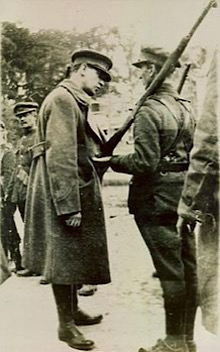
Nationalist forces enter Newcastle West, County Limerick, on Monday, August 7, 1922, after a twelve-hour battle, in which twelve anti-Treaty Irish Republican Army (IRA) members, sometimes referred to as Irregulars, are killed. The casualties of the Nationalists are less than those of the Irregulars.
Taking little respite after Sunday’s labors, the Nationals advance from Rathkele on Monday morning, and by midday are in sight of their fresh objective. Armored cars enter the town and machine gun fire is directed against a party of Irregulars, causing many casualties.
When the artillery goes into action against the headquarters of the Irregulars, the Irregulars flee precipitately along Cord road.
Owing to the slow progress in the operations in Southern Ireland, the meeting of Dáil Éireann, scheduled to open Saturday, is postponed again.
The official army bulletin announces that the Nationals captured Castle Island on Saturday, August 5. It says that the counties of Cork and Kerry with a part of South Tipperary and a small area in County Waterford are the only districts held by the Irregulars with any degree of security.
The streets of Dublin are lined with great crowds of people on Tuesday, August 8, for the military funeral of nine National Army soldiers who were killed in fighting the Republican Irregulars in County Kerry. Michael Collins, Chairman of the Provisional Government, and all the leading officers of the army in Dublin march beside the hearses. Each coffin is covered with the Republican tricolour. There are many clergymen and other civilians in the funeral procession.
Prominent Catholics of Dublin and Belfast are trying to effect a better understanding between the Ulster and Free State Governments, according to the Daily Mail. This newspaper further states that all efforts to this end, which have all been taken with the advice and approval of leading English Catholics, are without official character.
A message from Strabane, County Tyrone, received by the Exchange Telegraph Company on August 8 states that a settlement between the Ulster Government and the Free State authorities is imminent, the terms of agreement having been practically arranged in negotiations proceeding in London.
In Downing Street, however, all knowledge of any such Irish negotiations is disclaimed and a telegram from Belfast quotes Ulster Government officials as denying that a settlement with the Free State is imminent.
The Free State Government is also unaware of any negotiations for a settlement between the Ulster Government and the Free State authorities. It is further states that such negotiations are unlikely to take place.
(From: “Irish Irregulars Routed With Loss,” The New York Times, August 9, 1922 | Pictured: General Michael Collins inspects a soldier at Newcastle West, County Limerick, August 8, 1922)
Chancellor is born at 8 Fitzwilliam Place, Dublin, on January 9, 1910. Her parents are John William Chancellor, a Dublin clockmaker, jeweler, and photographer, and Cicely Chancellor (née Granger). They marry in Billericay, Essex, in 1904. She has an elder sister, Joyce Fanny, who also becomes an actress. She attends Nightingale Hall and Alexandra College, going on to train as a secretary.
Chancellor’s first appearance on stage is as a fairy in a benefit performance at the Gaiety Theatre in 1914. She appears again at the Gaiety in 1922 as Gwennie in F. Anstey‘s The Man from Blankley’s, and then studies drama under Frank Fay. In the 1920s, she acts in the Dublin Drama League’s productions in the Abbey Theatre. Once she joins the Gate Theatre her career progresses, establishing her as one of the principal actresses in the Gate by the early 1930s.
Chancellor plays Naomi alongside Orson Welles in a production of Jud Süss in October 1931. Welles becomes infatuated with her and later describes her as “the sexiest thing that ever lived.” In 1931, she debuts in J. B. Fagan‘s production of The New Gossoon by George Shiels as Biddy Henley at the Apollo Theatre. Her most noted roles are as Toots in Youth’s the Season in 1932 by Mary Manning, Laura in a production of Carmilla in 1932, based on the Gothicnovella by Sheridan Le Fanu, Ophelia in 1932 and Cicely in The Importance of Being Earnest in 1933. Touring with the Gate company in 1935, she plays Stella in its production of Lord Longford‘s Yahoo performed in the Westminster Theatre, London. She stars with James Mason in the Gate’s production of Pride and Prejudice in 1937. Disappointed with the parts she is getting at the Gate after that and much to the annoyance of Micheál Mac Liammóir and Hilton Edwards, she joins Lord Longford’s first provincial tour in 1937.
In the late 1930s, Chancellor works more often in London. Following her appearance as Baby Furze in the 1938 production of Spring Meeting by Molly Keane and John Perry, she is nominated as “Star of the Future” by the Daily Mail. She acts alongside Alec Guinness and Peggy Ashcroft in 1940 in Clemence Dane‘s Cousin Muriel at the Globe Theatre, directed by John Gielgud.
Chancellor returns to the Gaiety Theatre in 1941 to act with Hilton Edwards in a production of Caesar and Cleopatra by George Bernard Shaw, a production that marks the 75th anniversary of the Gaiety. The press welcomes her return to the company, but her fellow actors are disturbed by the fact she is then living with Denis Johnston, the husband of fellow actress Shelah Richards. After Johnston’s divorce, they marry in March 1945 in Dungannon, County Tyrone. She partly retires from acting to raise their sons, but also due to her increasing deafness that had begun in her teens.
In 1969, Chancellor returns to Ireland with her family and settles in Dalkey, County Dublin. She dies in Dún Laoghaire on April 27, 1984, and is buried in the close of St. Patrick’s Cathedral, Dublin.
Murphy is an active Irish republican paramilitary from his late teens. In March 1972, he is arrested in Dundalk regarding an assault and is sentenced to two years in prison after the Garda Síochána find a loaded revolver in his car. He is imprisoned in the Curragh Camp but escapes in October 1972 and is not recaptured until May 1973. In June 1976, he is imprisoned again, receiving a three-year sentence for firearms offences and a one-year sentence for Provisional Irish Republican Army membership, both sentences to run concurrently. In July 1983, he is arrested in the United States after attempting to buy a consignment of M60 machine guns to be shipped to Ireland for use by the Irish National Liberation Army (INLA). He receives a five-year prison sentence but returns to Ireland in December 1985 after being released early.
In the late 1980s, Murphy begins investing in property and forms a company named Emerald Enterprises in 1990. He purchases the Emerald Bar public house in Dundalk for IR£100,000, and it later becomes a meeting place for dissident republicans. Other investments included 30 acres of land in Drogheda bought for IR£52,000 in 1995, and his company wins contracts for an IR£11 million development at Dublin City University (DCU) and the multi-million-pound International Financial Services Centre in the Dublin Docklands.
Murphy is arrested by the Gardaí on February 21, 1999, for questioning under anti-terrorist legislation. On February 24, he becomes the first person to be charged in connection with the Omagh bombing, when he appears before Dublin‘s Special Criminal Court and is charged with conspiring to cause an explosion under the terms of Ireland’s Offences Against the State Act, between August 13-16, 1998. He is also charged with membership in an illegal organisation, the Real Irish Republican Army (RIRA).
On October 10, 2000, the BBC television show Panorama names Murphy as one of four people connected with the Omagh bombing, along with Seamus Daly and Liam Campbell. In 2001, he undertakes legal action against the BBC and Daily Mail publishers Associated Newspapers for contempt of court. The action against Associated Newspapers is settled on July 31, 2001, and the newspaper releases a statement saying Murphy is entitled to be presumed innocent of the charges against him until proven guilty.
Murphy’s trial begins at Special Criminal Court in Dublin on October 12, 2001. The court hears that Murphy had supplied two mobile phones which were used during the bombing. One witness, Murphy’s second cousin, retracts his evidence and the judge calls the conduct of two detectives outrageous, saying they had persistently lied under cross-examination. Despite this, on January 22, 2002, he is convicted of conspiring to cause the Omagh bombing, and on January 25 is sentenced to 14 years imprisonment with the judge describing him as a long-time republican extremist.
On January 21, 2005, Murphy’s conviction is overturned and a new trial ordered, due to the invasion of Murphy’s presumption of innocence, and alteration of Gardaí interview notes and evidence presented by two officers. A week later, his legal case against the BBC is resolved, with the BBC issuing a statement that Murphy “was fully entitled to maintain his innocence of the charges against him and to test the evidence against him at his trial.”
On October 23, 2006, two Gardaí officers are found not guilty of perjuring themselves during Murphy’s trial. On May 23, 2007, it is announced that Murphy is suffering from short-term memory loss resulting from a car accident in 1988. His lawyers attempt to prevent a retrial taking place, on the grounds that his condition interferes with his right to a fair hearing. The Court of Criminal Appeal is scheduled to hear his case again in October 2008. Following a retrial held in January 2010, he is acquitted on February 24, 2010.
In 2009, Murphy is one of four men found by a civil court to be liable for the Omagh bombing in a case taken by relatives of the victims. On July 7, 2011, in Belfast High Court, Lord Justice Malachy Higgins directs a retrial of the civil claims against Murphy. He questions evidence surrounding emails from U.S. undercover agent David Rupert while overturning the judgment on Murphy. The paucity of the email evidence, the lack of consistency in the emails or at least ambiguity, the possibility of initials referring to someone other than Murphy and the fact that they refer on occasions to double hearsay considerably weaken the emails as evidence, he says. Following a civil retrial on March 20, 2013, Murphy and Seamus Daly are found liable for involvement in the bombing.
Moloney, aged 55, who lives alone at Portobello Place on the south side of Dublin, is on his way home when he is attacked. He is punched in the side of the head and falls to the ground as the two men in their 20s attack him. The incident is caught on CCTV and police make quick arrests just hours after the murder. Officers believe Moloney may have been robbed as he lay unconscious on the ground, as his wallet and identification are missing.
A murder investigation is launched after a post mortem examination confirms that Moloney had died from serious head injuries as a result of the assault.
Formerly with The Irish News in Belfast and the Irish Independent in Dublin, Moloney had been freelancing on his return from a spell teaching in Vietnam. His final article, on the Ulster Bank IT crisis, appears in the Irish edition of the Daily Mail just hours before his death.
Group Managing Editor of Independent Papers Ireland Ltd. Michael Denieffe pays tribute to Moloney in telling the Irish Independent, “On behalf of Independent Newspapers, I want to express our shock at the untimely death of our former colleague, Eugene Moloney. He was a resourceful and fearless journalist. It is a tragic irony that Eugene has died in an incident similar to many he would have recorded in his years working for the Evening Herald and the Irish Independent. Our sympathies go to his family and friends.”
The Irish News editor Noel Doran tells the paper he is deeply shocked by the death of his good friend Eugene Moloney. “Eugene and I studied journalism together at the former College of Business Studies in Belfast in the late 1970s, and went on to share flats over a number of years. Eugene was a talented and respected reporter with The Irish News during the height of the Troubles and was also the paper’s music columnist for a lengthy period.”
(From: “Journalist Eugene Moloney murdered as attempted robbery goes wrong in Dublin” by Patrick Counihan, IrishCentral, http://www.irishcentral.com, June 25, 2012)
In April 1913 London‘s Daily Mail offers a prize of £10,000 to the aviator who first crosses the Atlantic Ocean in an airplane from any point in the United States, Canada or Newfoundland to any point in Great Britain or Ireland in 72 continuous hours. The competition is suspended with the outbreak of war in 1914 but reopens after Armistice is declared in 1918.
Several teams enter the competition and, when Alcock and Brown arrive in St. John’s, the Handley Page team are in the final stages of testing their aircraft for the flight, but their leader, AdmiralMark Kerr, is determined not to take off until the plane is in perfect condition. The Vickers team quickly assembles their plane and while the Handley Page team are conducting yet another test, the Vickers plane takes off from Lester’s Field.
It is not an easy flight. The overloaded aircraft has difficulty taking off the rough field and barely misses the tops of the trees. At 5:20 PM the wind-driven electrical generator fails, depriving them of radio contact, their intercom and heating. An exhaust pipe bursts shortly afterwards, causing a frightening noise which makes conversation impossible without the failed intercom.
Alcock and Brown also have to contend with thick fog, which prevents Brown from being able to navigate using his sextant. Alcock twice loses control of the aircraft in the fog and nearly crashes into the sea. He also has to deal with a broken trim control that makes the plane become very nose heavy as fuel is consumed. Their electric heating suits fail, making them very cold in the open cockpit.
At 3:00 AM they fly into a large snowstorm. They are drenched by rain, their instruments ice up, and the plane is in danger of icing and becoming unflyable. The carburetors also ice up.
They make landfall in County Galway at 8:40 AM on June 15, 1919, not far from their intended landing place, after less than sixteen hours of flying time. The aircraft is damaged upon arrival because they land on what appears from the air to be a suitable green field, but which turns out to be Derrygilmlagh Bog, near Clifden. This causes the aircraft to nose-over, although neither of the airmen is hurt. Brown says that had the weather been favorable they could have pressed on to London. Their first interview is given to Tom ‘Cork’ Kenny of the Connacht Tribune.
Alcock and Brown are treated as heroes on the completion of their flight. The Secretary of State for Air, Winston Churchill, presents them with the Daily Mail prize. In addition to a share of the Daily Mail award, Alcock receives 2,000 guineas (£2,100) from the State Express Cigarette Company and £1,000 from Laurence R. Philipps for being the first Briton to fly the Atlantic Ocean. Both men are knighted a week later by King George V at Windsor Castle.
(Pictured: Statue of Alcock and Brown formerly located at London Heathrow Airport. Relocated to Clifden, Connemara, County Galway, Ireland to celebrate centenary in 2019.)
Sir James Peter Comyn, Irish-born barrister and English High Court judge, is born at Beaufield House, Stillorgan, County Dublin on March 8, 1921. Considered by many to be “the finest all-round advocate at the English bar”, he is appointed to the High Court of Justice in 1978, serving on the bench until his retirement in 1985.
Comyn is the son of Nationalist barrister James Comyn KC and of Mary Comyn. Through his father he is the nephew of the barrister Michael Comyn KC. Both his father and uncle had been political and legal advisers to Éamon de Valera, who at one point uses Beaufield House as a safe house. However, the Comyn brothers have a falling out with de Valera shortly before he comes to power in 1932, and Michael Comyn is passed over as Attorney General of the Irish Free State. As a result, James Comyn, who is then attending Belvedere College in Dublin, is sent by his father to attend The Oratory School in England. He spends six months as a trainee at The Irish Times under the editor R. M. “Bertie” Smyllie, but abandons journalism after a joke he added to an obituary is printed in the paper, leading to his demotion to the racing department.
Comyn is called to the English bar by the Inner Temple in 1942, the Irish bar in 1947, and the Hong Kong bar in 1969. In 1944, he begins his pupillage with Edward Holroyd Pearce KC, later a law lord, and joins his chambers at Fountain Court. He practises in London and on the Western circuit, supplementing his earnings by teaching banking, a subject of which he knows nothing. On one occasion, he rises in Lambeth County court to cross-examine a female defendant in an eviction case. Just as he begins by saying “Madam,” the defendant opens her bag, takes out a dead cat, and throws it at him. The judge’s reaction is to tell the defendant, “Madam, if you do that again, I’ll commit you.” Comyn wins the case.
Comyn takes silk in 1961, and acquires a large practice as a senior, appearing in many high-profile cases. In 1964, he wins damages for libel for the former safe-breaker Alfred George Hinds against a Scotland Yard inspector by convincing the jury that Hinds is in fact innocent. In 1970, he successfully defends the Labour MP Will Owen, who is accused of providing information to the Czechoslovak intelligence services. In 1975, he defeats the government’s attempt to obtain an injunction against the publication of the diaries of former minister Richard Crossman.
Comyn is Recorder of Andover between 1964 and 1971 (honorary life recorder from 1972), commissioner of assize for the Western Circuit in 1971, and a Recorder of the Crown Court between 1972 and 1977. He is elected a bencher of the Inner Temple in 1968 and serves as chairman of the Bar council from 1973 to 1974.
Having refused a previous invitation by Quintin Hogg, Baron Hailsham of St. Marylebone to join the bench, Comyn is again nominated by Elwyn Jones, Baron Elwyn-Jones, in 1977, and is appointed a High Court judge in 1978, receiving the customary knighthood upon his appointment. Initially assigned to the Family Division, he does not take to the work and is reassigned to the Queen’s Bench Division in 1979. He has a reputation for leniency in sentencing, first acquired as Recorder of Andover. In 1980–81, he presides over an unsuccessful libel action by a member of the Unification Church, colloquially known as the Moonies, against the Daily Mail, the longest libel trial in England up to that time. His Irish background makes him the target of Irish Republican Army (IRA) action, and in 1981 the Provisional IRA burns his house in Tara.
Recurring bouts of depression lead to Comyn’s early retirement, on grounds of ill health, in 1985. In retirement, he divides his time between England and Ireland, whose citizenship he has retained. He writes a number of books, including memoirs, light verse, and books on famous trials. He also breeds Friesian cattle. He dies in Navan, County Meath on January 5, 1997, at age 75.
Vicars is born on July 27, 1862 in Leamington Spa, Warwickshire, England, and is the youngest child of Colonel William Henry Vicars of the 61st Regiment of Foot and his wife Jane (nee Gun-Cunninghame). This is his mother’s second marriage, the first being to Pierce O’Mahony by whom she has two sons. He is very attached to his Irish half-brothers and spends much time at their residences. On completing his education at Magdalen College School, Oxford and Bromsgrove School he moves permanently to Ireland.
Vicars quickly develops an expertise in genealogical and heraldic matters and makes several attempts to be employed by the Irish heraldic administration of Ulster King of Arms, even offering to work for no pay. In 1891 he is one of the founder members of the County Kildare Archaeological Society and remains its honorary secretary until his death.
Vicars first attempts to find a post in the Office of Arms when in 1892 he applies unsuccessfully for the post of Athlone Pursuivant on the death of the incumbent, Bernard Louis Burke. In a letter dated October 2, 1892 his half-brother Pierce Mahony writes that Sir Bernard Burke, Ulster King of Arms, is dying and urges him to move at once. Burke dies in December 1892, and Vicars is appointed to the office by letters patent dated February 2, 1893. In 1896 he is knighted, in 1900 he is appointed Commander of the Royal Victorian Order (CVO) and in 1903 he is elevated to Knight Commander of the Order (KCVO). He is also a fellow of the Royal Society of Antiquaries of Ireland and a trustee of the National Library of Ireland.
In 1897 Vicars publishes An Index to the Prerogative Wills of Ireland 1536 -1810, a listing of all persons in wills proved in that period. This work becomes very valuable to genealogists after the destruction of the source material for the book in 1922 when the Public Record Office at the Four Courts is destroyed at the start of the Irish Civil War.
Vicars’ career is very distinguished until 1907 when it is hit by the scandal of the theft of the Irish Crown Jewels. As Registrar of the Order of St. Patrick, he has custody of the insignia of the order, also known as the “crown jewels.” They are found to be missing on July 6, and a Crown Jewel Commission is established in January 1908 to investigate the disappearance. Vicars and his barrister Tim Healy refuse to attend the commission’s hearings. The commission’s findings are published on January 25, 1908 and he is dismissed as Ulster five days later.
On November 23, 1912, the Daily Mail publishes serious false allegations against Vicars. The substance of the article is that Vicars had allowed a woman reported to be his mistress to obtain a copy of the key to the safe and that she had fled to Paris with the jewels. In July 1913 he successfully sues the paper for libel. The paper admits that the story is completely baseless and that the woman in question does not exist. He is awarded damages of £5,000.
Vicars leaves Dublin and moves to Kilmorna, near Listowel, County Kerry, the former seat of one of his half-brothers. He marries Gertrude Wright in Ballymore, County Westmeath on July 4, 1917. He continues to protest his innocence until his death, even including bitter references to the affair in his will.
In May 1920 up to a hundred armed men break into Kilmorna House and hold Vicars at gunpoint while they attempt to break into the house’s strongroom. On April 14, 1921, he is taken from Kilmorna House, which is set afire, and shot dead in front of his wife. According to the communiqué issued from Dublin Castle, thirty armed men took him from his bed and shot him, leaving a placard around his neck denouncing him as an informer. On April 27, as an official reprisal, four shops are destroyed by British Armed Forces in the town of Listowel. The proclamation given under Martial law and ordering their demolition states:
“For any outrage carried out in future against the lives or property of loyalist officials, reprisals will be taken against selected persons known to have rebel sympathies, although their implication has not been proved.”
Alfred Charles William Harmsworth, Viscount Northcliffe, one of the most successful newspaper publishers in the history of the British press and a founder of popular modern journalism, is born on July 15, 1865 in Chapelizod, near Dublin.
After an impoverished childhood and a few attempts at making a quick fortune, young Harmsworth embarks on freelance journalism as a contributor to popular papers, rises to editorial positions, and starts a paper called Answers to Correspondents. After some difficulty in securing financial backing, he begins publication, soon shortening the name to Answers. As the paper gains public favour, he is joined by his brother Harold, whose financial ability and capacity for attracting advertising, combined with Alfred’s genius for sensing the public taste, make it a success. Answers is followed by many other inexpensive popular periodicals, chief among them Comic Cuts and Forget-Me-Not, for the new reading public of women. These form the basis for what becomes Amalgamated Press, the largest periodical-publishing empire in the world.
In 1894 Harmsworth enters the newspaper field, purchasing the nearly bankrupt London Evening News and transforming it into a popular newspaper with brief news reports, a daily story, and a column for women. Within a year circulation grows to 160,000 copies, and profits are substantial. Conceiving the idea of a chain of halfpenny morning papers in the provinces, he purchases two papers in Glasgow, Scotland, and merges them into the Glasgow Daily Record. He then decides to experiment with a popular national daily in London. The Daily Mail, first published on May 4, 1896, is a sensational success. Announced as “the penny newspaper for one halfpenny” and “the busy man’s daily journal,” it is exactly suited to the new reading public. All news stories and feature articles are kept short, and articles of interest to women, political and social gossip, and a serial story are made regular features. With its first issue, the Daily Mail establishes a world record in daily newspaper circulation, a lead it never loses during Harmsworth’s lifetime.
Next Harmsworth purchases the Weekly Dispatch when it is nearly bankrupt and transforms it into the Sunday Dispatch, the biggest-selling Sunday newspaper in the country. In 1903 he founds the Daily Mirror, which successfully exploits a new market as a picture paper, with a circulation rivaling that of the Daily Mail. He saves The Observer from extinction in 1905, the year in which he is made Baron Northcliffe. In 1908 he reaches the pinnacle of his career by securing control of The Times, which he transforms from a 19th-century relic into a modern newspaper.
Northcliffe’s contributions to the British effort in World War I begin with his early exposure in the Daily Mail of the British army’s shell shortage. His criticisms of Lord Kitchener arouse intense resentment in some quarters, but he also presses for the creation of a separate Ministry of Munitions and for the formation in 1915 of a wartime coalition government. For his service as head of the British war mission in the United States in 1917, he is created a viscount. He acts as the British government’s director of propaganda aimed at Germany and other enemy countries in 1918. By this time Northcliffe’s press empire appears to hold such power over public opinion that he tries unsuccessfully to influence the composition of Prime MinisterDavid Lloyd George’s cabinet. Always unpredictable, he becomes the victim of a megalomania that damages his judgment and leads to the breakdown that precedes his death.
Harmsworth’s health declines during 1921 due mainly to a streptococcal infection. He goes on a world tour to revive himself, but it fails to do so. He dies of endocarditis in a hut on the roof of his London house on August 14, 1922, leaving three months’ pay to each of his six thousand employees. The viscountcy, barony, and baronetcy of Northcliffe become extinct upon his death. His body is buried at East Finchley Cemetery in North London.
Northcliffe’s success as a publisher rests on his instinctive understanding of the new reading public that had been created by compulsory education. Though he wants political power, the effect of his newspapers upon public affairs is generally considered to have been smaller than he believed. His influence lay rather in changing the direction of much of the press away from its traditional informative and interpretative role to that of the commercial exploiter and entertainer of mass publics.
In November 1938, Lord Killanin is commissioned into the Queen’s Westminsters, a territorial regiment of the British Army, where he is responsible for recruiting fellow journalists, including future The Daily Telegraph editor Bill Deedes, and friends who are musicians and actors. He reaches the rank of major and takes part in the planning of D-Day and the Invasion of Normandy in 1944, acting as brigade major for the 30th Armoured Brigade, part of the 79th Armoured Division. He is appointed, due to the course of operations, a Member of the Order of the British Empire (MBE). After being demobilised, he goes to Ireland. He resigns his TA commission in 1951.
In 1950, Lord Killanin becomes the head of the Olympic Council of Ireland (OCI) and becomes his country’s representative in the IOC in 1952. He becomes senior vice-president in 1968, and succeeds Avery Brundage, becoming President-elect at the 73rd IOC Session (August 21–24) held in Munich prior to the 1972 Summer Olympics. He takes office soon after the Games.
Lord Killanin serves as Honorary Consul-General of Monaco in Ireland from 1961 to 1984 and as Chairman of the Race Committee for Galway Racecourse from 1970 to 1985. A keen horse racing enthusiast, he also serves as a steward of the Irish Turf Club on two occasions and on the National Hunt Steeplechase Committee. In his business life Lord Killanin is a director of many companies including Irish Shell, Ulster Bank, Beamish & Crawford and Chubb Ireland. He is a founder member of An Taisce (The National Trust for Ireland) and is chairman of the National Monuments Advisory Council until his death.
Lord Killanin dies at his home in Dublin on April 25, 1999, at the age of 84 and, following a bilingual funeral Mass at St. Enda’s Church in Spiddal, County Galway, he is buried in the family vault in the New Cemetery, Galway.