seamus dubhghaill

Promoting Irish Culture and History from Little Rock, Arkansas, USA


Leave a comment

Birth of Mícheál Ó Muircheartaigh, Gaelic Games Commentator

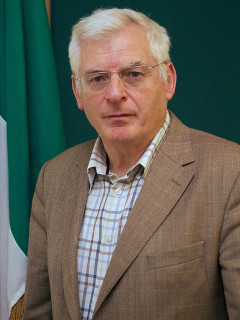
Mícheál Ó Muircheartaigh, an Irish Gaelic games commentator for the Irish national radio and television, RTÉ, is born in Doonshean just outside Dingle, County Kerry, on August 20, 1930. In a career that spans six decades he comes to be regarded as the “voice of Gaelic games.” He has been described as a national treasure. His prolific career earns him a place in Guinness World Records.

Ó Muircheartaigh grows up on the family farm and is educated locally in Dingle. In September 1945, he begins studying at Coláiste Íosagáin in Ballyvourney in the County Cork Gaeltacht where he trains to be a teacher. It is at this all-Irish language school that his name changes from Michael Moriarty to the Irish version Mícheál Ó Muircheartaigh. He says that Irish is his stronger language. In September 1948, he begins the final year of his teacher training at St. Patrick’s College of Education in Drumcondra, Dublin.

In early March 1949, Ó Muircheartaigh, along with ten other students from the college, and several from other colleges, do a test commentary on a hurling match at Croke Park. Each student has to commentate for five minutes in Irish and the most successful is to be selected for further commentary work. Up to this point, he has never seen a game of hurling before in his life. He is the one selected and his first assignment is to provide an all-Irish commentary on the 1949 Railway Cup final on Saint Patrick’s Day.

Ó Muircheartaigh graduates from St. Patrick’s College a little later and also completes a Bachelor of Arts degree from University College Dublin (UCD) in 1952. He also completes a Higher Diploma in Education in 1953. He teaches economics, accountancy and Irish in both primary and secondary schools throughout Dublin, the majority of which are run by the Christian Brothers. He continues teaching up until the 1980s, when he becomes a full-time broadcaster with RTÉ.

For the early part of his broadcasting career, Ó Muircheartaigh commentates on Minor GAA matches, in the Irish language. He also replaces the legendary Michael O’Hehir when he is not available to commentate. Eventually when O’Hehir is forced to retire in the mid-1980s Ó Muircheartaigh takes over as the station’s premier radio commentator. He develops his own inimitable style of commentary, and his accent is unmistakably that of a native Irish speaker. He is a true lover of Gaelic Athletic Association, and it is reflected in the enthusiasm he brings to matches. His unusual turn of phrase makes him a much-loved broadcaster and often imitated character. He becomes particularly famous in Ireland for his unusual turns of phrase in the heat of the moment while commentating. Towards the end of his life, he commentates on RTÉ Radio 1. In 2004, he publishes his autobiography, From Dún Sion to Croke Park.

On March 5, 1988, Ó Muircheartaigh presents the Saturday Live show on RTÉ 1. In 1990, he holds an impromptu interview with Britain’s Prince Edward, after his greyhound had won at the English Greyhound Derby qualifier when he was commentating.

Ó Muircheartaigh’s commentaries for RTÉ Radio 1’s Sunday Sport show win him a Jacob’s Award in 1992. He is also the Parade Grand Marshal for the 2007 St. Patrick’s Festival, having been given the honour by the chairman of the festival in recognition and appreciation of his unique contribution to Irish culture. He is the Parade Grand Marshal for the 2011 St. Patrick’s Parade in Toronto, Ontario, Canada, also in recognition and appreciation of his unique contribution to Irish culture.

On September 16, 2010, Ó Muircheartaigh announces his retirement from broadcasting. The last All-Ireland he commentates on is the 2010 All-Ireland Senior Football Championship Final on September 19, 2010.

On October 29, 2010, it is announced that the 2nd International Rules test at Croke Park would be Ó Muircheartaigh’s final broadcast as commentator on RTÉ Radio 1. The following day he commentates his final commentary alongside RTÉ’s pundit and former Meath footballer Bernard Flynn.

Ó Muircheartaigh is contracted to officiate at the 2011–2012 Volvo Ocean Race finish in Galway where he commentates on the finish to the round-the-world race, giving it a uniquely Irish conclusion. Sailing is his longtime hobby.

Ó Muircheartaigh writes a weekly sports column for Foinse, the Irish-language newspaper free with the Irish Independent each Wednesday. He is invited to read out a piece in Irish and in English at an event called “Laochra” in Croke Park on April 24, 2016, to commemorate the 100th anniversary of the Easter Rising.

In 2007, Ó Muircheartaigh is awarded the UCD Foundation Day Medal. His nephew by marriage, John McGuire, has presented several programmes on RTÉ.

Ó Muircheartaigh dies in hospital in Dublin at the age of 93 on June 25, 2024.

Ó Muircheartaigh is awarded an honorary doctorate by NUI Galway in 1999 for his lifetime service to broadcasting. Shortly after his 90th birthday, he is awarded the only GAA GPA All Stars Award of 2020. No further All Stars can be awarded as competition is suspended due to the COVID-19 pandemic and only completed that December.

Leave a comment

Birth of Joe Higgins, Politician & Member of the European Parliament

Joe Higgins, a former Socialist Party politician who serves as a Teachta Dála (TD) for the Dublin West constituency from 1997 to 2007 and from 2011 to 2016, is born in Lispole, County Kerry, on May 20, 1949. He serves as a Member of the European Parliament (MEP) for the Dublin constituency from 2009 to 2011.

One of nine children of a small farming family, Higgins goes to school in the Dingle Christian Brothers School, and after finishing he enrolls in the priesthood. As part of his training, he is sent to a Catholic seminary school in Minnesota, United States, in the 1960s. He becomes politicised at the time of anti-Vietnam War protests and the civil rights movement. He is a brother of Liam Higgins, who plays football with the Kerry GAA senior team in the 1960s and 1970s. He is bilingual in English and Irish.

Higgins returns to Ireland and attends University College Dublin (UCD), studying English and French. For several years he is a teacher in several Dublin inner city schools. While at university he joins the Labour Party and becomes active in the Militant Tendency, an entryist Trotskyist group that operates within the Labour Party. Throughout his time in the Labour Party, he is a strong opponent of coalition politics, along with TDs Emmet Stagg and Michael D. Higgins. He is elected to the Administrative Council of the Labour Party by the membership in the 1980s. In 1989, he is expelled alongside 13 other members of Militant Tendency by party leader Dick Spring. The group eventually leaves the party and forms Militant Labour, which becomes the Socialist Party in 1996.

Higgins spends over half his salary on the Socialist Party and causes he supports. He is elected to Dublin County Council in 1991 for the Mulhuddart electoral area and is until 2003 a member of Fingal County Council. In 1996, he campaigns against local authority water and refuse charges and contests the Dublin West by-election, losing narrowly to Brian Lenihan Jnr.

Higgins is first elected to Dáil Éireann at the 1997 Irish general election and re-elected at the 2002 general election. He loses his seat at the 2007 general election but regains it at the 2011 general election. From 2002 to 2007, he is a member of the Technical Group in the Dáil which consists of various independent TDs, Sinn Féin and the Green Party grouped together for better speaking time.

Higgins speaks out against the Iraq War while a TD, and addresses the Dublin leg of the March 20, 2003 International Day of Action. He is also prominent in the successful 2005 campaign to bring Nigerian school student Olukunle Eluhanla back to Ireland after he had been deported. He remains an opponent of the deportation policy.

Higgins uses his platform in the Dáil to raise the issue of exploitation of migrant and guest workers in Ireland. He and others claim that many companies are paying migrants below the minimum wage and, in some cases, not paying overtime rates. He expresses opposition in the Dáil to the jailing of the Rossport Five in July 2005. He raises the outsourcing of jobs by Irish Ferries in the Dáil in November 2005, requesting new legislation to regulate what he describes as “these modern slavers.”

Higgins successfully contests the 2009 European Parliament election for the Dublin constituency, beating two incumbents, Mary Lou McDonald of Sinn Féin and Eoin Ryan of Fianna Fáil, for the third and final seat. He is elected on the same day to Fingal County Council for the Castleknock electoral area, topping the poll. As Irish law prohibits politicians having a dual mandate, he vacates the council seat in July 2009 and is replaced by Matt Waine. He was a member of the European United Left–Nordic Green Left (EUL–NGL) group in the European Parliament, the European Parliament’s Committee on International Trade, and the delegation for relations with the countries of South Asia. He is also a substitute member of the Committee on Employment and Social Affairs, the Committee on Petitions and the delegation for relations with the Mercosur countries. Paul Murphy replaces him as an MEP when he is re-elected to the Dáil in 2011.

Higgins is elected again as TD for Dublin West at the 2011 Irish general election. He wins the third seat (of four) with 8,084 first preference votes. In his first speech in the 31st Dáil, he opposed the nomination of Fine Gael‘s Enda Kenny as Taoiseach. On May 4, 2011, Kenny is forced to apologise to Higgins in the Dáil after falsely accusing him of being a supporter of Osama bin Laden after Higgins offers criticism of his assassination by the CIA. He had asked the Taoiseach, “Is assassination only justified if the target is a reactionary, anti-democratic, anti-human rights obscurantist like bin Laden?”

In the Dáil, Higgins accuses Tánaiste Eamon Gilmore of doing nothing for the 14 Irish citizens being held “incommunicado” by Israel in November 2011. In December 2011, he describes as a disgraceful campaign of intimidation the fines imposed by the government on people who are unable to pay a new household charge brought in as part of the latest austerity budget and says to Enda Kenny that he will be “the new Captain Boycott of austerity in this country.” He asks that Minister for Finance Michael Noonan provide EBS staff with the 13th month end-of-year payment they are being denied.

In September 2012, Higgins publicly disagrees with former Socialist Party colleague Clare Daly, saying it is “unfortunate” that she has resigned from the party, but that it is impossible for Daly under the banner of the Socialist Party to continue to offer political support to Mick Wallace, who is at that time embroiled in scandal.

Higgins announces in April 2014 that he will not contest the next Dáil election. At the time he states his belief that the “baton of elected representation” should be carried by another generation of Socialist Party politicians — like Ruth Coppinger and Paul Murphy.


Leave a comment

The Warrenpoint Ambush

The Warrenpoint ambush, also known as the Narrow Water ambush, the Warrenpoint massacre or the Narrow Water massacre, is a guerrilla attack by the Provisional Irish Republican Army (IRA) on August 27, 1979. The IRA’s South Armagh Brigade ambushes a British Army convoy with two large roadside bombs on the A2 road at Narrow Water Castle, just outside Warrenpoint, County Down, Northern Ireland.

The road and castle are on the northern bank of the Newry River, which marks the border between Northern Ireland and the Republic of Ireland. The Republic’s side of the river, the Cooley Peninsula in County Louth, is an ideal spot from which to launch an ambush. It is thickly wooded, which gives cover to the ambushers, and the river border prevents British forces from giving chase.

On the afternoon of August 27, a British Army convoy of one Land Rover and two four-ton lorries carrying soldiers of the 2nd Battalion, Parachute Regiment is driving from Ballykinlar Barracks to Newry. The British Army is aware of the dangers of using the stretch of road along the Newry River and often declares it out of bounds. However, they sometimes use it to avoid setting a pattern. At 4:40 p.m., as the convoy is driving past Narrow Water Castle, an 800-pound fertiliser bomb, hidden among bales of straw on a parked flatbed trailer, is detonated by remote control by IRA members watching from across the border in County Louth. The explosion catches the last lorry in the convoy, hurling it onto its side and instantly killing six paratroopers, whose bodies are scattered across the road. There are only two survivors amongst the soldiers traveling in the lorry, both of whom receive serious injuries. The lorry’s driver, Anthony Wood (19), is one of those killed. All that remains of his body is his pelvis, welded to the seat by the fierce heat of the blast.

According to the soldiers, immediately after the blast they are targeted by rifle fire from the woods on the Cooley Peninsula on the other side of the border, with this view supported by two part-time firefighters assisting the wounded. Shortly afterwards, the two IRA members arrested by the Garda Síochána and suspected of being behind the ambush, are found to have traces of gunsmoke residue on their hands and on the motorbike they are riding. The IRA’s first statement on the incident, however, denies that any shots had been fired at the troops, and according to Royal Ulster Constabulary (RUC) researchers, the soldiers might have mistaken the sound of ammunition cooking off for enemy gunfire. Nevertheless, at the official inquiry the soldiers declare on oath that they had been fired on.

The surviving paratroopers radio for urgent assistance, and reinforcements are dispatched to the scene by road. A rapid reaction unit is sent by Gazelle helicopter, consisting of Lieutenant Colonel David Blair, commanding officer of the Queen’s Own Highlanders, his signaler Lance Corporal Victor MacLeod, and army medics. Another helicopter, a Wessex, lands to pick up the wounded. Colonel Blair assumes command once at the site.

William Hudson, a 29-year-old from London, is killed by the British Army and his cousin Barry Hudson, a 25-year-old native of Dingle, is wounded when shots are fired across the Newry River into the Republic of Ireland about 3 km from the village of Omeath, County Louth.

The pair are partners in ‘Hudson Amusements’ and had been operating their amusements in Omeath for the duration of the Omeath Gala. When the first explosion is heard across the Lough, the pair go down to the shore to see what is unfolding. The pair makes their way to Narrow Water on the southern side of the border to get a better view of what is happening on the northern side. Barry Hudson is shot in the arm and as he falls to the ground he sees his cousin, who is the son of a coachman at Buckingham Palace, fall to the ground, shot in the head. He dies almost immediately.

The IRA had been studying how the British Army behaves after a bombing and correctly predicts that they would set up an incident command point (ICP) at the stone gateway on the other side of the road. At 5:12 p.m., thirty-two minutes after the first explosion, another 800-pound bomb hidden in milk pails explodes at the gateway, destroying it and hurling lumps of granite through the air. It detonates as the Wessex helicopter is taking off carrying wounded soldiers. The helicopter is damaged by the blast but does not crash.

The second explosion kills twelve soldiers, ten from the Parachute Regiment and the two from the Queen’s Own Highlanders. Lieutenant Colonel Blair is the second Lieutenant Colonel to be killed in the Troubles up until then, following Lieutenant Colonel Corden-Lloyd of the 2nd Battalion Royal Green Jackets in 1978. Only one of Colonel Blair’s epaulettes remains to identify him as his body had been vaporised in the blast. The epaulette is taken from the scene by Brigadier David Thorne to a security briefing with Prime Minister Margaret Thatcher to “illustrate the human factor” of the attack. Mike Jackson, then a major in the Parachute Regiment, is at the scene soon after the second explosion and later describes seeing human remains scattered over the road, in the water and hanging from the trees. He is asked to identify the face of his friend, Major Peter Fursman, still recognisable after it had been ripped from his head by the explosion and recovered from the water by divers from the Royal Engineers.

Press photographer Peter Molloy, who arrives at the scene after the first explosion, comes close to being shot by an angry paratrooper who sees him taking photographs of the dead and dying instead of offering to help the wounded. The soldier is tackled by his comrades. Molloy says, “I was shouted at and called all sorts of things, but I understood why. I had trespassed on the worst day of these fellas’ lives and taken pictures of it.”

The Warrenpoint ambush is a victory for the IRA. It is the deadliest attack on the British Army during the Troubles and the Parachute Regiment’s biggest loss since World War II, with sixteen paratroopers killed. General Sir James Glover, Commander of British forces in Northern Ireland, later says it was “arguably the most successful and certainly one of the best planned IRA attacks of the whole campaign.” The ambush happens on the same day that Lord Mountbatten, a prominent member of the British royal family, is killed by an IRA bomb aboard his boat at Mullaghmore, County Sligo, along with three others.

Republicans portray the attack as retaliation for Bloody Sunday in 1972 when the Parachute Regiment shot dead 13 unarmed civilians during a protest march in Derry. Graffiti appears in republican areas declaring “13 gone and not forgotten, we got 18 and Mountbatten.” The day after the Mountbatten and Warrenpoint attacks, the Ulster Volunteer Force (UVF) retaliates by shooting dead a Catholic man, John Patrick Hardy (43), at his home in Belfast‘s New Lodge estate. Hardy is targeted in the mistaken belief that he is an IRA member.

Very shortly after the ambush, IRA volunteers Brendan Burns and Joe Brennan are arrested by the Gardaí. They are stopped while riding a motorbike on a road opposite Narrow Water Castle. They are later released on bail due to lack of evidence. Burns dies in 1988 when a bomb he is handling explodes prematurely. In 1998, former IRA member Eamon Collins claims that Burns had been one of those who carried out the Warrenpoint ambush. No one has ever been criminally charged.

According to Toby Harnden, the attack “drove a wedge” between the Army and the RUC. Lieutenant General Sir Timothy Creasey, General Officer Commanding Northern Ireland, suggests to Margaret Thatcher that internment should be brought back and that liaison with the Gardaí should be left in the hands of the military. Sir Kenneth Newman, the RUC Chief Constable, claims instead that the British Army practice since 1975 of supplying their garrisons in south County Armagh by helicopter gives too much freedom of movement to the IRA. One result is the appointment of Sir Maurice Oldfield to a new position of Co-ordinator of Security Intelligence in Northern Ireland. His role is to co-ordinate intelligence between the military, MI5 and the RUC. Another is the expansion of the RUC by 1,000 members. Tim Pat Coogan asserts that the deaths of the 18 soldiers hastens the move to Ulsterisation.

Lieutenant Colonel Blair is remembered on a memorial at Radley College, Oxfordshire.


Leave a comment

Death of Author Muiris Ó Súilleabháin

Muiris Ó Súilleabháin, anglicised as Maurice O’Sullivan, Irish author famous for his Irish language memoir of growing up on the Great Blasket Island and in Dingle, County Kerry, off the western coast of Ireland, drowns on June 25, 1950, while swimming at Knocknacarra off the Connemara coast.

Ó Súilleabháin is born on the Great Blasket Island on February 19, 1904. Following the death of his mother when he is six months old, he is raised in an institution in Dingle, County Kerry. At the age of eight, he returns to the Great Blasket Island to live with his father, grandfather and the rest of his siblings, and learns the native language.

Ó Súilleabháin is persuaded to write his memoirs by George Derwent Thomson, a linguist and professor of Greek who had come to the island to hear and learn the Irish language. It is Thomson who encourages him to join Garda Síochána in Dublin in 1927 rather than emigrate to the United States as do most of the young people. He is stationed in the Gaeltacht area of Connemara, where he maintains contact with Thomson.

Fiche Blian ag Fás is published in Irish and English in 1933. As one of the last areas of Ireland in which the old Irish language and culture has continued unchanged, the Great Blasket Island is a place of enormous interest to those seeking traditional Irish narratives. Thomson edits and assembles the memoir, and arranges for its translation into English with the help of Moya Llewelyn Davies.

While Fiche Blian ag Fás is received with tremendous enthusiasm by critics, including E. M. Forster, their praise at times has a condescending tone. Forster describes the book as a document of a surviving “Neolithic” culture. Such interest is tied up with romantic notions of the Irish primitive, and thus when Ó Súilleabháin tries to find a publisher for his second book, Fiche Bliain faoi Bhláth (in English, Twenty Years a-Flowering), there is little interest, as this narrative necessarily departs from the romantic realm of turf fires and pipe-smoking wise-women.

In 1934, Ó Súilleabháin leaves the Guards and settles in Connemara. He marries Cáit ní Chatháin of Carraroe on July 10, 1934. They have one daughter, Máirín, and one son, Eoin, a dramatist and writer.

Ó Súilleabháin drowns on June 25, 1950, while swimming off the Connemara coast. He is buried at Barr an Doire near Carraroe. Dylan Thomas commences, but does not finish, a film script of Twenty Years a-Growing. The partially completed film script is published in 1964.


Leave a comment

Death of James FitzMaurice

James FitzMaurice, a member of the 16th century ruling Geraldine dynasty in the province of Munster, dies on August 18, 1579. He rebels against the crown authority of Queen Elizabeth I of England in response to the onset of the Tudor conquest of Ireland. He leads the first of the Desmond Rebellions in 1569, spends a period in exile in continental Europe, but returns with an invasion force in 1579. He dies shortly after landing.

FitzMaurice is the son of Maurice Fitzjohn of Totane, a brother of John FitzGerald, de facto 12th Earl of Desmond, and Julia O’Mulryan of County Tipperary, cousin of Gerald FitzGerald, 14th Earl of Desmond. Totane had been granted the barony of Kerricurrihy in County Cork, but Gerald fell out with Totane and wars are fought between the families.

After the Desmond defeat at Battle of Affane in 1565, the 14th Earl and his brother, John of Desmond, are detained in England. During their absence, FitzMaurice becomes captain general of County Desmond with the warrant of the Earl. This means he has authority over the soldiers retained in the service of the Desmond Fitzgeralds. In July 1568, he enters Clanmaurice, the territory of the lord of Lixnaw, to distrain for rent and assert the Desmond authority. Having seized 200 head of cattle and wasted the country, he is confronted by Lixnaw on the way home and utterly defeated.

At the end of 1568, the absent Earl of Desmond grants Sir Warham St. Leger a lease of the barony of Kerricurrihy, which cast FitzMaurice’s inheritance into confusion. In 1569 the Lord Deputy of Ireland, Sir Henry Sidney, is informed by FitzMaurice that he has assembled the people of Desmond to tell them that the Lord Deputy was unable to procure the release of the captive earl, who would be executed or perpetually imprisoned, and that the people should proclaim a new earl or captain. With one voice, the people cry out for FitzMaurice to be captain. The earl’s wife, Eleanor Butler, writes to her husband in November that FitzMaurice is seeking to bring the earl into further disrepute and to usurp his inheritance, “by the example of his father.”

To reassert Geraldine authority, FitzMaurice then launches what becomes known as the first of the Desmond Rebellions. The southern part of Ireland erupts into a general rebellion, owing in part to attempts at establishing plantations. In June 1569, FitzMaurice and the Earl of Clancarty (MacCarthy Mor) invade Kerrycurrihy, spoil the inhabitants, take the castle-abbey of Tracton, hang the garrison, and refuse to depart without the surrender to them of the custody of Lady St. Leger and Lady Grenville, the wives of the principal English colonists. FitzMaurice then joins in league with the turbulent brothers of the Earl of Ormond and enters a bond with the Earl of Thomond and John Burke, son of the Earl of Clanricard. He writes to the mayor and corporation of Cork in July ordering the abolition of the new heresy of Protestantism, at a time when he appears to have been taking instruction from Irish Jesuits.

By September 1569, Sidney has broken the back of the rebellion and leaves Sir Humphrey Gilbert behind to suppress FitzMaurice, who seeks refuge in the woods of Aherlow, and after Gilbert’s departure FitzMaurice raises a new force in February 1570 and by a surprise night attack, takes Kilmallock and after hanging the chief townsmen at the market cross, plunders its wealth and burns the town. In February 1571, Sir John Perrot lands at Waterford as Lord President of Munster and challenges FitzMaurice to a duel, which FitzMaurice declines with the remark, “For if I should kill Sir John Perrot the Queen of England can send another president into this province; but if he do kill me there is none other to succeed me or to command as I do.”

FitzMaurice attacks Perrot but retires on mistaking a small cavalry company for the advance party of a larger force. After a second and successful siege by Perrot of the Geraldine stronghold of Castlemaine, FitzMaurice sues for pardon, which is granted in February 1573, after he prostrates himself in Kilmallock church with the president’s sword point next to his heart. He swears fealty to the crown and gives up his son as hostage.

On the return to Ireland of the Earl of Desmond in 1573, FitzMaurice leaves for the continent, offering his reasons variously as a desire to gain pardon from the Queen through the French court, and the unkindness of the earl. In March 1575 he and his family, along with the Geraldine Seneschal of Imokilly, James Fitzedmund Fitzgerald, and the White Knight, Edmund FitzGibbon, sail on the La Arganys for Saint-Malo, Brittany where they are received by the governor. He has several interviews with Catherine de’ Medici in Paris, offering to help make Henry III of France king of Ireland, and is granted a pension of 5,000 crowns in 1576.

Early in the following year FitzMaurice leaves for the Spanish court, where he offers the crown to the brother of King Philip II, Don John. The king is cautious, however. FitzMaurice leaves his sons Maurice and Gerald with Cardinal Antoine Perrenot de Granvelle, and travels to Italy to meet Pope Gregory XIII.

At the papal court FitzMaurice meets adventurer Captain Thomas Stukley, and together they persuade the pope to underwrite the cost of 1,000 troops to invade Ireland, most of whom, according to Philip O’Sullivan Beare, are desperadoes the pope wishes to get out of Italy. Fitzmaurice and Stukley are to rendezvous in Lisbon and proceed to Ireland, however, Stukley decides to throw his troops and support to King Sebastian‘s expedition to Morocco, where he dies.

Following the diversion of Stukley to Morocco, FitzMaurice sets out with the nuncio Nicholas Sanders, and Matthew de Oviedo from Ferrol in Galicia, Spain on June 17, 1579, with a few troops on his vessel and three Spanish shallops. They capture two English vessels in the channel and arrive at Dingle on July 16, 1579, launching the Second Desmond Rebellion.

On July 18 they cast anchor in Ard na Caithne, where they garrison at Dún an Óir (Fort of Gold), and are joined on July 25 by two galleys with 100 troops. Four days later their ships are captured by the English fleet under the command of Sir William Wynter. Having exhorted the Earl of Desmond and the Earl of Kildare, as Geraldine leaders, to fight the heretics, FitzMaurice leaves the fort to await the arrival of Stukley who, unknown to him, had been killed at the Battle of Alcácer Quibir in the previous year, during a campaign by King Sebastian of Portugal.

FitzMaurice goes to make a vow at the monastery of the Holy Cross in County Tipperary but becomes caught in a skirmish with the forces of his cousin, Theobald Burke, during which he is shot with a ball in the hollow of the chest, but cuts his way through to Burke and his brother William, both of whom he kills with single strokes of his sword.

The battle is won, but close to the scene his injuries overcome him. He makes his will and orders his friends to cut off his head after death in order that his enemies might not mutilate his body. He begs his attendants to attest that he had not turned tail on the enemy. They assure him and wish him to be quiet because hostile soldiers are closing in, but he insists, “My wounds are clear, my wounds are clear.” Upon his death, a kinsman orders the decapitation and then wraps the head in cloth. An attempt is made to conceal his trunk under a tree, but it is discovered by a hunter and brought to the town of Kilmallock. For weeks, the trunk is nailed to the gallows, until it is shattered by musket fire and collapses.


Leave a comment

The Conor Pass Ambush

Two Royal Irish Constabulary (RIC) men are killed on Conor Pass in Dingle, County Kerry, on July 13, 1920 during the Irish War of Independence.

District Inspector Michael Fallon, accompanied by three other police in a motor car, are ambushed on the Conor Pass between Cloghane and Dingle, County Kerry. The D.I. is returning from an inspection of the barracks at Cloghane when the party is ambushed by members of the Irish Republican Army (IRA) West Kerry No.1 Brigade who are billetted at Fibough, in the Slieve Mish Mountains. The IRA volunteers include J. Dowling, Paddy Paul Fitzgerald, Dan Jeffers and Mick McMahon among their number.

Constables George Roach 62449 and Michael Linehan 63592 are killed outright. D.I. Fallon and Constable Joseph Campbell 67905, the driver, are both wounded. The IRA removes the bodies from the car and takes away the rifles and revolvers of the police. They then take Constable Campbell prisoner, dropping him off about three miles down the road.

Constable Linehan is 34 years old and single, and is originally from Cork. He has twelve years police service. His funeral takes place at St. Mary’s Catholic Church, Limerick, with burial in Mount St. Lawrence Cemetery. A hearse cannot be obtained so the constabulary, in relays, carry the coffin from the church to the cemetery.

Constable Roach has thirteen years service and is from County Clare. He is also a single man.

Compensation awards for gunshot injuries are later made to D.I. Fallon of £850 and to Constable Campbell of £600.

(From: “Constables George Roach and Michael Linehan, killed on the Connor Pass 1920” by Peter Mc, The Royal Irish Constabulary Forum (www.irishconstabulary.com), March 7, 2011)


Leave a comment

Launch of Irish Language Radio Station RTÉ Raidió na Gaeltachta

RTÉ Raidió na Gaeltachta, abbreviated RnaG, an Irish language radio station owned and operated by Raidió Teilifís Éireann (RTÉ), goes on the air for the first time on April 2, 1972, launched by President Éamon de Valera. The station is available on FM in Ireland and via satellite and on the Internet. The station’s main headquarters are in Casla, County Galway with major studios also in Gweedore, County Donegal and Dingle, County Kerry.

After the Irish Free State is formed and the Irish Civil War is concluded, the new state sets up a single radio channel named 2RN in 1926, launched by Douglas Hyde. The channel, operating out of Dublin, largely serves the Anglosphere population and at best reaches as far as County Tipperary, a situation that does not change until more powerful transmitters are adopted in the 1930s at Athlone.

In 1943, de Valera, at the time serving as Taoiseach and whose wife Sinéad Ní Fhlannagáin is a keen Conradh na Gaeilge activist, promotes the idea of a Gaeltacht station, but there is no breakthrough. By this time, 2RN has become Radio Éireann and still only has one channel, with limited broadcasting hours, often in competition for listeners with BBC Radio and Radio Luxembourg.

In the 1950s, a general liberalisation and commercialisation, indeed Americanisation begins to occur in Ireland, as a push is made to move Ireland from a rural-agrarian society with a protectionist cultural policy towards a market economy basis, with supply and demand the primarily basis of public communications. In 1960, RTÉ is established, and direct control of communications moves from a government ministry position to a non-governmental RTÉ Director-General position, first filled by Edward Roth

In the late 1960s, a civil rights movement in the Gaeltacht emerges, seeking development and services for Irish speakers, including a radio service. Out of the Gluaiseacht Chearta Siabhialta na Gaeltachta‘s advocacy comes the pirate radio station Saor Raidió Chonamara in 1970. This sets the subsequent discourse for Irish language and Gaeltacht issues as a civil rights and minority rights imperative.

Gerry Collins, the Minister for Posts and Telegraphs, announces in Dáil Éireann in February 1971 that a new radio station for the Gaeltacht will be created. Raidió na Gaeltachta begins broadcasting at 3:00 PM on April 2, 1972, as part of an Easter Sunday programming. During the very first broadcast, the main station at Casla, County Galway is not yet finished and the studios in County Kerry and County Donegal are still under construction, so the broadcast originates from Galway. The first Ceannaire (Controller) Pádraic Ó Raghallaigh opens the show, which is followed by a recording from President Éamon de Valera. A recording of Seán Ó Riada‘s Irish language Mass, Ceol an Aifrinn, from the Seipéal Mhic Dara at Carraroe is also played.

At foundation, the station begins with a staff of seven, including six former teachers and a businessman, and broadcasts for only two hours a day and is only available in or near the three largest Gaeltacht districts. The local studio at Derrybeg in Gweedore, County Donegal aids the native Irish music scene there. In the 1970s, Raidió na Gaeltachta gives early coverage to Clannad and Mairéad Ní Mhaonaigh, later the singer for Altan. These groups gain popularity not only in Ireland, but on the international stage, selling millions of records during the 1980s especially. The station is dedicated to bringing the listener general news, both national and international, as well as Gaelic sports coverage and more localised affairs of significance to the community in the Gaeltacht.

For many years RnaG is the only Irish language broadcaster in the country. In recent years it has been joined by a television service, Telefís na Gaeilge (TG4), and by regional community radio stations Raidió na Life in Dublin, Raidió Fáilte in Belfast, and Raidió Rí-Rá.


Leave a comment

The Siege of Smerwick

smerwick-massacre-memorial

Following a three-day siege, the English Army beheads over 600 Papal soldiers and civilians at Dún an Óir, County Kerry on November 10, 1580.

On November 5, a naval force led by Admiral Sir William Wynter arrives at Smerwick Harbour, replenishing the supplies of Arthur Grey, 14th Baron Grey de Wilton, who is camped at Dingle, and landing eight artillery pieces. On November 7, Lord Grey de Wilton lays siege to the Smerwick garrison. The invading forces are geographically isolated on the tip of the narrow Dingle Peninsula, cut off by Mount Brandon, one of the highest mountains in Ireland, on one side and the much larger English force on the other. The English forces begin the artillery barrage on Dún an Óir on the morning of the November 8, which rapidly breaks down the improvised defences of the fort.

After a three-day siege, the commander Sebastiano di San Giuseppe surrenders on November 10. Accounts vary on whether they had been granted quarter. Grey de Wilton orders the summary executions, sparing only the commanders. Grey has also heard that the main Irish rebel army of 4,000 are somewhere in the hills to his east, looking to be rearmed and supplied by Di San Giuseppe, and they might in turn surround his army, but this army never appears.

According to Grey de Wilton’s account, contained in a despatch to Queen Elizabeth I dated November 11, 1580, he rejects an approach made by the besieged Spanish and Italian forces to agree to terms of a conditional surrender in which they would cede the fort and leave. Lord Grey de Wilton claims that he insisted that they surrender without preconditions and put themselves at his mercy, and that he subsequently rejects a request for a ceasefire. An agreement is finally made for an unconditional surrender the next morning, with hostages being taken by English forces to ensure compliance. The following morning, an English force enters the fort to secure and guard armaments and supplies.

Local historian Margaret Anna Cusack notes in 1871 that there is a degree of controversy about Lord Grey de Wilton’s version of events to Elizabeth, and identifies three other contemporary accounts, by O’Daly, O’Sullivan Beare and Russell, which contradict it. According to these versions, Grey de Wilton promises the garrison their lives in return for their surrender, a promise which he breaks. Like Grey himself, none of these commentators can be described as neutral, as they are all either serving the state or opposed to it. Cusack’s interpretation of the events cannot be described as unbiased, given her position as a Catholic nun and fervent Irish nationalist at the time.

According to Cusack, the few that are spared suffer a worse fate. They are offered life if they renounce their Catholic faith. On refusal, their arms and legs are broken in three places by an ironsmith. They are left in agony for a day and night and then hanged.

According to the folklore of the area, the execution of the captives takes two days, with many of the captives being beheaded in a field known locally in Irish as Gort a Ghearradh (the Field of the Cutting). Their bodies are later thrown into the sea. Archaeologists have not yet discovered human remains at the site, although a nearby field is known as Gort na gCeann (the Field of the Heads) and local folklore recalls the massacre.

(Pictured: A memorial to the victims of the massacre at Dún an Óir)


Leave a comment

Birth of Writer Pádraig Ó Siochfhradha

padraig-o-siochfhradha

Pádraig Ó Siochfhradha, writer under the pseudonym An Seabhac and promoter of the Irish language, is born in the Gaeltacht near Dingle, County Kerry on March 10, 1883. His brother, Mícheál Ó Siochfhradha is also a writer, teacher, and Irish language storyteller.

Ó Siochfhradha becomes an organiser for Conradh na Gaeilge, cycling all over the countryside to set up branches and promote the Irish language. As a writer, he takes the penname An Seabhac, the Hawk, writing books including An Baile Seo Gainne (1913) and Jimín Mháire Thaidhg (1921), both of which draw on his Dingle youth and are later published in one volume as Seoda an tSeabhaic (1974).

Ó Siochfhradha is a prominent and influential figure of early 20th century Irish culture, a key populariser of the Irish Revival. He is an author, storyteller, folklorist, activist and politician.

Ó Siochfhradha’s nickname is thought to be a consequence of his years as a travelling teacher, when he adopts it as a pseudonym for the writing of his most famous book Jimín Mháire Thaidhg. This book, known in its English translation as Jimeen, is a fictionalised account of life growing up in the country, which follows the tribulations and misadventures of a young boy who cannot stay out of trouble.

Ó Siochfhradha works as a teacher from 1910 until 1922 in Kildare and in the Fermoy region of Kerry. He also works as an editor of The Light, a bilingual magazine which lasts six years, from 1907 to 1913. He is a member of Conradh na Gaeilge from early in his life and a frequent member of the League of Employment, which is an outgrowth of Conradh na Gaeilge. In 1911, a resolution, proposed by him and a colleague, is adopted that helps set the agenda for the ongoing revival of the Irish language. The proposal is to teach Irish to children of secondary school age as a living language rather than an antique one. This strategy persists to the present day.

Ó Siochfhradha becomes an active organiser for the Irish Volunteers in 1913 and is imprisoned three times for his activities. He spends time in Durham Prison in England and on Bere Island, County Cork.

In 1922 Ó Siochfhradha moves to Dublin under the auspices of the Department of Education. It is around this time that he is thought to have taken up residence in 119 Morehampton Road, Donnybrook, where he remains for the rest of his life. He continues to stay active in a large number of writing and political projects. He is secretary to the Irish Manuscripts Commission from October 1928 to October 1932.

During the Irish Civil War, it is said Ó Siochfhradha does his best to reconcile the opposing sides of the conflict. His political sympathies are primarily republican, and he spends a great deal of energy in the 1920s establishing Irish-speaking schools in Dublin. He is a member of Seanad Éireann from 1946–1948, 1951–1954 and 1957–1964, being personally nominated by his friend Taoiseach Éamon de Valera, on each occasion.

Ó Siochfhradha dies on November 19, 1964. His personal papers are on loan to Tralee Library and his archive has been digitised and stored by the University of Limerick.

(From: Stair na hÉireann/History of Ireland (https://stairnaheireann.net), “Pádraig Ó Siochfhradha – An Seabhac”)


Leave a comment

Fungie Statue Unveiled

fungie-statueA bronze life-size statue of Fungie, also known as the Dingle Dolphin, is unveiled in a special millennium ceremony in Dingle, County Kerry on January 2, 2000.

Fungie is a common bottlenose dolphin who lives in very close contact with humans in Dingle Bay. According to locals he is first seen in the harbour in 1983, and continues to seek out human contact over thirty years later. Dolphins have been known to live to 48 years of age. Fungie is a 13-foot male fully grown bottlenose dolphin weighing in at around 500 pounds.

Fungie is known to interact playfully with swimmers, surfers, kayakers and divers in the water. There have not been any recorded cases of Fungie being aggressive towards humans. Although it is normal for social animals like dolphins to live in close contact with each other, it is still a rare occurrence for them to seek out human contact, and Fungie is the first recorded occurrence of a dolphin interacting positively with humans in the wild in Ireland. Fungie has been observed eating garfish, something not previously known to be eaten by dolphins.