seamus dubhghaill

Promoting Irish Culture and History from Little Rock, Arkansas, USA


Leave a comment

First Mail Coach Run from Dublin to Waterford

On July 5, 1790, the Irish mail coach service makes its first run from Dublin to Waterford, marking a significant milestone in Ireland’s postal history. This is part of the broader expansion of the General Post Office’s (GPO) mail coach network, which had been introduced in Ireland in 1789.

A twice-weekly mail coach service operates between Dublin and Drogheda to the north, Kilkenny to the south and Athlone to the west as early as 1737 and for a short period from 1740, a Dublin to Belfast mail coach exists. In winter, this route takes three days, with overnight stops at Drogheda and Newry. In summer, travel time is reduced to two days. In 1789, mail coaches begin a scheduled service from Dublin to Belfast. They meet the mail boats coming from Portpatrick in Scotland at Donaghadee, County Down.

The Irish mail coach system is modeled on the successful English service introduced in 1784 by John Palmer, which uses specially built coaches to carry the Royal Mail under contract to independent operators. These coaches are designed for speed and efficiency, stopping only for mail collection and delivery, and are protected by armed guards. The Dublin–Waterford route is one of the early inland services added to the network, complementing other major routes such as LondonNorwich, LiverpoolLeeds, and London–Dover.

The July 5, 1790 run from Dublin to Waterford is notable because it is the first scheduled mail coach service on that route, replacing slower and less secure methods like mounted riders or carts. It demonstrates the GPO’s ability to extend its network to key inland towns, improving communication between Dublin and the southeast of Ireland. It also reflects the rapid expansion of the mail coach system in Ireland by 1790, with many towns already having daily mail delivery and collection.

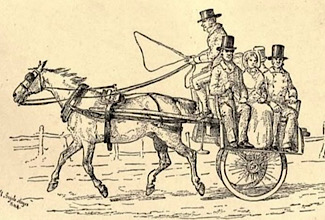
While the primary purpose is to carry the Royal Mail, passengers can also travel at a premium fare. The coaches can carry four seated passengers inside and more standing outside, with the driver and guard occupying the front seats. The journey from Dublin to Waterford is relatively short for the time, but still requires careful scheduling to meet the strict post office timetable.

This first run lays the foundation for a regular mail service that becomes a vital part of Ireland’s transport and communication infrastructure until the advent of railways in the 1830s. By the mid-19th century, most of the mail coaches in Ireland are eventually out-competed by Charles Bianconi’s country-wide network of open carriages, before this system in turn succumbs to the railways. The Dublin–Waterford route, like others, is eventually replaced by the faster rail services, but its role in modernizing Ireland’s postal system is crucial.
Leave a comment

The Break of Dromore

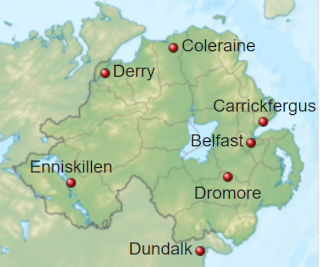
The Break of Dromore takes place on March 14, 1689, near Dromore, County Down in the early stages of the Williamite War in Ireland. It features Catholic Jacobite troops under Richard Hamilton and Protestant Williamite militia led by Hugh Montgomery and Arthur Rawdon.

The Protestant forces are taken by surprise and there is little fighting, reflected in the term “Break,” a Scottish word for rout. Victory secures eastern Ulster for the Jacobites but they fail to fully exploit their success.

While much of the Protestant population of east Ulster supports the claim of William III to thrones of Ireland, England and Scotland, the rest of Ireland, including the Lord Deputy of Ireland, Richard Talbot, 1st Earl of Tyrconnell, and the army, support James II. As a result, war breaks out in Ireland after James is deposed in the Glorious Revolution. At the start of the conflict, the Jacobites are left in control of two fortified positions at Carrickfergus and Charlemont in territory which is predominantly Williamite in sympathy. The local Williamites raise a militia and meet in a council at Hillsborough. They make an ineffective assault on Carrickfergus. However, this is easily beaten off and a local Catholic cleric named O’Hegarty reports that the Williamite are badly armed and trained.

The Jacobite commander in the north is Richard Hamilton, an experienced soldier who serves with the French military from 1671 to 1685, when he is appointed a colonel in the Irish Army. In September 1688, he and his regiment are transferred to England. When James flees into exile, he is held in the Tower of London. Released on parole by William in February, he is sent to negotiate with Talbot but drops this mission once back in Ireland. Alexander Osbourne, a Presbyterian clergyman, is sent to offer the Hillsborough council a pardon in return for surrender but they refuse, reportedly encouraged by Osbourne. On March 8, Hamilton marches north from Drogheda with 2,500 men to subdue the Williamites by force.

On March 14 Hamilton crosses the River Lagan and attacks a 3,000 strong Williamite force under Lord Mount Alexander at Dromore. Alexander’s cavalry falls back in disorder following a charge by the Jacobite dragoons. Seeing this, Hamilton orders a general advance of his infantry and the Williamite foot flee toward Dromore itself. They are overtaken in the village by the Jacobite cavalry and slaughtered, roughly 400 being killed and the rest fleeing for their lives.

Lord Mount Alexander rides to Donaghadee and takes a ship to England, while many other Protestants leave for Northern England or Scotland. Hamilton’s men capture Hillsborough, along with £1,000 and large stocks of food but fail to pursue their opponents. This allows the bulk of the militia under Rawdon and Henry Baker to reach Coleraine, then make their way to Derry, where they take part in the successful defence of the city.


Leave a comment

Assassination of Irish Republican Ronnie Bunting

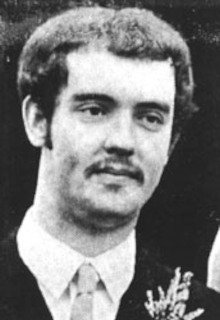
Ronnie Bunting, a Protestant Irish republican and socialist activist, is assassinated on October 15, 1980, when several gunmen enter his home in the Downfine Gardens area of Andersonstown.

Bunting is born into an Ulster Protestant family in East Belfast. His father, Ronald Bunting, had been a major in the British Army and Ronnie grew up in various military barracks around the world. His father became a supporter and associate of Ian Paisley and ran for election under the Protestant Unionist Party banner.

Having completed his education and graduating from Queen’s University Belfast, Bunting briefly becomes a history teacher in Belfast, but later becomes involved in the Northern Ireland Civil Rights Association and then with Irish republican organisations.

Unlike most Protestants in Northern Ireland, Bunting becomes a militant republican. His father, by contrast, was a committed Ulster loyalist. Despite their political differences, they remain close.

Bunting joins the Official Irish Republican Army (OIRA) around 1970 as he is attracted to their left-wing and secular interpretation of Irish republicanism and believes in the necessity of armed revolution. The other wing of the IRA, the Provisional Irish Republican Army, is seen to be more Catholic and nationalist in its outlook. At this time, the communal conflict known as the Troubles is beginning and the Official IRA is involved in shootings and bombings. He is interned in November 1971 and held in Long Kesh until the following April.

In 1974, Bunting follows Seamus Costello and other militants who disagree with the Official IRA’s ceasefire of 1972, into a new grouping, the Irish National Liberation Army (INLA). Immediately, a violent feud breaks out between the Official IRA and the INLA.

In 1975, Bunting survives an assassination attempt when he is shot in a Belfast street. In 1977, Costello is killed by an Official IRA gunman in Dublin. Bunting and his family hide in Wales until 1978, when he returns to Belfast. For the remaining two years of his life, he is the military leader of the INLA. The grouping regularly attacks the British Army and Royal Ulster Constabulary (RUC) in Belfast. He calls in claims of responsibility to the media by the code name “Captain Green.”

At about 4:30 AM on October 15, 1980, several gunmen wearing balaclavas storm Bunting’s home in the Downfine Gardens area of Andersonstown. They shoot Bunting, his wife Suzanne and another Protestant INLA man and ex-member of the Red Republican Party, Noel Lyttle, who has been staying there after his recent release from detention.

Both Bunting and Lyttle are killed. Suzanne Bunting, who is shot in the face, survives her serious injuries. The attack is claimed by the Ulster Defence Association (UDA), but the INLA claims the Special Air Service are involved.

Upon his death, Bunting’s body is kept in a funeral parlour on the Newtownards Road opposite the headquarters of the UDA. On the day of the funeral, as the coffin is being removed, UDA members jeer from their building. The Irish Republican Socialist Party wants a republican paramilitary-style funeral for Bunting but his father refuses and has his son buried in the family plot of a Church of Ireland cemetery near Donaghadee.