seamus dubhghaill

Promoting Irish Culture and History from Little Rock, Arkansas, USA


Leave a comment

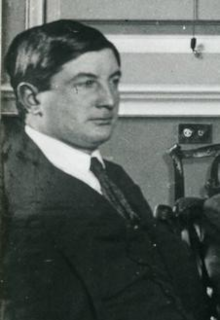
Death of Leonard McNally, Barrister, Playwright, United Irishman

Leonard McNally, an Irish barrister, playwright, lyricist, founding member of the United Irishmen and spy for the British Government within Irish republican circles, dies in Dublin on June 8, 1820.

McNally is born in Dublin in 1752, the son of a merchant and wine importer. He is raised by his mother with the support of his uncle. He is born into a Roman Catholic family, but at some point in the 1760s he converts to the Church of Ireland. He is passionate about theatre, entirely self-educated and initially becomes a merchant in Bordeaux like his father.

However, in 1774 McNally goes to London to study law at the Middle Temple but returns to Dublin to be called to the Irish bar in 1776. After returning to London in the late 1770s, he qualifies as a barrister in England as well, in 1783. He practises for a short time in London and, while there, supplements his income by writing plays and editing The Public Ledger.

Returning to Ireland, McNally developes a successful career as a barrister in Dublin. He develops an expertise in the law of evidence and, in 1802, publishes what becomes a much-used textbook, The Rules of Evidence on Pleas of the Crown. The text plays a crucial role in defining and publicising the beyond reasonable doubt standard for criminal trials.

Not long after returning to Ireland, McNally becomes involved in radical politics, having already in 1782 published a pamphlet in support of the Irish cause. He becomes Dublin’s leading radical lawyer of the day. In 1792, he represents James Napper Tandy, a radical member of the Irish Parliament, in a legal dispute over parliamentary privilege. In the early 1790s, he becomes a founder member of the United Irishmen, a clandestine society which soon develops into a revolutionary Irish republican organisation. He ranks high in its leadership and acts as the organisation’s chief lawyer, representing many United Irishmen in court. This includes defending Wolfe Tone and Robert Emmet, the leaders of the 1798 and 1803 rebellions respectively, at their trials for treason. In 1793, he is wounded in a duel with Sir Jonah Barrington, who had insulted the United Irishmen. Barrington subsequently describes McNally as “a good-natured, hospitable, talented and dirty fellow.”

After McNally’s death in 1820, it emerges that he had for many years been an informant for the government, and one of the most successful British spies in Irish republican circles that there has ever been. In 1794, when a United Irishmen plot to seek aid from Revolutionary France is uncovered by the British government, McNally turns informer to save himself, although, subsequently, he also receives payment for his services. He is paid an annual pension in respect of his work as an informer of £300 a year, from 1794 until his death in 1820.

From 1794, McNally systematically informs on his United Irishmen colleagues, who often gather at his house for meetings. It is he that betrays Lord Edward FitzGerald, one of the leaders of the 1798 rebellion, as well as Robert Emmet in 1803. A significant factor in the failure of the 1798 rebellion is the excellent intelligence provided to the government by its agents. McNally is considered to be one of the most damaging informers.

The United Irishmen represented by McNally at their trials are invariably convicted and he is paid by the crown for passing the secrets of their defence to the prosecution. During the trial of Emmet, he provides details of the defence’s strategy to the crown and conducts his client’s case in a way that assists the prosecution. For example, three days before the trial he assures the authorities that Emmet “does not intend to call a single witness, nor to trouble any witness for the Crown with a cross-examination, unless they misrepresent facts… He will not controvert the charge by calling a single witness.” For his assistance to the prosecution in Emmet’s case, he is paid a bonus of £200, on top of his pension, half of which is paid five days before the trial.

After McNally’s death, his activities as a government agent become generally known when his heir attempts to continue to collect his pension of £300 per year. He is still remembered with opprobrium by Irish nationalists. In 1997, the Sinn Féin newspaper, An Phoblacht, in an article on McNally, describes him as “undoubtedly one of the most treacherous informers of Irish history.”

McNally is a successful dramatist and writes a number of well-constructed but derivative comedies, as well as comic operas. His first dramatic work is The Ruling Passion, a comic opera written in 1771, and he is known to have authored at least twelve plays between 1779 and 1796 as well as other comic operas. His works include The Apotheosis of Punch (1779), a satire on the Irish playwright Richard Brinsley Sheridan, Tristram Shandy (1783), which is an adaptation of Laurence Sterne‘s novel, Robin Hood (1784), Fashionable Levities (1785), Richard Cœur de Lion (1786), and Critic Upon Critic (1788).

McNally also writes a number of songs and operettas for Covent Garden. One of his songs, The Lass of Richmond Hill, becomes very well-known and popular following its first public performance at Vauxhall Gardens in London in 1789. It is said to be a favourite of George III and popularises the romantic metaphor “a rose without a thorn,” a phrase which he used in the song.

Nothing is known of McNally’s first wife Mary O’Brien, other than that she dies in 1786. In London in 1787, he elopes with Frances I’Anson, as her father William I’Anson a solicitor, disapproves of McNally. Frances, and her family’s estate, Hill House in Richmond, North Yorkshire, is the subject of a song with lyrics by McNally and composed by James Hook, The Lass of Richmond Hill. In 1795, Frances dies during childbirth at age 29 and is survived by only one daughter. In early 1799, McNally marries his third wife, Louisa Edgeworth, the daughter of a clergyman from County Longford.

When McNally’s son, who has the same and professions, dies on February 13, 1820, it is widely reported to have been McNally. The son is buried in Donnybrook, Dublin, on February 17, 1820, and McNally sends a letter on March 6, 1820, to the Proprietor of Saunders’s Newsletter seeking damages for the severe injury caused by the circulation of his death. In June 1820, McNally is on his deathbed, and although he had been a Protestant for most of his adult life, he seeks absolution from a Roman Catholic priest. He dies and is also buried in Donnybrook on June 8, 1820.
Leave a comment

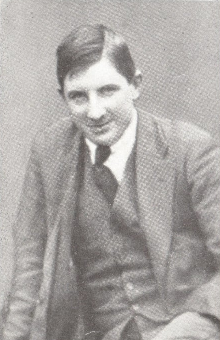
Death of Diarmuid O’Hegarty, Civil Servant & Revolutionary

Diarmuid O’Hegarty (Irish: Ó hÉigeartuigh), civil servant and revolutionary, dies in Dublin on March 14, 1958.

O’Hegarty is born Jeremiah Stephen Hegarty on December 26, 1892, in Lowertown, Skibbereen, County Cork, the eldest of seven children of Jeremiah Hegarty (1856–1934) and his wife Eileen (née Barry), both teachers. He is educated at the Christian Brothers school, St. Patrick’s Place, Cork, joins the Dublin civil service in 1910 and is posted to the Department of Agriculture and Technical Instruction, acquiring invaluable administrative experience as private secretary to T. P. Gill, secretary of the department.

O’Hegarty is a member of the Keating branch of the Gaelic League and the closely associated Teeling circle of the Irish Republican Brotherhood (IRB). In 1913 he becomes secretary and stage manager of a troupe of Gaelic players, Na hAisteoirí, which includes several who later become prominent revolutionaries: Piaras Béaslaí, Gearóid O’Sullivan, Fionán Lynch, and Con Collins. As second lieutenant of F Company, 1st Battalion, Dublin Brigade, Irish Volunteers, during the Easter Rising, he is in charge of barricades in Church Street, Mary Lane, Mary’s Abbey, and Jameson Distillery, an area which sees fierce fighting. Imprisoned in Knutsford (May 1-18), he is released in error and returns to his post in the civil service. On his return he is a key figure in the reorganisation of the Volunteers and IRB, becoming a member of the executive of the IRB’s supreme council along with Michael Collins and Seán Ó Murthuile. He also becomes a central figure in Kathleen Clarke‘s prisoner support group, the Irish Volunteer Dependents Fund, and when it amalgamates with the more moderate Irish National Aid Association to form the INA&VDF in August 1916, he helps to ensure that it is dominated by republicans.

O’Hegarty is very close to Michael Collins and Harry Boland and in 1918 this IRB triumvirate exercises considerable control in the nomination of Sinn Féin candidates for the 1918 Irish general election. In the same year he is dismissed from the civil service for refusing to take the oath of allegiance, but his administrative talents find ample outlet in the secretariat of the revolutionary Dáil and later in the service of the Irish Free State to such an extent that he has been called ‘the civil servant of the revolution’ and ‘the Grey Eminence of the Free State Government.’ As clerk of the First Dáil and secretary to the Dáil cabinet (1919–21), he is largely responsible for its success, organising meetings of the clandestine parliament and coordinating the work of various departments from his offices on the corner of O’Connell Street and Abbey Street and later in Middle Abbey Street. He is determined that the Dáil will demonstrate its worth by ‘functioning as any progressive government would be expected to function.’ He records the minutes and handles all correspondence of the Dáil cabinet. As the conduit through which the Dáil’s ministers communicate, his role is central to the effective operation of government on the run. The influence this gives him within the revolutionary movement is bolstered by his senior role within the IRB and the positions of military significance which he occupies. He is a member of the Volunteer Executive (Jun 1916–Nov 1921), Irish Republican Army (IRA) Director of Communications (Jul 1918–Mar 1920), and Director of Organisation (Mar 1920–Apr 1921). When convicted of illegal assembly and jailed in Mountjoy Prison (Nov 1919–Feb 1920), he immediately wields power within the prison, ordering Noel Lemass off a hunger strike.

O’Hegarty resigns his military duties in April 1921 to concentrate on his work in the Dáil secretariat and serves as secretary to the Irish delegation during the Anglo–Irish Treaty negotiations in London (Oct–Dec 1921). He is a vital voice for the Treaty within the IRB and is appointed secretary to the cabinet of the Provisional Government in 1922, participating in the unsuccessful army unification talks of May 1922. During the Irish Civil War, he is briefly seconded from his civil service post to serve as military governor of Mountjoy Prison (Jul-Aug 1922), where he threatens that prisoners who persist in leaning out of windows and talking to the public outside the prison will be shot. Peadar O’Donnell, who is a prisoner there at the time, remembers him as the focus of much “republican bitterness.” A member of the army council during the Irish Civil War, he serves as Director of Organisation (Jul–Dec 1922) and Director of Intelligence (Dec 1922–May 1923), leaving the army with the rank of lieutenant general on May 1, 1923, to resume his civil service career.

O’Hegarty is secretary to the Executive Council of the Irish Free State (1923–32) and principal private secretary to its president, W. T. Cosgrave. Again, he records the cabinet minutes and is the administrative pivot upon which government turns. He serves as secretary to numerous governmental delegations and is widely praised for his work in this role at the 1926 Imperial Conference and the 1930 Imperial Conference. In 1927 he goes to New York to represent the government at a hearing into the fate of republican funds in the United States. His career is the prime example of the influence of revolutionary veterans within the higher civil service in the early years of the state. After the change of government following the 1932 Irish general election, he is one of the very few senior civil servants who is effectively removed from his position. He is appointed to be a commissioner of public works, becoming chairman in 1949, a position he holds until his retirement in 1957. In 1939–40 he serves on the Economy Committee established by the government to advise on wartime spending, and in 1941 is a member of a tribunal of inquiry into public transport, which is principally concerned with the poor financial state of Great Southern Railways.

On April 27, 1922, with Michael Collins as his best man, O’Hegarty marries Claire Archer, daughter of Edward Archer, a post office telegraph inspector from Dublin, and Susan Archer (née Matthews). Her brother is William (Liam) Archer. They live at 9 Brendan Road, Donnybrook, Dublin.

O’Hegarty dies on March 14, 1958, in Dublin, leaving an estate of £5,441. His papers are in the University College Dublin (UCD) Archives.


3 Comments

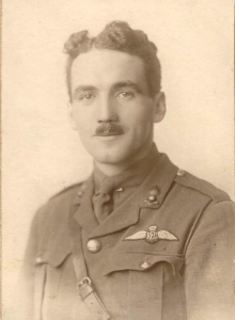
Death of Captain George McElroy, World War I Fighter Pilot

Captain George Edward Henry McElroy MC & Two Bars, DFC & Bar, a leading Irish fighter pilot of the Royal Flying Corps and Royal Air Force during World War I, is killed by ground fire on July 31, 1918, while flying over enemy lines. He is credited with 47 aerial victories.

McElroy is born on May 14, 1893, at Donnybrook, County Dublin, to Samuel and Ellen McElroy. He enlists promptly at the start of World War I in August 1914 and is shipped out to France two months later. He is serving as a corporal in the Motor Cyclist Section of the Royal Engineers when he is first commissioned as a second lieutenant on May 9, 1915. While serving in the Royal Irish Regiment he is severely affected by mustard gas and is sent home to recuperate. He is in Dublin in April 1916, during the Easter Rising, and is ordered to help quell the insurrection. He refuses to fire upon his fellow Irishmen and is transferred to a southerly garrison away from home.

On June 1, 1916, McElroy relinquishes his commission in the Royal Irish Regiment when awarded a cadetship at the Royal Military Academy, Woolwich, from which he graduates on February 28, 1917, and is commissioned as a second lieutenant in the Royal Garrison Artillery.

McElroy is promptly seconded to the Royal Flying Corps, being trained as a pilot at the Central Flying School at Upavon Aerodrome and appointed a flying officer on June 28. On July 27 his commission is backdated to February 9, 1916, and he is promoted to lieutenant on August 9. On August 15 he joins No. 40 Squadron RFC, where he benefits from mentoring by Edward “Mick” Mannock. He originally flies a Nieuport 17, but with no success in battle. By the year’s end he is flying Royal Aircraft Factory S.E.5s and claims his first victory on December 28.

An extremely aggressive dogfighter who ignores often overwhelming odds, McElroy’s score soon grows rapidly. He shoots down two German aircraft in January 1918, and by February 18 has run his string up to 11. At this point, he is appointed a flight commander with the temporary rank of captain and transferred to No. 24 Squadron RFC. He continues to steadily accrue victories by ones and twos. By March 26, when he is awarded the Military Cross, he is up to 18 “kills.” On April 1, the Army’s Royal Flying Corps (RFC) and the Royal Naval Air Service (RNAS) are merged to form the Royal Air Force, and his squadron becomes No. 24 Squadron RAF. He is injured in a landing accident on April 7 when he brushes a treetop while landing. By then he has run his score to 27. While he is sidelined with his injury, on April 22, he is awarded a bar to his Military Cross. Following his convalescence, he returns to No. 40 Squadron in June, scoring three times, on June 26, June 28, and June 30. The latter two triumphs are observation balloons and run his tally to 30.

In July, McElroy adds to his score almost daily, a third balloon busting on July 1, followed by one of the most triumphant months in the history of fighter aviation, adding 17 victims during the month. His run of success is threatened on July 20 by a vibrating engine that entails breaking off an attack on a German two-seater and a rough emergency landing that leaves him with scratches and bruises. There is a farewell luncheon that day for his friend Gwilym Hugh “Noisy” Lewis. Their mutual friend “Mick” Mannock pulls McElroy aside to warn him about the hazards of following a German victim down within range of ground fire.

On July 26, “Mick” Mannock is killed by ground fire. Ironically, on that same day, “McIrish” McElroy receives the second Bar to his Military Cross. He is one of only ten airmen to receive the second Bar.

McElroy’s continues apparent disregard for his own safety when flying and fighting can have only one end. On July 31, 1918, he reports destroying a Hannover C for his 47th victory. He then sets out again. He fails to return from this flight and is posted missing. Later it is learned that he had been killed by ground fire. He is 25 years old.

McElroy receives the Distinguished Flying Cross posthumously on August 3, citing his shooting down 35 aeroplanes and three observation balloons. The Bar would arrive still later, on September 21, and would laud his low-level attacks. In summary, he shoots down four enemy aircraft in flames and destroys 23 others, one of which he shares destroyed with other pilots. He drives down 16 enemy aircraft “out of control” and out of the fight. In one of those cases, it is a shared success. He also destroys three balloons.

McElroy is interred in Plot I.C.1 at the Laventie Military Cemetery in La Gorgue, northern France.


Leave a comment

Death of Bernard Cowen, Fianna Fáil Politician

Bernard Francis Cowen, Irish Fianna Fáil politician who serves as Minister of State for Disadvantaged Areas from March 1982 to December 1982, dies on January 24, 1984, at Donnybrook, Dublin. He serves as a Teachta Dála (TD) for the Laois–Offaly constituency from 1969 to 1973 and 1977 to 1984. He is a Senator for the Agricultural Panel from 1973 to 1977.

Born on January 29, 1932, in Clara, County Offaly, Cowen is the son of Christy Cowen, a cattle dealer and a Fianna Fáil member who served as a member of Offaly County Council from 1932 until his death in 1967. He is educated at Clara National School and subsequently attends Tullamore CBS. After completion of his secondary schooling, he works in the family business which includes a public house and a butcher shop. He later becomes an auctioneer.

Cowen first becomes involved in politics in 1967, when he is co-opted onto Offaly County Council, following the death of his father. Later that year he heads the poll in the Tullamore area and retains his seat until his death.

Cowen is first elected to Dáil Éireann as a Fianna Fáil TD for Laois–Offaly constituency at the 1969 Irish general election. Fianna Fáil returns to government for the fourth successive time following a general election, however, as a new TD, he remains on the backbenches. He loses his seat at the 1973 Irish general election as a Fine GaelLabour coalition government is formed. However, he is subsequently elected to the 13th Seanad for the Agricultural Panel.

Cowen returns to the Dáil following the 1977 Irish general election, when Fianna Fáil returns to power in a landslide. Once again, he remains on the backbenches.

In 1979, Jack Lynch resigns as Taoiseach and Leader of Fianna Fáil. Cowen supports the bid of Charles Haughey for the leadership. Haughey wins the subsequent leadership election. In spite of offering his support, Cowen fails to secure promotion to ministerial office.

A period of political instability follows with three general elections being held throughout 1981 and 1982. Cowen retains his seat in all of these elections. In March 1982, he is finally promoted to junior ministerial level, when he is appointed Minister of State at the Department of Agriculture with special responsibility for disadvantaged areas. He holds that position until December of the same year, when Fianna Fáil loses power.

While attending a meeting of Offaly County Council in January 1984, Cowen is taken ill. He is taken to St. Vincent’s Hospital in Dublin where he dies several days later on January 24, 1984. He is survived by his wife, Mary, and three sons. The consequent by-election for his seat in the 24th Dáil, is won by his second son, Brian, who goes on to serve as Taoiseach from 2008 to 2011. In 2011, Cowen’s youngest son, Barry, is elected to the seat previously held by his father and brother, having previously been an Offaly County Councillor for the Tullamore electoral area.


Leave a comment

Birth of Diarmuid O’Hegarty, Civil Servant & Revolutionary

Diarmuid O’Hegarty (Ó hÉigeartuigh), civil servant and revolutionary, is born Jeremiah Stephen Hegarty on December 26, 1892, in Lowertown, Skibbereen, County Cork, the eldest of seven children of Jeremiah Hegarty (1856–1934) and his wife Eileen (née Barry), both teachers. He is educated at the Christian Brothers school, St. Patrick’s Place, Cork, joins the civil service in 1910 and is posted to the Department of Agriculture and Technical Instruction, acquiring invaluable administrative experience as private secretary to T. P. Gill, secretary of the department.

O’Hegarty is a member of the Keating branch of the Gaelic League and the closely associated Teeling circle of the Irish Republican Brotherhood (IRB). In 1913 he becomes secretary and stage manager of a troupe of Gaelic players, Na hAisteoirí, which includes several who later become prominent revolutionaries: Piaras Béaslaí, Gearóid O’Sullivan, Fionán Lynch, and Con Collins. As second lieutenant of F Company, 1st Battalion, Dublin Brigade, Irish Volunteers, during the Easter Rising, he is in charge of barricades in Church Street, Mary Lane, Mary’s Abbey, and Jameson Distillery, an area which sees fierce fighting. Imprisoned in Knutsford (May 1-18), he is released in error and returns to his post in the civil service. On his return he is a key figure in the reorganisation of the Volunteers and IRB, becoming a member of the executive of the IRB’s supreme council along with Michael Collins and Seán Ó Murthuile. He also becomes a central figure in Kathleen Clarke‘s prisoner support group, the Irish Volunteer Dependents Fund, and when it amalgamates with the more moderate Irish National Aid Association to form the INA&VDF in August 1916, he helps to ensure that it is dominated by republicans.

O’Hegarty is very close to Michael Collins and Harry Boland and in 1918 this IRB triumvirate exercises considerable control in the nomination of Sinn Féin candidates for the 1918 Irish general election. In the same year he is dismissed from the civil service for refusing to take the oath of allegiance, but his administrative talents find ample outlet in the secretariat of the revolutionary Dáil and later in the service of the Irish Free State to such an extent that he has been called ‘the civil servant of the revolution’ and ‘the Grey Eminence of the Free State Government.’ As clerk of the First Dáil and secretary to the Dáil cabinet (1919–21), he is largely responsible for its success, organising meetings of the clandestine parliament and coordinating the work of various departments from his offices on the corner of O’Connell Street and Abbey Street and later in Middle Abbey Street. He is determined that the Dáil will demonstrate its worth by ‘functioning as any progressive government would be expected to function.’ He records the minutes and handles all correspondence of the Dáil cabinet. As the conduit through which the Dáil’s ministers communicate, his role is central to the effective operation of government on the run. The influence this gives him within the revolutionary movement is bolstered by his senior role within the IRB and the positions of military significance which he occupies. He is a member of the Volunteer Executive (Jun 1916–Nov 1921), Irish Republican Army (IRA) Director of Communications (Jul 1918–Mar 1920), and Director of Organisation (Mar 1920–Apr 1921). When convicted of illegal assembly and jailed in Mountjoy Prison (Nov 1919–Feb 1920), he immediately wields power within the prison, ordering Noel Lemass off a hunger strike.

O’Hegarty resigns his military duties in April 1921 to concentrate on his work in the Dáil secretariat and serves as secretary to the Irish delegation during the Anglo–Irish Treaty negotiations in London (Oct–Dec 1921). He is a vital voice for the Treaty within the IRB and is appointed secretary to the cabinet of the Provisional Government in 1922, participating in the unsuccessful army unification talks of May 1922. During the Irish Civil War, he is briefly seconded from his civil service post to serve as military governor of Mountjoy Prison (Jul-Aug 1922), where he threatens that prisoners who persist in leaning out of windows and talking to the public outside the prison will be shot. Peadar O’Donnell, who is a prisoner there at the time, remembers him as the focus of much ‘republican bitterness.’ A member of the army council during the Irish Civil War, he serves as Director of Organisation (Jul–Dec 1922) and Director of Intelligence (Dec 1922–May 1923), leaving the army with the rank of lieutenant general on May 1, 1923, to resume his civil service career.

O’Hegarty is secretary to the Executive Council of the Irish Free State (1923–32) and principal private secretary to its president, W. T. Cosgrave. Again, he records the cabinet minutes and is the administrative pivot upon which government turns. He serves as secretary to numerous governmental delegations and is widely praised for his work in this role at the 1926 Imperial Conference and the 1930 Imperial Conference. In 1927 he goes to New York to represent the government at a hearing into the fate of republican funds in the United States. His career is the prime example of the influence of revolutionary veterans within the higher civil service in the early years of the state. After the change of government following the 1932 Irish general election, he is one of the very few senior civil servants who is effectively removed from his position. He is appointed to be a commissioner of public works, becoming chairman in 1949, a position he holds until his retirement in 1957. In 1939–40 he serves on the Economy Committee established by the government to advise on wartime spending, and in 1941 is a member of a tribunal of inquiry into public transport, which is principally concerned with the poor financial state of Great Southern Railways.

On April 27, 1922, with Michael Collins as his best man, O’Hegarty marries Claire Archer, daughter of Edward Archer, a post office telegraph inspector from Dublin, and Susan Archer (née Matthews). Her brother is William (Liam) Archer. They live at 9 Brendan Road, Donnybrook, Dublin.

O’Hegarty dies on March 14, 1958, in Dublin, leaving an estate of £5,441. His papers are in the University College Dublin (UCD) Archives.


Leave a comment

Birth of David James O’Donoghue, Biographer & Editor

David James O’Donoghue, Irish biographer, editor, and bookseller, is born in Chelsea, London, England on July 22, 1866.

O’Donoghue is born to Irish parents and grows up in the Hans Town area of Chelsea. He is the son of John O’Donoghue, a bricklayer from Kilworth, County Cork, and Bridget Griffin, who is from County Tipperary. He is the third of nine children, and has four brothers, Thomas, John, James, and Edmund, and four sisters, Mary, Ellen, Katherine, and Agnes. He is first an upholsterer‘s apprentice from the age of sixteen before becoming a journalist and author.

O’Donoghue attends a Catholic school and furthers his education at the British Museum. He begins his journalistic work by writing for the Dublin papers upon subjects relating to Irish music, art, and literature. A founder-member of the Irish Literary Society in London, he is also vice president of the National Literary Society, Dublin, and the compiler of a biographical dictionary, The Poets of Ireland (1891–93; revised edition, 1912), with entries on 2,000 authors. His published works also include Irish Poetry of the Nineteenth Century (1894), Humor of Ireland (1894), List of 1300 Irish Artists (1894), The Life and Writings of James Clarence Mangan (1897), Bibliographical Catalogue of Collections of Irish Music (1899), and Geographical Distribution of Irish Ability (1906).

O’Donoghue publishes an edition of James Fintan Lalor‘s writings (1895) and an edition of William Carleton‘s Traits and Stories of the Irish Peasantry (four volumes, 1896–97). He edits the works of Samuel Lover (six volumes, 1898–99) and the prose works (1903) and poems (1904) of James Clarence Mangan. He writes biographies on William Carleton (1896), Richard Pockrich (1899), and Robert Emmet (1902).

In 1896 O’Donoghue moves to Dublin. In 1909 he becomes librarian of University College Dublin. He is co-editor of Catalogue of the Gilbert Library (in Dublin; 1918). William Butler Yeats writes of him in his Autobiographies of William Butler Yeats (1938).

O’Donoghue dies suddenly on June 27, 1917, at his home on Auburn Avenue, Donnybrook, Dublin. He is buried in Dublin’s Glasnevin Cemetery.


1 Comment

RTÉ Television Centre Bombing

File written by Adobe Photoshop? 5.0

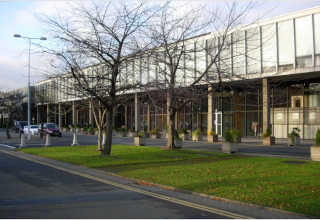
At the beginning of “The Troubles” in Northern Ireland, the Ulster Volunteer Force (UVF) plants their first bomb in the Republic of Ireland, damaging the RTÉ Television Centre in Donnybrook, Dublin, on August 5, 1969. No injuries result from the bombing.

The RTÉ Television Centre is a television studio complex which is owned by Raidió Teilifís Éireann (RTÉ) and has been home to Ireland’s national public service broadcaster since 1961. The building houses the main production studios for RTÉ Television, the control rooms for all RTÉ’s TV channels, and RTÉ’s main newsroom.

At 1:30 AM on the morning of August 5, a bomb explodes at the RTÉ Television Centre causing damage primarily to the western end of the studios. The explosion is heard over a wide area of Dublin. Only a skeleton staff are on duty and nobody is injured. The bombing takes place during the protest campaign by the Northern Ireland Civil Rights Association but before the 1969 Northern Ireland riots.

The bomb, which is believed to be a time bomb placed at the rear wall of the studio building, causes no structural damage to the building but destroys the wardrobe department and shatters windows in a large section of the building, including the large structural plate glass panels which are a feature of the building.

Army explosive experts are called in to investigate the cause of the explosion and determine who planted it.


Leave a comment

The Debut of “The Late Late Show”

Created with GIMP

The Late Late Show, the Irish talk show, airs on RTÉ One for the first time on July 6, 1962. It is the world’s second longest-running late-night talk show, following The Tonight Show in the United States. Perceived as the official flagship television programme of Ireland’s public service broadcaster Raidió Teilifís Éireann (RTÉ), it is regarded as an Irish television institution and is broadcast live across two hours plus in front of a studio audience on Friday nights between September and May.

Having maintained the same name and format continuously, The Late Late Show is first broadcast on Friday, July 6, 1962 and in colour from 1976. Originating as temporary summer filler for a niche Saturday night audience, it later moves to its current home on Friday night schedules. The format has remained largely the same throughout — dialogue, sketch comedy, musical performances, discourse on topical issues. It has influenced attitudes of the populace towards approval or disapproval of its chosen topics, directed social change and helped shape Irish societal norms. It averages 650,000 viewers per episode and has consistently achieved RTÉ’s highest ratings.

For much of its early life, RTÉ Television Centre‘s Studio 1 in Donnybrook, Dublin is its home. This original studio accommodates a small audience of about 120. In 1995, The Late Late Show transfers to the more spacious Studio 4, adapted specifically to cater for this and Kenny Live. Three external broadcasts have aired, most recently from the Wexford Opera House on September 5, 2008.

Original host Gay Byrne presents the show until May 21, 1999. Pat Kenny is Byrne’s successor hosting the show for 10 years between 1999 and 2009. Ryan Tubridy is the current presenter, having succeeded Kenny in September 2009. Under Tubridy, first QUINN Group and then Sky Broadband add sponsorship deals. Tubridy’s arrival coincides with a marked increase in audience ratings with some early statistics comparing him to the Byrne era. On February 1, 2013, Pat Kenny returns to host that night’s edition following the death of Tubridy’s father.


2 Comments

Birth of Stage & Screen Actress Marie Kean

Compressed by jpeg-recompress

Marie Kean, actress of stage and screen whose career spanned over 40 years, is born in the village of Rush, County Dublin on June 27, 1918. The Stage calls her one of Ireland’s most impressive actresses, and “an artist of considerable emotional depth and theatrical command.”

Kean grows up in Rush and is educated at Loreto College, North Great George’s Street, Dublin. She learns her craft at the Gaiety School of Acting and is part of the Abbey Theatre company until 1961.

Kean’s leading role as the kindly matriarch, Mrs. Kennedy, in the RTÉ Radio serial drama, The Kennedys of Castleross, makes her famous throughout Ireland. She stars in the programme for the duration of its 18-year run.

In 1968, Kean wins a Jacob’s Award for her performance as Winnie in RTÉ television’s production of Samuel Beckett‘s play Happy Days, a role she had previously performed on stage and which she describes later as her favourite part. Among her other television roles is that of Mrs. Conn Brickley, Bridget’s mother, in an episode of The Irish R.M. called “The Boat’s Share.”

Kean’s many stage appearances include performances in the plays of John Millington Synge, Seán O’Casey and Brian Friel. She takes the lead role of Maggie Polpin in the 1969 world première of John B. Keane‘s play Big Maggie at the Cork Opera House. In 1978 she wins the State of New York best actress award for her performance in what has become Keane’s most successful play.

Arguably her most memorable film role is as Barry’s scheming mother in Stanley Kubrick‘s Barry Lyndon. She also plays a bigoted Irish shopkeeper in David Lean‘s Ryan’s Daughter. Her final movie appearance is in John Huston‘s The Dead (1987), in which she plays the part of Mrs. Malins.

Marie Kean dies in Donnybrook, Dublin at the age of 75 on December 30, 1993. Her husband, William Mulvey, predeceases her in 1977.


Leave a comment

Birth of Writer Pádraig Ó Siochfhradha

padraig-o-siochfhradha

Pádraig Ó Siochfhradha, writer under the pseudonym An Seabhac and promoter of the Irish language, is born in the Gaeltacht near Dingle, County Kerry on March 10, 1883. His brother, Mícheál Ó Siochfhradha is also a writer, teacher, and Irish language storyteller.

Ó Siochfhradha becomes an organiser for Conradh na Gaeilge, cycling all over the countryside to set up branches and promote the Irish language. As a writer, he takes the penname An Seabhac, the Hawk, writing books including An Baile Seo Gainne (1913) and Jimín Mháire Thaidhg (1921), both of which draw on his Dingle youth and are later published in one volume as Seoda an tSeabhaic (1974).

Ó Siochfhradha is a prominent and influential figure of early 20th century Irish culture, a key populariser of the Irish Revival. He is an author, storyteller, folklorist, activist and politician.

Ó Siochfhradha’s nickname is thought to be a consequence of his years as a travelling teacher, when he adopts it as a pseudonym for the writing of his most famous book Jimín Mháire Thaidhg. This book, known in its English translation as Jimeen, is a fictionalised account of life growing up in the country, which follows the tribulations and misadventures of a young boy who cannot stay out of trouble.

Ó Siochfhradha works as a teacher from 1910 until 1922 in Kildare and in the Fermoy region of Kerry. He also works as an editor of The Light, a bilingual magazine which lasts six years, from 1907 to 1913. He is a member of Conradh na Gaeilge from early in his life and a frequent member of the League of Employment, which is an outgrowth of Conradh na Gaeilge. In 1911, a resolution, proposed by him and a colleague, is adopted that helps set the agenda for the ongoing revival of the Irish language. The proposal is to teach Irish to children of secondary school age as a living language rather than an antique one. This strategy persists to the present day.

Ó Siochfhradha becomes an active organiser for the Irish Volunteers in 1913 and is imprisoned three times for his activities. He spends time in Durham Prison in England and on Bere Island, County Cork.

In 1922 Ó Siochfhradha moves to Dublin under the auspices of the Department of Education. It is around this time that he is thought to have taken up residence in 119 Morehampton Road, Donnybrook, where he remains for the rest of his life. He continues to stay active in a large number of writing and political projects. He is secretary to the Irish Manuscripts Commission from October 1928 to October 1932.

During the Irish Civil War, it is said Ó Siochfhradha does his best to reconcile the opposing sides of the conflict. His political sympathies are primarily republican, and he spends a great deal of energy in the 1920s establishing Irish-speaking schools in Dublin. He is a member of Seanad Éireann from 1946–1948, 1951–1954 and 1957–1964, being personally nominated by his friend Taoiseach Éamon de Valera, on each occasion.

Ó Siochfhradha dies on November 19, 1964. His personal papers are on loan to Tralee Library and his archive has been digitised and stored by the University of Limerick.

(From: Stair na hÉireann/History of Ireland (https://stairnaheireann.net), “Pádraig Ó Siochfhradha – An Seabhac”)