seamus dubhghaill

Promoting Irish Culture and History from Little Rock, Arkansas, USA


Leave a comment

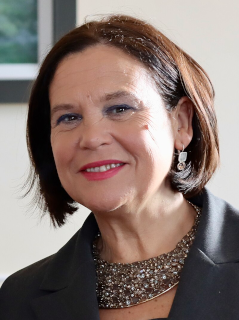
Birth of Mary Lou McDonald, Current President of Sinn Féin

Mary Louise McDonald, Irish politician and President of Sinn Féin since February 2018, is born in Dublin on May 1, 1969.

McDonald is born into a middle-class family in south Dublin. Her father Patrick McDonald, a builder and surveyor, and her mother Joan, separate when she is nine years old, and she stays with her mother in Rathgar. She has three siblings, one older and two younger. Her great-uncle, James O’Connor, was a member of the Anti-Treaty IRA and was executed at the Curragh Camp during the Irish Civil War.

McDonald is educated at Rathgar National School and at the Catholic all-girls, Notre Dame des Missions in Churchtown, South Dublin, where she is involved in debating. She then attends Trinity College Dublin (TCD), the University of Limerick and Dublin City University (DCU), studying English Literature, European Integration Studies and Human Resource Management.

She works as a researcher for the Institute of European Affairs, a consultant for the Irish Productivity Centre, a human resources consultancy that is jointly operated by Ibec and Irish Congress of Trade Unions (ICTU), and a trainer in the Partnership Unit of the Educational and Training Services Trust.

McDonald starts her political career by first joining Fianna Fáil in 1998 but leaves the party after a year due to core policy differences, particularly in relation to Northern Ireland and social justice. She quickly realises that Sinn Féin is a more appropriate party for her Republican views after meeting Sinn Féin members through the Irish National Congress.

She first runs for office at the 2002 Irish general election when she unsuccessfully contests the Dublin West constituency for Sinn Féin, polling 8.02% of first preference votes.

In 2004, McDonald becomes Sinn Féin’s first Member of the European Parliament (MEP) in Ireland, when she is elected at the 2004 European Parliament election in Ireland for the Dublin constituency, receiving over 60,000 first preference votes. She serves until 2009 and is a prominent member of the Employment and Social Affairs committee and Civil Liberties committee.

McDonald is an unsuccessful candidate in the Dublin Central constituency at the 2007 Irish general election. In 2009 she becomes the vice president of Sinn Féin.

McDonald contests the Dublin Central constituency again at the 2011 Irish general election, this time picking up 13.1% of first preference votes. She is successful in taking the last seat in the constituency. Following the election, she becomes Sinn Féin’s Spokesperson for Public Expenditure and Reform and is a member of the Public Accounts Committee from then until 2017.

After her re-election to the Dáil at the 2016 Irish general election, in which she tops the poll in Dublin Central, she becomes Sinn Féin’s All-Ireland Spokesperson for Mental Health and Suicide Prevention, which she holds until being elected president of Sinn Féin in 2018.

At a Sinn Féin party conference on November 18, 2017, Gerry Adams is re-elected party leader but announces that he will ask party leadership to call for a special Ard Fheis to be held within three months to choose a new president, and that he will not stand for re-election as TD for the Louth constituency in the next election.

At the close of nominations to succeed Adams on January 20, 2018, McDonald is announced as the president-elect of Sinn Féin, as she is the sole nominee to enter the race. She is confirmed as president at a special Ard Fheis on February 10, 2018, in Dublin.

McDonald is nominated as Taoiseach on February 20, 2020, but is defeated 45 to 84. On June 26, 2020, Fianna Fáil, Fine Gael, and the Green Party form a coalition government, leaving Sinn Féin as the largest opposition party, and McDonald as Leader of the Opposition. She dismisses the coalition agreement as a “marriage of convenience,” and accuses Fianna Fáil and Fine Gael of conspiring to exclude Sinn Féin from government.

At the 2024 Irish general election, McDonald is re-elected to the Dáil topping the poll in Dublin Central with Sinn Féin increasing their seat share by two seats, remaining the second largest party by representation in the Dáil and attaining 19% of the first preference votes, a fall of 5.5% from 2020 and fall behind Fianna Fáil by 2.9% and Fine Gael by 1.8%.

McDonald is again nominated as Taoiseach on December 18, 2024, but is defeated 44 to 110.

McDonald’s husband, Martin Lanigan, works as a gas control superintendent for the emergency dispatch division of Gas Networks Ireland, a state infrastructure provider. They have two children and live in Cabra, Dublin.

Leave a comment

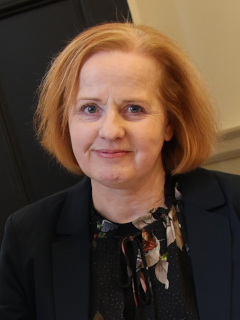
Birth of Ruth Coppinger, Socialist Party TD for Dublin West

Ruth Coppinger, Irish politician and member of the Socialist Party, and Teachta Dála (TD) for the Dublin West constituency, is born in Dublin on April 18, 1967.

Coppinger is a member of Fingal County Council for the Mulhuddart local electoral area from 2003 to 2014. She is co-opted to the council in 2003, replacing Joe Higgins, and is elected in 2004 and re-elected in 2009. She is an unsuccessful candidate for the Socialist Party at the 2011 Dublin West by-election.

Following victory in the 2014 Dublin West by-election, Coppinger joins her party colleague Joe Higgins in the Dáil. After being elected, she calls for a mass campaign of opposition to water charges being implemented by the Fine GaelLabour Party coalition.

In November 2014, Coppinger calls for the gradual nationalisation of U.S. multinationals to prevent job losses. In response, Fianna Fáil’s jobs spokesperson Dara Calleary calls the idea “reckless and ludicrous,” as it would “place a massive burden on taxpayers and the public finances.”

In September 2015, Coppinger joins homeless families from Blanchardstown, in occupying a NAMA-controlled property as part of a campaign to raise awareness of the housing crisis. In October 2015, she joins families in their occupation of a show house in her constituency, to protest the lack of availability of affordable social housing. She also supports the tenants of Tyrrelstown, who are made homeless when a Goldman Sachs vulture fund sells their houses.

Coppinger is re-elected to the Dáil at the 2016 Irish general election, this time under the Anti-Austerity Alliance–People Before Profit banner. On March 10. 2016, at the first sitting of the 32nd Dáil, she nominates Richard Boyd Barrett for the office of Taoiseach, quoting James Connolly from a hundred years previously when she says, “The day has passed for patching up the capitalist system. It must go,” and declaring, “We will not vote for the identical twin candidates” of Fine Gael and Fianna Fáil after they “imposed austerity.” On April 6, 2016, following the failure of the Dáil to elect a Taoiseach at that first sitting, she is nominated for the role of Taoiseach, becoming the first female nominee in the history of the state.

In 2018 Coppinger praises the MeToo movement for exposing patterns of abuse and systemic inequality. However, she also notes the limitations of achieving justice through traditional channels and calls for a stronger focus on combating intimate partner violence and societal tolerance of such abuse.

In April 2018, in the lead-up to the repeal of the Eighth Amendment, Coppinger, along with her colleague Paul Murphy, holds up a Repeal sign during leader’s questions and is reprimanded by the Ceann Comhairle. She is an advocate for abortion rights in Ireland, and is a founding member of ROSA, a movement for reproductive justice in Ireland. Earlier, in 2016, she tables the private members’ motion to repeal the Eighth Amendment.

In November 2018, Coppinger protests in the Dáil against the conduct of a rape trial in Ireland. During the trial, the defence team, as part of their argument that the sex had been consensual, states that the 17-year-old victim had worn a thong with a lace front. The defendant is subsequently found not guilty. During a sitting of the Dáil, Coppinger holds up a similar pair of underwear and admonishes the conduct of the trial, suggesting victim blaming tactics had been used and suggests this is a routine occurrence in Irish courts. She calls on Taoiseach Leo Varadkar to support her party’s bill that would increase sex education in Irish schools and provide additional training to the Irish judiciary and jurors on how to handle cases of rape. Varadkar responds that victims should not be blamed for what happens to them, irrespective of how they are dressed, where they are or if they have consumed alcohol.

In 2019 Coppinger sponsors a private member’s bill – the Domestic Violence (No-contact order) (Amendment) Bill 2019. The bill lapses with the dissolution of the Dáil and Seanad.

At the general election in February 2020, Coppinger is defeated in the Dublin West constituency. She unsuccessfully contests the 2020 Seanad election for the National University of Ireland constituency.

In June 2024, Coppinger is elected to Fingal County Council for the Castleknock local electoral area on the 7th Count. At the 2024 Irish general election, she is re-elected to the Dáil.

Coppinger is an advocate of secularism and believes in abolishing both the Angelus and the Dáil prayer, viewing them as relics of an outdated intertwining of religion and governance. She supports the separation of Church and State, criticising the Catholic Church‘s historical influence in education and health, as well as its financial privileges, including exemptions from accountability under regulations like SIPO. She has called for the requisitioning of Church lands and property, citing the Church’s failure to meet commitments to abuse victims and the necessity of addressing historical injustices.

On drug policy, Coppinger supports decriminalisation and endorses the Portuguese model, which treats addiction as a health issue rather than a criminal matter. She emphasises the hypocrisy of criminalising drug use while overlooking the societal harm caused by alcohol and advocates for expanding access to medicinal cannabis, criticising the political inertia in addressing this need.

In 2013, during referendum to abolish the Irish senate, Coppinger campaigns for a yes vote, calling the institution elitist and undemocratic. However, in 2020, following the loss of her Dáil seat, she runs unsuccessfully for a seat in the Senate. Challenged by the Irish Examiner on this, she states that so long as the Senate continues to exist, it should be used to further progressive causes.

Coppinger lives in Mulhuddart and is a secondary school teacher. Her eldest brother, Eugene Coppinger, serves on Fingal County Council from 2011 to 2019.


Leave a comment

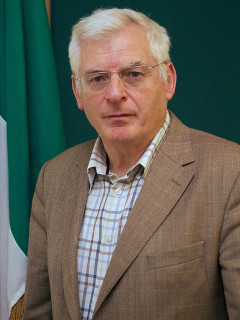
Birth of Joe Higgins, Politician & Member of the European Parliament

Joe Higgins, a former Socialist Party politician who serves as a Teachta Dála (TD) for the Dublin West constituency from 1997 to 2007 and from 2011 to 2016, is born in Lispole, County Kerry, on May 20, 1949. He serves as a Member of the European Parliament (MEP) for the Dublin constituency from 2009 to 2011.

One of nine children of a small farming family, Higgins goes to school in the Dingle Christian Brothers School, and after finishing he enrolls in the priesthood. As part of his training, he is sent to a Catholic seminary school in Minnesota, United States, in the 1960s. He becomes politicised at the time of anti-Vietnam War protests and the civil rights movement. He is a brother of Liam Higgins, who plays football with the Kerry GAA senior team in the 1960s and 1970s. He is bilingual in English and Irish.

Higgins returns to Ireland and attends University College Dublin (UCD), studying English and French. For several years he is a teacher in several Dublin inner city schools. While at university he joins the Labour Party and becomes active in the Militant Tendency, an entryist Trotskyist group that operates within the Labour Party. Throughout his time in the Labour Party, he is a strong opponent of coalition politics, along with TDs Emmet Stagg and Michael D. Higgins. He is elected to the Administrative Council of the Labour Party by the membership in the 1980s. In 1989, he is expelled alongside 13 other members of Militant Tendency by party leader Dick Spring. The group eventually leaves the party and forms Militant Labour, which becomes the Socialist Party in 1996.

Higgins spends over half his salary on the Socialist Party and causes he supports. He is elected to Dublin County Council in 1991 for the Mulhuddart electoral area and is until 2003 a member of Fingal County Council. In 1996, he campaigns against local authority water and refuse charges and contests the Dublin West by-election, losing narrowly to Brian Lenihan Jnr.

Higgins is first elected to Dáil Éireann at the 1997 Irish general election and re-elected at the 2002 general election. He loses his seat at the 2007 general election but regains it at the 2011 general election. From 2002 to 2007, he is a member of the Technical Group in the Dáil which consists of various independent TDs, Sinn Féin and the Green Party grouped together for better speaking time.

Higgins speaks out against the Iraq War while a TD, and addresses the Dublin leg of the March 20, 2003 International Day of Action. He is also prominent in the successful 2005 campaign to bring Nigerian school student Olukunle Eluhanla back to Ireland after he had been deported. He remains an opponent of the deportation policy.

Higgins uses his platform in the Dáil to raise the issue of exploitation of migrant and guest workers in Ireland. He and others claim that many companies are paying migrants below the minimum wage and, in some cases, not paying overtime rates. He expresses opposition in the Dáil to the jailing of the Rossport Five in July 2005. He raises the outsourcing of jobs by Irish Ferries in the Dáil in November 2005, requesting new legislation to regulate what he describes as “these modern slavers.”

Higgins successfully contests the 2009 European Parliament election for the Dublin constituency, beating two incumbents, Mary Lou McDonald of Sinn Féin and Eoin Ryan of Fianna Fáil, for the third and final seat. He is elected on the same day to Fingal County Council for the Castleknock electoral area, topping the poll. As Irish law prohibits politicians having a dual mandate, he vacates the council seat in July 2009 and is replaced by Matt Waine. He was a member of the European United Left–Nordic Green Left (EUL–NGL) group in the European Parliament, the European Parliament’s Committee on International Trade, and the delegation for relations with the countries of South Asia. He is also a substitute member of the Committee on Employment and Social Affairs, the Committee on Petitions and the delegation for relations with the Mercosur countries. Paul Murphy replaces him as an MEP when he is re-elected to the Dáil in 2011.

Higgins is elected again as TD for Dublin West at the 2011 Irish general election. He wins the third seat (of four) with 8,084 first preference votes. In his first speech in the 31st Dáil, he opposed the nomination of Fine Gael‘s Enda Kenny as Taoiseach. On May 4, 2011, Kenny is forced to apologise to Higgins in the Dáil after falsely accusing him of being a supporter of Osama bin Laden after Higgins offers criticism of his assassination by the CIA. He had asked the Taoiseach, “Is assassination only justified if the target is a reactionary, anti-democratic, anti-human rights obscurantist like bin Laden?”

In the Dáil, Higgins accuses Tánaiste Eamon Gilmore of doing nothing for the 14 Irish citizens being held “incommunicado” by Israel in November 2011. In December 2011, he describes as a disgraceful campaign of intimidation the fines imposed by the government on people who are unable to pay a new household charge brought in as part of the latest austerity budget and says to Enda Kenny that he will be “the new Captain Boycott of austerity in this country.” He asks that Minister for Finance Michael Noonan provide EBS staff with the 13th month end-of-year payment they are being denied.

In September 2012, Higgins publicly disagrees with former Socialist Party colleague Clare Daly, saying it is “unfortunate” that she has resigned from the party, but that it is impossible for Daly under the banner of the Socialist Party to continue to offer political support to Mick Wallace, who is at that time embroiled in scandal.

Higgins announces in April 2014 that he will not contest the next Dáil election. At the time he states his belief that the “baton of elected representation” should be carried by another generation of Socialist Party politicians — like Ruth Coppinger and Paul Murphy.


Leave a comment

Alexion Pharmaceuticals Announces €450m Expansion in Dublin

On May 11, 2015, Alexion Pharmaceuticals announces plans to significantly expand its operations in Ireland by constructing the company’s first ever biologics manufacturing facility outside the United States. The new 20,000 sq. metre plant will manufacture biologic drugs for treatment of rare and severe diseases.

Alexion Pharmaceuticals, a subsidiary of AstraZeneca, is a pharmaceutical company headquartered in Boston, Massachusetts, that specializes in orphan drugs to treat rare diseases. With costs that can reach as much as $2 million per year, the drugs manufactured by Alexion are some of the most expensive drugs worldwide.

The four-year project, which will be constructed at Alexion’s College Park site in Blanchardstown, is expected to create approximately 200 additional full-time jobs on completion, which will bring Alexion’s total workforce in Ireland to almost 500 employees.

Since first entering Ireland in 2013, Alexion has invested €130m in two facilities – a vial fill and finish facility in Athlone and a global supply chain facility at College Park. Phase one of the College Park facility, comprising Global Supply Chain HQ, laboratories, packaging and warehousing operations is expected to be operational by year end. Approximately 560 construction workers are involved in the development of the current Athlone and College Park projects, and the planned expansion of College Park will also create over 800 construction jobs.

Alexion has worked closely with the Department of Jobs and IDA Ireland on the development of its operations in Ireland.

Julie O’Neill, EVP Global Operations, states, “Alexion is pleased to progress the development of our College Park facility with a significant expansion that will now include our first biologics manufacturing facility outside the United States. This project further underscores our commitment to Ireland and is enabled by our ability to recruit highly competent and professional personnel to support the production and distribution of our medicine, Soliris (Eculizumab), and our strong pipeline of biologics medicines. Alexion has a unique mission to develop life-transforming therapies for patients with severe and life-threatening ultra-rare disorders. We are already serving the very few patients in Ireland suffering from two very rare and devastating diseases; with this major expansion, our Irish operations, comprising biologics manufacturing, vial fill-finish and global supply chain, will be at the forefront of this vital work globally.”

Welcoming the announcement, Tánaiste and Minister for Social Protection Joan Burton TD says, “Alexion’s latest expansion is an extremely strong endorsement for Ireland, and Dublin West in particular, as an attractive location for high-end investment from the pharmaceutical industry. It underlines the jobs-led recovery that is underway, with 90,000 jobs created and the Live Register down by a third since the peak of the crisis. We are determined to maintain this progress into the future. As Tánaiste and Social Protection Minister, my Department stands ready to assist Alexion with their recruitment needs, in particular through our Employer Engagement Unit.”

Speaking at College Park, the Minister for Jobs, Enterprise and Innovation Richard Bruton TD adds, “Biopharma is a sector which we have specifically targeted as part of the Action Plan for Jobs, due to the large potential for employment growth which it offers Ireland, and we have taken a number of steps to support the growth of this sector in Ireland. Today’s announcement by Alexion is a huge boost for west Dublin and the whole country, and huge credit is owed to Julie and her team as well as the IDA. Employment will be provided for 1,000 extra people, and the knock-on impact of this massive €450m investment for the wider economy will be enormous. We are developing a powerful cluster of biopharma plants in Ireland which I am determined now to build on.”


2 Comments

Death of Tomás Mac Giolla, Workers’ Party and Sinn Féin Politician

Tomás Mac Giolla, Workers’ Party of Ireland politician who serves as Lord Mayor of Dublin from 1993 to 1994, leader of the Workers’ Party from 1962 to 1988 and leader of Sinn Féin from 1962 to 1970, dies on February 4, 2010. He serves as a Teachta Dála (TD) for the Dublin West constituency from 1982 to 1992.

Mac Giolla is born Thomas Gill in Nenagh, County Tipperary, on January 25, 1924. His uncle T. P. Gill is a Member of Parliament (MP) and member of the Irish Parliamentary Party (IPP) of Charles Stewart Parnell. His father, Robert Paul Gill, an engineer and architect, also stands unsuccessfully for election on a number of occasions. His mother is Mary Hourigan.

Mac Giolla is educated at the local national school in Nenagh before completing his secondary education at St. Flannan’s College in Ennis, County Clare. It is while at St. Flannan’s that he changes to using the Irish language version of his name. He wins a scholarship to University College Dublin where he qualifies with a Bachelor of Arts degree, followed by a degree in Commerce.

A qualified accountant, Mac Giolla is employed by the Irish Electricity Supply Board (ESB) from 1947 until he goes into full-time politics in 1977.

In his early life Mac Giolla is an active republican. He joins Sinn Féin and the Irish Republican Army (IRA) around 1950. He is interned by the Government of Ireland during the 1956–1962 IRA border campaign. He also serves a number of prison sentences in Mountjoy Prison in Dublin.

At the 1961 Irish general election, Mac Giolla unsuccessfully contests the Tipperary North constituency for Sinn Féin. In 1962, he becomes President of Sinn Féin and is one of the people who moves the party to the left during the 1960s. In 1969, Sinn Féin splits, and he remains leader of Official Sinn Féin. It is also in 1962 that he marries May McLoughlin who is also an active member of Sinn Féin as well as Cumann na mBan, the women’s section of the IRA. In 1977, the party changes its name to Sinn Féin the Workers Party and in 1982 it becomes simply the Workers’ Party.

Mac Giolla is elected to Dublin City Council representing the Ballyfermot local electoral area in 1979 and at every subsequent local election until he retires from the council in 1997. In the November 1982 Irish general election, he is elected to Dáil Éireann for his party. In 1988, he steps down as party leader and is succeeded by Proinsias De Rossa. He serves as Lord Mayor of Dublin from 1993 to 1994 and remains a member of Dublin Corporation until 1998.

While president Mac Giolla is regarded as a mediator between the Marxist-Leninist wing headed by Sean Garland and the social democratic wing of Prionsias De Rossa. At the 1992 special Ardfheis he votes for the motion to abandon democratic centralism and to re-constitute the party much as the Italian Communist Party became the Democratic Party of the Left. However, the motion fails to reach the required two-thirds majority. Following the departure of six Workers’ Party TDs led by De Rossa to form the new Democratic Left party in 1992, Mac Giolla is the sole member of the Workers’ Party in the Dáil. He loses his Dáil seat at the 1992 Irish general election by a margin of just 59 votes to Liam Lawlor of Fianna Fáil.

In 1999, Mac Giolla writes to the chairman of the Flood Tribunal calling for an investigation into revelations that former Dublin Assistant City and County Manager George Redmond had been the official supervisor at the election count in Dublin West and was a close associate of Liam Lawlor. In 2003, Redmond is convicted of corruption by a Dublin court but subsequently has his conviction quashed due to conflicting evidence.

In his eighties Mac Giolla continues to be active and is a member of the group which campaigns to prevent the demolition of No. 16 Moore Street in Dublin city centre, where the surrender after the Easter Rising was completed. He also serves on the Dublin ’98 committee to commemorate the 200th anniversary of the Irish Rebellion of 1798.

Tomás Mac Giolla dies in Beaumont Hospital in Beaumont, Dublin on February 4, 2010, after a long illness.

(Pictured: Tomás Mac Giolla, former president of the Workers’ party and lord mayor of Dublin in 2007, by Niall Carson, PA Wire, Press Association Images)


Leave a comment

Death of T. P. Gill, Member of the Irish Parliamentary Party

Thomas Patrick (T. P.) Gill, a prominent member of the Irish Parliamentary Party (IPP) in the late 19th and early 20th century, dies on January 19, 1931. He is a Member of Parliament (MP) in the British House of Commons representing the South Louth constituency unopposed from 1885 to 1892. His uncle Peter is an unsuccessful election candidate in 1868 in County Tipperary.

Gill is born on October 25, 1858, in Ballygraigue, Nenagh, County Tipperary, the first of four sons of Robert Gill, a civil engineer who is assistant county surveyor, and Mary (née Clampett), daughter of a woolen merchant, James Clampett of Mount Kennett, County Limerick. He attends St. Joseph’s CBS Nenagh, St. John’s College, Kilkenny, and Trinity College Dublin becoming a journalist, firstly as editor of the Catholic World magazine of New York, and an associate editor of the North American Review (1883–85). He marries Annie Fennell of Dublin in 1882 and they have two sons, Donat and Roy, and a daughter Finola.

Gill is a friend and political ally of Charles Stewart Parnell. After the death of Parnell, he remains with the Irish Parliamentary Party. He works with Horace Plunkett in developing the Irish co-operative movement. He is member and honorary secretary to the 1895 Recess Committee which leads to the formation of both the Department of Agriculture and Technical Instruction (DATI), forerunner of the Irish Department of Agriculture, and the Vocational Education Committee (VEC). His key work for the Recess Committee is research into the state aid to agriculture in France and Denmark. In February 1900, he is appointed Secretary of the new Department of Agriculture and Technical Instruction in Ireland. In 1907, he is appointed Chairman of the Departmental Committee on Irish Forestry. He also serves on a number of governmental committees concerning agriculture and agricultural production. He is President of the Irish Technical Instruction Association from 1925 to 1929.

A raconteur with, in the words of R. A. Anderson, ‘a queer charm about him,’ Gill moves in Dublin literary circles, and in his retirement, he makes a translation of Louis Paul-Dubois’ Le drame irlandais et l’Irlande nouvelle (1927), published posthumously as The Irish struggle and its results (1934).

Gill is an uncle of former Workers’ Party of Ireland president and Dublin West TD Tomás Mac Giolla.

Gill dies in a Dublin hospital on January 19, 1931. His papers are in the National Library of Ireland.

(Pictured: “Portrait of T.P. Gill, Journalist, Secretary, Department of Agriculture and Technical Instruction,” oil on canvas by Sarah Purser, 1898, National Gallery of Ireland)


Leave a comment

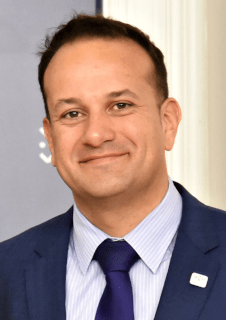
Birth of Leo Varadkar, Fine Gael Politician & Taoiseach

Leo Eric Varadkar, Irish Fine Gael politician who is serving since June 2020 as Tánaiste and Minister for Enterprise, Trade and Employment, is born on January 18, 1979, in the Rotunda Hospital, Dublin.

Varadkar is the third child and only son of Ashok and Miriam (née Howell) Varadkar. His father was born in Bombay (now Mumbai), India, and moved to the United Kingdom in the 1960s to work as a doctor. His mother, born in Dungarvan, County Waterford, meets her future husband while working as a nurse in Slough, Berkshire, England. He is educated at the St. Francis Xavier national school in Blanchardstown, Dublin, and then The King’s Hospital, a Church of Ireland secondary school in Palmerstown. During his secondary schooling, he joins Young Fine Gael. He is admitted to Trinity College Dublin (TCD), where he briefly reads law before switching to its School of Medicine. At TCD, he is active in the university’s Young Fine Gael branch and serves as Vice-President of the Youth of the European People’s Party, the youth wing of the European People’s Party, of which Fine Gael is a member. He is selected for the Washington Ireland Program for Service and Leadership (WIP), a half-year personal and professional development program in Washington, D.C., for students from Ireland.

Varadkar graduates in 2003, after completing his internship at King Edward Memorial Hospital in Mumbai. He then spends several years working as a non-consultant hospital doctor in St. James’s Hospital, Dublin, and Connolly Hospital, Blanchardstown, before specialising as a general practitioner in 2010.

In 2004, Varadkar joins Fine Gael and becomes a member of Fingal County Council and later serves as Deputy Mayor of Fingal. He is elected to Dáil Éireann for the first time in 2007. During the campaign for the 2015 same-sex marriage referendum, he comes out as gay, becoming the first serving Irish minister to do so.

Varadkar is elected a Teachta Dála (TD) for the Dublin West constituency in 2007. He serves under Taoiseach Enda Kenny as Minister for Transport, Tourism and Sport from 2011 to 2014, Minister for Health from 2014 to 2016, and Minister for Social Protection from 2016 to 2017.

In May 2017, Kenny announces that he is planning to resign as Taoiseach and Fine Gael leader. Varadkar stands in the leadership election to replace him. Although more party members vote for his opponent, Simon Coveney, he wins by a significant margin among Fine Gael members of the Oireachtas and is elected leader on June 2. Twelve days later, he is appointed Taoiseach, and at 38 years of age becomes the youngest person to hold the office. He is Ireland’s first, and the world’s fourth, openly gay head of government and the first Taoiseach of Indian heritage.

In 2020, Varadkar calls a general election to be held in February. While polls in 2019 have suggested a favourable result for Fine Gael, they ultimately come in third in terms of seats and votes, behind Fianna Fáil and Sinn Féin, with 35 seats, a loss of 15 seats for the party from the previous general election, when it had finished in first position. He resigns and is succeeded by Micheál Martin as Taoiseach. He is subsequently appointed Tánaiste and Minister for Enterprise, Trade and Employment as part of a three-party coalition composed of Fianna Fáil, Fine Gael and the Green Party.


Leave a comment

Birth of Tomás Mac Giolla, Irish Workers’ Party Politician

tomas-mac-giolla

Tomás Mac Giolla, Workers’ Party of Ireland politician who serves as Lord Mayor of Dublin from 1993 to 1994, leader of the Workers’ Party from 1962 to 1988 and leader of Sinn Féin from 1962 to 1970, is born Thomas Gill in Nenagh, County Tipperary on January 25, 1924. He serves as a Teachta Dála (TD) for the Dublin West constituency from 1982 to 1992.

Mac Giolla’s uncle T. P. Gill is a Member of Parliament (MP) and member of the Irish Parliamentary Party (IPP) of Charles Stewart Parnell. His father, Robert Paul Gill, an engineer and architect, also stands unsuccessfully for election on a number of occasions. His mother is Mary Hourigan.

Mac Giolla is educated at the local national school in Nenagh before completing his secondary education at St. Flannan’s College in Ennis, County Clare. It is while at St. Flannan’s that he changes to using the Irish language version of his name. He wins a scholarship to University College Dublin where he qualifies with a Bachelor of Arts degree, followed by a degree in Commerce.

A qualified accountant, Mac Giolla is employed by the Irish Electricity Supply Board (ESB) from 1947 until he goes into full-time politics in 1977.

In his early life Mac Giolla is an active republican. He joins Sinn Féin and the Irish Republican Army (IRA) around 1950. He is interned by the Government of Ireland during the 1956–1962 IRA border campaign. He also serves a number of prison sentences in Mountjoy Prison in Dublin.

At the 1961 Irish general election, Mac Giolla unsuccessfully contests the Tipperary North constituency for Sinn Féin. In 1962, he becomes President of Sinn Féin and is one of the people who moves the party to the left during the 1960s. In 1969, Sinn Féin splits, and he remains leader of Official Sinn Féin. It is also in 1962 that he marries May McLoughlin who is also an active member of Sinn Féin as well as Cumann na mBan, the women’s section of the IRA. In 1977, the party changes its name to Sinn Féin the Workers Party and in 1982 it becomes simply the Workers’ Party.

Mac Giolla is elected to Dublin City Council representing the Ballyfermot local electoral area in 1979 and at every subsequent local election until he retires from the council in 1997. In the November 1982 Irish general election, he is elected to Dáil Éireann for his party. In 1988, he steps down as party leader and is succeeded by Proinsias De Rossa. He serves as Lord Mayor of Dublin from 1993 to 1994 and remains a member of Dublin Corporation until 1998.

While president Mac Giolla is regarded as a mediator between the Marxist-Leninist wing headed by Sean Garland and the social democratic wing of Prionsias De Rossa. At the 1992 special Ardfheis he votes for the motion to abandon democratic centralism and to re-constitute the party much as the Italian Communist Party became the Democratic Party of the Left. However, the motion fails to reach the required two-thirds majority. Following the departure of six Workers’ Party TDs led by De Rossa to form the new Democratic Left party in 1992, Mac Giolla is the sole member of the Workers’ Party in the Dáil. He loses his Dáil seat at the 1992 Irish general election by a margin of just 59 votes to Liam Lawlor of Fianna Fáil.

In 1999, Mac Giolla writes to the chairman of the Flood Tribunal calling for an investigation into revelations that former Dublin Assistant City and County Manager George Redmond had been the official supervisor at the election count in Dublin West and was a close associate of Liam Lawlor. In 2003, Redmond is convicted of corruption by a Dublin court but subsequently has his conviction quashed due to conflicting evidence.

In his eighties Mac Giolla continues to be active and is a member of the group which campaigns to prevent the demolition of No. 16 Moore Street in Dublin city centre, where the surrender after the Easter Rising was completed. He also serves on the Dublin ’98 committee to commemorate the 200th anniversary of the Irish Rebellion of 1798.

Tomás Mac Giolla dies in Beaumont Hospital in Beaumont, Dublin on February 4, 2010, after a long illness.


Leave a comment

Death of Jim Mitchell, Fine Gael Politician

jim-mitchell

Jim Mitchell, senior Irish politician who serves in the cabinets of Taoiseach Garret FitzGerald, loses his three-year battle with cancer in Dublin on December 2, 2002.

Mitchell begins his political involvement when he supports Seán MacBride, leader of the radical republican Clann na Poblachta in the 1957 general election. He joins Fine Gael in 1967, becoming that party’s unsuccessful candidate in a by-election in 1970. He seeks a party nomination to run in the 1973 Irish general election. However, he agrees not to contest the seat to allow Declan Costello, a senior figure in his party and son of former Taoiseach John A. Costello, to be elected. Costello goes on to serve as Attorney General of Ireland in the 1973-1977 National Coalition of Fine Gael and the Labour Party.

Mitchell is elected to Dublin Corporation in 1974. In 1976, at the age of 29, he becomes the youngest ever Lord Mayor of Dublin. He is an unsuccessful candidate for Dáil Éireann in the 1973 general election in Dublin South-West and loses again in the 1976 by-election in the same constituency, to Labour’s Brendan Halligan.

In the 1977 general election he is elected to the 21st Dáil for the new constituency of Dublin Ballyfermot. With the party’s loss of power in 1977, the new leader, Garret FitzGerald appoints Mitchell to the Party’s Front Bench as spokesman on Labour. At the 1981 general election Mitchell is elected for the Dublin West and Fine Gael dramatically increases its number of seats, forming a coalition government with the Labour Party. On his appointment as Taoiseach, Garret FitzGerald causes some surprise by excluding some of the older conservative ex-ministers from his cabinet. Instead, young liberals like Mitchell are appointed, with Mitchell receiving the high-profile post of Minister for Justice, taking responsibility for policing, criminal and civil law reform, penal justice, etc. The Fine Gael-Labour government collapses in January 1982 but regains power in December of that year. Mitchell again is included in a FitzGerald cabinet, as Minister for Transport.

As Minister for Transport, Mitchell grants the aviation license to a fledgling airline called Ryanair on November 29, 1985. This is granted despite strong opposition by Ireland’s national carrier Aer Lingus. The issue of the license breaks Aer Lingus’ stranglehold on flights to London from the Republic of Ireland.

Mitchell, who is seen as being on the social liberal wing of Fine Gael, is out of favour with John Bruton when he becomes Fine Gael leader in 1990. When Bruton forms the Rainbow Coalition in December 1994, Mitchell is not appointed to any cabinet post.

Mitchell contests and wins Dáil elections in 1977, 1981, (February and November) 1982, 1987, 1989, 1992, 1997. He runs for his party as its candidate to become a member of the European Parliament in the 1994 and 1998 elections. He also is director of elections for Austin Currie, the Fine Gael candidate, in the 1990 presidential election.

In 2001, Bruton is deposed as Fine Gael leader and replaced by Michael Noonan. Mitchell serves as his deputy from 2001 to 2002. He also chairs the key Oireachtas Public Accounts Committee. The Committee’s work under his chairmanship is widely praised for its inquiry into allegations of corruption and wide-scale tax evasion in the banking sector.

Though regarded in politics as one of Fine Gael’s “survivors,” who holds onto his seat amid major boundary changes, constituency changes and by attracting working class votes in a party whose appeal is primarily middle class, Mitchell loses his Dublin Central seat in the 2002 general election. That election witnesses a large-scale collapse in the Fine Gael vote, with the party dropping from 54 to 31 seats in Dáil Éireann. Although Mitchell suffers from the swing against Fine Gael in Dublin, he is not aided by the fact that Inchicore, which is considered his base in the constituency has been moved to Dublin South-Central. He chooses not to run in that constituency as his brother, Gay, is a sitting Teachta Dála (TD) running for re-election for that constituency.

Mitchell earlier has a liver transplant in an attempt to beat a rare form of cancer which had cost the lives of a number of his siblings. Though the operation is successful, the cancer returns. Although he appears to be making a recovery, Jim Mitchell ultimately dies of the disease on December 2, 2002.

His former constituency colleague and rival, Taoiseach Bertie Ahern, describes Jim Mitchell as having made an “outstanding contribution to Irish politics.”