seamus dubhghaill

Promoting Irish Culture and History from Little Rock, Arkansas, USA


Leave a comment

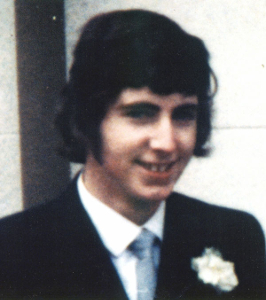
Birth of Hunger Striker Edward Martin Hurson

edward-martin-hurson

Edward Martin Hurson, Irish republican hunger striker and a volunteer in the East Tyrone Brigade of the Provisional Irish Republican Army (IRA), is born in Cappagh, County Tyrone, on September 13, 1956.

Hurson is one of nine children born to Johnnie and Mary Ann Hurson. Both of his parents come from the Cappagh district, and every member of the family is born into the white-washed farmhouse perched precipitously on top of the thirty hilly acres of rough land. Martin is close to the land as he grows up. He is educated to a primary level at Crosscavanagh Primary School in Galbally and at secondary level in St. Patrick’s, Galbally. When he is not at school, he is more often than not helping out about the farm, driving a tractor, helping to rear “croppy pigs,” or looking after cattle.

After leaving school, he works as an apprentice fitter welder for a while before going to Manchester, England where he stays for eighteen months with his brother Francis and works in the building trade. Returning to County Tyrone around Christmas of 1974, both he and his brother spend time in Bundoran, County Donegal, a known IRA training and supply centre.

Hurson, together with Kevin O’Brien, Dermot Boyle, Peter Kane, and Pat O’Neill are arrested and taken to the Omagh Royal Ulster Constabulary (RUC) barracks on November 11, 1976. He is beaten about the head, back, and testicles, spread-eagled against a wall and across a table, slapped, punched, and kicked. Under torture Martin signs statements admitting involvement in republican activity. On Saturday night, November 13, Martin is charged with a landmine explosion at Galbally in November 1975.

This charge is later dropped, but he is then further charged with IRA membership and explosive offences. Hurson spends a year on remand before being convicted in November 1977 and sentenced to 20 years for possession of landmines and conspiracy. He appeals his conviction on the grounds that the judge had ignored medical evidence about his ill-treatment.

The appeal is dismissed but he is granted a retrial. At the four-day trial in September 1979, the Omagh statements are ruled inadmissible, but instead of Martin walking free the judge goes on to accept the admissibility of the Cookstown statements, themselves extracted under threat of renewed torture. Following his retrial, he appeals his conviction once again, challenging the admissibility of the Cookstown statements, but his appeal is disallowed in June 1980.

Hurson becomes engaged to his long-term girlfriend, Bernadette Donnelly, while in prison. He is part of the blanket protest and joins the 1981 Irish Hunger Strike on May 28, replacing South Derryman Brendan McLaughlin who withdraws following a perforated stomach ulcer.

He loses the ability to hold down water after approximately 40 days on hunger strike and suffers a horrifically agonising death due to dehydration at 4:30 AM on July 13, after only 46 days on hunger strike, considerably shorter than any other hunger striker. Near the end his family considers the possibility of intervening to save his life, but they are told that he will likely have permanent brain damage.

Leave a comment

Birth of U2’s The Edge, David Howell Evans

the-edge

David Howell Evans, British-born Irish musician and songwriter best known by his stage name The Edge and as the lead guitarist, keyboardist, and backing vocalist of the rock band U2, is born at the Maternity Hospital in Barking, Essex, England on August 8, 1961. A member of U2 since its inception, he has recorded 13 studio albums with the band as well as one solo record.

The Edge is raised in Ireland after the Evans family relocates there while he is still an infant. He receives his initial formal education at St. Andrew’s National School in Dublin. As a child he also receives piano and guitar lessons, and practises music with his elder brother Richard. In 1976, at Mount Temple Comprehensive School, he goes to a meeting in response to an advert posted by another pupil, Larry Mullen Jr., on the school’s noticeboard seeking musicians to form a new band with him. Among the other pupils who respond to the note are Paul Hewson (Bono) and Adam Clayton. The band goes through a number of versions before becoming known as U2 in March 1978.

U2 begins its public performance life in small venues in Dublin, occasionally playing at other venues elsewhere in Ireland. In December 1979 they perform their first concerts outside Ireland, in London, and in 1980 begin extensive touring across the British Isles. Their debut album Boy is released in 1980.

In 1981, leading up to the October Tour, Evans comes very close to leaving U2 for religious reasons, but he decides to stay. During this period, he becomes involved with a group called Shalom Tigers, in which bandmates Bono and Larry Mullen Jr. are also involved. Shortly after deciding to remain with the band, he writes a piece of music that later becomes Sunday Bloody Sunday.

U2 eventually becomes one of the most popular acts in popular music, with successful albums such as 1987’s The Joshua Tree and 1991’s Achtung Baby. Over the years, the Edge has experimented with various guitar effects and introduced influences from several genres of music into his own style, including American roots music, industrial music, and alternative rock. With U2, the Edge also plays keyboards, co-produced their 1993 record Zooropa, and occasionally contributes lyrics.

In addition to his regular role within U2, The Edge has also recorded with such artists as Johnny Cash, B. B. King, Tina Turner, Ronnie Wood, Jah Wobble, Holger Czukay, Jay-Z, and Rihanna. He has collaborated with U2 bandmate Bono on several projects, including the soundtracks to the musical Spider-Man: Turn Off the Dark and the Royal Shakespeare Company‘s London stage adaptation of A Clockwork Orange.

The Edge, Bob Ezrin, and Henry Juszkiewicz co-found Music Rising in 2005, a charity that helps provide replacement instruments for those that were lost in Hurricane Katrina. The instruments are originally only replaced for professional musicians, but they soon realise the community churches and schools need instruments as well. The charity’s slogan is “Rebuilding the Gulf Region note by note” and has helped over a hundred musicians who were affected by the hurricane. The Edge also serves on the board of The Angiogenesis Foundation, a 501(c)(3) nonprofit organisation dedicated to improving global health by advancing angiogenesis-based medicine, diets, and lifestyle.

In 2011, Rolling Stone magazine places him at number 38 on its list of “The 100 Greatest Guitarists of All Time.” In 2012, Spin ranks him 13th on their own list.


Leave a comment

Birth of “Jem” Finer, Founding Member of The Pogues

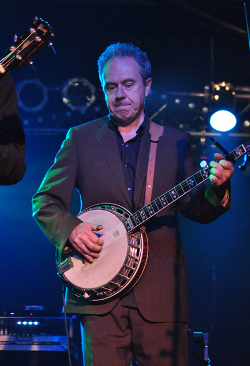
jem-finerJeremy Max “Jem” Finer, English musician, artist, composer, and one of the founding members of The Pogues, is born in Stoke-on-Trent, England on July 20, 1955.

After college at Keele University, Finer travels around Europe and spends some time working on a barge in France. He settles in London and becomes the bass player in a group called The Petals and lives in 32 Burton Street, a house which he sometimes shares with Spider Stacey and Shane MacGowan. Together with James Fearnley they found The Pogues. Primarily a banjoist, he also plays other instruments, including mandola, saxophone, hurdy-gurdy, and the guitar. Apart from Shane MacGowan, Finer is the most prolific composer for the band.

Finer appears on all the band’s albums until their breakup in 1996. He continues working as a musician and composer after leaving The Pogues.

On January 1, 2000, the Finer-composed Longplayer piece of music is started and is designed to last 1,000 years without ever repeating itself. It currently exists in both computer-generated and live versions. Longplayer represents a convergence of many of his concerns, particularly those relating to systems, long-durational processes, and extremes of scale in both time and space.

Finer serves as “Artist in Residence” at the Astrophysics Sub-department of the University of Oxford between October 2003 and June 2005. Finer and Hamburg-based swamp pop legend DM Bob begin recording and performing together in 2005, releasing their album Bum Steer in August of that year and co-producing the debut album by experimental pop band Marseille Figs. In July 2005, Finer wins the PRS Foundation New Music Award on the basis of his proposal to build a device that will automatically “compose” a song of indeterminate length by harnessing the creative force of the weather.

In March 2012, Mobile Sinfonia, a global composition for ringtones is launched, developed during a year Finer spends as a non-resident artist at the University of Bath. This piece concerns mutual invasion of soundscape via ringtones.

Finer is currently working on a number of new projects continuing his interest in long-term sustainability and the reconfiguring of older technologies, including Spiegelei, a spherical camera obscura featuring Finer’s innovative 360-degree projection system and the Supercomputer in Cambridge, a 5-bit mechanical sculpture which will compute minimal musical scores.


Leave a comment

Death of Francis McCloskey, First Fatality of “The Troubles”

the-troubles

Francis McCloskey, a 67-year-old Catholic civilian, dies on July 14, 1969, one day after being hit on the head with a baton by an officer of the Royal Ulster Constabulary (RUC) during street disturbances in Dungiven, County Derry. McCloskey is sometimes considered to be the first fatality of The Troubles.

McCloskey is found unconscious on July 13 near the Dungiven Orange Hall following a police baton charge against a crowd who had been throwing stones at the hall. Witnesses later say they had seen police beating a figure with batons in the doorway where McCloskey is found, although police claim he had been unconscious before the baton charge and may have been hit with a stone.

The Troubles is the common name for the ethno-nationalist conflict in Northern Ireland that begins in the late 1960s and is deemed by most to end with the Good Friday Agreement of 1998. Although the Troubles mainly take place in Northern Ireland, violence spills over at times into parts of the Republic of Ireland, England, and mainland Europe.

The conflict is primarily political, but it also has an ethnic or sectarian dimension, although it is not a religious conflict. A key issue is the constitutional status of Northern Ireland. Unionists and loyalists, who are mostly Protestants and consider themselves British, generally want Northern Ireland to remain within the United Kingdom. Irish nationalists and republicans, who are mostly Catholic and consider themselves Irish, generally want it to leave the United Kingdom and join a united Ireland. The conflict begins amid a campaign to end discrimination against the Catholic/nationalist minority by the Protestant/unionist government and police force in 1968. The campaign is met with violence, eventually leading to the deployment of British troops and subsequent warfare.

The main participants in the Troubles are republican paramilitaries such as the Provisional Irish Republican Army (IRA) and Irish National Liberation Army (INLA), loyalist paramilitaries such as the Ulster Volunteer Force (UVF) and Ulster Defence Association (UDA), the British Army and Royal Ulster Constabulary (RUC), and political activists and politicians. The security forces of the Republic of Ireland play a smaller role. More than 3,500 people are killed in the conflict, of whom 52% were civilians, 32% are members of the British security forces, and 16% are members of paramilitary groups. There has been sporadic violence since the signing of the Good Friday Agreement, including a campaign by anti-ceasefire republicans.


1 Comment

Edward Martin Hurson Dies on Hunger Strike

edward-martin-hursonEdward Martin Hurson, a volunteer in the East Tyrone Brigade of the Provisional Irish Republican Army (IRA), dies on July 13, 1981, after 46 days on hunger strike.

Hurson, from Cappagh, County Tyrone, Northern Ireland, is one of nine children born to Johnnie and Mary Ann Hurson. He is educated to a primary level at Crosscavanagh Primary School in Galbally and at secondary level in St. Patrick’s, Galbally.

After leaving school, he works as a welder for a while before going to England where he stays for eighteen months with his brother Francis and works in the building trade. Returning to County Tyrone at the end of 1974, both he and his brother spend time in Bundoran, County Donegal, a known IRA training and supply centre.

In November 1976, Hurson, together with Kevin O’Brien, Dermot Boyle, Peter Kane, and Pat O’Neill are arrested. Hurson is tried and convicted of involvement in three IRA landmine incidents, one at Cappagh in September, one at Galbally, County Tyrone in November 1975 and a third at Reclain in February 1976, when several members of the Royal Ulster Constabulary and Ulster Defence Regiment narrowly escape being killed. He receives concurrent sentences of twenty, fifteen, and five years for these convictions.

Hurson becomes engaged to his long-term girlfriend, Bernadette Donnelly, while in prison. He is part of the blanket protest and joins the 1981 Irish Hunger Strike on May 28, replacing Brendan McLaughlin who withdraws following a perforated stomach ulcer.

He loses the ability to hold down water after about 40 days on hunger strike, and dies of dehydration after only 46 days, considerably shorter than any other hunger striker (the next shortest is Francis Hughes at 59 days). Near the end, his family considers the possibility of intervening to save his life, but they are told that he would probably have permanent brain damage.


Leave a comment

Death of Jeremiah O’Donovan Rossa

jeremiah-odonovan-rossa

Jeremiah O’Donovan Rossa, Irish Fenian leader and prominent member of the Irish Republican Brotherhood, dies suddenly in Staten Island, New York, on June 29, 1915.

Jeremiah O’Donovan Rossa is born Jeremiah O’Donovan at Reenascreena, Rosscarbery, County Cork, on September 10, 1831. Rossa becomes a shopkeeper in Skibbereen where, in 1856, he establishes the Phoenix National and Literary Society, the aim of which is “the liberation of Ireland by force of arms.” This organisation later merges with the Irish Republican Brotherhood (IRB), founded two years later in Dublin.

In December 1858, Roosa is arrested and jailed without trial until July 1859. He is charged with plotting a Fenian rising in 1865, put on trial for high treason, and sentenced to penal servitude for life due to previous convictions. He serves his time in Pentonville, Portland, and Chatham prisons in England.

In an 1869 by-election, Roosa is returned to the British House of Commons for the Tipperary constituency, defeating the Liberal Catholic Denis Caulfield Heron by 1054 to 898 votes. The election is declared invalid because Rossa is an imprisoned felon.

After giving an understanding that he will not return to Ireland, Rossa is released as part of the Fenian Amnesty of 1870. Boarding the S.S. Cuba, he leaves for the United States with his friend John Devoy and three other exiles. Together they were dubbed “The Cuba Five.”

Rossa takes up residence in New York City, where he joins Clan na Gael and the Fenian Brotherhood. He organises the first ever bombings by Irish republicans of English cities in what is called the “dynamite campaign.” The campaign lasts through the 1880s and makes him infamous in Britain. The British government demands his extradition from America but without success.

In 1885, Rossa is shot outside his office near Broadway by an Englishwoman, Yseult Dudley, but his wounds are not life-threatening. He is allowed to visit Ireland in 1894, and again in 1904. On the latter visit, he is made a “Freeman of the City of Cork.”

Rossa is seriously ill in his later years and is finally confined to a hospital bed in St. Vincent’s Hospital, Staten Island, where he dies at the age of 83 on June 29, 1915. His body is returned to Ireland for burial and a hero’s welcome. The funeral at Glasnevin Cemetery on August 1, 1915, is a huge affair, garnering substantial publicity for the Irish Volunteers and the IRB at time when a rebellion, later to emerge as the Easter Rising, is being actively planned. The graveside oration given by Patrick Pearse remains one of the most famous speeches of the Irish independence movement stirring his audience to a call to arms.


Leave a comment

State Visit of U.S. President John F. Kennedy

jfk-state-visit

John F. Kennedy, an Irish American and the first Catholic to become president of the United States, arrives in Ireland on a state visit on June 26, 1963. After Air Force One touches down at Dublin airport, Kennedy’s motorcade weaves through the streets of Dublin city, the thrilled crowd, lacking ticker tape, improvises by throwing rolls of bus tickets.

Kennedy is proud of his Irish roots and makes a special visit to his ancestral home in Dunganstown, County Wexford, while in the country. There, he is greeted by a crowd waving both American and Irish flags and is serenaded by a boys’ choir that sings The Boys of Wexford. Kennedy breaks away from his bodyguards and joins the choir for the second chorus, prompting misty-eyed reactions from both observers and the press.

Kennedy meets with 15 members of his extended Irish family at the Kennedy homestead in Dunganstown. There he enjoys a cup of tea and some cake and makes a toast to “all those Kennedys who went and all those Kennedys who stayed.” His great-grandfather, Thomas Fitzgerald, had left Ireland for the United States in the middle of the Great Famine of 1848 and settled in Boston, becoming a cooper. Generations of his descendants go on to make their mark on American politics.

At the time of JFK’s visit to Ireland, the predominantly Catholic Irish Republic has been an independent nation for 41 years. The northern counties of the island, however, remain part of the largely Protestant British Empire and still suffer from long-standing sectarian violence. On the day after his arrival in Dublin, Kennedy speaks before the Irish parliament, where he openly condemns Britain’s history of persecuting Irish Catholics. Two days later, he travels to England, America’s oldest ally, to meet with British Prime Minister Harold Macmillan and his cabinet to discuss setting up a pro-democratic regime in British Guiana.

Kennedy later tells his aides that his favourite part of the trip was the wreath laying and silent funeral drill done by the Irish Army cadets at Arbour Hill military cemetery in Dublin.

Five months later, his widow, Jacqueline Kennedy, makes a special request to the Irish government. She asks that those same Irish army cadets, who so impressed the President on his visit, perform the drill again at his state funeral. Within days, those awe-stuck, trembling young men stand just inches away from foreign dignitaries from over 90 countries and perform their silent funeral drill in memory of a president that had inspired their country just a few short months earlier.


Leave a comment

Formation of the Independent Orange Order

independent-orange-orderThe Independent Orange Order, a Protestant fraternal organisation, is formed in Belfast on June 11, 1903 by Thomas Sloan and others associated with the Belfast Protestant Association, who have been expelled from the Orange Order because they voice opposition to it being used for party political ends by Ulster Unionists. Originally it is associated with the labour movement, but it soon realigns itself with traditional unionist politics.

It takes its name in memory of King William of Orange of the house of Orange who fights at the Battle of the Boyne, brings about the Glorious Revolution and the Bill of Rights giving the Westminster parliament ultimate power of the country rather than the Monarch. The Independent Order is small compared to the main organisation with 1,500 to 2,000 members. It is largely based around north County Antrim in Northern Ireland but has lodges around the world, including England, Scotland, and Australia. Its annual main Twelfth of July demonstration is held in a north Antrim town or village.

The first notable effect after the formation of the Independent Order is a more liberal interpretation of the rules of the “Old Order.” In the early years of the Institution, many suffer the full wrath of the “powers that be,” who are opposed to any splitting of the Orange Order. Jobs are lost, homes are burned, and their headquarters in Belfast is bombed.

Independent Orangeism today maintains that it is essential for the Orange Institution to be kept free from politics and to guard the principles of Reformation Protestantism. They often express alarm when they believe these principles are endangered by conciliatory politicians. They are opposed to ecumenism and, while being opposed to Orangeism being linked to the Ulster Unionist Party, they are not apolitical and tend to work alongside unionist politicians and parties.

The Institution also promotes Ulster Protestant history and proclaims the principle of “Liberty of Conscience.” They declare their right to think and act independently without direction from political or clerical masters, they seek to strengthen the position of Orangeism, and they often warn of the danger of the development of a social and cultural Orangeism devoid of Protestant principle.


Leave a comment

Birth of Irish Folk Singer Christy Moore

Christopher Andrew “Christy” Moore, Irish folk singer, songwriter, and guitarist, is born in Newbridge, County Kildare, on May 7, 1945.

After attending Newbridge College, Moore works as a bank employee and has a desire to express himself using traditional music. During a twelve-week bank strike in 1966, he goes to England, as do many striking officials, but he does not return when the strike is settled. Doing general labouring work, he frequents the folk clubs and the Irish music pubs where he meets Séamus Ennis, Margaret Barry, Luke Kelly, Martin Byrnes, and many other traditional musicians.

Moore’s first album, Paddy on the Road, a minor release of 500 copies, is recorded with Dominic Behan in 1969. In 1972, his first major release, Prosperous, brings him together with three musicians, Liam O’Flynn, Andy Irvine, and Dónal Lunny, who shortly thereafter form the Irish folk music band Planxty. For a short time, they called themselves “CLAD,” an acronym of their names, but soon decide on Planxty.

After leaving Planxty in 1975, Moore continues his solo career, reforming his old band on occasion. He also forms the band Moving Hearts with Lunny and five other musicians in 1980. In 1987, he appears on Gay Byrne‘s The Late Late Show performing with The Dubliners for their 25th anniversary. In 2000, he publishes his autobiography, One Voice.

Moore’s earlier years of heavy drinking, sleeping dysfunctional hours, continual traveling, and often eating takeout foods results in a decline in health and several operations. Moore’s battle with alcohol and subsequent heart operations takes their toll. At the end of the 1990s, Moore reduces his workload for medical reasons.

Moore releases his first new studio album in four years on April 17, 2009, entitled Listen, and promotes it through a series of live gigs. In December 2011, he releases the album, Folk Tale. His most recent album, Where I Come From, is released in November 2013 and features a new protest song called Arthur’s Day. The album peaks at No. 3 on the Irish album charts.

Moore is best known for his political and social commentary which reflects a left-wing, Irish republican perspective, despite the fact that his mother was a Fine Gael county councillor and parliamentary candidate in Kildare. He supports the republican H-Block protestors with the albums H-Block in 1978, the launch of which is raided by the police, and The Spirit of Freedom. He also records songs by hunger striker Bobby Sands, including Back Home in Derry. Moore ceases support of the military activities of the Irish Republican Army (IRA) in 1987 as a result of the Enniskillen bombing.

Political songs Moore has performed throughout his career include Mick Hanly’s On the Blanket about the protests of republican prisoners, Viva la Quinta Brigada about Irish volunteers who fought against the Fascists in the Spanish Civil War, and Minds Locked Shut about Bloody Sunday in Derry.

In 2007, Moore is named Ireland’s greatest living musician in RTÉ‘s People of the Year Awards.


Leave a comment

Death of Diarmait Mac Murchada, Irish King of Leinster

diarmait-mac-murchada

Diarmait Mac Murchada, Irish King of Leinster whose appeal to the English for help in settling an internal dispute leads to the Anglo-Norman invasion and conquest of Ireland by England, dies on May 1, 1171, of “an insufferable and unknown disease.”

Mac Murchada is born around 1110, the son of Donnchad mac Murchada, King of Leinster and Dublin. His father is killed in battle in 1115 by his cousin Sigtrygg Silkbeard, king of the Dublin Vikings, and is buried by them in Dublin along with the body of a dog which is considered to be a huge insult.

After the death of Énna Mac Murchada, his older brother, Mac Murchada unexpectedly becomes King of Leinster. This is opposed by the High King of Ireland, Toirdelbach Ua Conchobair, who fears that Mac Murchada will become a rival. Toirdelbach sends one of his allied Kings, the belligerent Tigernán Ua Ruairc, to conquer Leinster and oust the young Mac Murchada. Ua Ruairc goes on a brutal campaign slaughtering the livestock of Leinster and thereby trying to starve the province’s residents. Mac Murchada is ousted from his throne but is able to regain it with the help of Leinster clans in 1132. Two decades of an uneasy peace followed between Ua Conchobair and Mac Murchada. In 1152 he even assists the High King in a raid of the land of Ua Ruairc who has become a renegade.

As King of Leinster, between 1140–70, Mac Murchada commissions Irish Romanesque churches and abbeys at Baltinglass, Glendalough, Ferns, and Killeshin. He sponsors convents at Dublin, two at Aghade, County Carlow, and at Kilculliheen near Waterford city. He also sponsors the successful career of churchman St. Lorcán Ua Tuathail and presides at the synod of Clane in 1161 when Ua Tuathail is installed as archbishop of Dublin.

In 1166, Ireland’s new High King and Mac Murchada’s only ally, Muirchertach Ua Lochlainn, has fallen and a large coalition led by Mac Murchada’s arch enemy, Tigernán Ua Ruairc, marches on Leinster. The High King deposes Mac Murchada from the throne of Leinster, and he flees to Wales and from there to England and France seeking the support of Henry II of England in the recruitment of soldiers to reclaim his kingship. Henry authorises Mac Murchada to seek help from the soldiers and mercenaries in his kingdom. Those who agreed to help include Richard de Clare (Strongbow) and half-brothers Robert FitzStephen and Maurice FitzGerald.

In Mac Murchada’s absence, Ruaidrí Ua Conchobair, son of Mac Murchada’s former enemy, the High King Toirdelbach Ua Conchobair, has become the new High King of Ireland.

Mac Murchada brings an advance party of adventurers back to Ireland in 1167, recaptures Wexford, and waits for Strongbow to arrive. From his base in Wales, Strongbow launches an offensive in 1170, capturing Waterford and Dublin, taking control of the East coast, much to the dismay of the Gaelic Chieftains and Ua Conchobair. To cement the alliance, Mac Murchada marries his daughter, Aoife, to Strongbow, in Christ Church Cathedral in Dublin 1170.

The Irish Chieftains do not allow the invaders to settle, however, and they are continually attacked and harassed. It begins to appear likely that they will be driven from Ireland. However, they receive support from Henry II, who has become concerned about the amount of power and influence that Strongbow is amassing in Ireland. The subsequent domination of South Wales by the Normans is a result of the need to keep supply lines into Eastern Ireland open.

Mac Murchada dies on May 1, 1171, leaving Strongbow to declare himself King of Leinster. Mac Murchada is buried in the Cathedral graveyard of Ferns village.