seamus dubhghaill

Promoting Irish Culture and History from Little Rock, Arkansas, USA


Leave a comment

Birth of Sam Hanna Bell, Novelist, Playwright & Broadcaster

Sam Hanna Bell, Scottish-born Northern Irish novelistshort story writer, playwright, and broadcaster, is born in Glasgow to Ulster Scots parents on October 16, 1909.

Following the sudden death of his father in 1918, Bell is brought at the age of seven to live near Raffery in the Strangford Lough area of County Down. He lives with his mother and two brothers in a cottage with no electricity or running water. This is the setting of his acclaimed novel of Ulster rural life, December Bride (1951). He moves to Belfast in 1921, where he works at a variety of manual jobs before securing a post with the BBC in 1945. He is a co-founder of the left-leaning literary journal, Lagan, in 1943.

Bel’s first collection of short stories, Summer Loanen and Other Stories, is published in 1943. His novels include December Bride (1951), The Hollow Ball (1961), A Man Flourishing (1973) and Across the Narrow Sea (1987).

Bell is recruited to the BBC in 1946, along with fellow writer, W. R. Rodgers, by poet and radio producerLouis MacNeice. Some of his work as a radio producer is highly innovative. This is Northern Ireland, An Ulster Journey (1949) is a classic radio feature incorporating actuality, poetry, music and narration. In later work, Bell incorporates the voices of “ordinary people” in his attempt to paint a picture of Ulster as rooted in the lives and traditions of its people. His collaboration with W. R. Rodgers, The Return Room (1955), is one of the most important post-war Irish radio features and shows the influence of Dylan Thomas on Rodgers, the poet.

In the 1940s, along with his BBC colleague John Boyd, the essayist (and anti-Partition activist) Denis Ireland, actors Joseph Tomelty and J. G. Devlin, poets John Hewitt and Robert Greacen, and the Rev. Arthur Agnew, Bell is one of an intellectual set, “the club of ten” Linen Hall Library members that meets weekly next to the library in Campbell’s cafe.

In 1977, Bell is honoured with an MBE in recognition of his contribution to the cultural life of Northern Ireland.

December Bride is made into an acclaimed film in 1990. Reviewing the film, The Irish Times columnist and literary critic Fintan O’Toole says it is “not just a remarkable artistic achievement, but also a remarkable political one…restoring a richness and complexity to a history that has been deliberately narrowed.” In April 1999, December Bride is selected by award-winning novelist and critic Colm Tóibín and publisher, writer and critic Dame Carmen Callil, for inclusion in The Modern Library: The 200 Best Novels in English Since 1950 (Picador).

Bell dies on February 9, 1990, at 190 King’s Road, Knock, Belfast, aged 80, shortly before the premiere of the film of December Bride. On October 15, 2009, the eve of what would have been Bell’s centenary, a blue plaque is unveiled by Northern Ireland Minister of Culture, Arts and Leisure Nelson McCausland on the Belfast house where Bell had written December Bride. Such plaques are erected to commemorate and honour notable people.


Leave a comment

Death of Poet Michael Hartnett

Michael Hartnett, Irish poet who writes in both English and Irish, dies in Dublin from Alcoholic Liver Syndrome on October 13, 1999

Hartnett is born in Croom Hospital in Croom, County Limerick, on September 18, 1941. He is one of the most significant voices in late 20th-century Irish writing and has been called “Munster‘s de facto poet laureate.”

Although Hartnett’s parents’ name is Harnett, he is registered in error as Hartnett on his birth certificate. In later life he declines to change this as his legal name is closer to the Irish Ó hAirtnéide. He grows up in the Maiden Street area of Newcastle West, County Limerick, spending much of his time with his grandmother, Bridget Halpin, who resides in the townland of Camas, in the countryside nearby. He claims that his grandmother is one of the last native speakers to live in County Limerick, though she is originally from northern County Kerry. Although she speaks to him mainly in English, he listens to her conversing with her friends in Irish, and as such, he is quite unaware of the imbalances between English and Irish. When he begins school, he is made aware of the tensions between both languages and is surprised to discover that Irish is considered an endangered language, taught as a contrived, rule-laden code, with little of the literary attraction which it holds for him. He is educated in the local national and secondary schools in Newcastle West. He emigrates to England the day after he finishes his secondary education and goes to work as a tea boy on a building site in London.

Hartnett has started writing by this time and his work comes to be known of the poet John Jordan, who is professor of English at University College Dublin (UCD). Jordan invites him to attend the university for a year. While back in Dublin, he co-edits the literary magazine Arena with James Liddy. He also works as curator of James Joyce‘s tower at Sandycove for a time. He returns briefly to London, where he meets Rosemary Grantley on May 16, 1965, and they are married on April 4, 1966. His first book, Anatomy of a Cliché, is published by Poetry Ireland in 1968 to critical acclaim and he returns to live permanently in Dublin that same year.

Hartnett works as a night telephonist at the telephone exchange on Exchequer Street. He now enters a productive relationship with New Writers Press, run by Michael Smith and Trevor Joyce. They publish his next three books. The first of these is a translation from the Irish, The Old Hag of Beare (1969), followed by Selected Poems (1970) and Tao (1972). This last book is a version of the Chinese Tao Te Ching. His Gypsy Ballads (1973), a translation of the Romancero Gitano of Federico García Lorca, is published by the Goldsmith Press.

In 1974 Hartnett decides to leave Dublin and return to his rural roots, as well as deepen his relationship with the Irish language. He goes to live in Templeglantine, five miles from Newcastle West, and works for a time as a lecturer in creative writing at Thomond College of Education, Limerick.

In his 1975 book, A Farewell to English, Hartnett declares his intention to write only in Irish in the future, describing English as “the perfect language to sell pigs in.” A number of volumes in Irish follow including Adharca Broic (1978), An Phurgóid (1983) and Do Nuala: Foighne Chrainn (1984). A biography on this period of his life entitled A Rebel Act Michael Hartnett’s Farewell To English by Pat Walsh is published in 2012 by Mercier Press.

In 1984 Hartnett returns to Dublin to live in the suburb of Inchicore. The following year marks his return to English with the publication of Inchicore Haiku, a book that deals with the turbulent events in his personal life over the previous few years. This is followed by a number of books in English including A Necklace of Wrens (1987), Poems to Younger Women (1989) and The Killing of Dreams (1992).

Hartnett also continues working in Irish, and produces a sequence of important volumes of translation of classic works into English. These include Ó Bruadair, Selected Poems of Dáibhí Ó Bruadair (1985) and Ó Rathaille The Poems of Aodhaghán Ó Rathaille (1999). His Collected Poems appear in two volumes in 1984 and 1987 and New and Selected Poems in 1995.

Hartnett dies in St. Vincent’s Hospital, Dublin, from Alcoholic Liver Syndrome on October 13, 1999. A new Collected Poems appears in 2001.

Every April a literary and arts festival is held in Newcastle West in honour of Hartnett. Events are organised throughout the town and a memorial lecture is given by a distinguished guest. Former speakers include Nuala O’Faolain, Paul Durcan, David Whyte and Fintan O’Toole. The annual Michael Hartnett Poetry Award of € 4,000 also forms part of the festival. Funded by the Limerick City and County Council Arts Office and the Arts Council of Ireland, it is intended to support and encourage poets in the furtherance of their writing endeavours. Previous winners include Sinéad Morrissey and Peter Sirr.

During the 2011 Éigse, Paul Durcan unveils a bronze life-sized statue of Hartnett sculpted by Rory Breslin, in the Square, Newcastle West. Hartnett’s son Niall speaks at the unveiling ceremony.


Leave a comment

Birth of Geraldine Kennedy, First Female Editor of “The Irish Times”

Geraldine Kennedy, Irish journalist and politician who serves as the first female editor of The Irish Times newspaper, is born on September 1, 1951, in Tramore, County Waterford. She previously serves as a Teachta Dála (TD) for the Dún Laoghaire constituency from 1987 to 1989.

Kennedy studies at Dublin Institute of Technology (DIT) and begins her journalistic career with a regional newspaper, The Munster Express. She moves to The Cork Examiner after less than a year but spends only a few years there before joining The Irish Times.

On the foundation of the Sunday Tribune in 1980, Kennedy joins it as the paper’s political correspondent. The paper’s publisher, John Mulcahy, had become familiar with Kennedy when she had contributed to his journal, The Hibernia Magazine. When the Tribune briefly ceases production, she moves to the Sunday Press.

In 1982, Kennedy’s telephone, along with those of two other journalists, is tapped by former Minister for Justice Seán Doherty. Early in 1987, she successfully sues the incumbent Charles Haughey-led Fianna Fáil government for illegally tapping her phone. The revelation in 1992 that Charles Haughey had personally ordered the phone taps leads to Haughey’s resignation as Taoiseach.

Kennedy stands in the 1987 Irish general election as a candidate for the newly formed Progressive Democrats party in Dún Laoghaire. She comes in third in the poll, winning 9.4% of the first-preference vote. She is one of fourteen Progressive Democrat TDs elected to Dáil Éireann in that election, a feat the party never achieves again. She is appointed the party’s spokesperson for foreign affairs.

She stands again in the 1989 Irish general election and wins 9% of the first-preference vote but fails to retain her seat.

Following her election defeat, Kennedy returns to The Irish Times, then edited by Conor Brady, whom she had worked with at the Tribune when he was the editor. She avoids party-political journalism for several years, but she returns to covering politics in the early 1990s and becomes the political editor of The Irish Times in 1999. She becomes the newspaper’s first female editor upon the departure of Brady in late 2002. One of her rivals for the editor’s chair is the paper’s high-profile columnist, Fintan O’Toole.

Kennedy is paid more than the editor of Britain’s top non-tabloid newspaper The Daily Telegraph, which has a circulation of about nine times that of The Irish Times. Later columnist Fintan O’Toole tells the Sunday Independent, “We as a paper are not shy of preaching about corporate pay and fat cats but with this there is a sense of excess. Some of the sums mentioned are disturbing. This is not an attack on Ms. Kennedy, it is an attack on the executive level of pay. There is double standard of seeking more job cuts while paying these vast salaries.”

In September 2006, Kennedy approves the publication of an article in The Irish Times giving confidential details of investigations being made into payments purported to have been made in 1993 to Taoiseach Bertie Ahern. She refuses, upon request of the investigating Mahon Tribunal, to provide details of the source of the printed information. She responds that the documents have since been destroyed. Her refusal causes the Tribunal to seek High Court orders compelling her to provide details of the source. On October 23, 2007, the High Court grants the orders compelling her to go before the Tribunal and answer all questions. In its judgment, the High Court, criticising her decision to destroy the documents, says it was an “astounding and flagrant disregard of the rule of law.” In 2009, however, the Supreme Court of Ireland overturns this ruling, holding that the High Court had not struck the correct balance between the journalists’ right to protect their source and the tribunal’s right to confidentiality.

Kennedy announces on March 12, 2011, her intention to retire from The Irish Times by September, after a nine-year term as editor. She actually retires in June and is succeeded by news editor Kevin O’Sullivan on June 23, 2011.

In August 2012, Kennedy is appointed Adjunct Professor of Journalism at the University of Limerick. She has been awarded five honorary doctorates from Irish universities.


Leave a comment

Birth of Eugene McCabe, Novelist, Playwright & Screenwriter

Eugene McCabe, Scots-born Irish novelist, short story writer, playwright, and television screenwriter, is born in Glasgow, Scotland, on July 7, 1930. John Banville says McCabe is “in the first rank of contemporary Irish novelists.”

Born to Irish emigrants in Scotland, McCabe moves with his family to Ireland in the early 1940s. He lives on a farm near Lackey Bridge, just outside Clones, County Monaghan. He is educated at Castleknock College.

McCabe’s play King of the Castle causes a minor scandal when first staged in 1964, and is protested by the League of Decency. He writes his award-winning trilogy of television plays, consisting of Cancer, Heritage and Siege, because he feels he has to make a statement about the Troubles. His 1992 novel Death and Nightingales is hailed by Irish writer Colm Tóibín as “one of the great Irish masterpieces of the century” and a “classic of our times” by Kirkus Reviews.

McCabe defends fellow novelist Dermot Healy, who had been negatively reviewed by Eileen Battersby in The Irish Times in 2011, using the Joycean invective “shite and onions”, provoking controversy in the Irish literary community.

Fintan O’Toole notes how living in Monaghan, just across the border from County Fermanagh, informed McCabe’s writing, and described him as “the great laureate of…indeterminacy, charting its inevitably tragic outcomes while holding somehow to the notion that it might someday become a blessing.”

McCabe dies at the age of 90 on August 27, 2020, in Cavan, County Cavan. He is survived by his wife Margot, his four children, Ruth, Marcus, Patrick and Stephen, and thirteen grandchildren.


Leave a comment

Birth of Poet Michael Hartnett

Michael Hartnett, Irish poet who writes in both English and Irish, is born in Croom Hospital in Croom, County Limerick, on September 18, 1941. He is one of the most significant voices in late 20th-century Irish writing and has been called “Munster‘s de facto poet laureate.”

Although Hartnett’s parents’ name is Harnett, he is registered in error as Hartnett on his birth certificate. In later life he declines to change this as his legal name is closer to the Irish Ó hAirtnéide. He grows up in the Maiden Street area of Newcastle West, County Limerick, spending much of his time with his grandmother, Bridget Halpin, who resides in the townland of Camas, in the countryside nearby. He claims that his grandmother is one of the last native speakers to live in County Limerick, though she is originally from northern County Kerry. Although she speaks to him mainly in English, he listens to her conversing with her friends in Irish, and as such, he is quite unaware of the imbalances between English and Irish. When he begins school, he is made aware of the tensions between both languages, and is surprised to discover that Irish is considered an endangered language, taught as a contrived, rule-laden code, with little of the literary attraction which it holds for him. He is educated in the local national and secondary schools in Newcastle West. He emigrates to England the day after he finishes his secondary education and goes to work as a tea boy on a building site in London.

Hartnett has started writing by this time and his work comes to be known of the poet John Jordan, who is professor of English at University College Dublin. Jordan invites him to attend the university for a year. While back in Dublin, he co-edits the literary magazine Arena with James Liddy. He also works as curator of James Joyce‘s tower at Sandycove for a time. He returns briefly to London, where he meets Rosemary Grantley on May 16, 1965, and they are married on April 4, 1966. His first book, Anatomy of a Cliché, is published by Poetry Ireland in 1968 to critical acclaim and he returns to live permanently in Dublin that same year.

Hartnett works as a night telephonist at the telephone exchange on Exchequer Street. He now enters a productive relationship with New Writers Press, run by Michael Smith and Trevor Joyce. They publish his next three books. The first of these is a translation from the Irish, The Old Hag of Beare (1969), followed by Selected Poems (1970) and Tao (1972). This last book is a version of the Chinese Tao Te Ching. His Gypsy Ballads (1973), a translation of the Romancero Gitano of Federico García Lorca, is published by the Goldsmith Press.

In 1974 Hartnett decides to leave Dublin and return to his rural roots, as well as deepen his relationship with the Irish language. He goes to live in Templeglantine, five miles from Newcastle West, and works for a time as a lecturer in creative writing at Thomond College of Education, Limerick.

In his 1975 book, A Farewell to English, Hartnett declares his intention to write only in Irish in the future, describing English as “the perfect language to sell pigs in.” A number of volumes in Irish follow including Adharca Broic (1978), An Phurgóid (1983) and Do Nuala: Foighne Chrainn (1984). A biography on this period of his life entitled A Rebel Act Michael Hartnett’s Farewell To English by Pat Walsh is published in 2012 by Mercier Press.

In 1984 Hartnett returns to Dublin to live in the suburb of Inchicore. The following year marks his return to English with the publication of Inchicore Haiku, a book that deals with the turbulent events in his personal life over the previous few years. This is followed by a number of books in English including A Necklace of Wrens (1987), Poems to Younger Women (1989) and The Killing of Dreams (1992).

Hartnett also continues working in Irish, and produces a sequence of important volumes of translation of classic works into English. These include Ó Bruadair, Selected Poems of Dáibhí Ó Bruadair (1985) and Ó Rathaille The Poems of Aodhaghán Ó Rathaille (1999). His Collected Poems appear in two volumes in 1984 and 1987 and New and Selected Poems in 1995.

Hartnett dies from Alcoholic Liver Syndrome on October 13, 1999. A new Collected Poems appears in 2001.

Every April a literary and arts festival is held in Newcastle West in honour of Hartnett. Events are organised throughout the town and a memorial lecture is given by a distinguished guest. Former speakers include Nuala O’Faolain, Paul Durcan, David Whyte and Fintan O’Toole. The annual Michael Hartnett Poetry Award of € 4,000 also forms part of the festival. Funded by the Limerick City and County Council Arts Office and the Arts Council of Ireland, it is intended to support and encourage poets in the furtherance of their writing endeavours. Previous winners include Sinéad Morrissey and Peter Sirr.

During the 2011 Éigse, Paul Durcan unveils a bronze life-sized statue of Hartnett sculpted by Rory Breslin, in the Square, Newcastle West. Hartnett’s son Niall speaks at the unveiling ceremony.


Leave a comment

The Inaugural Meeting of Aosdána

The inaugural meeting of Aosdána, an Irish association of artists, takes place in the Old Parliament House in Dublin on April 14, 1983. It is created in 1981 on the initiative of a group of writers with support from the Arts Council of Ireland. Membership, which is by invitation from current members, is limited to 250 individuals, up from 200 prior to 2005. Its governing body is called the Toscaireacht.

At the suggestion of writer Anthony Cronin, who becomes a founding member, Aosdána is originally established in 1981 by Taoiseach Charles Haughey, well known for his support for the Arts, although columnist Fintan O’Toole has argued that this also serves to deflect criticism of Haughey’s political actions. Haughey’s successor, Garret FitzGerald, formally addresses the inaugural assembly of Aosdána in Dublin.

The process of induction into Aosdána relies entirely on members proposing new members. Applications by artists themselves are not allowed. Some members receive a stipend, called the Cnuas, from the Arts Council of Ireland. This stipend is intended to allow recipients to work full-time at their art. The value of the Cnuas in 2015 is €17,180.

The title of Saoi is the highest honour that members of Aosdána can bestow upon a fellow member. No more than seven living members can be so honoured at one time. The honour is conferred by the President of Ireland in a ceremony during which a gold torc is placed around the neck of the recipient by the President. The current living Saoithe are Seóirse Bodley (composer), Camille Souter (painter), Imogen Stuart (sculptor), George Morrison (film-maker), Edna O’Brien (writer), and Roger Doyle (composer). Among the deceased holders of the title of Saoi are the Nobel Laureates Samuel Beckett and Seamus Heaney, dramatists Brian Friel and Tom Murphy, and the artists Patrick Scott and Louis le Brocquy.

The poet Pearse Hutchinson, a member of Aosdána, describes the organisation as “a miracle and a godsend” that allows him to continue writing at a time when he might have had to give up. Composer Roger Doyle has also spoken about the difference it makes, “I was elected to Aosdána in 1986. This gave me a small stipend from the Government each year, which enabled me to devote all my time to composing. This changed my life for the better and I have composed non-stop since then.”

The Toscaireacht is a committee of ten members, called Toscairí, of the Aosdána. It meets several times a year to deal with the administration and external relations of Aosdána, reports to every General Assembly, which meets once a year, and sets its Agenda. When new members of Aosdána are proposed, the Toscairí have the task of verifying that the nomination process has been complied with, and also that the candidate is willing to accept membership, before the next stage of election is begun.

Toscairí are elected to the Toscaireacht by the members of Aosdána for two year terms. All members of Aosdána are eligible for election, and nominations must be made in writing by three members. The electoral process is in two stages. First, within each of Aosdána’s three disciplines (Music, Literature, and Visual Arts), the two nominees with the highest number of votes are elected. This guarantees a minimum of two Toscairí from each of the disciplines. Next, the remaining four places are filled by the remaining nominees from any discipline who have the highest number of votes.

The current Toscairí are Anne Haverty (literature), Deirdre Kinahan (literature); Eamon Colman (visual art), Enda Wyley (literature), Geraldine O’Reilly (visual art), Gerard Smyth (literature), Gráinne Mulvey (music), Mary O’Donnell (literature), Michael Holohan (music), and Theo Dorgan (literature).

The procedure at meetings is laid down in the Toscaireacht’s Standing Orders. Minutes of its meetings appear on Aosdána’s web site (aosdana.artscouncil.ie).


Leave a comment

Geraldine Kennedy Appointed Editor of The Irish Times

Geraldine Kennedy, Irish journalist and politician, is appointed editor of The Irish Times on October 11, 2002, becoming the first female editor of a national daily newspaper.

Kennedy is born on September 1, 1951, in Tramore, County Waterford. She studies at Dublin Institute of Technology and begins her journalistic career with a regional newspaper, The Munster Express. She moves to The Cork Examiner after less than a year but spends only a few years there before joining The Irish Times.

On the foundation of the Sunday Tribune in 1980, Kennedy joins it as the paper’s political correspondent. The paper’s publisher, John Mulcahy, had become familiar with her when she had contributed to his journal Hibernia. When the Tribune briefly ceases production, she moves to the Sunday Press.

In 1982, Kennedy’s telephone, along with those of two other journalists, is tapped by former Minister for Justice Seán Doherty. Early in 1987, Kennedy successfully sues the incumbent Charles Haughey-led Fianna Fáil government for illegally tapping her phone. The revelation in 1992 that Haughey had ordered the phone taps leads to his resignation as Taoiseach.

Kennedy stands in the 1987 Irish general election as a candidate for the newly formed Progressive Democrats party in Dún Laoghaire. She comes third in the poll, winning 9.4% of the first-preference vote. She is one of fourteen Progressive Democrats TDs elected to Dáil Éireann in that election — a feat the party never achieves again. She is appointed the party’s spokesperson for foreign affairs. She stands again in the 1989 Irish general election and wins 9% of the first-preference vote but fails to retain her seat.

Following her election defeat, Kennedy returns to The Irish Times, then edited by Conor Brady, whom she had worked with at the Tribune when he was the editor. She avoids party-political journalism for several years, but she returns to covering politics in the early 1990s and becomes The Irish Times‘ political editor in 1999. She becomes the newspaper’s first female editor upon the departure of Conor Brady in October 2002. One of her rivals for the editor’s chair is the paper’s high-profile columnist, Fintan O’Toole.

Kennedy is paid more than the editor of Britain’s top non-tabloid newspaper The Daily Telegraph, which has a circulation of about nine times that of The Irish Times. Later columnist Fintan O’Toole tells the Sunday Independent, “We as a paper are not shy of preaching about corporate pay and fat cats but with this there is a sense of excess. Some of the sums mentioned are disturbing. This is not an attack on Ms. Kennedy, it is an attack on the executive level of pay. There is double standard of seeking more job cuts while paying these vast salaries.”

In September 2006, Kennedy approves the publication of an article in The Irish Times giving confidential details of investigations being made into payments purported to have been made in 1993 to Taoiseach Bertie Ahern. She refuses, upon request of the investigating Mahon Tribunal, to provide details of the source of the printed information. She responds that the documents have since been destroyed. Her refusal causes the Tribunal to seek High Court orders compelling her to provide details of the source. On October 23, 2007, the High Court grants the orders compelling her to go before the Tribunal and answer all questions. In its judgment, the High Court, criticising her decision to destroy the documents, says it is an “astounding and flagrant disregard of the rule of law.” In 2009, however, the Supreme Court of Ireland overturns this ruling, holding that the High Court had not struck the correct balance between the journalists’ right to protect their source and the tribunal’s right to confidentiality.

Kennedy announces on March 12, 2011, her intention to retire from The Irish Times by September, after a nine-year term as editor. She actually retires in June, and is succeeded by news editor, Kevin O’Sullivan, who succeeds her as editor on June 23, 2011.

In August 2012, Kennedy is appointed Adjunct Professor of Journalism at the University of Limerick. She has been awarded five honorary doctorates from Irish universities.


Leave a comment

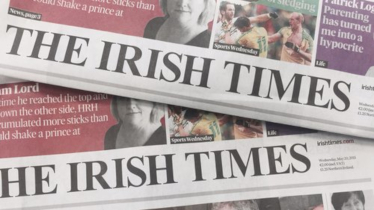
Launch of “The Irish Times”

the-irish-times

The Irish Times, an Irish daily broadsheet newspaper, is launched at 4 Lower Abbey Street in Dublin on March 29, 1859. The first appearance of a newspaper using the name The Irish Times occurs in 1823 but it closes in 1825. The title is revived as a thrice weekly publication by Major Lawrence E. Knox. It is originally founded as a moderate Protestant Irish nationalist newspaper, reflecting the politics of Knox, who stands unsuccessfully as a parliamentary candidate for Isaac Butt’s Home Rule League. In its early days, its main competitor is the Dublin Daily Express.

Though formed as a Protestant nationalist paper, within two decades and under new owners it becomes the voice of British unionism in Ireland. It is no longer marketed as a unionist paper, but rather presents itself politically as “liberal and progressive,” as well as promoting neoliberalism on economic issues. The editorship of the newspaper from 1859 until 1986 is controlled by the Anglo-Irish Protestant minority, only gaining its first nominal Irish Catholic editor 127 years into its existence.

The paper’s most prominent columnists include writer and arts commentator Fintan O’Toole and satirist Miriam Lord. The late Taoiseach Garret FitzGerald is once a columnist. Senior international figures, including Tony Blair and Bill Clinton, have written for its op-ed page. Its most prominent columns have included the political column Backbencher, by John Healy, Drapier, an anonymous piece produced weekly by a politician giving the ‘insider’ view of politics, Rite and Reason, a weekly religious column edited by ‘religious affairs’ editor Patsy McGarry, and the long running An Irishman’s Diary. An Irishman’s Diary is written by Patrick Campbell in the forties (under the pseudonym ‘Quidnunc’), by Seamus Kelly from 1949 to 1979 (also writing as ‘Quidnunc’) and more recently by Kevin Myers. After Myers’ move to the rival Irish Independent, An Irishman’s Diary has usually been the work of Frank McNally. On the sports pages, Philip Reid is the paper’s golf correspondent.

One of its most popular columns is the biting and humorous Cruiskeen Lawn satire column written, originally in Irish, later in English, by Myles na gCopaleen, the pen name of Brian O’Nolan who also writes books using the name Flann O’Brien. Cruiskeen Lawn is an anglicised spelling of the Irish words crúiscín lán, meaning “full little jug.” Cruiskeen Lawn makes its debut in October 1940, and appears with varying regularity until O’Nolan’s death in 1966.

The editor is Paul O’Neill who succeeds Kevin O’Sullivan on April 5, 2017. The deputy editor is Deirdre Veldon. The Irish Times is published every day except Sundays and employs 420 people.