seamus dubhghaill

Promoting Irish Culture and History from Little Rock, Arkansas, USA


Leave a comment

Birth of Bobby Molloy, Independent Politician

Robert Molloy, independent politician, is born in Galway, County Galway, on July 9, 1936.

Molloy’s father, Michael Edward Molloy, is originally from Ballyhaunis, County Mayo, and runs a successful wholesale drapery business in the city. His mother, Rita Stanley, hails from Clifden, County Galway. He is educated at Coláiste Iognáid and University College Galway. Before entering politics, he works for several years in printing, the clothing industry and his family’s drapery firm.

Molloy is first elected to Dáil Éireann as a Fianna Fáil TD for the Galway West constituency at the 1965 Irish general election. In 1968, he is also elected Mayor of Galway. The following year he was appointed as Parliamentary Secretary to the Minister for Education

Molloy’s early political career is marked by his loyalty to Fianna Fáil’s leadership under Taoiseach Jack Lynch. He quickly rises through the ranks and is appointed Minister for Local Government in 1970, a position he holds until 1973. His tenure as Minister for Local Government is characterised by his efforts to modernise and streamline local government structures in Ireland. His tenure in Fianna Fáil sees him as a stalwart of the party’s establishment, though tensions with its leadership grow over the years, particularly with Charles Haughey.

In opposition from 1973, Molloy serves as the frontbench spokesman, where he becomes involved in a high-profile dispute with James Tully, the Labour Minister for Local Government, over the controversial redrawing of constituencies, known as the “Tullymander.” Molloy, along with fellow Fianna Fáil member Brendan Crinion, used Dáil privilege to accuse Tully of having an improper commercial relationship with a builder in County Meath. The accusation is strongly denied by Tully and Molloy and Crinion later withdraw the charge. Despite this, Molloy faces severe repercussions, being forced to resign from his frontbench position. He is subsequently condemned by a judicial tribunal and censured by the Dáil for abusing parliamentary privilege.

When Fianna Fáil returns to office in 1977, Molloy becomes Minister for Defence in the final government of Jack Lynch.

Molloy supports George Colley in the 1979 Fianna Fáil leadership electionCharles Haughey wins the contest and drops Molloy, alongside other opponents, from the cabinet. Thereafter Molloy becomes a member of the Gang of 22 who oppose Haughey’s leadership of the party.

In 1986, Molloy resigns from Fianna Fáil and joins the newly formed Progressive Democrats, spearheaded by Haughey’s arch-rival Desmond O’Malley. Molloy’s move is seen as a major break from the political establishment, as the Progressive Democrats advocate for low-tax, market-oriented economic policies and a more liberal economic agenda. His decision is driven by his dissatisfaction with the direction of Fianna Fáil under Haughey’s leadership and his belief that the party has become increasingly alienating. 

In 1989, Molloy contests the European Parliament elections but is unsuccessful in his attempt. Following the 1989 Irish general election, Molloy, along with newly elected MEP for Munster Pat Cox, represents the Progressive Democrats in the lengthy negotiations with Fianna Fáil to form a coalition government. Once the negotiations conclude, he is reinstated in the Cabinet as Minister for Energy under Taoiseach Charles Haughey, who had previously caused Molloy’s political humiliation a decade earlier. Over the following three years, Molloy and his Progressive Democrat colleague Desmond O’Malley have a working relationship with their former Fianna Fáil colleagues, though tensions grow due to resentment over their presence in the Cabinet. The issue comes to a head when Molloy and O’Malley make it clear they will not serve in a Cabinet that includes Brian Lenihan Snr, following his controversial remarks during the 1990 Irish presidential election about alleged phone calls to President Patrick Hillery from 1982.

In January 1992, Haughey faces further complications when Seán Doherty reveals information about the phone tapping of journalists dating back to 1982. Despite this, the coalition government ends when Albert Reynolds, Haughey’s successor, calls for a general election after accusing O’Malley of giving “dishonest” evidence to the Beef Tribunal. Molloy strongly denounces Reynolds’ accusation, describing it as “outrageous,” and criticises him for what he perceives as a “lack of generosity” in recent North-South negotiations, in which Molloy had represented the Progressive Democrats in talks with British Unionists.

Molloy stands at the European Parliament elections again in 1994 but is again unsuccessful.

Following the 1997 Irish general election, Molloy is part of the negotiations that lead to the formation of a coalition government between the Progressive Democrats and Fianna Fáil. On that occasion, he is appointed as Minister of State at the Department of the Environment and Local Government and sits at cabinet as Minister of State to the Government.

Molloy resigns as a minister and quits politics just before the 2002 Irish general election amid controversy surrounding his involvement in the rape case of Barbara Naughton. The controversy stems from a letter Molloy sent to then Minister for Justice, John O’Donoghue, on behalf of a constituent whose relative had been convicted of rape. The letter, which requests the temporary release of the individual pending an appeal, leads to public criticism. The case is high-profile, involving a Connemara man sentenced to eleven years for the systematic abuse of his young daughter. During the trial, the judge, Philip O’Sullivan, notes that someone acting on Molloy’s behalf had tried to contact him in his chambers to clarify whether he had received certain correspondence from the victim’s sister, which the judge describes as “quite improper.” In response to the backlash, Molloy resigns, describing the letter as a “human error of judgment,” but insisting it was not intended to be dishonest. He retires from politics after the election.

Molloy is a member of Fianna Fáil for over 20 years, but his views are not always in line with the mainstream of the party, particularly under the leadership of Charles Haughey. His decision to leave Fianna Fáil in 1986 and join the Progressive Democrats is motivated by ideological differences, notably the party’s move toward a more conservative, state-controlled economy. Molloy, on the other hand, embraces a platform of fiscal conservatism, with an emphasis on reducing taxes, deregulation, and the liberalisation of the economy.

In terms of social issues, Molloy is ahead of his time in advocating for progressive policies, particularly on women’s rights. In a survey conducted in 1976 by the Women’s Political Association (WPA), Molloy scores among the highest of any member of the Dáil for his progressive stance on issues affecting women. He supports measures such as divorce, contraception, and family law reform, which are seen as highly controversial at the time. His responses to the WPA’s questions reveal that he holds views that are in stark contrast to many of his colleagues within Fianna Fáil. His progressive views on women’s rights are notable, as he is the only member of Jack Lynch’s cabinet who consistently supports reformist policies on issues like family law and the role of women in public life.

In 1972, Molloy marries Phyllis Barry, a Montessori teacher from Foxrock, County Dublin, whose father is a cousin of the executed revolutionary Kevin Barry. The couple meet while campaigning in a by-election in mid-Cork. Together, they have four children: Sinead, Sorcha, Donnacha, and Dara.

Molloy dies at the age of 80 on October 2, 2016, in Salthill, Galway, County Galway. He is buried at Bohermore Cemetery, Bohermore, Galway.
Leave a comment

The Mountjoy Prison Helicopter Escape

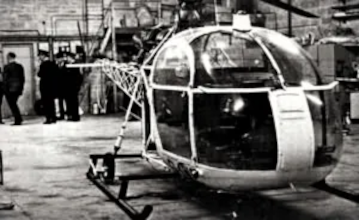
The Mountjoy Prison helicopter escape occurs on October 31, 1973, when three Provisional Irish Republican Army (IRA) volunteers escape from Mountjoy Prison in Dublin aboard a hijacked Alouette II helicopter, which briefly lands in the prison’s exercise yard. The escape makes headlines around the world and is an embarrassment to the Irish coalition government of the time, led by Fine Gael‘s Liam Cosgrave, which is criticised by opposition party Fianna Fáil. A manhunt involving twenty thousand members of the Irish Defence Forces and Garda Síochána is launched for the escapees, one of whom, Seamus Twomey, is not recaptured until December 1977. The Wolfe Tones write a song celebrating the escape called “The Helicopter Song,” which tops the Irish Singles Chart.

Following the outbreak of the Troubles in the late 1960s, the Provisional IRA conducts an armed campaign that seeks to create a united Ireland by ending Northern Ireland‘s status as part of the United Kingdom. As a result of increasing levels of violence in Northern Ireland, internment without trial is introduced there in August 1971, and in the Republic of Ireland the coalition government led by Fine Gael’s Liam Cosgrave is attempting to curb IRA activity. Fine Gael had come to power on a law-and-order ticket, with a policy of “getting tough on crime.” Suspected IRA members are arrested and accused of IRA membership by a superintendent in the Garda Síochána, a crime under the Offences against the State Acts. They are tried at the juryless Special Criminal Court in Dublin, where the traditional IRA policy of not recognising the court results in a fait accompli as no defence is offered and IRA membership carries a minimum mandatory one-year sentence, resulting in internment in all but name. In September 1973 IRA Chief of Staff Seamus Twomey appears at the Special Criminal Court charged with IRA membership, and states, “I refuse to recognise this British-orientated quisling court.” He is found guilty and receives a five-year sentence. By October 1973 the IRA’s command structure is seriously curbed, with Twomey and other senior republicans J. B. O’Hagan and Kevin Mallon all being held in Mountjoy Prison.

The IRA immediately begins making plans to break Twomey, O’Hagan and Mallon out of the prison. The first attempt involves explosives that had been smuggled into the prison, which are to be used to blow a hole in a door which will give the prisoners access to the exercise yard. From there, they are to scale a rope ladder thrown over the exterior wall by members of the IRA’s Dublin Brigade who are to have a getaway car waiting to complete the escape. The plans when the prisoners cannot gain access to the exercise yard and the rope ladder is spotted, so the IRA begins making new escape plans. The idea of using a helicopter in an escape had been discussed before in a plot to break Gerry Adams out of Long Kesh internment camp but had been ruled out because of faster and more sophisticated British Army helicopters being stationed at a nearby base. The IRA’s GHQ staff approves the plan to break out Twomey, O’Hagan and Mallon, and arrangements are made to obtain a helicopter. A man with an American accent calling himself Mr. Leonard approaches the manager of Irish Helicopters at Dublin Airport, with a view to hiring a helicopter for an aerial photographic shoot in County Laois. After being shown the company’s fleet of helicopters, Leonard arranges to hire a five-seater Alouette II for October 31.

Leonard arrives at Irish Helicopters on October 31 and is introduced to the pilot of the helicopter, Captain Thompson Boyes. Boyes is instructed to fly to a field in Stradbally, in order to pick up Leonard’s photographic equipment. After landing Boyes sees two armed, masked men approaching the helicopter from nearby trees. He is held at gunpoint and told he will not be harmed if he follows instructions. Leonard leaves with one gunman, while the other gunman climbs aboard the helicopter armed with a pistol and an ArmaLite rifle. Boyes is instructed to fly towards Dublin following the path of railway lines and the Royal Canal and is ordered not to register his flight path with Air Traffic Control. As the helicopter approaches Dublin, Boyes is informed of the escape plan and is instructed to land in the exercise yard at Mountjoy Prison.

In the prison’s exercise yard, the prisoners are watching a football match. Shortly after 3:35 p.m. the helicopter swings in to land in the prison yard, with Kevin Mallon directing the pilot using semaphore. A prison officer on duty initially takes no action as he believes the helicopter contains the Minister for Defence, Paddy Donegan. After prisoners surround the eight prison officers in the yard, fights break out as the officers realise an escape attempt is in progress. As other prisoners restrain the officers, Twomey, Mallon and O’Hagan board the helicopter. As the helicopter takes off, in the confusion one officer shouts, “Close the gates, close the fucking gates.” The helicopter flies north and lands at a disused racecourse in the Baldoyle area of Dublin, where the escapees are met by members of the IRA’s Dublin Brigade. Boyes is released unharmed, and the escapees are transferred to a taxi that had been hijacked earlier and are transported to safe houses.

The escape makes headlines around the world and is an embarrassment for Cosgrave’s government, which is criticised for “incompetence in security matters” by opposition party Fianna Fáil. An emergency debate on security is held in Dáil Éireann on November 1.

The IRA releases a statement on the escape, which reads, “Three republican prisoners were rescued by a special unit from Mountjoy Prison on Wednesday. The operation was a complete success, and the men are now safe, despite a massive hunt by Free State forces.” Shortly after the escape Twomey gives an exclusive interview to German magazine Der Spiegel, where the reporter says people throughout Europe are joking about the incident as “the escape of the century.” Irish rebel band the Wolfe Tones writes a song celebrating the escape called “The Helicopter Song,” which is immediately banned by the government yet still tops the Irish Singles Chart after selling twelve thousand copies in a single week.

The escape results in all IRA prisoners being held at Mountjoy Prison and Curragh Camp being transferred to the maximum security Portlaoise Prison. In order to prevent any further escapes, the perimeter of the prison is guarded by members of the Irish Army, and wires are erected over the prison yard to prevent any future helicopter escape. Cosgrave states there will be “no hiding place” for the escapees, and a manhunt involving twenty thousand members of the Irish Defence Forces and Garda Síochána ensues.

Mallon is recaptured at a Gaelic Athletic Association dance in a hotel near Portlaoise on December 10, 1973, and imprisoned in Portlaoise Prison. He escapes from there in a mass break-out on August 18, 1974, when nineteen prisoners escape after overpowering guards and using gelignite to blast through the gates. He is recaptured in Foxrock in January 1975 and returned to Portlaoise Prison. O’Hagan is recaptured in Dublin in early 1975, and also imprisoned in Portlaoise Prison. After the end of his original twelve-month sentence, he is immediately arrested and sentenced to a further two years imprisonment for escaping. Twomey evades recapture until December 2, 1977, when he is spotted sitting in a car in Sandycove by members of the Garda’s Special Branch who are investigating an arms shipment after a tip-off from police in Belgium. He drives away after spotting the officers, before being recaptured in the centre of Dublin after a high-speed car chase. He is also imprisoned in Portlaoise Prison until his release in 1982.

In 2021, Brendan Hughes publishes an autobiography Up Like a Bird, an account of the planning and organisation of the escape, co-authored with Doug Dalby.


Leave a comment

Death of Samuel Beckett, Playwright & Poet

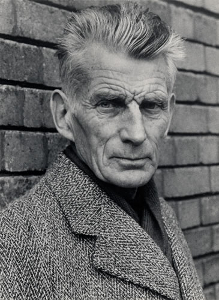
Samuel Barclay Beckett, avant-garde novelist, playwright, theatre director, and poet, dies in ParisFrance on December 22, 1989.

Beckett is born on Good Friday, April 13, 1906, in FoxrockDublin. His father, William Frank Beckett, works in the construction business and his mother, Maria Jones Roe, is a nurse. Beckett attends Earlsfort House School in Dublin and then, at age 14, he goes to Portora Royal School, the same school attended by Oscar Wilde. He receives his bachelor’s degree from Trinity College, Dublin in 1927. In his youth he periodically experiences severe depression keeping him in bed until mid-day. This experience later influences his writing.

In 1928, Beckett finds a welcome home in Paris where he meets and becomes a devoted student of James Joyce. In 1931, he embarks on a restless sojourn through Great Britain, France and Germany. He writes poems and stories and does odd jobs to support himself. On his journey, he comes across many individuals who inspire some of his most interesting characters.

In 1937, Beckett settles in Paris. Shortly thereafter, he is stabbed by a pimp after refusing his solicitations. While recovering in the hospital, he meets Suzanne Dechevaux-Dumesnuil, a piano student in Paris. The two become life-long companions and eventually marry. After meeting with his attacker, Beckett drops the charges, partly to avoid the publicity.

During World War II, Beckett’s Irish citizenship allows him to remain in Paris as a citizen of a neutral country. He fights in the resistance movement until 1942 when members of his group are arrested by the Gestapo. He and Suzanne flee to the unoccupied zone until the end of the war.

After the war, Beckett is awarded the Croix de Guerre for bravery during his time in the French resistance. He settles in Paris and begins his most prolific period as a writer. In five years, he writes EleutheriaWaiting for GodotEndgame, the novels MolloyMalone DiesThe Unnamable, and Mercier et Camier, two books of short stories, and a book of criticism.

Beckett’s first publication, Molloy, enjoys modest sales, but more importantly praise from French critics. Soon, Waiting for Godot, achieves quick success at the small Theatre de Babylone putting Beckett in the international spotlight. The play runs for 400 performances and enjoys critical praise.

Beckett writes in both French and English, but his most well-known works, written between World War II and the 1960s, are written in French. Early on he realizes his writing has to be subjective and come from his own thoughts and experiences. His works are filled with allusions to other writers such as Dante AlighieriRené Descartes, and James Joyce. Beckett’s plays are not written along traditional lines with conventional plot and time and place references. Instead, he focuses on essential elements of the human condition in dark humorous ways. This style of writing has been called “Theater of the Absurd” by Martin Esslin, referring to poet Albert Camus’ concept of “the absurd.” The plays focus on human despair and the will to survive in a hopeless world that offers no help in understanding.

The 1960s are a period of change for Beckett. He finds great success with his plays across the world. Invitations come to attend rehearsals and performances which lead to a career as a theater director. In 1961, he secretly marries Suzanne Dechevaux-Dumesnuil who takes care of his business affairs. A commission from the BBC in 1956 leads to offers to write for radio and cinema through the 1960s.

Beckett continues to write throughout the 1970s and 1980s, mostly in a small house outside Paris. There he can give total dedication to his art of evading publicity. In 1969, he is awarded the Nobel Prize in Literature, though he declines accepting it personally to avoid making a speech at the ceremonies. However, he should not be considered a recluse. He often times meets with other artists, scholars and admirers to talk about his work.

By the late 1980s, Beckett is in failing health and is moved to a small nursing home. His wife Suzanne dies on July 17, 1989. His life is confined to a small room where he receives visitors and writes. Suffering from emphysema and possibly Parkinson’s disease, he dies on December 22, 1989.


Leave a comment

Birth of Peter Sutherland, Barrister & Politician

File source: http://commons.wikimedia.org/wiki/File:Peter-Sutherland-2011.jpg

Peter Denis Sutherland, businessman, barrister and politician, is born in Foxrock, Dublin on April 25, 1946. He is a barrister by profession and a Senior Counsel of the Bar Council of Ireland. He is known for serving in a variety of international organisations, political and business roles.

Sutherland is educated at Gonzaga College, Ranelagh, Dublin. He is of partial Scottish ancestry. He graduates in Civil Law at University College Dublin and practices at the Irish Bar between 1969 and 1980. He marries Maruja Sutherland, a Spaniard, in 1974.

Sutherland makes his entry into politics when he is appointed Attorney General of Ireland in June 1981. He resigns in March 1982 only to take the post again between December 1982 and December 1984.

Sutherland is appointed to the European Commission in 1985. He is Chairman of the Committee that produces The Sutherland Report on the completion of the Internal Market of the European Economic Community (EEC), commissioned by the European Commission and presented to the European Council at its Edinburgh meeting in 1992.

Sutherland serves as United Nations Special Representative of the Secretary-General for International Migration from January 2006 until March 2017. He is responsible for the creation of the Global Forum on Migration and Development (GFMD). He also serves as President of the International Catholic Migration Commission, as well as member of the Migration Advisory Board of the International Organisation for Migration.

In 1993, Sutherland becomes Director-General of the General Agreement on Tariffs and Trade, now the World Trade Organization. He serves as Chairman of Allied Irish Banks (AIB) from 1989 to 1993 and as Chairman of Goldman Sachs from 1995 to 2015.

In September 2016, Sutherland suffers a heart attack while on his way to Mass at a Catholic Church in London. Six months later, he resigns from his post as United Nations Special Representative of the Secretary-General for International Migration because of poor health. After a long illness, he dies at St. James’s Hospital in Dublin on January 7, 2018, of complications from an infection, at the age of 71. He is buried in Kilternan Cemetery Park in Dublin.

Peter Sutherland received numerous awards including European Person of the Year Award (1988).

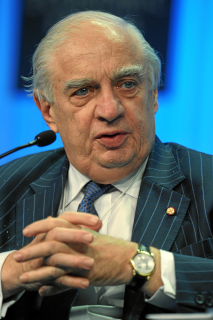
(Pictured: Peter D. Sutherland, Chairman, Goldman Sachs International, United Kingdom; Member of the Foundation Board of the World Economic Forum, speaks during the session ‘China’s Impact on Global Trade and Growth’ at the Annual Meeting 2011 of the World Economic Forum in Davos, Switzerland, January 27, 2011. Copyright by World Economic Forum swiss-image.ch/Photo by Michael Wuertenberg)


Leave a comment

Birth of Playwright & Poet Samuel Barclay Beckett

Samuel Barclay Beckett, avant-garde novelist, playwright, theatre director, and poet, is born on Good Friday, April 13, 1906, in FoxrockDublin. His father, William Frank Beckett, works in the construction business and his mother, Maria Jones Roe, is a nurse. Beckett attends Earlsfort House School in Dublin and then, at age 14, he goes to Portora Royal School, the same school attended by Oscar Wilde. He receives his bachelor’s degree from Trinity College, Dublin in 1927. In his youth he periodically experiences severe depression keeping him in bed until mid-day. This experience later influences his writing.

In 1928, Beckett finds a welcome home in Paris where he meets and becomes a devoted student of James Joyce. In 1931, he embarks on a restless sojourn through Great BritainFrance and Germany. He writes poems and stories and does odd jobs to support himself. On his journey, he comes across many individuals who inspire some of his most interesting characters.

In 1937, Beckett settles in Paris. Shortly thereafter, he is stabbed by a pimp after refusing his solicitations. While recovering in the hospital, he meets Suzanne Dechevaux-Dumesnuil, a piano student in Paris. The two become life-long companions and eventually marry. After meeting with his attacker, Beckett drops the charges, partly to avoid the publicity.

During World War II, Beckett’s Irish citizenship allows him to remain in Paris as a citizen of a neutral country. He fights in the resistance movement until 1942 when members of his group are arrested by the Gestapo. He and Suzanne flee to the unoccupied zone until the end of the war.

After the war, Beckett is awarded the Croix de Guerre for bravery during his time in the French resistance. He settles in Paris and begins his most prolific period as a writer. In five years, he writes EleutheriaWaiting for GodotEndgame, the novels MolloyMalone DiesThe Unnamable, and Mercier et Camier, two books of short stories, and a book of criticism.

Beckett’s first publication, Molloy, enjoys modest sales, but more importantly praise from French critics. Soon, Waiting for Godot, achieves quick success at the small Theatre de Babylone putting Beckett in the international spotlight. The play runs for 400 performances and enjoys critical praise.

Beckett writes in both French and English, but his most well-known works, written between World War II and the 1960s, are written in French. Early on he realizes his writing has to be subjective and come from his own thoughts and experiences. His works are filled with allusions to other writers such as Dante AlighieriRené Descartes, and James Joyce. Beckett’s plays are not written along traditional lines with conventional plot and time and place references. Instead, he focuses on essential elements of the human condition in dark humorous ways. This style of writing has been called “Theater of the Absurd” by Martin Esslin, referring to poet Albert Camus’ concept of “the absurd.” The plays focus on human despair and the will to survive in a hopeless world that offers no help in understanding.

The 1960s are a period of change for Beckett. He finds great success with his plays across the world. Invitations come to attend rehearsals and performances which lead to a career as a theater director. In 1961, he secretly marries Suzanne Dechevaux-Dumesnuil who takes care of his business affairs. A commission from the BBC in 1956 leads to offers to write for radio and cinema through the 1960s.

Beckett continues to write throughout the 1970s and 1980s, mostly in a small house outside Paris. There he can give total dedication to his art evading publicity. In 1969, he is awarded the Nobel Prize in Literature, though he declines accepting it personally to avoid making a speech at the ceremonies. However, he should not be considered a recluse. He often times meets with other artists, scholars and admirers to talk about his work.

By the late 1980s, Beckett is in failing health and is moved to a small nursing home. His wife Suzanne dies in July 1989. His life is confined to a small room where he receives visitors and writes. He dies on December 22, 1989, in a hospital of respiratory problems just months after his wife.